Postoperative Cerebrospinal Fluid Leakage after Surgical Repair of Myelomeningocele and Tethered Cord Syndrome in Pediatric Patients
- Muhammad Haroon , Senior Registrar Department of Neurosurgery Sandeman Provincial Hospital Affiliated With Bolan Medical College, Quetta
- Alamzeb Khan , Senior Registrar Department of Neurosurgery Sandeman Provincial Hospital Affiliated With Bolan Medical College, Quetta
- Asghar Khan Babar , Associate Professor Neurosurgery Department Sandeman Provincial Hospital Affiliated With Bolan Medical College, Quetta
Article Information:
Abstract:
Background: The leakage of cerebrospinal fluid (CSF) is a postoperative complication noted after surgical correction of spinal dysraphism, especially in children undergoing myelomeningocele and tethered cord syndrome surgeries. If not treated promptly, CSF leaks can increase the risk of infection, lengthen the duration of hospitalization, and increase the need for further surgical procedures. To assess the frequency of CSF leakage in pediatric patients undergoing surgical repair for myelomeningocele and tethered cord syndrome, and to identify clinical and surgical factors associated with its occurrence. Methods: A descriptive observational study with a 63 participant sample was conducted between January to December 2024 at BOLAN MEDICAL COLLEGE QUETTA which included pediatric patients with tethered cord syndrome or myelomeningocele scheduled for surgery. Information was gathered regarding demographic characteristics, kind of neural defect, surgical procedures performed, topical agent used, presence of VP shunts, intraoperative data, and postoperative management. The main outcome of interest was the development of postoperative CSF leak. Relationships were evaluated using the chi-square test with a significance level of p < 0.05. Results: CSF leakage occurred in 28.6% of patients. Leakage was significantly more frequent in patients with myelomeningocele than in those with tethered cord syndrome (p = 0.021). Surgical closure using duraplasty was associated with a higher leak rate compared to primary closure (p = 0.004). The presence of a VP shunt and intraoperative CSF leakage were also significant predictors (p = 0.036 and p = 0.021, respectively). Conversely, the use of surgical sealants significantly reduced the incidence of leakage (p = 0.002). Most cases were managed conservatively, and the majority of patients recovered without neurological deficits. Conclusion: CSF leakage remains a frequent concern after surgical correction of spinal anomalies in children. The type of lesion, surgical method, and presence of a shunt play important roles in predicting leakage. Preventive strategies such as meticulous closure and the use of sealants can help reduce complications and improve surgical outcomes.
Keywords:
Article :
INTRODUCTION:
Cerebrospinal fluid (CSF) leakage is a recognized complication after performing neurosurgery on children with myelomeningocele, tethered cord syndrome (TCS), and other spinal anomalies, along with other neural tube defects. These
conditions are usually surgically managed at a young age to mitigate the risk of further irreversible neurological decline while protecting the remaining neural tissue. The closure should be watertight sutured; however, that might not be possible in practice due to clinical difficulties in newborns and infants with fragile and immature tissue planes [1-3].
The most severe form of spina bifida, i.e., myelomeningocele, commonly manifests at birth as a lumbosacral spinal sacral protrusion. Since it is left open and usually comes along with hydrocephalus, there is a notoriously high risk of CSF leakage post surgery. Tethered cord syndrome is less dramatic, but still entails some form of surgery to relieve the neuromuscular junction of unnecessary tension to reduce the risk of progressive damage. In either circumstance, the post-surgical recovery period and the long-term prognosis will depend on the closure technique, along with the surgical repair of the defect [4-6].
Even with advancements in surgical techniques and materials, the percentage of CSF leakage still poses a problem. About intraoperative details, factors like sealant application, duraplasty, and the surgeon's skill in controlling intra-sac pressure contribute to the possibility of leakage. Moreover, some pre-existing factors like hydrocephalus along with VP shunts can hinder healing and pressure dynamics after surgery [7-9].
The literature is increasingly focused on determining preventive measures that can reduce the incidence of CSF leaks by modifying some of their risk factors. However, scant information exists regarding the world's low and middle-income countries, particularly those regions where surgical aids and postoperative management are not readily accessible.
This study was undertaken to evaluate the frequency of CSF leakage in patients undergoing surgery for tethered cord syndrome and myelomeningocele, and to assess the clinical, surgical, and postoperative factors that may contribute to its occurrence. By identifying the most significant predictors of leakage, the study aims to support better surgical planning and improve overall outcomes in this vulnerable patient population.
METHODOLOGY:
This is a descriptive observational study conducted from January to December 2024. 63 pediatric patients underwent either tethered cord syndrome (TCS) or myelomeningocele repair at BOLAN MEDICAL COLLEGE QUETTA. The pediatric neurosurgery team contemporaneously managed all patients during the study period. Prior to the commencement of data collection, all consents from the pertinent institutional review boards were acquired. During the entire duration of the study, the privacy and confidentiality of all patients' information were protected.
The sample was taken from patients utilizing a non-probability consecutive sampling method. Inclusion criteria included patients from birth up to 12 years old diagnosed with myelomeningocele or tethered cord syndrome with surgical correction. Patients with incomplete medical records or those lost to follow up beyond one week post-operatively were excluded from the study.
Data for each patient in the sample was obtained from a uniform proforma containing demographic data such as age at surgery, sex, weight, and gestational age at birth. Other clinical and surgical data captured also included diagnosis (TCS or myelomeningocele), location of the lesion, hydrocephalus status, VP shunt candidate, type of closure (primary vs. duraplasty), use of surgical sealants, pertinent findings during surgical exploration, and postoperative wound care performed.
Postoperative cerebrospinal fluid (CSF) leakage was the primary outcome. It was defined as any clear fluid discharge from the wound site within the first postoperative week that tested positive for beta-2 transferrin or required clinical intervention. Management strategies and short-term neurological outcomes of patients with CSF leakage were also documented.
All surgeries were performed under general anaesthesia, and the attending surgeon made operative decisions, such as whether to perform a duraplasty or use sealants, based on intraoperative findings. Postoperative positioning (prone, supine, or side-lying) and wound care regimens were noted for each case.
The collected data were analysed using SPSS version 26. Frequencies and percentages were calculated for categorical variables, while mean and standard deviation were used for continuous variables. The chi-square test was applied to assess associations between different factors and the development of postoperative CSF leakage. A p-value of less than 0.05 was considered statistically significant
RESULTS:
In this study of 63 pediatric patients who underwent surgery for tethered cord syndrome or myelomeningocele, CSF leakage occurred in 18 individuals. While examining age distribution, no significant link was found between age group and leak development. Neonates and infants comprised most cases, yet leakage was reasonably balanced across all age brackets. Similarly, gender did not show a notable association with postoperative leakage, with male and female patients nearly equally affected. However, the diagnosis category did reveal a clear pattern patients diagnosed with myelomeningocele were significantly more likely to experience CSF leakage compared to those with tethered cord syndrome. Although lesion location varied among patients (lumbar, lumbosacral, thoracolumbar), the site did not influence the occurrence of leakage statistically. This suggests that the type of neural tube defect may play a more central role in CSF complications than anatomical location or patient demographics.
Table 1: Demographic and Clinical Characteristics of Patients (n=63)
|
Variable |
Category |
Frequency (n) |
Percentage (%) |
CSF Leak Present (n=18) |
CSF Leak Absent (n=45) |
p-value |
|
Age Group |
Neonate (0–28 days) |
22 |
34.9% |
8 |
14 |
0.273 |
|
Infant (1–12 months) |
26 |
41.3% |
6 |
20 |
||
|
>1 year |
15 |
23.8% |
4 |
11 |
||
|
Sex |
Male |
38 |
60.3% |
11 |
27 |
0.787 |
|
Female |
25 |
39.7% |
7 |
18 |
||
|
Diagnosis |
Myelomeningocele |
43 |
68.3% |
15 |
28 |
0.021* |
|
Tethered Cord Syndrome (TCS) |
20 |
31.7% |
3 |
17 |
||
|
Location of lesion |
Lumbar |
29 |
46.0% |
10 |
19 |
0.418 |
|
Lumbosacral |
24 |
38.1% |
6 |
18 |
||
|
Thoracolumbar |
10 |
15.9% |
2 |
8 |
Surgical technique emerged as a critical factor influencing CSF leakage. Among those who underwent primary closure, the leak rate was low. In contrast, over half of the patients who received closure with duraplasty developed leakage, showing a significant statistical association. This may reflect the more complex nature of cases requiring duraplasty or the fragility of the tissue involved. Similarly, a ventriculoperitoneal (VP) shunt was linked to higher rates of CSF leakage. This relationship may stem from altered cerebrospinal fluid pressure dynamics in shunted patients. The use of surgical sealant was notably protective patients who received sealant had far fewer leaks than those who did not. This finding highlights the value of adjunct techniques in improving wound integrity and reducing postoperative complications.
Table 2: Surgical Variables and CSF Leak Association (n=63)
|
Variable |
Category |
Frequency (n) |
CSF Leak Present |
CSF Leak Absent |
p-value |
|
Surgical technique used |
Primary closure |
42 |
7 |
35 |
0.004* |
|
Closure with duraplasty |
21 |
11 |
10 |
||
|
VP Shunt present |
Yes |
18 |
9 |
9 |
0.036* |
|
No |
45 |
9 |
36 |
||
|
Use of surgical sealant |
Yes |
25 |
3 |
22 |
0.002* |
|
No |
38 |
15 |
23 |
Several intra- and postoperative factors were linked to CSF leakage. Notably, if leakage was detected during the surgery, patients were more likely to develop postoperative leaks. This highlights the importance of meticulous intraoperative repair. Wound complications, such as infection or dehiscence, also contributed significantly to leakage. Patients with such complications had more than double the leak rate compared to those with clean healing. A prolonged hospital stay (greater than seven days) correlated with increased CSF leakage, likely reflecting both the complexity of cases and the need for additional interventions. Though not statistically significant, patients placed in the prone position after surgery tended to have fewer leaks than those managed supine or side-lying.
Table 3: Intraoperative and Postoperative Factors (n=63)
|
Variable |
Category |
Frequency (n) |
CSF Leak Present |
CSF Leak Absent |
p-value |
|
Intraoperative CSF Leak Noted |
Yes |
20 |
10 |
10 |
0.021* |
|
No |
43 |
8 |
35 |
||
|
Postoperative positioning |
Supine |
21 |
9 |
12 |
0.085 |
|
Prone |
24 |
4 |
20 |
||
|
Side-lying |
18 |
5 |
13 |
||
|
Wound complication |
Yes |
14 |
7 |
7 |
0.031* |
|
No |
49 |
11 |
38 |
||
|
Hospital stay > 7 days |
Yes |
28 |
12 |
16 |
0.049* |
|
No |
35 |
6 |
29 |
Among the 18 patients who developed postoperative CSF leakage, over half were successfully managed using conservative methods, including wound care and bed rest. Only five patients required reoperation to address the leakage, and a smaller subset underwent VP shunt-related interventions. Overall, the prognosis was good nearly 89% of the children recovered without any neurological deficits. Only two patients experienced mild but lasting complications, emphasizing the importance of early detection and appropriate management in avoiding permanent outcomes.
Table 4: Management and Outcome of CSF Leakage (n=18 with CSF leak)
|
Management Strategy |
Frequency (n) |
Percentage (%) |
|
Conservative (bed rest, dressings) |
10 |
55.6% |
|
Reoperation (wound revision/closure) |
5 |
27.8% |
|
VP Shunt revision/addition |
3 |
16.6% |
|
Recovery without neurological deficit |
16 |
88.9% |
|
Residual neurological deficit |
2 |
11.1% |
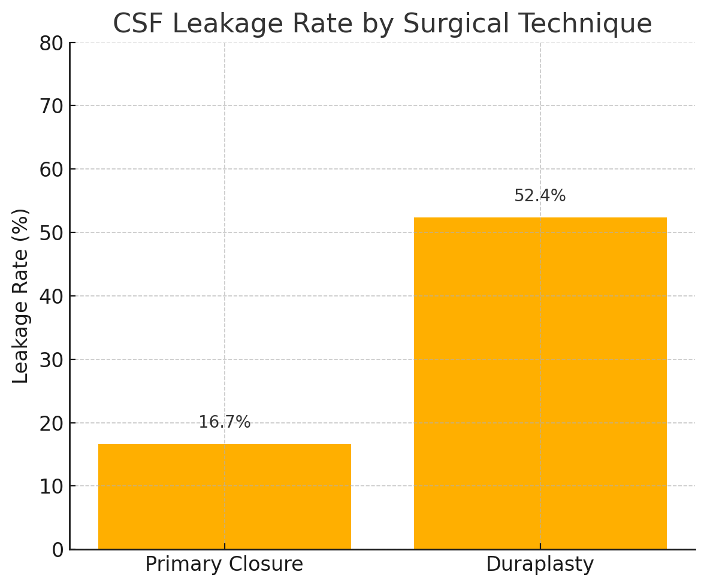
Figure 1: bar graph showing the CSF leakage rate by surgical technique. As illustrated, patients who underwent duraplasty had a significantly higher leakage rate compared to those who received primary closure, underscoring the clinical importance of surgical approach in minimizing postoperative CSF complications. Let me know if you want another graph (e.g., for VP shunt or sealant use).
DISCUSSION:
The findings of this study reveal that cerebrospinal fluid (CSF) leakage remains a frequent complication following surgical correction of myelomeningocele and tethered cord syndrome, with an overall incidence of approximately 28.6%. While various demographic factors such as age, sex, and lesion location showed no significant association with the occurrence of CSF leakage, several surgical and perioperative factors emerged as strong predictors.
A significant observation was the higher leakage rate in patients diagnosed with myelomeningocele compared to those with tethered cord syndrome. This aligns with previous studies suggesting that myelomeningocele, an open neural tube defect, poses a greater challenge for achieving watertight closure, especially in newborns with fragile tissue structures. Studies also reported similar trends, with CSF leakage occurring more frequently in myelomeningocele due to complex closure requirements and associated hydrocephalus [10-12].
Surgical technique played a pivotal role in determining postoperative outcomes. Patients who underwent duraplasty had a significantly higher risk of CSF leakage compared to those managed with primary closure. This may be explained by the fact that duraplasty is often reserved for more severe or high-tension defects, which inherently carry a greater risk of wound-related complications. Similar studies observed increased leakage in cases requiring augmented dural closure [13-15].
The use of surgical sealants demonstrated a protective effect, significantly reducing the incidence of postoperative leakage. This finding supports the growing body of literature advocating for adjunctive materials in enhancing closure integrity. Studies highlighted the efficacy of fibrin glue and collagen patches in decreasing postoperative leaks in pediatric neurosurgical procedures [16-18].
The presence of a VP shunt was also significantly associated with CSF leakage, which may be due to the altered pressure dynamics introduced by the shunt system. Elevated CSF drainage or improper shunt placement could compromise the integrity of the closure. A similar study found that patients with early shunt placement were more prone to leakage and required additional wound management [19, 20].
Intraoperative complications, such as CSF leakage, along with wound complications like an infection or dehiscence, were found to correlate with poor postoperative outcomes. It is critical to prevent postoperative fluid collections by identifying and supporting any visible intraoperative leaks and attempts to mitigate collection through suction. Also, strategic postoperative positioning may help relieve some pressure from the surgical site, although this did not achieve statistical significance within our findings.
It is worth noting that the majority of patients who suffered from CSF leakage were treated conservatively and went on to develop no long-term complications. Only a small proportion required reoperation or adjustment of a VP shunt. Most patients retained good neurological function, in agreement with previously published studies that highlight the need for prompt intervention and proper wound care and “propose favorable outcomes.”
CONCLUSION:
This study highlights that CSF leakage is a notable concern in pediatric neurosurgical patients undergoing correction for myelomeningocele and tethered cord syndrome. The risk is significantly higher in patients with myelomeningocele, those undergoing duraplasty, and in the presence of VP shunts. The use of surgical sealants and careful intraoperative techniques are effective preventive strategies. While most cases can be managed conservatively, a small number may require surgical intervention. Early identification and tailored postoperative care remain essential to minimizing complications and promoting recovery. Future studies with larger cohorts and multicenter data may help establish standardized protocols to reduce CSF leakage in such vulnerable populations.
REFERENCES:
1 SHAIKH, M.A., et al., Frequency of Cerebrospinal Fluid Leak in Patients Undergoing Myelomeningocele and Tethered Cord Syndrome Repair.
2. Furtado, L.M.F., et al., Tethered cord syndrome after myelomeningocele repair: a literature update. Cureus, 2020. 12(10).
3. Baldia, M. and V. Rajshekhar, Minimizing CSF leak and wound complications in tethered cord surgery with prone positioning: outcomes in 350 patients. World Neurosurgery, 2020. 137: p. e610-e617.
4. Khan, A., et al., Incidence of Cerebrospinal Fluid Leak in Patients with Myelomeningocele and TCS Repair. Pakistan Journal of Medical and Health Sciences, 2021. 15(2): p. 591-593.
5. Rehman, M.A., et al., Frequency of SCF Leakage in Post-operative Patients of Tethered Spinal Cord in A Tertiary Care Hospital. Pakistan Journal Of Neurological Surgery, 2022. 26(2): p. 283-290.
6. KHAN, B., et al., Cerebrospinal fluid leak after repair of congenital spinal pathologies, incidence and management. Pakistan Journal Of Neurological Surgery, 2020. 24(3): p. 253–257-253–257.
7. Ahmed, S., et al., The Incidence and Treatment of Cerebrospinal Fluid Leakage Following Repair of Congenital Spinal Pathologies. Pakistan Journal of Medical & Health Sciences, 2022. 16(05): p. 1473-1473.
8. Amaral, V.C.G., et al., Tethered Cord Syndrome, in Intraoperative Monitoring: Neurophysiology and Surgical Approaches. 2022, Springer. p. 539-563.
9. Pastuszka, A., et al., Fetoscopic Myelomeningocele Repair with Complete Release of the Tethered Spinal Cord Using a Three-Port Technique: Twelve-Month Follow-Up—A Case Report. Diagnostics, 2022. 12(12): p. 2978.
10. Jiang, J., et al., Clinical observations on the release of tethered spinal cord in children with intra-operative neurophysiological monitoring: A retrospective study. Journal of Clinical Neuroscience, 2020. 71: p. 205-212.
11. Mahajan, C., Neural tube defects: meningocele and encephalocele. Fundamentals of Pediatric Neuroanesthesia, 2021: p. 219-232.
12. Theodore, N., et al., Posterior vertebral column subtraction osteotomy for recurrent tethered cord syndrome: a multicenter, retrospective analysis. Neurosurgery, 2021. 88(3): p. 637-647.
13. Brown, O.H., et al., A simplified approach to myelomeningocele defect repair. Annals of Plastic Surgery, 2021. 86(1): p. 58-61.
14. Khan, M., et al., Spectrum of spinal dysraphism in pediatric patients in a tertiary care hospital. Pakistan Journal Of Neurological Surgery, 2021. 25(2): p. 225-236.
15. Blount, J.P., et al., Neurosurgery guidelines for the care of people with spina bifida. Journal of pediatric rehabilitation medicine, 2020. 13(4): p. 467-477.
16. Cheng, C., et al., Anterior sacral meningocele: a new classification and treatment using the dorsal transsacral approach. Spine, 2020. 45(7): p. 444-451.
17. Pillai, S.S., Spinal dysraphism. Kerala Journal of Orthopaedics, 2022. 1(1): p. 3-8.
18. Marathe, N., L.-N. Lohkamp, and M.G. Fehlings, Spinal manifestations of Ehlers-Danlos syndrome: a scoping review. Journal of Neurosurgery: Spine, 2022. 37(6): p. 783-793.
19. Reghunath, A., R.G. Ghasi, and A. Aggarwal, Unveiling the tale of the tail: an illustration of spinal dysraphisms. Neurosurgical review, 2021. 44(1): p. 97-114.
20. Weisbrod, L.J. and W. Thorell, Tethered cord syndrome (TCS). 2022..