Maximizing Lyophilization Process Efficiency: Solving Scale-up Problems and Other Common Pitfalls
- Amit Gupta , Research Scholar, Department of Pharmaceutics, Progressive Education Society Modern College of Pharmacy, Nigadi, Pune, Maharashtra, India-411044 Affiliated to Savitribai Phule Pune University.
- Karimunnisa Sameer Shaikh , Professor, Department of Pharmaceutics, Progressive Education Society Modern College of Pharmacy, Nigadi, Pune, Maharashtra, India-411044. Affiliated to Savitribai Phule Pune University.
Article Information:
Abstract:
Background: This review article provides an in-depth examination of lyophilization's critical role in the pharmaceutical industry. The introduction outlines the significance of the lyophilization process, which enhances the shelf life. The article identifies practical challenges faced during lyophilization, including environmental variations and the complex behavior of biological materials. A detailed characterization of freeze-dried products is presented, emphasizing the assessment of quality and performance. Additionally, the review explores methodologies to improve production efficiency during scale-up, such as the As-is methodology, trial-and-error method, robust cycle methodology, and modeling approach. These strategies aim to optimize the lyophilization process, ensuring consistent product quality while tackling issues related to ice nucleation, temperature distribution, heat and mass transfer, and the integrity of container closure systems. In conclusion, the article emphasizes the necessity of understanding the challenges associated with lyophilization to achieve successful scale-up and transfer outcomes. It advocates for ongoing research into advanced modeling techniques and innovative process designs as essential for enhancing the efficiency and effectiveness of lyophilization. After tackling and resolving these challenges, the pharmaceutical industry may unlock the true power of lyophilization, resulting in better-preserved biologics and improved therapeutic options for patients.
Keywords:
Article :
INTRODUCTION :
Different drying procedures have been developed to extend the shelf life of pharmaceutical, biopharmaceutical products. Lyophilization is one of the most used drying methods in the field of pharmaceutical industry.1 Currently, it is also acquiring popularity in the pharmaceutical industry for the purpose of stabilizing unstable molecules and sterile products.1-3 Lyophilization, as defined by science, is the process of freezing a substance and then sublimating the water out of it.4
Importance of lyophilisation in Pharma-Industry
It is a critical process in the pharmaceutical industry due to its significant impact on the stability, efficacy, and safety of various biopharmaceutical products. Some of the applications are mentioned below: 5,6
1. Stability Enhancement: Lyophilization effectively removes water from drug formulations, reducing the risk of hydrolysis and other degradation reactions that can compromise the active ingredients. This is particularly vital for biologics, such as proteins and vaccines, which are sensitive to moisture and temperature fluctuations.
2. Extended Shelf Life: By transforming liquid formulations into stable powders, lyophilization significantly extends the shelf life of pharmaceuticals. This is especially important for products that are prone to degradation over time when stored in liquid form
3. Improved Transportation and Storage: Lyophilized products are lightweight and less prone to physical damage during transport. They can be stored at ambient temperatures, which simplifies logistics and reduces the need for cold chain management, ultimately lowering costs and ensuring product availability.
4. Ease of Reconstitution: Many lyophilized pharmaceuticals can be easily reconstituted with water or other solvents just before administration, providing flexibility in dosage and application. This is crucial for parenteral formulations where accurate dosing is essential
5. Enhanced Bioavailability: Lyophilization can improve the bioavailability of certain drugs by enhancing their solubility. The process can help maintain the solubility and stability of active ingredients, leading to better therapeutic outcomes
Practical problems encountered during lyophilisation
Lyophilization, while essential for stabilizing biological molecules like therapeutic proteins, antibodies, and cell and gene therapies, presents several challenges. A primary difficulty is the complexity of these molecules, which are highly sensitive to environmental conditions. For example, common components such as buffers and surfactants used during manufacturing can destabilize the molecules in freeze-dried or frozen formulations. Phosphate buffers may precipitate during freezing, leading to pH shifts that destabilize proteins. Minimizing buffer concentration is recommended to maintain stability. Additionally, biologics are prone to interactions at various interfaces, including the air/liquid, liquid/packaging, and solution/ice interfaces, leading to protein unfolding, aggregation, and a loss of bioactivity. Freeze concentration during ice formation brings molecules into close proximity, further risking pH shifts and increased ionic strength. Since protein structure depends on interactions with water, completely removing water can destabilize proteins, necessitating some residual moisture for stability. Moreover, the lyophilization process requires specialized knowledge tailored to each biologic. Different formulation components like nanoparticles or liposomes demand careful study to ensure proper behaviour during freeze-drying. The mechanical parameters—temperature, pressure, and time—must be adjusted based on the specific molecule being processed. Finally, lyophilization poses a high contamination risk because the product is exposed for extended periods. Sterile conditions as per Class 100 of ISO 5 are recommended to mitigate this risk. Clean in place and steam in place capabilities should be available to maintain sterility and reduce contamination during the process.5,7,8
Before addressing the solutions to overcome the problems occurring during lyophilization, we first look into the details of the process and mechanics of lyophilization process.
Process of lyophilisation:
The process of lyophilization involves three steps: 1) Phase of freezing; 2) Phase of primary drying; and 3) Phase of secondary drying. Water in the product is transformed into ice during the first stage, also known as the freezing stage. This phase, also known as super-cooling, is characterized by a persistent change in temperature. Super-cooling is mainly dependent on the freezing rate, which can take a long time.
The primary drying stage, also known as the sublimation stage, is the second stage. The pressure within the chamber drops during this phase to below the ice's vapour pressure. Heat transmission occurs in the chamber as a result of the shelf temperature being steadily raised in this step. The melting of ice is caused by this heat transfer. Subsequently, the product that has been sublimed is moved to the condenser, where frozen water condenses. The latent heat of sublimation is term which describe a heat that is now being lost from the product and is recirculating within the shelf.9 This is the most costly and time-consuming procedure. As a result, the optimization and abbreviation of this phase shall yield a lyo-process that is economical. 10-15
The third phase is the secondary drying process. During this step, temperature of storage area is increased than primary stage. The water trapped within the solute is referred to as non-freezing water. This process involves the diffusion and desorption of this water, which ultimately lowers the amount of water that remains in the product. This phase of lyophilisation is critical since it is conducted at high temperatures, and there is a greater risk of product degradation if exposed to these temperatures for extended periods. It is important to allocate sufficient time for the removal of any remaining water, as failure to do so can adversely affect product profile.16Diagrammatic representation of steps in process of lyophilization is shown figure 1.17
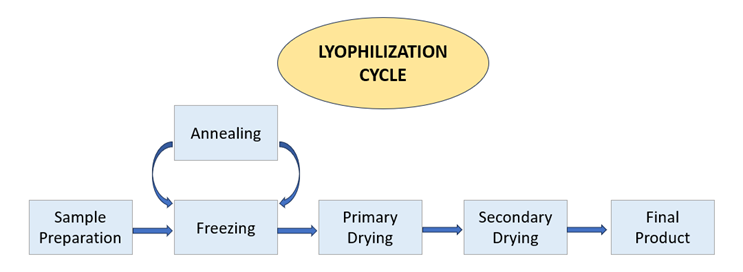
The quality of the product relies entirely on the optimization of multiple factors during all three processes.The primary factors influencing the quality of the lyo-product are: 1) phase transitions from ice to water, 2) phase transitions from ice to vapour, 3) desorption of moisture from the product surface, 4) re-sublimation of water vapour extracted from the product on the condenser surface, 5) removal of the ice layer from the capacitor surface, etc.18
When compared to vacuum drying, the most difficult part of freeze drying is maintaining product freezing to prevent the existence of free water. The freezing rate is of utmost importance in lyophilization as it directly impacts the pace at which ice nucleation and crystal development occur, ultimately determining the physical and morphological characteristics of the product. Furthermore, the speed at which sublimation occurs has an impact on the structure of the ice, which subsequently influences product profile.19 Consequently, it’s essential to optimize all three steps of freeze-drying in order to guarantee the highest quality output. Though there are certain empirical criteria to follow for scale-up batches to assure product quality, recently designed lyophilizers only allow optimization at the laboratory scale. The main purpose of these empirical recommendations is product quality and stability;therefore, process efficiency is not taken into account during optimization, and the process optimization may not be cost-effective. This paper will examine the challenges associated with scaling up the lyophilization process and propose troubleshooting ways to address them. 16
Anapproach for the maximizing efficiency of the lyophilization process requires considerations of the following
a) Thorough monitoring of the properties of the lyophilized product using advanced analytical techniques during optimization of lyophilization
b) Smooth and efficient scale up
Monitoring of properties of the lyophilized product
An effectiveness of freeze-drying process is dependent upon several critical process parameters, including temperature, pressure, and duration. These characteristics should be determined based on an analysis of the physical properties of the formulation. 20 It is important to use advanced techniques for the organoleptic evaluation of lyophilized frozen product. Studying the formulation development process requires the physical characterization of the frozen formulation, while studying the hard cake formation, % moisture level, crystalline nature, glass transition temperature, time for reconstitution, pH, with other variables requires the characterization of the freeze-dried product. In addition to this, it is necessary to investigate chemical qualities such as product stability. It usually takes a lot of time to carry out the chemical tests needed to get data regarding a product's stability. Due to this, people depend on physical characteristics and link them with product stability. 21
Freezing is the primary stage of the lyophilisation. 18A process of freezing begins with the formation of ice nuclei, which are then followed by the growth of ice crystals. The temperature where ice nucleation starts is known as the ice nucleation temperature. This temperature is influenced by a variety of process and formulation characteristics, as well as container characteristics. 22Consequently, the temperature at which this occurs and rates where ice crystals starts to generate exhibit heterogeneity, thereby exerting a significant influence on the quality of the product. There is a limited number of suitable techniques to investigate ice-crystal generation and temperature where which it begins. Currently, visual observation is the sole direct technique that is available. The primary focus of characterization studies is the examination of the porous cake that remains following the completion of the ice crystal cycle. 23 The shape and size of the ice crystals that are created during freezing dictate how the pores are shaped. Scanning Electron Microscopy (SEM) is the predominant technique employed for investigating the structure and form of cakes. 24 During the freezing stage, solutes undergo crystallization. However, in practice, crystallization typically occurs only after the temperature is lowered by around 10-15 degrees below the freezing point. At the temperature beneath the Tg' of the frozen concentrate / highly concentrated solutes, the solutes that do not form crystals are transformed into amorphous solids. This phenomenon is referred to as solidification.25 This temperature is largely determined by how much water is in the system. During primary drying, if the temperature exceeds Tg, then solid substance will liquefy or the viscosity of the amorphous phase will decrease. This will cause deterioration of the pore structure in the dried matrix, leading to occurrence of "cake collapse" in the lyophilized material and the temperature is referred to as the collapse temperature (Tc). This temperature is exclusively applicable to amorphous systems, whereas Tg is specifically used for crystalline substances. Generally, Tc refers to the temperature at which the structure of the dry region next to ice breaks down. 26
During the primary longest phase of the lyophilisation process, it is necessary to maintain a high product temperature to get lowest possible drying time. It is necessary to also consider the pressure of the chamber. Hence, to get optimal results, process should be conducted at a temperature reaching near the maximum permissible range for the product, denoted as Tc (amorphous product) / Te (crystalline product). Despite this, end product will most likely be a cake of porous nature, which possesses favourable de-hydration characteristics witha fair appearance. The cakecollapse results in a product with considerable residual moisture, leading to unstable and/or a lengthy timefor re constitution.27-28 It is essential to determine the characteristics of eutectic point (Te), Tgand/or Tc to properly plan freezing and the primary drying procedures. Several methodologies, including differential scanning calorimetry (DSC) and differential thermal analysis (DTA), dielectric analysis (DEA), and freeze-drying microscopy (FDM), have been used to determine Te, Tg, and Tc.
DTA tracks the thermal differential between test sample and a reference sample (thermally stable) over time or relative to the sample temperature, whereas differential scanning calorimetry (DSC) tracks the change in energy, or heat flow, rather than temperature. It is possible to regulate the temperature of the sample container (such as the DSC pan) in both methods in a manner analogous to cold drying. This is because DTA can sometimes identify phase shifts in situations (such sample size and containers) that are more similar to the real freeze-drying process, which is seen as a benefit.29 Although DTA is utilized in certain laboratories on an ongoing basis, DSC prove to be more sophisticated technique than DTA. Methods such as TEA or electro kinetic analysis measures the change resistance of electrical impulse with respect to temperature. In the frozen state, is resistance is higherowing to the restricted movement of charge-carrying entities. Upon heating the sample for thawing, this decreases dramatically, but the ionic movement speed up. Electric resistance measurements can be used to analyse the thermal characteristics of product after it is frozen. While the device is less often used compared to DSC. Additionally, Dielectric analysis (DEA) is conducted to characterize the lyophilized product. Dielectric characteristics are determined by the material's capacity to undergo polarization in the presence of an electromagnetic field. Polarization is a dynamic phenomenon that is influenced by the structure and molecular characteristics of the product. Hence, dielectric value offers the opportunity to characterize these features.30,31 In addition to this, the prevailing method for characterizing lyophilized products nowadays is freeze-drying microscopy. By incorporating a cryo-stage, along with a controllable cooling system and a vacuum system, a microscope can be utilized to directly examine the microstructures of the formulation solution sample while it is being frozen and freeze-dried. This technique is referred to as freeze-drying microscopy (FDM). Freeze-drying microscopy (FDM) is widely considered the most effective method for determining the collapse temperature of a product. This technique allows for the visual observation of structural loss, specifically cake collapse, under controlled experimental conditions that simulate the actual freeze-drying process.32 When combined with thermal approaches, the FDM technique offers significant insights into the importance of each transition in the lyophilization process and the quality of product.33,34
In addition, X-ray Powder Diffractometry (XRPD) and Freeze-Drying X-ray Powder Diffractometry are employed for characterization purposes. X-ray powder diffractometry (XRPD) is often considered the most reliable method for qualitatively determining the presence of crystalline structures. It has been a preferred approach for determining the physical state of freeze-dried solids. Recording the physical condition of a product right after freeze-drying and at regular intervals throughout stability investigations is frequently neglected. However, this practice can offer a vital understanding into potential issues related to physical or chemical stability. The X-ray chamber's improved capability to regulate temperature and humidity allows for the convenient examination of the physical stability of freeze-dried products in connection to storage circumstances. By connecting a vacuum pump to the cryo-stage of an X-ray diffractometer, it is possible to perform a complete freeze drying process within the sample chamber of the XRPD. The in-situ monitoring allows for the observation of the phase changes that take place during the procedure. The process was referred to as freeze-drying X-ray powder diffractometry (FDXRPD). Understanding the freeze-drying cycle can provide information on the phase transitions of the solute, which are affected by the process parameters and can impact its physical state. 35-37 This allows for the identification of the crucial process factors and results in a consistent product that fulfils regulatory criteria. Nevertheless, the FDXRPD exhibits a lower level of sensitivity compared to DSC and is not appropriate for analyzing transitions occurring in the amorphous state, such as glass transitions. Utilizing a combined XRD-DSC system under freeze-drying conditions is an exceedingly valuable approach for optimizing freeze-dried pharmaceutical products38. In addition, Nuclear Magnetic Resonance (NMR) is not commonly employed for the characterization of freeze-dried items. In this context, Nuclear Magnetic Resonance (NMR) is employed to quantify the degree of molecular movement in solids that are either frozen or freeze-dried. This measurement can then be linked to the stability of the product. NMR enables the identification of the source of molecular movement, hence allowing for the assessment of the molecular mobility of the medication and excipients in a freeze-dried formulation.39
The moisture content is a crucial metric that might impact the product's quality. If there is any remaining moisture in the product, it might have an impact on both the microstructure and thermal properties. The determination of residual moisture should be conducted during the secondary drying phase. Methods such as the Dynamic Vapour Sorption System, Symmetrical Gravimetric Analyser, and Near-Infrared Reflectance Spectroscopy can be employed to ascertain the moisture content of the product. 40-43
Table 2 outlines the different stages of lyophilization (freezing, primary drying, and secondary drying) and identifies the critical properties that must be monitored for ensuring product quality. It also describes the various methods used to assess these properties during each stage.
Table 2: Monitoring Critical Properties During Lyophilization: Stages of Drying and Methods of Measurement
|
Stage of Drying |
Critical Property of the Lyophilized Product to Be Monitored |
Method for Monitoring the Critical Property |
|
Freezing Stage |
Ice nucleation temperature, ice crystal formation, physical properties of the frozen formulation |
Visual observation, Scanning Electron Microscopy (SEM), X-ray Powder Diffraction (XRPD) |
|
Primary Drying |
Amorphous solidification, collapse temperature (Tc), crystalline properties |
Differential Scanning Calorimetry (DSC), Differential Thermal Analysis (DTA), Freeze-Drying Microscopy (FDM), Dielectric Analysis (DEA) |
|
Secondary Drying |
Residual moisture content, stability of the final product |
Dynamic Vapour Sorption System, Symmetrical Gravimetric Analyser, Near-Infrared Reflectance Spectroscopy (NIR) |
Scaling up Lyophilization Processes
The transfer of the lyophilization process from laboratory to large-scale production necessitates a thorough understanding of the formulation, process parameters, and equipment. Based on experience in process scale-up, it is clear that the freezing, primary drying, and secondary drying steps of the freeze-drying process can be affected by changes in scale. 44 The objective of the scale-up procedure is to attain a comparable thermal history of the product between the laboratory and commercial methods throughout all stages of lyophilization. This is done to ensure that the product maintains the same quality attributes and storage stability profile.
As previously stated, the freezing process directly impacts the size and shape of ice, which in turn affects its porosity. Therefore, if the freezing profiles (including freezing rate and degree of supercooling) in the laboratory and the commercial manufacturing process are comparable, the porous structure should be identical. Nevertheless, within the manufacturing setting, the absence of particles creates an environment where a more pronounced level of supercooling occurs.45 This super cooling has an impact on the structure of ice crystals and consequently, the size of the pores, resulting in variations in the resistance of the final product (Rp). Compared to laboratory settings, production environments must include nearly zero particles, meaning that there are far fewer possible nucleation sites in the final product. Higher levels of super cooling result from this, and this has an impact on the creation of (smaller) ice crystals once more. Reducing the size of ice crystals leads to smaller openings in the material, which in turn restricts the pace at which vapor may pass through. The application of optimal annealing treatment enables Ostwald ripening, a process in which larger crystals develop at the expense of smaller ones, resulting in the elimination of heterogeneity in ice size. This compensates for the disparities observed in the lab-scale procedure.
The primary drying stage is typically the most time-consuming phase of the operation and poses the greatest risk to the quality of the product. The process of ice sublimation occurs in this phase by the application of heat and reduced pressure. In the secondary drying stage, the primary goal is to eliminate the remaining water that has been unfrozen. This is achieved by raising the temperature of the product, which encourages the water molecules to travel through the solid's glassy structure and reach the surface, where they can then evaporate. The purpose of the secondary drying stage is to decrease the remaining water content in the product, which in turn raises the glass transition temperature (Tg) and improves the product's capacity to be stored for longer periods of time. In this step, the temperature setting for the shelf is higher than in the primary drying stage. The chamber pressure will generally remain the same or increase compared to primary drying. However, this process typically lasts only a few hours.
The recent developments in process control have simplified the development of the lyophilisation process at the laboratory scale. Nevertheless, the transition to commercial scale is both technically and logistically intricate, necessitating multiple adjustments to the laboratory-scale procedure.46-49
Significant distinctions exist between freeze-drying processes conducted in a pharmaceutical development laboratory and those carried out in a GMP manufacturing environment.50Equipment design and capabilities can vary significantly. For instance, there may be changes in the placement of the condenser, with some models having an internal condenser located along the side walls or in the back of the chamber, while others have a condenser connected to the chamber through a short duct, typically with an isolation valve. Laboratory equipment typically enables the freezing of products to lower temperatures compared to production equipment and may facilitate faster temperature ramping of the product. It is crucial to have a thorough understanding of the capabilities of the equipment in order to effectively apply the constraints of production equipment to laboratory activities. This will help prevent any unexpected issues during the scale-up process.51 It is advisable to take into account any known discrepancies while developing a lyophilization cycle, if feasible.
It is important to acknowledge that the variation in batch sizes is a factor that contributes to the uncertainty in scaling up. 52 Addressing issues such as vial breakage and vial fogging could be crucial.53, 54Various methodologies are employed to optimize the lyophilization cycle at the scale-up level in order to address the aforementioned difficulties. Here are a few examples-
As-is methodology
The As-is methodology in optimizing the lyophilization cycle at the scale-up level involves evaluating the existing (or "as-is") lyophilization process used at the laboratory or pilot scale and directly applying it to larger production scales with minimal modifications. This approach begins with a thorough assessment of the current process parameters—such as shelf temperature, chamber pressure, and drying times—that were established during smaller-scale experiments. The goal is to scale up the process by transferring these parameters to industrial-scale equipment while maintaining product quality and process efficiency. During this transition, engineers and scientists assess the behaviour of the product under scaled-up conditions, identifying potential issues such as heat transfer differences, extended drying times, or equipment limitations that may arise when moving from small batches to larger ones. Adjustments may be made to maintain consistent product quality, such as modifying freeze-drying times or temperature profiles. The As-is methodology allows for a more straightforward scale-up process by preserving the integrity of the original lyophilization cycle design. However, challenges often arise due to the differences in equipment and batch sizes, requiring careful optimization to ensure the process remains robust at the industrial level without compromising product stability or efficiency.
The trial-and-error method
The trial-and-error methodology in the optimization of the lyophilization cycle at the scale-up level involves making systematic adjustments to the lyophilization process parameters and observing the outcomes to optimize the cycle. This approach is often used when direct scaling from laboratory to production size is not straightforward or when the initial cycle does not yield the desired product quality at larger scales. Key process parameters such as shelf temperature, chamber pressure, freezing rate, and drying times are incrementally modified based on the observed performance, including drying efficiency, product appearance, and residual moisture content.
During this process, each adjustment is followed by a cycle run to determine its impact on critical quality attributes like stability, structure, and potency of the lyophilized product. Feedback from each cycle informs further adjustments, gradually honing in on an optimized cycle. The trial-and-error method is iterative and relies heavily on empirical data gathered during the scale-up process. Although it can be time-consuming and resource-intensive, it helps to fine-tune the lyophilization process for complex or sensitive formulations that may behave unpredictably when scaled up. This approach is particularly useful when dealing with challenging formulations where theoretical or predictive scaling models may fall short. In summary, the trial-and-error methodology involves iterative testing and modification to optimize the lyophilization cycle, making it more suitable for large-scale production while maintaining product quality. 55, 56
Robust cycle methodology
This design creates a cycle on a pilot scale with sufficient safety margins, serving as an alternative to the trial-and-error method.57 The robust cycle methodology in lyophilization cycle optimization focuses on designing a process that can withstand variations in key parameters, such as temperature, pressure, and drying time, without compromising product quality. This approach ensures that even under less-than-ideal conditions, the lyophilization process remains efficient and stable, consistently producing high-quality products during large-scale manufacturing. To create a robust cycle, critical parameters are rigorously tested across a wide range of conditions. This often involves design of experiments (DoE) and risk-based methodologies, where the process is deliberately pushed to its limits to identify the boundaries within which it can reliably perform. By understanding these limits, manufacturers can ensure that the cycle is resilient to minor deviations caused by equipment variability or environmental factors. A robust cycle reduces the need for constant monitoring and adjustments during production, making the process more efficient and reproducible. It is particularly beneficial in large-scale operations where small variations are inevitable. Ultimately, the robust cycle methodology aims to create a flexible and reliable lyophilization process that maintains product integrity and quality under diverse manufacturing conditions. 58
Modelling approach
The modeling approach is a widely used and efficient method to optimize the lyophilization process, especially during the scale-up phase. It is valuable because it reduces the need for expensive and time-consuming experimental trials, saving both time and money. Here’s how it works, step by step:
Purpose:The method focuses on optimizing the lyophilization (freeze-drying) process, particularly the primary drying stage, which takes the most time in the entire process.48
How It Works:Researchers create mathematical and computational models to simulate how the lyophilization process works under different conditions (e.g., variations in temperature, pressure, and moisture levels).
Instead of physically running numerous tests, they use these simulations to predict outcomes.
Tools and Techniques:Methods like finite element analysis (for structural and thermal behavior), thermodynamic modeling (to study energy changes), and computational fluid dynamics (to analyze fluid and heat flow) are applied.
These techniques allow a detailed understanding of how heat and mass transfer occurs during lyophilization.
Benefits:The simulations identify the best conditions for the process, such as optimal temperature and pressure settings.
This reduces the cost and effort of trial-and-error experiments.
It speeds up the development and ensures high-quality lyophilized products.
In short, the modeling approach helps researchers fine-tune the lyophilization process more efficiently, making it a reliable tool for producing consistent, high-quality products on a larger scale. 59,60
Addressing the Challenges during Scale-up and transfer
Various challenges can be faced during scale-up of lyophilisation process. These may include difference in ice nucleation, Shelf-surface temperature distribution, Difference Heat and mass transfer, Difference in chamber pressure, Vial breakage, Moisture content variation, Melt back and edging effect, Vial fogging, etc.
Difference in ice nucleation
Variations in the amounts of particulate matter in the environment may affect the lyophilization process during the freezing stage, when ice crystals are created. For instance, the grade A and grade B environments [as per International Organization for Standardization (ISO) standards, particularly ISO 14644-1, and the European Union Good Manufacturing Practices (GMP)] guidelines have significantly lower particle levels compared to an unclassified laboratory environment. The presence of fewer particles that can act as ice nucleation sites leads to greater levels of supercooling in the manufacturing area compared to the laboratory. Significant levels of supercooling result in reduced opportunities for ice crystal development. The sublimation of smaller ice crystals results in the formation of smaller holes in the solid being dried. This leads to an increase in the resistance to the transfer of water vapor during the primary drying process. An elevation in resistance to the mass transfer of water vapor can prolong the drying process, but it can also lead to an elevation in product temperature. If the temperature of the product rises close to or surpasses the critical temperature, the drying process may fail. It is ideal to employ identical circumstances in both laboratory and commercial scales. However, it is neither practical or cost-effective to maintain grade A conditions in the laboratory. Annealing, performed after freezing, is a method that can be used to reduce the variations in ice crystal size during manufacture. 61 During annealing, the product is maintained at a temperature higher than Tg′ to allow for an extended period of crystal growth, known as Ostwald's ripening. This method is comparatively straightforward and does not necessitate any adjustments to the equipment. An alternative strategy involves inducing controlled ice nucleation using either rapid depressurization or ice fogtechniques, both in laboratory-scale development and throughout production scale-up.62, 63 Implementing a controlled ice nucleation stage necessitates customized adjustments to the equipment, which could be cost-prohibitive and involve the need for equipment requalification and resubmission of regulatory documentation. Alternatively, the vacuum-induced nucleation approach has the potential to be executed on a commercial scale.64 However, its successful implementation may necessitate software adaption and a large-scale demonstration.
Shelf-surface temperature distribution
The lack of uniformity in shelf temperature is a prevalent issue that results in inconsistent temperature distribution throughout all the shelves. Variations in temperature between and within shelves result in variations in the temperature of the vials. The variations in product temperature result in inconsistency within the batch, causing certain product in vials to undergo faster drying than others. Eliminating the non-uniformity of shelf temperature poses a challenging task. Nevertheless, it is possible to implement measures to analyse the specific impacts and mitigate their influence on the uniformity of shelf temperature. Shelf temperature homogeneity can be achieved through edge design, which refers to the structural geometry of lyophilizer shelf edges. By optimizing geometry and flow dynamics, edge design minimizes temperature variations, ensuring uniform heat transfer across the surface. This results in faster achievement of consistent temperatures and reduces drying inconsistencies across vials, improving product quality and process efficiency. The design influences heat and airflow distribution, playing a crucial role in shelf stability and the uniform temperature distribution across the shelf during the lyophilization process. Simulations demonstrate that the redesigned edge greatly enhances temperature uniformity over time. 65
Difference in Heat and mass transfer
Traditional freeze dryers employ shelves where vials or other containers are stacked. Thermal fluid is employed to regulate the temperature of the solution in the containers on each tier. Nevertheless, vials positioned on the outermost rows of the shelves are subject to the transmission of thermal energy from the walls and entrance of the freeze drier. The phenomenon known as the edge effect can cause variations in temperature between containers positioned at the edge of the shelf and those positioned in the center.66 The merchandise stored in containers positioned along the periphery of a shelf tends to have a higher temperature compared to the merchandise stored in containers positioned in the centre of the shelf. Hence, the temperature at which the product situated on the periphery of a shelf may be affected should be taken into account when designing the lyophilization cycle. The temperature gradient between the edge and centre is frequently determined by the shelf temperature. Theoretically, the edge effect could be significantly reduced if the walls and doors of commercial dryers could be kept at or close to the temperature of the product. However, the authors are unaware of any existing technique in production that achieves this. Consequently, it is customary (particularly among the co-authors of this study) to create a cautious cycle that ensures the edge/corner vials do not exceed the product temperature, while also enabling the central vials to dry completely. Manufacturers generally employ this method unless they are prepared to compromise the quality of the vials. An approach to completely eliminate the edge effect is to implement a continuous lyophilization process, in which each individual vial is dried under carefully regulated circumstances. A spin freeze drying technique or continuous freeze drying process with suspended vials offers a solution to eliminate the edge effect, resulting in a substantial reduction in freeze drying process time.67, 68 However, these technologies are not currently accessible on a large basis.
Difference in chamber pressure
The chamber pressure is a crucial element that must be carefully controlled during the primary drying process. Pressure in the chamber is measured and regulated using capacitance manometers, which can accurately measure pressures regardless of the gas composition. Nevertheless, several outdated freeze dryers continue to rely solely on a Pirani or comparable pressure sensor, which measures gas composition to determine readings. To achieve equivalent product temperatures between laboratory and commercial scale, it is necessary to change the pressure set points. 69 Additionally, it is important to ensure that the product temperature remains below the collapse temperature. It is crucial to acknowledge that pressure sensors, specifically capacitance manometers, which are utilized in commercial manufacturing, are frequently subjected to steam. Consequently, the initial reading may change by a little amount of millitorr following each treatment. This factor should be considered when implementing a large-scale lyophilization process in an industrial setting.
Vial breakage and impact of container closure system
Commercially available vials can be categorized into two types: moulded and tubular. When comparing tubular glass vials to moulded vials, the latter are more resilient and sturdier. However, they also have the drawback of displaying inconsistent thickness across the vial's length and a reduced ability to transfer heat. Tubular vials exhibit higher heat transfer through contact conductivity in the portions that come into contact with the shelf, as well as more gas conduction in the space between the shelf and the bottom of the vial, compared to moulded vials.70,71 The stippled bottom of the moulded vials along with the curved shape at the bottom, restricts direct contact between the shelf surface area and the vial bottom, hence minimizing heat transfer.72 The treatment of the vial can also influence the procedure or the lyophilization cycle. For borosilicate vials, it has been shown that the process of washing and depyrogenation causes the formation of small holes in the glass, which affects the surface qualities of the glass. This could potentially contribute to vial fogging, a phenomenon that is not well known in commercial manufacture. It occurs due to the interaction between the composition of the formulation and the glass surface. Another aspect of the vial that can be considered is its coating or makeup. Applying polymer coatings to the outside of vials can prevent damage during shipment and guard against surface pitting and delamination induced by washing, depyrogenation, and commercial-scale filling procedures. These coatings do not have a substantial impact on heat transfer coefficients, according to unpublished studies. The use of an inner coating or the process of siliconization can significantly decrease the occurrence of vial fogging. However, it is not advisable to proceed with siliconization due to the potential difficulties it can cause, which may affect the clarity of the solution. Therefore, it is recommended to do a siliconization assessment.
SUMMARY AND CONCLUSION :
The review article provides a comprehensive overview of the critical aspects of lyophilization in the pharmaceutical industry. It begins with an introduction to the lyophilization process, emphasizing its significance in preserving sensitive biological materials, which enhances their stability and shelf life. The article highlights the importance of lyophilization for formulating effective pharmaceutical products, particularly vaccines and proteins, while also addressing practical challenges encountered during the process, such as variations in environmental conditions and the behavior of biological materials. The characterization of freeze-dried products is discussed in detail, focusing on assessing the quality and performance of lyophilized formulations. Additionally, strategies to enhance production efficiency during scaling up are explored, including methodologies like the As-is methodology, trial-and-error method, robust cycle methodology, and modeling approach. These techniques aim to optimize the lyophilization process, ensuring consistent product quality while addressing challenges such as ice nucleation differences, temperature distribution, heat and mass transfer, and container closure system integrity.
In conclusion, while lyophilization presents several challenges during scale-up and transfer, understanding these factors is crucial for achieving successful outcomes. Future perspectives highlighted in the article suggest that continued research into advanced modeling techniques and innovative process designs will be essential to further enhance the efficiency and effectiveness of lyophilization in pharmaceutical applications. By addressing these challenges, the pharmaceutical industry can unlock the full potential of lyophilization, leading to better-preserved biologics and improved therapeutic options for patients.
REFERENCES:
1. Mahdavi SA, Jafari SM, Ghorbani M, Assadpoor E. Spray-drying microencapsulation of anthocyanins by natural biopolymers: A review. Drying Technology. 2014; 4;32(5):509-518. DOI:10.1080/07373937.2013.839562
2. Nireesha GR, Divya L, Sowmya C, Venkateshan NN, Lavakumar V. Lyophilization/freeze drying-an review. International Journal of Novel Trends in Pharmaceutical Sciences. 2013;10;3(4):87-98. DOI: 10.5958/0974-360X.2020.00441.2
3. Matejtschuk P, Malik K, Duru C, Bristow A. Lyophilization-freeze drying of biologicals: process development to ensure biostability. American Pharmaceutical Review. 2009; 12(2):12.
4. Bjelošević M, Pobirk AZ, Planinšek O, Grabnar PA. Excipients in freeze-dried biopharmaceuticals: Contributions toward formulation stability and lyophilisation cycle optimisation. International Journal of Pharmaceutics. 2020;25;576:119029. doi: 10.1016/j.ijpharm.2020.119029.
5. Kasper JC, Winter G, Friess W. Recent advances and further challenges in lyophilization. European Journal of Pharmaceutics and Biopharmaceutics. 2013; 1;85(2):162-169. DOI: 10.1016/j.ejpb.2013.05.019
6. Bjelošević M, Pobirk AZ, Planinšek O, Grabnar PA. Excipients in freeze-dried biopharmaceuticals: Contributions toward formulation stability and lyophilisation cycle optimisation. International Journal of Pharmaceutics. 2020; 25;576:119029. DOI: 10.1016/j.ijpharm.2020.119029
7. Mirasol F. Lyophilization presents complex challenges. Bio-Pharm International. 2020; 1; 33(1):22-24.
8. Khandagale PM, Bhairav B, Saudagar RB. Lyophilization Technique: A Review. Asian Journal of Research in Pharmaceutical Science. 2016;6(4):269-276. DOI: 10.5958/2231-5659.2016.00038.2
9. Pikal MJ, Rambhatla S, Ramot R. The impact of the freezing stage in lyophilization: effects of the ice nucleation temperature on process design and product quality. American Pharmaceutical Review. 2002; 5:48-53.
10. Goldman JM, More HT, Yee O, Borgeson E, Remy B, Rowe J, Sadineni V. Optimization of primary drying in lyophilization during early-phase drug development using a definitive screening design with formulation and process factors. Journal of Pharmaceutical Sciences. 2018; 1;107(10):2592-2600.
11. DOI 10.1016/j.xphs.2018.06.001
12. Daraoui N, Dufour P, Hammouri H, Hottot A. Model predictive control during the primary drying stage of lyophilisation. Control Engineering Practice. 2010;1;18(5):483-494.https://doi.org/10.1016/j.conengprac.2010.01.005
13. Fissore D, Barresi AA. Scale-up and process transfer of freeze-drying recipes. Drying Technology. 2011; 1;29(14):1673-1684.
14. Pisano R, Fissore D, Barresi AA, Rastelli M. Quality by design: scale-up of freeze-drying cycles in pharmaceutical industry. AapsPharmscitech. 2013; 14:1137-1149.doi: 10.1208/s12249-013-0003-9
15. Kodama T, Sawada H, Hosomi H, Takeuchi M, Wakiyama N, Yonemochi E, Terada K. Optimization of primary drying condition for pharmaceutical lyophilization using a novel simulation program with a predictive model for dry layer resistance. Chemical and Pharmaceutical Bulletin. 2014 ;1;62(2):153-159. https://doi.org/10.1248/cpb.c13-00674
16. Pikal MJ. Use of laboratory data in freeze drying process design: heat and mass transfer coefficients and the computer simulation of freeze drying. PDA Journal of Pharmaceutical Science and Technology. 1985;1;39(3):115-139.
17. Kawasaki H, Shimanouchi T, Kimura Y. Recent development of optimization of lyophilization process. Journal of Chemistry. 2019; 2019(1):9502856. https://doi.org/10.1155/2019/9502856
18. Gaidhani KA, Harwalkar M, Bhambere D, Nirgude PS. Lyophilization/freeze drying–a review. World Journal of Pharmaceutical Research. 2015;4(8):516-543.
19. Nowak D, Jakubczyk E. The freeze-drying of foods—The characteristic of the process course and the effect of its parameters on the physical properties of food materials. Foods. 2020; 18;9(10):1488. DOI: 10.3390/foods9101488
20. Nuytten G, Revatta SR, Van Bockstal PJ, Kumar A, Lammens J, Leys L, Vanbillemont B, Corver J, Vervaet C, De Beer T. Development and application of a mechanistic cooling and freezing model of the spin freezing step within the framework of continuous freeze-drying. Pharmaceutics. 2021;3;13(12):2076. DOI:10.3390/pharmaceutics13122076
21. Tchessalov S, Maglio V, Kazarin P, Alexeenko A, Bhatnagar B, Sahni E, Shalaev E. Practical advice on scientific design of freeze-drying process: 2023 update. Pharmaceutical Research. 2023;40(10):2433-2455. DOI: 10.1007/s11095-023-03607-9
22. Liu J. Physical characterization of pharmaceutical formulations in frozen and freeze-dried solid states: techniques and applications in freeze-drying development. Pharmaceutical Development and Technology. 2006;1;11(1):3-28. doi: 10.1080/10837450500463729
23. Deck LT, Ochsenbein DR, Mazzotti M. Stochastic ice nucleation governs the freezing process of biopharmaceuticals in vials. International Journal of Pharmaceutics. 2022;25;625:122051. DOI: 10.1016/j.ijpharm.2022.122051
24. Tejedor MB, Fransson J, Millqvist-Fureby A. Freeze-dried cake structural and physical heterogeneity in relation to freeze-drying cycle parameters. International Journal of Pharmaceutics. 2020; 30;590:119891. DOI: 10.1016/j.ijpharm.2020.119891
25. Pérez-Bermúdez I, Castillo-Suero A, Cortés-Inostroza A, Jeldrez C, Dantas A, Hernández E, Orellana-Palma P, Petzold G. Observation and Measurement of Ice Morphology in Foods: A Review. Foods. 2023;31;12(21):3987. https://doi.org/10.3390/foods12213987
26. Bogdanova E, Fureby AM, Kocherbitov V. Influence of cooling rate on ice crystallization and melting in sucrose-water system. Journal of Pharmaceutical Sciences. 2022; 1;111(7):2030-2037. https://doi.org/10.1016/j.xphs.2022.01.027
27. Searles JA, Carpenter JF, Randolph TW. Annealing to optimize the primary drying rate, reduce freezing‐induced drying rate heterogeneity, and determine T'g in pharmaceutical lyophilization. Journal of Pharmaceutical Sciences. 2001;1;90(7):872-887. doi: 10.1002/jps.1040.
28. Adams GD, Ramsay JR. Optimizing the lyophilization cycle and the consequences of collapse on the pharmaceutical acceptability of Erwinia L-asparaginase. Journal of Pharmaceutical Sciences. 1996;1;85(12):1301-1305. doi: 10.1021/js960146p.
29. Lueckel B, Helk B, Bodmer D, Leuenberger H. Effects of formulation and process variables on the aggregation of freeze-dried interleukin-6 (IL-6) after lyophilization and on storage. Pharmaceutical Development and Technology. 1998;1;3(3):337-346.https://doi.org/10.3109/10837459809009861
30. Liu J. Physical characterization of pharmaceutical formulations in frozen and freeze-dried solid states: techniques and applications in freeze-drying development. Pharmaceutical Development and Technology. 2006;1;11(1):3-28.https://doi.org/10.1080/10837450500463729
31. Smith G, Duffy AP, Shen J, Olliff CJ. Dielectric relaxation spectroscopy and some applications in the pharmaceutical sciences. Journal of Pharmaceutical Sciences. 1995; 1;84(9):1029-1044.https://doi.org/10.1002/jps.2600840902
32. Pearson DS, Smith G. Dielectric analysis as a tool for investigating the lyophilization of proteins. Pharmaceutical Science & Technology Today. 1998;1;1(3):108-117.https://doi.org/10.1016/S1461-5347(98)00030-3
33. Ma X, Wang DQ, Bouffard R, MacKenzie A. Characterization of murine monoclonal antibody to tumor necrosis factor (TNF-MAb) formulation for freeze-drying cycle development. Pharmaceutical Research. 2001;18:196-202. doi: 10.1023/a:1011084518936.
34. Kasraian K, Spitznagel TM, Juneau JA, Yim K. Characterization of the sucrose/glycine/water system by differential scanning calorimetry and freeze-drying microscopy. Pharmaceutical Development and Technology. 1998 ;1;3(2):233-239. doi: 10.3109/10837459809028500.
35. Kett VL, Fitzpatrick S, Cooper B, Craig DQ. An investigation into the subambientbehavior of aqueous mannitol solutions using differential scanning calorimetry, cold stage microscopy, and X-ray diffractometry. Journal of pharmaceutical Sciences. 2003;1;92(9):1919-1929.https://doi.org/10.1002/jps.10449
36. Pyne A, Suryanarayanan R. Phase transitions of glycine in frozen aqueous solutions and during freeze-drying. Pharmaceutical Research. 2001; 18:1448-1454.https://doi.org/10.1023/A:1012209007411
37. Pyne A, Chatterjee K, Suryanarayanan R. Crystalline to amorphous transition of disodium hydrogen phosphate during primary drying. Pharmaceutical Research. 2003;20:802-803.https://doi.org/10.1023/A:1023445905372
38. Pyne A, Surana R, Suryanarayanan R. Crystallization of Mannitol below T g′ during Freeze-Drying in Binary and Ternary Aqueous Systems. Pharmaceutical Research. 2002; 19:901-908. https://doi.org/10.1023/A:1016177404647
39. Liu J. Physical characterization of pharmaceutical formulations in frozen and freeze-dried solid states: techniques and applications in freeze-drying development. Pharmaceutical Development and Technology. 2006; 1;11(1):3-28.https://doi.org/10.1080/10837450500463729
40. Bugay, D.E. Magnetic Resonance Spectrometry. In Physical Characterization of Pharmaceutical Solid; Brittain, H.G. Ed.; Marcel Dekker: New York, 1995, 93–125.
41. Clavaud M, Lema-Martinez C, Roggo Y, Bigalke M, Guillemain A, Hubert P, Ziemons E, Allmendinger A. Near-infrared spectroscopy to determine residual moisture in freeze-dried products: model generation by statistical design of experiments. Journal of Pharmaceutical Sciences. 2020;1;109(1):719-729.https://doi.org/10.1016/j.xphs.2019.08.028
42. Sun M, Liu DQ, Kord AS. A systematic method development strategy for determination of pharmaceutical genotoxic impurities. Organic Process Research & Development. 2010;16; 14(4):977-985.http://dx.doi.org/10.1021/op100089p
43. Zhou L, Socha JM, Vogt FG, Chen S, Kord AS. A systematic method development strategy for water determinations in drug substance using Karl Fischer titrations. American Pharmaceutical Review. 2010;13(1):74-84.
44. Zhou GX, Ge Z, Dorwart J, Izzo B, Kukura J, Bicker G, Wyvratt J. Determination and differentiation of surface and bound water in drug substances by near infrared spectroscopy. Journal of Pharmaceutical Sciences. 2003;1;92(5):1058-1065.https://doi.org/10.1002/jps.10375
45. Bhatnagar BS, Tchessalov S, Lewis LM, Johnson R. Freeze drying of biologics. Encyclopedia of pharmaceutical Science and Technology. 2013;1;4.
46. Pikal MJ. Freeze drying. In: Swarbrick J, ed. Encyclopedia of Pharmaceutical Technology, 3rd edn. New York, NY: Informa Healthcare USA, Inc, 2006: 1807–1833.
47. Tchessalov S, Dixon D, Warne N. Principles of lyophilization cycle scale-up. American Pharmaceutical Review. 2007; 10(3):88.
48. Trappler E. Scale-up strategy for a lyophilization process. American Pharmaceutical Review. 2001; 4:55-62.
49. Tchessalov S. Principals of lyophilization scale-up. InCPPR (Center for Pharmaceutical Processing Research) Freeze Drying of Pharmaceuticals and Biologicals Conference, Garmisch-Partenkirchen 2006.
50. Kamat M, Varshney D. Lyophilization Process Technology Transfer Towards Product Launch. Lyophilized Biologics and Vaccines: Modality-Based Approaches. 2015:381-397.https://doi.org/10.1007/978-1-4939-2383-0_17
51. Gamiz AG, Dewulf J, De Soete W, Heirman B, Dahlin P, Jurisch C, Krebser U, De Meester S. Freeze drying in the biopharmaceutical industry: An environmental sustainability assessment. Food and Bioproducts Processing. 2019;1; 117:213-223.https://doi.org/10.1016/j.fbp.2019.06.010
52. Kuu WY, Hardwick LM, Akers MJ. Correlation of laboratory and production freeze drying cycles. International Journal of Pharmaceutics. 2005;30;302(1-2):56-67.https://doi.org/10.1016/j.ijpharm.2005.06.022
53. Ohori R, Akita T, Yamashita C. Scale-up/tech transfer issues of the lyophilization cycle for biopharmaceuticals and recently emerging technologies and approaches. Drying Technology. 2023 ;23;41(2):233-250.https://doi.org/10.1080/07373937.2021.2015372
54. Abdul-Fattah AM, Oeschger R, Roehl H, Dauphin IB, Worgull M, Kallmeyer G, Mahler HC. Investigating factors leading to fogging of glass vials in lyophilized drug products. European Journal of Pharmaceutics and Biopharmaceutics. 2013;1;85(2):314-326.https://doi.org/10.1016/j.ejpb.2013.06.007
55. Langer C, Mahler HC, Koulov A, Marti N, Grigore C, Matter A, Chalus P, Singh S, Lemazurier T, Joerg S, Mathaes R. Method to predict glass vial fogging in lyophilized drug products. Journal of Pharmaceutical Sciences. 2020;1;109(1):323-330.https://doi.org/10.1016/j.xphs.2019.08.024
56. Tsinontides SC, Rajniak P, Pham D, Hunke WA, Placek J, Reynolds SD. Freeze drying—principles and practice for successful scale-up to manufacturing. International Journal of Pharmaceutics. 2004;6;280(1-2):1-16.https://doi.org/10.1016/j.ijpharm.2004.04.018
57. Kawasaki H, Shimanouchi T, Kimura Y. Recent development of optimization of lyophilization process. Journal of Chemistry. 2019;2019(1):9502856.https://doi.org/10.1155/2019/9502856
58. Sane SU, Hsu CC. Considerations for successful lyophilization process scale-up, technology transfer, and routine production. InFormulation and Process Development Strategies for Manufacturing Biopharmaceuticals 2010;26 (p. 797). John Wiley & Sons Inc Hoboken, NJ.
59. Dixon D, Tchessalov S, Bhatnagar B. Lyophilization: process design, robustness, and risk management. Challenges in Protein Product Development. 2018:407-39.https://doi.org/10.1007/978-3-319-90603-4_19
60. Zhu T, Moussa EM, Witting M, Zhou D, Sinha K, Hirth M, Gastens M, Shang S, Nere N, Somashekar SC, Alexeenko A. Predictive models of lyophilization process for development, scale-up/tech transfer and manufacturing. European Journal of Pharmaceutics and Biopharmaceutics. 2018;1;128:363-378.https://doi.org/10.1016/j.ejpb.2018.05.005
61. Shivkumar G, Kazarin PS, Strongrich AD, Alexeenko AA. LyoPRONTO: an open-source lyophilization process optimization tool. AAPS PharmSciTech. 2019;20:1-7.doi: 10.1208/s12249-019-1532-7.
62. Searles JA, Carpenter JF, Randolph TW. Annealing to optimize the primary drying rate, reduce freezing‐induced drying rate heterogeneity, and determine T'g in pharmaceutical lyophilization. Journal of Pharmaceutical Sciences. 2001;1;90(7):872-887.doi: 10.1002/jps.1040.
63. Konstantinidis AK, Kuu W, Otten L, Nail SL, Sever RR. Controlled nucleation in freeze‐drying: Effects on pore size in the dried product layer, mass transfer resistance, and primary drying rate. Journal of Pharmaceutical Sciences. 2011;1;100(8):3453-3470. DOI: 10.1002/jps.22561
64. Vollrath I, Friess W, Freitag A, Hawe A, Winter G. Comparison of ice fog methods and monitoring of controlled nucleation success after freeze-drying. International Journal of Pharmaceutics. 2019;10;558:18-28.https://doi.org/10.1016/j.ijpharm.2018.12.056
65. Oddone I, Pisano R, Bullich R, Stewart P. Vacuum-induced nucleation as a method for freeze-drying cycle optimization. Industrial & Engineering Chemistry Research. 2014; 26;53(47):18236-18244.http://dx.doi.org/10.1021/ie502420f
66. Cullen S, Walsh E, Gervasi V, Khamar D, McCoy TR. Technical transfer and commercialisation of lyophilised biopharmaceuticals—application of lyophiliser characterisation and comparability. AAPS Open. 2022 Sep 1;8(1):14.https://doi.org/10.1186/s41120-022-00059-0
67. Scutellà B, Plana-Fattori A, Passot S, Bourlès E, Fonseca F, Flick D, Trelea IC. 3D mathematical modelling to understand atypical heat transfer observed in vial freeze-drying. Applied Thermal Engineering. 2017; 5;126:226-236.https://doi.org/10.1016/j.applthermaleng.2017.07.096
68. Van Bockstal PJ, De Meyer L, Corver J, Vervaet C, De Beer T. Noncontact infrared-mediated heat transfer during continuous freeze-drying of unit doses. Journal of Pharmaceutical Sciences. 2017;1;106(1):71-82. DOI: 10.1016/j.xphs.2016.05.003
69. Capozzi LC, Trout BL, Pisano R. From batch to continuous: freeze-drying of suspended vials for pharmaceuticals in unit-doses. Industrial & Engineering Chemistry Research. 2019; 4;58(4):1635-1649.https://doi.org/10.1021/acs.iecr.8b02886
70. Nail S, Tchessalov S, Shalaev E, Ganguly A, Renzi E, Dimarco F, Wegiel L, Ferris S, Kessler W, Pikal M, Sacha G. Recommended best practices for process monitoring instrumentation in pharmaceutical freeze drying—2017. AapsPharmscitech. 2017t;18:2379-2393. doi: 10.1208/s12249-017-0733-1.
71. Tang X, Pikal MJ. Design of freeze-drying processes for pharmaceuticals: practical advice. PharmaceuticalResearch. 2004;21:191-200.https://doi.org/10.1023/B:PHAM.0000016234.73023.75
72. Pikal MJ, Roy ML, Shah S. Mass and heat transfer in vial freeze‐drying of pharmaceuticals: Role of the vial. Journal of Pharmaceutical Sciences. 1984;73(9):1224-1237.https://doi.org/10.1002/jps.2600730910
73. Wenzel T, Gieseler H. Molded vial manufacturing and its impact on heat transfer during freeze-drying: Vial geometry considerations. American Association of Pharmaceutical Scientists PharmSciTech. 2021; 22:1-2.http://dx.doi.org/10.1208/s12249-021-01926-x