Integrating Neuman System Model in Care Burden and Quality Of Life of Family Caregivers of Patients with Spinal Cord Injury
- Raheela Aster , MSN Scholar, Lahore School of Nursing, The University of Lahore, Pakistan
- Azeem Kaleem , Assistant Professor, Lahore School of Nursing, The University of Lahore, Pakistan
- Madiha Mukhtar , Associate Professor, Lahore School of Nursing, The University of Lahore, Pakistan
Article Information:
Abstract:
Background: Objective: To evaluate quality of life of family caregivers of patients with spinal cord injury through Neuman system model Materials & Methods: A quasi-experimental (one group pre-post) study design was used. The study was carried-out in Neuro department at Punjab Institute of Neuro-Sciences Lahore. People of this study are selected from Punjab Institute of Neuroscience Lahore. A sample size of 28 cases was calculated with a 95%confidence interval, d=0.09 and the mean difference of pre-post caregiver knowledge score as 4.04+0.26. After adding a 20% dropout rate, the sample size was 34. Study duration was 9 months after the approval from Research Ethics Committee (REC) FAHS, UOL with REC-UOL-511/08/24. Results: The sample was balanced by gender (52.9% men, 47.1% women) and mostly had low education. Injuries were distributed across cervical (38.2%), lumbar (35.3%), and thoracic (26.5%) cases. NSM-based intervention improved caregivers’ psychological, physiological, and sociocultural domains, lowering total burden and increasing quality of life. These findings show the NSM model effectively reduces stress and enhances caregiver well-being. Conclusion: NMS based intervention reduce caregiver burden, improved quality of life, and showed potential for use in low resource settings , warranting further research in broader populations.
Keywords:
Article :
INTRODUCTION:
Spinal cord injury (SCI) is a global health concern, with its incidence varying significantly across different regions. The reported rate of SCI ranges from 3.3 to 195 cases per million individuals in nine countries (Jazayeri, 2023). Similarly, World Health Organization (WHO) estimates 40 to 80 new SCI cases per million people on annual basis (WHO, 2020). In Pakistan 90% of individuals with SCI account tetraplegia (10%) or paraplegia (80%) (Ara et al., 2023). This assumes to increase caregiving burden of individuals with SCI.
Notably, traumatic events like spinal cord injuries can have profound physical, psychological, and social impacts on affected individuals as well as on their primary caregivers. In most cases, family members assume the role of primary caregivers who play an essential support and assistance to those affected by SCI. Although caregiving may be a significant and fulfilling affair, it has also come with a lot of challenges that may have a detrimental impact on the overall health and living standards of caregivers (Chang et al., 2020). As the prevalence of SCIs is high, the roles and duties of caregivers should be dramatically changed. In most cases, caregivers complain that their quality of life has been affected significantly because of the pressure that comes with SCI care. To elaborate caregivers, face particular issues regarding care linked to mobility problems, bowel and bladder problems (constipation, abdominal distention, and urinary retention), frozen arm contractures, skin issues (cyanosis, breakdowns, and bedsores), foot edema, respiratory infections (e.g., pneumonia), thrombus formation, positioning, and traction problems of patients. These continuous anxieties are some of the main stressors that have led to physical and emotional stressors among caregivers. Interestingly, the initial two years of SCI are associated with the possibility of recidivism to the hospital in 36-40 percent of patients that only exacerbates the burden of caregiving (Stillman et al., 2017). It can be presumed because of the insufficient preparation of caregivers concerning proper care delivery and improved patient outcomes (Maitan et al., 2018). Therefore, the caregivers are to be provided with proper educational interventions that can help them to better support people with SCI (Khan et al., 2021).
PROBLEM STATEMENT
Spinal cord injuries are highly common and the number is between 3.3 percent to 195 cases per million (Jazayeri et al., 2023). As the World Health Organization (WHO) estimates, it occurs 40 to 80 cases per million people every year globally (WHO, 2020). In Pakistan, no national prevalence rates have been defined, but regional data indicate that there is an incidence of approximately 10 per million per year in at least one province (Ara et al., 2023), and the burden of caretakers is reported as 48.68% (Keihanian et al., 2022). Amongst the caregivers, only 31.3% reported moderate load, 45% severe hardship, and 12.5 severe burden (Khan et al., 2021). Karim et al. (2024) also claim that family caregivers of patients with spinal injuries experience significant weight of social, emotional, economic, and physical issues. To support them, it is necessary to realize these factors and their effects on the quality of life. Future studies ought to assess existing interventions, and come up with new measures to cut down load and enhance well-being. In Pakistan, since little nursing support is provided, the family or employer is left to provide care, which is usually not well-trained, monitored or established in practice, therefore, the programs of caregiver training and counseling are necessary.
SIGNIFICANCE OF THE STUDY
· Interventions, education, respite care, peer support, and counseling effectively reduced caregiver stress and improved quality of life.
· The study aimed to increase awareness among hospital management and promote staff training and community-based education.
· Findings enabled healthcare providers to deliver appropriate care and education to families requiring long-term support.
MATERIALS AND METHODS:
A quasi-experimental (one group pre post) study design was used. The study was carried-out in Neuro department at Punjab Institute of Neuro-Sciences Lahore. A sample size of 28 cases was calculated with a 95%confidence interval, d=0.09 and the mean difference of pre-post caregiver knowledge score as 4.04+0.26. After adding a 20% dropout rate, the sample size was 34. Study duration was 9 months after the approval from Research Ethics Committee (REC) FAHS, UOL with REC-UOL-511/08/24.
Inclusion criteria
· Primary Caregivers
· Adult : age 18-45 years
· speak Urdu, English
· live near to Lahore like Kasure Shadar etc.
Exclusion criteria
· Those caregivers who are healthcare professionals.
· Caregivers suffering from severe mental health issues or cognitive impairments may not be able to effectively participate in intervention activities.
DATA COLLECTION TOOLS
Data were gathered through questionnaire.
Demographic Data: age, gender, marital status, education, type of injury, level of injury
Tool 1: caregiver burden inventory questionnaire
A caregiver burden inventory questionnaire consists of 22 items, minimum score is o and maximum score is 88. The scoring criteria is that
Absent of burden < 44
Light burden 45-66
Intense burden 66- 88
Tool ll: World Health Organization QOL Brief questionnaire (WHO-QOL-BREF)
Quality of life was assessed using the abbreviated version of the World Health Organization QOL Brief questionnaire (WHO-QOL-BREF) 25. This is a self-report questionnaire containing 25 items rated on five- point Likert scales. Each individual item of the WHOQOL-BREF is scored from 1 to 5 on a response scale, which is stipulated as a five-point ordinal scale. The scores are then transformed linearly to a 0–100-scale. The physical health domain includes items on mobility, daily activities, functional capacity, energy, pain, and sleep.
The scoring criteria is that:
Very Good QOL 76-100
Good QOL 51-75
Poor QOL 26-50
Very poor QOL 0-25
DATA COLLECTION PROCEDURE
Data was collected at two points, pre and post educational intervention. Caregivers was observed for care burden and their quality of life by using questionnaire.
Pre-interventional phase
In this phase, caregiver was selected in the study following the inclusion and exclusion criteria of the study. The aims and objectives of the study was shared with participants. Consents was taken from all the study participants. Pre-interventional data was collected by researcher and each participant was assessed for care burden and QOL at their original patient admission place by maintaining anonymity. Pre-education data of patients was recorded from patient’s charts.
Intervention plan on Neuman system Model
Humans are open systems with layered defenses that protect the self-core, including the flexible line of defense (FLD), normal line of defense (NLD), and line of resistance (LR), arranged from outer to inner levels. Each line involves psychological, sociocultural, developmental, and moral dimensions. Stress reactions occur when these defenses fail. Initial stress arises from the adaptable line of defense and NSM failing, and if NSH also fails, the innermost line of resistance activates to protect the core during disruptive events.
Interventional phase
Participants completed a 12-week educational program combining face-to-face, booklet, hands-on, and video-based training. Skills were reinforced before competency assessment. Caregivers also learned to manage key post-injury issues such as mobility, bowel/bladder care, contractures, skin problems, edema, infection, thrombosis, and positioning.
Post-interventional phase
After 12 weeks of intervention, giving a four weeks gap, the participants of the study was assessed for post- care burden and quality of life by using same validated questionnaire.
RESULTS:
This chapter consists of 3 sections. Section I deals with demographic characteristics, section II deals with care burden, and Section III deals with the quality of life of caregivers.
Section I: Demographic Characteristics
Education of Participants
|
|
N |
% |
|
Illiterate |
9 |
26.5% |
|
primary |
7 |
20.6% |
|
Matric |
8 |
23.5% |
|
Intermediate |
6 |
17.6% |
In this table 47.1% of participants are either illiterate or have only completed basic school, reflecting the poor educational attainment of the majority. Just 11.8% are graduates, compared to 41.1% who have completed secondary education (Matric and Intermediate). This suggests that the group has restricted access to higher education.
Gender of Participants
|
|
N |
% |
|
Male |
18 |
52.9% |
|
Female |
16 |
47.1% |
The gender distribution of participants is displayed in the table and graph, with somewhat more men (52.9%) than women (47.1%). Despite the slight majority being men, this suggests a fairly balanced sample. The study's conclusions are more gender diverse thanks to the almost equal representation.
Marital Status of Participants
|
|
N |
% |
|
Single |
16 |
47.1% |
|
Married |
18 |
52.9% |
The marital status of the participants is displayed in the table and graph, which indicates that 47.1% are single and a slight majority (52.9%) are married. This almost equal distribution indicates that both married groups are fairly represented, which can contribute to a variety of viewpoints in the research, particularly if marital status affects the variables under investigation.
Level of Injury
|
|
N |
% |
|
Cervical |
13 |
38.2% |
|
Lumber |
12 |
35.3% |
|
Thoracic |
9 |
26.5% |
The distribution of participants by degree of injury is shown in the table and graph. With 38.2% of participants suffering a cervical injury, lumbar injuries come in second at 35.3% and thoracic injuries at 26.5%. This rather uniform distribution of damage levels points to a diversified sample that might aid in researching the effects of various spinal injury sites on experiences or outcomes.
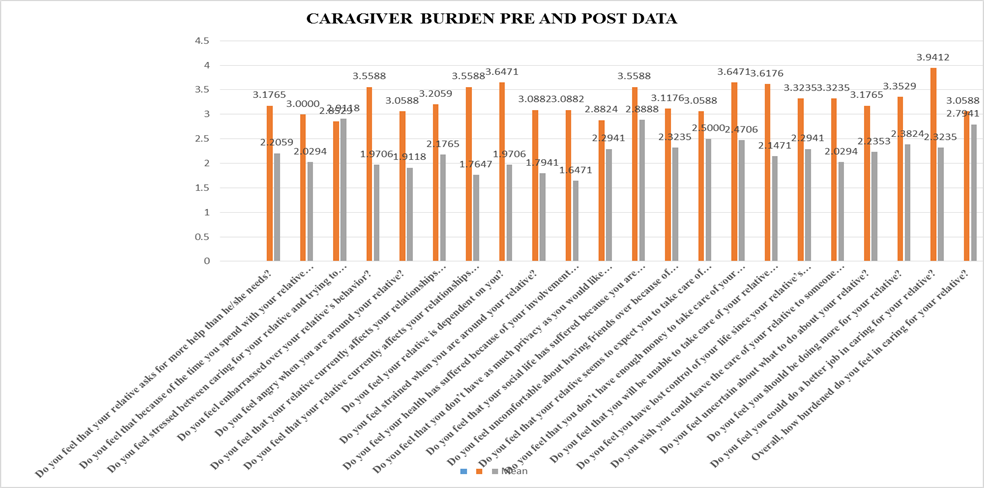
The chart shows caregiver burden before and after the Neuman Systems Model (NSM) intervention, highlighting emotional and physical challenges. Pre-intervention scores (red) indicate high stress, strain, anger, and overall burden from meeting patients’ complex needs. Post-intervention scores (green) are lower, reflecting reduced stress and strain and demonstrating the intervention’s positive effect on caregivers’ well-being.
This suggests that the intervention, possibly based on the Neuman Systems Model (NSM), reduced some mental and physical strain. NSM emphasizes supporting caregivers by reducing stress, promoting resource use, and maintaining system balance. It views caregivers as dynamic systems influenced by internal and external factors such as patient needs, personal health, and emotional stress. The model’s principles of prevention, support, and stress balance can improve caregivers’ quality of life, as reflected in the reduced caregiver burden. The intervention likely enhanced coping skills, psychological support, and empowerment, leading to better overall wellbeing.
SIGNIFICANCE VALUES ACCORDING TO NEWMAN SYSTEM MODEL (CARE GIVER BURDEN)
|
Neuman Domain |
Average Pre |
Average Post |
Mean Change |
Significance (p) |
|
Psychological |
2.233 |
3.251 |
+1.019 |
p = 2.36 × 10⁻¹⁰ |
|
Physiological |
1.765 |
3.647 |
+1.882 |
p = 2.36 × 10⁻¹⁰ |
|
Sociocultural |
2.108 |
3.074 |
+0.967 |
p = 2.36 × 10⁻¹⁰ |
|
Holistic (Total) |
2.794 |
3.941 |
+1.147 |
p = 2.36 × 10⁻¹⁰ |
Psychological Domain:
The psychological component of caregiver burden rose from a pre-intervention mean of 2.233 to 3.251, a change of +1.019 (p = 2.36 × 10⁻¹⁰), indicating increased emotional stress from prolonged caregiving, including worry, guilt, anger, and exhaustion. This growing strain may lead to burnout, emphasizing the need for psychological support like counseling and stress-reduction strategies.
Physiological Domain:
The physiological domain rose from 1.765 to 3.647 (+1.882, p = 2.36 × 10⁻¹⁰), showing significant physical strain from caregiving, including fatigue, poor sleep, and neglected self-care, highlighting the need for health checkups, wellness programs, and respite care.
Sociocultural Domain:
Within the sociocultural dimension, care load rose from a pre-intervention mean of 2.108 to 3.074, a mean change of +0.967, and was statistically significant (p = 2.36 × 10⁻¹⁰). This domain reflects caregiving’s impact on social roles, financial strain, cultural expectations, and social isolation. The increase suggests that unmet family and societal expectations are contributing to caregivers’ feelings of burden and loneliness.
Holistic (Total) Burden:
The holistic burden score, combining social, emotional, and physical pressures, rose significantly from 2.794 to 3.941 (+1.147, p = 2.36 × 10⁻¹⁰), showing caregiving challenges accumulate across areas. This highlights the need for interventions offering social, emotional, and physical support to protect caregivers.
QULAITY OF LIFE PRE AND POST DATA
|
|
Mean |
Median |
Mode |
Std. Deviation |
Mini |
Maxi |
|
|
How would you rate your quality of life? |
3.3077 |
3.0000 |
3.00 |
0.56911 |
2.00 |
4.00 |
|
|
How satisfied are you with your health? |
3.6154 |
4.0000 |
4.00 |
0.59007 |
2.00 |
4.00 |
|
|
How much do you need any medical treatment to function in your life? |
3.5641 |
4.0000 |
4.00 |
0.50236 |
3.00 |
4.00 |
|
|
How much do you enjoy life? |
3.1026 |
3.0000 |
3.00 |
0.71800 |
2.00 |
4.00 |
|
|
To what extent do you feel your life to be meaningful? |
3.1538 |
3.0000 |
3.00 |
0.53991 |
2.00 |
4.00 |
|
|
How well are you able to concentrate? |
3.0513 |
3.0000 |
4.00 |
0.85682 |
2.00 |
4.00 |
|
|
How safe do you feel in your daily life? |
3.3590 |
3.0000 |
3.00 |
0.48597 |
3.00 |
4.00 |
|
|
How healthy is your physical environment? |
3.1795 |
3.0000 |
4.00 |
0.85446 |
1.00 |
4.00 |
|
|
Do you have enough energy for everyday life? |
3.1026 |
3.0000 |
3.00 |
0.55226 |
2.00 |
4.00 |
|
|
Are you able to accept your bodily appearance? |
3.4103 |
4.0000 |
4.00 |
0.67738 |
2.00 |
4.00 |
|
|
Have you enough money to meet your needs? |
3.5641 |
4.0000 |
4.00 |
0.64051 |
2.00 |
4.00 |
|
|
How available to you is the information that you need in your day-to-day life? |
3.0000 |
3.0000 |
3.00 |
0.72548 |
2.00 |
4.00 |
|
|
To what extent do you have the opportunity for leisure activities? |
3.2308 |
3.0000 |
3.00 |
0.58316 |
2.00 |
4.00 |
|
|
How well are you able to get around? |
3.3077 |
3.0000 |
4.00 |
0.73104 |
2.00 |
4.00 |
|
|
How satisfied are you with your sleep? |
3.0513 |
3.0000 |
3.00 |
0.39395 |
2.00 |
4.00 |
|
|
How satisfied are you with your ability to perform your daily living activities |
3.1795 |
3.0000 |
4.00 |
0.82308 |
2.00 |
4.00 |
|
|
How satisfied are you with your capacity for work? |
3.2308 |
3.0000 |
3.00 |
0.42683 |
3.00 |
4.00 |
|
|
How satisfied are you with yourself |
3.2821 |
3.0000 |
3.00 |
0.60475 |
2.00 |
4.00 |
|
|
How satisfied are you with your personal relationships? |
3.3846 |
4.0000 |
4.00 |
0.71139 |
2.00 |
4.00 |
|
|
How satisfied are you with your sex life? |
2.9231 |
3.0000 |
3.00 |
0.57968 |
2.00 |
4.00 |
|
|
How satisfied are you with the support you get from your friends? |
3.3846 |
3.0000 |
3.00 |
0.59007 |
2.00 |
4.00 |
|
|
How satisfied are you with the conditions of your living place? |
3.4872 |
4.0000 |
4.00 |
0.60139 |
2.00 |
4.00 |
|
|
How satisfied are you with your access to health services? |
3.0769 |
3.0000 |
3.00 |
0.48038 |
2.00 |
4.00 |
|
|
How satisfied are you with your mode of transportation? |
2.8974 |
3.0000 |
3.00 |
0.75376 |
2.00 |
4.00 |
|
|
How often do you encounter nagative feelings,such as blue mood, stress and anxiety…? |
3.1795 |
3.0000 |
3.00 |
0.50637 |
2.00 |
4.00 |
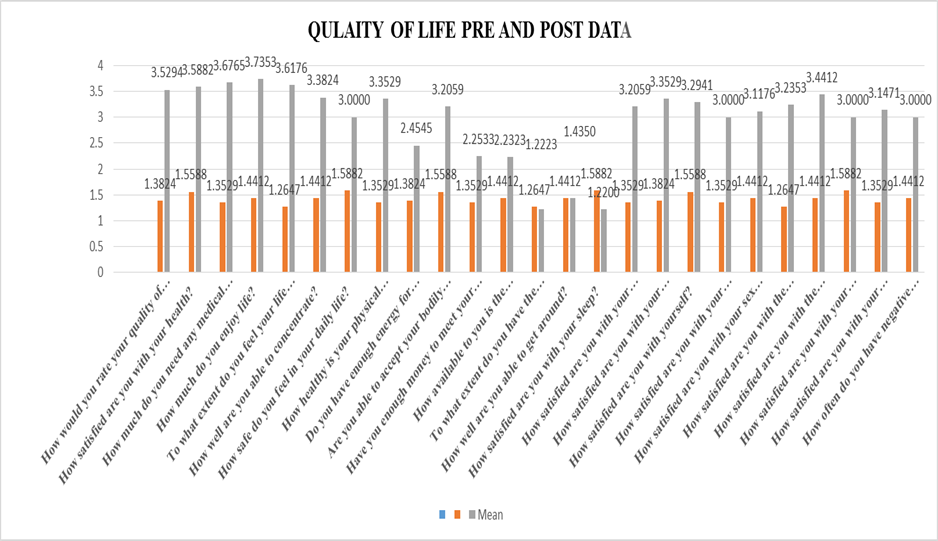
Based on the Neuman System Model (NSM) intervention, the graph shows pre- and post-test mean scores of caregivers’ quality of life (QOL) based on the Neuman Systems Model (NSM) intervention. Post-test scores (blue) improved across most QOL aspects, including safety, health, contentment, and overall well-being. Caregivers reported higher satisfaction and better health, reflecting that the NSM intervention likely addressed their psychological, emotional, and physical needs. Improvements were particularly notable in feelings of safety and contentment, suggesting reduced stress and enhanced coping, enabling caregivers to manage their roles more effectively.
SIGNIFICANCE VALUES ACCORDING TO NEWMAN SYSTEM MODEL (QUALITY OF LIFE)
|
Neuman Model Domain |
Average Pre |
Average Post |
Mean Change |
Significance (p) |
|
Physiological |
1.382 |
0.49 |
-12.49 |
3.39 × 10⁻¹³ |
|
Psychological |
1.441 |
0.50 |
-11.60 |
2.06 × 10⁻¹² |
|
Sociocultural |
1.264 |
0.45 |
-15.04 |
3.11 × 10⁻¹⁵ |
|
Developmental |
1.382 |
0.49 |
-12.49 |
3.39 × 10⁻¹³ |
|
Spiritual |
1.264 |
0.45 |
-15.04 |
3.11 × 10⁻¹⁵ |
Physiological Domain
This area includes energy, physical health, body function, and sleep quality. The pre-intervention mean was 1.382 (SD = 0.49), showing a significant difference from the neutral baseline (t = -12.49, p = 3.39 × 10⁻¹³). This indicates noticeably lower physiological wellbeing, such as fatigue, sleep problems, or health limitations, highlighting the need for targeted interventions like clinical monitoring, dietary support, or physical rehabilitation
Psychological Domain
This dimension covers mental clarity, mood, self-esteem, focus, and emotional well-being. The pre-intervention mean was 1.441 (SD = 0.50, t = -11.60, p = 2.06 × 10⁻¹²), indicating significant emotional and cognitive distress, such as depression, anxiety, poor focus, or reduced quality of life. The findings highlight the need for mental health support through mindfulness, stress-reduction, or therapy.
Sociocultural Domain
Intimacy, cultural expectations, social support, and interpersonal interactions lies in the ambit of this domain. The pre-intervention mean was lowest at 1.264 (SD = 0.45). A t-score of -15.04 and p = 3.11 × 10⁻¹⁵ indicate significant dissatisfaction with sexual life, relationships, or social support. These results underscore the need for relationship therapy, peer support, or community involvement in interventions.
Developmental Domain
This category incorporates role functioning, daily tasks, work ability, and mobility. With the same variability (0.49) and t-statistic (-12.49) as the physiological domain, the average score was 1.382, showing that stress from exhaustion or impairment affected both areas. The p-value (3.39 × 10⁻¹³) indicates a significant reduction in the ability to meet daily or work demands, highlighting the need for occupational therapy, ergonomic improvements, or job-readiness programs.
Spiritual Domain
This domain reflects a person’s sense of purpose, meaning, and existential fulfillment. The pre-score was 1.264, matching the sociocultural score. The t-statistic (-15.04) and p-value (3.11 × 10⁻¹⁵) indicate very low spiritual well-being, associated with purposelessness, despair, or emptiness. Interventions could address this through spiritual/religious materials, values-based reflection, life coaching, or spiritual therapy.
PRE-TEST & POST INTERVENTION DATA ANALYSIS
|
|
Burden( Pre-Test) |
QOL (Pre-Test) |
Burden( Post -Test) |
QOL |
|
Mean values |
72.2941 |
35.5882 |
49.0653 |
73.6998 |
|
St . deviation |
13.12415
|
12.27
|
18.92958 |
9.36195 |
|
P- values (Significant) |
>. 0300 |
>.0250 |
< .000 |
<.001 |
The table shows pre-test and post-test data to illustrate how the Neuman Systems Model (NSM) can reduce caregiver burden and improve quality of life (QOL) for family caregivers of spinal cord injury patients. The data show significant changes in both burden and QOL, indicating a measurable benefit from the NSM-based intervention. The pre-test mean burden score was 72.2941, reflecting high stress, which dropped to 49.0653 post-intervention, demonstrating reduced stress and difficulties for caregivers.
Caregivers’ quality of life improved from a pre-test mean of 35.59 to 73.70 after the intervention, with a reduced standard deviation (12.27 → 9.36), showing more consistent well-being. The NSM-based intervention had a significant positive effect (p > .001), demonstrating its effectiveness in reducing stress and enhancing caregivers’ lives.
DISCUSSION:
The study applied the Neuman Systems Model (NSM) to caregivers of SCI patients, examining its impact on burden and quality of life. Nearly half had minimal education, which NSM links to limited cognitive capacity, yet post-intervention improvements in psychological (+1.019), physiological (+1.882), and sociocultural (+0.967) domains show that practical training and psychosocial support effectively bridged gaps. Gender and marital status shaped stressors: females faced emotional exhaustion, males role adjustment challenges, singles lacked support, and married caregivers balanced family and care duties. Injury level also influenced burden, with cervical cases requiring complex care. Overall, NSM-guided interventions enhanced coping, role acceptance, and system stability across domains.The statistically significant increase in mean quality of life (QOL) scores observed among caregivers following the intervention further corroborates previous research highlighting the importance of holistic caregiver support. Comprehensive caregiver interventions—encompassing social, emotional, and physical domains—have been shown to positively impact caregivers’ overall well-being. These results are consistent with those reported by Yeh et al. (2019), who demonstrated that targeted interventions can effectively reduce emotional and physical caregiving burdens while increasing satisfaction and a sense of safety. The efficacy of the NSM-based intervention is further supported by rigorous statistical evidence.
Despite the overall effectiveness of the intervention, the increase in the standard deviation of burden scores following the intervention indicates variability in participant response. This heterogeneity suggests that while many caregivers benefited substantially, some did not experience equivalent improvements. This variation in outcomes underscores the need for personalized approaches to caregiver support. While system-based interventions such as those guided by the NSM are generally effective, they may not sufficiently account for the individual context and needs of every caregiver.
The demographic characteristics of the study participants provide further context for interpreting the findings. A substantial proportion (47.1%) had either completed only basic education or were illiterate, while only 11.8% had attained formal education beyond primary school. This low level of educational attainment may have implications for health literacy, the uptake of intervention strategies, and access to information on effective coping mechanisms. The sample was approximately gender balanced (52.9% male and 47.1% female), enhancing the generalizability of findings across male and female caregivers. Additionally, marital status was nearly evenly distributed, with 47.1% single and 52.9% married, suggesting that spousal support may be a critical moderating variable in caregiving outcomes. These differences in injury classification allowed the investigation to consider varying levels of caregiving complexity and their differential impacts on caregiver burden.
CONCLUSION:
This study found that an intervention based on the Neuman Systems Model (NSM) significantly reduced caregiver burden and improved the quality of life for family caregivers of individuals with spinal cord injury. By addressing internal and external stressors, the intervention enhanced caregivers’ overall well-being. It proved effective even among participants with limited education and resources, suggesting its potential in low-resource settings. These findings support the use of NSM-based approaches in caregiver support programs and health policy. Further research with larger, more diverse samples and longer follow-up is recommended.
Future Recommendations
1. Integrating NSM-based caregiving into health curricula to promote holistic care skills.
2. Providing focused training for stroke caregivers on communication, mobility, and rehabilitation.
3. Developing targeted interventions for caregiver stress, burnout, and anticipatory grief.
4. Implementing individualized caregiver plans covering all five NSM domains.
5. Establishing caregiver registries and routine burden screening in primary care.
6. Incorporating standardized caregiver assessments in discharge planning for high-care units.
7. Training community health workers to deliver culturally appropriate caregiver support in underserved areas.
REFERENCES:
1. Almeida, A. S., Paguia, A., & Neves, A. P. (2024). Nursing Interventions to Empower Family Caregivers to Manage the Risk of Falling in Older Adults: A Scoping Review. International Journal of Environmental Research and Public Health, 21(3), 246.
2. Ara, Z., Singh, A., Raj, S., Walliullah, S., & Srivastava, R. N. (2023). Spinal Cord Injury Prevalence and Treatment Modalities. In Spinal Cord Injury-Current Trends in Acute Management, Function Preservation and Rehabilitation Protocols. IntechOpen.
3. Chang, F., Xie, H., Zhang, Q., Sun, M., Yang, Y., Chen, G., Wang, H., Li, C., & Lu, J. (2020). Quality of life of adults with chronic spinal cord injury in mainland china: a cross-sectional study. Journal of Rehabilitation Medicine, 52(5).
4. Conti, A., Ricceri, F., Scivoletto, G., Clari, M., & Campagna, S. (2021). Is caregiver quality of life predicted by their perceived burden? A cross-sectional study of family caregivers of people with spinal cord injuries. Spinal Cord, 59(2), 185-192.
5. Farajzadeh, A., Akbarfahimi, M., Maroufizadeh, S., & Miri Lavasani, N. (2021). Factors associated with quality of life among caregivers of people with spinal cord injury. Occupational Therapy International, 2021, 1-10.
6. Galehdar, N., & Heydari, H. (2023). Exploring caregivers’ perceptions of community-based service requirements of patients with spinal cord injury: a qualitative study. BMC primary care, 24(1), 94. Hannoodee, S., & Dhamoon, A. S. (2020). Nursing neuman systems model.
7. Jazayeri, S. B., Maroufi, S. F., Mohammadi, E., Ohadi, M. A. D., Hagen, E.-M., Chalangari, M., Jazayeri, S. B., Safdarian, M., Zadegan, S. A., & Ghodsi, Z. (2023). Incidence of traumatic spinal cord injury worldwide: A systematic review, data integration, and update. World neurosurgery: X, 18, 100171.
8. Karim, S., Masih, S., & Sarwar, H. (2024). Challenges Faced by Family Caregivers of Patients with Spinal Cord Injury. Journal of Health and Rehabilitation Research, 4(1), 670-676.
9. Keihanian, F., Kouchakinejad-Eramsadati, L., Yousefzadeh-Chabok, S., & Homaie Rad, E. (2022). Burden in caregivers of spinal cord injury patients: a systematic review and meta-analysis. Acta Neurologica Belgica, 122(3), 587-596.
10. Khan, M. S., Farooq, O., Aqeel, R., Darain, H., Habib, G., Ahmad, I., & Inayat, F. (2021). Level of mental burden among caregivers of spinal cord injured patients.
11. Lynch, J., & Cahalan, R. (2017). The impact of spinal cord injury on the quality of life of primary family caregivers: a literature review. Spinal Cord, 55(11), 964-978.
12. Maitan, P., Frigerio, S., Conti, A., Clari, M., Vellone, E., & Alvaro, R. (2018). The effect of the burden of caregiving for people with spinal cord injury (SCI): a cross-sectional study. Annali dell'Istituto superiore di sanita, 54(3), 185-193.
13. Mohammed, R. S., Boateng, E. A., Amponsah, A. K., Kyei-Dompim, J., & Laari, T. T. (2023). Experiences of family caregivers of people with spinal cord injury at the neurosurgical units of the Komfo Anokye Teaching Hospital, Ghana. PloS one, 18(4), e0284436.
14. Molazem, Z., Falahati, T., Jahanbin, I., Jafari, P., & Ghadakpour, S. (2014). The effect of psycho-educational interventions on the quality of life of the family caregivers of the patients with spinal cord injury: a randomized controlled trial. International journal of community based nursing and midwifery, 2(1), 31.,