6D PRINTING IN DENTISTRY: WHERE DO WE STAND TODAY? - A MINI REVIEW
- Priyanka K. Cholan , Faculty, Department of Periodontics and Oral Implantology, SRM Dental College, Ramapuram, Bharathi Salai, Chennai, Tamil Nadu, India
- Suweadha K , Postgraduate Student, Department of Periodontics and Oral Implantology, SRM Dental College, Ramapuram, Bharathi Salai, Chennai, Tamil Nadu, India
- Sanjanaa S , Undergraduate Student, Department of Periodontics and Oral Implantology, SRM Dental College, Ramapuram, Bharathi Salai, Chennai, Tamil Nadu, India
- Leena V , Undergraduate Student, Department of Periodontics and Oral Implantology, SRM Dental College, Ramapuram, Bharathi Salai, Chennai, Tamil Nadu, India
- Ojasvitaa H. Menon , Postgraduate Student, Department of Periodontics and Oral Implantology, SRM Dental College, Ramapuram, Bharathi Salai, Chennai, Tamil Nadu, India
- Lakshmi Ramachandran , Faculty, Department of Periodontics and Oral Implantology, SRM Dental College, Ramapuram, Bharathi Salai, Chennai, Tamil Nadu, India
Article Information:
Abstract:
Background: Additive manufacturing has rapidly evolved from conventional 3D printing to advanced multi-dimensional systems capable of greater geometrical accuracy, functional adaptability, and biological integration. This review highlights how 5D printing introduces curved-layer deposition that enhances mechanical strength, reduces material waste, and improves anatomical conformity, supporting applications in prosthodontics, implantology, and orthodontics and traces the progression from 3D, 4D, and 5D printing toward the emerging concept of 6D printing, with emphasis on its relevance to dentistry. Building on these foundations, 6D printing integrates multi-axis manufacturing with stimuli-responsive materials, real-time sensing, and AI-driven feedback to create adaptive, patient-specific dental constructs capable of modifying shape, stiffness, or function over time marking a transition toward a new era of bio-intelligent dentistry.
Keywords:
Article :
INTRODUCTION:
Additive Manufacturing (AM), commonly known today as 3D printing, originated with Kodama’s early work in 1981 using the stereolithographic approach in which material is deposited along the x-, y-, and z-axes, enabling the controlled fabrication of both solid and porous configurations [1]. Its ability to generate detailed geometries with minimal waste has made it an indispensable tool in modern dentistry, where customized crowns, bridges, and complete dentures are routinely produced [2].
The concept of 4D printing, introduced by Skylar Tibbit in 2013, is defined as an evolution of 3D printing in which time is incorporated as an additional dimension [3]. With the use of smart, stimuli-responsive materials, printed structures can alter their form, behavior, or function when exposed to triggers such as heat, moisture, pH variations, or electromagnetic fields [4]. Later, Progress in manufacturing continued with the emergence of 5D printing in 2016, developed within American research institutions to enhance structural strength and surface fidelity using multi-axis fabrication pathways [5].
The emerging idea of 6D printing has been proposed as the next major advancement, offering the possibility of fabricating autonomous, patient-specific devices [6]. This dimension integrates multi-axis movement, time-dependent transformations, smart materials, and intelligent feedback control into a single manufacturing platform [7]. Unlike earlier methods, 6D printing incorporates real-time sensing, artificial intelligence, and adaptive response mechanisms, enabling printed constructs to modify their behavior in relation to their environment or functional load [8].
By merging the geometric versatility of 5D printing with the responsive capabilities of 4D materials, 6D printing aims to create self-adjusting, highly durable, and functionally optimized structures [9]. Though still largely conceptual and in early developmental stages, the technology is gaining attention across biomedical and engineering disciplines for its potential to deliver predictive, personalized, and autonomous solutions, marking a transformative shift in the trajectory of additive manufacturing [10].
2. LITERATURE REVIEW:
A comprehensive literature search was conducted using PubMed, Scopus, Web of Science, and various clinical trial registries to identify relevant studies published between October 2010 and October 2025. The search was restricted to English-language publications. A combination of keywords and Boolean operators was used, including (“Four-Dimensional Printing”), (“4D Printing Technology” AND “Smart Materials”), (“Bio-Smart Materials”), (“Shape Memory Materials” AND “Dentistry”), (“5D Printing”), (“Multi-Axis Printing”), and (“6D Printing”). The initial database queries retrieved a broad range of articles spanning engineering, biomedical, and dental sciences. After the removal of duplicates, titles and abstracts were screened to exclude studies unrelated to dentistry, additive manufacturing, or smart material applications. Additional exclusions were made for articles lacking methodological depth, focusing solely on traditional 3D printing, or presenting conceptual descriptions without clinical relevance. Manual hand-searching of reference lists from key papers ensured that no significant studies were missed. Ultimately, 39 peer-reviewed articles met the inclusion criteria and were incorporated into this review, forming the scientific basis for evaluating the evolution, applications, and challenges of 3D through 6D printing technologies in dentistry.
3. THE EVOLUTION OF 6D PRINTING::
The innovative development beyond traditional 3D printing comes from its limitations and the rising demand for complex, adaptable, and high-performing structures in biomedical uses [11]. While 3D printing allows for precise customization, it mainly creates static structures that struggle to respond to changing biological conditions [12]. The layer-by-layer process can lead to uneven mechanical properties, longer production times, and weaker strength in intricate shapes [13]. Owing to these limitations the 4D printing emerged to tackle some of these problems by using time and smart materials, allowing printed objects to change shape in response to outside triggers [14]. However, issues remained with complex fabrication, printing curved surfaces, and ensuring mechanical durability [15]. To further address geometric and strength issues, 5D printing was introduced using multi-axis deposition, enabling the creation of complex curved structures [16].
Despite these improvements, the need for intelligent, adaptive, and patient-specific solutions has led to the idea of 6D printing [17]. This combines the geometric accuracy of 5D printing with the dynamic responsiveness of 4D printing and incorporates real-time sensing and AI-driven feedback systems [18]. As a result, 6D printing represents a logical and essential step forward in additive manufacturing for advanced biomedical and personalized therapy applications [19]. Table 1 summarizes the core differentiating features across 3D to 6D printing.
|
TABLE I: COMPARATIVE FEATURES ACROSS DIMENSIONS FROM 3D TO 6D |
||||
|
FEATURE |
3D PRINTING |
4D PRINTING |
5D PRINTING |
6D PRINTING |
|
CORE ELEMENT |
Geometry (X,Y,Z) |
Time / Stimuli |
Multi-axis Motion |
Synergy (4D+5D) |
|
PRIMARY BENEFIT |
Precise Replication |
Dynamic Adaptation |
3-5x Strength |
Intelligence + Strength |
|
LAYERING |
Flat/Horizontal |
Flat/Horizontal |
Curved/Contoured |
Curved/Contoured |
|
MATERIAL TYPE |
Static/Standard |
Smart/Responsive |
Standard/High-perf |
Smart/Functional |
|
EFFICIENCY |
High Support Waste |
High Support Waste |
~25% Material Saving |
Optimized |
4. EMERGING CONCEPTS UNDERPINNING 5D PRINTING: :
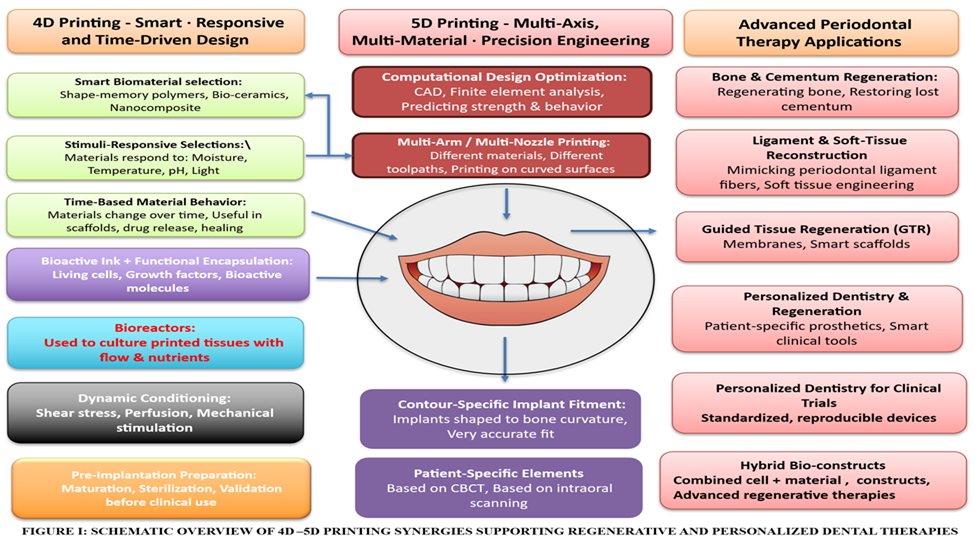
5D printing utilizes multi-axis, curved-layer deposition to generate structures that follow natural anatomical geometries, resulting in superior mechanical strength, surface quality, and reduced material waste compared with traditional 3D printing [20]. When integrated with advanced biomaterials and bio-inks, this approach promotes tissue-mimetic layer architecture, enhances cell adhesion, and supports regenerative outcomes [21]. These engineering advantages translate directly into dental applications, where curved toolpaths yield restorations with greater geometric accuracy, smoother surfaces, and improved resistance to occlusal loading [22]. In implantology, multi-axis control enables fabrication of porous scaffolds that replicate alveolar bone microstructures, facilitating vascularization, cellular ingrowth, and long-term osseointegration [23]. Orthodontic appliances such as aligners and retainers also benefit from improved anatomical conformity and consistent thickness, contributing to better comfort and predictable tooth movement [24]. Conceptual overview showing the relationship between 4D and 5D printing and their advanced periodontal therapy applications shown in Figure I.
5. FOUNDATION OF 6D PRINTING: A MULTI-DIMENSIONAL INTEGRATION::
5D printing takes the conventional additive printing process and refines it by creating curved layers at different axes, creating stronger and more biomimetic-structured three-dimensional bodies than could be previously achieved [25]. The subsequent utilization of advanced biomaterials makes it possible to create highly robust bodies, which could be more easily withstood in cyclic, weight-bearing, or physiological loading [26]. In continuing with its emphasis on precision in terms of its strength and construction, 6D printing takes additive printing technology and refines it even further by incorporating smart materials and cyber-physical controls [27]. In which, it creates bodies which could sense and evolve in response to biological stimuli in real time. This makes printed bodies not only robust but also intelligent and self-regulatory. [28].
5.1 APPLICATIONS OF 6D PRINTING IN DENTISTRY
The oral cavity is a highly dynamic biomechanical environment, yet conventional dental devices remain passive within these fluctuating conditions [29]. 6D printing introduces adaptive constructs capable of responding to mechanical forces, chemical changes, and biological cues, offering improved durability and more predictable long-term performance [30]. A key application is the creation of bioactive or “living” oral grafts, where smart-material–integrated gingival or mucosal scaffolds can adjust their shape, porosity, or therapeutic release throughout healing . In orthodontics, 6D printing enables smart aligners made from shape-memory or self-regulating polymers that autonomously modify force delivery, reducing the need for repeated clinical adjustments [31].
Emerging advancements also include sensor-embedded and self-repairing dental constructs, in which integrated micro-sensors monitor strain, temperature, pH, or micromovements in real time. When coupled with self-healing polymers and bioactive nanocomposites, these materials can repair microcracks or surface defects on their own, extending the functional lifespan of restorations and implants exposed to cyclic loading [32]. Additionally, changes in stiffness, geometry, or surface chemistry caused by the immunological response to dynamic materials can influence macrophage behavior, foreign body reactions, and long-term integration, is crucial for the safe translation of 6D-printed devices, especially in maxillofacial applications where chronic inflammation may compromise treatment outcomes [33]. Collectively, these advancements position 6D printing as a significant step toward adaptive, biologically responsive, and personalized dental care [34].
6. CHALLENGES OF 6D PRINTING: THE ULTIMATE INTEGRATION::
Despite its potential, 6D printing remains in an early developmental stage, with limited standardized research, few validated clinical workflows, and a small user base, making current adoption largely experimental [35] A major obstacle is the lack of an integrated digital ecosystem, as CBCT imaging, AI-driven design, real-time sensing, and multi-axis fabrication still function in disconnected systems. The use of smart, stimuli-responsive materials adds further complexity, requiring precise predictive modeling that current simulation tools cannot reliably support for long-term mechanical or biological behavior [36].
Sustainability concerns also pose challenges. Advanced polymers, nanocomposites, and bioactive materials used in 6D printing raise issues related to recyclability, environmental persistence, and lifecycle impact [37]. Additionally, multi-axis fabrication and continuous sensing systems may increase energy consumption, reducing the environmental benefits of material-efficient deposition (Table II). Addressing these issues will require the development of environmentally responsible smart materials, energy-efficient workflows, and standardized environmental assessment frameworks tailored to adaptive biomedical devices.
|
TABLE II : COMPARATIVE OVERVIEW OF 4D, 5D, AND 6D PRINTING |
|||||
|
TECHNOLOGY |
DIMENSION FOCUS |
MECHANICAL NATURE |
INTERACTION CAPABILITY |
PRIMARY TECHNICAL CHALLENGE |
PRIMARY MATERIAL CHALLENGE |
|
4D PRINTING |
Time / Materials |
Flat-layered; Lower strength |
Stimuli-responsive transformation |
Stair-stepping/Weak layers |
Limited ceramic availability |
|
5D PRINTING |
Motion / Axis |
Curved-layered; 3-5x Strength |
Static; High mechanical precision |
Complex predictive modeling |
Cell viability/Single stimulus |
|
6D PRINTING |
Synergy |
Curved-layered & High Strength |
Intelligent & Adaptive Response |
Slicing for non-planar layers |
High equipment & labor costs |
7. TRANSLATIONAL CONSIDERATIONS- FROM BENCH TO BEDSIDE::
Bringing multi-dimensional printing into clinical dentistry remains challenging due to technological, material, and regulatory limitations. While 3D printing is widely used for models and guides, broader clinical adoption is restricted by the high cost of certified materials and the extensive post-processing needed for biocompatibility [37]. For 4D and 6D systems, predicting how smart materials will behave inside the oral cavity requires advanced computational modeling that is not yet fully developed [38]. Transitioning to 5D and 6D printing also faces mechanical and digital barriers, including the lack of reliable software for generating non-planar, multi-axis toolpaths. Regulatory frameworks add further complexity, as existing standards are designed for static devices rather than implants that change shape or function over time [39]. Additionally, the long-term fatigue performance of curved-layer 5D structures must be thoroughly validated before they can replace conventional metal implants. Overall, substantial technological and regulatory progress is required before these advanced printing modalities can be routinely integrated into clinical practice.
8 CONCLUSION: THE ERA OF BIO-INTELLIGENCE :
The future of multi-dimensional printing is moving toward integrating biological adaptability with enhanced mechanical performance and digital intelligence. Continued progress in 5D printing is expected to enable highly anatomical, patient-tailored implants, particularly periodontal and bone scaffolds designed to mimic individual curvature and internal architecture. At the same time, 6D printing is emerging as a transformative approach in dental and maxillofacial applications through constructs capable of modifying their stiffness, geometry, or therapeutic output in response to local physiological cues.
Future directions also include chairside, AI-enabled 6D bioprinting platforms that use patient imaging and live sensor feedback to fabricate soft-tissue substitutes in real time. Research efforts should increasingly target the development of multi-stimuli responsive materials that coordinate mechanical, thermal, and biochemical reactions, supported by advanced AI-based predictive models for long-term performance assessment. Effective translation into clinical practice will require close cooperation among scientists, clinicians, and regulatory authorities.
Speculative advancements such as “7D printing,” which integrates adaptive materials with nanoscale or cellular feedback mechanisms, further illustrate a shift toward fully bio-intelligent regenerative and restorative dentistry. Collectively, these innovations point toward a future centered on adaptive, personalized, and biologically integrated dental solutions.
REFERENCE::
1. Anas S, Khan MY, Rafey M, Faheem K. Concept of 5D printing technology and its applicability in the healthcare industry. Materials Today: Proceedings. 2022;56:1726-32.
2. Reddy PR, Devi PA. Review on the advancements of additive manufacturing—4D and 5D printing. Int J Mech Prod Eng Res Dev. 2018;8(4):397-402.
3. Khorsandi D, Rezayat D, Sezen S, Ferrao R, Khosravi A, Zarepour A, et al. Application of 3D, 4D, 5D, and 6D bioprinting in cancer research. J Mater Chem B. 2024;12(19):4584-612.
4. Vasiliadis AV, Koukoulias N, Katakalos K. From 3D- to 6D-printing technology in orthopedics. J Funct Biomater. 2022;13(3):101.
5. Pandey A, Shrivastava KJ, Shukla S, Singh S. Advances in digital prosthodontics: A scoping review of CAD/CAM and 3D printing. Peoples J Sci Res. 2025;18(000).
6. Haleem A, Javaid M, Vaishya R. 5D printing and its expected applications in orthopaedics. J Clin Orthop Trauma. 2018;10(4):809.
7. Dargude S, Shinde S, Jagdale S, Polshettiwar S, Rajput A. Evolution of 5D and 6D Printing: Innovations and Biomedical Applications. Hybrid Advances. 2025:100470.
8. Lai J, Wang M. Developments of additive manufacturing and 5D printing in tissue engineering. J Mater Res. 2023;38(21):4692-725.
9. Bhardwaj A, Goyal N, Gupta A, Yadav A, Goyal L. Future applications of 5D printing in dentistry. Future Sci Dent. 2025;1(1):21-5.
10. JayaLakshmi K, LakshmanaRao B, Sudheer K, Sathvika A, Bhanuprasad, Udayabhanu K. 5D printing—The new era in dentistry. Int J Sci Res Eng Manag. 2024;8(5):1-5.
11. Gao B, Yang Q, Zhao X, Jin G, Ma Y, Xu F. 4D bioprinting for biomedical applications. Trends Biotechnol. 2016;34(9):746-56.
12. Zheng X, Wang X, Wang Y, Wang J. AI-driven additive manufacturing. Addit Manuf. 2024;78:103987.
13. Aafreen MM, Cholan PK, Ilango P, Parthasarathy H, Tadepalli A, Ramachandran L (2025)
14. Exploring the 4D printing linked bio-smart materials in dentistry: a concise overview. Front Dent Med 6:1558382.
15. Javaid M, Haleem A. Additive manufacturing applications in medical cases. Alex Eng J. 2018;57:1421-31.
16. Revilla-León M, Özcan M. Additive manufacturing in dental polymers. Br Dent J. 2019;227:705-14.
17. Fu J, Wang YK, Yang MT, Desai RA, Yu X, Liu Z, Chen CS. Mechanical regulation of cell function using 3D substrates. Nat Methods. 2010;7(9):733-6.
18. Chakraborty S, Sharma N, Ramakrishna S. Multi-material additive manufacturing. Prog Addit Manuf. 2022;7:601-27.
19. Fang G, Dong S, Li W, et al. Strength enhancement via curved-layer deposition in multi-axis printing. Addit Manuf. 2020;36:101512.
20. Townsend A, Senin N, Blunt L, et al. Metrology for additive manufacturing. Precis Eng. 2016;46:34-47.
21. Martinez PR, Lee J, Kim YJ. Cyber-physical additive manufacturing systems. Rob Comput Integr Manuf. 2023;83:102540.
22. Do AV, Khorsand B, Geary SM, Salem AK. 3D printing scaffolds for tissue regeneration. Nanotechnol Sci Appl. 2015;8:47-66.
23. Chang S, Zhang Y, Chen Z. Mechanical fatigue of porous scaffolds in multi-axis 3D printing. Mater Sci Eng C. 2021;120:111671.
24. Gladman AS, Matsumoto EA, Nuzzo RG, Mahadevan L, Lewis JA. Biomimetic 4D printing. Nat Mater. 2016;15:413-8.
25. Zhang B, Luo Y, Ma L. Smart orthodontic devices using shape-memory polymers. Dent Mater. 2022;38(5):748-60.
26. Rao FM, Kumar S. Sustainable smart materials for next-gen printing. Mater Today Adv. 2023;20:100968.
27. Grunert R, Jones A, McLaughlin J. Regulatory challenges in advanced printed medical devices. Regul Toxicol Pharmacol. 2024;145:105452.
28. Chumnanvej S, Rojvanit C. CBCT-guided workflows in digital implantology. Clin Oral Implants Res. 2023;34(4):401-12.
29. Phan TT, Huang M, et al. Digital twins in biomedical manufacturing. Biomanuf Rev. 2024;9:12.
30. Miri AK, et al. Biofabrication of cell-laden constructs. Nat Protoc. 2019;14:1941-73.
31. Zhou X, Li S, Chen L. Nanoscale bio-intelligent systems. Adv Healthc Mater. 2023;12:2300567.
32. Topol EJ. High-performance medicine: the convergence of AI and health. Nat Med. 2019;25:44–56.
33. Gu X et al. Smart bio-responsive materials for regenerative dentistry. Adv Funct Mater. 2022;32:2204568.
34. Anderson JM et al. Immune response to biomaterials. Semin Immunol. 2019;45:101338.
35. Zhang Y et al. Immune modulation in smart biomaterials. Adv Healthc Mater. 2023;12:2300988.
36. Ramakrishna S et al. Smart biomaterials in next-generation implants. J Mater Sci. 2020;55:11230–45.
37. Rao FM, Kumar S. Green chemistry in smart material development. Mater Today Adv. 2023;18:100945.
38. Bhardwaj A et al. Smart dental devices in next-gen orthodontics. Future Sci Dent. 2025;1(2):55–63.
39. Revilla-León M, Özcan M. Design considerations in AM-based prosthodontics. Br Dent J. 2019;228:555–62.
40. Zhang B et al. Additive manufacturing for functional dental materials. Dent Mater. 2022;38:715–29.