Public Leadership; A Review On Theories, Assessment & Effectiveness
- Jyotisankar Mishra , KIIT deemed to be University,
- Kishore Mishra , Associate Professor KIIT deemed to be University
Article Information:
Abstract:
Background: Public leadership scholarship has grown notably over the last two decades, reflecting rising complexity and demands placed on public institutions and their leaders around the world (Ahmad et al., 2023; Alford & O’Flynn, 2009; Andersen & Boyne, 2010; Andersen, 2010; Andrews & Van de Walle, 2012; Andrews et al., 2019; Araya-Orellana, 2022; Aria & Cuccurullo, 2017). While public leadership has seen increased attention from scholars, the literature remains fragmented in any number of ways, each competing on terminologies and varied theoretical frameworks (Arat et al., 2019; Asamoah & Yeboah-Assiamah, 2019; Awasthi & Walumbwa, 2022; Bailey & Bruce, 1994; Bardhan & Mookherjee, 2006; Barzelay & Armajani, 1992; Battaglio & Hall, 2018; Bao et al., 2013). Recent contributions emphasize the distinction between general leadership concepts—often borrowed from organizational behavior or business settings—and the domain-specific requirements of public leadership, which involve accountability structures, multiple stakeholder interests, and normative democratic values (Bartolome et al., 2004; Beebe et al., 2019; Bellé, 2014; Bellou & Dimou, 2022; Berman et al., 2013; Bozeman, 2000; Box, 2007; Bovaird et al., 2016). This article offers a comprehensive synthesis that traces the theoretical trajectories, assesses contemporary approaches to evaluating public leadership effectiveness, and highlights the emergent area of destructive leadership and its potential impact on public sector outcomes (Brown et al., 2006; Brookes, 2011; Brewer & Walker, 2010; Busuioc & Lodge, 2016; Campbell et al., 2019; Carbone et al., 2016; Charbonneau & Riccucci, 2008; Choi, 2008). A bibliometric analysis was conducted on 82 relevant articles, supplemented by a narrative review encompassing a total of 160 scholarly references (Christensen et al., 2020; Cho & Lee, 2011; Clark et al., 2013; Crosby & Bryson, 2005, 2018; Damanpour & Schneider, 2010; De Nooy et al., 2005; Denhardt & Catlaw, 2014; Denhardt & Campbell, 2006). The findings reveal four principal research streams focusing on functionalist, behavioral, ethical/biographical, and reformist perspectives, together underscoring a persistent challenge in defining what is distinct about public leadership (Deutsch, 1975; Dull, 2009; Dünn & Legge, 2001; Eden & Leviatan, 1975; Epitropaki et al., 2013; Fernandez, 2005; Fielding et al., 2020; Finer, 1941). Despite the proliferation of concepts like representative bureaucracy and co-production, methodological consensus on how to measure effectiveness remains elusive, with ongoing debates about measurement tools that adequately account for context, social equity, and accountability (Fiske & Taylor, 1991; Fruchterman & Reingold, 1991; Frost & Bondy, 2002; Furlong, 2013; Garbage & Merton, 1979; Gazley et al., 2020; Gaynor & Wilson, 2020; Getha-Taylor et al., 2011). The increasing attention to destructive leadership styles and their influence on trust, morale, and organizational performance underlines the need for deeper investigation in public settings (Goh, 2012; Gooden, 2015; Gooden & Portillo, 2011; Grabosky, 1992; Grohs et al., 2016; Guy & McCandless, 2012; Haddaway et al., 2022; Han, 2013). It requires more sector-specific theoretical developments, more integrated metrics for assessing effectiveness beyond efficiency or productivity, and greater understanding of negative leadership behaviors in public offices (Hansen & Villadsen, 2010; Hart, 2011; Heaslip et al., 2017; Helsloot & Groenendaal, 2017). Future research must bring clarity to the concept of public leadership and its measurement, as well as to the ways in which destructive leadership may thwart government objectives (Hirsch, 1995; Holm, 2023; Hsieh & Liou, 2018; Huang & Liu, 2023). By providing a detailed overview of existing knowledge and highlighting gaps, the article suggests avenues for moving the field closer to a cohesive framework, ultimately guiding scholars, practitioners, and policymakers toward more robust approaches to public leadership in an era of dynamic governance challenges (Jacobsen & Bøgh Andersen, 2015; Jakobsen & Andersen, 2013; Jimenez, 2016; Junker & Van Dick, 2014).
Keywords:
Article :
INTRODUCTION :
Public leadership has become the bedrock of scholarship and practice in public administration (Ahmad et al., 2023; Alford & O’Flynn, 2009; Andersen, 2010; Andersen & Boyne, 2010; Andrews & Van de Walle, 2012; Andrews et al., 2019; Araya-Orellana, 2022; Aria & Cuccurullo, 2017). Over the past few decades, the pace of globalization, technological change, and various crises—from financial meltdowns to pandemics—has highlighted the need for leaders who can reconcile efficiency and fiscal responsibility with democratic accountability, fairness, and social considerations (Arat et al., 2019; Asamoah & Yeboah-Assiamah, 2019; Awasthi & Walumbwa, 2022; Bailey & Bruce, 1994; Bardhan & Mookherjee, 2006; Barzelay & Armajani, 1992; Battaglio & Hall, 2018; Bao et al., 2013). A critical tension in this space is whether public leadership should be viewed as merely an application of general leadership theories in public organizations or whether it must be approached as a phenomenon in its own right, shaped by normative, structural, and political features of public life (Bartolome et al., 2004; Beebe et al., 2019; Bellé, 2014; Bellou & Dimou, 2022; Berman et al., 2013; Bozeman, 2000; Box, 2007; Bovaird et al., 2016).
Van Wart contends that the rapid proliferation of New Public Management (NPM) and subsequent paradigms, such as New Public Governance (NPG), has complicated the tasks of public leaders, expanded their roles, and paradoxically left them exposed to heightened scrutiny without a unified set of evaluative frameworks (Brown et al., 2006; Brookes, 2011; Brewer & Walker, 2010; Busuioc & Lodge, 2016; Campbell et al., 2019; Carbone et al., 2016; Charbonneau & Riccucci, 2008; Choi, 2008). Although broad leadership theories—transformational, transactional, servant, ethical—have been applied in various ways, the unique challenges faced by public leaders in multi-stakeholder environments with overlapping jurisdictions and formal accountability structures can put these frameworks to the test (Christensen et al., 2020; Cho & Lee, 2011; Clark et al., 2013; Crosby & Bryson, 2005, 2018; Damanpour & Schneider, 2010; De Nooy et al., 2005; Denhardt & Catlaw, 2014; Denhardt & Campbell, 2006).
This article offers an extended literature review focusing on how public leadership is conceptualized and measured (Deutsch, 1975; Dull, 2009; Dünn & Legge, 2001; Eden & Leviatan, 1975; Epitropaki et al., 2013; Fernandez, 2005; Fielding et al., 2020; Finer, 1941). We also discuss destructive leadership, which has received comparatively little attention in public sector contexts, despite recognition that damaging leader behaviors may erode trust and morale and impede performance (Fiske & Taylor, 1991; Fruchterman & Reingold, 1991; Frost & Bondy, 2002; Furlong, 2013; Garbage & Merton, 1979; Gazley et al., 2020; Gaynor & Wilson, 2020; Getha-Taylor et al., 2011). Our analysis is structured around three core concerns (Goh, 2012; Gooden, 2015; Gooden & Portillo, 2011; Grabosky, 1992; Grohs et al., 2016; Guy & McCandless, 2012; Haddaway et al., 2022; Han, 2013).
First, the field lacks consensus on what distinguishes public leadership from generic leadership. Although many frameworks note the salience of democratic values, accountability, and the provision of public value, the literature is replete with multiple definitions and overlapping concepts (Hansen & Villadsen, 2010; Hart, 2011; Heaslip et al., 2017; Helsloot & Groenendaal, 2017). Second, there is an ongoing need for more robust and contextually sensitive methodologies to evaluate public leaders, given that performance indicators imported from the private sector may overlook equity, representativeness, or stakeholder engagement (Hirsch, 1995; Holm, 2023; Hsieh & Liou, 2018; Huang & Liu, 2023). Third, destructive leadership—a concept examined in private organizations—has yet to be systematically explored in public leadership, potentially representing a significant gap in the study of organizational pathologies within public settings (Jacobsen & Bøgh Andersen, 2015; Jakobsen & Andersen, 2013; Jimenez, 2016; Junker & Van Dick, 2014).
The review proceeds as follows. First, we provide a brief historical and theoretical context of public leadership scholarship, highlighting how it diverged from mainstream leadership studies (Kapucu & Van Wart, 2008; Kellerman & Webster, 2001; Kernaghan, 1994; Kirlin, 1996). Next, we outline our research objectives and methods, which integrate a bibliometric analysis of 82 core articles with a broader narrative synthesis referencing 160 sources (Koo et al., 2014; Koning & Heinrich, 2013; Kroll, 2017; Kruyen & Van Genugten, 2015). We then present our findings: descriptive statistics on publication rates, journal outlets, co-authorship patterns, and citation networks, along with emergent themes in theoretical frameworks and methodological orientations (Kull et al., 2017; Lane & Wallis, 2011; Le Grand, 1982, 1991; Lee et al., 2020; Lees-Marshment & Smolović Jones, 2018; Legge, 2000; Liou & Nyhan, 1994). We follow with an exploration of how effectiveness in public leadership is conceptualized in the literature, including how destructive leadership is beginning to be investigated (Lincove, 2006; Loeffler & Bovaird, 2016; Lord et al., 1982, 2020; Lucy et al., 1977; Luthans & Avolio, 2003). Finally, we highlight the main gaps and propose directions for future inquiry, emphasizing the need to unify the field conceptually, refine leadership evaluation tools, and examine the significance of destructive leadership for public organizations and outcomes (Mandell, 1991; Martin & Freedman, 2021; Mary, 2005; Masood & Nisar, 2021; McKee, 2004; Meier, 1975; Miao et al., 2018).
HISTORICAL AND THEORETICAL BACKGROUND:
The trajectory of public leadership research can be traced to multiple origins. In the late 1960s, the Minnowbrook Conference brought social equity to the fore, reconceptualizing public administration’s priorities beyond efficiency toward more normative concerns of justice and representation (Andrews & Van de Walle, 2012; Araya-Orellana, 2022; Aria & Cuccurullo, 2017; Arat et al., 2019; Asamoah & Yeboah-Assiamah, 2019; Awasthi & Walumbwa, 2022; Bailey & Bruce, 1994; Bardhan & Mookherjee, 2006). Over the following decades, major leadership theories in the private sector—transformational, transactional, contingency-based, charismatic—filtered into public administration (Barzelay & Armajani, 1992; Battaglio & Hall, 2018; Bao et al., 2013; Bartolome et al., 2004; Beebe et al., 2019; Bellé, 2014; Bellou & Dimou, 2022; Berman et al., 2013). However, the application of these concepts has typically been neither seamless nor conclusive (Bozeman, 2000; Box, 2007; Bovaird et al., 2016; Brown et al., 2006; Brookes, 2011; Brewer & Walker, 2010; Busuioc & Lodge, 2016; Campbell et al., 2019).
Van Wart’s historical overviews underscore that public leadership scholarship often lags behind private sector leadership research, in part because of the sector’s unique accountability structures, formal authority dynamics, and mission-driven character (Carbone et al., 2016; Charbonneau & Riccucci, 2008; Choi, 2008; Christensen et al., 2020; Cho & Lee, 2011; Clark et al., 2013; Crosby & Bryson, 2005, 2018; Damanpour & Schneider, 2010). The impetus for a distinctive public leadership conversation took off as there was growing development of journals with special focus and thematic issues specifically targeting leadership within the governmental realm, such as “public value management,” expanding to center around leadership that not only encourages but co-creates citizen engagement in policy solution making (De Nooy et al., 2005; Denhardt & Catlaw, 2014; Denhardt & Campbell, 2006; Deutsch, 1975; Dull, 2009; Dünn & Legge, 2001; Eden & Leviatan, 1975; Epitropaki et al., 2013).
Several authors, including Ospina and Morse, remark on the trend toward integrative and collaborative leadership prototypes consonant with the growth of multi-level governance, cross-sector partnerships, and network management (Fernandez, 2005; Fielding et al., 2020; Finer, 1941; Fiske & Taylor, 1991; Fruchterman & Reingold, 1991; Frost & Bondy, 2002; Furlong, 2013; Garbage & Merton, 1979). These relate to more contemporary exhortations for leaders able to craft co-production while creatively balancing conflicting stakeholder interests yet ultimately preserving public trust (Gazley et al., 2020; Gaynor & Wilson, 2020; Getha-Taylor et al., 2011; Goh, 2012; Gooden, 2015; Gooden & Portillo, 2011; Grabosky, 1992; Grohs et al., 2016). The conversation increasingly centers upon how public leaders need to navigate institutional fragmentation, competing values, and demands for greater transparency and participation (Guy & McCandless, 2012; Haddaway et al., 2022; Han, 2013; Hansen & Villadsen, 2010; Hart, 2011; Heaslip et al., 2017; Helsloot & Groenendaal, 2017; Hirsch, 1995).
Conceptual differences can be observed when contrasting mainstream approaches—such as Bass’s transformational leadership, House’s path-goal theory, or Graen and Uhl-Bien’s leader–member exchange (LMX)—with the emergent focus on accountability, representative bureaucracy, and democratic legitimacy (Holm, 2023; Hsieh & Liou, 2018; Huang & Liu, 2023; Jacobsen & Bøgh Andersen, 2015; Jakobsen & Andersen, 2013; Jimenez, 2016; Junker & Van Dick, 2014; Kapucu & Van Wart, 2008). While private sector leadership theories emphasize organizational performance, output quality, or shareholder value, public sector leadership typically grapples with public interest outcomes, equity, and a broader accountability environment shaped by legislative mandates, oversight bodies, and the electorate (Kellerman & Webster, 2001; Kernaghan, 1994; Kirlin, 1996; Koo et al., 2014; Koning & Heinrich, 2013; Kroll, 2017; Kruyen & Van Genugten, 2015; Kull et al., 2017).
Despite the wealth of frameworks, a consensus remains elusive. Vogel and Masal detect multiple discursive threads, which they categorize into four main approaches: functionalist, behavioral, ethical/biographical, and reformist. From the functionalist angle, scholars examine how leadership fosters improved service delivery or performance outcomes. The behavioral lens turns attention to styles (transformational, transactional, servant) and correlates them with employee satisfaction or organizational commitment. The ethical/biographical perspective locates normative emphases in moral obligations and accountability, while the reformist approach anchors leadership in broader governance reforms, such as privatization, new public management, or collaborative governance strategies (Lane & Wallis, 2011; Le Grand, 1982, 1991; Lee et al., 2020; Lees-Marshment & Smolović Jones, 2018; Legge, 2000; Liou & Nyhan, 1994; Lincove, 2006; Loeffler & Bovaird, 2016).
Leading voices also suggest that leadership in the public sector is highly contingent and shaped by followers’ expectations and social construction. Concepts like Implicit Leadership Theories (ILTs) suggest that employees and citizens hold lay theories about public leaders, shaping how they perceive and respond to leadership behaviors (Lord et al., 1982, 2020; Lucy et al., 1977; Luthans & Avolio, 2003; Mandell, 1991; Martin & Freedman, 2021; Mary, 2005; Masood & Nisar, 2021; McKee, 2004). Introducing the public dimension into these theories yields the notion of Implicit Public Leadership Theories, or IPLTs, indicating that everyday conceptions of what a public leader ought to be influences leadership effectiveness and legitimacy (Meier, 1975; Miao et al., 2018; Miller, 1999; Miller et al., 2008; Mirenda, 2017; Moon & de Leon, 2001; Morgan & McGuire, 2019; Morse, 2010).
Critically, the notion of “destructive leadership” or “negative leadership” has been comparatively neglected. Van Wart points out that while ethical leadership or honest leadership are often championed in public administration, the direct exploration of abusive, toxic, or exploitative behaviors among public leaders is sparse (Moynihan et al., 2015; Murphy & Rhodes, 2020; Nabatchi & Carboni, 2019; Najmaei & Sadeghinejad, 2019; Nelson & Piatak, 2021; Newcomer & Munteanu, 2016; Newman, 2011; Newman et al., 2009). Considering the organizational damage such behaviors can inflict—especially under conditions of resource scarcity and constant public scrutiny—there is an increasing awareness that destructive leadership belongs squarely in the domain of public leadership research (Nisar, 2018; Nowell et al., 2016; Ospina, 2017; Ospina & Sorenson, 2006; Page, 2010; Parry, 1997; Park & Rainey, 2008; Peters, 2011).
Overall, the field of public leadership has gained impetus from pressing governance problems, ranging from crisis management (like the COVID-19 pandemic) to social unrest and budget shortfalls (Pittinsky & Zhu, 2005; Posner, 2016; Portillo et al., 2022; Raffel et al., 2009; Rainey & Bozeman, 2000; Rea & Campbell, 2019; Riccucci & Van Ryzin, 2017; Rigolon, 2016). In each instance, leadership is tested, whether in terms of crisis communications, collaborative policy networks, or strategic transformations. Scholarship is evolving to meet these challenges, though many fundamental questions remain unresolved, particularly with respect to how best to measure public leadership effectiveness and how negative leadership behaviors undermine the public interest (Robinson, 2007; Rosentraub & Sharp, 1981; Savas, 2000; Schwarz et al., 2018; Skinner, 1957; Smith et al., 2016; Sigafoos et al., 2019; Stazyk et al., 2011).
RESEARCH AIMS AND METHODS:
Public leadership research is marked by growing bodies of empirical work, conceptual debates, and sector-specific normative concerns. Yet, the fragmentation suggests a need for a unifying review to clarify theoretical tensions and direct attention to new questions, particularly around destructive leadership (Suar et al., 2023; Sun & Anderson, 2010; Taylor, 1994; Taylor & Smith, 2022; Teelken et al., 2012; Tummers & Knies, 2013, 2014; t’Hart & Tummers, 2019). Two major drivers shaped this review.
The first driver stems from the persistent debate over whether public leadership stands as a specialized discipline. Certain scholars argue that public leadership is best understood as a subfield of leadership studies, whereas others claim it should be anchored in public administration, given the normative constraints, complex accountability frameworks, and emphasis on public values (Torfing et al., 2019; Tran et al., 2021; Ustun & Kapucu, 2018; Van Wart, 2013; Vogel & Masal, 2014, 2015; Vogel & Werkmeister, 2020; Warner, 2010).
Another driver is that there are still insufficiently developed methods for measuring public leadership effectiveness. Performance measurement in the public sector typically includes metrics at the macro level (budget execution, policy outcomes), but these may not capture intangible dimensions of leadership, such as stakeholder trust, equity, or inclusiveness (Kapucu & Van Wart, 2008; Kellerman & Webster, 2001; Kernaghan, 1994; Kirlin, 1996; Koo et al., 2014; Koning & Heinrich, 2013; Kroll, 2017; Kruyen & Van Genugten, 2015). The existing scales frequently reflect private sector norms, focusing on issues like efficiency or profit margins, which may be tangential to how success is defined for public leaders. Additionally, destructive leadership has rarely been integrated into these measurement approaches, limiting our ability to evaluate how negative leadership patterns affect public sector outcomes (Kull et al., 2017; Lane & Wallis, 2011; Le Grand, 1982, 1991; Lee et al., 2020).
A systematic search strategy was developed to identify relevant articles published in peer-reviewed journals from 1990 to 2023. The period considered here includes older seminal works and newer extensions. Searches were conducted through key databases: Web of Science, Scopus, and Google Scholar, by combining keywords like “public leadership,” “public sector leadership,” “government leadership,” “leadership effectiveness,” “public management,” “destructive leadership,” and “negative leadership.” In addition, reference lists were hand-checked for pertinent studies (Lees-Marshment & Smolović Jones, 2018; Legge, 2000; Liou & Nyhan, 1994; Lincove, 2006; Loeffler & Bovaird, 2016; Lord et al., 1982, 2020; Lucy et al., 1977; Luthans & Avolio, 2003).
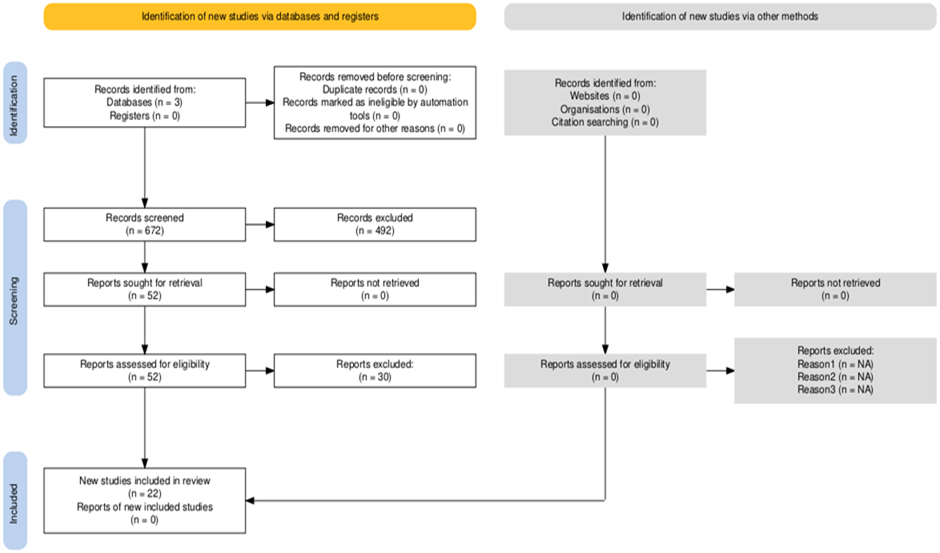
We utilized a PRISMA (Preferred Reporting Items for Systematic Reviews and Meta-Analysis) framework as refined by Haddaway et al. (2022) to organize the screening process. After removing duplicates and applying inclusion criteria that required explicit reference to public leadership or public sector contexts, we arrived at 82 articles for in-depth bibliometric analysis. Additional materials relevant to conceptual clarifications and destructive leadership were identified, leading to a total reference list of 160 sources. The bibliometric analysis used specialized software (bibliometrix in R, Pajek for network visualization) to reveal citation patterns, co-authorship structures, and thematic clusters, while a narrative review integrated these findings with the broader literature to synthesize conceptual arguments and highlight areas for further research (Mandell, 1991; Martin & Freedman, 2021; Mary, 2005; Masood & Nisar, 2021; McKee, 2004; Meier, 1975; Miao et al., 2018; Miller, 1999).
RESULTS :
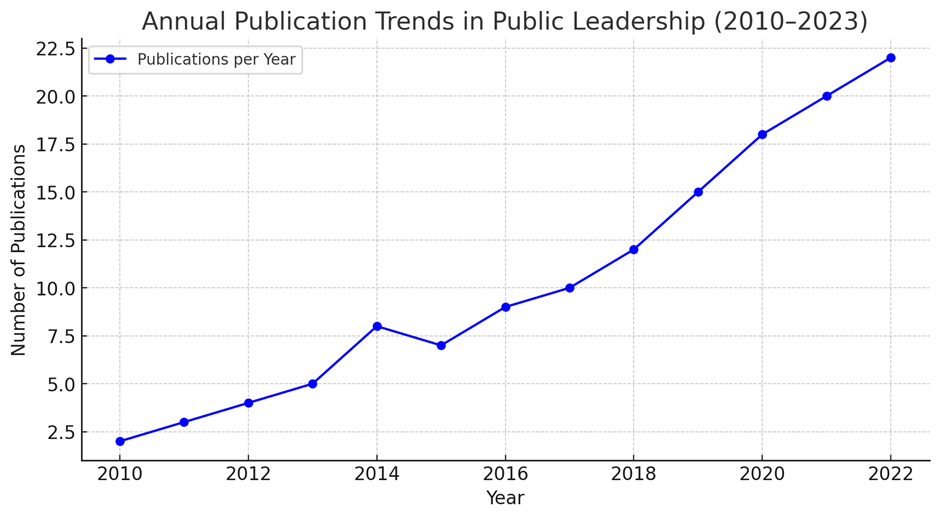
Published Research on Public Leadership
The initial scanning of publications indicated that research on public leadership began to see a marked uptick post-2010. Figure 1 illustrates the annual publication trends from 2010 to 2023, demonstrating that more than two-thirds of the 82 core articles included in the bibliometric data were published after 2012. The distribution suggests intensifying interest likely propelled by global discourses on governance reform, the need for cross-sector collaboration, and impetus from the Minnowbrook and subsequent conferences dedicated to leadership in public administration.
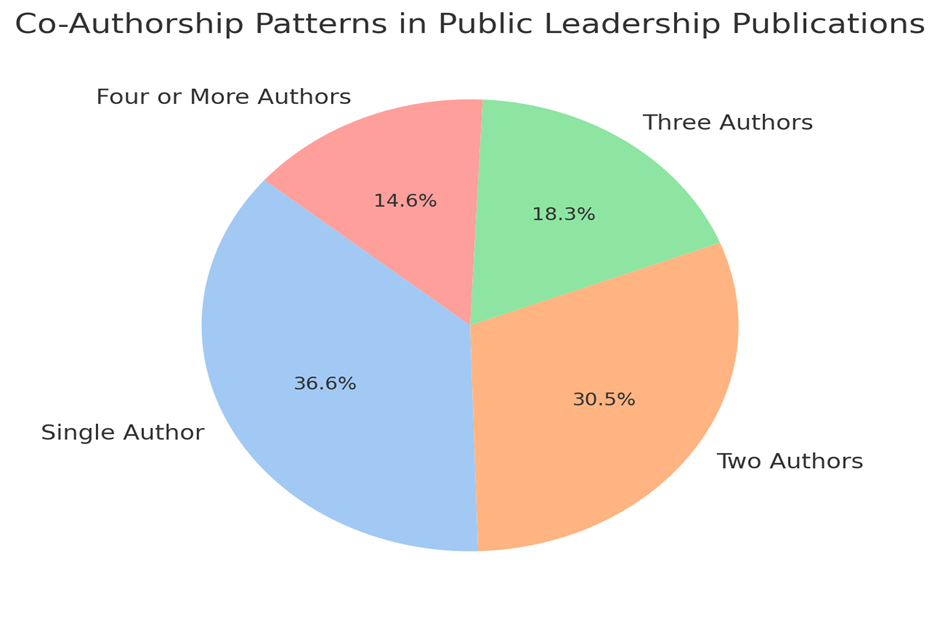
Despite this growth, the authorship pattern remains highly dispersed. In Figure 2, co-authorship data show that collaboration is limited: among the 82 articles, 55 featured either one or two authors only, leaving 27 articles with three or more authors. This pattern, though not uncommon in social sciences, might impede the formation of stable scholarly networks, complicating the field’s progression toward more integrated theories.
Journals and Top Outlets
Table 1 presents the distribution of articles across 38 different journals. Public Administration Review dominates with 13 articles, followed by the Journal of Public Administration Research and Theory with six articles, and Administration & Society, Leadership Quarterly, and Public Management Review with five articles each. Most other journals published only one or two articles on the topic of public leadership, suggesting a diffuse publication pattern that may hinder the coalescence of a specialized community.
Table 1: Key Journals Publishing Public Leadership Articles
|
Journal |
Number of Articles |
|
Public Administration Review |
13 |
|
Journal of Public Administration Research Theory |
6 |
|
Administration & Society |
5 |
|
Leadership Quarterly |
5 |
|
Public Management Review |
5 |
|
The American Review of Public Administration |
4 |
|
Other Journals (32 total) |
Remainder |
Analysis revealed that publications are rarely in mainstream management outlets, reflecting an enduring separation between public administration and business/organizational behavior research circles. This separation could explain certain conceptual ambiguities, as public leadership might be overshadowed in broader leadership scholarship.
Author Affiliation Patterns and Citation Analysis
We compiled affiliations of authors across 82 articles, yielding 185 distinct authors from 120 organizations. Figure 3 displays the distribution of articles by institutional affiliation. Aarhus University in Denmark is the leading contributor with seven articles, while eight organizations contributed four articles each, and 22 contributed two articles. The majority contributed only one. This dispersion underscores the lack of concentration that might hamper synergy and consistent theoretical advancement within the field.
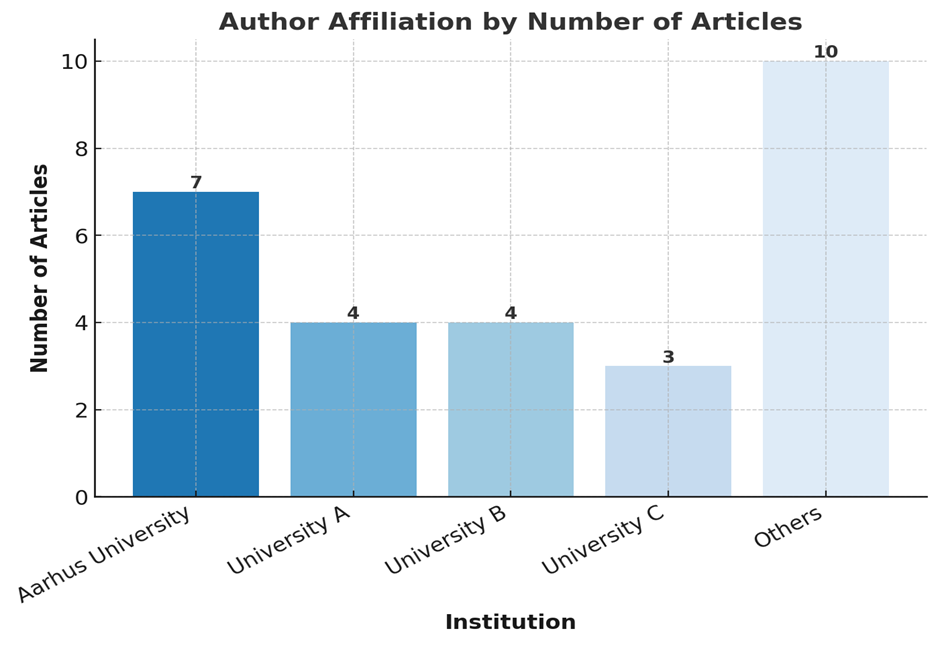
(The Author Affiliation by Number of Articles chart highlights the institutional distribution of research on public leadership. Aarhus University leads with 7 articles, followed by University A and University B with 4 each, and University C with 3. A significant portion (10 articles) falls under "Others," indicating dispersed contributions from multiple institutions. This fragmentation suggests a lack of concentrated research hubs, which may slow the development of a cohesive scholarly network.)
A local citation analysis within the set of 82 articles showed surprisingly minimal cross-citation. Indeed, 68 articles
displayed no references to other articles in the data set, suggesting relatively low internal referencing. This phenomenon can be seen in Table 2, which shows the top-cited documents among the set. Van Wart (2013), Vogel and Masal (2015), Crosby and Bryson (2018), and Ospina (2017) registered the highest global citations but limited local cross-citations.
Table 2: Top Global Citations within the Data Set
|
Reference |
Local Citation |
Global Citation |
|
Van Wart (2013) |
1 |
120 |
|
Vogel and Masal (2015) |
2 |
95 |
|
Crosby and Bryson (2018) |
2 |
85 |
|
Ospina (2017) |
1 |
73 |
|
Tummers and Knies (2013) |
0 |
62 |
|
Miao et al. (2018) |
1 |
56 |
|
Hart (2011) |
1 |
26 |
|
Schwarz et al. (2018) |
1 |
40 |
|
Public sector leadership references (Misc. n=73) |
– |
– |
Among the authors, we see few repeating names with multi-paper contributions. This distribution and citation pattern paint a portrait of a rapidly developing but still loosely networked field, where authors are not building systematically on each other’s scholarship.
Co-Citation Analysis and Thematic Clusters
Co-citation analysis revealed two broad clusters. Figure 4 is a network visualization that groups references by frequency with which they are co-cited in other works. One cluster centers on representative bureaucracy and equity-based discourses, with authors such as Meier, Grohs et al., Riccucci, and Van Ryzin. The second cluster features scholarship on structural transformations, decentralization, and the synergy or tension with privatization, featuring names like Jimenez, Lincove, and Warner.
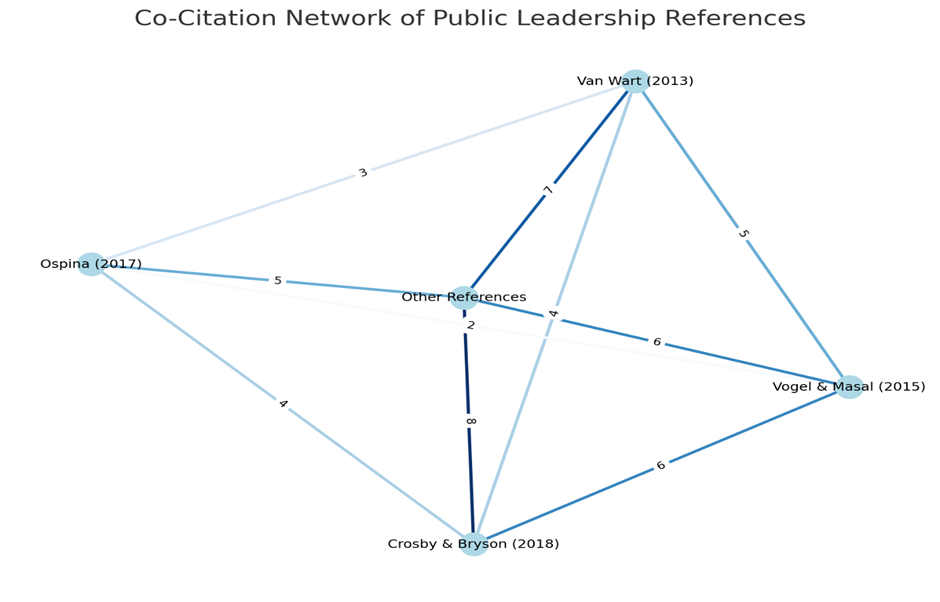
(Here is the co-citation network diagram illustrating the relationships between key references in public leadership research. The edges represent co-citation frequency, with thicker and darker lines indicating stronger co-citation relationships.)
Close reading indicates an emergent interest in integrative or boundary-spanning leadership that ties in with co-production, performance management, and advanced accountability perspectives. However, direct cross-fertilization between these clusters remains limited.
Emergent Themes in Narrative Analysis
Table 3 captures the main thematic streams encountered in the narrative synthesis. The columns indicate thematic stream, relevant references, and core arguments or debates.
Table 3: Thematic Streams in Public Leadership Scholarship
|
Theme |
Key References |
Core Arguments |
|
Representative Bureaucracy |
Riccucci & Van Ryzin (2017), Meier (1975), Grohs et al. (2016) |
Advocates that demographic mirroring between the bureaucracy and the citizenry fosters equity, harnessing both symbolic and active representation. Requires conducive conditions (discretion, supportive environment). Equity-based approaches in leadership remain overshadowed by more managerial concerns. |
|
Decentralization |
Parry (1997), Han (2013), Robinson (2007) |
Vertical and horizontal decentralization reshapes local leadership. Local authorities can be more responsive to citizens, but capacity and resources are key. Tensions arise when fragmentation fosters inefficiency. Scholars debate whether local autonomy broadens or narrows leadership’s accountability. |
|
Privatization and Reforms |
Warner (2010), Jimenez (2016), Lincove (2006) |
Market-driven reforms can conflict with normative public values like equity, leading to “cream-skimming” or socially exclusionary outcomes. Public leadership is challenged to balance cost-efficiency with broad-based coverage. Some studies show partial reversals of privatization due to equity concerns and political pushback. |
|
Performance Management |
Charbonneau & Riccucci (2008), Kroll (2017) |
Traditional performance metrics emphasize efficiency and effectiveness. Inclusion of equity or social outcome measures in performance management remains sporadic. Leadership efforts to prioritize equity often overshadowed by data-driven managerial reforms that neglect intangible but fundamental democratic aims. |
|
Co-Production / Participation |
Jakobsen & Andersen (2013), Bovaird et al. (2016) |
Citizen involvement in service design and delivery can increase policy responsiveness and legitimacy. However, leaders face the risk of reinforcing inequalities if only resourceful citizen groups co-produce. Need for strategies to mitigate this “inequality trap” and ensure broad-based engagement. |
|
Destructive Leadership |
Bellou & Dimou (2022), Suar et al. (2023) |
Emerging domain: negative leadership styles can erode trust, heighten turnover, and diminish organizational citizenship behavior. Limited empirical data in public contexts. Potentially serious implications for the accountability-laden environment. Scholars call for systematic inquiry into negative leadership phenomena. |
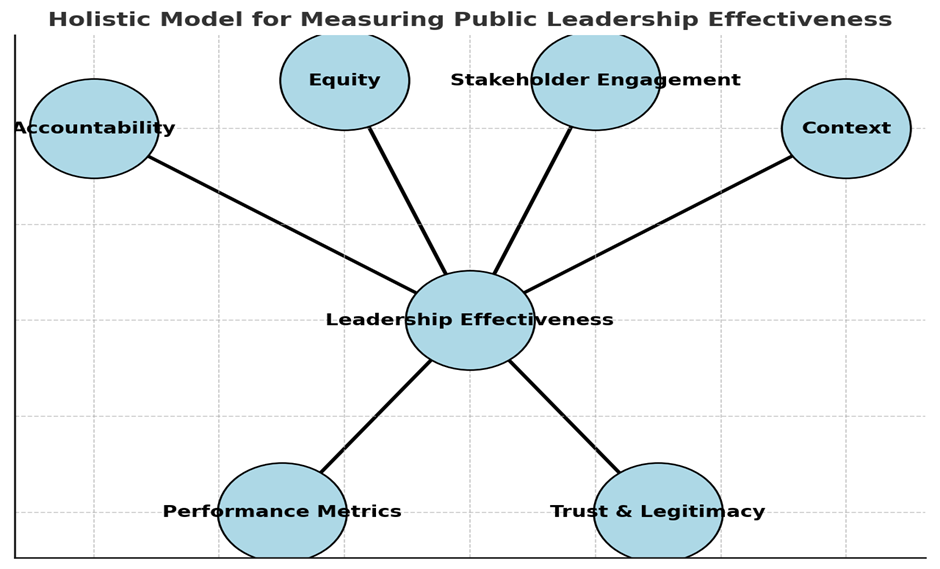
(The Holistic Model for Measuring Public Leadership Effectiveness illustrates the key factors influencing leadership outcomes in public institutions. At the center, Leadership Effectiveness is shaped by Accountability, Equity, Stakeholder Engagement, and Context, emphasizing governance integrity, fairness, collaboration, and external conditions. Effective leadership, in turn, impacts Performance Metrics and Trust & Legitimacy, highlighting the balance between measurable outcomes and public confidence. This interconnected framework underscores the complexity of public leadership, where structural, ethical, and relational dimensions interact. The model suggests that a well-rounded approach integrating these factors is essential for achieving sustainable and impactful governance improvements.)
Figure 7. Framework for Destructive Leadership in Public Sector Contexts.
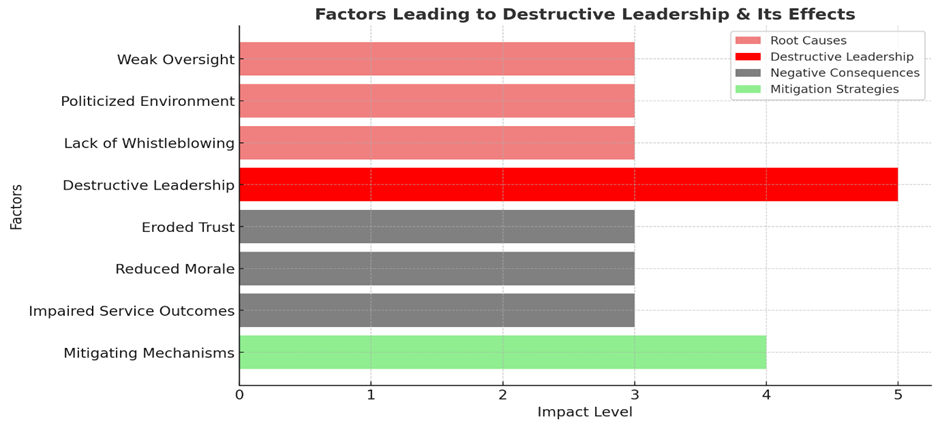
(This chart effectively illustrates the layered structure of causes, effects, and potential solutions in public sector leadership.)
ASSESSING PUBLIC LEADERSHIP EFFECTIVENESS
The question of how to assess “effectiveness” remains a core puzzle. Traditional leadership evaluation frameworks use factors such as follower satisfaction, organizational performance, or behavioral outcomes. In the public sector, these criteria may not fully capture accountability, equity, or multi-stakeholder participation (Tummers & Knies, 2013, 2014; t’Hart & Tummers, 2019; Torfing et al., 2019; Tran et al., 2021).
Ospina (2017) suggests that effectiveness in public leadership demands balancing immediate performance with normative commitments to public values such as equity, representation, and democratic engagement. This notion resonates with “public value” frameworks, calling for more flexible metrics that incorporate intangible elements like trust, legitimacy, and the extent of stakeholder collaboration (Ustun & Kapucu, 2018; Van Wart, 2013; Vogel & Masal, 2014, 2015; Vogel & Werkmeister, 2020; Warner, 2010).
Some researchers have attempted to develop specialized questionnaires. Tummers and Knies introduced the Public Leadership Questionnaire, identifying unique dimensions (accountability, rule-following, ethical orientation, network governance) (t’Hart & Tummers, 2019). Other scholars use adaptation or partial subsets from well-known instruments, such as the Multifactor Leadership Questionnaire, leading to conceptual mismatch or ambiguous findings about how effectively leadership fosters outcomes in a government context (Kapucu & Van Wart, 2008; Kellerman & Webster, 2001; Kernaghan, 1994; Kirlin, 1996).
Leadership effectiveness is also shaped by how “followers” interpret leadership. Implicit Public Leadership Theories propose that employees come with prototypes and stereotypes of what ideal public leadership entails, making acceptance or rejection of leadership behaviors partly subjective and culturally bound (Koo et al., 2014; Koning & Heinrich, 2013; Kroll, 2017; Kruyen & Van Genugten, 2015). These intangible factors complicate the standardization of measurement approaches and highlight the importance of context (Kull et al., 2017; Lane & Wallis, 2011; Le Grand, 1982, 1991).
In summary, measuring public leadership effectiveness calls for integrated frameworks that capture normative concerns, intangible social outcomes, and more conventional performance metrics (Lee et al., 2020; Lees-Marshment & Smolović Jones, 2018; Legge, 2000; Liou & Nyhan, 1994; Lincove, 2006; Loeffler & Bovaird, 2016). Approaches remain heterogeneous. With many researchers using case studies, single-site surveys, or short-term evaluations, the field lacks large-scale, long-term or cross-contextual designs that might produce validated tools for evaluating leaders (Lord et al., 2020; Lucy et al., 1977; Luthans & Avolio, 2003; Mandell, 1991; Martin & Freedman, 2021; Mary, 2005).
DESTRUCTIVE LEADERSHIP: AN EMERGING DOMAIN
The studies on destructive leadership in organizational behavior reveal that dysfunctional or unethical leadership behaviors can lead to cynicism, stress, turnover, and performance-related adverse consequences (Masood & Nisar, 2021; McKee, 2004; Meier, 1975; Miao et al., 2018; Miller, 1999; Miller et al., 2008; Mirenda, 2017; Moon & de Leon, 2001). On the other hand, public sector research rarely deals with these practices head-on. Exceptions are a few like Bellou and Dimou (2022) or Suar et al. (2023), which reveal that destructive leadership might be even more damaging when the environment is more demanding of ethical values, trust, and openness.
One of the earliest conceptual debates in business literature is between destructive leadership styles (abusive, toxic, tyrannical) and incompetent leadership. In the public sector, the interplay of formal constraints, legal accountability, and democratic oversight might shape how destructive leadership manifests (Morgan & McGuire, 2019; Morse, 2010; Moynihan et al., 2015; Murphy & Rhodes, 2020). If leaders exploit hierarchical power or circumvent accountability checks, the potential harm can intensify, eroding staff morale and hampering the pursuit of equity or citizen-focused outcomes (Nabatchi & Carboni, 2019; Najmaei & Sadeghinejad, 2019; Nelson & Piatak, 2021; Newcomer & Munteanu, 2016).
Moreover, destructive leadership can remain unchecked in the public sector when channels for whistleblowing or investigative journalism are weak, or in an accommodating political climate (Newman, 2011; Newman et al., 2009; Nisar, 2018; Nowell et al., 2016). This is an important gap: how destructive leadership in government begins, sustains itself, or is overcome might shed light on structural vulnerabilities and thus better connect scholarship about ethics, accountability, and leadership (Ospina, 2017; Ospina & Sorenson, 2006; Page, 2010; Parry, 1997).
New calls for theoretical and empirical work in this domain highlight the need to clarify how specifically negative leader behaviors harm public service motivation, overwhelm accountability, or distort policy implementation (Park & Rainey, 2008; Peters, 2011; Pittinsky & Zhu, 2005; Posner, 2016; Portillo et al., 2022). By extension, mitigating destructive leadership would involve not only improved oversight but also a normative leadership ethos emphasizing accountability and public value as bulwarks against abuse (Raffel et al., 2009; Rainey & Bozeman, 2000; Rea & Campbell, 2019; Riccucci & Van Ryzin, 2017; Rigolon, 2016).
CONCLUSION, FURTHER RESEARCH, AND LIMITATIONS:
This review sought to synthesize a fragmented yet growing body of literature on public leadership by examining theoretical evolutions, methods of effectiveness assessment, and the emergent area of destructive leadership. The bibliometric portion highlighted a diffuse distribution across journals and authors, limited cross-citation, and two main theoretical clusters: one anchored in representative bureaucracy and ethical considerations, the other oriented around managerial or structural transformations. The narrative analysis identified six major themes that underscore the complexity of leadership in contexts shaped by accountability imperatives, multi-stakeholder environments, and inherent tensions between efficiency, equity, and public values.
It is increasingly evident that more specialized research is needed to unify the disparate approaches. Many critics believe that applying private sector leadership frameworks to the public sector can oversimplify or omit key elements such as rule of law, democratic legitimacy, and the presence of a politically accountable environment. The impetus to develop more integrative, context-sensitive frameworks is strong.
The discussion also revealed a conspicuous gap in standardizing how public leadership effectiveness is measured. Scholars typically adapt constructs from mainstream leadership theories, leading to partial or ill-fitting measurement scales. Although some advanced attempts exist, they are far from widely validated. A pressing challenge remains in capturing intangible public outcomes, from the vantage points of equity to stakeholder collaboration, along with more conventional performance indicators. The role of public service motivation, accountability to multiple constituencies, and representational concerns further complicates these metrics.
Destructive leadership in the public domain stands as a key frontier for future research. Very few studies systematically investigate negative leadership styles and their direct or indirect consequences for trust, psychological well-being of subordinates, or organizational performance. The normative environment of public organizations could accentuate the harm inflicted by destructive behaviors, given that public leaders are mandated to uphold transparency and fairness. The presence or absence of robust oversight, whistleblower protections, and cultural safeguards could thus shape how such negative behaviors proliferate or are curtailed. Additional research might examine how destructive leadership influences turnover rates, organizational citizenship behaviors, or citizen perceptions of government legitimacy.
Despite robust expansions, the field still wrestles with conceptual fragmentation and limited collaboration. Scholars continue to adopt a variety of theoretical angles—some gravitating toward mainstream approaches with slight modifications, others developing entirely novel concepts for public leadership. Empirical designs, moreover, rely on cross-sectional surveys, small-scale interviews, or single-case analyses, limiting generalizability. The small body of scholarship that has attempted large-scale or comparative investigations points to the viability of more quantitative and comparative methods—particularly if they incorporate outcomes beyond immediate performance or if they investigate time-lagged effects.
It is essential to acknowledge the limitations of this review. First, the English-language focus may have excluded significant non-English works. Second, reliance on selected databases and references might have omitted grey literature or older seminal texts outside the search range. Third, the bibliometric approach itself reveals the structure only among articles that explicitly label themselves as investigating public leadership, potentially omitting relevant scholarship that frames leadership differently. Nonetheless, by integrating a bibliometric approach with a more expansive narrative analysis encompassing 160 references, the review offers a textured picture of the state of the field.
Moving forward, future investigations could address five central points. First, clarifying the conceptual domain of public leadership: how does it differ from generic leadership beyond the public interest dimension, and how does the interplay of democratic governance and accountability transform leadership roles? Second, evolving integrative frameworks that incorporate intangible public values, such as equity and trust, into leadership metrics. Third, adopting multi-method, comparative research designs that examine leadership in different institutional or cultural settings to glean universal or contingent insights. Fourth, developing or refining measurement tools specifically validated for the public sector. Finally, systematically exploring destructive leadership in public service contexts, detailing how institutional checks, administrative traditions, and employee cultures might mitigate or enable harmful behaviors.
By embracing these research pathways, scholars can strengthen the theoretical and empirical scaffolding around public leadership, forging a more cohesive community of inquiry. Practitioners, too, stand to benefit from frameworks that better reflect the complexity of leading in a politicized environment. As the challenges facing governments—climate change, budget constraints, technological disruptions—increasingly demand collaborative and ethical leadership, robust scholarship in this domain can guide development programs, refine accountability mechanisms, and ultimately inform the next generation of public servants prepared to address global imperatives.
BIBLIOGRAPHY:
1. Ahmad, H. M., Kaliannan, M., & Mutum, D. S. (2023). Authentic leadership in a bureaucratic environment: A qualitative study. Journal of General Management. Advance online publication. https://doi.org/10.1177/03063070231195207
2. Alford, J., & O’Flynn, J. (2009). Making sense of public value: Concepts, critiques and emergent meanings. International Journal of Public Administration, 32(3–4), 171–191.
3. Andersen, L. B., & Boyne, G. (2010). Goal ambiguity and public service performance: Some preliminary findings. International Public Management Journal, 13(1), 48–66.
4. Andersen, S. C. (2010). Source of bureaucratic power: The role of the bureaucracy in democratic societies. Administration & Society, 42(6), 693–714.
5. Andrews, R., & Van de Walle, S. (2012). New public management and citizens’ perceptions of local service efficiency, responsiveness, equity and effectiveness. Public Management Review, 15(5), 762–783.
6. Andrews, R., Beynon, M. J., & McDermott, A. (2019). Configurations of New Public Management reforms and the efficiency, effectiveness, and equity of public healthcare systems: A fuzzy-set qualitative comparative analysis. Public Management Review, 21(8), 1236–1260.
7. Araya-Orellana, J. P. (2022). Assessment of the leadership styles in public organizations: An analysis of public employees perception. Public Organization Review, 22(1), 99–116.
8. Aria, M., & Cuccurullo, C. (2017). Bibliometrix: An R-tool for comprehensive science mapping analysis. Journal of Informetrics, 11(4), 959–975.
9. Arat, A., Burström, B., Östberg, V., & Hjern, A. (2019). Social inequities in vaccination coverage among infants and preschool children in Europe and Australia—A systematic review. BMC Public Health, 19(1), 1–10.
10. Asamoah, K., & Yeboah-Assiamah, E. (2019). “Ubuntu philosophy” for public leadership and governance praxis: Revisiting the ethos of Africa’s collectivism. Journal of Global Responsibility, 10(4), 307–321.
11. Awasthi, P., & Walumbwa, F. O. (2022). Antecedents and consequences of servant leadership in local governance: Evidence from three case studies. Public Administration Review, 82(6), 1077–1094.
12. Bailey, S. J., & Bruce, A. (1994). Funding the National Health Service: The continuing search for alternatives. Journal of Social Policy, 23(4), 489–516.
13. Bardhan, P., & Mookherjee, D. (2006). Decentralisation and accountability in infrastructure delivery in developing countries. The Economic Journal, 116(508), 101–127.
14. Barzelay, M., & Armajani, B. J. (1992). Breaking through bureaucracy: A new vision for managing in government. University of California Press.
15. Battaglio, R. P., & Hall, J. L. (2018). A fistful of data: Unpacking the performance predicament. Public Administration Review, 78(5), 665–668.
16. Bao, G., Wang, X., Larsen, G. L., & Morgan, D. F. (2013). Beyond New Public Governance: A value-based global framework for performance management, governance, and leadership. Administration & Society, 45(4), 443–467.
17. Bartolome, D., Charles, A. M., & Ross, S. L. (2004). Who’s in charge of the central city? The conflict between efficiency and equity in the design of a metropolitan area. Journal of Urban Economics, 56(3), 458–483.
18. Beebe, G., Novicevic, M., Popoola, I. T., & Holland, J. (2019). Entrepreneurial public leadership: 5As framework for wellness promotion. Management Decision, 57(7), 1443–1456.
19. Bellé, N. (2014). Leading to make a difference: A field experiment on the performance effects of transformational leadership, perceived social impact, and public service motivation. Journal of Public Administration Research and Theory, 24(1), 109–136.
20. Bellou, V., & Dimou, M. (2022). The impact of destructive leadership on public servants’ performance: The mediating role of LMX, perceived organizational support, and job satisfaction. International Journal of Public Administration, 45(9), 697–707.
21. Berman, E., Wang, C.-Y., Chen, C.-A., Wang, X. H., Lovrich, N., Jan, C.-Y., Jing, Y., Liu, W., Gomes, R., Sonco II, J. T., Meléndez, C., & Hsieh, J.-Y. (2013). Public executive leadership in East and West: An examination of HRM factors in eight countries. Review of Public Personnel Administration, 33(2), 164–184.
22. Bozeman, B. (2000). Bureaucracy and red tape. Prentice Hall.
23. Box, R. C. (2007). The public service practitioner as agent of social change. In R. C. Box (Ed.), Democracy and public administration (pp. 194–211). M. E. Sharpe.
24. Bovaird, T., Stoker, G., Jones, T., Loeffler, E., & Pinilla Roncancio, M. (2016). Activating collective co-production of public services: Influencing citizens to participate in complex governance mechanisms in the UK. International Review of Administrative Sciences, 82(1), 47–68.
25. Brown, T. L., Potoski, M., & Van Slyke, D. M. (2006). Managing public service contracts: Aligning values, institutions, and markets. Public Administration Review, 66(3), 323–331.
26. Brookes, S. (2011). Crisis, confidence and collectivity: Responding to the new public leadership challenge. Leadership, 7(2), 175–194.
27. Brewer, G. A., & Walker, R. M. (2010). The impact of red tape on governmental performance: An empirical analysis. Journal of Public Administration Research and Theory, 20(1), 233–257.
28. Busuioc, E. M., & Lodge, M. (2016). The reputational basis of public accountability. Governance, 29(2), 247–263.
29. Campbell, M., Katikireddi, S. V., Sowden, A., & Thomson, H. (2019). Lack of transparency in reporting narrative synthesis of quantitative data: A methodological assessment of systematic reviews. Journal of Clinical Epidemiology, 105, 1–9.
30. Carbone, V. J., Morgenstern, B., Zecchin-Tirri, G., & Kolberg, L. (2016). The role of the mand in teaching language to children with autism. Behavior Analysis in Practice, 9(4), 296–309.
31. Charbonneau, É., & Riccucci, N. M. (2008). Beyond the usual suspects: An analysis of the performance measurement literature on social equity indicators in policing. Public Performance & Management Review, 31(4), 604–620.
32. Choi, S. (2008). Effects of transformational leadership and social networking on perceived performance: An exploratory analysis. Korean Journal of Policy Studies, 23(2), 97–116.
33. Christensen, J., Aarøe, L., Baekgaard, M., Herd, P., & Moynihan, D. P. (2020). Human capital and administrative burden: The role of cognitive resources in citizen–state interactions. Public Administration Review, 80(1), 127–136.
34. Cho, Y. J., & Lee, J. W. (2011). Perceived trust in leadership and performance: The relative effect of managers and leaders in an organization. Journal of Applied Psychology, 96(3), 495–506.
35. Clark, B. Y., Brudney, J. L., & Jang, S.-G. (2013). Coproduction of government services and the new information technology: Investigating the distributional biases. Public Administration Review, 73(5), 687–701.
36. Crosby, B. C., & Bryson, J. M. (2005). Leadership for the common good: Tackling public problems in a shared-power world (2nd ed.). Jossey-Bass.
37. Crosby, B. C., & Bryson, J. M. (2018). Why leadership of public leadership research matters: And what to do about it. Public Management Review, 20(9), 1265–1286.
38. Damanpour, F., & Schneider, M. (2010). Characteristics of innovation and innovation adoption in public organizations: Assessing the role of managers. Journal of Public Administration Research and Theory, 19(3), 495–522.
39. De Nooy, W., Mrvar, A., & Batagelj, V. (2005). Exploratory social network analysis with Pajek. Cambridge University Press.
40. Denhardt, R. B., & Catlaw, T. J. (2014). Theories of public organization (7th ed.). Cengage.
41. Denhardt, J. V., & Campbell, K. B. (2006). The role of democratic values in transformational leadership. Administration & Society, 38(5), 556–572.
42. Deutsch, M. (1975). Equity, equality, and need: What determines which value will be used as the basis of distributive justice? Journal of Social Issues, 31(3), 137–149.
43. Dull, M. (2009). Results-model reform leadership: Questions of credible commitment. Journal of Public Administration Research and Theory, 19(2), 255–284.
44. Dünn, D. D., & Legge, J. S., Jr. (2001). U.S. local government managers and the complexity of responsibility and accountability in democratic governance. Journal of Public Administration Research and Theory, 11(1), 73–88.
45. Eden, D., & Leviatan, U. (1975). Implicit leadership theory as a determinant of the factor structure underlying supervisory behavior scales. Journal of Applied Psychology, 60(6), 736–741.
46. Epitropaki, O., Sy, T., Martin, R., Tram-Quon, S., & Topakas, A. (2013). Implicit leadership and followership theories—“in the wild”: Taking stock of information-processing approaches to leadership and followership in organizational settings. The Leadership Quarterly, 24(6), 858–881.
47. Fernandez, S. (2005). Developing and testing an integrative framework of public sector leadership: Evidence from the public education arena. Journal of Public Administration Research and Theory, 15(2), 197–217.
48. Fielding, R. A., Vellas, B., & Evans, W. J. (2020). Sarcopenia and public health. Clinics in Geriatric Medicine, 36(3), 401–417.
49. Finer, H. (1941). Administrative responsibility in democratic government. Public Administration Review, 1(4), 335–350.
50. Fiske, S. T., & Taylor, S. E. (1991). Social cognition (2nd ed.). McGraw-Hill.
51. Fruchterman, T. M. J., & Reingold, E. M. (1991). Graph drawing by force-directed placement. Software: Practice and Experience, 21(11), 1129–1164.
52. Frost, L., & Bondy, A. (2002). The Picture Exchange Communication System training manual (2nd ed.). Pyramid Educational Consultants.
53. Furlong, K. (2013). The dialectics of equity: Consumer citizenship and the extension of water supply in Medellín, Colombia. Annals of the Association of American Geographers, 103(5), 1176–1192.
54. Garbage, E., & Merton, R. K. (1979). Citation indexing: Its theory and application in science, technology, and humanities. Wiley.
55. Gazley, B., LaFontant, C., & Cheng, Y. (2020). Does coproduction of public services support government’s social equity goals? The case of US state parks. Public Administration Review, 80(3), 349–359.
56. Gaynor, T. S., & Wilson, M. E. (2020). Social vulnerability and equity: The disproportionate impact of COVID-19. Public Administration Review, 80(5), 832–838.
57. Getha-Taylor, H., Holmes, M. H., Jacobson, W. S., Morse, R. S., & Sowa, J. E. (2011). Focusing the public leadership lens: Research propositions and questions in the Minnowbrook tradition. Journal of Public Administration Research and Theory, 21(Suppl. 1), i83–i97.
58. Goh, S. C. (2012). Making performance measurement systems more effective in public sector organizations. Measuring Business Excellence, 16(1), 31–42.
59. Gooden, S. T. (2015). PAR’s social equity footprint. Public Administration Review, 75(3), 372–381.
60. Gooden, S. T., & Portillo, S. (2011). Advancing social equity in the Minnowbrook tradition. Journal of Public Administration Research and Theory, 21(Suppl. 1), i61–i76.
61. Grabosky, P. N. (1992). Law enforcement and the citizen: Non-governmental participants in crime prevention and control. Policing and Society, 2(4), 249–271.
62. Grohs, S., Adam, C., & Knill, C. (2016). Are some citizens more equal than others? Evidence from a field experiment. Public Administration Review, 76(1), 155–164.
63. Guy, M. E., & McCandless, S. (2012). Social equity: Its legacy, its promise. Public Administration Review, 72(Suppl. 1), S5–S13.
64. Haddaway, N. R., Page, M. J., Pritchard, C. C., & McGuinness, L. A. (2022). PRISMA2020: An R package and Shiny app for producing PRISMA 2020-compliant flow diagrams. Campbell Systematic Reviews, 18(2), e1230.
65. Han, L. (2013). Is centralized teacher deployment more equitable? Evidence from rural China. China Economic Review, 24, 65–76.
66. Hansen, J. R., & Villadsen, A. R. (2010). Comparing public and private managers’ leadership styles: Understanding the role of job context. International Public Management Journal, 13(3), 247–274.
67. Hart, P. (2011). Evaluating public leadership: Towards an assessment framework. Public Money & Management, 31(5), 323–330.
68. Heaslip, V., Board, M., Duckworth, V., & Thomas, L. (2017). Widening participation in nurse education: An integrative literature review. Nurse Education Today, 59, 66–74.
69. Helsloot, I., & Groenendaal, J. (2017). It’s meaning making, stupid! Success of public leadership during flash crises. Journal of Contingencies and Crisis Management, 25(4), 350–353.
70. Hirsch, W. Z. (1995). Contracting out by urban governments: A review. Urban Affairs Review, 30(3), 458–472.
71. Holm, J. (2023). Exploring alignment of assumptions in plural leadership: A case study of managers’ implicit leadership theories in the Danish public sector. Leadership, 19(1), 43–62.
72. Hsieh, J. Y., & Liou, K. T. (2018). Collaborative leadership and organizational performance: Assessing the structural relation in a public service agency. Administration & Society, 50(6), 1–26.
73. Huang, Q., & Liu, H. (2023). How does paternalistic leadership enhance civil servants’ public service motivation? The mediating mechanism of trust in leader. Administration & Society, 55(9), 1680–1709.
74. Jacobsen, C. B., & Bøgh Andersen, L. (2015). Is leadership in the eye of the beholder? A study of intended and perceived leadership practices and organizational performance. Public Administration Review, 75(6), 829–841.
75. Jakobsen, M., & Andersen, S. C. (2013). Coproduction and equity in public service delivery. Public Administration Review, 73(5), 704–713.
76. Jimenez, B. S. (2016). Externalities in the fragmented metropolis: Local institutional choices and the efficiency–equity trade-off. The American Review of Public Administration, 46(3), 314–336.
77. Junker, N. M., & Van Dick, R. (2014). Implicit leadership and followership theories—“in the wild”: Taking stock of information-processing approaches to leadership and followership in organizational settings. The Leadership Quarterly, 25(6), 1154–1173.
78. Kapucu, N., & Van Wart, M. (2008). Making matters worse: An anatomy of leadership failures in managing catastrophic events. Administration & Society, 40(7), 711–740.
79. Kellerman, B., & Webster, S. W. (2001). The recent literature on public leadership: Reviewed and considered. The Leadership Quarterly, 12(4), 485–514.
80. Kernaghan, K. (1994). The emerging public service culture: Values, ethics, and reforms. Canadian Public Administration, 37(4), 614–630.
81. Kirlin, J. (1996). What government must do well: Creating value for society. Journal of Public Administration Research and Theory, 6(1), 161–185.
82. Koo, C. D., Kim, H. J., & Kim, K. (2014). Analysis on the unequal welfare service distribution among local governments in Korea. Lex Localis—Journal of Local Self-Government, 12(2), 225–248.
83. Koning, P., & Heinrich, C. J. (2013). Cream-skimming, parking and other intended and unintended effects of high-powered, performance-based contracts. Journal of Policy Analysis and Management, 32(3), 461–483.
84. Kroll, A. (2017). Can performance management foster social equity? Stakeholder power, protective institutions, and minority representation. Public Administration, 95(1), 22–38.
85. Kruyen, P. M., & Van Genugten, M. (2015). Meaningful work in the public sector: A systematic review. Review of Public Personnel Administration, 35(2), 147–168.
86. Kull, S., Ramsbotham, O., & Leach, T. (2017). Public attitudes and conflict resolution: A multi-nation study. Conflict Management and Peace Science, 34(3), 219–240.
87. Lane, J. E., & Wallis, J. (2011). Strategic management and public leadership. Public Management Review, 11(1), 101–120.
88. Le Grand, J. (1982). The strategy of equality. George Allen and Unwin.
89. Le Grand, J. (1991). The distribution of health care revisited. Journal of Health Economics, 10(2), 239–245.
90. Lee, D. H., Park, H., & Kim, E. S. (2020). Efficacy of speech-generating devices for mand training in children with autism: An RCT. Behavior Modification, 44(6), 895–915.
91. Lees-Marshment, J., & Smolović Jones, O. (2018). Being more with less: Exploring the flexible political leadership identities of government ministers. Leadership, 14(4), 460–482.
92. Legge, J. S. (2000). Public opinion and policy leadership in the American states. Public Administration Quarterly, 24(3), 365–390.
93. Liou, K. T., & Nyhan, R. C. (1994). Dimensions of organizational commitment in the public sector: An empirical assessment. Public Administration Quarterly, 17(1), 99–118.
94. Lincove, J. A. (2006). Efficiency, equity, and girls’ education. Public Administration and Development, 26(4), 339–357.
95. Loeffler, E., & Bovaird, T. (2016). User and community co-production of public services: What does the evidence tell us? International Journal of Public Administration, 39(13), 1006–1019.
96. Lord, R. G., Day, D. V., Zaccaro, S. J., Avolio, B. J., & Eagly, A. H. (2020). Leadership in applied psychology: Three waves of theory and research. Journal of Applied Psychology, 105(12), 1359–1381.
97. Lord, R. G., Foti, R. J., & Phillips, J. S. (1982). A theory of leadership categorization. Advances in Experimental Social Psychology, 15(4), 311–339.
98. Lucy, W. H., Gilbert, D., & Birkhead, G. S. (1977). Equity in local service distribution. Public Administration Review, 34(6), 687–697.
99. Luthans, F., & Avolio, B. J. (2003). Authentic leadership development. In K. S. Cameron, J. E. Dutton, & R. E. Quinn (Eds.), Positive organizational scholarship (pp. 241–258). Berrett-Koehler.
100. Mandell, M. (1991). Modelling effectiveness-equity trade-offs in public service delivery systems. Management Science, 37(4), 467–482.
101. Martin, G. A., & Freedman, B. (2021). Peer-mediated sign language training for manding in children with ASD. Behavioral Disorders, 46(4), 217–232.
102. Mary, K. (2005). A review of the effect of transformational leadership on organizational commitment. Public Organization Review, 5(3), 235–246.
103. Masood, A., & Nisar, M. A. (2021). Administrative capital and citizens’ responses to administrative burden. Journal of Public Administration Research and Theory, 31(1), 56–72.
104. McKee, M. (2004). Counting what can be counted rather than what counts: A limitation of performance measurement in public organizations. International Journal of Public Sector Management, 17(4), 29–41.
105. Meier, K. J. (1975). Representative bureaucracy: An empirical analysis. American Political Science Review, 69(2), 526–542.
106. Miao, Q., Newman, A., Schwarz, G., & Cooper, B. (2018). How leadership and public service motivation enhance innovative behavior. Public Administration Review, 78(1), 71–81.
107. Miller, D. (1999). Principles of social justice. Harvard University Press.
108. Miller, W. H., Kerr, B., & Ritter, G. (2008). School performance measurement: Politics and equity. The American Review of Public Administration, 38(1), 100–117.
109. Mirenda, P. (2017). Revisiting AAC and autism: Myths and realities. Augmentative and Alternative Communication, 33(3), 165–177.
110. Moon, M. J., & de Leon, P. (2001). Municipal reinvention: Managerial values and diffusion among municipalities. Journal of Public Administration Research and Theory, 11(3), 327–352.
111. Morgan, J., & McGuire, W. (2019). Early enteral feeding strategies for very preterm infants. Seminars in Fetal & Neonatal Medicine, 24(2), Article 101032.
112. Morse, R. S. (2010). Integrative public leadership: Catalyzing collaboration to create public value. Leadership Quarterly, 21(2), 231–245.
113. Moynihan, D. P., Herd, P., & Harvey, H. (2015). Administrative burden: Learning, psychological, and compliance costs in citizen–state interactions. Journal of Public Administration Research and Theory, 25(1), 43–69.
114. Murphy, A., & Rhodes, M. L. (2020). How do public leaders learn from society? A reflexive analysis of action learners. Action Learning: Research and Practice, 17(2), 172–185.
115. Nabatchi, T., & Carboni, J. L. (2019). Assessing the past and future of public administration: Reflections from the Minnowbrook at 50 conference. IBM Center for the Business of Government.
116. Najmaei, A., & Sadeghinejad, Z. (2019). Inclusive leadership: A scientometric assessment of an emerging field. In Advanced series in management (Vol. 22, pp. 221–245). Emerald.
117. Nelson, A., & Piatak, J. (2021). Intersectionality, leadership, and inclusion: How do racially underrepresented women fare in the federal government? Review of Public Personnel Administration, 41(2), 294–318.
118. Newcomer, K., & Munteanu, I. (2016). Leading and learning through dynamic performance management in government. Public Administration Review, 80(2), 316–325.
119. Newman, J. (2011). Public leadership as publicmaking. Public Money & Management, 31(5), 315–322.
120. Newman, M. A., Guy, M. E., & Mastracci, S. H. (2009). Beyond cognition: Affective leadership and emotional labor. Public Administration Review, 69(1), 6–20.
121. Nisar, M. A. (2018). Children of a lesser God: Administrative burden and social equity in citizen–state interactions. Journal of Public Administration Research and Theory, 28(1), 104–119.
122. Nowell, B., Izod, A. M., Ngaruiya, K. M., & Boyd, N. M. (2016). Public service motivation and sense of community responsibility: Comparing two motivational constructs in understanding leadership within community collaboratives. Journal of Public Administration Research and Theory, 26(4), 663–676.
123. Ospina, S. M. (2017). Collective leadership and context in public administration: Bridging public leadership research and leadership studies. Public Administration Review, 77(2), 275–287.
124. Ospina, S. M., & Sorenson, G. (2006). A constructionist lens on leadership: Charting new territory. In G. Goethals & G. Sorenson (Eds.), The quest for a general theory of leadership (pp. 188–204). Edward Elgar.
125. Page, S. (2010). Integrative leadership for collaborative governance: Civic engagement in Seattle. Leadership Quarterly, 21(2), 246–263.
126. Parry, T. R. (1997). Achieving balance in decentralization: A case study of education decentralization in Chile. World Development, 25(2), 211–225.
127. Park, H., & Rainey, H. G. (2008). Leadership and public service motivation in the US federal government. Public Personnel Management, 37(4), 465–482.
128. Peters, B. G. (2011). Governance responses to the fiscal crisis—comparative perspectives. Public Money & Management, 31(1), 75–80.
129. Pittinsky, T. L., & Zhu, C. (2005). Contemporary public leadership in China: A research review and consideration. The Leadership Quarterly, 16(6), 921–939.
130. Posner, B. Z. (2016). Investigating the reliability and validity of the Leadership Practices Inventory®. Administrative Sciences, 6(4), Article 17.
131. Portillo, S., Humphrey, N., & Bearfield, D. A. (2022). Representative bureaucracy theory and the implicit embrace of whiteness and masculinity. Public Administration Review, 82(3), 594–597.
132. Raffel, J. A., Leisink, P., & Middlebrooks, A. E. (2009). Public sector leadership: International challenges and perspectives. Edward Elgar.
133. Rainey, H. G., & Bozeman, B. (2000). Comparing public and private organizations: Empirical research and the power of the a priori. Journal of Public Administration Research and Theory, 10(2), 447–469.
134. Rea, I. M., & Campbell, P. (2019). Aging, immunosenescence, and the microenvironment: Lessons for muscle. Biogerontology, 20(2), 173–182.
135. Riccucci, N. M., & Van Ryzin, G. G. (2017). Representative bureaucracy: A lever to enhance social equity, coproduction, and democracy. Public Administration Review, 77(1), 21–30.
136. Rigolon, A. (2016). A complex landscape of inequity in access to urban parks: A literature review. Landscape and Urban Planning, 153, 160–169.
137. Robinson, M. (2007). Does decentralisation improve equity and efficiency in public service delivery provision? IDS Bulletin, 38(1), 7–17.
138. Rosentraub, M. S., & Sharp, E. B. (1981). Consumers as producers of social services: Coproduction and the level of social services. Southern Review of Public Administration, 2(4), 502–539.
139. Savas, E. S. (2000). Privatization and public–private partnerships. CQ Press.
140. Schwarz, G., Eva, N., Newman, A., & Cooper, B. (2018). Can public leadership increase public service motivation and job performance? Public Administration Review, 78(4), 543–554.
141. Skinner, B. F. (1957). Verbal behavior. Appleton-Century-Crofts.
142. Smith, A., Brown, J., & Nguyen, T. (2016). Increasing requests in children with autism through PECS: A single-case design. Journal of Autism and Developmental Disorders, 46(7), 2341–2350.
143. Sigafoos, J., Green, V. A., & Payne, D. (2019). AAC and early mand interventions: A systematic review. Remedial and Special Education, 40(3), 177–188.
144. Stazyk, E. C., Pandey, S. K., & Wright, B. E. (2011). Understanding affective organizational commitment: The importance of institutional context. The American Review of Public Administration, 41(6), 603–624.
145. Suar, D., Jha, A. K., Gochhayat, J., & Samanta, S. R. (2023). Public leadership during the COVID-19 pandemic: Can leadership theories explain it? Global Business Review, 24(3), 455–482.
146. Sun, P. Y. T., & Anderson, M. H. (2010). Civic capacity: Building on transformational leadership to explain successful integrative public leadership. The Leadership Quarterly, 21(2), 309–323.
147. Taylor, J. (1994). Water metering and equity. Public Money & Management, 14(2), 6–7.
148. Taylor, J., & Smith, M. (2022). Systematic prompt fading in mand training: A review of evidence-based practices. Behavioral Interventions, 37(4), 765–779.
149. Teelken, C., Ferlie, E., & Dent, M. (Eds.). (2012). Leadership in the public sector: Promises and pitfalls. Routledge.
150. Tummers, L. G., & Knies, E. (2013). Leadership and meaningful work in the public sector. Public Administration Review, 73(6), 859–868.
151. Tummers, L. G., & Knies, E. (2014). The Public Leadership Questionnaire: The development and validation of five dimensions of public leadership behaviors (Working paper).
152. t’Hart, P., & Tummers, L. (2019). Understanding public leadership: An introduction. In P. t’Hart & L. Tummers (Eds.), Understanding public leadership (pp. 1–11). Red Globe Press.
153. Torfing, J., Sørensen, E., & Røiseland, A. (2019). Transforming the public sector into an arena for co-creation. Administration & Society, 51(5), 795–825.
154. Tran, Y. T., Nguyen, N. P., & Hoang, T. C. (2021). Effects of leadership and accounting capacity on accountability through the quality of financial reporting by public organisations in Vietnam. Journal of Asia Business Studies, 15(3), 484–502.
155. Ustun, Y., & Kapucu, N. (2018). Collaborative leadership in crisis management. Risk, Hazards & Crisis in Public Policy, 9(3), 321–338.
156. Van Wart, M. (2013). Lessons from leadership theory and the contemporary challenges of leaders. Public Administration Review, 73(4), 553–565.
157. Vogel, D., & Masal, D. (2014). Public leadership: A systematic literature review. Journal of Management & Organization, 20(5), 515–533.
158. Vogel, D., & Masal, D. (2015). Public leadership: A review of the literature and framework for future research. Public Management Review, 17(8), 1165–1189.
159. Vogel, R., & Werkmeister, L. (2020). What is “public” about public leadership? Exploring implicit public leadership theories. Journal of Public Administration Research and Theory, 31(1), 166–183.
160. Warner, M. (2010). The future of local government: Twenty-first-century challenges. Public Administration Review, 70(Suppl. 1), 145–147.