Impact Of Structured Anesthesia Information Sheets On Preoperative Anxiety In Patients Undergoing Lower Abdominal Surgery: A Randomized Controlled Trial
- Annu kawre , sms medical college
- Sagar , sms medical college
- Anupama gupta , professor sms medical college
Article Information:
Abstract:
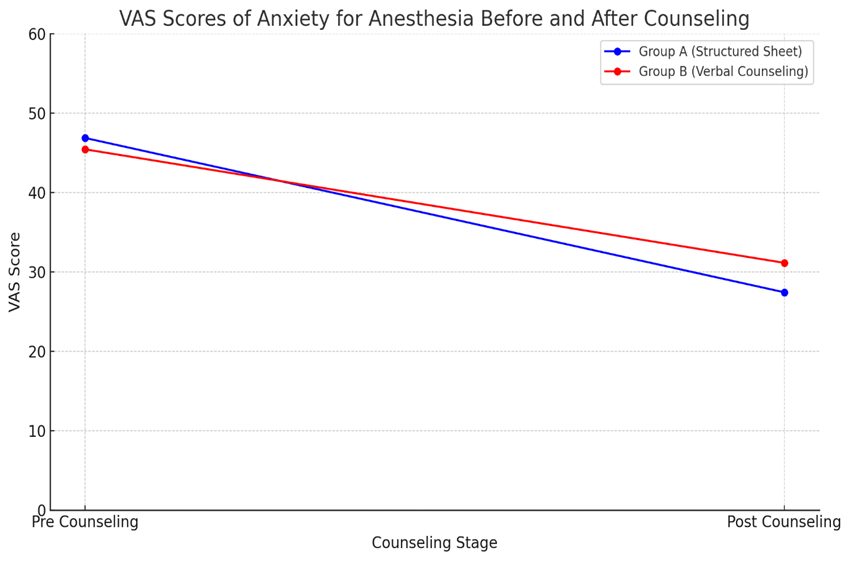
Background: Preoperative anxiety can negatively impact surgical outcomes and patient recovery. Structured counseling methods, such as anesthesia information sheets, may offer an effective strategy to reduce this anxiety more effectively than traditional verbal counseling. Methods: In this randomized controlled trial at SMS Medical College, 70 patients scheduled for lower abdominal surgery were assigned to receive either structured counseling using an anesthesia information sheet or conventional verbal counseling. Anxiety levels were assessed using the Visual Analogue Scale for Anxiety (VAS-A) before and after the intervention. Results: The structured counseling group (Group A) exhibited a greater reduction in VAS-A scores post-counseling compared to the verbal counseling group (Group B) (27.43±7.41 vs. 31.14±5.83, p=0.023). Similar trends were observed in anxiety related to surgery, with significant improvements in VAS scores from pre- to post-counseling in both groups, with Group A showing greater decreases. Conclusion: Structured anesthesia information sheets significantly reduce preoperative anxiety compared to conventional verbal counseling, supporting their integration into preoperative care protocols.
Keywords:
Article :
INTRODUCTION :
Preoperative anxiety is a common phenomenon that significantly impacts patient outcomes and recovery trajectories. The anxiety primarily stems from fears related to the outcome of the surgery, the surgical process itself, and concerns over anesthesia. This heightened state of apprehension can lead to various physiological responses including increased heart rate and blood pressure, which may complicate anesthetic management and affect surgical outcomes. Effective preoperative counseling has been shown to mitigate these anxieties, but the mode and structure of this counseling can vary widely.1,2,3
Structured information delivery, using tools such as anesthesia information sheets, has been hypothesized to provide better outcomes in reducing preoperative anxiety compared to conventional verbal counseling. These structured sheets aim to provide consistent, comprehensive information that can be referred back to as needed, potentially alleviating anxiety more effectively than the transient nature of verbal advice.4
The present study, conducted at the Department of Anesthesiology, SMS Medical College and its affiliated hospitals, aimed to evaluate the impact of structured anesthesia information sheets versus conventional verbal counseling on preoperative anxiety among patients undergoing lower abdominal surgeries. This randomized controlled trial addressed a critical gap in anesthetic practice by quantitatively measuring the efficacy of two different counseling approaches on patient anxiety, assessed through Visual Analogue Scale-Anxiety (VAS-A) scores.5,6,7
With an increasing emphasis on patient-centered care, understanding the role of patient education through preoperative counseling as an intervention to improve surgical outcomes becomes paramount.8 This study’s findings are intended to contribute to the optimization of preoperative protocols that can significantly enhance patient experiences and outcomes in surgical settings.
MATERIALS AND METHODS:
Study Design
This prospective randomized analytical observational study was conducted in the Department of Anesthesiology at SMS Medical College and its attached group of hospitals in Jaipur. The study commenced following approval from the ethics committee and continued until the desired sample size was reached.
Study Setting and Duration
The study area encompassed the hospital settings where patients with lower abdominal diseases attended the outpatient department (OPD). The duration spanned from the ethics committee approval date to the completion of data collection.
Study Population
The study population included patients visiting the OPD, eligible for lower abdominal surgery based on predefined inclusion and exclusion criteria.
Inclusion Criteria
· Patients scheduled for lower abdominal surgery.
· Age between 18 and 45 years.
· ASA grades I and II.
· Provision of written informed consent.
Exclusion Criteria
· Use of beta-blocker medications.
· Known psychiatric or memory disorders.
· History of drug abuse or addiction.
· Current smokers or alcohol users.
· Patients with hypertension.
Sample Size
The sample size was determined based on a study power of 80% and an alpha error of 0.05, with an assumed standard deviation of 6.9 in VAS-A scores for the conventional group from a seed article. To detect a minimum mean difference of 5 in VAS-A scores between two groups, 31 patients per group were required. This was adjusted to 35 patients per group to account for an anticipated 10% dropout rate.
Group Allocation
· Group A (n=35): Received counseling using a structured anesthesia information sheet 2 hours before surgery.
· Group B (n=35): Received conventional verbal counseling 2 hours before surgery.
Sampling and Randomization
Patients were consecutively sampled and allocated into two groups via a computer-generated random number table. Group assignments were kept in opaque sealed envelopes to ensure concealment.
Blinding
The study was blinded, with both participants and anesthesiologists unaware of the group allocations.
Intervention
Patients underwent counseling according to their group allocation two hours before surgery. Monitoring devices for SPO2, ECG, and NIBP were attached, and baseline preoperative anxiety scores (VAS-A) along with hemodynamic parameters were recorded.
Statistical Analysis
Data were processed using Microsoft Excel 2010. Qualitative data were expressed as percentages and proportions, and quantitative data as means and standard deviations. Statistical significance was analyzed using IBM SPSS Statistics version 29, with categorical data compared using the Chi-square test and continuous data using the Student's t-test. A p-value of less than 0.05 was considered statistically significant.
Procedure
After verifying fasting status and obtaining written informed consent, intravenous access was established. All monitors were attached, and preoperative assessments were conducted. Patients were counseled two hours prior to surgery, and the post-intervention VAS-A was recorded, marking the study's endpoint. Subsequently, patients were taken to the operating theater where regional anesthesia was administered according to institutional protocols.
RESULTS :
The study included two groups of 35 patients each, undergoing lower abdominal surgery. Group A received preoperative counseling using a structured anesthesia information sheet, while Group B was provided with conventional verbal counseling. The primary outcome measured was the change in preoperative anxiety, quantified using the Visual Analogue Scale for Anxiety (VAS-A).
Demographic and Baseline Characteristics The demographic analysis revealed no significant differences between the two groups regarding age, sex, weight, educational qualifications, marital status, and ASA grades, ensuring comparability. The mean age in Group A was 35.46±7.66 years and in Group B was 35.80±7.39 years, with a p-value of 0.953, indicating statistical nonsignificance.
Anxiety Outcomes Pre-counseling VAS-A scores were comparable between the two groups (Group A: 46.86±13.88, Group B: 45.43±11.20; p=0.637). Post-counseling results showed a significant reduction in anxiety levels in Group A (27.43±7.41) compared to Group B (31.14±5.83), with a p-value of 0.023. The intra-group comparison further highlighted a statistically significant reduction in anxiety within each group (p<0.001 for both groups), with Group A showing a greater decrease.
Surgical Anxiety Outcomes Similarly, anxiety related to surgery measured through VAS scores also showed significant improvement post-counseling in Group A compared to Group B, with post-counseling scores of 22.00±5.84 in Group A and 26.11±2.39 in Group B (p=0.0003). The decrease from pre-counseling to post-counseling was also statistically significant within each group.
These results underscore the effectiveness of structured anesthesia information sheets in reducing preoperative anxiety more significantly than conventional verbal counseling. The findings advocate for an integration of structured informational tools in preoperative counseling protocols to enhance patient care and reduce anxiety-related complications in surgical settings.
TABLE 1: AGE DISTRIBUTION OF PATIENTS
|
Age Group |
Group A (n=35) |
% |
Group B (n=35) |
% |
|
18-30 years |
8 |
22.86 |
7 |
20.00 |
|
31-40 years |
17 |
48.57 |
18 |
51.43 |
|
>40 years |
10 |
28.57 |
10 |
28.57 |
|
Total |
35 |
100.00 |
35 |
100.00 |
|
Mean±SD |
35.46±7.66 |
|
35.80±7.39 |
|
|
P value |
\multicolumn{4}{c |
}{0.953 (NS)} |
|
|
TABLE 2: VAS SCORE OF ANXIETY FOR ANESTHESIA
|
Condition |
Group A (Mean±SD) |
Group B (Mean±SD) |
P value |
|
Pre-counseling |
46.86±13.88 |
45.43±11.20 |
0.637 (NS) |
|
Post-counseling |
27.43±7.41 |
31.14±5.83 |
0.023 (S) |
|
Difference in VAS-A Score |
19.43±9.68 |
14.29±10.79 |
<0.001 (S) |
TABLE 3: VAS SCORE OF ANXIETY FOR SURGERY
|
Condition |
Group A (Mean±SD) |
Group B (Mean±SD) |
P value |
|
Pre-counseling |
41.14±12.07 |
40.46±7.32 |
0.775 (NS) |
|
Post-counseling |
22.00±5.84 |
26.11±2.39 |
0.0003 (S) |
|
Difference in VAS Score |
19.14±9.81 |
14.35±8.07 |
0.023 (S) |
Figure 1: Bar Graph of Age Distribution in Groups A and B
|
|
|
8 |
|
17 |
|
10 |
|
7 |
|
18 |
|
10 |
|
0 |
|
2 |
|
4 |
|
6 |
|
8 |
|
10 |
|
12 |
|
14 |
|
16 |
|
18 |
|
20 |
|
18-30 |
|
years |
|
years |
|
31-40 |
|
>40 |
|
years |
|
NUMBER OF CASES |
|
Figure 1 Age Distribution |
|
Group A |
|
Group B |
DISCUSSION:
This randomized controlled trial demonstrated that structured anesthesia information sheets significantly reduce preoperative anxiety compared to conventional verbal counseling among patients undergoing lower abdominal surgery. This finding aligns with existing literature emphasizing the importance of effective communication in medical settings, particularly in the preoperative phase where anxiety can adversely affect both patient experience and surgical outcomes.9
The substantial reduction in VAS-A scores post-counseling observed in Group A supports the hypothesis that structured information, which patients can review and digest at their own pace, may be more reassuring than traditional verbal methods. The ability to revisit the structured information may help in alleviating anxiety by providing a sense of control and preparedness, which is less achievable through a single verbal interaction. This aspect of the study underscores the role of information retention in anxiety management, suggesting that the permanence of written information could be crucial in preoperative settings.10,11
Furthermore, the significant improvements in anxiety levels about surgery itself in Group A suggest that the effects of structured information extend beyond general preoperative anxiety to include specific anxieties about the surgical process. These findings are particularly relevant in the context of Enhanced Recovery After Surgery (ERAS) protocols, which prioritize reducing preoperative stress as a key component of optimizing surgical outcomes.12
However, it is noteworthy that while the differences in anxiety reduction between the two groups were statistically significant, the clinical significance should be interpreted with consideration of individual patient contexts. The study’s implications for practice involve integrating structured counseling tools into routine preoperative care, potentially standardizing this as part of ERAS protocols across surgical disciplines.13
Limitations of this study include its focus on a single surgical category and a specific hospital setting, which may affect the generalizability of the findings. Future research could explore the application of structured information sheets across different types of surgeries and diverse demographic groups to validate and expand on these results.
CONCLUSION
The study conclusively found that structured anesthesia information sheets are more effective than conventional verbal counseling in reducing preoperative anxiety among patients undergoing lower abdominal surgery. This suggests a clear benefit to incorporating structured informational tools into preoperative practices, potentially improving patient outcomes by alleviating anxiety. Such practices not only support clinical care improvements but also enhance patient satisfaction and may contribute to faster recovery and better overall health outcomes.
BIBLIOGRAPHY:
1. Caumo W, Ferreira MB. Perioperative anxiety: Psychobiology and effects in postoperative recovery. Pain Clin 2003;15:87-101.
2. Navarro-García MA, Marín-Fernández B, de Carlos-Alegre V, Martínez-Oroz A, Martorell-Gurucharri A, Ordoñez-Ortigosa E, et al. Preoperative mood disorders in patients undergoing cardiac surgery: Risk factors and postoperative morbidity in the intensive care unit. Rev Esp Cardiol 2011;64:1005-10.
3. Doan LV, Blitz J. Preoperative Assessment and Management of Patients with Pain and Anxiety Disorders. Curr Anesthesiol Rep. 2020;10(1):28-34. doi: 10.1007/s40140-020-00367-9. Epub 2020 Jan 10. PMID: 32435161; PMCID: PMC7222996.
4. Ai AL, Kronfol Z, Seymour E, Bolling SF. Effects of mood state and psychosocial functioning on plasma Interleukin-6 in adult patients before cardiac surgery. Int J Psychiatry Med 2005;35:363-76.
5. Pearson S, Maddern GJ, Fitridge R. The role of pre-operative state-anxiety in the determination of intra-operative neuroendocrine responses and recovery. Br J Health Psychol 2005;10(Pt 2):299-310.
6. 18.Wang R, Huang X, Wang Y and Akbari M (2022) Non-pharmacologic Approaches in Preoperative Anxiety, a Comprehensive Review. Front. Public Health 10:854673. doi: 10.3389/fpubh.2022.854673
7. Gade H, Friborg O, Rosenvinge JH, Småstuen MC, Hjelmesæth J. The impact of a preoperative cognitive behavioural therapy (CBT) on dysfunctional eating behaviours, affective symptoms and body weight
8. 1 year after bariatric surgery: a randomised controlled trial. Obes Surg. (2015) 25:2112– 9. doi: 10.1007/s11695-015-1673-z
9. Cassin SE, Sockalingam S, Du C, Wnuk S, Hawa R, Parikh SV, et al. Pilot randomized controlled trial of telephone-based cognitive behavioural therapy for preoperative bariatric surgery patients. Behav
10. Res Ther. (2016) 80:17–22. doi: 10.1016/j.brat.2016.03.001
11. Rajeswari SR, Rayala Chandrasekhar CV, Uloopi K, RojaRamya KS, Ramesh MV. Effectiveness of cognitive behavioral play therapy and audiovisual distraction for management of preoperative anxiety in children. Int J Clin Pediatr Dent. (2019) 12:419. doi: 10.5005/jpjournals-10005-1661
12. Lim L, Chow P, Wong C-Y, Chung A, Chan Y-H, Wong W-K, et al. Doctor–patient communication, knowledge, and question prompt lists in reducing preoperative anxiety–a randomized control study. Asian J Surg. (2011) 34:175–80. doi: 10.1016/j.asjsur.2011.11.002
13. Jadin SMMF. Effect of structured pre-anesthetic communication on preoperative patient anxiety. Medizinische Fakultät der Universität Basel. (2018) 8:1–5. doi: 10.4172/2155-6148.1000767
14. Nikumb VB, Banerjee A, Kaur G, Chaudhury S. Impact of doctorpatient communication on preoperative anxiety: study at industrial township, Pimpri, Pune. Ind Psychiatry J. (2009) 18:19. doi: 10.4103/0972-6748.57852
15. Abbasi S, Akbari L. The effect of personnel primary communication on the pre-operative anxiety of patients admitted to operating room. Nurs Pract Today. (2015) 2:164–70.