Comparison of Stone Clearance Rate of PCNL in Obese Patients vs Non Obese Patients
- Maaz Khan , PGR (Urology), Department of Urology, Institute of Kidney Diseases (IKD), MTI HMC, Peshawar, Pakistan
- Riaz Ahmad Khan , Associate Professor, Department of Urology, Institute of Kidney Diseases (IKD), MTI HMC, Peshawar, Pakistan
- Muhammad Azam Khan , Trainee Medical Officer, Department of Urology, Institute of Kidney Diseases (IKD), MTI HMC, Peshawar, Pakistan
- Abdur Rahim , PGR (Urology), Department of Urology, Institute of Kidney Diseases (IKD), MTI HMC, Peshawar, Pakistan
- Shahab Uddin Khan , Trainee Medical Officer, Department of Urology, Institute of Kidney Diseases (IKD), MTI HMC, Peshawar, Pakistan
Article Information:
Abstract:
Objective: To compare the stone clearance rate of percutaneous nephrolithotomy (PCNL) in obese and non-obese patients. Study design: Analytical Comparative Cross-Sectional Study. Study duration and setting: This study was conducted at the department of urology, Institute of Kidney Diseases, Peshawar from 04 September 2025 to 03 December 2025. Methodology: The study was conducted on 116 patients, categorized into obese (BMI ≥30 kg/m², n=58) and non-obese (BMI <30 kg/m², n=58) groups, with 10–20 mm symptomatic renal stones were included. Patients with abnormal coagulopathy state, UTI, pregnancy, abnormal upper urinary tract anatomy and axial skeleton defect were excluded. All patients underwent the PCNL procedure. Complete stone clearance was assessed in both groups. Data were analysed with SPSS 22.0. Categorical variables were compared using the chi square/fisher’s exact test, numerical variables were compared using Mann-Whitney test and Independent T test. A p-value ≤ 0.05 was considered significant. Results: Operative time was longer in the obese group than in the non-obese group (p < 0.001). Complete stone clearance was achieved in 47 obese patients (81.0%) and 52 non-obese patients (89.7%) (p = 0.189). The complications including fever, anaemia, urinary leakage, and transfusion requirement, post procedure showed no significant difference between both groups. Conclusion: Percutaneous nephrolithotomy is an effective procedure for the management of 10 to 20 mm symptomatic renal stones in both obese and non-obese patients. The procedure demonstrated an equally safe complication profile for both groups. Stone clearance was observed more in non-obese patients
Keywords:
Article :
INTRODUCTION:
Percutaneous nephrolithotomy (PCNL) is well known intervention for managing the complex renal calculi, surpassing the open surgical methods regarding the efficacy and recovery times. This procedure entails the percutaneous access to renal collecting system with fragmentation and stones removal; proofing it indispensable for stones greater than 2 cm in diameter 1,2. Though PCNL has been practised for decades, ongoing refinements in technique have driven enhancements in outcomes and extended its applicability worldwide. With the global rise in obesity which is a known risk factor for stone formation, evaluating how raised BMI influences stone clearance following the PCNL has become a concern in the field of urology 3,4.
The technical execution of PCNL among the obese individuals presents pragmatic contests due to raised skin to stone distance and potential for prolonged operative times. Studies suggested that stone free rates (SFRs) following PCNL are statistically comparable in obese cases in comparison to non-obese highlighting the similar efficacy regardless of variations in body habitus 5,6. Ultrasound‑guided PCNL performed demonstrated no significant difference in SFRs between obese and non‑obese patients (87.76 % and 73.47 %) respectively 6. Regional clinical evidence remains crucial, mainly yielded the variations in the patient demographics and resource contexts 7,8. Reported an overall SFR of 75.82 % among the PCNL cases; noticing that greater BMI accounts for the predictors of complications as well as prolonged operative times 8.
Another study demonstrated the 72.3 % SFR among the obese patients affirming the feasibility of PCNL whereas recognizing the equipoise in efficacy and procedural complexity 9. Existing research comparing mini and standard PCNL techniques establish no substantial disparity in SFRs in obese and non‑obese patients as supporting the perception that body habitus does not alone regulate efficacy. In fact, mini‑PCNL may offer greater SFRs and reduced blood transfusion rates among the obese individuals in comparison to standard techniques. The physiological and anatomical discriminations of obesity make a discrete surgical landscape. A direct consequence of greater retroperitoneal and subcutaneous fat can pose considerable challenge during the percutaneous access, possibly contributing to the tract dilation issues.10-12
PCNL remains the intervention of choice for large volume calculi with SFR being the principal cause of long term success, however the procedure’s efficacy in context of obesity remains a subject of ongoing debate in modern urological practice. This study is rationally imperative to yield a high grade, context explicit evidence that will elucidate, thereby addressing the critical knowledge gap with implications for surgical protocol standardization and pursuit of excellence in endourological care. The aim of this study is to compare the stone clearance rate of PCNL in obese vs non-obese patients.
MATERIALS AND METHODS:
Percutaneous nephrolithotomy (PCNL) is well known intervention for managing the complex renal calculi, surpassing the open surgical methods regarding the efficacy and recovery times. This procedure entails the percutaneous access to renal collecting system with fragmentation and stones removal; proofing it indispensable for stones greater than 2 cm in diameter 1,2. Though PCNL has been practised for decades, ongoing refinements in technique have driven enhancements in outcomes and extended its applicability worldwide. With the global rise in obesity which is a known risk factor for stone formation, evaluating how raised BMI influences stone clearance following the PCNL has become a concern in the field of urology 3,4.
The technical execution of PCNL among the obese individuals presents pragmatic contests due to raised skin to stone distance and potential for prolonged operative times. Studies suggested that stone free rates (SFRs) following PCNL are statistically comparable in obese cases in comparison to non-obese highlighting the similar efficacy regardless of variations in body habitus 5,6. Ultrasound‑guided PCNL performed demonstrated no significant difference in SFRs between obese and non‑obese patients (87.76 % and 73.47 %) respectively 6. Regional clinical evidence remains crucial, mainly yielded the variations in the patient demographics and resource contexts 7,8. Reported an overall SFR of 75.82 % among the PCNL cases; noticing that greater BMI accounts for the predictors of complications as well as prolonged operative times 8.
Another study demonstrated the 72.3 % SFR among the obese patients affirming the feasibility of PCNL whereas recognizing the equipoise in efficacy and procedural complexity 9. Existing research comparing mini and standard PCNL techniques establish no substantial disparity in SFRs in obese and non‑obese patients as supporting the perception that body habitus does not alone regulate efficacy. In fact, mini‑PCNL may offer greater SFRs and reduced blood transfusion rates among the obese individuals in comparison to standard techniques. The physiological and anatomical discriminations of obesity make a discrete surgical landscape. A direct consequence of greater retroperitoneal and subcutaneous fat can pose considerable challenge during the percutaneous access, possibly contributing to the tract dilation issues.10-12
PCNL remains the intervention of choice for large volume calculi with SFR being the principal cause of long term success, however the procedure’s efficacy in context of obesity remains a subject of ongoing debate in modern urological practice. This study is rationally imperative to yield a high grade, context explicit evidence that will elucidate, thereby addressing the critical knowledge gap with implications for surgical protocol standardization and pursuit of excellence in endourological care. The aim of this study is to compare the stone clearance rate of PCNL in obese vs non-obese patients.
RESULT:
The present study was conducted on 116 patients, divided in two groups, group A had obese patients (n = 58), while group B had non-obese patients (n = 58). The baseline parameters are presented in table no. I, median operative time was significantly higher in the obese group, compared to non-obese group (p < 0.001). The mean BMI in obese group was significantly higher than the non-obese group (p < 0.001). Gender distribution is presented in figure 1, in group A female majority was observed, while in group B male majority was observed.
The characteristics of the stone are presented in table no II. Table no III shows the comorbidity profile of the patients in both groups.
Stone clearance outcomes demonstrated a non-significant difference. Stone clearance was achieved in 47 obese patients (81.0%) compared to 52 non-obese patients (89.7%) (p = 0.189) (Table IV).
Table V presents the postoperative complications in both groups, no significant difference were found in the safety profile of the procedure in both groups.
Table I Baseline parameters
|
Baseline parameters |
Group A (Obese) |
Group B (Non-obese) |
p value |
|
Median (IQR) |
Median (IQR) |
||
|
Age (Years) |
38.5 (33.25-47.25) |
37 (25-46) |
0.100* |
|
Operative time (Mins) |
106 (92-121.75) |
88 (76-104) |
< 0.001* |
|
Symptoms duration (Days) |
15.50 (11-22) |
15 (10-19.50) |
0.169* |
|
Stone size (mm) |
16 (15.75-17) |
16 (13-18) |
0.308* |
|
Mean±SD |
Mean±SD |
||
|
BMI (Kg/m2) |
33.40±1.62 |
25.36±1.39 |
< 0.001+ |
|
*Mann-Whitney Test; +Independent Samples T test |
|||
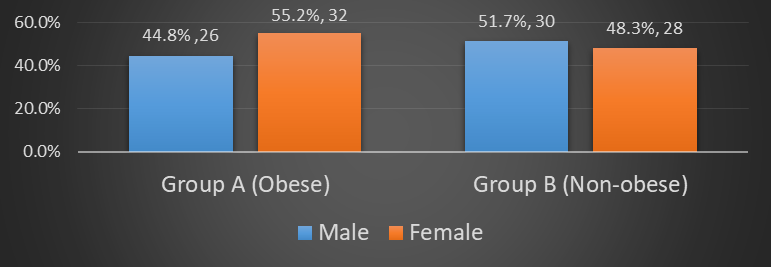
Figure 1: Gender distribution
Table II Stone characteristics
|
Stone characteristics |
Groups |
||||
|
Group A (Obese) |
Group B (Non-obese) |
||||
|
n |
% |
n |
% |
||
|
Stone location |
Renal pelvis |
27 |
46.6% |
24 |
41.4% |
|
Upper calyx |
6 |
10.3% |
5 |
8.6% |
|
|
Middle calyx |
14 |
24.1% |
16 |
27.6% |
|
|
Lower calyx |
11 |
19.0% |
13 |
22.4% |
|
|
Stone laterality |
Right |
38 |
65.5% |
41 |
70.7% |
|
Left |
20 |
34.5% |
17 |
29.3% |
|
|
Stone number |
Single |
42 |
72.4% |
46 |
79.3% |
|
Multiple |
16 |
27.6% |
12 |
20.7% |
|
|
Stone composition |
Calcium oxalate |
27 |
46.6% |
37 |
63.8% |
|
Calcium phosphate |
4 |
6.9% |
7 |
12.1% |
|
|
Uric acid |
19 |
32.8% |
5 |
8.6% |
|
|
Mixed |
8 |
13.8% |
9 |
15.5% |
|
Table III Comorbidity profile of the patients
|
Comorbidities |
Groups |
||||
|
Group A (Obese) |
Group B (Non-obese) |
||||
|
n |
% |
n |
% |
||
|
Hypertension |
Yes |
9 |
15.5% |
7 |
12.1% |
|
No |
49 |
84.5% |
51 |
87.9% |
|
|
Diabetes |
Yes |
4 |
6.9% |
3 |
5.2% |
|
No |
54 |
93.1% |
55 |
94.8% |
|
Table IV Comparison of stone clearance in both groups
|
Stone clearance |
Groups |
p value |
|||
|
Group A (Obese) |
Group B (Non-obese) |
||||
|
n |
% |
n |
% |
0.189 |
|
|
Yes |
47 |
81.0% |
52 |
89.7% |
|
|
No |
11 |
19.0% |
6 |
10.3% |
|
|
Chi square was used |
|||||
Table V: Comparison of postop complications between both groups
|
Postop complications |
Groups |
p value |
||||
|
Group A (Obese) |
Group B (Non-obese) |
|||||
|
n |
% |
n |
% |
|||
|
Fever |
Yes |
12 |
20.7% |
9 |
15.5% |
0.469 |
|
No |
46 |
79.3% |
49 |
84.5% |
||
|
Anaemia |
Yes |
5 |
8.6% |
3 |
5.2% |
0.717 |
|
No |
53 |
91.4% |
55 |
94.8% |
||
|
Leakage |
Yes |
4 |
6.9% |
2 |
3.4% |
0.679 |
|
No |
54 |
93.1% |
56 |
96.6% |
||
|
Need for blood transfusion |
Yes |
6 |
10.3% |
4 |
6.9% |
0.508 |
|
No |
52 |
89.7% |
54 |
93.1% |
||
|
Chi-square Fisher’s exact test was used |
||||||
DISCUSSION :
This study examined the outcomes following percutaneous nephrolithotomy, comparing obese and non-obese patients with medium-sized symptomatic stones 10 to 20 mm. The demographic profile showed a cohort of patients with a median age in the fourth decade. There was a higher proportion of female patients in the obese group 32 (55.2%), while a slight male predominance was observed in the non-obese group. The significantly longer operative time for obese patients (106 vs 88 minutes) in the present study can be attributed to technical challenges, including increased subcutaneous adipose tissue and greater skin-to-stone distance, which complicate percutaneous access and tract maintenance.
Regarding the stone characteristics, obese patients had a substantially higher prevalence of uric acid stones compared to non-obese patients. This finding is similar with established pathophysiological mechanisms linking obesity, insulin resistance, and uric acid metabolism.14,15 Bux et al. noted that metabolic syndrome components such heart diseases and renal stones were more frequent with obese
patients.15 Conversely, calcium oxalate stones were more common in the non-obese group. This compositional difference is an important finding. Uric acid stones are considered softer and more amenable to fragmentation, which could theoretically bias the results leading to better outcomes in the obese group. However, this potential advantage did not add an advantage for the obese group in the clearance rates.
The stone clearance showed no significant difference between both groups, although the non-obese group had a higher clearance rate but the difference could not reach the level of significance. This finding aligns with Iqbal et al. who reported no significant difference in stone-free rates across various BMI categories, with success rates of 77.69%, 73.79% and 75% for normal, overweight, and obese patients, respectively.7 These findings suggest that PCNL techniques effectively overcome the anatomical challenges presented by obesity at least for this specific stone size range. The non-significant difference in stone clearance, regardless of the longer operative times and different stone composition, showed that the surgeons successfully adapted their expert techniques to achieve comparable outcomes. This may involve using adjusting puncture angles, or using more meticulous fragmentation strategies to overcome the technical difficulties, although not assessed in the present study, future studies should also include the surgeon’s skill level. One of the inclusion criteria for the present study was to include only those patients who had stone size 10 to 20 cm, studies have shown that larger stone sizes have a lower clearance rate.8,17
Regarding postoperative complications, the rates were similar between the groups, highlighting the established safety of PCNL across obese and non-obese strata. Fever was the most common complication in both cohorts. Other complications like anaemia, leakage, and transfusion needs were slightly more frequent in the obese group, but none of them were statistically significant. Yusuf et al. in their case study, reported successfully performed PCNL on a patient with a BMI of 62 kg/m² without reporting major complications.18 Khan et al. also reported safety of PCNL in obese patients, lower complications rate.19 Bhatti et al. also validated this finding, the found no significant complication rates between obese and non-obese patients.20
The novelty of the study lies in providing an evidence based outcomes of PCNL in obese and no-obese patients, from a high volume specialized institute for kidney diseases for surgeons practicing in comparable environments, rather than data derived from international studies with different technological access and patient profile.
This study has several limitations which needs to be acknowledged. The single-centre and non-randomised design limits the strength of generalisability. The absence of long-term follow-up data prevents assessment of whether the clinically insignificant residual fragments in the non-obese group or obese group later passed spontaneously or not. The skill level of the surgeon was not evaluated. The study also did not take into account all potential confounders, such as the unit density of the stones and the degree of hydronephrosis, which can influence PCNL success regardless of BMI.
CONCLUSION :
In conclusion, the study demonstrated that PCNL is an effective technique for the management of symptomatic renal stones in obese and non-obese patients equally, furthermore the study demonstrated that the technique had an equivalent safety profile for both obese and no-obese patients. Stone clearance was observed more in non-obese patients. It demonstrated that local centres for kidney diseases can achieve outcomes comparable to those reported nationally and internationally, effectively in managing the technical demands of obesity.
No conflict of interest was declared by the authors
No funding was received
Patient consent was taken
BIBLIOGRAPHY:
1. Qin P, Zhang D, Huang T, Fang L, Cheng Y. Comparison of mini percutaneous nephrolithotomy and standard percutaneous nephrolithotomy for renal stones> 2cm: a systematic review and meta-analysis. Int Braz J Urol. 2022;48(4):637-48. DOI:https://doi.org/10.1590/S1677-5538.IBJU.2021.0347
2. Deng J, Li J, Wang L, Hong Y, Zheng L, Hu J, Kuang R. Standard versus mini-percutaneous nephrolithotomy for renal stones: a meta-analysis. Scand J Surg. 2021;110(3):301-11. DOI:https://doi.org/10.1177/14574969209204
3. Xu Y, Huang X. Effect of body mass index on outcomes of percutaneous nephrolithotomy: a systematic review and meta-analysis. Front Surg. 2022;9:922451. DOI: https://doi.org/10.3389/fsurg.2022.922451
4. Martínez-Corral ME, Vázquez-Cancela O, Fernández-Pérez C, Pérez-Fentes DA. Impact of Obesity on the Outcomes of Supine Percutaneous Nephrolithotomy: A Propensity Score Analysis. J Endourol. 2025;39(3):237-44. DOI:https://doi.org/ 10.1089/end.2024.0714
5. Bulut EC, Elmas B, Küpeli B. Evaluation of the Impact of Body Mass Index on the Outcomes of Supine Percutaneous Nephrolithotomy. New J Urol. 2024;19(3):121-8. DOI:https://doi.org/10.33719/nju1534944
6. Perez D, Neeman BB, Dotan D, Raisin G, Chertin B, Kafka I. Ultrasound-guided percutaneous nephrolithotomy (PCNL) success rates in patients with elevated body mass index: a comparative study. Urolithiasis. 2023;51(1):111. DOI: https://doi.org/10.21203/rs.3.rs-2576716/v1
7. Iqbal N, Hasan A, Razzaq S, Rashid FS. Effect of Body Mass Index on complications and success rates of percutaneous nephrolithotomy-A tertiary care hospital experience. Pak J Med Sci. 2022;38(8):2112-17. DOI:https://doi.org/10.12669/pjms.38.8.3663
8. Khalil MA, Patujo YH, Ullah F, Ibrar U, Adil R, Inam QA, et al. An analysis of percutaneous nephrolithotomy (PCNL) performed at the institute of kidney disease, pakistan: stone clearance and complications. Cureus. 2024;16(12):e75430. DOI: https://doi.org/ 10.7759/cureus.75430.
9. Khalid MU, Nawaz M, Javed MU, Shahzad K, Ahmad H, Mirza ZI. Safety and efficacy of prone percutaneous nephrolithotomy (PCNL) in morbidly obese patients. Professional Med J. 2022;29(04):500-5. 5. DOI:https://doi.org/10.29309/TPMJ/2022.29.04.6462
10. Xiao B, Zeng X, Ji C, Zhang G, Hu W, Jin S, et al. Percutaneous Nephrolithotomy With X-Ray Free Technique in Morbidlyobese Patients: Outcomes and Skills From A Large High-Volume Stone Management Center. Clin Surg. 2021;3368. https://www.clinicsinsurgery.com/open-access/percutaneous-nephrolithotomy-with-x-ray-free-technique-in-morbidly-obese-patients-8197.pdf
11. Cormio A, Auciello M, Falagario UG, Ricapito A, Mangiatordi A, Castellani D, et al. Mini and standard percutaneous nephrolithotomy in obese patients. Results from a single-surgeon large series. Eur Urol Open Sci. 2024;63:113-8. DOI:https://doi.org/10.1016/j.euros.2024.03.011
12. Maheshwari PN, Gite VA, Arora AM, Agrawal M. PCNL in Complex Situations: Obese Patients and Spinal Deformities, Ectopic, and Pelvic Kidneys. Springer. 2022;275-83. DOI:https://doi.org/10.1007/978-981-16-6001-6_26
13. Choban PS, Flancbaum L. The impact of obesity on surgical outcomes: a review. J Am Coll Surg. 1997;185(6):593-603. DOI:https://doi.org/ 10.1016/s1072-7515(97)00109-9.
14. Jalal L, Jaffery Z, Nasir A, Shoukat W, Khalid A, Irfan A, et al. Exploring the pathophysiological link between obesity and kidney stone formation: cost-effective dietary and lifestyle strategies for prevention. Ann Med Surg (Lond). 2025;87(10):6521-6527. DOI:https://doi.org/ 10.1097/MS9.0000000000003691.
15. Kelly C, Geraghty RM, Somani BK. Nephrolithiasis in the Obese Patient. Curr Urol Rep. 2019;20(7):36. DOI:https://doi.org/10.1007/s11934-019-0898-0.
16. Bux K, Mansoor M, Kumar N, Ali S, Khan SA, Hussain S. Impact of body mass index on the outcome of percutaneous nephrolithotomy for renal stone. J Surg Pakistan. 2021;26(4):126-30. Available from www.jsp.org.pk/index.php/jsp/article/view/281/220
17. Abdelhafez MF, Amend B, Bedke J, Kruck S, Nagele U, Stenzl A, et al. Minimally invasive percutaneous nephrolithotomy: a comparative study of the management of small and large renal stones. Urology. 2013;81(2):241-5. DOI:https://doi.org/10.1016/j.urology.2012.09.030.
18. Yusuf F, Elmekresh A, Kumar S, Bagheri F. Percutaneous Nephrolithotripsy in Morbidly Obese Patient: A Case Report. Case Rep Urol. 2022;2022:5899896. DOI:https://doi.org/ 10.1155/2022/5899896.
19. Khan F, Inamullah S. Assessment of the feasibility and safety of supine percutaneous nephrolithotomy under regional anesthesia for obese patients with a body mass index >30. Biol. Clin. Sci. Res. J. 2024: 945. DOI:https://doi.org/ 10.54112/bcsrj.v2024i1.945
20. Bhatti KH, Channa AA, Sohail N, Abdelrahman KM, Shaat AHA, Bodour AA, Gomha FS, Smain AM, Alhabash SS, Ali HM. Efficacy and safety of supine percutaneous nephrolithotomy in obese patients. J Ayub Med Coll Abbottabad. 2024;36(1):45-49. DOI:https://doi.org/10.55519/JAMC-01-12496.