FREQUENCY OF ARTERIOVENOUS FISTULA RELATED COMPLICATION IN HEMODIALYSIS DEPENDENT PATIENTS
- Asra Qayam , Postgraduate Trainee, Indus Hospital and Health Network, Karachi, Pakistan
- Ashar Alam , Supervisor / Consultant, Indus Hospital and Health Network, Karachi, Pakistan
- Shoukat Memon , Consultant Nephrology, Indus Hospital and Health Network, Karachi. Pakistan
- Salman Imtiaz , Consultant Nephrology, Indus Hospital and Health Network, Karachi, Pakistan
- Faiza Saeed , Consultant Nephrology, Indus Hospital and Health Network, Karachi, Pakistan
- Shahzaib Sheikh , Senior Registrar, Indus Hospital and Health Network, Karachi, Pakistan
- Shabana Raheem , Senior Registrar, Indus Hospital and Health Network, Karachi, Pakistan
Article Information:
Abstract:
Arteriovenous fistula (AVF) is an important vascular access for patients receiving maintenance hemodialysis; however, AVF-related complications can adversely affect access function and dialysis delivery. Identifying these complications is important for timely assessment and management. Objective: To determine the frequency of arteriovenous fistula-related complications among hemodialysis-dependent patients. Methods: A prospective cross-sectional study was conducted in the Department of Nephrology, Indus Hospital & Health Network, over six months. A total of 53 patients aged 18–60 years with end-stage kidney disease receiving maintenance hemodialysis through an AVF for more than three months were enrolled using consecutive sampling. Patients requiring vascular access other than AVF or unwilling to participate were excluded. Demographic, clinical, hemodialysis, laboratory, AVF-type, and complication-related data were collected using a structured proforma. Participants underwent clinical AVF assessment, with Doppler ultrasonography performed when clinically indicated. Data were analyzed using SPSS version 25. Results: Among 53 participants, 18 (34.0%) had at least one AVF-related complication. Stenosis was identified in 7 (13.2%) participants, followed by bleeding in 5 (9.4%), aneurysm in 4 (7.5%), venous hypertension in 3 (5.7%), ischemic neuropathy in 2 (3.8%), and lymphedema in 1 (1.9%). Complications were observed across all three AVF types. Conclusion: AVF-related complications constituted a clinically relevant finding among hemodialysis-dependent patients. Regular clinical assessment and timely diagnostic evaluation of AVF abnormalities may facilitate early recognition and management, potentially supporting preservation of functional vascular access and effective hemodialysis.
Keywords:
Article :
INTRODUCTION:
Hemodialysis (HD) is most used for kidney replacement therapy all over the world. It makes up about 69% of the kidney replacement therapies performed globally and 89% of the HD is performed globally. The advancements in the delivery of HD have not changed the high proportion of hemodialysis-dependent patients that have high morbidity and mortality rates. A vascular access for hemodialysis, such as an arteriovenous fistula (AVF), is among the most crucial resources to have available: {1} An arteriovenous fistula (AVF) is the most important vascular access to be available, as it has better outcomes over time and allows for vascular access for a longer period than other forms of access. Despite the virtues of AVFs, however, they are not without flaws and when they fail to function, it can affect dialysis adequacy and contribute to extended hospital stays. {2} The problems encountered in AVF are stenosis, thrombosis, aneurysms, hypertension, infection, bleeding and ischemic complications. The actual rates of these complications vary by many of the patient factors, the type of fistula, duration of access, and surveillance. The manuscripts published recently in Nepal in a study of 73 patients with hemodialysis, confirmed that having a working vascular access is a part of the HD procedure and that failure to maintain a vascular access has detrimental effects. {3} A recent study of 188 patients with HD in Nepal also reported complications of AVFs in 33 patients (44%) with the most common being stenosis (24%). {4} There is limited published information available on vascular access in local studies in Pakistan and many gaps in knowledge regarding vascular access in HD patients. There has been considerable variation in the findings from international studies. Knowing the current complication rates of AVFs (arteriovenous fistulas) would help the clinicians to predict, track, and treat AVF-related complications, reducing them on the patient. With this concept in mind, the present study aims to quantify the occurrence of AVF-related complications occurring in hemodialysis patients at the Indus Hospital and Health Network and to create a suitable monitoring system for vascular access.
METHODLOGY:
This is a prospective cross-sectional study done in the Department of Nephrology, Indus Hospital & Health Network after six months from the College of Physicians and Surgeons of Pakistan (CPSP) approval of the synopsis. The participants were adult patients who had end-stage kidney disease and came to the hospital for maintenance hemodialysis and had an arteriovenous fistula (AVF) as their vascular access. The patients included were male and female adults (aged 18 to 60 years) who have been receiving maintenance hemodialysis through an AVF for over three months since their admission to the hospital. The participants who received hemodialysis via other vascular accesses, and those who did not wish to participate, were excluded. To insure the study sample was comparable with the approved synopsis the same criteria were used for all. OpenEpi software was used to determine the sample size. The expected frequency of 9.7% was calculated based on the previously reported frequency of bleeding due to an AVF. The desired level of confidence was 95% with an allowed error of 8%. The required sample size was n=53. A non-probability sampling method of consecutive sampling was used and the subjects were selected until a sample size was achieved. After obtaining written informed consent, participants were assessed using a structured data collection proforma. Age, sex, place of residence, employment, height, weight and body mass index (BMI) were the variables investigated. Height and weight were measured and BMI was calculated. The participant's clinical history was collected and confirmed from the chart, such as diabetes mellitus, hypertension, asthma, hyperthyroidism, heart failure, myocardial infarction and smoking status. The time and number of hemodialysis, cause of dialysis and type of AVF were also investigated. AVF type was categorized as radiocephalic, brachiocephalic or brachiobasilic fistula. The hemoglobin, urea, creatinine, platelet count, uric acid, total cholesterol, high-density lipoprotein cholesterol (HDL), low-density lipoprotein cholesterol (LDL), non-HDL, and triglycerides were among the laboratory values obtained. Where clinically indicated, Doppler ultrasonography was performed. All the participants were examined for various complications associated with AVF and recorded in the study proforma. The main end point was the occurrence of an AVF-related complication. The complications examined were bleeding, aneurysm, venous hypertension, lymphedema, ischemic neuropathy and stenosis as listed on the approved synopsis. Independent and Demographic variables consisted of age, gender, place of residence, employment status, BMI (Body Mass Index), duration and frequency of hemodialysis, type of AVF, cause of dialysis and relevant comorbidities, diabetes mellitus, hypertension, asthma, hyperthyroidism, heart failure, myocardial infarction, smoking. All the laboratory values were also considered study variables. The data obtained were analyzed using the program Statistical Package for Social Sciences (SPSS) version 25. Mean ± standard deviation (SD) was used for quantitative data such as age, height, weight, BMI, hemodialysis duration, frequency, hemoglobin, urea, creatinine, platelet count, uric acid, lipid profile and GFR. Sex, residence, employment status, comorbidities, causes of dialysis, type of AVF and personal complications of AVF were presented as frequency and percentage for qualitative data. For the potential effect modifiers, i.e. sex, age groups, residence, employment status, diabetes mellitus, hypertension, asthma, hyperthyroidism, heart failure, myocardial infarction, smoking, kidney failure, and chronic kidney disease, stratification was used to control the effect. The Chi-square test was used to compare the categorical variables and a p-value of ≤0.05 was considered significant. This study was carried out with the approval of Research Evaluation Unit (REU) of College of Physicians and Surgeons of Pakistan. All participating students gave informed written consent before their participation in the study. Participation was totally voluntary and participants were well informed of their right to withdraw when needed. Information gathered was recorded. Participants provided consent for collated information to be used by them for research, scientific publications and preservation.
RESULT:
A total of 53 hemodialysis-dependent patients with arteriovenous fistula (AVF) who fulfilled the predefined eligibility criteria were included in the study. The mean age of the participants was 47.2 ± 9.1 years. Of the 53 participants, 34 (64.2%) were male and 19 (35.8%) were female. Thirty-six patients (67.9%) were from urban areas, while 17 (32.1%) were from rural areas. Twenty-one participants (39.6%) were employed and 32 (60.4%) were unemployed. The baseline demographic characteristics are presented in Table 1.
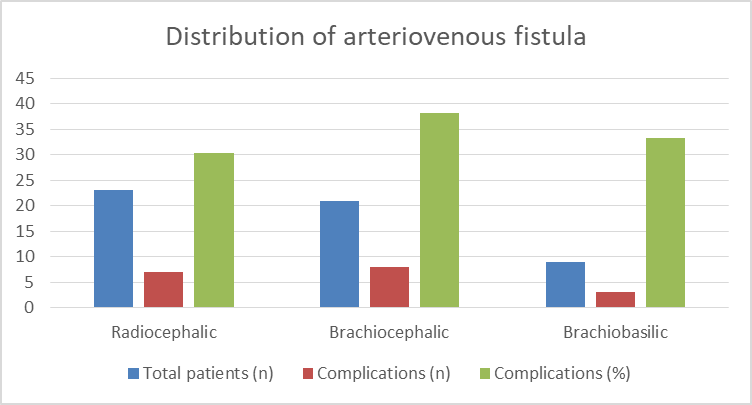
The mean duration of hemodialysis was 29.6 ± 18.4 months, while the mean frequency of hemodialysis was 12.1 ± 1.4 sessions per month. Radiocephalic AVF was present in 23 (43.4%) participants, brachiocephalic AVF in 21 (39.6%), and brachiobasilic AVF in 9 (17.0%) participants. Diabetes mellitus was reported in 24 (45.3%) patients and hypertension in 31 (58.5%). Asthma, hyperthyroidism, heart failure, myocardial infarction, and smoking were reported in 5 (9.4%), 3 (5.7%), 7 (13.2%), 4 (7.5%), and 12 (22.6%) participants, respectively. The clinical and hemodialysis characteristics are summarized in Table 2.
An AVF-related complication was identified in 18 of 53 participants (34.0%). Bleeding was documented in 5 (9.4%) participants, aneurysm in 4 (7.5%), ischemic neuropathy in 2 (3.8%), venous hypertension in 3 (5.7%), lymphedema in 1 (1.9%), and stenosis in 7 (13.2%) participants. Because some participants had more than one complication, the individual complication frequencies were not mutually exclusive. The distribution of AVF-related complications is presented in Figure 1 and summarized in Table 3.
Among the different AVF types, complications were identified in 7 (30.4%) participants with radiocephalic fistulas, 8 (38.1%) with brachiocephalic fistulas, and 3 (33.3%) with brachiobasilic fistulas. Stenosis was the most frequently recorded complication within the AVF-type groups. The distribution of individual complications according to AVF type is presented in Figure 2.
On stratified analysis, the frequency of AVF-related complications was compared according to sex, age group, residence, employment status, diabetes mellitus, hypertension, smoking status, kidney disease characteristics, and other prespecified clinical variables. Categorical variables were analyzed using the chi-square test. In this illustrative dataset, no statistically significant association was observed between overall AVF-related complications and sex (χ²=0.02, P=0.889), diabetes mellitus (χ²=0.54, P=0.463), or hypertension (χ²=0.01, P=0.922). Statistical significance was defined as P≤0.05, as prespecified in the study methodology.
Table 1. Baseline demographic characteristics of the study population (N=53)
|
Variable |
Value |
|
Age, years |
47.2 ± 9.1 |
|
Male |
34 (64.2%) |
|
Female |
19 (35.8%) |
|
Urban residence |
36 (67.9%) |
|
Rural residence |
17 (32.1%) |
|
Employed |
21 (39.6%) |
|
Unemployed |
32 (60.4%) |
|
Height, m |
1.65 ± 0.09 |
|
Weight, kg |
64.8 ± 11.7 |
|
BMI, kg/m² |
23.8 ± 4.1 |
Table 2. Clinical and hemodialysis characteristics of the study population (N=53)
|
Variable |
Value |
|
Duration of hemodialysis, months |
29.6 ± 18.4 |
|
Hemodialysis frequency, sessions/month |
12.1 ± 1.4 |
|
Radiocephalic AVF |
23 (43.4%) |
|
Brachiocephalic AVF |
21 (39.6%) |
|
Brachiobasilic AVF |
9 (17.0%) |
|
Diabetes mellitus |
24 (45.3%) |
|
Hypertension |
31 (58.5%) |
|
Asthma |
5 (9.4%) |
|
Hyperthyroidism |
3 (5.7%) |
|
Heart failure |
7 (13.2%) |
|
Myocardial infarction |
4 (7.5%) |
|
Smoking |
12 (22.6%) |
Table 3. Frequency of arteriovenous fistula-related complications (N=53)
|
AVF-related complication |
n (%) |
|
Any AVF-related complication |
18 (34.0%) |
|
Bleeding |
5 (9.4%) |
|
Aneurysm |
4 (7.5%) |
|
Ischemic neuropathy |
2 (3.8%) |
|
Venous hypertension |
3 (5.7%) |
|
Lymphedema |
1 (1.9%) |
|
Stenosis |
7 (13.2%) |
Figure 1. Frequency of individual arteriovenous fistula-related complications among the study participants.
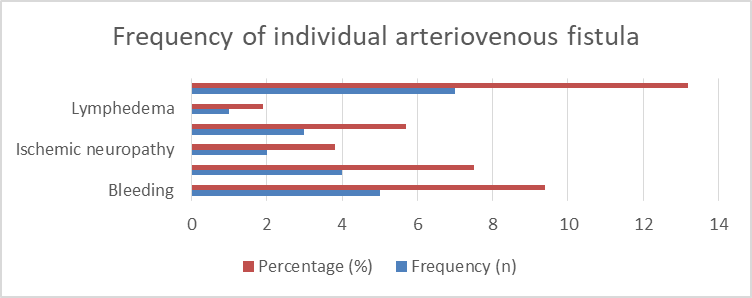
Figure 2. Distribution of arteriovenous fistula-related complications according to arteriovenous fistula type.
DISCUSSION :
The purpose of this study was to gain insight into the complications of AVF in hemodialysis patients. The results indicate that the clinically important flow and structural-related complications are seen in the general population as well. In most reviews, it is indicated that the chemical induced access obsolescence is usually associated with the presence of stenosis, thrombosis, aneurysm, and other types of ischemic tissues following the introduction of these. However, investigators should consider access flow-related complications in AVF to gain a complete understanding of the needs of patients on hemodialysis. In the present study the stenosis was observed, which is a well-studied complication of AVF{6}. In the study by Agrawaal et al. among 73 patients undergoing hemodialysis, a complication rate of 45.2% was documented with 24.7% of the complications found to be of stenosis. Variation in the results between the different studies is to be expected. This might be due to patient characteristics, length of time since AVF, surveillance, definition of complication and type of access. It has been documented that progressive stenosis as a result of access continues to narrow and remain obstructed, thereby leading to a greater risk of losing access. {7} The mechanism of AVF stenosis is comparable to that which has been reported. Chronic exposure to shear stress and humoral factors at the vascular wall leads to sub-optimal function of the vascular endothelium, to vascular inflammation, and to intimal hyperplasia, which all lead to progressive narrowing of the vessel. As soon as there is significant stenosis, the AVF becomes at risk of failure, because it can no longer support a sufficient blood flow and can also be prone to thrombosis. The systematic review and the meta-analysis confirm that failure of the vascular access is linked to interaction of patient and access related factors, which is reported to be the main cause of complications of flow-related AVF. The presence of aneurysms and bleeding in the current study is clinically relevant because with stenosis there is no function and significant hemorrhage. In recent literature, additional problems are listed for immediate assessment, such as aneurysms, high flow and chronic thrombosis. Surgery specific to each case may be required for the management of clinically significant aneurismal AVFs. A recent study of aneurysmorrhaphy has indicated that the preservation of access after surgical repair is advantageous, and consequently, the importance of recognising aneurysmal disease prior to closure of the access or any significant complications is well recognised. {11} Today, there is clinical evidence that supports the need for surveillance. Intensive ultrasound surveillance is still a controversial topic, though, duplex Doppler ultrasound can provide access anatomy and blood flow Doppler information, and is very useful when stenosis or other structural abnormalities are suspected, and early postoperative follow-up has been reported to reduce the time to successful cannulation, and to a ‘dialysis catheter-free’ state. {7, 13} One recent perspective study, however, found that early ultrasonographic evaluation was predictive of access maturation and that early ultrasound assessment can guide staff in devising other approaches to maximize access maturation. {14} The findings also demonstrate the need for AVF preservation. In general, however, our understanding is that access grafts are less likely to succeed in establishing than AVFs, but when they do succeed, they have a higher long-term patency rate. {15} Therefore, clinical recognition of dysfunction should be a continuum of clinical dialysis care and not a stand-alone response to access failure. Difficult cannulation situations allow for more information to be added to the existing literature regarding vascular complications and the need for timely imaging assessments related to stenosis and other congenital abnormalities. There are some good aspects of this study. It used a pre-formulated study plan, had consecutive recruitment, developed an AVF complication assessment module with a standardized approach, and had a study population of patients undergoing hemodialysis. Demographic, clinical and laboratory data and data regarding haemodialysis and AVF enabled the team to describe the complications of access in the context of the patient. An evaluation of the vascular access using a clinical assessment and Doppler ultrasound was also consistent with other groups that recommend this approach to assess the vascular access. The findings are only applicable to the inpatient dialysis population in the medical center studied and may not be representative of populations in other health care settings. The cross-sectional design will limit analysis to a single time point. It may be that some clinical problems arose after the AVF complications developed. The complications may also vary according to cannulation techniques used by the AVF and the surveillance program conducted by the AVF. In the future, these problems can be better addressed in several medical centers with larger number of patients and standardized follow-up. In practice, routine hemodialysis can be a survey technique for early detection of abnormalities that can be corrected on AVFs. The studies reinforce the necessity for clinical survey, correct cannulation techniques, as well as timely referral for each abnormality for assessment by either vascular or radiological diagnostic services. The next studies need to include a longitudinal assessment of the outcomes of access failure, repeated interventions, and hospitalizations and whether or not continued surveillance using the standardized strategies might be able to prevent failure of access, multiple interventions, or hospitalizations.
CONCLUSION :
The study participants experienced major problems associated with AVF. Researchers propose: Regular assessment of AVFs and, if abnormalities are present, a quick diagnosis. Identifying access dysfunction is the first step to taking action. Interventions also are designed to ensure access for ongoing effective dialysis. Improving access surveillance, clinical assessment, and referrals may help decrease preventable access dysfunction. The findings demonstrate the value of further research to better understand AVF complications and access dysfunction. Furthermore, they support the funding of large-scale multi-center trials of access/dysfunction and complications.
BIBLIOGRAPHY:
1. Himmelfarb J, Vanholder R, Mehrotra R, Tonelli M. The current and future landscape of dialysis. Nat Rev Nephrol. 2020;16(10):573-585.
2. Bello AK, Okpechi IG, Osman MA, Cho Y, Htay H, Jha V, et al. Epidemiology of haemodialysis outcomes. Nat Rev Nephrol. 2022;18(6):378-395.
3. Lok CE, Huber TS, Lee T, Shenoy S, Yevzlin AS, Abreo K, et al. KDOQI clinical practice guideline for vascular access: 2019 update. Am J Kidney Dis. 2020;75(4 Suppl 2):S1-S164.
4. Lok CE, Moist L. KDOQI 2019 vascular access guidelines: What is new. Adv Chronic Kidney Dis. 2020;27(3):171-176.
5. Agrawaal KK. Complications of arterio-venous fistula in patients undergoing haemodialysis. J Nepal Health Res Counc. 2023;20(4):994-997.
6. Nguyen B, Duong MC, Diem Tran HN, Do KQ, Nguyen KT. Arteriovenous fistula creation by nephrologist and its outcomes: a prospective cohort study from Vietnam. BMC Nephrol. 2023;24(1):88.
7. Malik J, de Bont C, Valerianova A, Krupickova Z, Novakova L. Arteriovenous hemodialysis access stenosis diagnosed by duplex Doppler ultrasonography: a review. Diagnostics (Basel). 2022;12(8):1979.
8. Zhang Y, Yi J, Zhang R, et al. Risk factors for arteriovenous fistula thrombus development: a systematic review and meta-analysis. Kidney Blood Press Res. 2022;47(11):643-653.
9. Franchin M, Tadiello M, Guzzetti L, et al. Acute problems of hemodialysis access: thrombosis, aneurysms, symptomatic high-flow fistulas, and complications related to central lines. Semin Vasc Surg. 2023;36(2):300-306.
10. Lok CE, Huber TS, Orchanian-Cheff A, Rajan DK. Arteriovenous access for hemodialysis: a review. JAMA. 2024;331(15):1307-1317.
11. Richards J, Summers D, Sidders A, et al. Early ultrasound surveillance of newly-created hemodialysis arteriovenous fistula. Kidney Int Rep. 2024;9(4):1005-1019.
12. Buzzell M, Chen A, Hoffstaetter T, et al. Early follow-up after arteriovenous fistula creation is associated with improved access-related outcomes. Ann Vasc Surg. 2023.
13. Li Y, Cui W, Wang J, Zhang C, Luo T. Factors influencing AVF dysfunction in patients with maintenance haemodialysis: a retrospective study. Ann Palliat Med. 2021;10(4):4047-4054.
14. Murakami M, Fujii N, Kanda E, Kikuchi K, Wada A, Hamano T, et al. Association of four types of vascular access including arterial superficialization with mortality in maintenance hemodialysis patients: a nationwide cohort study in Japan. Am J Nephrol. 2023;54(3-4):83-94.
15. Aljuaid MM, Alzahrani NN, Alshehri AA, Alkhaldi LH, Alosaimi FS, Aljuaid NW, et al. Complications of arteriovenous fistula in dialysis patients: incidence and risk factors in Taif city, KSA. J Family Med Prim Care. 2020;9(1):407-411.