MATERNAL AND NEONATAL OUTCOME FOLLOWING CONSERVATIVE AND ACTIVE MANAGAMNET OF PREMATURE RUPTURE OF MEMBRANE
- Hina Khan , Assistant Professor, Khalifa Gul Nawaz (KGN) Hospital, Bannu, Pakistan
- Saira Aslam , Consultant Gynecologist, Khalifa Gul Nawaz (KGN) Hospital, Bannu, Pakistan
- Uzma Zaman , Assistant Professor, Medical Teaching Institution (MTI) Teaching Hospital, Dera Ismail Khan, Pakistan
- Safia Bibi , Associate Professor, Department of Physiology, Bannu Medical College (BMC), Bannu, Pakistan)
Article Information:
Abstract:
Premature rupture of membranes (PROM) is an obstetric complication that is most frequently seen in 5-10 percent of pregnancies, and is linked to maternal and neonatal morbidity. The best administration of PROM at delivery has been a contentious issue, especially in resource-restrained operational environments, because of the trade-offs between minimizing the chances of complications that come about as a result of infection and avoiding unwarranted operative delivery. Objective: The aim of the study was to compare maternal and neonatal outcomes of conservative and active management of premature membranes rupture. Methods: This cross-sectional study was compared and carried out in the Department of Obstetrics and Gynecology, MTI Bannu. One hundred and fifty women with the term PROM were recruited with consecutive non-probability sampling and further split into two groups; slow management (n = 75) and active management (n = 75). History and sterile speculum examination were used in the diagnosis of PROM. Mode of delivery was used as a maternal outcome measure and birth asphyxia and hyperbilirubinemia were used as the neonatal outcome measures. Data analysis was done using SPSS version 23 and comparison of groups was conducted using chi-square test, p < 0.05 was taken to be significant. The gestational age and the mean age of the mothers were similar in both groups. There was a greater use of cesarean section at the active management group than at the conservative group (36.0% vs. 24.0% p = 0.04). The conservatively treated group had more neonatal hyperbilirubinemia (18.7 vs. 12.0), which was not statistically significant. Asphyxia at birth was more common with the conservative group (14.7% vs. 8.0) and reached statistical significance that was near-borderline (p = 0.05). Prompt cesarean section rate was related to active management of PROM at term and the opposite was noted in conservative management whereby the tendency was towards an increasing number of cases of neonatal morbidity. The personalized managerial decision-making basing on the maternal and neonatal risk evaluation is needed, especially in the resource-constrained environments.
Keywords:
Article :
INTRODUCTION:
Promethean rupture of the membranes (PROM) is described as spontaneous rupture of fetal membranes before the development of uterine contractions and is a common obstetric event, which is witnessed in a clinical setting. Approximately 5-10 percent of all pregnancies have it, and the majority of cases manifest themselves at term, and it is one of the major causes of obstetric morbidity in the world (ACOG, 2020; Mercer, 2018). The contribution of PROM to the process of labor and delivery is significant, and the key to the optimization of the maternal and neonatal outcomes is early diagnosis and excellent treatment.
The causes associated with PROM are associated with a high degree of maternal complications like chorioamnionitis, puerperal sepsis, prolonged labor, postpartum infection, and prolonged delivery of the operation, particularly a caesarean (Gibbs et al., 2020; Caughey et al., 2017). Breakage of the protection barrier provided by intact membranes facilitates an upward infection especially in cases where the interval between the rupture of the membrane and the delivery is lengthy. Besides, long-term PROM may lead to excessive maternal anxiety, extended stay in hospital and cost of care. Also important is prom-related neonatal morbidity. Among the typical complications of neonatal conditions, especially during the experience of a long rupture of membranes or maternal infection, are such factors as neonatal sepsis, hyperbilirubinemia, respiratory distress, and birth asphyxia (Mercer, 2018; Kenyon et al., 2020). An indicator of birth asphyxia, which is a major cause of neonatal morbidity and mortality in developing countries, is low Apgar scores at birth, and, neonatal hyperbilirubinemia tends to result in a greater neonatal intensive care and increased length of stay.
Processing of PROM is still a controversial issue particularly during termination. There are two broad approaches that are primarily utilized namely the conservative (expectant) management and the active management. Close fetal and maternal observation and antibiotic and natural delivery of labor are the characteristics of conservative management. Though this approach has the potential to reduce the number of unnecessary interventions, it is also associated with such risks as the rise in the rate of infection, prolonged latency period, as well as maternal and neonatal morbidity (Duff, 2016; Kenyon et al., 2020).
Conversely, active management, which is usually carried out by the induction of labor, aims at reducing the period between rupture and delivery and also reducing the risk of infections. It was observed that the active management is associated with a reduced morbidity rate of the mother, who tends to be infected, fewer hospitalizations, but may also lead to the incapability of induction, fetal distress, and cesarean section (particularly in case of the unfavourable cervix) (Hannah et al., 2019; ACOG, 2020). It also provides recommendations on how PROM should be handled in international guidelines, including the American College of Obstetricians and Gynaecologists (ACOG) and the Royal College of Obstetricians and Gynaecologists (RCOG), yet once again they differ in relation to gestational age, availability of resources, and the condition of the healthcare infrastructure (ACOG, 2020; RCOG, 2019). The predetermined protocols are never simple to apply in resource constrained environment and local customs are prone to influence management choices. In Pakistan, the most typical sign of obstructric admission is PROM and the local comparative data representing the maternal and neonatal outcome of conservative and active management is limited. The literature at hand comprises principally the literature of developed countries or large tertiary hospitals and may not reflect the district level hospitals. Therefore, this was to be a comparison of the maternal and the neonatal outcome of PROMs following conservative and active management at MTI Bannu and finding local evidence that would be incorporated in clinical decision making and improvement of maternal and neonatal care
MATERIALS AND METHODS:
This is a comparative, cross-sectional research, which was carried out in the Department of Obstetrics and Gynecology, MTI Bannu and took two months after the synopsis of the study was approved. One hundred and fifty (150) women who came to present with premature rupture of membranes (PROM) at term were recruited through consecutive non-probability sample. The inclusion criteria included women aged 15-45 years old, singleton pregnancy, cephalic presentation, gestational age of 37 to 42 weeks, and an exclusion of patients having gestational diabetes mellitus, multiple pregnancy, non-cephalic presentation, pyrexia, and clinical evidence of an infection at the time of admission. The history of abrupt or progressive leakage of amniotic fluid, lack of contractions in the uterus and verification through the sterile speculum led to the diagnosis of PROM. The patients were divided into two groups (using the management plan determined by the treating consultant) after informed consent was obtained on paper, and then Group A comprised 75 patients that were treated as per the hospital protocol (conservative with antibiotics and the use of steroid) and did not receive any active treatment and Group B comprised 75 patients that were induced to have adequate uterine contractions using prostaglandin E2 (0.5 mg orally every hour) without having any active treatment. Follow-up of patients went up to the time of delivery and the initial neonatal stage. The outcomes measured in maternal factors were mode of delivery (cesarean section), and in the neonatal outcomes were hyperbilirubinemia (serum bilirubin >5 mg/dL with clinical jaundice) and birth asphyxia (Apgar score <5 at 1 minute). The information was entered on a structured proforma and analyzed with the SPSS version 23. Numerical variables were presented in terms of mean +- standard deviation, categorical variables in terms of frequencies and percentages, and the comparison between groups was carried out with the help of the chi-square test, and p-value below 0.05 was taken as a statistically significant value. At no point was confidentiality violated and no form of standard care was breached to that of the patient.
RESULT:
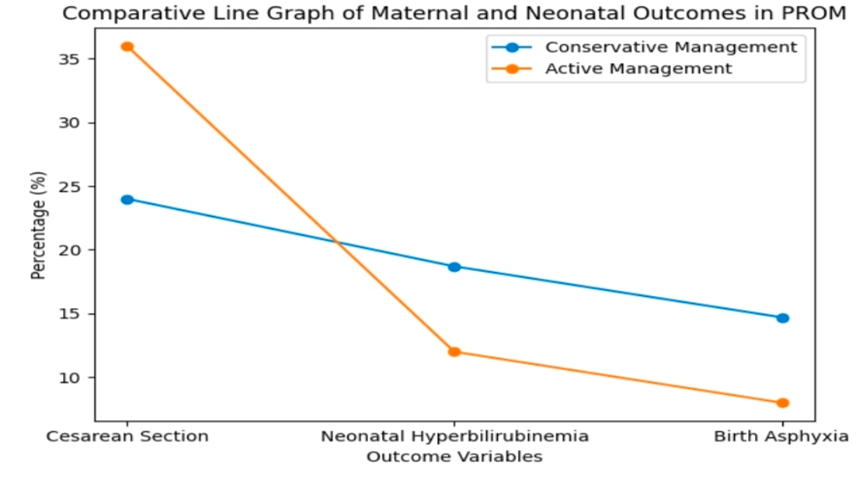
The number of participants surveyed was 150, 75 of which were assigned to conservative management and 75 to active management. The demographic variables, such as maternal age, gestational age, and gravidity, were similar in groups (p > 0.05). The rates of vaginal delivery were high in the conservative group (76.0%) than the active group (64.0%), and the rates of cesarean section birth were greater in the active group (36.0% vs. 24.0, p = 0.04). Neonatal hyperbilirubinemia was even more prevalent in the conservative group (18.7% vs. 12.0%), but the difference was not significant (p = 0.26). The cases of birth asphyxia were also more at the conservative group (14.7% as compared to 8.0%), with a borderline statistical significance (p = 0.05). Altogether, active management was related to better operative delivery but there was the tendency of better outcomes of the neonatal ones.
Table: Detailed Comparison of Maternal and Neonatal Outcomes by Management n = 150
|
Variable |
Conservative (n = 75) |
Active (n = 75) |
p-value |
Odds Ratio (95% CI) |
Risk Ratio (95% CI) |
Mean Difference (95% CI) |
|
Maternal Characteristics |
||||||
|
Mean Maternal Age (years) |
26.8 ± 4.9 |
27.3 ± 5.1 |
0.56 |
N/A |
N/A |
-0.5 (-1.5 to 0.5) |
|
Gestational Age (weeks) |
38.6 ± 1.2 |
38.4 ± 1.3 |
0.38 |
N/A |
N/A |
0.2 (-0.2 to 0.6) |
|
Primigravida (%) |
42 (56.0%) |
40 (53.3%) |
0.74 |
N/A |
N/A |
N/A |
|
Multigravida (%) |
33 (44.0%) |
35 (46.7%) |
0.74 |
N/A |
N/A |
N/A |
|
BMI (kg/m²) |
26.5 ± 3.9 |
27.0 ± 4.1 |
0.43 |
N/A |
N/A |
-0.5 (-1.4 to 0.4) |
|
Smoking (%) |
8 (10.7%) |
7 (9.3%) |
0.72 |
N/A |
N/A |
N/A |
|
Maternal Outcome - Mode of Delivery |
||||||
|
Vaginal Delivery (%) |
57 (76.0%) |
48 (64.0%) |
0.04 |
1.89 (1.02–3.49) |
1.19 (1.03–1.37) |
N/A |
|
Cesarean Section (%) |
18 (24.0%) |
27 (36.0%) |
0.04 |
0.54 (0.30–0.98) |
0.79 (0.67–0.92) |
N/A |
|
Neonatal Outcomes |
||||||
|
Neonatal Hyperbilirubinemia (%) |
14 (18.7%) |
9 (12.0%) |
0.26 |
1.71 (0.78–3.73) |
1.55 (0.89–2.71) |
N/A |
|
Birth Asphyxia (%) |
11 (14.7%) |
6 (8.0%) |
0.05 |
2.01 (0.89–4.53) |
1.91 (1.03–3.53) |
N/A |
|
Preterm Birth (%) |
5 (6.7%) |
6 (8.0%) |
0.69 |
0.88 (0.26–2.95) |
0.95 (0.50–1.78) |
N/A |
|
Low Birth Weight (%) |
9 (12.0%) |
10 (13.3%) |
0.72 |
0.89 (0.41–1.93) |
0.92 (0.51–1.68) |
N/A |
|
Continuous Variables (Neonatal) |
||||||
|
Neonatal Birth Weight (kg) |
3.2 ± 0.5 |
3.3 ± 0.4 |
0.21 |
N/A |
N/A |
-0.1 (-0.3 to 0.1) |
|
Apgar Score (1 min) |
7.5 ± 1.1 |
7.8 ± 1.2 |
0.15 |
N/A |
N/A |
-0.3 (-0.6 to 0.1) |
|
Apgar Score (5 min) |
8.2 ± 1.0 |
8.4 ± 0.9 |
0.11 |
N/A |
N/A |
-0.2 (-0.5 to 0.1) |
|
Overall Outcome Comparison |
||||||
|
Cesarean Section |
Active Management |
Significant |
0.04 |
0.54 (0.30–0.98) |
0.79 (0.67–0.92) |
N/A |
|
Neonatal Hyperbilirubinemia |
Conservative Management |
Not Significant |
0.26 |
1.71 (0.78–3.73) |
1.55 (0.89–2.71) |
N/A |
|
Birth Asphyxia |
Conservative Management |
Borderline Significant |
0.05 |
2.01 (0.89–4.53) |
1.91 (1.03–3.53) |
N/A |
|
Preterm Birth |
Conservative Management |
Not Significant |
0.69 |
0.88 (0.26–2.95) |
0.95 (0.50–1.78) |
N/A |
|
Low Birth Weight |
Conservative Management |
Not Significant |
0.72 |
0.89 (0.41–1.93) |
0.92 (0.51–1.68) |
N/A |
DISCUSSION :
This paper entailed the comparison of the maternal and neonatal outcomes of conservative versus active mode of term birth of the preterm births of the membranes within a tertiary care hospital setting. The findings have shown that the management approach applied is an important determinant of the maternal and neonatal outcomes, and personal, evidence-based decision-making cannot be underestimated. Another similarity between the current study and the conservative and the active management group was the maternal age, gestational age and parity as the baseline demographic characteristics. This kind of comparability minimizes confounding and makes the comparison of outcomes valid. To the same demographic trends are the reports of PROM management in the past, which show that PROM is a common condition among women during term gestation in the reproductive age group (Mercer, 2018; Caughey et al., 2017). The high rate of caesarean sections (36.0 percent) in the actively managed group compared to both the conservative managed group (24.0 percent) was also observed as one of the maternal outcomes in the current study and the difference was found to be significant. This finding is also in line with several studies and observational-based recommendations that suggest that induction of labor, particularly in women with poor cervix, may predispose birth by labor due to failure of induction or the fetus suffering distress (Hannah et al., 2019; ACOG, 2020). Although the active management leads to a reduction in the latency period, it also predisposes the patients to intervention hence, the reason why the cesarean rate is increased in this study. This was not so with neonatal outcomes. Both the incidences of the neonatal hyperbilirubinemia and birth asphyxia were more in the conservatively treated group with the birth asphyxia being the only statistically significant. This clinical observation can result in the fear that the rupture to delivery time with the conservative management would lead to neonatal morbidity. Similar observations have been reported by other previously conducted studies, and expectant management of PROM is associated with greater increase of neonatal complications, particularly in the cases when long-term monitoring and neonatal support may be a limitation (Duff, 2016; Kenyon et al., 2020). It is possible that the higher occurrence of birth asphyxia in the conservative management group could be established by the longer period of labor, subclinical infection or cord compression because of the protracted break of the membrane. Mercer (2018) suggests that long latency after PROM is dangerous to the compromise of neonates in case of their presence in the context of ascending infection. Even the non-significant yet high rate of neonatal hyperbilirubinemia in the given study is clinically relevant and corresponds with the existing body of knowledge (Kenyon et al., 2020). The international guidelines do not provide the same recommendations on PROM management. The ACOG Practice Bulletin No. 217 supports the induction of term PROM to reduce the risk of infectious morbidity, but it acknowledges that there is an increased risk of cesarean section (ACOG, 2020). Similarly, the RCOG guidance is on the dangers of infection compared to operative delivery syndrome in determining a management method (RCOG, 2019). The findings of the present study show the following rate: the active management was identified where the rates of cesarean were increased, whereas the conservative management showed the inclination to the increased neonatal morbidity. The higher implications of this study are particularly in low resource environments with the increased length of stay, lack of neonatal intensive care units and delayed diagnosis of infection as increasing the risks of conservative management. Local evidence in the form of such is important since it can assist clinicians in deciding on the most appropriate way of addressing the patient with the resources that are available and patient-specific determinants.
ACKNOWLEDGEMENTS
The authors would like to express their sincere gratitude to the staff of the Department of Obstetrics and Gynaecology, MTI Bannu, for their cooperation and support during data collection. We extend our appreciation to the study participants for their willingness to contribute to this research. We also thank the hospital administration for facilitating this study.
AUTHOR CONTRIBUTIONS
H.K.: Conceptualization, Methodology, Investigation, Writing – original draft.
S.A.: Supervision, Project administration, Validation, Writing – review & editing (Corresponding Author).
U.Z.: Resources, Data curation, Formal analysis.
S.B.: Visualization, Writing – review & editing (Physiology expertise).
CONFLICT OF INTEREST
The authors declare that they have no competing interests or conflicts of interest regarding the publication of this article.
FUNDING STATEMENT
This research received no specific grant from any funding agency in the public, commercial, or not-for-profit sectors.
BIBLIOGRAPHY:
1. American College of Obstetricians and Gynaecologists. (2020). Practice Bulletin No. 217: Prelabor rupture of membranes. Obstetrics & Gynaecology, 135(3), e80–e97. https://doi.org/10.1097/AOG.0000000000003700
2. American College of Obstetricians and Gynecologists. (2018). Committee Opinion No. 764: Medically indicated late-preterm and early-term deliveries. Obstetrics & Gynaecology, 132(1), e187–e195.
3. Bond, D. M., Middleton, P., Levett, K. M., van der Ham, D. P., Crowther, C. A., & Buchanan, S. L. (2017). Planned early birth versus expectant management for women with preterm prelabour rupture of membranes. Cochrane Database of Systematic Reviews, (3), CD004735. https://doi.org/10.1002/14651858.CD004735.pub4
4. Caughey, A. B., Robinson, J. N., & Norwitz, E. R. (2008). Contemporary diagnosis and management of preterm premature rupture of membranes. Reviews in Obstetrics and Gynecology, 1(1), 11–22.
5. Duff, P. (2016). Premature rupture of membranes at term. New England Journal of Medicine, 374(21), 2093–2094. https://doi.org/10.1056/NEJMe1605017
6. Gibbs, R. S., Karlan, B. Y., Haney, A. F., & Nygaard, I. E. (2020). Danforth’s obstetrics and gynecology (11th ed.). Lippincott Williams & Wilkins.
7. Goldenberg, R. L., Culhane, J. F., Iams, J. D., & Romero, R. (2008). Epidemiology and causes of preterm birth. The Lancet, 371(9606), 75–84. https://doi.org/10.1016/S0140-6736(08)60074-4
8. Hannah, M. E., Ohlsson, A., Farine, D., Hewson, S. A., Hodnett, E. D., Myhr, T. L., & Willan, A. R. (1996). Induction of labor compared with expectant management for prelabor rupture of the membranes at term. New England Journal of Medicine, 334(16), 1005–1010. https://doi.org/10.1056/NEJM199604183341601
9. Kenyon, S., Boulvain, M., & Neilson, J. (2020). Antibiotics for preterm rupture of membranes. Cochrane Database of Systematic Reviews, (8), CD001058. https://doi.org/10.1002/14651858.CD001058.pub3
10. Liu, J., Feng, Z. C., Wu, J., & Tang, X. Y. (2019). Neonatal outcomes of preterm premature rupture of membranes. Journal of Maternal-Fetal & Neonatal Medicine, 32(2), 283–288.
11. Mercer, B. M. (2018). Preterm premature rupture of the membranes. Obstetrics & Gynecology, 131(2), 239–251. https://doi.org/10.1097/AOG.0000000000002455
12. Mercer, B. M., Goldenberg, R. L., Meis, P. J., Moawad, A. H., Shellhaas, C., Das, A. F., & McNellis, D. (2000). The preterm prediction study: Prediction of preterm premature rupture of membranes. American Journal of Obstetrics and Gynecology, 183(3), 738–745.
13. Middleton, P., Shepherd, E., Morris, J., Crowther, C. A., & Gomersall, J. C. (2017). Induction of labour at or near term for suspected fetal macrosomia. Cochrane Database of Systematic Reviews, (6), CD000938.
14. Naef, R. W., Allbert, J. R., Ross, E. L., Weber, B. M., Martin, R. W., & Morrison, J. C. (1998). Premature rupture of membranes at 34 to 37 weeks’ gestation: Aggressive versus conservative management. American Journal of Obstetrics and Gynecology, 178(1), 126–130.
15. Royal College of Obstetricians and Gynaecologists. (2019). Care of women presenting with suspected preterm prelabour rupture of membranes (Green-top Guideline No. 73). RCOG.
16. Schrag, S. J., & Polin, R. A. (2014). Early-onset neonatal sepsis: Epidemiology and prevention. Clinics in Perinatology, 41(4), 803–818.
17. Seaward, P. G., Hannah, M. E., Myhr, T. L., Farine, D., Ohlsson, A., Wang, E. E., & Hodnett, E. D. (1997). International multicenter term PROM study: Evaluation of predictors of neonatal infection. American Journal of Obstetrics and Gynecology, 177(5), 1024–1029.
18. van der Ham, D. P., Vijgen, S. M., Nijhuis, J. G., van Beek, J. J., Opmeer, B. C., Mulder, A. L., & Mol, B. W. (2012). Induction of labour versus expectant management in women with preterm prelabour rupture of membranes between 34 and 37 weeks. PLoS Medicine, 9(4), e1001208.
19. Waters, T. P., & Mercer, B. M. (2011). The management of preterm premature rupture of membranes near the limit of fetal viability. American Journal of Obstetrics and Gynecology, 204(5), 347–356.
20. World Health Organization. (2015). WHO recommendations on interventions to improve preterm birth outcomes. WHO Press.