Comparison of the Efficacy of Different Types of Nickel–Titanium Archwires During Initial Orthodontic Alignment
- Mahmil Zahra , FCPS Resident Orthodontics, Dr. Ishrat-ul-Ibad Khan Institute of Oral Health Sciences (DIKIOHS), Ojha Campus, Dow University of Health Sciences (DUHS), Karachi.
- Imtiaz Ahmed , Dean of Dentistry, and Head of Department Orthodontics, Dr. Ishrat-ul-Ibad Khan Institute of Oral Health Sciences (DIKIOHS), Ojha Campus, Dow University of Health Sciences (DUHS), Karachi.
- Komal Jan , Lecturer, orthodontics, Dr. Ishrat-ul-Ibad Khan Institute of Oral Health Sciences (DIKIOHS), Dow, Dental College, Ojha Campus, Dow University of Health Sciences (DUHS), Karachi.
- Sadaf Zehra , FCPS Resident Orthodontics, Dr. Ishrat-ul-Ibad Khan Institute of Oral Health Sciences (DIKIOHS), Ojha Campus, Dow University of Health Sciences (DUHS), Karachi.
- Bushra Anis , FCPS Resident Orthodontics, Dr. Ishrat-ul-Ibad Khan Institute of Oral Health Sciences (DIKIOHS), Ojha Campus, Dow University of Health Sciences (DUHS), Karachi.
Article Information:
Abstract:
Nickel–titanium (NiTi) archwires are widely used for initial orthodontic alignment, but evidence comparing different NiTi types remains limited. Objective: To compare the efficiency of superelastic, copper, and co-axial NiTi archwires during initial mandibular alignment. Methods: This nine-month study (November 2024–July 2025) was conducted at the Orthodontic Department, Dr. Ishrat-ul-Ibad Khan Institute of Oral Health Sciences, Dow University of Health Sciences. A total of 171 patients with a mandibular Little’s Irregularity Index (LII) ≤6 mm were randomly allocated by lottery into three groups (n=57 each): superelastic NiTi (Group 1), copper NiTi (Group 2), and co-axial NiTi (Group 3). Mandibular impressions and study models were obtained at baseline and 4, 8, and 12 weeks. Data were analyzed using SPSS version 27, with p<0.05 considered significant. Results: Mean age was 14.93 ± 2.45, 14.40 ± 2.45, and 14.80 ± 2.47 years in Groups 1, 2, and 3, respectively (p=0.99). Baseline LII was 4.80 ± 0.91, 4.37 ± 0.90, and 4.81 ± 0.70 mm, respectively (p=0.10). At 12 weeks, LII decreased to 0.53 ± 0.62, 0.70 ± 0.50, and 0.92 ± 0.59 mm (p=0.257), corresponding to reductions of 88.9%, 86.9%, and 84.8%. Within-group reductions were significant (p<0.001). Conclusion: All three archwires were associated with substantial improvement in mandibular alignment over 12 weeks. Although the greatest numerical reduction was observed with superelastic NiTi, no statistically significant difference in alignment was detected among the three groups.
Keywords:
Article :
INTRODUCTION:
A key component of contemporary orthodontic treatment is fixed appliance therapy, which applies orthodontic forces via archwires. The most crucial phase of fixed orthodontic treatment, leveling and alignment, involves correction of both vertical and horizontal discrepancies and reduction of crowding [1].
The mandibular anterior region is most frequently affected by malocclusion. Multiple commercially available archwires with different materials and dimensions are used for alignment; therefore, selecting an optimal archwire sequence during the initial phase remains clinically significant [2].
Nickel–titanium archwires have significantly advanced orthodontic biomechanics due to their ability to deliver light, continuous forces with reduced need for frequent activation. Wire dimension and alloy composition strongly influence force delivery and clinical performance [3]. Andreasen and Hilleman first introduced nickel–titanium wires in orthodontics, while subsequent developments demonstrated improved springback compared to stainless steel wires [4].
Superelastic nickel–titanium archwires are widely used in initial alignment due to shape memory and superelasticity. Thermoelastic variants exhibit transition temperatures near body temperature, while superelastic types function below room temperature. The addition of copper allows better control of transition temperature and reduces hysteresis, improving force consistency [5].
Clinically, nickel–titanium alloys are preferred due to high resilience and wide working range. Copper–nickel–titanium archwires, introduced by Sachdeva, further enhanced thermal responsiveness and stress distribution, potentially improving tooth movement efficiency [6].
However, clinical conditions differ significantly from laboratory settings due to bracket–wire interaction, friction, and intraoral loading variability, which may alter the actual performance of archwires [7,8].
Little’s Irregularity Index remains a reliable tool for quantifying anterior crowding and alignment [9]. Coaxial archwires have also been reported to produce gentle continuous forces with favorable alignment efficiency due to high flexibility and low load-deflection rate [10,11].
Recent randomized clinical trials have compared conventional and advanced nickel–titanium archwires during the initial alignment phase. While these studies generally reported similar alignment efficiency among different archwire systems, variations in wire composition and mechanical properties may influence force delivery, patient comfort, and biological response [8,12]. However, evidence directly comparing superelastic nickel–titanium, copper–nickel–titanium, and co-axial nickel–titanium archwires using the same clinical population, standardized assessment intervals, and Little’s Irregularity Index as the primary measure of mandibular alignment is limited. In particular, comparative clinical evidence involving all three archwire types in South Asian orthodontic populations is scarce.
Thus, this randomized controlled trial was designed to compare the efficiency of superelastic nickel–titanium, copper–nickel–titanium, and co-axial nickel–titanium archwires during the initial alignment phase in patients with moderate mandibular crowding.
MATERIALS AND METHODS:
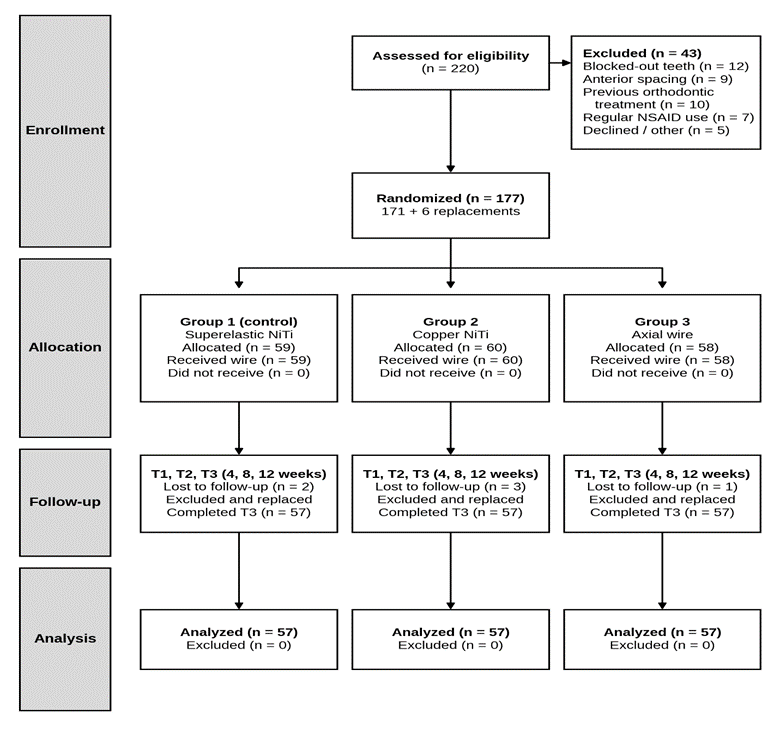
Figure#1: Consort Diagram of the Patients
This Quasi experimental study was carried out over a period of nine months from November, 2024 to July, 2025 in Orthodontic Department of DIKIOHS, DUHS after the approval of the research protocol from the Ethical Review Committee of the hospital [IRB-3595/DUHS/Approval/2024/340]. After obtaining written informed consent, a total of 171 patients with a mandibular Little’s Irregularity Index score ≤6 mm (moderate irregularity), aged 12–30 years, of either gender, were included. Participants were recruited using a non-probability consecutive sampling technique; however, randomization was performed only for group allocation to ensure internal validity. It was ensured that all patients were systemically and periodontally healthy. Patients with blocked-out teeth, anterior spacing, previous orthodontic treatment, or those regularly using NSAIDs were excluded. Sample size was calculated using G*Power software, considering mean Little’s Irregularity Index values of 4.84±0.85 mm (Group 1), 5.44±1.49 mm (Group 2), and 4.83±1.05 mm (Group 3), with 80% power and 5% level of significance. The calculation was performed using the F-test family (one-way ANOVA: fixed effects, omnibus), with an effect size (f) of 0.25 (medium effect), α error of 0.05, power (1–β) of 0.80, and three groups, resulting in a minimum sample size of 57 patients per group, as referenced by Sharma et al.⁶ Patients were divided into three groups randomly using lottery method. Group 1 (Superelastic NiTi) was taken as Control group. Group 2 (Copper NiTi) and Group 3 (Axial wire) were used as experimental groups. Because the three archwire types could potentially be distinguished by their physical appearance or colour, blinding of the operator was not possible. Participants were not informed of the specific study hypothesis or the comparative performance of the three archwire types. The outcome assessor, however, was blinded to group allocation during assessment of the study models to minimize observer bias. For random allocation, slips bearing the three group names were prepared in equal numbers, mixed thoroughly, and one slip was drawn for each enrolled participant, thereby assigning the participant to one of the three study groups. To ensure allocation concealment and minimize selection bias, the group assignment was not disclosed before the participant was enrolled and the baseline assessment was completed.
A specific operator used an indirect joining method with light cure glue (3M TransbondTM XT, St. Paul, Minnesota, USA) to bond the mandibular teeth of every patient. Before bonding, the teeth were cleaned and isolated, followed by etching of the enamel surfaces with 35% phosphoric acid for 15 seconds. The etched surfaces were thoroughly rinsed and gently air-dried. Transbond™ XT primer was then applied to the enamel surface according to the manufacturer’s instructions and air-dried. 3M Transbond™ XT light-cure adhesive was applied to the bracket bases, and the brackets were positioned and adjusted appropriately. The adhesive was light-cured for 10 seconds using an Ortholux™ LED curing light. All patients had their 0.018 × 0.025-inch slot MBT prescriptions (3M Gemini UnitekTM, Monrovia, California, USA) joined. 0.010" stainless steel ligature wire was used to fasten each archwire. The same operator created the mandibular study models and alginate impressions at four different time intervals: before treatment (T0), at four (T1), eight (T2), and twelve (T3) weeks. The resulting study models were then sent to a different researcher for blinding. Little’s Irregularity Index (LII) was used to assess mandibular anterior dental irregularity. It measures the linear displacement between the adjacent anatomical contact points of the six mandibular anterior teeth, from canine to canine. The five individual contact-point displacements were measured and summed to obtain the total LII score in millimetres.14
10 cases were chosen at random, and four weeks after the initial measurements—first by the chief observer and then by another observer—the measurements were redone to ascertain the measurement errors. To determine inter- and intra-examiner error, the Kappa test and Chronbach's alpha were used. The observers' agreement was determined to be good, with a kappa score of 0.89.
Data were entered & analyzed by utilizing SPSS statistical package version 27 software. Shapiro–Wilk test was applied to check normality of quantitative data such as age & LII score. Data was normally distributed as p-value was > 0.05, therefore, mean + Sd were computed for quantitative data. Frequency & percentages were calculated for gender. One-way Anova was applied to compare LII score among three groups. Repeated Measures ANOVA was applied for intragroup comparison. The assumption of sphericity was assessed using Mauchly’s test, and Greenhouse–Geisser correction was considered where appropriate. P-value < 0.05 was considered statistically significant.
RESULT:
An entirety of 171 patients were included in this research were divided randomly into three groups. The baseline characteristics of the study participants are presented in Table 1. The mean age of the patients in Group 1 (Superelastic NiTi) was 14.93 ± 2.45 years, in Group 2 (Copper NiTi) 14.40 ± 2.45 years, and in Group 3 (Co-axial NiTi) 14.80 ± 2.47 years. There was no statistically significant difference in age among three groups (p = 0.99). Similarly, gender distribution among groups was comparable. In Group 1, 23 (40.35%) were men & 34 (59.6%) were women; in Group 2, 27 (47.3%) were men & 30 (52.3%) were women; while in Group 3, 21 (36.8%) were men & 36 (63.1%) were women. The difference in gender distribution was not statistically significant (p = 0.509), as shown in table#1.
Table # 1: Baseline Characteristics of the Patients
|
Baseline Characteristics |
Group 1: Superelastic NiTi (n=57) |
Group 2: Copper NiTi (n=57)
|
Group 3: Co Axial wire (n=57)
|
P-value |
|
Age (Mean + SD) years |
14.93±2.45 |
14.4±2.45 |
14.8±2.47 |
0.99 |
|
Gender n(%):
|
23 (40.35%) 34 (59.6%) |
27 (47.3%) 30 (52.3%) |
21 (36.8%) 36 (63.1%) |
0.509 |
The comparison of LII scores at different time intervals is presented in Table 2. At baseline (T0), the mean LII scores were 4.80 ± 0.91 mm in the Superelastic NiTi group, 4.37 ± 0.90 mm in the Copper NiTi group, and 4.81 ± 0.70 mm in the Co-axial NiTi group indicating no significantly difference among the groups (p = 0.10). A progressive reduction in LII scores was observed in all three groups over the study period. At 4 weeks (T1), the mean LII scores decreased to 1.90 ± 1.10 mm, 2.10 ± 1.00 mm, and 1.83 ± 1.00 mm in Groups 1, 2, and 3 respectively, with no statistically significant difference among the groups (p = 0.709). At 8 weeks (T2), the mean LII scores were 1.32 ± 1.33 mm in the Superelastic NiTi group, 1.61 ± 1.10 mm in the Copper NiTi group, and 1.40 ± 0.97 mm in the Co-axial NiTi group, again showing no statistically significant intergroup difference (p = 0.584). At 12 weeks (T3), the LII scores further reduced to 0.53 ± 0.62 mm in Group 1, 0.70 ± 0.50 mm in Group 2, and 0.92 ± 0.59 mm in Group 3. Despite these numerical differences, the intergroup comparison remained statistically non-significant (p = 0.257).
Table # 2: Comparison of Little’s Irregularity Index at different time intervals among three archwire groups.
|
Groups |
T0 |
T1 |
T2 |
T3 |
P-value |
|
Group 1: Superelastic NiTi |
4.80±0.91 |
1.9±1.1 |
1.32±1.33 |
0.53±0.62 |
< 0.001 |
|
Group 2: Copper NiTi
|
4.37±0.9 |
2.1±1.0 |
1.61±1.1 |
0.7±0.5 |
< 0.001 |
|
Group 3: Co Axial wire
|
4.81±0.7 |
1.83±1 |
1.4±0.97 |
0.92±0.59
|
< 0.001 |
|
P-value |
0.10 |
0.709 |
0.584 |
0.257 |
|
The percentage reduction in LII over the 12-week period is summarized in Table 3. The Superelastic NiTi group demonstrated an 88.9% reduction (mean reduction: 4.27 mm), the Copper NiTi group 86.9% reduction (mean reduction: 4.67 mm), and the Co-axial NiTi group 84.0% reduction (mean reduction: 3.67 mm). Although the Superelastic NiTi group showed the highest percentage reduction, the difference in LII reduction among the three groups was not statistically significant (p > 0.05), indicating that the three archwire types produced comparable improvements in mandibular anterior alignment over the 12-week period.
Intragroup comparison using repeated-measures ANOVA demonstrated a statistically significant reduction in LII scores over time within each group (p < 0.001), indicating effective alignment with all three archwire types. The mean reduction in LII ranged from 3.67 to 4.67 mm across the three groups, corresponding to percentage reductions of 84.0% to 88.9%, demonstrating substantial improvement in mandibular anterior alignment within each group.
Table # 3: Percentage reduction in LII over a period in three groups
|
Group |
Mean Reduction (T0–T3) |
Reduction in (%) |
|
Superelastic NiTi |
4.27 mm |
88.9% |
|
Copper NiTi |
4.67 mm |
86.9% |
|
Co-axial NiTi |
3.89 mm |
84.8% |
DISCUSSION :
The initial phase of orthodontic treatment is mainly focused on relieving crowding in an efficient manner while keeping patient discomfort and biological side effects, such as root resorption, to a minimum. For this purpose, an ideal aligning archwire is expected to deliver light, continuous forces along with sufficient flexibility and resilience to support controlled tooth movement [12,13].In the present study, all three types of NiTi archwires—superelastic, copper NiTi, and seven-stranded coaxial showed a clear and statistically significant reduction in mandibular anterior crowding over the 12-week observation period (p < 0.001). However, when the groups were compared with each other at different time points, no statistically significant differences were found. This suggests that all three archwire types performed in a similar manner during the initial alignment phase. These findings are in agreement with earlier studies that also reported comparable alignment efficiency among different NiTi and multistranded archwires [13–15]. The mean LII fell from 4.37–4.81 mm at baseline to 0.53–0.92 mm at 12 weeks, and most of the correction occurred early: approximately 62% to 77% of the total reduction was achieved within the first four weeks in all three groups. This early, rapid alignment is in line with Atik et al. [23], who reported that most of the reduction in irregularity with Cu-NiTi and superelastic NiTi archwires occurred betweenbaseline and the second month.
The absence of a significant difference between superelastic NiTi and copper NiTi in the present study is consistent with several randomized trials. Pandis et al. [22] compared 0.016-inch Cu-NiTi with 0.016-inch NiTi for mandibular anterior crowding and found no significant difference in the time needed to alleviate crowding; they suggested that differences between laboratory and clinical loading patterns may cancel the laboratory-derived advantage of Cu-NiTi wires. Similarly, Atik et al. [23] found comparable reductions in Little’s irregularity index with Cu-NiTi and superelastic NiTi in adolescents (p = 0.581), although in the maxillary arch; Azizi et al. [24] found no significant difference in the irregularity index after six weeks between A-NiTi and Cu-NiTi wires in 88 patients; Abdelrahman et al. [25], in 74 patients, reported that superelastic, thermoelastic, and conventional NiTi archwires were similar in alignment efficiency during the initial aligning stage; and over 12 weeks, Aydin et al. [21] found similar alignment efficiency with NiTi and heat-activated Cu-NiTi archwires, while Keerthana and Chitra [1] found superelastic and heat-activated NiTi wires equally effective in alleviating lower anterior crowding.
With regard to the coaxial wire, our results agree with Sharma et al. [6], who compared 0.014-inch superelastic NiTi, 0.014-inch Cu-NiTi, and 0.016-inch seven-stranded coaxial NiTi in the mandibular arch of 45 patients over 12 weeks. In that trial, all three wires significantly reduced LII and the intergroup differences in LII were not significant, although the coaxial wire brought LII to zero in fewer patients at 12 weeks (14% versus 46.6% in each of the other two groups). Our findings are also in line with Noori and Yassir [26], who found that tubular coaxial NiTi and Cu-NiTi archwires produced comparable reductions in LII over 16 weeks (5.22 mm and 6.03 mm, respectively; difference not significant), and with a later two-trial study by the same group [8], in which superelastic NiTi, SmartArch, Cu-NiTi, and tubular coaxial NiTi archwires performed comparably in alignment efficiency. Sebastian et al. [20] likewise reported a similar reduction in crowding with coaxial and single-stranded superelastic wires in extraction cases. In contrast, Sebastian [27] reported significantly greater alignment with a coaxial superelastic NiTi wire than with a single-stranded superelastic wire over 12 weeks, and the Cochrane review [14] concluded that single-strand superelastic wires probably have a lower alignment rate over four weeks than coaxial superelastic wires, while noting that the remaining evidence was of low or very low certainty. This discrepancy may be partly methodological: Sebastian’s trial was small (24 patients) and measured alignment with a coordinate measuring machine rather than LII, which is insensitive to reciprocal rotations and vertical discrepancies. In our study, the coaxial group had a numerically lower LII at four weeks (1.83 mm versus 1.90 mm for superelastic NiTi), but this early difference was small and was not sustained; at 12 weeks the residual irregularity was numerically highest in the coaxial group (0.92 mm, compared with 0.53 mm for superelastic NiTi and 0.70 mm for Cu-NiTi), which is consistent with the observation of Sharma et al. [6] that the coaxial wire is less likely to achieve complete alignment in moderate crowding.
Evidence from systematic reviews and clinical trials further supports the observation that no single archwire consistently demonstrates superior performance in terms of alignment speed or patient-related outcomes such as discomfort [16]. The most recent Cochrane update concluded that there is insufficient evidence to determine whether any particular archwire material or size is superior to another [14], and the systematic review and meta-analysis of Papageorgiou et al. [28], which included 16 randomized trials, found only small and imprecise differences between initial aligning archwires. It has also been suggested that differences in clinical performance are often minimized by intraoral conditions, including saliva, ligation techniques, and biological variations in periodontal response [16–18].
Although a few studies have reported better performance with certain wire types, such as superelastic or multistranded archwires, the overall literature remains inconsistent [19,20]. These differences are likely influenced more by variations in study design, wire dimensions, and clinical protocols rather than true material superiority. Trials differ in the severity of baseline crowding (LII 5–9 mm in Noori and Yassir [8,26] versus ≤6 mm in the present study), the wire diameters and sequences used, the interval between visits, the arch studied, and the measurement method. Baseline severity may be particularly relevant: Pandis et al. [22] observed that arches with more severe crowding (irregularity index >5) took significantly longer to resolve, so differences between wires may become apparent only in more severe crowding, whereas the moderate irregularity in our sample left less scope for differences to emerge.
Patient age may also contribute: the mean age in our study (approximately 14.7 years) was close to that in Noori and Yassir [26] (15.45 years) and Pandis et al. [22] (13.1 years), and the rapid tissue remodeling of adolescents may allow any light-force NiTi wire to align teeth quickly, narrowing the differences among wires. In the present study, even though the superelastic NiTi group showed a slightly higher percentage reduction in crowding (88.9%), compared with 84.0% in the copper NiTi group and 80.9% in the coaxial group, this did not translate into any statistically significant advantage over the other groups, supporting the idea that their overall clinical effectiveness is comparable. Although standardized effect size estimates (e.g., partial eta squared) were not calculated, the reduction in Little’s Irregularity Index (LII) varied between approximately 81% and 89% for all three groups over the 12 weeks. These results suggest that all archwires produced a significant clinical improvement, although no statistically significant differences were found between the groups.
It is also important to consider that the properties observed in laboratory testing, such as superelastic behavior and force delivery characteristics, may not always reflect actual clinical performance. Once placed in the oral environment, factors such as bracket interaction, moisture, and individual biological response can significantly modify the behavior of orthodontic archwires, which may explain the lack of clear differences between the groups in this study [21]. From a clinical standpoint, because alignment efficiency was comparable, the choice among these wires may reasonably be guided by cost, availability, and clinician preference, as also suggested by Noori and Yassir [26].
This study has some limitations. Follow-up was limited to 12 weeks, and pain perception and root resorption were not assessed, although these are important outcomes when comparing aligning archwires. LII does not capture reciprocal rotations or vertical discrepancies of teeth, and the study was conducted at a single center. Patients lost to follow-up were excluded and replaced to maintain 57 patients per group, so the analysis was per-protocol rather than intention-to-treat. Future multicenter trials with larger samples, more severe crowding, longer follow-up, and patient-reported outcomes are recommended to confirm these findings.
CONCLUSION :
All three NiTi archwire systems—superelastic, copper NiTi, and seven-stranded coaxial were effective in producing a significant reduction in mandibular anterior crowding during the initial alignment phase, with no statistically significant differences observed among them over the 12-week period. Although the superelastic NiTi group showed a slightly higher percentage reduction, the overall clinical performance of all three archwires was comparable, but none of the archwires demonstrated clear superiority in initial alignment, and their selection may therefore depend on clinical preference and case requirements.
Financial support and sponsorship: Nil
Conflicts of interest: There are no conflicts of interest.
BIBLIOGRAPHY:
1. Keerthana P, Chitra P. Alleviation of Lower Anterior Crowding with Super- Elastic and Heat-Activated NiTi Wires: A Prospective Clinical Trial. Turk J Orthod. 2021 Jun;34(2):127-35. doi: 10.5152/TurkJOrthod.2021.20084.
2. Tahamtan S, Hajihosseini M, Sohrabi A. Comparison of alignment efficiency of different sizes of superelastic nickel-titanium archwires in the initial phase of fixed orthodontic treatment: a single-center, double-blind randomized clinical trial. Am J Orthod Dentofacial Orthop. 2024 Aug;166(2):104-111.
3. Elhanouty MZ, Al-Nimri KS, Alomari SA. A comparison between two orthodontic archwire sequences in terms of speed of alignment and root resorption: a randomized controlled clinical trial. Clin Oral Investig. 2023 Sep;27(9):5671-78. doi: 10.1007/s00784-023-05188-8.
4. Agrawal N, Sodawala J, Shukla S, Olfat YA, Taher AO, Olfat TA. Comparison of Initial Alignment Efficiency and Pain Perception of Three Copper-Nickel-Titanium Archwires of Different Manufacturers in Orthodontic Patients: A Randomized Clinical Trial. J Pharm Bioallied Sci. 2025 Jun;17(Suppl 2):S1701-S1703. doi: 10.4103/jpbs.jpbs_268_25.
5. Marzal R, Albaladejo A, Curto D, Curto A. Influence of orthodontic archwire (nickel-titanium versus copper-nickel-titanium) on pain in adult patients in the aligning phase of treatment with self-ligating brackets (two months of follow-up): a prospective observational pilot study. Head Face Med. 2025 Feb 25;21(1):9. doi: 10.1186/s13005-025-00483-z.
6. Sharma S, Verma S, Kumar V, Verma RK, Singh SP. Comparison of alignment efficacy and arch dimensions changes with superelastic-, heat-activated-, and seven stranded coaxial nickel-titanium archwires during fixed orthodontic treatment – A double-blind randomized clinical trial. APOS Trends Orthod. 2024;14:148-55. doi: 10.25259/APOS_44_2023
7. Chaudhary A, Goyal M, Mittal S, Aggarwal I, Vishavkarma P, Munjal A. Importance of frictional forces in orthodontic treatments: a review article. Int J Oral Health Dent. 2025;11(3):179–187.
8. Noori RM, Ahmed OK, Kadhum AS, Yassir YA, Di Blasio M, Russo D, Cicciù M, Minervini G. The Effectiveness of Conventional and Advanced Aligning Archwires: The Insights of Two Randomized Clinical Trials. Eur J Dent. 2025 Oct;19(4):985-997. doi: 10.1055/s-0044-1795080.
9. Uysal I, Yilmaz B, Atilla AO, Evis Z. Nickel titanium alloys as orthodontic archwires: a narrative review. Eng Sci Technol Int J. 2022;36:101277.
10. Kapgate S, Kumar A, Chaudhary V, Atram H, Gedam S, Charde P, et al. Mechanical properties and clinical significance of orthodontic wires. Int J Community Med Public Health. 2022;9(2):932–936. doi:10.18203/2394-6040.ijcmph20220047.
11. Sawas MA, Al Nassir MA, Nayas LM, Alabdulkarim MN, Faden FY, Alghamlas AS, et al. Mechanical properties and clinical significance of orthodontic wires. Int J Community Med Public Health. 2022 Feb;9(2):932–936. doi:10.18203/2394-6040.ijcmph20220047.
12. B Edward Giftson Noah, S.D. Milling Tania, S. Veerasankar, Bevin Shaga, Jebilla Pringle, Razick Nishadh M, Shahina Juneith. Comparison of Efficacy and Rate of Alignment using Three Different Arch wires: A Randomized Clinical Trial. Int J Orthod Rehabil 2025;16(4):39-51. doi: 10.56501/Intjorthodrehabil.164.ijor0053
13. Jain S, Sharma P, Shetty D. Comparison of two different initial archwires for tooth alignment during fixed orthodontic treatment-A randomized clinical trial. J Orthod Sci. 2021 Aug 4;10:13. doi: 10.4103/jos.JOS_17_20.
14. Liu C, Wei Z, Jian F, McIntyre G, Millett DT, Lai W, Wang Y. Initial arch wires used in orthodontic treatment with fixed appliances. Cochrane Database Syst Rev. 2024 Feb 6;2(2):CD007859. doi: 10.1002/14651858.CD007859.pub5.
15. Georgieva M, Andreeva L, Petrov V. Patient-reported pain during initial leveling with three types of nickel–titanium orthodontic archwires: A single-blinded comparative study. Appl Sci. 2025;15(17):9385. doi:10.3390/app15179385
16. Kumar IG, Jyothikiran H, Pradeep S, Suma S, Shubhankar SK. Orthodontic wire sequences and treatment efficiency: A systematic review. Asian J Dent Sci. 2025;8(1):477-487. doi:10.9734/AJDS/2025/v8i1267.
17. Riley M, Bearn DR. A systematic review of clinical trials of aligning archwires. J Orthod. 2009 Mar;36(1):42-51. doi: 10.1179/14653120722914.
18. Cioffi I, Piccolo A, Tagliaferri R, Paduano S, Galeotti A, Martina R. Pain perception following first orthodontic archwire placement-thermoelastic vs superelastic alloys: a randomized controlled trial. Quintessence Int. 2012;43:61-9.
19. Sandhu SS, Shetty VS, Mogra S, Varghese J, Sandhu J, Sandhu JS. Efficiency, behavior, and clinical properties of superelastic NiTi versus multistranded stainless steel wires: a prospective clinical trial. Angle Orthod. 2012 Sep;82(5):915-21. doi: 10.2319/100311-622.1.
20. Sebastian B, Abraham ME, Sarma PS, Cherian KK. Alignment efficiency of coaxial tubular superelastic nickel-titanium vs single-stranded superelastic nickel-titanium in relieving mandibular anterior crowding in extraction cases: A single-centre randomized controlled clinical trial. Orthod Craniofac Res. 2019 May;22(2):105-111. doi: 10.1111/ocr.12289.
21. Aydin B, Şenişık NE, Koşkan Ö. Evaluation of the alignment efficiency of nickel-titanium and copper-nickel-titanium archwires in patients undergoing orthodontic treatment over a 12-week period: A single-center, randomized controlled clinical trial. Korean J Orthod. 2018 May;48(3):153-162. doi: 10.4041/kjod.2018.48.3.153.
22. Pandis N, Polychronopoulou A, Eliades T. Alleviation of mandibular anterior crowding with copper-nickel-titanium vs nickel-titanium wires: a double-blind randomized control trial. Am J Orthod Dentofacial Orthop. 2009;136(2):152.e1–7.
23. Atik E, Gorucu-Coskuner H, Akarsu-Guven B, Taner T. A comparative assessment of clinical efficiency between premium heat-activated copper nickel-titanium and superelastic nickel-titanium archwires during initial orthodontic alignment in adolescents: a randomized clinical trial. Prog Orthod. 2019;20(1):46.
24. Azizi F, Extiari A, Imani MM. Tooth alignment and pain experience with A-NiTi versus Cu-NiTi: a randomized clinical trial. BMC Oral Health. 2021;21(1):431.
25. Abdelrahman RS, Al-Nimri KS, Al Maaitah EF. A clinical comparison of three aligning archwires in terms of alignment efficiency: a prospective clinical trial. Angle Orthod. 2015;85(3):434–9.
26. Noori RM, Yassir YA. Effectiveness of tubular coaxial nickel-titanium and copper nickel-titanium orthodontic aligning archwires: a randomized clinical trial. Int Orthod. 2023;21(4):100812.
27. Sebastian B. Alignment efficiency of superelastic coaxial nickel-titanium vs superelastic single-stranded nickel-titanium in relieving mandibular anterior crowding: a randomized controlled prospective study. Angle Orthod. 2012;82(4):703–8.
28. Papageorgiou SN, Konstantinidis I, Papadopoulou K, Jäger A, Bourauel C. A systematic review and meta-analysis of experimental clinical evidence on initial aligning archwires and archwire sequences. Orthod Craniofac Res. 2014;17(4):197–215.