The Frequency and Causes of Extended Programme Immunization (EPI) Vaccine Refusal in Jinnah Medical College Hospital (JMCH) A Tertiary Care Hospital.
- Hasnain Bukhari , MBBS, Department of Pediatrics, Jinnah Medical College Hospital, Karachi, Pakistan
- Asma Noureen , MBBS, FCPS, Department of Pediatrics, Jinnah Medical and Dental College / Hospital, Karachi, Pakistan
- Nadeem Noor , MBBS, DCH, FCPS, MRCPCH (UK), Department of Pediatrics, Jinnah Medical and Dental College, Karachi, Pakistan
- Mehtab Hussain , MBBS, FCPS, Department of Pediatrics, Jinnah Medical and Dental College, Karachi, Pakistan
- Mehrozia Nuzhat , MBBS, CHPE, FCPS, Department of Pediatrics, Jinnah Medical and Dental College, Karachi, Pakistan.
Article Information:
Abstract:
Objective:To determine the frequency and causes of Extended Programme on Immunization (EPI) vaccine refusal among parents of children attending Jinnah Medical College Hospital (JMCH), Karachi. Study Design: Descriptive cross-sectional study. Place and Duration of Study: This study was conducted in the Outpatient and Inpatient Pediatric Departments of Jinnah Medical College Hospital, Karachi, over a period of six months following approval from the College of Physicians and Surgeons Pakistan (CPSP). Methodology: A total of 122 parents of children aged 6 weeks to 5 years were enrolled using non-probability consecutive sampling. Data were collected through a semi-structured, interviewer-administered questionnaire assessing socio-demographic characteristics, vaccine status, and reasons for refusal or hesitancy. Data were analyzed using SPSS version 26, and associations were tested using chi-square or Fisher’s exact test, with a p-value <0.05 considered statistically significant. Results: Out of 122 participants, 38 (31.1%) parents reported vaccine refusal or hesitancy. Common reasons included fear of side effects (42.1%), religious or cultural beliefs (23.7%), misinformation (21.1%), and previous negative experiences (13.1%). Significant associations were found between hesitancy and low maternal education (p=0.012), low household income (p=0.004), and exposure to misinformation (p<0.001). Encouragingly, 60.5% of hesitant parents expressed willingness to vaccinate if provided accurate information by healthcare professionals.Conclusion: Vaccine hesitancy is a prevalent and modifiable barrier to EPI coverage in this setting. Interventions targeting misinformation, improving maternal education, and enhancing trust through healthcare provider engagement are crucial to increasing vaccine uptake
Keywords:
Article :
INTRODUCTION:
Vaccination is one of the most cost-effective public health interventions at a global level where the Expanded Programme on Immunization (EPI) was introduced in Pakistan to lower the childhood morbidity and mortality due to the vaccine-preventable diseases (VPDs) including poliomyelitis, measles, and tuberculosis 1,2. Alongside progress, full-course EPI coverage of children 12–23 months in Pakistan is approximately 66% and falls below WHO-mandated threshold targets 1.
Vaccine hesitancy and refusal – the vaccine delay or refusal to be vaccinated in the presence of vaccines – have become major obstacles for the attainment of an appropriate level of immunization 3,4. Internationally, the COVID-19 pandemic has led to increasing hesitancy estimates in low- and middle-income countries (LMICs), with rates of around 20%, that are even higher in certain regions 4,5. Parents' refusal of vaccines (including EPI vaccines as well as polio vaccines) has been recorded for children in Pakistan up to 25% 6.
There are several potential reasons for this reluctance. As for demand-side determinants of health services utilization behaviour, misinformation especially through social media, cultural and religious beliefs, low literacy rate, and distrust of the health system are implicated 7, 8. In both the routine and polio vaccine refusal, the influences have been presented in studies from high-risk areas of Pakistan. 9.
At the supply side, systemic obstacles including lack of vaccines, failures of cold chain, poor outreach and geographic inaccessibility all continue to impede immunization especially in rural areas 2. This situation has exacerbated during the pandemic where misinformation and COVID-19 transmission fears in health facilities have decreased service utilization in vaccination programs 5,10.
Studies have demonstrated that customized educational programs, community-based approaches, and peer counseling successfully increase parental trust and immunization adherence. Targeted health education was associated with increased vaccination coverage in under fives in a Randomized Control Trial in rural Sindh 12.
Pakistan’s current challenges in combating vaccine hesitancy and refusal Although increased awareness is helping, challenges are still significant for Pakistan when it comes to tackling vaccine hesitancy and refusal. Local frequency and causes of EPI v accine refusal, e.g. in tertiary care centres, are important information for public health strategies and improvement of vaccine coverage 1,2,6.
METHODOLOGY:
This descriptive cross-sectional study was carried out in Jinnah Medical College Hospital, (JMCH) Karachi, including Outpatient Department (OPD) and paediatric wards. The study was conducted for 6 months after approval of ethics committee ERC and CPSP. The objective was to establish the prevalence and reasons for EPI vaccine non-acceptance or hesitancy among caregivers of children aged 6 weeks to 5 years old.
Using the WHO sample size calculator, assuming a reported prevalence of vaccine hesitancy among future health care workers, 95% confidence level, and 5% error margin, a sample size of 122 participants was determined. The participants were chosen by non-probability consecutive sampling. All parents or guardians meeting the inclusion criteria and attending during the study period were eligible for participation. The inclusion criteria were parents of children of age between 6 weeks and 5 years of any sex presenting to OPD or admitted to pediatric ward with any illness. Written consent was obtained from all subjects. Exclusions were children unable to be vaccinated for medical reasons, those with immunocompromised state, anyone who had experienced a documented serious adverse event after vaccination in the past.
The information was gathered by trained staff members and the principal investigator using a semi-structured questionnaire in face-to-face interviews. The questionnaire asked for information on demographics (e.g., child age, parental education, employment, family size and income), access to a vaccination card, and a number of questions about vaccine hesitancy. Questions investigated beliefs about whether the vaccines work, experience with side effects, exposure to misinformation, influence of religious or community leaders, and practical barriers related to distance, wait time and the cost of travel. Interviews were carried out in Urdu that participants could understand, and which was also important for data credibility.
For this study, vaccine hesitancy was defined as the refusal or delay to accept EPI vaccines when they were available. Refusal was defined as receipt of no doses of one or more vaccines and was associated with reasons including misinformation or religious attitudes, whereas reluctance was considered as delayed vaccination due to indecision, unawareness, or access-related issues.
Statistical analysis was performed with IBM SPSS (statistical package for the social sciences) v. 26. Age of child and mother were reported as means and standard deviations as quantitative variables, while parental education, employment status, reasons of hesitancy were reported as frequencies and percentages as categorical variables. Chi-square test or Fisher’s exact test was used to analyse relationship between vaccine hesitancy and sociodemographic factors, and p-value of <0.05 were considered to indicate statistical significance.
RESULTS:
One hundred and twenty-two mother-father pairs for children between 6 weeks and 5 years were included in the research. Children’s ages ranged from 7 to 65 months with a mean ± standard deviation of 18.7 ± 10.2 months, 54% (n = 66) were male and 46% (n = 56) female. Majority of the participants were rural 36 (67.2%), and mean age of the mother was 28.3 ± 4.9. With respect to education, 38.5% of mothers and 29.5% of fathers were illiterate. Most mothers (59.8%) were housewives, and 18.9% of fathers were without work. Seventy-one-point three percent cases had monthly household income less than or equal to 15,000 PKR. Cellular phone access was higher in men (82.8%) than in women (61.5%). The summary of this information is shown in Table 1.
A total of 38 parents (31.1%) refused or delayed vaccination of their children and were determined to be vaccine hesitant and 84 parents (68.9%) were non-hesitant (Table 2, Figure 1). Of the 38 vaccine-hesitant parents, 55.3% had previously refused at least one vaccine and 44.7% expressed reluctance or delay. Fear of side effects (42.1%), religious/cultural beliefs (23.7%), misinformation (21.1%), and previous vaccine experiences (13.1%) were considered as main reasons for vaccine hesitancy (Table 3, Figure 2).
Univariate analysis demonstrated significant association between vaccine hesitancy and maternal education (p = 0.012), lower household income (p = 0.004) and exposure to misinformation (p < 0.001). Although a larger family size with more than 2 children was positively associated with hesitancy, this was not statistically significant (p = 0.08). Furthermore, vaccine-hesitant parents who felt vaccines could cause serious long-term side effects were 70.5%, and those who had encountered discouraging information from community members or non-medical sources were 63.2%.
Interestingly, 60.5% of ambivalent parents claimed being willing to change their mind after receiving good counselling from competent health professionals. These results underscore the existence of a high level of vaccine hesitancy and underline its modifiable existence. This is a window of opportunity for specific interventions.
Table 1: Demographic Characteristics of Participants
|
Variable |
Value |
|
Mean Age of Child (months) |
18.7 ± 10.2 |
|
Gender (Male) |
54% (n=66) |
|
Gender (Female) |
46% (n=56) |
|
Residence (Urban) |
67.2% (n=82) |
|
Residence (Peri-urban/Rural) |
32.8% (n=40) |
|
Mean Age of Mother (years) |
28.3 ± 4.9 |
|
Mother with No Formal Education |
38.5% (n=47) |
|
Father with No Formal Education |
29.5% (n=36) |
|
Mother Unemployed |
59.8% (n=73) |
|
Father Unemployed |
18.9% (n=23) |
|
Household Income <15,000 PKR |
71.3% (n=87) |
|
Mother Has Mobile Phone |
61.5% (n=75) |
|
Father Has Mobile Phone |
82.8% (n=101) |
Table 2: Frequency and Proportion of Vaccine Hesitancy
|
Vaccine Hesitancy Status |
Frequency (n) |
Percentage (%) |
|
Hesitant |
38 |
31.1 |
|
Non-Hesitant |
84 |
68.9 |
Table 3: Reported Causes of Vaccine Hesitancy
|
Cause of Hesitancy |
Frequency (n) |
Percentage (%) |
|
Fear of Side Effects |
16 |
42.1 |
|
Religious/Cultural Beliefs |
9 |
23.7 |
|
Misinformation |
8 |
21.1 |
|
Negative Past Experience |
5 |
13.1 |
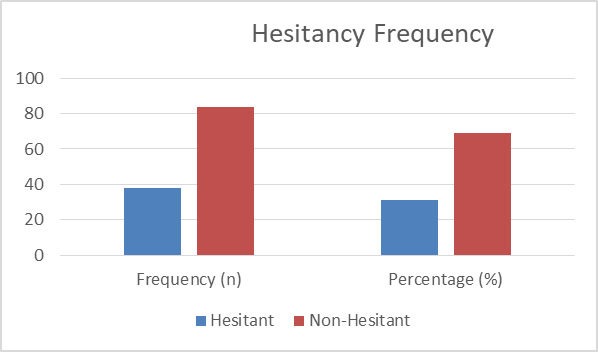
Figure 1.Statistic of Hesitancy Frequency
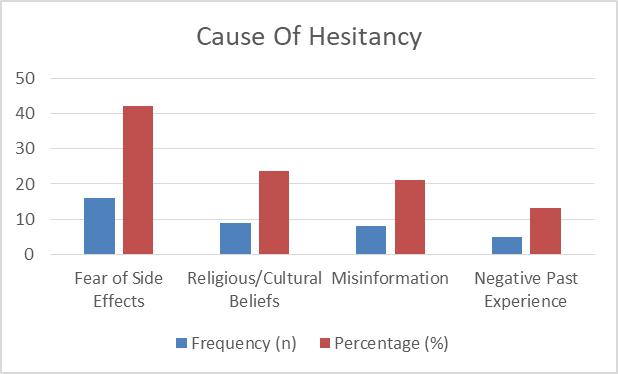
Figure 2.Cause of Hesitancy
DISCUSSION :
In the present study, 31.1% of parents of infants attending JMCH reported a delay or refusal of at least one dose of EPI vaccines which seems to be consistent with recent national level studies [13]. An across-sectional survey in Pakistan for the year 2025 presented a 22% refusal rate, which was independently associated with maternal unemployment, low income, and geographical distance 13. Parallel findings were reported during the COVID-19, where 29% of the Pakistani adult population postponed their routine immunization because concerned of side effects from the vaccines and their efficacy 14,15.
There was also a strong effect of sociodemographic variables, with maternal low education and poor socio-economic status (SES) being related to hesitancy
(p = 0.012 and p = 0.004). These results are in accordance with other studies from Pakistan and LMICs, where education, family income, and trust on health system have been identified as instrumental factors influencing parental decision-making about child immunization 13,14. A south Asian regional analysis using the 5C model (confidence, complacency, constraints, calculation, and collective responsibility) framework also found low vaccine confidence and logistical aspects to be important contributors 24.
Misinformation was a major driver in our cohort, 21% of hesitant parents were misguided, whereas >60% received discouraging messages from peers, media, or community leaders. These findings are consistent with international literature that shows misinformation can deter vaccine uptake 14,16. In rural Quetta, a randomised trial has demonstrated that mobile audio intervention could help increase the acceptance of vaccine by 30% by debunking the myths and enhancing the vaccine literacy 17.
Religious and cultural beliefs, where 23.7% hesitation was found in this study, still a persistent obstacle. Fears about vaccine purity, infertility misconceptions, or perceptions about Western infiltration have also been cited as reasons for resistance to both EPI and polio initiatives in Pakistan 18,19. The persisting distrust has been exacerbated by extremist proponents and conspiracy theories leading to decreasing immunization in conservative and underserved populations 20.
Encouragingly, 60.5% of hesitant parents in our study were open to re-evaluating their decision if counselled appropriately, by healthcare workers. This fact further highlights the importance of local trusted communication messages, as proposed by WHO’s SAGE committee 21. Systematic reviews have indicated that community-tailored interventions such as peer educators, facilitation of religious leaders’ involvement, and exposure to myth busting workshops have been successful in combating vaccine hesitancy 22, 23.
Although legal enforcement (e.g. threatening arrest for polio refusal in Sindh) may achieve short-term adherence, it runs the risk of undermining trust in the healthcare system in the longer term 24. Therefore, a collaborative, educating and empathetic manner is necessary for a lasting vaccine acceptance.
CONCLUSION :
This study draws attention to a notable burden of VHP in parents attending a tertiary care hospital, with more than 30% of parents either refusing a delay in EPI immunizations. Low maternal education, misinformation, socioeconomic hardships, and cultural beliefs accounted for major causes. Of note, most of the hesitant parents expressed willingness to reconsider given the appropriate counseling by health care providers. These findings emphasized the importance of directed community-based health education programs, empowering local religious leaders, and refining health communication. Creating trust in vaccination programs through rational and respectful dialogue is crucial to increasing immunization rates and saving children from vaccine-preventable diseases in Pakistan.
REFERENCES:
1. Ali M, Hassan F, Mahmood K. Trends in childhood immunization coverage in Pakistan: challenges and opportunities. Pak J Public Health. 2023;13(4):215–20.
2. Siddiqui AA, Zahidie A, Fatmi Z. Barriers to EPI vaccination in Pakistan: evidence from a cross-sectional household survey. BMC Health Serv Res. 2021;21(1):619.
3. Bukhari SS, Nasir A, Khan MU, Khwaja A. Sociodemographic determinants of vaccine hesitancy among parents in Pakistan. Vaccine. 2023;41(5):1189–95.
4. Ali I, Sadique S, Ahmed F, et al. COVID-19 vaccine hesitancy in Pakistan: a cross-sectional analysis. BMJ Open. 2022;12(6):e059499.
5. Wagner AL, Masters NB, Domek GJ, et al. Comparisons of vaccine hesitancy across LMICs during COVID-19. Vaccine. 2022;40(22):3081–9.
6. Hussain SF, Boyle P, Patel P, Sullivan R. Eradicating polio in Pakistan: an analysis of the critical barriers and next steps. Vaccine. 2020;38(23):3861–7.
7. MacDonald NE, Dubé E. Addressing the gaps in vaccine confidence research. Hum Vaccin Immunother. 2020;16(5):1050–2.
8. Ji M, Huang Z, Ren J, Wagner AL. Vaccine hesitancy and receipt of mandatory and optional pediatric vaccines in China. Hum Vaccin Immunother. 2022;18(5):2043025.
9. Khan A, Khan TM, Tohid H, et al. Beliefs and barriers associated with routine immunization in urban slums of Pakistan. Hum Vaccin Immunother. 2021;17(12):5037–44.
10. Hussain S, Ali R, Hussain Z. The role of misinformation in vaccine hesitancy among Pakistani parents: a narrative review. J Coll Physicians Surg Pak. 2023;33(1):32–6.
11. Domek GJ, Contreras-Roldan IL, O’Leary ST, et al. Measuring vaccine hesitancy: field testing the WHO SAGE tool in LMICs. Vaccine. 2021;39(5):760–9.
12. Khattak FH, Zahidie A, Fatmi Z. Educational intervention to increase childhood immunization uptake in rural Pakistan: a randomized controlled trial. East Mediterr Health J. 2025;31(1):35–42.
13. Bukhari S, Zaidi S, Ahmed A, et al. Determinants of vaccine hesitancy among caregivers of children under five in Pakistan: a cross-sectional study. BMC Public Health. 2025;25(1):388.
14. Imran M, Aslam M, Ali F, et al. Demographic factors associated with acceptance, hesitancy and refusal of COVID-19 vaccine among residents of Sukkur during lockdown. J Pak Med Assoc. 2023;73(2):245–9.
15. Khan F, Akhtar A, Iqbal S, et al. Socioeconomic determinants of vaccine hesitancy during the COVID-19 pandemic in Pakistan. Front Public Health. 2024;12:1178992.
16. Ali I, Ahmed F, Bukhari M. COVID-19 vaccine hesitancy and misinformation in South Asia: a cross-national comparative study. BMC Public Health. 2025;25(1):412.
17. Ghaffar A, Zubair S, Hanif K, et al. Educational mobile messaging improved immunization uptake in rural Pakistan: evidence from a randomized field trial. BMC Health Serv Res. 2023;23(1):899.
18. Alam M, Uddin M, Rahman A, et al. Religious beliefs and vaccine refusal: insights from polio campaigns in Pakistan. Vaccines (Basel). 2023;11(5):947.
19. Bhatti Z, Najam N, Rizvi A. Influence of community leaders on vaccination attitudes in conservative regions of Pakistan. East Mediterr Health J. 2024;30(2):134–40.
20. Ahmed S, Iqbal N, Raza M. Polio vaccination law enforcement and its impact on public trust in Sindh, Pakistan. Int J Infect Dis. 2023;129:120–4.
21. WHO SAGE Working Group. Report on vaccine hesitancy: recommendations for building trust and uptake. Geneva: World Health Organization; 2022.
22. Saeed A, Saleem H, Jamil M, et al. Systematic review of interventions to reduce vaccine hesitancy in LMICs. Syst Rev. 2022;11(1):124.
23. Younas M, Rafiq H, Tariq S. Application of the 5C model in vaccine hesitancy: A review from South Asia. BMC Public Health. 2025;25(1):562.
24. Haq R, Mehmood S, Ashraf N, et al. Exposure to vaccine misinformation and its effect on immunization uptake in Pakistan: a longitudinal study. Vaccine. 2024;42(3):513–9.