Prophylaxis against Surgical Site Infections Using Local as Well as Systemic Antibiotics
- Faria Javed , Postgraduate Resident, Department of Surgery, Lahore General Hospital (LGH), Lahore, Pakistan
- Amma Javed Moeen , Head of Department, Department of Surgery, Lahore General Hospital (LGH), Lahore, Pakistan
- Ambrina Kausar , Consultant surgeon, Department of Surgery, Sheikh Zayed Hospital, Rahim Yar Khan, Pakistan
- Zafar Iqbal , Senior Registrar, Department of Surgery, Sheikh Zayed Hospital, Rahim Yar Khan, Pakistan
- Shoaib Ahmed , Postgraduate Resident, Department of Surgery, Lahore General Hospital (LGH), Lahore, Pakistan
Article Information:
Abstract:
Objective: To compare the frequency of surgical site infection in patients undergoing clean and clean-contaminated elective abdominal surgery using combined local and systemic antibiotic versus systemic antibiotic alone prophylaxis. Study design: It was a Randomized controlled trial. Clinical trial registration NCT07478874. Place & duration of the study: Surgical Unit, Lahore General Hospital, Lahore, from July to November 2025. Methodology: Initially 320 patients were screened. 284 eligible patients aged above 18 years scheduled for elective abdominal surgeries were randomized into two groups. Group A received intravenous cefazolin plus local gentamicin, while Group B received intravenous cefazolin alone. Patients were followed for 30 days. Surgical site infection was assessed by Southampton wound scoring. Data were analyzed using SPSS version 26. Results: Out of 284 randomized patients, 191 completed 30-day follow-up. Baseline demographic and operative characteristics were comparable between groups (all p values > 0.05). Surgical site infection occurred in 9 (9.2%) patients in Group A and 18 (19.4%) in Group B, showing a statistically significant difference (p=0.044). On stratified analysis, a significant reduction in surgical site infection was observed only in the 36 to 55 years’ age group. Conclusion: Combined local and systemic antibiotic prophylaxis reduced surgical site infection more effectively than systemic cefazolin alone in clean and clean-contaminated elective abdominal surgery.
Keywords:
Article :
INTRODUCTION:
Surgical site infection is defined as an infection occurring at or near the operative site within 30 days of surgery and may involve the superficial incision, deep soft tissues, or the organ or space entered during the procedure. 1 It remains one of the most frequent healthcare-associated infections in surgical practice, accounting for nearly one-fifth of hospital-acquired infections among surgical patients and representing a persistent global problem despite advances in asepsis and perioperative care. 2,3 In abdominal surgery, the burden is particularly important, with reported rates varying according to procedure type and operative complexity, and tending to be higher in open and high-risk gastrointestinal operations. 4 These infections are associated with increased postoperative morbidity, prolonged hospitalization, readmission, reoperation, excess antimicrobial use, higher treatment costs, and increased mortality risk, making their prevention a major priority in modern surgical care. 5,6
Systemic antibiotic prophylaxis remains the standard way to prevent surgical site infections in clean and clean-contaminated operations, with cefazolin continuing to be the preferred agent in most routine procedures because of its efficacy, safety profile, and appropriate tissue penetration. 7 To improve local protection, adjunct strategies have been explored in which a local or topical antibiotic is added to the systemic regimen with the aim of achieving higher antimicrobial concentration at the wound and reducing early bacterial colonization. 8 However, the evidence so far has been mixed. Some studies suggest there may be benefits in certain gastrointestinal surgeries, but broader reviews have found that the added clinical value over standard systemic prophylaxis alone is limited or still unclear. 8–10 Concerns about antibiotic resistance and unnecessary antibiotic use also remain important. 11
Surgical site infections remain to impose a significant postoperative burden despite advancements in aseptic surgical techniques and perioperative care. The need for this study was felt because there is no universally accepted guideline to support routine use of combined local and systemic prophylaxis in these selected abdominal surgical procedures. The study was important because prophylactic regimens still vary among hospitals and surgeons and there is limited local evidence in Pakistan comparing local plus systemic versus systemic alone as a prophylaxis to prevent postoperative surgical site infections selected abdominal surgical procedures. The study supports rational antibiotic use in developing safer surgical practices and decreasing morbidity of patient.
MATERIAL AND METHOD :
This randomized controlled trial (NCT07478874) was conducted in Surgical Unit I, Lahore General Hospital, Lahore, over a period of six months from July 2025 to November 2025, after taking institutional review board (148 dated: 12-04-2024) and CPSP approval. Informed consent was obtained in writing prior to study participation. Baseline demographic and clinical information, including age, sex, BMI and planned surgical procedure, was recorded on a structured proforma.
Adult patients aged more than 18-75 years, of either gender, who were able to provide informed consent and were scheduled for clean or clean-contaminated elective surgical procedures, including umbilical hernia repair, inguinal hernia repair, non-perforated appendectomy, open and laparoscopic cholecystectomy, were considered eligible for inclusion. Patients with known allergy to cefazolin or gentamicin, those who had been using antibiotics for more than one week, and those with diabetes mellitus, previous surgical site infection, immunocompromised status, coronary artery disease, chronic obstructive pulmonary disease, or chronic kidney disease were excluded from the study.
A total of 284 patients were included, with 142 patients in each study arm. The sample calculation was done using a 5% level of significance, 80% power, and the proportion of patients with surgical site infections in the combined prophylaxis group and the systemic prophylaxis group being 2.5% and 9.5%, respectively. 12 Participants were recruited by non-probability consecutive sampling. Patients were then randomized into two groups by lottery method to ensure unbiased allocation.
Patients in Group A received combined prophylaxis consisting of intravenous cefazolin sodium 1 g given as a bolus along with local gentamicin sulphate 80 mg, administered intraoperatively by injection into the surgical wound. Patients in Group B received only intravenous cefazolin sodium 1 g as prophylactic systemic antibiotic coverage. Cefazolin was administered within 30 to 60 minutes before surgical incision.
All patients were observed during hospital stay and remained admitted in the surgical ward for 72 hours after the procedure, after which they were discharged if clinically stable. Follow-up was continued in the outpatient department for 30 days after surgery for assessment of wound status and detection of surgical site infection. Surgical site infection was defined as infection occurring within 30 days of the surgical procedure and was assessed by the Southampton wound scoring system. Grade 0 represented normal healing, Grade I normal healing with mild bruising or hematoma, Grade II erythema and other signs of inflammation, Grade III clear or hemo-serous discharge, Grade IV pus, and Grade V deep or severe infection with or without tissue breakdown or hematoma requiring aspiration. Any grade other than 0 was considered diagnostic for surgical site infection. Any grade other than Grade 0 was considered diagnostic of surgical site infection.
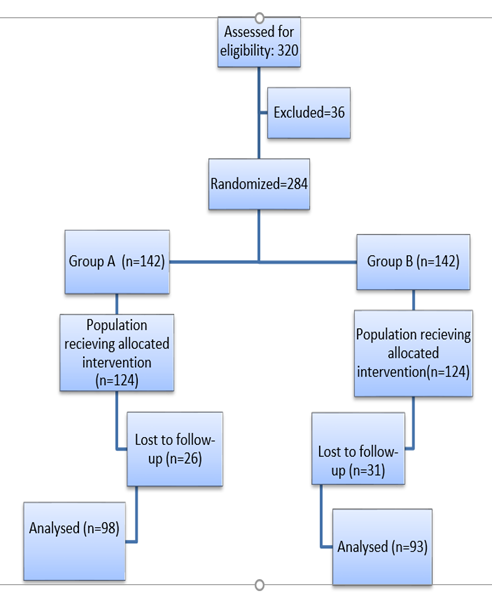
Figure 1: Consort flow diagram.
Data were entered and analyzed using SPSS version 26. Quantitative data collected for this study, such as age, body mass index, and time taken for surgery, were expressed in the form of mean ± standard deviation. Similarly, qualitative data collected for this study, such as gender and surgical site infection, were expressed in the form of frequency and percentage. The qualitative data collected for this study were compared using the Chi-square test, while quantitative data collected for this study were compared using the independent t-test. Stratification for age, gender, body mass index, and type of surgery was performed for this study. Post-stratification comparison for surgical site infection for both the groups was performed using the Chi-square test or Fisher’s exact test, where appropriate. The study considered a p-value less than 0.05 to be statistically significant.
RESULTS :
284 patients were randomized equally to Group A (combined local and systemic antibiotic prophylaxis) and Group B (systemic antibiotic prophylaxis alone), with 142 patients in each group. During 30-day, 57 patients were lost to follow-up, 26 from Group A and 31 from Group B. Among randomized patients, the baseline factors were comparable between groups (all p>0.05) (Table 1).
Table 1. Baseline demographic and operative characteristics of the study groups
|
Variable |
Group A |
Group B |
MD (95% CI) |
Test value (t/ χ²) |
p-value |
|
Age (years) |
45.54 ± 16.64 |
48.01 ± 15.82 |
-2.47 (-6.53 to 1.59) |
-1.197 |
0.232 |
|
Age category |
2.083 |
0.353 |
|||
|
18-35 years |
38 (30.6) |
29 (23.4) |
|||
|
36-55 years |
53 (42.7) |
54 (43.5) |
|||
|
56-75 years |
33 (26.6) |
41 (33.1) |
|||
|
Gender |
0.017 |
0.898 |
|||
|
Male |
71 (57.3) |
72 (58.1) |
|||
|
Female |
53 (42.7) |
52 (41.9) |
|||
|
BMI (kg/m²) |
27.36 ± 6.62 |
28.85 ± 6.35 |
-1.49 (-3.11 to 0.13) |
-1.811 |
0.071 |
|
BMI category |
1.715 |
0.634 |
|||
|
Underweight |
7 (5.6) |
6 (4.8) |
|||
|
Normal |
36 (29.0) |
31 (25.0) |
|||
|
Overweight |
51 (41.1) |
48 (38.7) |
|||
|
Obese |
30 (24.2) |
39 (31.5) |
|||
|
Type of surgery |
1.904 |
0.753 |
|||
|
Inguinal hernia repair |
35 (28.2) |
29 (23.4) |
|||
|
Laparoscopic cholecystectomy |
28 (22.6) |
36 (29.0) |
|||
|
Non-perforated appendectomy |
26 (21.0) |
28 (22.6) |
|||
|
Open cholecystectomy |
21 (16.9) |
18 (14.5) |
|||
|
Umbilical hernia repair |
14 (11.3) |
13 (10.5) |
|||
|
Operative time (minutes) |
81.53 ± 38.96 |
89.85 ± 40.24 |
-8.32 (-18.22 to 1.59) |
-1.653 |
0.100 |
|
Lost to follow-up |
0.569 |
0.450 |
|||
|
Yes |
26 (21.0) |
31 (25.0) |
|||
|
No |
98 (79.0) |
93 (75.0) |
Surgical site infection occurred in 9 (9.2%) patients in Group A and 18 (19.4%) in Group B (χ²=4.067, p=0.044). Southampton Grade 0 healing was recorded in 89 (90.8%) and 75 (80.6%) patients, respectively; score distribution was not significantly different (χ²=4.234, p=0.375) (Table 2).
Table 2. Comparison of postoperative outcomes between the study groups. (n = 191 Analysed)
|
Outcome variable |
Group A (n=98) |
Group B (n=93) |
Test value |
p-value |
|
SSI within 30 days |
4.067 |
0.044 |
||
|
Yes |
9 (9.2) |
18 (19.4) |
||
|
No |
89 (90.8) |
75 (80.6) |
||
|
Southampton wound score |
4.234 |
0.375 |
||
|
Grade 0 |
89 (90.8) |
75 (80.6) |
||
|
Grade 1 |
4 (4.1) |
8 (8.6) |
||
|
Grade 2 |
3 (3.1) |
5 (5.4) |
||
|
Grade 3 |
1 (1.0) |
3 (3.2) |
||
|
Grade 4 |
1 (1.0) |
2 (2.2) |
On stratified analysis, a significant reduction in SSI in favor of Group A was observed only in the 36-55 years’ age category, where SSI occurred in 2 (4.7%) patients in Group A versus 10 (24.4%) in Group B (χ²=6.678, p=0.010). No statistically significant difference was found in the 18-35 years or 56-75 years’ strata. Stratification by gender showed lower SSI frequencies in Group A among both males and females, although neither comparison was statistically significant. With respect to BMI, the overweight subgroup showed a lower SSI frequency in Group A, 3 (7.3%) versus 8 (22.2%), but the difference remained non-significant (χ²=3.478, p=0.062) (Table 3).
Table 3: Stratified Analysis of Surgical Site Infection Frequency by Age Category, Gender, BMI Category, and Type of Surgery (n = 191 Analysed)
|
Stratum |
Group A SSI: n (%) |
Group B SSI: n (%) |
p-value† |
|
A. By Age Category |
|||
|
18–35 years (n = 51) |
6 (20.7) |
4 (18.2) |
1.000 |
|
36–55 years (n = 84) |
2 (4.7) |
10 (24.4) |
0.010* |
|
56–75 years (n = 56) |
1 (3.8) |
4 (13.3) |
0.358 |
|
B. By Gender |
|||
|
Male (n = 113) |
6 (10.2) |
10 (18.5) |
0.204 |
|
Female (n = 78) |
3 (7.7) |
8 (20.5) |
0.104 |
|
C. By BMI Category |
|||
|
Underweight (<18.5 kg/m²) (n = 9) |
1 (20.0) |
2 (50.0) |
0.524 |
|
Normal weight (18.5–24.9 kg/m²) (n = 52) |
3 (10.7) |
4 (16.7) |
0.690 |
|
Overweight (25.0–29.9 kg/m²) (n = 77) |
3 (7.3) |
8 (22.2) |
0.101 |
|
Obese (≥30.0 kg/m²) (n = 53) |
2 (8.3) |
4 (13.8) |
0.678 |
|
D. By Type of Surgery |
|||
|
Inguinal hernia repair (n = 49) |
3 (10.7) |
1 (4.8) |
0.625 |
|
Laparoscopic cholecystectomy (n = 50) |
4 (18.2) |
7 (25.0) |
0.734 |
|
Non-perforated appendectomy (n = 42) |
0 (0.0) |
2 (9.5) |
0.488 |
|
Open cholecystectomy (n = 29) |
1 (6.2) |
4 (30.8) |
0.144 |
|
Umbilical hernia repair (n = 21) |
1 (9.1) |
4 (40.0) |
0.149 |
DISCUSSION :
The present study demonstrated that combined local and systemic antibiotic prophylaxis was associated with a significantly lower 30-day frequency of surgical site infection than systemic prophylaxis alone. Surgical site infection occurred in 9.2% of patients receiving combined prophylaxis compared with 19.4% of those receiving systemic cefazolin alone, yielding an absolute risk reduction of about 10% and indicating a clinically relevant reduction in postoperative wound morbidity. This study is important because surgical site infections remain a significant cause of delayed recovery, increased hospital stay, increased wound care, additional antibiotic use, and increased cost of treatment. Even small reductions in infection rates can result in significant improvements in patient recovery and efficient use of hospital resources. 5,13
The additional value of local antibiotic application, however, has remained uncertain. 14,15 Some procedure-specific studies have shown only numerical benefit without statistical significance. Hidalgo et al. (2024), in elective incisional hernia repair, reported SSI in 8.1% of the gentamicin group and 11.1% of the saline group (p=0.538), while the RINSE trial found no difference between antibiotic irrigation and saline in ventral hernia repair, with 30-day SSI rates of 9.09% and 9.91%, respectively (p=0.836). 16,17 Similarly, broader evidence syntheses have not supported routine topical antibiotic use across all clean wounds, particularly because benefit appears inconsistent across procedures and delivery methods. 12,18 In another study of hernia repair, surgical site infection occurred in three patients in the systemic cefazolin group, two patients in the topical gentamicin group, and none in the combined prophylaxis group, resulting in an overall infection rate of 1.8%. Although no infection was observed in the combined prophylaxis arm, the overall difference between groups was not statistically significant (p=0.285). 19
A biologically plausible explanation nevertheless exists for the reduction observed in the present study. Local antibiotic administration may produce high antimicrobial concentrations at the wound interface during the early period of bacterial contamination and may supplement systemic prophylaxis in tissues where perfusion is limited or dead space is present. At the same time, the mixed findings in previous literature suggest that any benefit is likely to be procedure-specific rather than universal and should therefore be interpreted with appropriate caution. 14
Age, body mass index, and procedure type are recognized risk factors of postoperative surgical site infection and may influence independently of the prophylactic regimen. 4,6 A statistically significant reduction in SSI was observed only in patients aged 36 to 55 years, whereas the younger and older strata did not show significant intergroup differences. This pattern is biologically probable because advanced age is associated with reduced tissue healing capacity, impaired immune responsiveness, and a greater burden of comorbidity. 20,21 The significant difference in this group may be due to the larger sample size within the 36 to 55 years age group. Surgical site infection frequencies were numerically lower with combined prophylaxis in both males and females, although sex-stratified differences did not reach statistical significance. Likewise, the overweight subgroup showed a clinically important but statistically non-significant reduction in SSI, which is consistent with the recognized adverse effect of increased adiposity on tissue perfusion, wound closure, and antibiotic tissue penetration. 4,6,20
The several strengths of the study include randomized controlled design, baseline comparability of both groups, use of standardized Southampton wound grading, and follow-up up to 30 days. The limitations of this study are that it is a single-center study with moderate numbers and loss to follow-up, there are small numbers within stratified and procedure-specific groups, consideration of co-morbidities, lack of antibiotic resistance assessment, and restricted generalizability to other surgical populations. The recommendations for further study are that there should be a larger study with multiple centers and evaluation of procedures and that there should be longer follow-up and cost-effectiveness analysis.
CONCLUSION :
This study demonstrated that combined local and systemic antibiotic prophylaxis is more effective than systemic antibiotic prophylaxis in reducing postoperative surgical site infection in patients undergoing clean and clean-contaminated elective abdominal procedures. The results support the potential role of local gentamicin prophylaxis in addition to standard systemic prophylaxis in reducing surgical site infection.
BIBLIOGRAPHY:
1. Hou Y, Collinsworth A, Hasa F, Griffin L. Incidence and impact of surgical site infections on length of stay and cost of care for patients undergoing open procedures. Surg Open Sci. 2023;11(1):1–18.
2. Zewdu S, Daniel A, Abebe A, Abraham Z, Elias H, Belete A. The burden of surgical site infection and associated factors among patients admitted to the surgical ward in resource-limited countries: an institutional-based cross-sectional study. Front Surg. 2025;12(1571033).
3. Rezaei AR, Zienkiewicz D, Rezaei AR. Surgical site infections: a comprehensive review. J Trauma Inj. 2025;38(2):71–81.
4. Zhang X, Yang Y, Liu P, Wang P, Li X, Zhu J, et al. Identification of Risk Factors and Phenotypes of Surgical Site Infection in Patients After Abdominal Surgery. Ann Surg. 2023;278(5):E988–94.
5. Shambhu S, Gordon AS, Liu Y, Pany M, Padula W V., Pronovost PJ, et al. The Burden of Health Care Utilization, Cost, and Mortality Associated with Select Surgical Site Infections. Jt Comm J Qual Patient Saf. 2024;50(12):857–66.
6. Xu ZH, Qu H, Gong ZZ, Kanani G, Zhang F, Ren YY, et al. Risk factors for surgical site infection in patients undergoing colorectal surgery: A meta-analysis of observational studies. PLoS One. 2021;16(10 October).
7. Klifto KM, Rydz AC, Biswas S, Hultman CS, Erdmann D, Phillips BT. Evidence-Based Medicine: Systemic Perioperative Antibiotic Prophylaxis for Prevention of Surgical-Site Infections in Plastic and Reconstructive Surgery. Plast Reconstr Surg. 2023;152(6):1154E-1182E.
8. Groenen H, Bontekoning N, Jalalzadeh H, Buis DR, Dreissen YEM, Goosen JHM, et al. Incisional Wound Irrigation for the Prevention of Surgical Site Infection: A Systematic Review and Network Meta-Analysis. JAMA Surg. 2024;159(7):792–800.
9. Pavlidis ET, Galanis IN, Pavlidis TE. Current opinions on the use of prophylactic antibiotics in patients undergoing laparoscopic cholecystectomy. World J Exp Med. 2025;17(3).
10. Futier E, Jaber S, Garot M, Vignaud M, Panis Y, Slim K, et al. Effect of oral antimicrobial prophylaxis on surgical site infection after elective colorectal surgery: multicentre, randomised, double blind, placebo controlled trial. Bmj. 2022;379.
11. Long DR, Cifu A, Salipante SJ, Sawyer RG, MacHutta K, Alverdy JC. Preventing Surgical Site Infections in the Era of Escalating Antibiotic Resistance and Antibiotic Stewardship. JAMA Surg. 2024;159(8):949–56.
12. Daood M, Jamal A, Mahar T, Hassan SS ul, Aleem S, Saeed R, et al. Comparison of Topical Antibiotics Plus Intravenous Antibiotics Versus Intravenous Antibiotics Alone in Prevention of Surgical Site Infection in Inguinal Hernia Repair: Topical vs. Intravenous Antibiotics in Preventing SSIs in Hernia Repair. J Heal Rehabil Res. 2024;4(3):1–6.
13. National Healthcare Safety Network. Centers for Disease Control and Prevention : Surgical Site Infection Event (SSI ). In: Centers for Disease Control and Prevention. Atlanta: CDC; 2021. p. 1–39.
14. Bratzler DW, Dellinger EP, Olsen KM, Perl TM, Auwaerter PG, Bolon MK, et al. Clinical practice guidelines for antimicrobial prophylaxis in surgery. Surg Infect (Larchmt). 2013;14(1):73–156.
15. Anderson DJ, Podgorny K, Berríos-Torres SI, Bratzler DW, Dellinger EP, Greene L, et al. Strategies to Prevent Surgical Site Infections in Acute Care Hospitals: 2014 Update. Infect Control Hosp Epidemiol. 2014;35(6):605–27.
16. Hidalgo NJ, Juvany M, Guillaumes S, Hoyuela C, Vidal Ó, Pera M. Effect of topical gentamicin in preventing surgical site infection in elective incisional hernia repair in a randomized controlled trial. Sci Rep. 2024;14(1).
17. Warren JA, Lucas C, Beffa LR, Petro CC, Prabhu AS, Krpata DM, et al. Reducing the incidence of surgical site infection after ventral hernia repair: Outcomes from the RINSE randomized control trial. Am J Surg. 2024;232:68–74.
18. Lin WL, Wu LM, Nguyen THY, Lin YH, Chen CJ, Huang WT, et al. Topical Antibiotic Prophylaxis for Preventing Surgical Site Infections of Clean Wounds: A Systematic Review and Meta-Analysis. Surg Infect (Larchmt). 2024;25(1):32–8.
19. Seker D, Seker GE, Bayar B, Ergul Z, Kulacoglu H. Topical antibiotic prophylaxis in Lichtenstein hernia repair and comparison of three methods: A prospective randomized clinical trial. Int J Abdom Wall Hernia Surg. 2021;4(2):58–63.
20. Cai W, Wang L, Wang W, Zhou T. Systematic review and meta-analysis of the risk factors of surgical site infection in patients with colorectal cancer. Transl Cancer Res. 2022;11(4):857–71.
21. Seidelman JL, Mantyh CR, Anderson DJ. Surgical Site Infection Prevention: A Review. Jama. 2023;329(3):244–52.