A Comparative Study Between Norethisterone Plus Calcium Dobesilate Versus Norethisterone Alone in The Treatment of Menorrhagia of Dysfunctional Uterine Bleeding Origin.
- Zarish Zia , Postgraduate Resident, Bahawal Victoria Hospital Bahawalpur, Punjab, Pakistan.
- Shakila Yasmeen , Professor, Gynecology and Obstetrics, Bahawal Victoria Hospital Bahawalpur, Punjab, Pakistan.
- Ayesha Yaqeen , Postgraduate Resident, Bahawal Victoria Hospital Bahawalpur, Punjab, Pakistan.
- Rukhsana Aziz , Senior Registrar, Bahawal Victoria Hospital Bahawalpur, Punjab, Pakistan.
- Madiha Fida , Postgraduate Resident, Bahawal Victoria Hospital Bahawalpur, Punjab, Pakistan.
- Najm ul Sehar , Postgraduate Resident, Bahawal Victoria Hospital Bahawalpur, Punjab, Pakistan.
Article Information:
Abstract:
Objective: To compare the efficacy of norethisterone plus calcium dobesilate versus norethisterone alone in the treatment of menorrhagia due to DUB. Study design: Quasi-experimental study Place and duration of study: The study was conducted in Obstetrics & Gynecology Department, Bahawal Victoria Hospital, Bahawalpur from September 2025 to November 2025. Methodology: This study enrolled 130 women, age 20 to 45 years, presenting with menorrhagia secondary to DUB. Patients were allocated into two groups (n=65 each). Group A received norethisterone alone and Group B received norethisterone plus calcium dobesilate. Treatment was administered over three consecutive cycles. Primary outcomes were cessation of abnormal bleeding and improvement in hemoglobin levels. Secondary outcome was restoration of regular menstrual cycles. Data was analyzed using SPSS version 25.0. Independent t-test/Mann–Whitney U test and Chi-square/Fisher’s exact test were applied, with p≤0.05 considered statistically significant. Stratified analysis was performed for age, BMI, parity, baseline hemoglobin and duration of menorrhagia. A p-value ≤0.05 was considered significant. Results: Cessation of abnormal bleeding was achieved in 60 (92.3%) of patients in Group B versus 50 (76.9%) in Group A (p=0.015). Hemoglobin rise was greater in Group B (11.10 ± 0.79 g/dL) than Group A (10.77 ± 0.98 g/dL; p=0.038). Restoration of regular menstrual cycles was higher in Group B with 57 (87.7%) patients compared to Group A with 47 (72.3%) patients (p=0.028). Conclusion: Combination therapy with norethisterone plus calcium dobesilate is more effective than norethisterone alone in controlling menorrhagia, improving hemoglobin and restoring regular menstrual cycles in women with DUB.
Keywords:
Article :
INTRODUCTION:
Dysfunctional uterine bleeding (DUB) results from disordered functions of uterus, in the absence of any detectable organic pathology.1 The prevalence of DUB has been reported to range from 10% to 30%.2 DUB is commonly manifested as menorrhagia whose reported prevalence among Pakistani women varies widely, ranging from 6.7% to 48%.3 Menstrual disorders, including menorrhagia, adversely impact a woman’s physical, social, mental and financial well-being.4
Traditionally, hysterectomy has been the mainstay of treatment for menorrhagia. However, over the past two decades, management has increasingly shifted toward non-surgical options that are more cost effective and preserve the uterus and fertility.5 Hormonal therapies such as norethisterone (progestin) have been shown to regulate endometrial proliferation and decrease excess blood loss.6 Norethisterone has side effects including breakthrough bleeding, mood changes and gastrointestinal discomfort.7
Calcium dobesilate is a non-hormonal substance with anti-inflammatory and vasoprotective properties.8 Calcium dobesilate causes decrease in vascular permeability and correction of microcirculation,9 thereby it may reduce menstrual blood loss. Particularly, this combination therapy may be of an advantage in patients with refractory menorrhagia or with the higher risk of vascular fragility and inflammation.
A descriptive case series comparing efficacy of norethisterone and calcium dobesilate in managing menorrhagia in DUB was done by Ch et al. which involved 600 women.10 Calcium dobesilate was administered to Group A and the Group B received norethisterone. Group A in terms of cessation of bleeding showed a success rate of 83.3% and Group B a success rate 98%. The success rate of the medical treatment (combined effectiveness of the two treatments used in the study, was Rx = (250 + 294) / 600 = 90.67%.
Evidence addressing the combination of norethisterone with calcium dobesilate compared to norethisterone alone as therapy of menorrhagia is remarkably lacking. This study aimed to compare success rates between norethisterone plus calcium dobesilate versus norethisterone alone in the treatment of menorrhagia of dysfunctional uterine bleeding origin. The present study attempted to deliver evidence of the efficacy and safety of combining norethisterone with calcium dobesilate for menorrhagia associated with DUB that may be the treatment of choice for such patients.
METHODOLOGY:
This quasi-experimental study was conducted in Obstetrics & Gynecology Department, Bahawal Victoria Hospital, Bahawalpur from Sep 2025 to Nov 2025, after getting approval from hospital ethical review committee (IRC no 406/DME/QAMC Bahawalpur dated 20/09/2025). Sample size of 130 patients was calculated using online calculator (www.openepi.com) taking success rate of the medical treatment Rx = 90.67%10, confidence level 95% and 5% margin of error. Non probability consecutive sampling technique was employed.
Women aged 20–45 years presenting with menorrhagia as patient-reported heavy menstrual bleeding lasting more than 7 days or requiring frequent pad changes (i.e., soaking >5 pads/day or changing every 1–2 hours, passage of clots >2.5 cm) due to dysfunctional uterine bleeding, non-pregnant women without any ongoing hormonal therapy or anticoagulant use and hemodynamically stable patients with no history of acute hemorrhagic episodes were included in this study. Women with organic causes of abnormal uterine bleeding (e.g. adenomyosis, or malignancy), patients with known endocrine disorders, patients with coagulation disorders, patients with chronic illnesses such as diabetes, renal disease or liver dysfunction that may affect treatment outcomes, women with known allergies or hypersensitivity to norethisterone or calcium dobesilate and pregnant or lactating women were excluded from this study.
Total 130 patients fulfilled inclusion and exclusion criteria during the study period and were enrolled in this study. These patients were divided in two groups by lottery method for the interventions being studied. Although a lottery method was used for group allocation, no formal randomization protocol or allocation concealment was employed; therefore, the study was treated as quasi-experimental. Each group included 65 patients. Patients to be treated by norethisterone alone were kept in group A and by norethisterone plus calcium dobesilate were kept in group B. Baseline data was collected including hemoglobin levels, BMI, parity, duration of menorrhagia and menstrual cycle regularity.
Management of patients in Group A began with Norethisterone 5 mg taken three times daily for a duration of 10 days, initiated on any day during an episode of abnormal bleeding. In most participants, the bleeding settled within about three days. Once the 10-day course was completed, a withdrawal bleed typically followed. The first day of this withdrawal bleed was considered “day 1” of a new cycle. From this point onward, the women were instructed to take Norethisterone 5 mg three times daily from day 5 through day 25 of the cycle. Stopping the medication at day 25 was expected to induce another withdrawal bleed. This 21-day hormone regimen was then repeated for the next three cycles. Participants were asked to report back on the first day of each withdrawal bleed so that the pattern and regularity of their cycles could be evaluated. Women who continued to experience irregular or unscheduled bleeding during treatment were advised to return for assessment at any time within the cycle. In Group B, patients received two capsules of Calcium Dobesilate 500 mg twice daily for the first month, followed by one capsule twice daily for the subsequent two months. In addition, they were administered Norethisterone following the same regimen as Group A.
Patients were instructed to monitor and report their menstrual bleeding patterns, including the number of pads or tampons used per day and the duration of bleeding. Patients were evaluated monthly for three consecutive months to assess bleeding status, hemoglobin levels and menstrual cycle regularity. Pre- and post-treatment hemoglobin levels and cycle regularity were assessed by a consultant gynecologist with a minimum of five years of clinical experience. The primary outcome was the cessation or significant reduction (≥50%) of abnormal bleeding within first three consecutive cycles of therapy, confirmed by patient report and hemoglobin level improvement of ≥1 g/dL from baseline. Secondary outcome included restoration of regular menstrual cycles defined as menstrual cycles occurring every 21 to 35 days with a variation of ±3 days from the previous cycle, based on self-reported cycle length over three consecutive cycles of therapy. All relevant data were systematically recorded in a standardized proforma. Patient flow diagram is shown in figure-1.
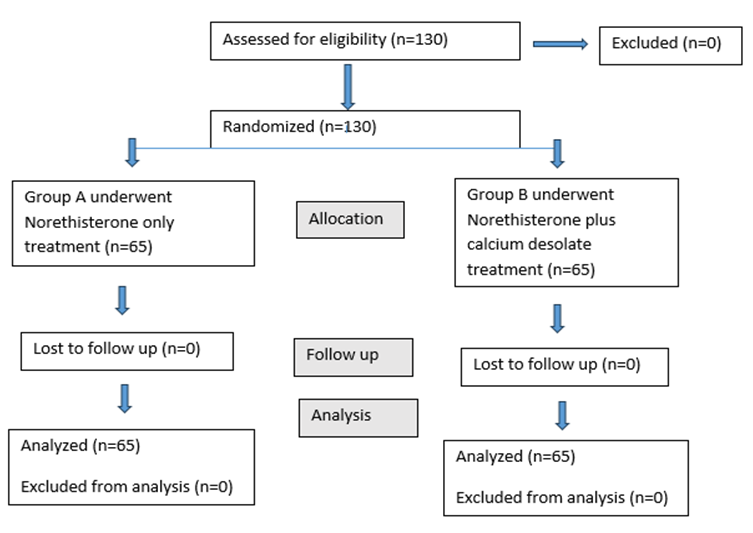
Figure-1: Patient flow diagram (n=130)
Data were entered and analyzed using statistical package for social sciences version 25.0. Continuous variables were assessed for normality using the Shapiro-Wilk test and presented as mean ± standard deviation for normally distributed data or median with interquartile range for non-normal data. Categorical variables were summarized as frequencies and percentages. Baseline characteristics between the two groups were compared using independent t-test or Mann-Whitney U test for continuous variables and Chi-square test for categorical variables. The primary outcomes, cessation of bleeding and improvement in hemoglobin levels, and the secondary outcome, restoration of regular menstrual cycles, were compared between groups using the Chi-square or Fisher’s exact test. Stratified analysis was performed to account for potential confounders such as age, BMI, parity, baseline hemoglobin and duration of menorrhagia. A p value of ≤0.05 was considered statistically significant.
RESULTS:
A total of 130 women were included, with 65 patients in each treatment group. Baseline characteristics including age, BMI, parity, duration of menorrhagia and baseline hemoglobin levels were comparable between the two groups, with no statistically significant differences observed (Table-I).
Table-I: Comparison of summary of basic demographics and clinical data (n=130)
|
Variable |
Group A Norethisterone only (n = 65) |
Group B Norethisterone + Calcium Dobesilate (n = 65) |
p-value |
|
Age - mean years ± SD |
32.93 ± 5.36 |
34.91 ± 5.25 |
0.035 (*) |
|
BMI - - median (IQR) |
26.60 (4.40) |
26.80 (4.40) |
0.298 (**) |
|
Parity - median (IQR) |
2.00 (2.00) |
1.00 (2.00) |
0.444 (**) |
|
Pre-treatment Hb - mean g/dl ± SD |
9.70 ± 0.85 |
9.72 ± 0.76 |
0.888 (*) |
|
Menorrhagia duration - mean months ± SD |
8.21 ± 2.85 |
8.02 ± 3.37 |
0.726 (*) |
*BMI: Body Mass Index, Hb: Haemoglobin, independent t-test (*) and Mann-Whitney U test (**) applied
Cessation of abnormal uterine bleeding and rise in hemoglobin levels following treatment was achieved in a statistically significant higher proportion of patients in Group B (n=60) as compared to Group A (n=50) (p ≤ 0.05). However, the hemoglobin increment was significantly greater in Group B (11.10 ± 0.79) compared to Group A (10.77 ± 0.98) with a p value of 0.038 (table-II). Restoration of regular menstrual cycles was observed more frequently in patients receiving combination therapy compared to norethisterone alone, with the difference reaching statistical significance (p ≤ 0.05) as shown in table-II.
Table-II: Comparison of post treatment abnormal bleeding control, Hb improvement and cycle regularity (n=130)
|
Variable |
Group A Norethisterone only (n = 65) |
Group B Norethisterone + Calcium Dobesilate (n = 65) |
p value |
|
|
Cessation of abnormal bleeding |
Yes, n (%) |
50 (76.92%) |
60 (92.30%) |
0.015 (***) |
|
No, n (%) |
15 (23.08%) |
5 (7.69%) |
||
|
Hb improvement > 1g/dl |
Yes, n (%) |
50 (76.92%) |
60 (92.30%) |
0.027 (***) |
|
No, n (%) |
15 (23.08%) |
5 (7.69%) |
||
|
Cycles regularity |
Yes, n (%) |
47 (72.30%) |
57 (87.69%) |
0.028 (***) |
|
No, n (%) |
18 (27.70%) |
8 (12.31%) |
||
|
Post-treatment Hb - mean g/dl ± SD |
10.77 ± 0.98 |
11.10 ± 0.79 |
0.038 (*) |
|
*BMI: Body Mass Index, Hb: Haemoglobin, Chi-square test (***) and independent t-test (*) applied.
Post-stratification analysis was performed to assess the potential influence of age, BMI, parity, duration of menorrhagia and pre-treatment hemoglobin on treatment outcomes. The treatment effect on cessation/ control of abnormal uterine bleeding remained generally consistent across most subgroups. Statistically significant differences were observed in patients with age ≤35 years (p-0.033), BMI >25 kg/m² (p = 0.003), parity <3 (p = 0.034), duration of menorrhagia >6 months (p = 0.006) and pre-treatment hemoglobin <10 g/dL (p = 0.003), as shown in Table-III.
Table-III. Stratified Analysis of Primary Outcome by various clinical variables (n=130)
|
Variable |
Subgroup |
Bleeding Cessation/ control |
Group A (n=65) |
Group B (n=65) |
p value |
|
Age in years |
≤35 |
Yes, n (%) |
31 (47.69%) |
31(47.69%) |
0.033 (****) |
|
No, n (%) |
10(15.38%) |
2(3.07%) |
|||
|
>35 |
Yes, n (%) |
19(29.23%) |
29(44.61%) |
0.268 (****) |
|
|
No, n (%) |
5(7.69%) |
3(4.61%) |
|||
|
BMI in kg/m2 |
≤25 |
Yes, n (%) |
20(30.76%) |
20(30.76%) |
1.000 (****) |
|
No, n (%) |
3(4.61%) |
3(4.61%) |
|||
|
>25 |
Yes, n (%) |
30(46.15%) |
40(61.53%) |
0.003 (****) |
|
|
No, n (%) |
12(18.46%) |
2(3.07%) |
|||
|
Parity count |
≤3 |
Yes, n (%) |
41(60.07%) |
55(84.61%) |
0.034 (***) |
|
No, n (%) |
12(18.46%) |
5(7.69%) |
|||
|
>3 |
Yes, n (%) |
9(13.84%) |
5(7.69%) |
0.515 (****) |
|
|
No, n (%) |
3(4.61%) |
0(0%) |
|||
|
Baseline Hb level in g/dl |
<10 |
Yes, n (%) |
25(38.46%) |
35(53.84%) |
0.003 (****) |
|
No, n (%) |
14(21.53%) |
3(4.61%) |
|||
|
≥10 |
Yes, n (%) |
25(38.46%) |
25(38.46%) |
1.000 (****) |
|
|
No, n (%) |
1(1.53%) |
2(3.07%) |
|||
|
Duration of menorrhagia in months |
≤6 |
Yes, n (%) |
15(23.07%) |
18(27.69%) |
1.000 (****) |
|
No, n (%) |
1(1.53%) |
2(3.07%) |
|||
|
>6 |
Yes, n (%) |
35(53.84%) |
42(64.61%) |
0.006 (****) |
|
|
No, n (%) |
14(21.53%) |
3(4.61%) |
* BMI: Body Mass Index, Hb: Haemoglobin, Chi square test (***) and Fischer’s exact test (****) applied
DISCUSSION :
In this study of 130 women with menorrhagia due to DUB, treatment with norethisterone plus calcium dobesilate was associated with significantly higher rates of bleeding cessation, greater hemoglobin improvement and more frequent restoration of regular menstrual cycles compared to norethisterone alone. Jaiswal et al. studied 308 women with AUB, among which bleeding control within 4 hours of norethisterone 10 mg CR was achieved in 63% patients (n=193).11 Breakthrough bleeding did not occur in 61% (n=187) and withdrawal bleeding was observed in 70% patients (n=216) within 24–72 hours of the last dose. Heavy bleeding persisted in only 7% of cases. Yasin et al. reported, in study involving 100 non-pregnant women presenting with irregular menstruation, that after three months of norethisterone therapy, 38 patients (76%) achieved cycle regularity, whereas 12 patients (24%) continued to experience irregular cycles despite good compliance.12 In another study, patients receiving norethisterone acetate demonstrated a mean hemoglobin rise of 1.91 ± 0.66 g/dL.13 The mean reduction in endometrial thickness at six months was –6.20 ± 2.66 mm.
A prospective audit evaluated high-dose norethisterone for controlling AUB in adolescents.14 The study included 29 girls in whom bleeding control was achieved within an average of 46 hours, even though nearly one-third initially required transfusion. Another study evaluating norethisterone for AUB reported meaningful improvement in bleeding patterns and quality-of-life measures.15 Women showed a steady decline in PBAC scores over three treatment cycles, with marked reduction in perceived blood loss and limitations in daily activities.
Multiple studies stated that calcium dobesilate exhibits a combination of antioxidant, anti-inflammatory and vasoprotective effects and that its use may help preserve endothelial integrity.16,17 A similar study mentioned calcium dobesilate improves microvascular circulation and protects endothelial function by inhibiting platelet aggregation and enhancing cAMP levels.18 These effects may help reduce menstrual blood loss, supporting its use alongside hormonal therapy in dysfunctional uterine bleeding as shown in our study.
Zhang et al. validated in their study that calcium dobesilate can decrease blood viscosity, inhibit platelet activity, reduce capillary permeability and improve microcirculatory and hemorheological function.19 Similar findings have been reported in another study supporting the use of calcium dobesilate for various bleeding and microvascular disorders20. These observations align with our study, suggesting that the addition of calcium dobesilate enhances therapeutic outcomes compared to hormonal therapy alone. The study has several limitations. First, the quasi-experimental design and single-center setting may limit generalizability. Second, the sample size, though adequate for primary outcomes, may not be powered for detailed subgroup analyses. Third, reliance on patient-reported menstrual patterns could introduce reporting bias and objective measures such as PBAC scores were not used. Finally, the short follow-up duration of three cycles precludes assessment of long-term efficacy and recurrence rates. Future multicenter randomized controlled trials with longer follow-up are recommended to confirm these findings.
CONCLUSION :
Combination therapy with norethisterone plus calcium dobesilate is more effective than norethisterone alone for the management of menorrhagia associated with DUB, resulting in higher rates of bleeding cessation, greater hemoglobin improvement and improved menstrual cycle regularity. The treatment is particularly beneficial in patients with younger age, higher BMI, lower parity, prolonged menorrhagia and lower baseline hemoglobin. This approach offers a safe, non-surgical alternative that can enhance quality of life while minimizing the side effects associated with hormonal therapy alone.
BIBLIOGRAPHY:
1. Rizwana T, Al-Fareed Z, Ilyas M, Maryam J, Usmani SS. PREVALENCE OF DYSFUNCTIONAL UTERINE BLEEDING IN PATIENTS WITH SUB FERTILITY. Pak Postgrad Med J 2022;32(02):54–57 https://doi.org/10.51642/ppmj.v32i02.424
2. Abebe M, Melaku G, Habtamu EH, Tsion MT. Abnormal uterine bleeding and its associated factors among reproductive-age women who visit the gynecology ward in Dilla University General Hospital, Southern Ethiopia, 2022. BMC women’s health 2024;24(1):284. https://doi.org/10.1186/s12905-024-03128-6
3. Habib S, Shams G, Zainab N, Akhtar R, Afridi S. Efficacy, safety, patient satisfaction, discontinuation, and need for hysterectomy in patients using mirena lng-ius as treatment of HMB. Khyber J Med Sci 2022;15(1):18–23. https://doi.org/10.70520/kjms.v15i1.264
4. Gett S, Singh S. Comparison between Ormeloxifene and Norethisterone in reducing menorrhagia in dysfunctional uterine bleeding. Int J Reprod Contracept Obstet Gynecol. 2018;7(12):4966-4972. https://doi.org/10.18203/2320-1770.ijrcog20184949
5. Kai J, Dutton B, Vinogradova Y, Hilken N, Gupta J, Daniels J. Medical treatment for heavy menstrual bleeding in primary care: 10-year data from the ECLIPSE trial. Br J Gen Pract 2022;72(725):e857–864. https://doi.org/10.3399/BJGP.2022.0260
6. Das P, Nafees E, Roy S. To compare the success in treatment of DUB with Ormeloxifene vs Norethisterone. Int J Acad Med Pharm 2023;5(3):1955-1960. https://dx.doi.org/10.47009/jamp.2025.7.5.131
7. Arun MB, Banerjee D, Bhardwaj F, Mallya S, Singal R, Sharma S, et al. Effect of norethisterone dose and duration in the management of abnormal uterine bleeding: a narrative review and case report. Drugs Context 2024;13:1–19. https://dx.doi.org/10.7573/dic.2024-4-1
8. Simó R, Simó-Servat O, Solà-Adell C, Bogdanov P, Hernández C. Mechanisms of retinal neuroprotection of calcium dobesilate: therapeutic implications. Neural Regen Res 2017;12(10):1620. https://dx.doi.org/10.4103/1673-5374.217333
9. Kim JT, Lee KH, Lee MW. Effect of calcium dobesilate on macular microvasculature in patients with diabetic retinopathy. PLOS one 2025;20(6):e0325714. https://doi.org/10.1371/journal.pone.0325714
10. Ch SM, Lali B. Use of calcium dobesilate and norethisterone in treatment of menorrhagia of dysfunctional uterine bleeding origin. J Surg Pakistan 2017;22(2):65-67. https://dx.doi.org/10.21699/jsp.22.2.8
11. Jaiswal A, Boruah AM, Jaiswal P, Chinda M. Real-world Safety and Effectiveness Analysis of Norethisterone in the Management of Abnormal Uterine Bleeding. J South Asian Fed Obstet Gynecol 2022;14(3):313–316. https://dx.doi.org/10.5005/jp-journals-10006-2048
12. Yasin A, Afzal M, Aziz U. A Comparison between the Effectiveness of Norethisterone and Dydrogesterone for treatment of Irregular Menstrual Cycle. Pakistan J Med Health Sci 2021;15(11):2876–2878.
13. Vasundhara G, Kose V, Anuja B. Comparative Efficacy of Ormeloxifene Versus Norethisterone Acetate in the Management of Abnormal Uterine Bleeding: A Randomized Controlled Trial. Cureus 2025; 17(11): e96844. https://dx.doi.org/10.7759/cureus.96844
14. Papapanagiotou IK, Charamanta M, Roidi S, Nikolaos Samer Al-Achmar, Soldatou A, Michala L. The Use of Norethisterone for the Treatment of Severe Uterine Bleeding in Adolescents: An Audit of Our Experience. J Pediatr Adolesc Gynecol 2019;32(6):596–599. https://doi.org/10.1016/j.jpag.2019.09.002
15. Shah HN, Joshi PM, Shukla J, Patel V. Use of Norethisterone in Management of Dysfunctional Uterine Bleeding. Zenodo 2024; 16(6); 682-687. https://dx.doi.org/10.5281/zenodo.12784013
16. Ashraf H, Lotfi M, Akbari M, Jahanbani-Ardakani H, Ghaffari M, Khalili MR. Effect of calcium dobesilate on retrobulbar blood flow and choroidal thickness in patients with non-proliferative diabetic retinopathy. Int Ophthalmol 2021;41(10):3479–3486. https://dx.doi.org/10.1007/s10792-021-01914-x
17. Sinan D, Ahmet C, Orkut G, Suleyman Y, Oguz K, Yavuz C, et al. Can calcium dobesilate be used safely for peripheral microvasculopathies that require neoangiogenesis? Med Sci Monit Basic Res 2013;19:253–257. https://dx.doi.org/10.12659/MSMBR.889427
18. Michal M, Gotti C. Effect of calcium dobesilate on platelet function. Thromb Res 1988;51(6):593–605. https://doi.org/10.1016/0049-3848(88)90143-0
19. Zhang H, Guo SH, Xue ZK, Zhang YR, Wang JR, Che JJ, et al. Effect of Calcium Dobesilate in Preventing Contrast-Induced Nephropathy in Patients with Diabetes and Chronic Kidney Disease. Clin 2021;76:e2942. https://dx.doi.org/10.6061/clinics/2021/e2942
20. Menteş BB, Ahmet G, Ertan T, Ferruh A, Selahattin Ü. Efficacy of calcium dobesilate in treating acute attacks of hemorrhoidal disease. Dis Colon Rectum 2001;44(10):1489–1495. https://doi.org/10.1007/BF02234604.