Effect of Gallbladder Retrieval Site on Postoperative Port-Site Morbidity Following Laparoscopic Cholecystectomy: A Double-blinded Randomized Controlled Trial
- Dania Javed , Postgraduate Trainee, Department of General Surgery, Patel Hospital Karachi, Pakistan
- Fariha Ashraf , Consultant General and Bariatric Surgeon, Department of General Surgery, Patel Hospital Karachi, Pakistan.
- Ghulam Murtaza , Consultant General and Bariatric Surgeon, Head of Department, General Surgery, Patel Hospital Karachi, Pakistan.
Article Information:
Abstract:
Objective: To compare postoperative port-site morbidity following gallbladder retrieval through the epigastric versus umbilical port during laparoscopic cholecystectomy (LC) Study Design and Setting: Single-centre, prospective, double-blinded randomized controlled trial, enrolled 321 patients undergoing elective LC between 1st January and 31st December 2023. Methodology: Participants were randomized to epigastric (n=161) or umbilical (n=160) gallbladder retrieval. Outcomes included port-site infection (PSI), port-site pain (PSP), and port-site hernia (PSH). PSI was assessed using CDC criteria within 30 days, PSP using the visual analogue scale at 3, 6, 12, and 24 hours, and PSH at 3 months. Multivariable logistic and linear regression identified independent predictors of postoperative morbidity. Results: Baseline characteristics were comparable between groups. PSI incidence did not differ significantly between epigastric and umbilical retrieval (10.4% vs 11.4%; p=0.782), although deeper infections were more frequent after epigastric retrieval (p=0.018). PSH occurred more often after umbilical retrieval (3.8% vs 1.2%) but without statistical significance (p=0.14). PSP declined similarly in both groups. Bile spillage (OR 23.16, 95% CI 8.73–61.44; p<0.001) and complicated gallbladder pathology (OR 3.11, 95% CI 1.44–6.74; p=0.004) independently predicted PSI, while diabetes, hypertension, age, and larger stone size influenced PSP. Conclusions: Gallbladder retrieval through either port resulted in comparable postoperative morbidity. Operative technique, particularly prevention of bile spillage, had greater influence on postoperative outcomes than retrieval-port selection.
Keywords:
Article :
INTRODUCTION:
Laparoscopic cholecystectomy (LC) is the gold-standard surgical treatment for symptomatic cholelithiasis and other benign gallbladder diseases because of its advantages over open surgery, including reduced postoperative pain, shorter hospital stay, earlier recovery, and superior cosmetic outcomes.1_3 Despite its widespread acceptance and safety profile, port-site complications remain an important cause of postoperative morbidity. Postoperative pain, surgical site infection (SSI), and port-site hernia are among the most frequently encountered complications and may adversely affect patient satisfaction, recovery, healthcare costs, and long-term surgical outcomes.2 During conventional four-port LC, after dissection, clipping and division of the cystic duct and artery, the gallbladder is separated from the liver bed and retrieved through either the epigastric or umbilical port. Although the extraction site is often selected according to surgeon preference, evidence suggests that the retrieval port may influence postoperative port-site morbidity.3
Several randomized controlled trials (RCTs) and meta-analyses have compared gallbladder retrieval through the epigastric and umbilical ports, with conflicting findings. A PRISMA-compliant meta-analysis by Mongelli et al. demonstrated significantly lower postoperative pain at 1, 6, 12, and 24 hours with umbilical-port retrieval, while no significant differences were observed in SSI or port-site hernia rates.4 Similarly, Jain et al. reported significantly lower visual analogue scale (VAS) pain scores and reduced retrieval difficulty following umbilical compared with epigastric gallbladder extraction. Surgical site infections were also observed exclusively in the epigastric group; however, interpretation of these findings is limited by the relatively small sample size.5 More recently, a double-blinded RCT by Anand et al. found significantly lower postoperative pain during the first 24 hours following umbilical-port retrieval, whereas differences in SSI and port-site hernia rates were not statistically significant.6
In contrast, evidence regarding SSI and port-site hernia has favored epigastric retrieval in some studies. An updated meta-analysis by Sood et al. concluded that epigastric extraction was associated with lower rates of port-site infection and incisional hernia, although some comparisons did not reach statistical significance because of low event rates.7 The authors suggested that reduced manipulation and stretching of the umbilical fascial defect during epigastric retrieval might explain these findings.7 Furthermore, a systematic review and trial sequential meta-analysis by Hajibandeh et al., involving more than 1,000 patients, reported no significant difference in postoperative pain or SSI between the extraction sites but demonstrated a significantly higher risk of port-site hernia following umbilical retrieval (RR 2.68, 95% CI 1.06–6.80).8 The authors therefore suggested that epigastric retrieval may be preferable because of its lower hernia risk.8 More recently, Kulkarni et al., in a systematic review and trial sequential meta-analysis of nine RCTs involving 1,036 participants, similarly found no significant difference in postoperative pain or SSI but demonstrated a significantly higher risk of port-site hernia following umbilical retrieval (RR 2.68, 95% CI 1.06–6.80).3
Despite several RCTs and meta-analyses comparing the two techniques, no consensus has been reached regarding the optimal extraction site because reported differences in postoperative pain, SSI, and port-site hernia remain inconsistent. Recent comparative and multicentre evidence has likewise produced differing results, with some studies favoring epigastric retrieval for port-site morbidity and others demonstrating lower postoperative pain or SSI following umbilical retrieval.1,9,10 The SAGES guidelines for biliary surgery state, “With no data to guide choice of technique, the gallbladder may be extracted as the surgeon prefers” (Level III, Grade C).11 Variations in study design, sample size, surgical technique, use of retrieval bags, pain assessment methods, and duration of follow-up may contribute to heterogeneity in reported outcomes. Moreover, many studies have focused predominantly on a single outcome, while relatively few RCTs have simultaneously evaluated postoperative pain, SSI, and port-site hernia within the same patient population. Most previous studies have also primarily compared crude postoperative outcomes without adjusting for patient- and operative-related factors that may independently influence postoperative morbidity. These inconsistencies and the continued lack of consensus regarding the ideal retrieval port justify further randomized evaluation.
Therefore, the present randomized controlled trial was conducted to compare the incidence of postoperative port-site pain, surgical site infection, and port-site hernia following gallbladder extraction through the epigastric versus umbilical port in adults undergoing elective laparoscopic cholecystectomy. The study aims to determine whether gallbladder extraction through the epigastric port is associated with greater postoperative port-site pain, hernia, and infection at the respective extraction site compared with gallbladder extraction through the umbilical port.
MATERIALS AND METHODS:
This was a single centric, double blinded, prospective randomized control trial, conducted in the Department of General Surgery, Patel Hospital, Karachi, Pakistan, 1st January 2023 till 31st December 2023. The study protocol was reviewed and approved by the Institutional Ethics Review Committee (PH/IRB/2022/021) and written informed consent was obtained from all the participants. The study was conducted in accordance with the ethical principles of the Declaration of Helsinki and applicable institutional guidelines. The study was designed and reported in accordance with the Consolidated Standards of Reporting Trials (CONSORT) 2010 Statement.12
The sample size was calculated in accordance with CONSORT guidelines for randomized controlled trials. OpenEpi version 3.01 was used for comparison of two independent proportions. The calculation was based on outcome data derived from a recent randomized controlled trial by Anand et al. (2023), which reported a difference in 30-day surgical site infection rates following gallbladder extraction during laparoscopic cholecystectomy between epigastric and umbilical port sites (30.8% versus 17.3%, respectively).6 Using these proportions, and assuming a two-sided significance level (α) of 0.05 corresponding to a 95% confidence interval, a statistical power of 80% (β = 0.20), and an equal allocation ratio of 1:1 between the two study groups, the minimum required sample size was 157 participants per group. This yielded a total sample size of 314 patients for the study. To account for an anticipated 10% attrition rate due to potential dropouts or incomplete follow-up, recruitment was continued beyond the minimum requirement; 321 eligible participants were ultimately included and randomized. 161 in group A (epigastric) and 160 in group B (Umbilical).
All eligible patients aged 17-80 years, admitted to the department for elective LC due to benign GB disease (including symptomatic GB stones or polyps) were considered under the inclusion criteria for the study, consistent with criteria employed in previous comparative studies of gallbladder retrieval sites.2,5,6 Exclusion criteria included: conversion to open cholecystectomy, chronic analgesic use (NSAIDs or gabapentin), chronic pain syndrome, pain hypersensitivity, COPD, pregnancy, morbid obesity (BMI >40 kg/m²), immune-compromised states, known malignancy, planned concomitant procedures, or any condition precluding informed participation. Similar exclusions have been employed in previous trials evaluating epigastric versus umbilical gallbladder retrieval. 2,5,6
Eligible participants were randomly assigned in a 1:1 ratio to undergo gallbladder retrieval through either the epigastric or umbilical port, using a computer-generated block randomization table (blocks of four) into Group A (epigastric extraction) or Group B (umbilical extraction). Allocation concealment was ensured by the principal investigator and disclosed to the operating team immediately prior to the procedure. The randomization sequence was generated before participant enrolment and implemented using sequentially numbered opaque sealed envelopes to ensure allocation concealment. This trial was a double-blinded study, meaning that both the participants and the observer assessing postoperative pain were unaware of which port site intervention was used.
All surgeries were performed by consultant general surgeons (having experience of more than 2 years) or Registrar under general anesthesia. Patients in both groups were admitted one day before the surgery. Anesthesia was standardized: all patients received intravenous paracetamol 1000 mg and nalbuphine 0.15 mg/kg at induction, All patients received Transverse Abdominis Plane (TAP) block and rectus block either pre incision, or laparoscopic assisted. Standard four-port LC was performed. The GB was then removed according to the group allocation using a retrieval bag. In Group A, a glove bag was inserted through the 10 mm epigastric port (camera at umbilical port) and the gallbladder delivered through the epigastric incision using Roberts forceps with incision extension when required; the converse was performed in Group B. All port sites were irrigated with povidone-iodine. Skin closure was with 3/0 prolene using vertical mattress sutures, followed by dressing.
Postoperatively, a standardized recovery protocol was followed. Regular diet was initiated once the patient was fully awake following surgery. Early ambulation was encouraged as soon as the patient regained consciousness. Intravenous cefazolin 1 g was administered at induction in all cases, followed by two additional postoperative doses at 8-hour intervals in contaminated cases. Patients received intravenous analgesia during their hospital stay, including paracetamol 1 g every 6 hours and ketorolac 30 mg every 8 hours. Standardized Rescue analgesia will be offered when patient VAS score will be more than 4. (Inj Nalbuphine 5mg IV PRN).
Data was collected using a predesigned, standardized proforma that recorded demographic characteristics, clinical variables, intraoperative findings, and postoperative outcomes. Intraoperative findings, stone size and extension of the extraction site were based on the online operative notes, documented by operating consultant himself, registrar or the senior resident (year 3 and year 4) after consulting with the consultant.
Primary outcome was to evaluate incidence of postoperative port site infection after gallbladder extraction from epigastric v/s umbilical port in LC for gallstones.
Port site infection (PSI) was assessed according to the Centers for Disease Control and Prevention (CDC) criteria within 30 days postoperatively or until complete wound healing.13 Patients were followed with regular follow ups on 15th and 30th postoperative day. PSI were documented in Performa through online consultant clinic notes. Patients were informed to report sooner if any complications occurred prior to scheduled follow-up visit. Follow-up assessment was conducted by treating consultants to maintain uniformity of data collection
Secondary outcome was to evaluate incidence of postoperative port site pain at 3,6,12 and 24hours at rest and on physical activity and hernia after gallbladder extraction from epigastric v/s umbilical port in LC for gallstones.
Pain was assessed using a Visual Analogue scale (0-10cm). The Visual Analogue Scale (VAS) is the standard tool for rating of pain –either patient’s own rating or rated by the health care worker. The VAS ranges from 0-10cm with 0 representing no pain and 10 representing worst pain. Patient marked a point on the line that matched the intensity of pain he or she felt. Pain was assessed at rest and at cough (standardized measure for pain induced by physical activity), at 3,6,12, and 24 hours after surgery by an observer blinded to both intervention and control group.
Port-site hernia (PSH) was assessed at 3 months follow-up through telephonic follow-up or earlier in out-patient department if any symptoms occurs. Patients were educated preoperatively regarding self-assessment for hernia. Diagnosis was made clinically using cough impulse examination during in-person visits, and ultrasound imaging was used when clinically indicated.
Data were anonymized, coded, and entered into Microsoft Excel 2016 (Microsoft Corp., Redmond, WA, USA) before being imported into IBM SPSS Statistics version 21.0 (IBM Corp., Armonk, NY, USA). Continuous variables were assessed for normality using the Shapiro–Wilk test and are presented as mean ± standard deviation (SD) or median with interquartile range (IQR), as appropriate. Categorical variables are presented as frequencies and percentages and were compared using the chi-square test. Comparisons between the two groups were performed using the independent-samples t test for normally distributed data and the Mann–Whitney U test for non-normally distributed data. Multivariable logistic regression analysis was performed to identify independent predictors of port site infection (PSI), while multivariable linear regression was used to evaluate factors associated with postoperative pain scores. Both regression models were adjusted for potential confounders, including intraoperative findings, bile spillage, stone size, incision extension, age, diabetes mellitus, and hypertension. A two-tailed P value of <0.05 was considered statistically significant.
RESULTS:
A total of 338 patients were assessed for eligibility; 17 were excluded before randomization because of obesity (n=4), planned concomitant procedures (n=8), pregnancy (n=4), or refusal to provide consent (n=1). The remaining 321 participants were randomized to epigastric (n=161) or umbilical (n=160) gallbladder retrieval. All randomized participants completed follow-up and were included in the final analysis. (Figure 1).
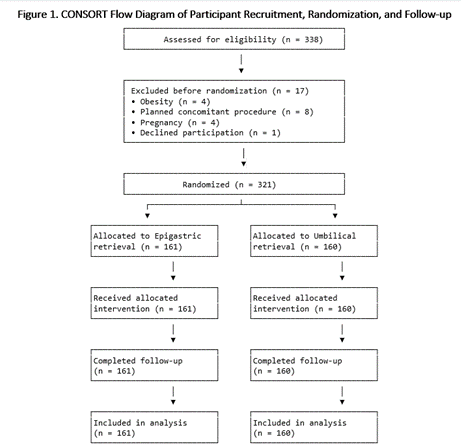
Figure 1: CONSORT flow diagram showing participant screening, exclusions before randomization, allocation, follow-up, and analysis. Of 338 patients assessed for eligibility, 17 were excluded before randomization. The remaining 321 participants were randomized to epigastric (n=161) or umbilical (n=160) gallbladder retrieval. All randomized participants completed follow-up and were included in the final analysis
Baseline demographic, clinical, operative, and pathological characteristics were comparable between groups (Table 1). Median age was 45 (IQR 37–56) years in the epigastric group and 46 (IQR 36–55) years in the umbilical group (P=0.55); approximately 70% of participants in both groups were female (P=0.756). No significant between-group differences were observed in comorbidities, smoking, previous abdominal surgery, operative urgency, gallbladder pathology, stone size, bile spillage, or extraction-incision extension (all P>0.05)
Overall, 35 patients (10.9%) developed PSI within 30 days. Incidence was comparable between epigastric and umbilical retrieval (10.4% vs 11.4%; P=0.782). However, infection severity differed significantly (P=0.018). Superficial PSI predominated in the umbilical group (94.4%), whereas deep and organ-space infections accounted for 35.3% and 11.8%, respectively, of infections in the epigastric group (Table 1). This finding suggests that while the retrieval site did not influence the overall incidence of SSI, it may have affected the pattern of postoperative wound infection.
PSH was uncommon and occurred more frequently after umbilical than epigastric retrieval (3.8% vs 1.2%), although the difference was not statistically significant (P=0.14). PSP declined progressively during the first 24 hours in both groups at rest and during coughing. Median pain trajectories were broadly comparable between retrieval sites, decreasing from approximately 5 at 3 hours to 2–3 at 24 hours (Table 1).
The distribution of intraoperative gallbladder pathology was similar between groups (p=0.619). Edematous thin-walled gallbladder was the predominant intraoperative finding in both groups (approximately 83%), while the frequencies of empyema and mucocele were comparable. Likewise, stone size distribution, intraoperative bile spillage, and the requirement for extension of the extraction incision did not differ significantly between groups (all p>0.05), indicating similar operative complexity across both study arms.
Multivariable logistic regression identified bile spillage as the strongest independent predictor of PSI (OR 23.16, 95% CI 8.73–61.44; P<0.001). Complicated gallbladder pathology (empyema or mucocele) was also independently associated with PSI (OR 3.11, 95% CI 1.44–6.74; P=0.004). Age, diabetes mellitus, hypertension, stone size, and extraction-incision extension were not independently associated with infection (Table 2).
Predictors of PSP varied by retrieval site and postoperative interval (Table 3). In the umbilical group, diabetes mellitus consistently predicted greater pain during coughing, while larger stone size independently predicted greater early postoperative pain, particularly at 3 hours. In the epigastric group, diabetes, hypertension, increasing age, and larger stone size were associated with greater pain, particularly at 12 hours. Hypertension remained associated with resting pain at 24 hours. Extraction-incision extension was not independently associated with PSP in either group.
Table 1. Comparison of demographic and clinicopathological variables between epigastric and umbilical port sites
|
Variable |
Category |
Epigastric |
Umbilical |
p-value |
|
Age, median (IQR) |
— |
45 (37–56) |
46 (36–55) |
0.55 |
|
Gender, n (%) |
Male |
49 (30.10%) |
45 (28.50%) |
0.756 |
|
Female |
114 (69.90%) |
113 (71.50%) |
||
|
DM, n (%) |
No |
91 (55.80%) |
80 (50.60%) |
0.351 |
|
Yes |
72 (44.20%) |
78 (49.40%) |
||
|
HTN, n (%) |
No |
96 (58.90%) |
98 (62.00%) |
0.566 |
|
Yes |
67 (41.10%) |
60 (38.00%) |
||
|
Thyroid disease, n (%) |
No |
120 (73.60%) |
113 (71.50%) |
0.673 |
|
Yes |
43 (26.40%) |
45 (28.50%) |
||
|
IHD, n (%) |
No |
154 (94.50%) |
144 (91.10%) |
0.246 |
|
Yes |
9 (5.50%) |
14 (8.90%) |
||
|
COPD, n (%) |
No |
155 (95.10%) |
154 (97.50%) |
0.262 |
|
Yes |
8 (4.90%) |
4 (2.50%) |
||
|
Asthma, n (%) |
No |
159 (97.50%) |
154 (97.50%) |
0.964 |
|
Yes |
4 (2.50%) |
4 (2.50%) |
||
|
Smoker, n (%) |
No |
158 (96.90%) |
151 (95.60%) |
0.52 |
|
Yes |
5 (3.10%) |
7 (4.40%) |
||
|
Past surgical history, n (%) |
No |
124 (77.00%) |
118 (75.60%) |
0.773 |
|
Yes |
37 (23.00%) |
38 (24.40%) |
||
|
Type of procedure, n (%) |
Elective |
31 (79.50%) |
29 (72.50%) |
0.468 |
|
Emergency |
8 (20.50%) |
11 (27.50%) |
||
|
SSI, n (%) |
No |
146 (89.60%) |
140 (88.60%) |
0.782 |
|
Yes |
17 (10.40%) |
18 (11.40%) |
||
|
SSI category, n (%) |
Superficial |
9 (52.90%) |
17 (94.40%) |
0.018 |
|
Deep |
6 (35.30%) |
1 (5.60%) |
||
|
Organ space |
2 (11.80%) |
0 |
||
|
Port site hernia, n (%) |
No |
161 (98.80%) |
152 (96.20%) |
0.14 |
|
Yes |
2 (1.20%) |
6 (3.80%) |
||
|
Bile spillage, n (%) |
No |
154 (94.50%) |
145 (91.80%) |
0.337 |
|
Yes |
9 (5.50%) |
13 (8.20%) |
||
|
Intraoperative findings, n (%) |
Edematous thin-walled GB |
136 (83.40%) |
132 (83.50%) |
0.619 |
|
Empyema GB |
14 (8.60%) |
10 (6.30%) |
||
|
Mucocele GB |
13 (8.00%) |
16 (10.10%) |
||
|
Stone size, n (%) |
Tiny subcentimetric |
84 (51.50%) |
81 (51.30%) |
0.881 |
|
1 cm |
67 (41.10%) |
63 (39.90%) |
||
|
Greater than 1 cm |
12 (7.40%) |
14 (8.90%) |
||
|
Incision extended, n (%) |
No |
122 (87.80%) |
119 (83.80%) |
0.341 |
|
Yes |
17 (12.20%) |
23 (16.20%) |
||
|
Pain at rest, median (IQR) |
3 hours |
5 (4-6) |
5 (5-7) |
|
|
|
6 hours |
4 (3-5) |
4 (3-5) |
|
|
|
12 hours |
3 (2-4) |
3 (2-3) |
|
|
|
24 hours |
3 (2-3) |
2 (2-3) |
|
|
Pain at physical activity, median(IQR) |
3 hours |
6 (5-7) |
5 (4-6) |
|
|
|
6 hours |
4 (3-5) |
4 (3-5) |
|
|
|
12 hours |
3 (3-5) |
3 (2-4) |
|
|
|
24hours |
3 (2-4) |
3 (2-4) |
|
DM: diabetes mellitus; HTN: hypertension; IHD: ischemic heart disease; COPD: chronic obstructive pulmonary disease; SSI: surgical site infection; GB: gallbladder. Significant = p<0.05.
Table 2. Regression analysis for surgical site infection and postoperative pain
|
Predictors |
SSI (Logistic Regression) |
|
OR (95% CI) p-value |
|
|
Age (yr) |
OR 0.998 (0.97–1.02) |
|
p=0.900 |
|
|
Diabetes mellitus |
OR 1.60 (0.78–3.25) |
|
p=0.194 |
|
|
Hypertension |
OR 0.89 (0.43–1.84) |
|
p=0.756 |
|
|
Stone size (≥1 cm) |
OR 1.13 (0.56–2.29) |
|
p=0.720 |
|
|
Intraoperative findings (empyema/mucocele) |
OR 3.11 (1.44–6.74) |
|
p=0.004 |
|
|
Bile spillage |
OR 23.16 (8.73–61.44) |
|
p=<0.001 |
|
|
Incision extended |
OR 1.18 (0.42–3.28) |
|
p=0.749 |
SSI: binary logistic regression — Odds Ratios (OR) with 95% CI. Yellow shading = p<0.05 (statistically significant, bold p-value). Intraop findings = empyema or mucocele gallbladder.
Table 3. Regression analysis postoperative pain
|
Predictors |
Umbilical Port – Pain Score β (95% CI) |
Epigastric Port – Pain Score β (95% CI) |
||||||||||||||
|
Rest |
Physical activity |
Rest |
Physical activity |
|||||||||||||
|
3 hrs |
6 hrs |
12hrs |
24hrs |
3 hrs |
6 hrs |
12 hrs |
24 hrs |
3 hrs |
6 hrs |
12 hrs |
24 hrs |
3 hrs |
6 hrs |
12 hrs |
24 hrs |
|
|
Diabetes mellitus |
β 0.250 (−0.09–0.61) |
β 0.220 (−0.06–0.51) |
β 0.070 (−0.15–0.29) |
β 0.150 (−0.05–0.36) |
β 0.510 (0.14–0.87) |
β 0.370 (0.07–0.66) |
β 0.340 (0.06–0.63) |
β 0.310 (0.07–0.55) |
β −0.040 (−0.38–0.29) |
β −0.100 (−0.35–0.15) |
β 0.370 (0.14–0.60) |
β 0.160 (−0.03–0.35) |
β 0.110 (−0.23–0.46) |
β 0.370 (0.07–0.67) |
β 0.320 (0.01–0.64) |
β 0.100 (−0.13–0.35) |
|
p=0.150 |
p=0.120 |
p=0.520 |
p=0.140 |
p=0.006 |
p=0.010 |
p=0.010 |
p=0.010 |
p=0.780 |
p=0.420 |
p=0.002 |
p=0.100 |
p=0.500 |
p=0.010 |
p=0.040 |
p=0.380 |
|
|
Stone size (≥1 cm) |
β 0.451 (0.096–0.805) |
β 0.170 (−0.11–0.46) |
β −0.010 (−0.24–0.20) |
β 0.100 (0.11–0.31) |
β 0.370 (0.009–0.74) |
β 0.100 (−0.19–0.40) |
β 0.200 (−0.07–0.49) |
β 0.220 (−0.01–0.47) |
β 0.250 (−0.08–0.59) |
β 0.220 (−0.03–0.47) |
β 0.340 (0.11–0.57) |
β 0.150 (−0.03–0.35) |
β 0.310 (−0.03–0.65) |
β 0.060 (−0.24–0.36) |
β 0.120 (−0.18–0.44) |
β 0.100 (−0.14–0.35) |
|
p=0.010 |
p=0.240 |
p=0.860 |
p=0.350 |
p=0.040 |
p=0.480 |
p=0.150 |
p=0.060 |
p=0.130 |
p=0.080 |
p=0.003 |
p=0.110 |
p=0.070 |
p=0.670 |
p=0.430 |
p=0.420 |
|
|
Incision extended |
β −0.040 (−0.56–0.48) |
β −0.010 (−0.44–0.40) |
β −0.080 (−0.42–0.26) |
β −0.103 (−0.43–0.22) |
β −0.380 (−0.91–0.14) |
β −0.170 (−0.62–0.27) |
β −0.120 (−0.56–0.31) |
β −0.170 (−0.53–0.19) |
β 0.010 (−0.49–0.53) |
β 0.040 (−0.34–0.42) |
β 0.070 (−0.26–0.41) |
β 0.007 (−0.28–0.29) |
β 0.010 (−0.51–0.54) |
β 0.080 (−0.37–0.54) |
β 0.150 (−0.33–0.63) |
β 0.070 (−0.29–0.43) |
|
p=0.880 |
p=0.920 |
p=0.640 |
p=0.530 |
p=0.150 |
p=0.440 |
p=0.570 |
p=0.340 |
p=0.940 |
p=0.830 |
p=0.650 |
p=0.960 |
p=0.950 |
p=0.710 |
p=0.530 |
p=0.690 |
|
|
Hypertension |
β −0.006 (−0.37–0.36) |
β −0.120 (−0.41–0.17) |
β −0.240 (−0.46–0.01) |
β −0.090 (−0.31–0.12) |
β −0.014 (−0.39–0.36) |
β −0.090 (−0.40–0.20) |
β −0.070 (−0.36–0.22) |
β −0.110 (−0.36–0.13) |
β 0.008 (−0.33–0.35) |
β 0.050 (−0.20–0.31) |
β 0.320 (0.08–0.55) |
β 0.220 (0.02–0.42) |
β 0.070 (−0.27–0.43) |
β 0.300 (−0.002–0.61) |
β 0.330 (0.01–0.65) |
β 0.150 (−0.10–0.40) |
|
p=0.970 |
p=0.410 |
p=0.030 |
p=0.810 |
p=0.940 |
p=0.510 |
p=0.620 |
p=0.350 |
p=0.960 |
p=0.660 |
p=0.008 |
p=0.020 |
p=0.670 |
p=0.050 |
p=0.030 |
p=0.230 |
|
|
Age |
β 0.004 (−0.10–0.018) |
β 0.005 (−0.007–0.016) |
β 0.000 (−0.009–0.009) |
β 0.003 (−0.005–0.010) |
β 0.007 (−0.008–0.020) |
β 0.007 (−0.005–0.018) |
β 0.010 (−0.001–0.020) |
β 0.006 (−0.003–0.010) |
β −0.005 (−0.010–0.009) |
β −0.002 (−0.010–0.008) |
β 0.010 (0.003–0.020) |
β 0.006 (−0.001–0.010) |
β −0.001 (−0.010–0.010) |
β 0.010 (0.001–0.020) |
β 0.010 (−0.002–0.020) |
β 0.005 (−0.005–0.010) |
|
p=<0.001 |
p=0.420 |
p=0.970 |
p=0.420 |
p=0.360 |
p=0.270 |
p=0.070 |
p=0.190 |
p=0.460 |
p=0.730 |
p=0.010 |
p=0.100 |
p=0.890 |
p=0.030 |
p=0.080 |
p=0.320 |
|
Pain scores: linear regression — β coefficients with 95% CI. Yellow shading = p<0.05 (statistically significant, bold p-value) ; hrs = hours postoperative.
DISCUSSION :
This prospective double-blinded RCT demonstrated that the choice of gallbladder retrieval port did not significantly influence overall PSI, PSP, or PSH following LC. In contrast, operative and patient-related factors independently influenced postoperative morbidity. Bile spillage and complicated gallbladder pathology were the strongest predictors of PSI, whereas diabetes, hypertension, age, and stone size influenced postoperative pain according to retrieval site and postoperative interval.
The primary outcome showed no significant difference in PSI between epigastric and umbilical retrieval (10.4% vs 11.4%). This is consistent with the RCTs of Raj et al. and Anand et al., which reported comparable wound infection rates between retrieval sites.²,⁶ Mongelli et al. similarly found no significant difference in SSI despite demonstrating lower postoperative pain with umbilical retrieval.⁴ More recently, Kulkarni et al. concluded that randomized evidence does not demonstrate a meaningful difference in SSI based solely on extraction site.³ These findings suggest that retrieval-port selection has limited influence on infection when contemporary specimen retrieval, antibiotic prophylaxis, and perioperative care are used.
Although overall PSI incidence was similar, infection depth differed significantly between groups. Superficial infections predominated after umbilical retrieval, whereas deeper infections were proportionally more frequent following epigastric retrieval. Previous studies have generally reported SSI as an overall endpoint, with limited subclassification according to CDC definitions of superficial, deep incisional, and organ-space infection.¹⁴–¹⁶ Consequently, evidence regarding differences in infection depth between retrieval sites remains limited. Anatomical differences between the epigastric and umbilical abdominal wall could potentially influence the extent of tissue involvement after contamination; however, this remains speculative and requires confirmation in larger multicentre studies.
A major finding was the strong association between intraoperative contamination and PSI. Bile spillage increased the odds of infection more than twenty-fold, while empyema or mucocele independently increased the odds approximately three-fold. Previous evidence regarding the infectious consequences of gallbladder perforation and bile spillage has been mixed. A systematic review and meta-analysis by Hajibandeh et al. found that iatrogenic gallbladder perforation was not significantly associated with SSI,8 whereas Peponis et al., in a prospective study of 1,001 patients, demonstrated a significantly higher SSI rate following bile spillage and identified bile spillage as an independent predictor of SSI.¹7 These findings suggest that the consequences of intraoperative contamination may depend not only on gallbladder perforation itself but also on the extent and nature of bile or stone spillage and subsequent intraoperative management. Complicated gallbladders are more inflamed and friable, increasing the likelihood of perforation and wound contamination during dissection and retrieval.¹8 These findings emphasize meticulous dissection, atraumatic specimen handling, prompt management of bile contamination, and use of retrieval bags, particularly in complicated gallbladder disease.19
Unlike PSI, portsite pain demonstrated a more complex relationship with patient characteristics. PSP declined progressively during the first 24 hours and followed broadly comparable trajectories between retrieval groups, suggesting that the extraction site itself exerted only a modest influence on postoperative discomfort. This differs from Siddiqui et al. and Anand et al., who reported lower early postoperative pain following umbilical retrieval,⁵,⁶ and from meta-analysis by Mongelli et al. which favored umbilical extraction at several postoperative intervals.4 One explanation may be the standardized multimodal analgesic regimen used in the present study, including TAP and rectus sheath blocks, which may have attenuated pain differences attributable to extraction-site trauma, aligning with the updated PROSPECT recommendations emphasizing the multifactorial nature of postoperative pain following LC and the importance of multimodal analgesia.20 Furthermore, our larger sample size and multivariable modelling allowed adjustment for patient- and disease-related factors that were not consistently evaluated in previous studies.
The regression analyses further demonstrated that pain was influenced by patient and disease characteristics rather than extraction site alone. Diabetes consistently predicted greater pain during coughing following umbilical retrieval, while larger stones were associated with greater early pain. Following epigastric retrieval, age, diabetes, hypertension, and stone size influenced pain, particularly during the intermediate postoperative period. These findings are consistent with evidence that postoperative pain following LC is multifactorial.21,22 Diabetes may alter nociceptive processing through inflammatory and peripheral neuropathic mechanisms,²3 while hypertension has been associated with altered pain perception and delayed tissue recovery.20,23,24 Similarly, larger gallstones may require greater fascial manipulation during extraction, potentially increasing local tissue trauma.22 Collectively, these findings support individualized analgesic strategies rather than reliance on extraction-site selection alone.
PSH occurred more frequently following umbilical retrieval (3.8% vs 1.2%), although the difference was not statistically significant. This trend parallels the multicentre study by van Bodegraven et al., which demonstrated a significantly higher incidence of trocar-site hernia after umbilical extraction.¹ Kulkarni et al. and Sood et al. similarly suggested an increased hernia risk with umbilical retrieval, potentially related to repeated fascial dilatation during specimen extraction.³,⁷,25 The absence of statistical significance in the present study may reflect the relatively low frequency of this complication together with the limited three-month follow-up period. PSH frequently present several months after surgery; therefore, longer surveillance may reveal additional clinically relevant differences.
Taken together, these findings indicate that optimizing operative technique may have greater impact on postoperative morbidity than selection of the retrieval port. Although overall outcomes were comparable between extraction sites, bile spillage emerged as the dominant modifiable predictor of infection. Prevention of contamination, careful specimen retrieval, and appropriate management of complicated gallbladders should therefore remain priorities during LC.
The strengths of this study include its prospective randomized double-blinded design, adequate sample size, standardized anesthetic and analgesic protocols, CDC-based SSI assessment, serial evaluation of postoperative pain, and multivariable analysis of potential predictors. In addition to comparing retrieval sites, the study provides insight into patient- and operative-related determinants of PSI and PSP, thereby extending the current evidence base.
Limitations of study
This study has limitation, its single-centre design may restrict generalizability. Although adequately powered for SSI, the study may have been underpowered to detect small differences in PSH because of its low incidence. Hernia follow-up was limited to three months, potentially missing late presentations. Cosmetic satisfaction and quality-of-life outcomes were also not evaluated and may represent important areas for future research.
CONCLUSION :
In patients undergoing laparoscopic cholecystectomy, bile spillage and complicated intraoperative gallbladder pathology—specifically empyema and mucocele—are the strongest independent predictors of port-site SSI, substantially outweighing the contribution of extraction port choice. The depth distribution of SSI differs between ports, with deeper infections more common with epigastric retrieval. Port-site pain is independently influenced by patient comorbidities (diabetes, hypertension, age) and stone size, with predictor significance varying by extraction site and postoperative time point. A trend toward higher hernia rates with umbilical retrieval warrants further study with longer follow-up. The findings of this randomized controlled trial indicate that meticulous operative technique and prevention of intraoperative contamination are more important determinants of postoperative port-site morbidity than the choice of gallbladder retrieval port itself.
Acknowledgement
The authors extend their sincere gratitude to Dr. Maryam Nasrummin Allah, PGRMO at Patel Hospital, Karachi, for her editorial assistance, guidance and contributions to the refinement of the manuscript. Special thanks are also extended to Miss Bushra Ayub, Senior Research Coordinator at Patel Hospital, for her valuable support with data analysis and statistical guidance throughout the study.
Authors’ Contributions
Dr. Dania Javed: Conceptualization, literature review, study design, data collection, data interpretation, manuscript writing, and critical revision.
Dr Fariha Ashraf: Conceptualisation, senior supervision of clinical work, critical appraisal, review and approval of final manuscript.
Dr. Ghulam Murtaza: Senior supervision of clinical work, methodological oversight, statistical analysis, data interpretation, critical appraisal, critical review and approval of the final manuscript.
Funding:
None
Conflict of Interest:
Authors declared no conflict of interest
BIBLIOGRAPHY:
1. Van Bodegraven EA, Oosterwijk PC, van Aalten SM, Schaafsma BE, Smeenk RM. Higher incidence of trocar site hernia with gallbladder extraction via umbilical versus epigastric trocar port: a multicentre retrospective analysis of laparoscopic cholecystectomy. Langenbecks Arch Surg. 2025 May 8;410(1):155. doi: 10.1007/s00423-025-03721-9. PMID: 40338310; PMCID: PMC12062153.
2. Raj A, Singh S, Raj A, Tajdar Y. A Randomized Controlled Trial Evaluating Postoperative Port Site Infections among Patients Undergoing Laparoscopic Cholecystectomy Either via Umbilical or Epigastric Port. Cureus. 2023 Nov 12;15(11):e48709. doi: 10.7759/cureus.48709. PMID: 38094556; PMCID: PMC10716629.
3. Kulkarni AA, Sharma G, Deo KB, Jain T. Umbilical port versus epigastric port for gallbladder extraction in laparoscopic cholecystectomy: a systematic review and meta-analysis of randomized controlled trials with trial sequential analysis. The Surgeon. 2022 Jun 1;20(3):e26-35. doi: 10.1016/j.surge.2021.02.009. Epub 2021 Apr 19. PMID: 33888427.
4. Mongelli F, La Regina D, Zschokke I, et al. Gallbladder Retrieval From Epigastric Versus Umbilical Port in Laparoscopic Cholecystectomy: A PRISMA-Compliant Meta-Analysis. Surg Innov. 2020 Apr;27(2):150-159. doi: 10.1177/1553350619890719. Epub 2019 Nov 28. PMID: 31777324.
5. Jain A, Tajudeen M, Sreekanth A, Raj Kumar N. Comparison of Postoperative Port-Site Pain After Gallbladder Retrieval From Epigastric Versus Umbilical Port in Patients of Laparoscopic Cholecystectomy for Symptomatic Cholelithiasis: A Randomized Controlled Trial. Cureus. 2021 Sep 18;13(9):e18087. doi: 10.7759/cureus.18087. PMID: 34692302; PMCID: PMC8523391.
6. Anand A, Jha AK, Kumar M, Kumar S, Kumar P. Port Site Morbidities Following the Extraction of the Gallbladder from the Umbilical Port in Comparison to the Epigastric Port in Laparoscopic Cholecystectomy: A Double-Blinded, Randomized Controlled Trial. Cureus. 2023 Sep 22;15(9):e45770. doi: 10.7759/cureus.45770. PMID: 37745735; PMCID: PMC10515674.
7. Sood S, Imsirovic A, Sains P, Singh KK, Sajid MS. Epigastric port retrieval of the gallbladder following laparoscopic cholecystectomy is associated with the reduced risk of port site infection and port site incisional hernia: An updated meta-analysis of randomized controlled trials. Ann Med Surg (Lond). 2020 May 25;55:244-251. doi: 10.1016/j.amsu.2020.05.017. PMID: 32528673; PMCID: PMC7283097.
8. Hajibandeh S, Hajibandeh S, Clark MC, Barratt OA, Taktak S, Subar D, et al. Retrieval of gallbladder via umbilical versus epigastric port site during laparoscopic cholecystectomy: a systematic review and meta-analysis. Surg Laparosc Endosc Percutan Tech. 2019;29(5):321–327. doi:10.1097/SLE.0000000000000662.
9. Jawed S, Jahangir SMN, Haque I. Umbilical port versus epigastric port for gallbladder retrieval in laparoscopic cholecystectomy: an intervention study. Asian J Med Sci. 2024;15(12):199–203. doi:10.71152/ajms.v15i12.4284.
10. Mahar MSGM, Mirani SH, Rizvi SB, Habibullah H, Shah P, Memon GFK. Comparison of port site (epigastric versus umbilical) infection following gall bladder retrieval in patient undergoing laparoscopic cholecystectomy. Pak J Med Dent. 2025. doi:10.36283/ziun-pjmd15-1/028.
11. Overby DW, Apelgren KN, Richardson W, Fanelli R. Society of American gastrointestinal and endoscopic surgeons. SAGES guidelines for the clinical application of laparoscopic biliary tract surgery Surg Endosc. 2010 Oct;24(10):2368-86.
12. Bennett JA. The Consolidated Standards of Reporting Trials (CONSORT): Guidelines for reporting randomized trials. Nurs Res. 2005 Mar-Apr;54(2):128-32. doi: 10.1097/00006199-200503000-00007. PMID: 15778654.
13. Centers for Disease Control and Prevention. National Healthcare Safety Network (NHSN) Patient Safety Component Manual: Chapter 9. Surgical Site Infection Event. Atlanta (GA): Centers for Disease Control and Prevention; 2025.
14. Rehman HU, Siddiqa M, Munam AU, Khan S. Frequency of port site wound infection after Gall Bladder removal with or without retrieval bag in Laparoscopic Cholecystectomy. J Pak Med Assoc. 2020 Sep;70(9):1533-1537. doi: 10.5455/JPMA.300311. PMID: 33040103.
15. Ali J, Parveen S, Iqbal M, Waheed A, Soomro K, Mehboob A. Port site infection and associated factors in laparoscopic cholecystectomy. J Surg Pakistan. 2022;27(2):55–59. doi:10.21699/jsp.27.2.6.
16. Pipal DK, Prakash R, Kalwan P, Sudha S, Pipal VR, Yadav S. Port Site Infection in Laparoscopic Cholecystectomy: A Prospective Observational Study at a Tertiary Care Hospital in India. Ann Afr Med. 2026 Jan 1;25(1):151-157. doi: 10.4103/aam.aam_33_25. Epub 2025 Jun 30. PMID: 40587093; PMCID: PMC12872124.
17. Peponis T, Eskesen TG, Mesar T, Saillant N, Kaafarani HMA, Yeh DD, et al. Bile spillage as a risk factor for surgical site infection after laparoscopic cholecystectomy: a prospective study of 1,001 patients. J Am Coll Surg. 2018;226(6):1030–1035. doi:10.1016/j.jamcollsurg.2017.11.025.
18. Mohamed HK, Albendary M, Wuheb AA, Ali O, Mohammed MJ, Osman M, et al. A systematic review and meta-analysis of bag extraction versus direct extraction for retrieval of gallbladder after laparoscopic cholecystectomy. Cureus. 2023;15(2):e35493. doi:10.7759/cureus.35493.
19. Chandra J N, Manivasagam SS, Choudhary S, Manocha P, Reddy BH. Insights Into Laparoscopic Port Site Complications: A Comprehensive Review. Cureus. 2024 Jun 28;16(6):e63431. doi: 10.7759/cureus.63431. PMID: 39077265; PMCID: PMC11284342.
20. Bourgeois C, Oyaert L, Van de Velde M, Pogatzki-Zahn E, Freys SM, Sauter AR, et al. Pain management after laparoscopic cholecystectomy: a systematic review and procedure-specific postoperative pain management (PROSPECT) recommendations. Eur J Anaesthesiol. 2024;41(11):841–855. doi:10.1097/EJA.0000000000002047.
21. Nepali B, Subedi A, Pokharel K, Ghimire A, Prasad JN. Preexisting chronic pain is not associated with moderate-to-severe acute pain after laparoscopic cholecystectomy: a prospective cohort study. Pain Rep. 2024 Nov 13;9(6):e1214. doi: 10.1097/PR9.0000000000001214. PMID: 39544228; PMCID: PMC11563003.
22. Zhang Z, Xu J, Yu D, Lin N, Peng J. Single-incision laparoscopic cholecystectomy reduced postoperative pain than three-incision laparoscopic cholecystectomy in patients with large gallstone, a retrospective study. Front Surg. 2024 Dec 5;11:1448684. doi: 10.3389/fsurg.2024.1448684. PMID: 39703818; PMCID: PMC11655490.
23. Sayed D, Deer TR, Hagedorn JM, Sayed A, D'Souza RS, Lam CM, et al. A systematic guideline by the ASPN Workgroup on the Evidence, Education, and Treatment Algorithm for Painful Diabetic Neuropathy: SWEET. J Pain Res. 2024;17:1461–1501. doi:10.2147/JPR.S451006.
24. Chen X, Chu Q, Peng Y, Chen Y, Kaye AD, Liu H, et al. Clinical practice guidelines for postoperative pain management in adults (2024 edition). J Anesth Transl Med. 2025;4(3):161–185. doi:10.1016/j.jatmed.2025.09.001
25. Biswas SK, Sarkar S, Rahman M, Sharma NK. Port Site Hernia After Laparoscopic Cholecystectomy: A Rare but Serious Complication. TAJ: Journal of Teachers Association. 2024 Dec 31;37(2):598-605.