Post Covid Sequelae and its Clinical Correlations: A Cohort Study
- Rahila Amir , Assistant Professor, Department of Medicine, Shifa College of Medicine (STMU), Islamabad, Pakistan
- Tehzeeb Zehra , Assistant Professor, Department of Medicine, Shifa College of Medicine (STMU), Islamabad, Pakistan
- Saadat Ali , Post graduate Resident, Anesthesiology-Medical college of Wisconsin-Milwaukee, WI 53226, USA
- Uzma Batool , Assistant Professor, Department of Medicine, Fazaia Medical College, Islamabad, Pakistan
- Muhammad Faisal Bacha , Assistant Professor, Department of Medicine, Akhter Saeed Medical College, Islamabad, Pakistan
- Wajahat Sultan Baig , Assistant Professor, Department of Medicine, Wah Medical College (NUMS), Wah Cantt, Pakistan
- Sardar Nawaz , Shifa College of Medicine (STMU), Islamabad, Pakistan
- Muhammad Waleed Imran , Shifa College of Medicine (STMU), Islamabad, Pakistan
Article Information:
Abstract:
Abstract: Background: COVID-19 manifests with a diverse array of clinical presentations and complications. Although the acute severity of COVID-19 has waned, interest persists in understanding its long-term aftermath, akin to sequelae seen with other viral illnesses. Objective: This study aims to identify post-COVID-19 sequelae and examine their relationships with specific clinical factors, thereby informing predictive models and support strategies for survivors. Materials and Methods: We conducted a cohort study at Shifa International Hospital, Islamabad, Pakistan, enrolling both inpatients and outpatients with PCR-confirmed COVID-19 between October 2020 and March 2021. Participants were monitored for six months to assess symptom persistence, and data were correlated with age, gender, comorbidities, treatment modalities, illness severity, acute complications, and length of hospitalization. Data entry and analysis were performed using IBM SPSS v23. Pearson’s Chi-square test and binary logistic regression evaluated associations among variables, with p < 0.05 (95% CI) denoting statistical significance. Results: Of the 306 patients analyzed, 116 (37.9%) reported one or more post-COVID-19 symptoms. Univariate analysis revealed significant associations between symptom persistence and steroid use, remdesivir administration, acute complications, disease severity, and hospital stay duration (p < 0.05). Multivariate analysis identified steroid use and prolonged hospitalization as independent predictors of post-COVID-19 sequelae. Conclusion: Steroid therapy and extended hospital stay predicts the likelihood of post-COVID-19 symptoms, suggesting these factors can help identify patients at higher risk for prolonged recovery.
Keywords:
Article :
INTRODUCTION:
COVID-19, a disease related to corona virus, after its emergence in December 2019 from the Wuhan city of China has rapidly escalated into a global health crisis, prompting the World Health Organization to declare a pandemic in March 2020. The condition caused various global implications related to health and economies in most parts of the world. The disease manifests usually as acute infective illness, presenting with a spectrum of illness ranging from asymptomatic or mild flu-like symptoms to severe acute respiratory syndrome¹. Majority of the symptoms are mild including fever, bodyaches, dry cough, fatigue and upper airway tract related complaints that are self-limiting and can subside without any treatment. Apart from the commonly observed pulmonary involvement, SARS-CoV-2 can also cause cardiac damage, thrombotic events, renal, gastrointestinal, neurologic, and psychiatric complications². While the acute epidemiology, pathogenesis, and clinical features of COVID-19 are well characterized2,3, its long-term consequences remain incompletely understood. Although most individuals recover uneventfully, a subset experiences persistent symptoms post-recovery, underscoring the need to elucidate these extended effects and their relationship to the acute phase⁴. As the population of COVID-19 survivors grows⁵, data revealed that 87% report at least one persistent symptom at discharge and 55% have three or more symptoms such as fatigue, dyspnea, chest pain, body aches, neurocognitive manifestations and dysautonomia at 60-day follow-up.4,6 These symptoms may last for months to years and patients reported them as affecting their routine and daily-life activities. The exact pathogenetic mechanisms are not well established, although the proposed mechanisms like immunopathogenic etiology, chronic endothelial inflammation and immune dysregulation etc. have been considered as possible explanations of these symptoms, however data regarding that is limited4,5.
The post covid-19 syndrome or Long COVID has impact not only one the quality of life of the affected individuals, but also a major challenge to the health care system including the cost of healthcare systems. Previous investigations have primarily focused on hospitalized cohorts2,3, leaving community-managed patients underrepresented.7,8. Therefore, we sought to identify post-COVID-19 sequelae in both hospitalized and outpatient populations, and to correlate these sequelae with clinical variables. This approach aims to facilitate the development of predictive tools for sequelae occurrence and guide prevention and management strategies.
MATERIALS AND METHODS:
We performed a cross-sectional cohort study at Shifa International Hospital, Islamabad, Pakistan between 1 October 2020 and 31 March 2021. All individuals aged 15–70 years with PCR-confirmed COVID-19 presenting to inpatient or outpatient services were eligible. Exclusion criteria included malignancy, end-stage organ failure (renal, hepatic, pulmonary, cardiac), uncontrolled diabetes mellitus, and preexisting immunosuppressive therapy. Institutional Review Board approval (IRB #094-21) and written informed consent were obtained. A sample size of 317 was calculated (95% CI, 3.8% margin of error, 13.8% estimated proportion⁹).
Demographics, comorbidities, oxygen requirements, hospital stay length, acute complications, and treatment regimens were recorded. Illness severity was scored using the WHO ordinal scale¹⁰, ranging from 0 (no evidence of infection) to 8 (death). Non-hospitalized patients scored 1 (no activity limitation) or 2 (activity limitation), while hospitalized patients were classified as mild (3 = no oxygen; 4 = nasal prongs/mask) or severe (5 = noninvasive ventilation/high-flow oxygen; 6 = mechanical ventilation; 7 = ventilation plus organ support).
These patients were followed up on telephone after 6 months of their illness for the enquiry of their symptoms, which persisted after covid infection, and were noted down on prescribed Performa. Data was stored and analyzed using IBM-SPSS version 23.0. Means with standard deviations were used for quantitative baseline characteristics and counts with percentages were reported for qualitative data sets. Pearson Chi Square Test was used to test the association of Post Covid Symptoms. Binary logistic regression was used for the identification of risk factors of Post Covid-19 Symptoms via odds ratio (with a confidence interval of 95%). Bar diagram and line chart was used to report the distribution of Post Covid-19 Symptoms along with the median duration of these symptoms. P-value of less than 0.05 was considered statistically significant.
RESULTS:
Of 317 enrolled patients, 11 were excluded for incomplete data, leaving 306 for analysis. Post-COVID-19 symptoms were reported by 116 (37.9%) and absent in 190 (62.1%). The cohort’s mean age was 52.19 ± 16.06 years, mean hospital stay 9.15 ± 1.4 days, and mean illness severity score 3.4 ± 1.40. Comorbidities included diabetes, hypertension, BPH, asthma, ischemic heart disease, CKD, and GERD. Acute complications (AKI, HAP, DVT, PE, CVA, DKA, MI, STEMI) occurred in 23% of those with persistent symptoms, but baseline characteristics showed no significant association with sequelae (all p > 0.05; Table 1).
Table 1: Post COVID symptoms according to demographics
|
Characteristics |
Post Covid symptoms |
p-value |
||||
|
No (n=116) |
Yes (n=190) |
|||||
|
n |
% |
n |
% |
|||
|
Age Group
|
≤50 years |
56 |
48.3 |
82 |
43.2 |
0.38 |
|
>50 years |
60 |
51.7 |
108 |
56.8 |
||
|
Gender |
Male |
60 |
51.7 |
110 |
57.9 |
0.29 |
|
Female |
56 |
48.3 |
80 |
42.1 |
||
|
Residence |
Islamabad |
46 |
39.7 |
81 |
42.6 |
0.57 |
|
Punjab |
50 |
43.1 |
77 |
40.5 |
||
|
KPK |
16 |
13.8 |
25 |
13.2 |
||
|
Baluchistan |
1 |
0.9 |
0 |
0.0 |
||
|
Sindh |
0 |
0.0 |
1 |
0.5 |
||
|
AJK |
2 |
1.7 |
6 |
3.2 |
||
|
Gilgit |
1 |
0.9 |
0 |
0.0 |
||
|
Co morbidity |
Yes |
66 |
56.9 |
107 |
56.3 |
0.92 |
|
No |
50 |
43.1 |
83 |
43.7 |
||
|
*p<0.05 was considered statistically significant using Pearson Chi Square test |
||||||
When examining clinical factors, 59.5% with sequelae had received steroids, 37.4% remdesivir, 71.4% were hospitalized, 41.2% had moderate illness (score 3–4), and 28.4% experienced acute complications. All these factors showed significant associations with post-COVID-19 symptoms on univariate analysis (p < 0.05; Table 2).
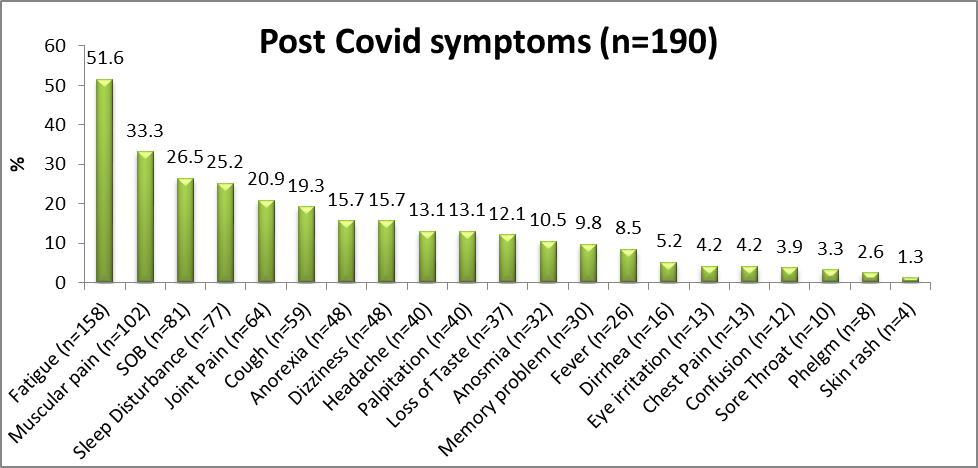
Fig 1: Post Covid Symptoms
Table 2: Post Covid symptoms related to Medication use and symptoms severity
|
Factors |
Post Covid symptoms |
p-value |
||||
|
No |
Yes |
|||||
|
n |
% |
n |
% |
|||
|
Steroids used |
Yes |
48 |
41.4 |
113 |
59.5 |
0.002* |
|
No |
68 |
58.6 |
77 |
40.5 |
||
|
Remdesevir use |
Yes |
22 |
19.0 |
71 |
37.4 |
0.001* |
|
No |
94 |
81.0 |
119 |
62.6 |
||
|
Place of care |
Home |
36 |
31.6 |
54 |
28.6 |
0.57 |
|
Hospital |
78 |
68.4 |
135 |
71.4 |
||
|
Symptoms Severity |
1 – 2 |
38 |
34.2 |
54 |
28.9 |
0.01* |
|
3 – 4 |
57 |
51.4 |
77 |
41.2 |
||
|
>4 |
16 |
14.4 |
56 |
29.9 |
||
|
Acute Complication |
Yes |
14 |
12.1 |
54 |
28.4 |
0.001* |
|
No |
102 |
87.9 |
136 |
71.6 |
||
|
Duration of hospital stay(days) |
1-7 |
60 |
0.48 |
64 |
51.6 |
0.000* |
|
8-14 |
13 |
26.5 |
36 |
73.4 |
||
|
15-28 |
3 |
10 |
27 |
90 |
||
|
>28 |
1 |
14 |
6 |
85.7 |
||
|
*p<0.05 was considered statistically significant using Pearson Chi Square test |
||||||
Figure 1 is used to show the Percentages of post-COVID symptoms. Fatigue was found to be the commonest post-COVID symptoms reported by 51.6% of patients, and skin rash was found to be the least reported symptom, i.e. 1.3%. None of the sample found with complaints of hair loss.
Figure 2 highlights the median duration of Post Covid symptoms with minimum and maximum duration, Median duration of Fatigue, shortness of breath (SOB), Cough, Anorexia, Muscular pain, joint pain, diarrhea, Phlegm, Eye irritation, sleep disturbance and palpitation was 4 weeks, Fatigue, Sleep Disturbance, joint pain, muscular pain, were found with maximum 52 days of duration. The median duration for Loss of taste, confusion and skin rash was 3 weeks, and fever, dizziness, chest pain were found with 2 weeks’ median duration of post Covid symptoms.
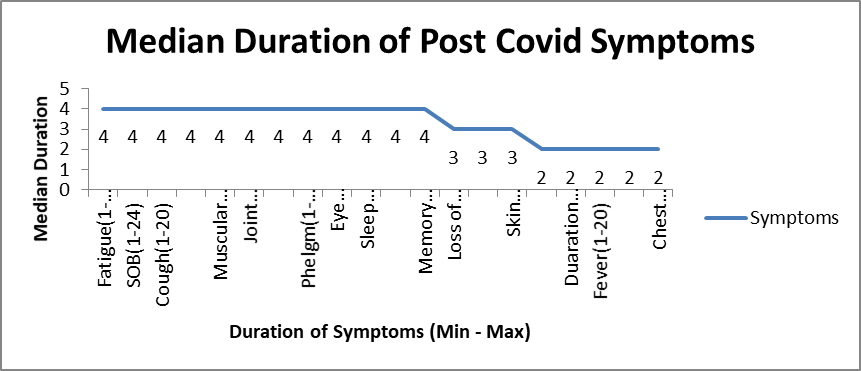
Fig 2: Duration of symptoms
Logistic regression (Table 3) revealed steroid use (OR 0.5, 95% CI 0.3–0.8) and remdesivir use (OR 0.4, 95% CI 0.2–0.7), illness severity (OR 1.3, 95% CI 1.1–1.5), acute complications (OR 2.9, 95% CI 1.5–5.5), and hospitalization duration (OR 1.1, 95% CI 1.1–1.2) as significant risk factors on univariate analysis. On multivariate analysis, only steroid use (OR 0.4, 95% CI 0.2–0.9) and hospitalization duration (OR 1.1, 95% CI 1.0–1.2) remained independent predictors.
Table 3: Logistic regression
|
Risk Factors |
Univariate |
Multivariate |
|
Odd ratio (95% C.I) |
Odd ratio (95% C.I) |
|
|
Age>55 |
1.2(0.8-2) |
1(0.5-2.1) |
|
Female |
0.8(0.5-1.2) |
1.1(0.6-2.1) |
|
Co morbidity |
1(0.6-1.6) |
1.3(0.6-2.9) |
|
Steroids used |
0.5* (0.3-0.8) |
0.4* (0.2-0.9) |
|
Remdesevir used |
0.4* (0.2-0.7) |
0.6(0.3-1.2) |
|
Place of care Hospital |
1.2(0.7-1.9) |
1.1(0.6-1.8) |
|
Duration of hospital Stay |
1.1* (1.1-1.2) |
1.1* (1.0 -1.2) |
|
Symptoms severity |
1.3* (1.1-1.5) |
0.7(0.4-1.1) |
|
Acute complications |
2.9* (1.5-5.5) |
0.3(0.1-0.7) |
|
*odd ratio found with p<0.05 Dependent variable : Post Covid Symptoms |
||
DISCUSSION :
In our study, we found that the most common post-COVID-19 symptoms reported were fatigue, myalgia, dyspnea, sleep disturbances, and arthralgia. These findings are consistent with previous studies such as those by Arnold et al. and Chopra et al., who also reported high rates of persistent fatigue and breathlessness post-recovery.11,12 Fatigue in particular appears to be a hallmark of post-COVID sequelae, with prevalence rates approximating 32% in larger reviews.¹³
Unlike some studies that identified age¹⁴ and female gender15,16, 17as predictors of post-COVID symptoms, our data did not reveal any significant association with age, gender, or comorbidities. This is in line with other research which also failed to establish such links18,19, suggesting that long-COVID may not be easily predicted by basic demographic factors.
Our results demonstrate a statistically significant association between the use of steroids and the persistence of symptoms. This may be explained by the adverse effects of corticosteroid therapy, such as steroid-induced myopathy, mood changes, electrolyte disturbances, or secondary infections, which may present clinically as fatigue, myalgia, or general malaise.²⁰ Additionally, patients who received remdesivir were more likely to experience post-COVID symptoms on univariate analysis, which may reflect underlying disease severity rather than a direct drug effect, as this association was not sustained in the multivariate analysis.
Asadi-pooya AA et al concluded in their study that long Covid-19 syndrome was a frequently observed situation and had significant associations with the severity of the illness14,21as also endorsed by our study, which showed that the severity of illness was directly proportional with the development of Post Covid Symptoms.
Moreover, the presence of acute complications during the illness phase was associated with post-COVID symptoms on univariate analysis. Although this relationship did not persist in the multivariate model, it may still suggest an indirect contribution to the sequelae through prolonged inflammation or organ damage.
One of the strongest and most consistent predictors of post-COVID symptoms in our study was the duration of hospitalization. Patients with extended hospital stays, especially those exceeding two weeks, were significantly more likely to report lingering symptoms. This may be reflective of more intensive treatment, immobility, or psychological stress associated with prolonged admissions. Prior studies have similarly suggested that longer hospital stays may correlate with higher post-acute morbidity.22,23 Additionally, hospital length of stay is often used as quality of care indicator and has been linked to both complications and functional decline. Hence, this is not astonishing that longer duration is associated with severe disease, multiple treatments, and complications, which are individually correlated with the post covid symptoms.24,25
Our findings emphasize the importance of considering not only the acute management of COVID-19 but also its long-term implications. As we continue to recover from the acute waves of the pandemic, identifying patients at risk for long-COVID is crucial to optimizing rehabilitation and follow-up care. The recognition that steroid use and prolonged hospital admission are independent predictors allows clinicians to better stratify patients and offer early intervention.
Limitations of this study include the retrospective nature of symptom reporting via telephone, which introduces potential recall bias. Furthermore, as a single-center study, the results may not be generalizable across different healthcare settings. However, the inclusion of both hospitalized and non-hospitalized patients enhances the applicability of our findings.
CONCLUSION :
Irrespective of age, gender, and comorbidities, the occurrence of post-COVID-19 symptoms, or long COVID was notably associated with greater disease severity, presence of acute complications, and the use of remdesivir. However, steroid use and prolonged hospitalization emerged as the strongest independent predictors. These findings highlight the importance of cautious steroid administration and minimizing hospital stay duration where clinically feasible, to reduce the risk of persistent post-COVID symptoms and improve long-term patient outcomes.
Conflict of Interest: None
Funding: None
BIBLIOGRAPHY:
1. Di Minno A, Ambrosino P, Calcaterra I, Di Minno MND. COVID-19 and Venous Thromboembolism: A Meta-analysis of Literature Studies. Semin Thromb Hemost. 2020;46(7):763–71.
2. Jacobs LG, Paleoudis EG, Bari DL Di, Nyirenda T, Friedman T, Gupta A, et al. Persistence of symptoms and quality of life at 35 days after hospitalization for COVID-19 infection. PLoS One [Internet]. 2020;15(12 December):1–14. Available from: http://dx.doi.org/10.1371/journal.pone.0243882
3. Huang C, Huang L, Wang Y, Li X, Ren L, Gu X, et al. 6-month consequences of COVID-19 in patients discharged from hospital: a cohort study. Lancet [Internet]. 2021;397(10270):220–32. Available from: http://dx.doi.org/10.1016/S0140-6736(20)32656-8
4. Sigfrid L, Cevik M, Jesudason E, Lim WS, Rello J, Amuasi JH, et al. What is the recovery rate and risk of long-term consequences following a diagnosis of COVID-19? - A harmonized, global longitudinal observational study. medRxiv. 2020;
5. Iqbal A, Iqbal K, Arshad Ali S, Azim D, Farid E, Baig MD, et al. The COVID-19 Sequelae: A Cross-Sectional Evaluation of Post- recovery Symptoms and the Need for Rehabilitation of COVID-19 Survivors. Cureus. 2021;2(2).
6. Carfì A, Bernabei R, Landi F. Persistent symptoms in patients after acute COVID-19. JAMA - J Am Med Assoc. 2020;324(6):603–5.
7. Tenforde MW, Kim SS, Lindsell CJ, Billig Rose E, Shapiro NI, Files DC, et al. Symptom Duration and Risk Factors for Delayed Return to Usual Health Among Outpatients with COVID-19 in a Multistate Health Care Systems Network — United States, March–June 2020. MMWR Morb Mortal Wkly Rep. 2020;69(30):993–8.
8. Rayner C, Lokugamage AU, Molokhia M. Covid-19: Prolonged and relapsing course of illness has implications for returning workers. BMJ Opin. 2020; https://blogs.bmj.com/bmj/2020/06/23/covid-19-prol.
9. World Health Organization. WHO R&D Blueprint novel Coronavirus COVID-19 Therapeutic Trial Synopsis. World Heal Organ [Internet]. 2020;(February 18, 2020, Geneva, Switzerland):1–9. Available from: http://www.moh.gov.sa/en/CoronaNew/PressReleases/Pages/default.aspx
10. Hastie, C.E., Lowe, D.J., McAuley, A. et al. True prevalence of long-COVID in a nationwide, population cohort study. Nat Commun 14, 7892 (2023). https://doi.org/10.1038/s41467-023-43661-w
11. Arnold DT, Hamilton FW, Milne A, Morley AJ, Viner J, Attwood M, et al. Patient outcomes after hospitalization with COVID-19 and implications for follow-up: Results from a prospective UK cohort. Thorax. 2021;76(4):399–401.
12. Chopra V, Flanders SA, O’Malley M, Malani AN, Prescott HC. Sixty-day outcomes among patients hospitalized with COVID-19. Ann Intern Med. 2021;174(4):576–8.
13. Ceban F, Ling S, Lui LMW, Lee Y, Gill H, Teopiz KM, et al. Fatigue and cognitive impairment in Post-COVID-19 Syndrome: A systematic review and meta-analysis. Brain Behav Immun. 2022; 101:93–135.
14. Sudre CH, Murray B, Varsavsky T, Graham MS, Penfold RS, Bowyer RC, et al. Attributes and predictors of long COVID. Nat Med. 2021;27(4):626–31.
15. Bai F, Tomasoni D, Falcinella C, Barbanotti D, Castoldi R, Mulè G, et al. Female gender is associated with long COVID syndrome: a prospective cohort study. Clin Microbiol Infect. 2022;28(4): 611.e9-611.e16.
16. Fernández-De-las-peñas C, Martín-Guerrero JD, Pellicer-Valero ÓJ, Navarro-Pardo E, Gómez-Mayordomo V, Cuadrado ML, et al. Female Sex Is a Risk Factor Associated with Long-Term Post-COVID Related-Symptoms but Not with COVID-19 Symptoms: The LONG-COVID-EXP-CM Multicenter Study. J Clin Med. 2022;11(2):4–5.
17. Mahmud R, Rahman MM, Rassel MA, Monayem FB, Sayeed SKJB, Islam MS, et al. Post-COVID-19 syndrome among symptomatic COVID-19 patients: A prospective cohort study in a tertiary care center of Bangladesh. PLoS One [Internet]. 2021;16(4 April):1–13. Available from: http://dx.doi.org/10.1371/journal.pone.0249644
18. Sultana S, Islam MT, Salwa M, Zakir Hossain SM, Hasan MN, Masum AA, et al. Duration and Risk Factors of Post-COVID Symptoms Following Recovery Among the Medical Doctors in Bangladesh. Cureus. 2021;13(5):1–8.
19. Osikomaiya B, Erinoso O, Wright KO, Odusola AO, Thomas B, Adeyemi O, et al. ‘Long COVID’: persistent COVID-19 symptoms in survivors managed in Lagos State, Nigeria. BMC Infect Dis. 2021;21(1):1–7.
20. Yang CJ, Wei YJ, Chang HL, Chang PY, Tsai CC, Chen YH, et al. Remdesivir use in the coronavirus disease 2019 pandemic: A mini-review. J Microbiol Immunol Infect. 2021;54(1):27–36.
21. Asadi-Pooya AA, Akbari A, Emami A, Lotfi M, Rostamihosseinkhani M, Nemati H, et al. Risk factors associated with long covid syndrome: A retrospective study. Iran J Med Sci. 2021;46(6):428–36.
22. Chiu H-C, Lin Y-C, Hsieh H-M, Chen H-P, Wang H-L, Wang J-Y. The impact of complications on prolonged length of hospital stay after resection in colorectal cancer: A retrospective study of Taiwanese patients. Journal of International Medical Research. 2017;45(2):691-705. doi:10.1177/0300060516684087
23. Tleyjeh IM, Saddik B, AlSwaidan N, AlAnazi A, Ramakrishnan RK, Alhazmi D, Aloufi A, AlSumait F, Berbari E, Halwani R. Prevalence and predictors of Post-Acute COVID-19 Syndrome (PACS) after hospital discharge: A cohort study with 4 months median follow-up. PloS one. 2021 Dec 7;16(12):e0260568.
24. Siddique SK, Zehra T, Tariq M, Latif S, Aamir R, Manzoor S. Correlation of Charlson’s Comorbidity Index with the length of stay and development of complications during hospital admission in the patients of heart failure. RMJ. 2024; 49(2): 282-285.
25. Thang S Han, Paul Murray, Jonathan Robin, Peter Wilkinson, David Fluck, Christopher H Fry, Evaluation of the association of length of stay in hospital and outcomes, International Journal for Quality in Health Care, Volume 34, Issue 2, 2022, mzab160, https://doi.org/10.1093/intqhc/mzab160