Fetomaternal Outcomes in Patients Diagnosed with Pre-Eclampsia
- Yusra Ahmed , Postgraduate Trainee, Ghulam Muhammad Mahar Medical College (GMMMC), Civil Hospital Sukkur, Sukkur, Pakistan
- Shoaibunisa , Professor of Obstetrics and Gynaecology, Ghulam Muhammad Mahar Medical College (GMMMC), Civil Hospital Sukkur, Sukkur, Pakistan
- Rubina Hafeez , Associate Professor Obstetrics and Gynaecology, Ghulam Muhammad Mahar Medical College (GMMMC), Civil Hospital Sukkur, Sukkur, Pakistan
- Shazia Amjad , Postgraduate Trainee, Ghulam Muhammad Mahar Medical College (GMMMC), Civil Hospital Sukkur, Sukkur, Pakistan
- Nazia , Postgraduate Trainee, Ghulam Muhammad Mahar Medical College (GMMMC), Civil Hospital Sukkur, Sukkur, Pakistan
- Anam , Postgraduate Trainee, Ghulam Muhammad Mahar Medical College (GMMMC), Civil Hospital Sukkur, Sukkur, Pakistan
Article Information:
Abstract:
Pre-eclampsia is a major hypertensive disorder of pregnancy and is associated with substantial maternal and perinatal morbidity and mortality. Early identification and appropriate management are important to reduce serious complications. Objective: To assess the fetomaternal outcomes among patients diagnosed with pre-eclampsia. Study Design: cross-sectional study. Place and Duration of Study: Department of Obstetrics and Gynecology, Ghulam Muhammad Mahar Medical College, Civil Hospital, Sukkur from 27 June 2025 to 27 October 2025. Methodology: A total of 176 pregnant women aged 18–45 years with gestational age greater than 20 weeks and diagnosed with pre-eclampsia were included through non-probability consecutive sampling. Maternal outcomes included progression to eclampsia, pulmonary edema, postpartum hemorrhage, acute kidney injury, HELLP syndrome, disseminated intravascular coagulation, and maternal mortality. Results: The mean age of the participants was 28.6 ± 5.7 years and the mean gestational age was 34.4 ± 3.1 weeks. Progression to eclampsia occurred in 57 (32.4%) patients. Postpartum hemorrhage was observed in 24 (13.6%), HELLP syndrome in 22 (12.5%), acute kidney injury in 18 (10.2%), pulmonary edema in 15 (8.5%), disseminated intravascular coagulation in 8 (4.5%), and maternal mortality in 5 (2.8%) patients. Among fetal and neonatal outcomes, low birth weight occurred in 103 (58.5%), preterm delivery in 92 (52.3%), NICU admission in 86 (48.9%), low APGAR score in 55 (31.3%), and perinatal mortality in 21 (11.9%) cases. Progression to eclampsia was significantly associated with maternal age ≥30 years, gestational age <34 weeks, primigravidity, unbooked status, and BMI ≥30 kg/m² (p<0.05). Conclusion: Pre-eclampsia was associated with considerable maternal and fetal morbidity, particularly progression to eclampsia, preterm delivery, low birth weight, and NICU admission. Early diagnosis, regular antenatal care, close maternal and fetal surveillance, and timely management may help improve fetomaternal outcomes.
Keywords:
Article :
INTRODUCTION:
Hypertension represents the most prevalent medical condition encountered during gestation, affecting approximately 10% of pregnancies [1]. Hypertensive disorders associated with pregnancy rank as the third leading contributor to maternal mortality in developing nations, accounting for 16% of maternal fatalities as per data from the World Health Organization [2]. It includes pre-eclampsia/eclampsia, gestational hypertension, chronic hypertension and types of pre-eclampsia/eclampsia occurring superimposed on chronic hypertension [3]. Please refer to external articles for information [4]. Approximately 4.6% of pregnant women around the globe have pre-eclampsia, and an estimated 4 million women are diagnosed with pre-eclampsia each year [4]. Pre-eclampsia is characterized as newly developed hypertension that arises after 20 weeks of gestation, in conjunction with proteinuria or other forms of maternal organ dysfunction, as defined by The International Society for the Study of Hypertension in Pregnancy (ISSHP) [5]. The pathogenesis of pre-eclampsia is influenced by a combination of genetic, epigenetic, environmental, and lifestyle factors. This condition is attributed to an imbalance between proangiogenic and antiangiogenic factors present in circulation, which is induced by syncytiotrophoblast stress resulting from inadequate placental perfusion. Pre-eclampsia if not efficiently managed results in adverse maternal outcomes including progression to eclampsia, acute kidney injury, HELLP syndrome and maternal mortality [6]. It is also associated with significantly adverse fetal outcomes including fetal distress, intrauterine growth restriction and seven-fold increased risk of intrauterine fetal death [7].
Bankole et al, studied maternal outcomes of pre-eclampsia and reported that progression to eclampsia was seen in 34% patients, 77.4% patients had pulmonary edema, 49.1% patients developed acute kidney injury, 30.2% patients had postpartum hemorrhage while 17% patients were diagnosed with HELLP syndrome. 57.8% neonates had low birth weight, 19.6% neonates had low APGAR score at 5 minutes, 32.8% required NICU admission and perinatal mortality was reported in 23.4% [8]. Verghese et al, also studied the fetomaternal outcomes in patients with pre-eclampsia. They reported that 25.6% women progressed to eclampsia while other adverse maternal outcomes included pulmonary edema (9.3%), postpartum hemorrhage (11.6%), acute kidney injury (7%) and HELLP syndrome (9.3%). Preterm delivery was seen in 46.5% cases, 48.8% neonates had low birth weight, 34.9% required NICU admission while perinatal mortality was reported in 13.9% cases [9]. Jehangir at al, reported that early onset pre-eclampsia was the associated with development of disseminated intravascular coagulation, seen in 10% cases [10]. While Iqbal et al, reported maternal mortality in 8.5% patients presenting with pre-eclampsia [11]. It is evident from literature that pre-eclampsia carries significant implications for mother and fetus and patients with pre-eclampsia must be monitored and managed intensively in order to improve fetomaternal outcomes and reduce pre-eclampsia related mortality [12-14].
Objective
To determine the frequency of adverse fetomaternal outcomes in pregnancies complicated by pre-eclampsia.
METHODOLOGY:
This Cross-Sectional Study was conducted at Ghulam Muhammad Mahar Medical College, situated within Civil Hospital, Sukkur from 27 June 2025 to 27 October 2025. The sample size was determined utilizing the World Health Organization's sample size calculator, employing the observed frequency of progression to eclampsia, which was recorded at (34%) [8]. The margin of error (d) was set at 7%, and the confidence interval (C.I) was established at 95%, resulting in an estimated sample size of 176. A non-probability consecutive sampling technique was used. Pregnant women aged 18–45 years, with gestational age greater than 20 weeks, irrespective of parity or gravidity, and diagnosed with pre-eclampsia according to the operational definition were included in the study. Patients with pre-pregnancy hypertension or gestational hypertension without proteinuria, molar pregnancy, uterine or placental abnormalities, severe anemia with hemoglobin <7 g/dL or thrombocytopenia with platelet count <80,000/µL before 20 weeks of gestation, history of epilepsy, depression or drug abuse, and chronic kidney disease with estimated glomerular filtration rate <60 mL/min were excluded.
Data Collection
Data collection was started after approval of the research synopsis by the Research Department of the College of Physicians and Surgeons Pakistan (CPSP) and the institutional ethical review committee. Pregnant women diagnosed with pre-eclampsia in the Department of Obstetrics and Gynecology at Ghulam Muhammad Mahar Medical College, Sukkur, who fulfilled the eligibility criteria were approached for participation. The purpose and procedure of the study were explained, and written informed consent was obtained before enrollment. Baseline demographic and clinical information, including age, residence, gestational age, parity, gravidity, booking status, type of pregnancy, body mass index, and systolic and diastolic blood pressure, was recorded on a predesigned proforma. All patients were managed in the inpatient department according to institutional protocols. Patients who developed new-onset seizures in the absence of another identifiable cause were classified as having progressed to eclampsia according to the operational definition. Participants were followed during the course of pregnancy and the early postpartum period for maternal and fetal outcomes. Maternal outcomes included progression to eclampsia, pulmonary edema, postpartum hemorrhage, acute kidney injury, HELLP syndrome, disseminated intravascular coagulation, and maternal mortality. Fetal and neonatal outcomes included preterm delivery, low birth weight, low APGAR score, neonatal intensive care unit admission, and perinatal mortality. All outcomes were recorded according to their predefined operational definitions. All information was entered into the study proforma by the principal investigator. Confidentiality was maintained by assigning coded identification numbers, and study records were accessible only to authorized personnel.
Data Analysis
Data were entered and analyzed using SPSS version 26.0. Normality of continuous variables was assessed using the Shapiro-Wilk test. Normally distributed continuous variables were presented as mean ± standard deviation, while non-normally distributed variables were reported as median with interquartile range. Continuous variables included age, gestational age, body mass index, parity, and gravidity. Categorical variables, including booking status, type of pregnancy, progression to eclampsia, pulmonary edema, postpartum hemorrhage, acute kidney injury, HELLP syndrome, disseminated intravascular coagulation, maternal mortality, preterm delivery, low birth weight, low APGAR score, NICU admission, and perinatal mortality, were presented as frequencies and percentages. Data were stratified according to age, gestational age, parity, gravidity, booking status, type of pregnancy, and body mass index to assess their relationship with adverse fetomaternal outcomes. Following stratification, the chi-square test was applied. A p-value <0.05 was considered statistically significant.
RESULTS:
A total of 176 pregnant women diagnosed with pre-eclampsia were included in the study. The mean age of the participants was 28.6 ± 5.7 years, while the mean gestational age at presentation was 34.4 ± 3.1 weeks. The mean body mass index was 27.5 ± 4.2 kg/m². Mean systolic and diastolic blood pressures were 158.6 ± 16.8 mmHg and 104.3 ± 11.2 mmHg, respectively. Most pregnancies were singleton, accounting for 167 (94.9%) cases, while 9 (5.1%) were twin pregnancies. Ninety-six (54.5%) women were booked, whereas 80 (45.5%) were unbooked (Table 1).
Table 1. Baseline demographic and obstetric characteristics of patients (n=176)
|
Variable |
Category /Measurement |
n (%) / Mean ± SD |
|
Age, years |
— |
28.6 ± 5.7 |
|
Gestational age, weeks |
— |
34.4 ± 3.1 |
|
BMI, kg/m² |
— |
27.5 ± 4.2 |
|
Systolic blood pressure, mmHg |
— |
158.6 ± 16.8 |
|
Diastolic blood pressure, mmHg |
— |
104.3 ± 11.2 |
|
Residence |
Urban |
101 (57.4) |
|
Rural |
75 (42.6) |
|
|
Parity |
Primigravida |
75 (42.6) |
|
Multigravida |
101 (57.4) |
|
|
Booking status |
Booked |
96 (54.5) |
|
Unbooked |
80 (45.5) |
|
|
Type of pregnancy |
Singleton |
167 (94.9) |
|
Twin |
9 (5.1) |
Progression to eclampsia was observed in 57 (32.4%) patients. Postpartum hemorrhage occurred in 24 (13.6%) women, followed by HELLP syndrome in 22 (12.5%), acute kidney injury in 18 (10.2%), and pulmonary edema in 15 (8.5%). Disseminated intravascular coagulation developed in 8 (4.5%) patients, while maternal mortality occurred in 5 (2.8%) cases (Table 2).
Table 2. Maternal outcomes among patients with pre- eclampsia (n=176)
|
Maternal outcome |
n (%) |
|
Progression to eclampsia |
57 (32.4) |
|
Pulmonary edema |
15 (8.5) |
|
Postpartum hemorrhage |
24 (13.6) |
|
Acute kidney injury |
18 (10.2) |
|
HELLP syndrome |
22 (12.5) |
|
Disseminated intravascular coagulation |
8 (4.5) |
|
Maternal mortality |
5 (2.8) |
Adverse fetal and neonatal outcomes were also common. Preterm delivery occurred in 92 (52.3%) pregnancies and low birth weight was recorded in 103 (58.5%) neonates. A low APGAR score was observed in 55 (31.3%) newborns. Eighty-six (48.9%) neonates required admission to the neonatal intensive care unit, while perinatal mortality was documented in 21 (11.9%) cases (Table 3).
Table 3. Fetal and neonatal outcomes among patients with pre-eclampsia (n=176)
|
Fetal/neonatal outcome |
n (%) |
|
Preterm delivery |
92 (52.3) |
|
Low birth weight |
103 (58.5) |
|
Low APGAR score |
55 (31.3) |
|
NICU admission |
86 (48.9) |
|
Perinatal mortality |
21 (11.9) |
Progression to eclampsia was significantly associated with several maternal and obstetric characteristics. Eclampsia occurred in 31 (42.5%) women aged ≥30 years compared with 26 (25.2%) women aged <30 years (χ²=5.79; p=0.016). Women presenting before 34 weeks of gestation had a higher frequency of progression to eclampsia than those presenting at ≥34 weeks (43.1% vs. 25.0%; χ²=6.33; p=0.012). Eclampsia was also more frequent among primigravida women (41.3% vs. 25.7%; p=0.029), unbooked patients (43.8% vs. 22.9%; p=0.003), and women with BMI ≥30 kg/m² (45.7% vs. 27.7%; p=0.025) (Table 4).
Table 4. Association of selected factors with progression to eclampsia (n=176)
|
Factor |
Category |
Eclampsia n (%) |
No eclampsia n (%) |
χ² |
p-value |
|
Age |
<30 years |
26 (25.2) |
77 (74.8) |
5.79 |
0.016 |
|
≥30 years |
31 (42.5) |
42 (57.5) |
|||
|
Gestational age |
<34 weeks |
31 (43.1) |
41 (56.9) |
6.33 |
0.012 |
|
≥34 weeks |
26 (25.0) |
78 (75.0) |
|||
|
Parity |
Primigravida |
31 (41.3) |
44 (58.7) |
4.78 |
0.029 |
|
Multigravida |
26 (25.7) |
75 (74.3) |
|||
|
Booking status |
Booked |
22 (22.9) |
74 (77.1) |
8.65 |
0.003 |
|
Unbooked |
35 (43.8) |
45 (56.3) |
|||
|
BMI |
<30 kg/m² |
36 (27.7) |
94 (72.3) |
5.01 |
0.025 |
|
≥30 kg/m² |
21 (45.7) |
25 (54.3) |
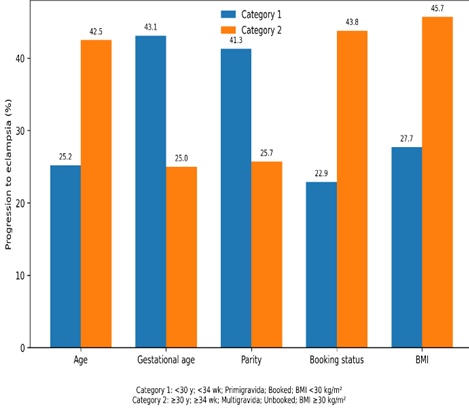
Figure 1: Progression to eclampsia according to selected maternal factors. The figure shows the percentage of women who progressed to eclampsia across categories of maternal age, gestational age, parity, booking status, and BMI.
DISCUSSION:
The present study evaluated maternal and fetal outcomes among 176 pregnant women diagnosed with pre-eclampsia. The findings demonstrated a considerable burden of adverse outcomes affecting both mothers and newborns. Progression to eclampsia occurred in 32.4% of patients, while other important maternal complications included postpartum hemorrhage, HELLP syndrome, acute kidney injury, pulmonary edema, disseminated intravascular coagulation, and maternal mortality. On the fetal side, low birth weight, preterm delivery, NICU admission, low APGAR score, and perinatal mortality were frequently observed. These findings highlight the multisystem nature of pre-eclampsia and its potential to cause serious maternal and perinatal complications [15]. The World Health Organization also recognizes pre-eclampsia and eclampsia as important causes of maternal and perinatal morbidity and mortality, with complications including eclampsia, HELLP syndrome, organ dysfunction, preterm birth, fetal growth restriction, and maternal and fetal death. Progression to eclampsia was observed in 57 (32.4%) women in the present study. This finding is clinically important because eclampsia represents one of the most severe consequences of uncontrolled pre-eclampsia. Progression may occur rapidly, particularly in women with severe disease or delayed access to appropriate obstetric care. Early identification of pre-eclampsia, adequate blood pressure control, close maternal and fetal monitoring, and timely use of magnesium sulfate remain important measures for reducing the risk of seizures. WHO guidance indicates that magnesium sulfate can substantially reduce progression to eclampsia among women with pre-eclampsia [16].
Among other maternal complications, postpartum hemorrhage occurred in 13.6%, HELLP syndrome in 12.5%, acute kidney injury in 10.2%, pulmonary edema in 8.5%, and disseminated intravascular coagulation in 4.5% of patients. Maternal mortality was recorded in 2.8% of cases. These outcomes reflect the systemic endothelial and vascular abnormalities associated with pre-eclampsia, which can affect hepatic, renal, hematological, cardiovascular, and neurological function [17]. Hypertensive disorders of pregnancy remain an important contributor to maternal mortality globally, especially in low- and lower-middle-income countries where delays in recognition and treatment may increase the severity of complications. Adverse fetal and neonatal outcomes were even more frequent. Low birth weight was observed in 58.5% of neonates, preterm delivery in 52.3%, NICU admission in 48.9%, and low APGAR score in 31.3%, while perinatal mortality occurred in 11.9%. These findings can be explained by impaired uteroplacental perfusion associated with pre-eclampsia and by the need for early delivery when maternal or fetal condition deteriorates. Preterm birth and impaired fetal growth are well-recognized consequences of pre-eclampsia, and hypertensive disorders of pregnancy are associated with increased risks of low birth weight, stillbirth, and early neonatal mortality [18].
The present study also found significant associations between progression to eclampsia and selected maternal characteristics. Women aged ≥30 years had a higher frequency of eclampsia than younger women, while patients presenting before 34 weeks of gestation were also more likely to progress to eclampsia. Earlier onset of pre-eclampsia is generally associated with more severe placental dysfunction and a greater risk of maternal and fetal complications. Similarly, primigravida women showed a significantly higher frequency of eclampsia than multigravida women. Nulliparity is a recognized risk factor for pre-eclampsia and is routinely considered during antenatal risk assessment. Unbooked women had a considerably higher frequency of progression to eclampsia than booked women, 43.8% versus 22.9%, respectively. This finding emphasizes the importance of regular antenatal care [19]. Women attending routine antenatal visits have greater opportunities for early blood pressure measurement, detection of proteinuria, identification of warning symptoms, and timely referral for specialist management. In contrast, women without regular antenatal surveillance may present only after severe hypertension or complications have already developed [20-22]. Access to skilled and timely maternity care remains particularly important in reducing preventable maternal and neonatal deaths. Obesity was another important factor associated with progression to eclampsia. Eclampsia occurred in 45.7% of women with BMI ≥30 kg/m² compared with 27.7% among those with BMI <30 kg/m². Obesity is an established risk factor for pre-eclampsia and may contribute through metabolic abnormalities, inflammation, insulin resistance, and vascular dysfunction. The association observed in the present study therefore supports the need for closer antenatal monitoring of women with increased BMI [23].
Limitations
This study had several limitations. First, it was conducted at a single tertiary care center, which may limit the generalizability of the findings to other populations and healthcare settings. Second, the use of non-probability consecutive sampling may have introduced selection bias. Third, some maternal and fetal outcomes may have been influenced by differences in disease severity, timing of presentation, antenatal care, and management received during hospitalization. In addition, the study mainly assessed short-term fetomaternal outcomes and did not evaluate long-term maternal cardiovascular health or neonatal development. Finally, residual confounding from unmeasured clinical and socioeconomic factors could not be completely excluded.
CONCLUSION:
Pre-eclampsia was associated with a substantial burden of adverse maternal and fetal outcomes. Progression to eclampsia, postpartum hemorrhage, HELLP syndrome, acute kidney injury, pulmonary edema, and maternal mortality were important maternal complications, while preterm delivery, low birth weight, NICU admission, low APGAR score, and perinatal mortality were common fetal and neonatal outcomes. Higher maternal age, earlier gestational age at presentation, primigravidity, unbooked status, and obesity were significantly associated with progression to eclampsia. Early detection, regular antenatal surveillance, timely referral, and appropriate management are essential to reduce fetomaternal complications in patients with pre-eclampsia.
REFERENCES:
1. Shah S. Hypertensive disorders in pregnancy. In: Obstetric and Gynecologic Nephrology: Women’s Health Issues in the Patient With Kidney Disease. 2020. p. 11-23.
2. Iqbal QJ, Javed A, Marri ZA, Sabeen N. Feto-maternal outcome of pregnancy complicated with preeclampsia. J Pharm Res Int. 2020;32(22):44-8.
3. Garovic VD, White WM, Vaughan L, Saiki M, Parashuram S, Garcia-Valencia O, et al. Incidence and long-term outcomes of hypertensive disorders of pregnancy. J Am Coll Cardiol. 2020;75(18):2323-34.
4. Dimitriadis E, Rolnik DL, Zhou W, Estrada-Gutierrez G, Koga K, Francisco RP, et al. Pre-eclampsia. Nat Rev Dis Primers. 2023;9(1):8.
5. Perry A, Stephanou A, Rayman MP. Dietary factors that affect the risk of pre-eclampsia. BMJ Nutr Prev Health. 2022;5(1):118.
6. Khattak AU, Khattak S. Frequency of fetomaternal outcomes in severe preeclampsia: preeclampsia and fetomaternal outcomes. Pak J Health Sci. 2024;5(5):15-9.
7. Bisson C, Dautel S, Patel E, Suresh S, Dauer P, Rana S. Preeclampsia pathophysiology and adverse outcomes during pregnancy and postpartum. Front Med (Lausanne). 2023;10:1144170.
8. Bankole AO, Onebunne CA, Owonikoko KM. Fetomaternal outcome of pre-eclampsia and eclampsia in LAUTECH Teaching Hospital, Ogbomoso: a 4-year review. Trop J Med Res. 2022;21(2):75-84.
9. Varghese L, Babu N, VC N. Feto-maternal outcomes of pre-eclampsia: a retrospective study. Manipal J Nurs Health Sci. 2022;8(2):5.
10. Jehangir S, Salam R, Akhtar N, Bashir N, Akram S, Sabir F, et al. Comparison of adverse maternal outcome in early onset versus delayed onset preeclampsia. Pak J Med Health Sci. 2023;17(6):164.
11. Iqbal QJ, Javed A, Marri ZA, Sabeen N. Feto-maternal outcome of pregnancy complicated with preeclampsia. J Pharm Res Int. 2020;32(22):44-8.
12. Magee LA, Sharma S, Nathan HL, Adetoro OO, Bellad MB, Goudar S, et al. The incidence of pregnancy hypertension in India, Pakistan, Mozambique, and Nigeria: a prospective population-level analysis. PLoS Med. 2019;16(4):e1002783.
13. Naeem A, Jan S, Ali M, Mubashir H, Hanif S, Abbasi S. The feto-maternal outcomes and incidence of early- and late-onset preeclampsia. Pak J Med Health Sci. 2022;16(10):807.
14. Chimrani J, Gupta K, Jain U, Jain S, Jain S, Jain G. Feto-maternal outcome in severe preeclampsia. Int J Acad Med Pharm. 2023;5(1):392-7.
15. Saxena U, Nisa S, Agarwal Y, Lachyan A, Chandan SK, Prasad S. Fetomaternal outcome in preeclampsia and eclampsia with posterior reversible encephalopathy syndrome. Qatar Med J. 2024;2024(4):59. doi:10.5339/qmj.2024.59.
16. Khattak AU, Khattak S. Frequency of fetomaternal outcomes in severe preeclampsia: preeclampsia and fetomaternal outcomes. Pak J Health Sci. 2024;5(5):15-9. doi:10.54393/pjhs.v5i05.1494.
17. Ahmed S, Shafi M, Awan A, Khan M, Bhutto S, Zameer N. Common fetomaternal outcomes among women with severe preeclampsia: a prospective cohort study. J Saidu Med Coll [Internet]. 2025 [cited 2026 Aug 21];15(4):662-8. Available from: http://jsmc.pk/index.php/jsmc/article/view/1103
18. Rahnemaei FA, Fashami MA, Abdi F, Abbasi M. Factors effective in the prevention of preeclampsia: a systematic review. Taiwan J Obstet Gynecol. 2020;59(2):173-82. doi:10.1016/j.tjog.2020.01.002.
19. Mousa A, Mandili RL, Aljahdali M. Maternal and fetal outcomes of preeclampsia with and without severe features in King Abdulaziz University Hospital, Jeddah, Saudi Arabia: a retrospective study. Cureus. 2022;14(11):e31013. doi:10.7759/cureus.31013.
20. Preeclampsia: background, pathophysiology, etiology [Internet]. Medscape; [cited 2026 Aug 21]. Available from: https://emedicine.medscape.com/article/1476919-overview
21. Costello RA, Leslie SW, Nehring SM. Disseminated intravascular coagulation. In: StatPearls [Internet]. Treasure Island (FL): StatPearls Publishing; 2025 [cited 2026 Aug 21]. Available from: http://www.ncbi.nlm.nih.gov/books/NBK441834/
22. Khalid F, Mahendraker N, Tonismae T. HELLP syndrome. In: StatPearls [Internet]. Treasure Island (FL): StatPearls Publishing; 2025 [cited 2026 Aug 21]. Available from: http://www.ncbi.nlm.nih.gov/books/NBK560615/
23. Sultana, R., Mondal, E., Islam, R., & Biswash, P. K. (2024). Fetomaternal outcome in patients with eclampsia: study in a territory care hospital in Bangladesh. International Journal of Reproduction, Contraception, Obstetrics and Gynecology, 13(2), 344–348. https://doi.org/10.18203/2320-1770.ijrcog20240131