One-pot Solvent-free synthesis of Dihydropyrano[2,3-c]pyrazoles promoted by Sulfonated Naphthalene Formaldehyde (SNF)
- T. G. Mundhe , Department of Chemistry, Sanjeevanee Mahavidyalaya Chapoli-413513, Dist: Latur, Affiliated to S. R. T. M. University, Nanded (MS), India.
- B. N. Chate , Department of Chemistry, Sanjeevanee Mahavidyalaya Chapoli-413513, Dist: Latur, Affiliated to S. R. T. M. University, Nanded (MS), India.
- M. H. Gagare , Department of Chemistry, Rajarshi Shahu Mahavidyalaya Latur-413512, Affiliated to S. R. T. M. University Nanded (MS), India
- A. S. Patki , Department of Chemistry, Shivaji Mahavidyalaya Renapur-413527, Dist: Latur, Affiliated to S. R. T. M. University, Nanded (MS), India.
Article Information:
Abstract:
In the present work, we report the synthesis of pyranopyrazole derivatives through a four-component reaction of aromatic aldehydes, ethyl acetoacetate, hydrazine hydrate, and malononitrile using Sulfonated Naphthalene Formaldehyde (SNF) as a heterogeneous catalyst. The study focuses on establishing a green and sustainable protocol under aqueous medium and evaluating the influence of different substituents on the reaction outcome. This work aims to explore an environmentally benign and efficient methodology for the construction of biologically important pyranopyrazole scaffolds. Furthermore, the investigation highlights the versatility of SNF as a reusable catalyst and its potential application in promoting multicomponent reactions. The developed method contributes to the advancement of green chemistry approaches in heterocyclic synthesis and provides a practical route for preparing structurally diverse pyranopyrazole derivatives.
Keywords:
Article :
INTRODUCTION:
Pyranopyrazoles constitute an important class of heterocyclic bioactive compounds that have been widely investigated in medicinal chemistry, particularly for their strong antibacterial potential in comparison with other heterocyclic frameworks [1]. Nitrogen-containing heterocycles are abundant in nature and play a vital role as structural motifs in many biologically active molecules. They are also frequently employed as intermediates in the synthesis and design of modern pharmaceuticals [2]. Within this broad category, pyranopyrazole derivatives have recently gained considerable attention owing to their diverse medicinal and agrochemical applications [3].
Multicomponent reactions (MCRs) have emerged as highly versatile strategies in organic and medicinal chemistry, enabling the combination of three or more reactants in a single step to produce complex molecules with excellent atom economy [4,5]. They are particularly valuable for convergent synthesis, allowing direct access to structurally diverse and biologically relevant compounds from simple starting materials, which is beneficial for drug discovery [6,7]. Compared to conventional stepwise methods, MCRs offer operational simplicity, reduced reaction times, broad substrate scope, high selectivity, and minimized waste, making them an attractive tool for sustainable and green synthetic methodologies [8].
Pyranopyrazoles are fused heterocyclic systems known for a wide range of biological activities, including fungicidal [9], bactericidal [10], vasodilatory [11], and anticancer properties [12]. They also serve as valuable pharmaceutical intermediates and biodegradable agrochemicals [13–16]. Furthermore, pyrano[2,3-c]pyrazoles have demonstrated insecticidal [17] and molluscicidal effects [18,19]. Pyranopyrazole derivatives have been reported to possess antihypertensive [20], anti-inflammatory [21], antimicrobial [22], and anticancer [23] activities. Several marketed drugs such as sulfaphenazole (antibacterial), celecoxib (anti-inflammatory), rimonabant (anti-obesity), and mepiprazole (antidepressant) are based on the pyrazole core structure [24].
The synthesis of dihydropyrano[2,3-c]pyrazoles was first reported in 1974 via a base-catalyzed cycloaddition of 4-arylidene-5-pyrazolone [25]. Over the years, various catalytic systems have been explored, including ferrite@silica [26], iodine [27], and proline [28]. Brønsted-acidic ionic liquids have also demonstrated efficiency in these transformations [29].
In alignment with green chemistry principles, eco-friendly alternatives such as photocatalysis have been developed [30]. Among biocatalysts, papain has gained attention as an inexpensive and sustainable enzyme. Initially applied in the Knoevenagel reaction, papain has since been utilized in a variety of other organic transformations, highlighting the potential of enzymes in greener synthetic approaches [31].
Other synthetic methods include the use of proline triflate [32] and nanocrystalline ZnO [33]. While these methods show good efficiency, limitations such as moderate yields, harsh reaction conditions, or the use of toxic solvents persist, reinforcing the need for more sustainable alternatives. Current trends emphasize recyclable catalysts, water-mediated reactions, and multicomponent processes to enhance both sustainability and energy efficiency [34].
Heterogeneous catalysts have attracted significant interest due to advantages such as high stability, ease of recovery, reduced toxicity, and reusability [35,36]. Notable examples include nanoparticle-supported ionic liquid systems, which continue to provide efficient and greener routes for heterocyclic synthesis [37, 38].
Sulfonated Naphthalene Formaldehyde (SNF), a water-soluble sulfonated polymer, has attracted attention as a green and cost-effective catalyst in organic synthesis. The presence of sulfonate groups distributed along the polymeric backbone provides catalytic activity, facilitating various acid-catalyzed transformations under mild reaction conditions. Its excellent compatibility with aqueous media, low toxicity, commercial availability, and ease of handling make SNF an attractive alternative to conventional mineral acids and metal-based catalysts. Consequently, SNF has been successfully employed in multicomponent reactions and the synthesis of biologically important heterocyclic compounds in accordance with the principles of green chemistry [39].
In the present study, we report an efficient and environmentally benign protocol for the synthesis of dihydropyrano[2,3-c]pyrazole derivatives via a four-component reaction of various benzaldehydes, ethyl acetoacetate, hydrazine hydrate, and malononitrile in the presence of Sulfonated Naphthalene Formaldehyde (SNF) as a catalyst. The reaction was carried out in water under mild conditions, providing a green and sustainable approach to the target heterocycles. A wide range of benzaldehyde derivatives bearing electron-donating and electron-withdrawing substituents was investigated to assess the catalytic efficiency, substrate scope, and versatility of SNF in promoting this multicomponent transformation.
Material and method:
All chemicals and reagents were obtained from commercial suppliers and used as received without further purification. Sulfonated Naphthalene Formaldehyde (SNF) was employed as the catalyst. Melting points were determined using a digital melting point apparatus and are uncorrected. The progress of the reactions was monitored by thin-layer chromatography (TLC) on silica gel 60 F254 aluminum-backed plates using an ethyl acetate/n-hexane solvent system. Fourier-transform infrared (FT-IR) spectra were recorded using KBr pellets and are reported in cm⁻¹. 1H NMR and 13C NMR spectra were acquired on a Bruker spectrometer using CDCl₃ or DMSO-d₆ as the solvent and tetramethylsilane (TMS) as the internal standard. Chemical shifts (δ) are expressed in parts per million (ppm), and coupling constants (J) are reported in hertz (Hz). The purity of the synthesized compounds was assessed by TLC, and their structures were confirmed by spectroscopic analysis in agreement with the reported literature data.
Standard Synthetic Procedure for Pyranopyrazole Derivatives
In a typical reaction, equimolar amounts of substituted aromatic aldehyde (1 mmol), malononitrile (1 mmol), hydrazine hydrate (1 mmol), and ethyl acetoacetate (1 mmol) were mixed in distilled water (10 mL) in a round-bottom flask. Sulfonated Naphthalene Formaldehyde (SNF) (10 wt%) was added as the catalyst, and the reaction mixture was stirred at 60 °C using a magnetic stirrer. The progress of the reaction was monitored by thin-layer chromatography (TLC). Upon completion, the reaction mixture was cooled to room temperature, resulting in the precipitation of the desired product. The solid product was isolated by simple filtration, washed with cold water followed by ethanol, and dried under vacuum to afford the corresponding pyranopyrazole derivatives (5a–k). The synthesized compounds were characterized by spectroscopic methods, and their physical and spectral data were found to be consistent with those reported in the literature. Owing to its high water solubility, the SNF catalyst remained in the aqueous filtrate after product separation. The catalyst-containing aqueous phase was subsequently reused in consecutive reaction cycles, demonstrating good recyclability with only a marginal decrease in catalytic activity.
Scheme1.: SNF catalyzed synthesis of Pranopyrazole under aqueous condition
RESULT AND DISCUSSION:
Catalytic Activity
The model reaction involving benzaldehyde, ethyl acetoacetate, hydrazine hydrate, and malononitrile was studied under different conditions to optimize the synthesis of pyranopyrazole derivatives. Initially, when the reaction was performed in the absence of any catalyst (Table1, Entries 1 and 2), either no product or only a trace amount was obtained even after prolonged reaction times. This observation highlights the necessity of a catalytic system to promote the condensation and cyclization steps effectively.
Table-1. Reaction condition optimization for pyranopyrazole synthesis using SNF.
|
Entry |
Catalyst |
Amount (wt%) |
Time (hr.) |
Temp. (0C) |
Solvent |
Yield (%)x |
|
1 |
- |
- |
12 |
RT |
- |
Nil |
|
2 |
- |
- |
24 |
RT |
- |
Trace |
|
3 |
SNF |
2.5 |
08 |
RT |
- |
5 |
|
4 |
SNF |
5 |
06 |
RT |
- |
13 |
|
5 |
SNF |
7.5 |
06 |
RT |
- |
25 |
|
6 |
SNF |
10 |
05 |
RT |
- |
52 |
|
7 |
SNF |
12.5 |
05 |
RT |
- |
55 |
|
8 |
SNF |
15 |
05 |
RT |
- |
56 |
|
9 |
SNF |
10 |
4 |
60 |
- |
66 |
|
10 |
SNF |
10 |
4 |
90 |
- |
68 |
|
11 |
SNF |
10 |
3 |
60 |
DMSO |
73 |
|
12 |
SNF |
10 |
4 |
60 |
DCM |
69 |
|
13 |
SNF |
10 |
2 |
60 |
Water |
84 |
|
X indicate isolated yield of the product. |
||||||
The effect of catalyst loading was subsequently investigated using Sulfonated Naphthalene Formaldehyde (SNF). As shown in Entries 3–8, increasing the catalyst loading from 2.5 to 10 wt% resulted in a gradual increase in product yield from 5% to 52%. Further increasing the catalyst loading to 12.5 and 15 wt% afforded only marginal improvements in yield (55% and 56%, respectively), suggesting that 10 wt% SNF provides an adequate number of active sites for efficient catalytic activity. Therefore, 10 wt% SNF was selected as the optimum catalyst loading.
The influence of temperature was then examined using 10 wt% SNF under solvent-free conditions. Raising the reaction temperature from room temperature to 60 °C increased the yield from 52% to 66% while reducing the reaction time from 5 h to 4 h (Table1, Entry 9). A further increase in temperature to 90 °C produced only a slight improvement in yield of 68% ( Table1,, Entry 10). Considering the minimal gain in product formation and the higher energy requirement, 60 °C was chosen as the optimum reaction temperature.
To further improve the reaction efficiency, the effect of solvent was investigated at 60 °C using 10 wt% SNF. Reactions carried out in DMSO and dichloromethane afforded the desired product in 73% and 69% yields, respectively (Table1, Entries 11 and 12). Remarkably, water proved to be the most effective reaction medium, delivering the target pyranopyrazole derivative in 84% isolated yield within only 2 h (Table1, Entry 13). The enhanced performance in water may be attributed to the excellent solubility of SNF in aqueous media, which promotes effective interaction between the catalyst and reactants. In addition, hydrogen-bonding interactions and the hydrophobic effect of water are likely to facilitate the multicomponent condensation process.
Overall, the optimum reaction conditions were identified as 10 wt% SNF in water at 60 °C, affording the desired pyranopyrazole derivative in 84% isolated yield within 2 h. The use of a readily available, water-soluble catalyst in combination with water as a green solvent renders the protocol operationally simple and environmentally benign.
Table-2. Comparative study of SNF and conventional catalysts in the synthesis of pyranopyrazole derivatives.
|
Entry |
Catalyst |
Time (hr.) |
Yield (%)X |
|
1 |
Na2CO3 |
8 |
28 |
|
2 |
Pyridine |
7 |
35 |
|
3 |
PTSA |
7.5 |
48 |
|
4 |
AcOH |
6 |
32 |
|
5 |
L-Proline |
5 |
35 |
|
6 |
SnCl4 |
5 |
52 |
|
7 |
FeCl3 |
6 |
58 |
|
8 |
[Bmim]BF4 |
4 |
69 |
|
9 |
SNF |
2 |
84 |
|
All catalysts were used in equivalent amounts (10 wt%). The reactions were carried out in aqueous medium at 60 °C. X is the isolated yield of the product. |
|||
After establishing the effectiveness of SNF as a catalyst, its performance was compared with various homogeneous and heterogeneous catalytic systems under the optimized reaction conditions (10 wt% catalyst, 60 °C, aqueous medium). The results are summarized in Table-2.
When conventional catalysts such as sodium carbonate pyridine, acetic acid and L-proline (Entries 1-2 and 4-5) were employed, only moderate yields (28–35%) were obtained, even after prolonged reaction times ranging from 5 to 8 h. The relatively low catalytic efficiency may be attributed to their limited ability to promote the sequential Knoevenagel condensation, Michael addition, and cyclization processes involved in pyranopyrazole formation.
The use of stronger Brønsted and Lewis acid catalysts, including PTSA (Entry 3), SnCl₄ (Entry 6), and FeCl₃ (Entry 7), improved the reaction efficiency, affording yields in the range of 48–58%. However, these catalysts still required relatively long reaction times for completion and suffer from drawbacks such as corrosiveness, difficult handling, and reduced environmental compatibility.
The ionic liquid [Bmim]BF₄ (Entry 8) exhibited improved catalytic activity, providing the desired product in 69% yield within 4 h. The enhanced performance may be attributed to the unique ionic environment created by the ionic liquid, which facilitates interaction among the reactants. Nevertheless, the yield and reaction rate remained inferior to those achieved using SNF.
Among all the catalysts investigated, Sulfonated Naphthalene Formaldehyde (SNF) demonstrated the highest catalytic efficiency, affording the desired pyranopyrazole derivative in 84% yield within only 2 h (Entry 9). The superior performance of SNF may be attributed to the presence of sulfonate functionalities distributed along its polymeric framework, which facilitate activation of the reactants and promote the multicomponent reaction sequence. Furthermore, its excellent solubility in water ensures efficient catalyst–substrate interaction throughout the reaction medium, thereby enhancing the overall reaction rate and product yield.
The comparative study clearly demonstrates that SNF outperforms the examined conventional catalysts in terms of both reaction efficiency and isolated yield. In addition, the combination of a readily available, inexpensive, water-soluble catalyst with water as a green reaction medium highlights the sustainable and environmentally benign nature of the developed methodology for the synthesis of pyranopyrazole derivatives.
Table-3. Electronic influence of aromatic aldehyde substituents on SNF catalyzed pyranopyrazole synthesis.
|
Entry |
Aldehyde |
Product |
Time (hr.) |
Yield (%)x |
M.P. (0C) |
|
|
Obs. |
Lit. [40-44] |
|||||
|
4a |
|
|
2 |
84 |
166-168 |
167-168 |
|
4b |
|
|
3 |
83 |
173-175 |
175-177 |
|
4c |
|
|
3 |
81 |
170-172 |
171-173 |
|
4d |
|
|
3.5 |
76 |
227-229 |
227-228 |
|
4e |
|
|
3 |
79 |
210-212 |
210-212 |
|
4f |
|
|
2 |
85 |
145-146 |
145-147 |
|
4g |
|
|
2 |
88 |
179-181 |
181-183 |
|
4h |
|
|
1.5 |
91 |
231-232 |
230-232 |
|
4i |
|
|
1.5 |
92 |
170-172 |
171-172 |
|
4j |
|
|
94 |
1.5 |
263-265 |
263-265 |
|
4k |
|
|
2 |
90 |
227-229 |
228-230 |
|
X indicates isolated yield of the product |
||||||
|
Entry |
Aldehyde |
Product |
Time (hr.) |
Yield (%)x |
M.P. (0C) |
|
|
Obs. |
Lit. [40-44] |
|||||
|
4a |
|
|
2 |
84 |
166-168 |
167-168 |
|
4b |
|
|
3 |
83 |
173-175 |
175-177 |
|
4c |
|
|
3 |
81 |
170-172 |
171-173 |
|
4d |
|
|
3.5 |
76 |
227-229 |
227-228 |
|
4e |
|
|
3 |
79 |
210-212 |
210-212 |
|
4f |
|
|
2 |
85 |
145-146 |
145-147 |
|
4g |
|
|
2 |
88 |
179-181 |
181-183 |
|
4h |
|
|
1.5 |
91 |
231-232 |
230-232 |
|
4i |
|
|
1.5 |
92 |
170-172 |
171-172 |
|
4j |
|
|
94 |
1.5 |
263-265 |
263-265 |
|
4k |
|
|
2 |
90 |
227-229 |
228-230 |
|
X indicates isolated yield of the product |
||||||
The optimized reaction conditions for the synthesis of pyranopyrazole derivatives were established using benzaldehyde as a model substrate. Under the optimized conditions, employing 10 wt% Sulfonated Naphthalene Formaldehyde (SNF) as the catalyst in water at 60 °C, the desired product was obtained in 84% yield within 2 h (Table-3, 4a). To evaluate the scope and generality of the developed protocol, a series of substituted aromatic aldehydes bearing electron-donating and electron-withdrawing groups were subjected to the reaction under the optimized conditions.
Aromatic aldehydes containing electron-donating substituents such as 4-methyl, 4-methoxy, 2,4,6-trimethoxy, and 4-hydroxy groups afforded the corresponding pyranopyrazole derivatives in 83%, 81%, 76%, and 79% yields, respectively (Table-3, 4b–4e). In general, these substrates required relatively longer reaction times than unsubstituted benzaldehyde. This behavior can be attributed to the electron-donating nature of the substituents, which decreases the electrophilicity of the aldehydic carbonyl carbon and consequently reduces its susceptibility toward nucleophilic attack during the initial condensation step.
In contrast, aldehydes bearing electron-withdrawing substituents, including 2-chloro, 3-chloro, 4-chloro, 4-fluoro, and 4-nitro groups (Table-3, 4f–4j), underwent smooth conversion to furnish the desired pyranopyrazole derivatives in comparatively higher yields and shorter reaction times. The enhanced reactivity of these substrates is attributed to the increased electrophilic character of the carbonyl carbon arising from the electron-withdrawing inductive effect of the substituents, which facilitates the formation of key reaction intermediates. Notably, furfural also participated efficiently in the reaction, affording the corresponding product in 90% yield within 2 h (Table-3, 4k). The excellent performance of this heteroaromatic substrate may be associated with its favorable electronic characteristics, which promote efficient progression of the multicomponent reaction sequence.
The structures of all synthesized compounds were established by spectroscopic analysis and comparison of their physical and spectral data with those reported in the literature. Overall, the developed SNF-catalyzed protocol exhibited broad substrate applicability and furnished the desired pyranopyrazole derivatives in good to excellent yields. The combination of a readily available and inexpensive catalyst with water as a green reaction medium highlights the practical and environmentally benign nature of the methodology.
Recyclability of Sulfonated Naphthalene Formaldehyde (SNF)
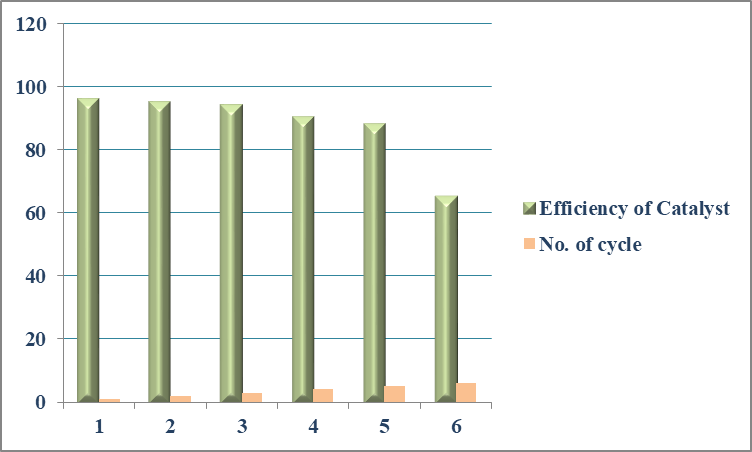
The recyclability of Sulfonated Naphthalene Formaldehyde (SNF) was examined using the model reaction under the optimized conditions. After completion of each reaction cycle, the product was separated by filtration, while the water-soluble SNF catalyst remained in the aqueous phase. The catalyst-containing filtrate was subsequently reused for the next cycle without significant modification.
As illustrated in Fig-1, SNF exhibited excellent catalytic stability during repeated use. The catalyst retained 96%, 95%, 94%, 90%, and 88% of its initial activity over the first five consecutive cycles, indicating only a marginal loss in catalytic efficiency. A more pronounced decrease was observed in the sixth cycle, where the catalyst retained 65% of its original activity. The gradual decline in performance after multiple runs may be attributed to catalyst loss during handling and recovery, dilution effects, or partial deactivation of catalytically active sites.
The results clearly demonstrate that SNF can be effectively recycled and reused for at least five consecutive cycles with minimal loss of catalytic activity. The combination of catalyst recyclability, aqueous reaction medium, operational simplicity, and high catalytic efficiency highlights the practical and environmentally benign nature of the developed protocol for the synthesis of pyranopyrazole derivatives.
|
Efficiency of Catalyst |
96 |
95 |
94 |
90 |
88 |
65 |
|
No. of cycle |
1 |
2 |
3 |
4 |
5 |
6 |
Fig-1: Recyclability of SNF
Spectral data of some selected synthesized derivative
The structural identity of the synthesized compounds was thoroughly confirmed by analyzing their spectral data, which showed good agreement with their observed physical properties. Furthermore, these spectral features were consistent with values reported in previously published literature, thereby validating the successful synthesis and structural integrity of the compounds [40-44].
6-Amino-3-methyl-4-phenyl-2,4-dihydropyrano[2,3-c]pyrazole-5-carbonitrile (Table-3, 4a)
FT-IR (KBr, cm⁻¹):704, 818, 1071, 1158, 1428, 1488, 1595, 1647, 2191, 3170, 3311, 3372. 1H NMR (DMSO, δ ppm): 1.82 (s, 3H), 4.68 (d, 1H), 6.77-7.18(m, 2H), 7.19-7.29 (m, 3H). ¹³C NMR (DMSO, δ ppm): 10.4, 37.2, 58.4, 97.8, 121.3, 127.5, 127.8, 129.1, 136.2, 144.5, 155.5, 161.6. Mass (m/z): 253 [M+H]⁺.
6-Amino-4-(4-methylphenyl)-3-methyl-2,4-dihydropyrano[2,3-c]pyrazole-5-carbonitrile (Table-3, 4b)
FT-IR (KBr, cm⁻¹): 793, 1048, 1163, 1334, 1509, 1647, 2181, 2960, 3022, 3140, 3366. (DMSO, δ ppm): 1.80 (s, 3H), 2.31 (s, 3H), 4.60 (s, 1H), 6.78-7.05 (s, 2H), 7.10-14 (s, 4H), 12.08 (s, 1H). ¹³C NMR (DMSO, δ ppm): 10.4, 21.8, 37.2, 38.6, 98.6, 121.8, 128.2, 129.8, 136.6, 136.9, 142.8, 155.1, 163.4. Mass (m/z): 267.
6-Amino-4-(4-hydroxyphenyl)-3-methyl-2,4-dihydropyrano[2,3-c]pyrazole-5-carbonitrile (Table-3, 4e).
FT-IR (KBr, cm⁻¹): 762, 1008, 1119, 1231, 1389, 1495, 1598, 1657, 2184, 2967, 3142, 3357, 3435. ¹H NMR (DMSO, δ ppm): 1.70 (s, 3H), 4.53 (s, 1H), 6.66 (s, 2H), 6.74 (d, 2H), 6.98 (d, 2H,), 9.18 (s, 1H,), 12.10 (s, 1H). ¹³C NMR (DMSO, δ ppm): 10.0, 37.6, 56.6, 100.7, 113.6, 121.7, 127.6, 133.5, 136.3, 154.1, 155.1, 163.7. Mass (m/z): 269 [M+H]⁺.
6-Amino-3-methyl-4-(furan-2-yl)-2,4-dihydropyrano[2,3-c] pyrazole-5-carbonitrile (Table-3, 4k)
FT-IR (KBr, cm⁻¹): 928, 1041, 1141, 1233, 1272, 1521, 1646, 2186, 3167, 3346. ¹H NMR (DMSO, δ ppm): 1.92 (s, 3H), 4.82 (s, 1H), 6.14–6.30 (m, 4H), 7.45 (s, 1H), 12.06 (s, 1H). ¹³C NMR (DMSO, δ ppm): 9.8, 30.1, 54.5, 96.0, 106.2, 110.8, 212.1, 137.0, 142.9, 155.7, 156.6, 162.2. Mass: m/z: 242 [M+H]⁺.
CONCLUSION :
An efficient, green, and operationally simple method has been developed for the synthesis of pyrano[2,3-c]pyrazole derivatives using Sulfonated Naphthalene Formaldehyde (SNF) as a catalyst in aqueous medium. Optimization studies established that 10 wt% SNF in water at 60 °C provides the best reaction conditions, affording the desired products in high yields within short reaction times. A variety of aromatic and heteroaromatic aldehydes were successfully transformed into the corresponding pyrano[2,3-c]pyrazoles, demonstrating the broad applicability of the protocol. Aldehydes containing electron-withdrawing substituents generally furnished higher yields and reacted more rapidly than those bearing electron-donating groups. Furthermore, SNF exhibited good recyclability, retaining most of its catalytic activity over five consecutive reaction cycles. The use of a readily available and inexpensive catalyst, water as a green solvent, simple product isolation, and satisfactory catalyst reusability makes the present methodology a practical and sustainable approach for the synthesis of biologically important pyrano[2,3-c]pyrazole derivatives.
Acknowledgment
The authors sincerely thank the management and principals of the research institutes for their invaluable encouragement and assistance throughout this project. Their support has been instrumental in the successful completion of this research.
Competing interests
The authors declare no competing interests.
BIBLIOGRAPHY:
1. B. M. Chougala, S. Samundeeswari, M. Holiyachi, L. A. Shastri, S. Dodamani, S. Jalalpure, S. R. Dixit, S. D. Joshi, V. A. Sunagar, Eur. J. Med. Chem., 125, 101 (2017).
2. M. M. Heravi, V. Zadsirjan, RSC Adv., 10, 44247 (2020).
3. B. P. Tripathi, A. Mishra, P. Rai, Y. K. Pandey, M. Srivastava, S. Yadav, J. Singh, New J. Chem., 41, 11148 (2017).
4. D. M. D’Souza, T. J. J. Mueller, Chem. Soc. Rev., 36, 1095 (2007).
5. A. Dömling, Chem. Rev., 106, 17 (2006).
6. P. A. Tempest, Curr. Opin. Drug Discov. Dev., 8, 776 (2005).
7. C. Kalinski, H. Lemoine, J. Schmidt, C. Burdack, J. Kolb, M. Umkehrer, G. Ross, Synlett, 24, 4007 (2008).
8. J. Zhu, H. Bienaymé (Eds.), Multicomponent Reactions in the Total Synthesis of Natural Products, Wiley-VCH, Weinheim, 2005, pp. 342–397.
9. A. Feurer, J. Luithle, S. Wirtz, G. Koenig, J. Stasch, E. Stahl, R. Schreiber, F. Wunder, D. Lang, PCT Int. Appl. WO 2004009589, Baye Healthcare Ag, Germany.
10. M. N. Nasr, M. M. Gineinah, Arch. Pharm. Med. Chem., 335, 289 (2002).
11. V. K. Ahluwalia, A. Dahiya, V. Garg, Indian J. Chem., 36B, 88 (1997).
12. M. R. Nadia, Y. K. Nahed, A. Fahmy, A. A. F. El-Sayed, Der Pharma Chem., 2, 400 (2010).
13. H. Junek, H. Aigner, Chem. Ber., 106, 914 (1973).
14. H. Wamhoff, E. Kroth, K. Strauch, Synthesis, 11, 1129 (1993).
15. Y. A. Sharanin, L. G. Sharanina, V. V. Puzanova, Zh. Org. Khim., 19, 2609 (1983).
16. G. Vasuki, K. Kandhasamy, Tetrahedron Lett., 49, 5636 (2008).
17. E. S. El-Tamany, F. A. El-Shahed, B. H. Mohamed, J. Serb. Chem. Soc., 64, 9 (1999).
18. F. M. Abdelrazek, P. Metz, N. H. Metwally, S. F. El-Mahrouky, Arch. Pharm., 339, 456 (2006).
19. A. Siddekha, A. Nizam, M. Pasha, Spectrochim. Acta A Mol. Biomol. Spectrosc., 81, 431 (2011).
20. V. K. Ahluwalia, A. Dahiya, V. K. Garg, Cheminform, 36, 88 (1997).
21. M. E. A. Zaki, H. A. Soliman, O. A. Hiekal, A. E. Rashad, Z. Naturforsch. C, 61, 1 (2006).
22. T. N. Bansode, R. M. Ansari, Y. K. Gawale, J. Pharm. Res., 4, 1141 (2011).
23. J. L. Wang, D. Liu, Z. J. Zhang, S. Shan, X. Han, S. M. Srinivasula, C. M. Croce, E. S. Alnemri, Z. Huang, Proc. Natl. Acad. Sci. U.S.A., 97, 7124 (2000).
24. M. M. Kamel, Acta Chim. Slov., 62, 136 (2015).
25. H. H. Otto, Arch. Pharm., 307, 444 (1974).
26. E. Soleimani, M. Jafarzadeh, P. Norouzi, J. Dayou, C. S. Sipaut, R. F. Mansa, P. Saei, J. Chin. Chem. Soc., 62, 1155 (2015).
27. M. Parshad, V. Verma, D. Kumar, Monatsh. Chem., 145, 1857 (2014).
28. H. Mecadon, M. R. Rohman, I. Kharbangar, B. M. Laloo, I. Kharkongor, M. Rajbangshi, B. Myrboh, Tetrahedron Lett., 52, 3228 (2011).
29. J. Ebrahimi, A. Mohammadi, V. Pakjoo, E. Bahramzade, A. Habibi, J. Chem. Sci., 124, 1013 (2012).
30. Y. Pan, X. Liu, W. Zhang, Z. Liu, G. Zeng, B. Shao, Q. Liang, Q. He, X. Yuan, D. Huang, M. Chen, Appl. Catal. B Environ., 265, 118579 (2020).
31. W. Hu, Z. Guan, X. Deng, Y. H. He, Biochimie, 94, 656 (2012).
32. J. Li, L. Lu, W. Su, Tetrahedron Lett., 51, 2434 (2010).
33. P. Ghosh, A. Das, J. Org. Chem., 78, 6170 (2013).
34. K. Tanaka, F. Toda, Chem. Rev., 100, 1025 (2000).
35. R. A. Sheldon, Green Chem., 9, 1273 (2007).
36. P. T. Anastas, J. C. Warner, Green Chemistry: Theory and Practice, Oxford University Press, New York (1998).
37. R. C. Ranu, A. Hajra, U. Jana, J. Org. Chem., 65, 6270 (2000).
38. F. Hu, M. Patel, F. T. Luo, J. Campos, Z. Xia, J. Am. Chem. Soc., 134, 14658 (2012).
39. S. Moradian, N. O. Mahmoodi, R. Shemshadi, Phosphorus Sulfur Silicon Relat. Elem., 184, 578 (2009).
40. D. Santhakumar, R. Josephine, B. Sakthivel, K. Sethuraman, A., Chem. Select 1(2016) 2332–2340.
41. S. Stankovich, D.A. Dikin, R.D. Piner, K.A. Kohlhaas, A. Kleinhammes, Y. Jia, Y. Wu, S.T. Nguyen, R.S. Ruoff, Carbon 45 (2007) 1558–1565.
42. S. N. Maddila, S. Maddila, W. E. van Zyl, S. B. Jonnalagadda, Res. Chem. Intermed., 43, 4313 (2017).
43. J. Ebrahimi, A. Mohammadi, V. Pakjoo, E. Bahramzade, A. Habibi, J. Chem. Sci., 124, 1013 (2012).
44. Y. U. Gadkari, N. T. Hatvate, V. N. Telvekar, Res. Chem. Intermed., 47, 4245 (2021).