Comparison of Clinical Outcome of Single Plating Versus Double Plating in the Treatment of Bicondylar Proximal Tibial Fractures
- Muhammad Nasir Baig , PGR, Trauma and Orthopedic Surgery, Allied hospital Faisalabad, Pakistan.
- Rana Dawood Ahmad Khan , Professor, Trauma and Orthopedic Surgery, Allied Hospital Faisalabad, Pakistan.
- Haider Ali , PGR, Trauma and Orthopedic Surgery, Allied hospital Faisalabad, Pakistan.
- Izhar Ul Haq , PGR, Trauma and Orthopedic Surgery, Allied hospital Faisalabad, Pakistan.
- Muhammad Adeem Busharat , Consultant Orthopedic Surgeon, Allied Hospital Faisalabad, Pakistan.
Article Information:
Abstract:
Objective: To compare clinical outcome of Single Plating versus Double Plating in the treatment of Bicondylar Proximal Tibial Fractures. Study Design: Cross sectional comparative trial. Place and Duration of Study: Orthopedic Surgery Department, Allied hospital Faisalabad, Faisalabad during 27 January 2025 to 27 July 2025. Methodology: A total of 124 patients with bicondylar proximal tibial fractures were included and randomly allocated into two equal groups: Group A (single lateral plating) and Group B (double plating). Baseline demographic and clinical variables were recorded. Functional outcomes were assessed using standardized scoring criteria, and union time was documented in weeks. Results: Both groups were comparable in age, gender, fracture type, and most comorbidities, except hypertension which was more prevalent in Group B (53.2% vs. 22.6%, p=0.000). Functional outcomes were significantly better with double plating, achieving excellent or good results in 70.9% of cases compared to 24.2% in the single plating group (p=0.000). Mean union time was similar between groups (12.97 ± 2.02 weeks vs. 13.39 ± 2.08 weeks, p=0.257). Conclusion: Double plating offers superior functional recovery compared to single plating for bicondylar proximal tibial fractures, without prolonging fracture union. Its use should be considered in complex fracture patterns where optimal fixation is desired.
Keywords:
Article :
INTRODUCTION:
The tibial condyles, along with their articular surfaces, form a major component of the knee joint and play a crucial role in weight transmission and mobility [1]. Fractures of the tibia are becoming increasingly common and account for approximately 1.2% of all fractures. These injuries typically result from a combination of axial compression and either valgus or varus forces [2]. In elderly individuals, particularly those over the age of sixty, such fractures commonly occur due to low-energy trauma like falls. In contrast, among younger adults, high-energy mechanisms such as fall from heights/road traffic accidents remain the most common contributing factors [2]. The treatment of bicondylar tibial fractures remains a significant challenge, and the optimal management strategy continues to be a subject of debate due to the risk of unsatisfactory outcomes [3]. Traditional methods, such as external fixation, gained some popularity in the past; however, they were associated with specific limitations, including inadequate articular reduction and pin tract infections. With the advent of modern surgical techniques and instrumentation, particularly the use of locking plates, the approach to managing these high-energy tibial plateau fractures has evolved significantly [4]. These advancements have enhanced fracture stabilization and allowed for improved anatomical alignment and early mobilization.
A single lateral locking plate can provide adequate stability and serve as an effective implant in the management of bicondylar tibial fractures. This approach minimizes soft tissue dissection by avoiding the need for a medial plate, as locking screws can be inserted percutaneously through guide arms, thereby reducing intraoperative soft tissue trauma [5]. However, maintaining axial alignment with single lateral plate fixation becomes challenging in unstable bicondylar fractures, particularly when the medial column fracture involves a coronal plane component [6]. In such cases, dual plating using two separate incisions to stabilize both the medial and lateral columns is often preferred. This technique allows for improved intraoperative visualization of the fracture geometry and offers rigid fixation of both tibial condyles, effectively preventing medial column collapse and subsequent varus deformity [7].
Ghaffari et al. compared the clinical outcomes of single lateral locking plate (SP) fixation versus dual plate (DP) fixation in patients with bicondylar proximal tibial fractures, using the Lysholm Knee Score for functional assessment. Their results indicated that the proportion of patients with excellent outcomes was 10% in the single plating group versus 30% in the double plating group. Similarly, good outcomes were reported in 15% versus 40%, fair in 45% versus 15%, and poor outcomes in 30% versus 15% of patients undergoing single and double plating, respectively [8]. These findings suggest that dual plating may offer superior functional results in selected patients.
Despite advancements in internal fixation techniques, the search for an ideal implant—whether single lateral plate or dual plating—for the management of bicondylar tibial plateau fractures remains ongoing. Therefore, the present study aims to compare the clinical outcomes of single lateral locking plate versus dual plate fixation in bicondylar tibial fractures. The fixation method associated with better clinical results may be recommended as the preferred approach in future practice.
METHODOLOGY:
This was a cross sectional comparative trial was conducted at the Department of Orthopedic Surgery, Allied Hospital, Faisalabad, 27 January 2025 to 27 July 2025. Through non-probability purposive sampling, 124 eligible cases (meeting inclusion/exclusion) criteria were included in the study. We used WHO sample size calculator for comparison of two proportions, with a 95% confidence level, 80% power, and anticipated functional outcome proportions of 10% in the single plating group and 30% in the double plating group. Sixty-two patients were allocated to each group.
Patients of both genders, aged between 18 and 65 years, presenting with bicondylar proximal tibial fractures classified as Schatzker types V and VI, were included. Patients with Gustilo grade II or III open fractures, Schatzker type I–IV fractures, pathological fractures, or medical conditions contraindicating surgery were excluded. Participants were explaining about the study in detail, assured of confidentiality and voluntary participation, and subsequently provided written informed consent.
Participants were randomized into two groups (Group A: Single plating, Group B: Double plating) using a computer-generated random number table. In Group A, patients underwent fixation using a single lateral locking plate through an anterolateral incision. Subchondral screws, as long as possible, were employed to support the medial tibial fragment. In Group B, double plating was performed using a lateral and medial approach. Under fluoroscopic guidance and longitudinal traction, joint congruity was verified. Arthrotomy was carried out via the lateral incision if required to visualize the articular surface and achieve anatomical reduction. A lateral locking plate was fixed first, followed by a medial plate placed either in the epiphyseal-metaphyseal or metaphyseal-diaphyseal region depending on fracture configuration.
All patients in both groups were encouraged to begin passive and active range-of-motion exercises starting from the second postoperative week after suture removal. A physiotherapist supervised rehabilitation at the outpatient clinic. The clinical outcome was evaluated using the Lysholm Knee Score. According to the score interpretation, outcomes were classified as excellent (95–100), good (84–94), fair (65–83), or poor (<65). Additional parameters recorded included duration of surgery (in minutes) and time to union (in weeks), defined by the ability to bear full weight without pain. Data were recorded on a predesigned proforma. Descriptive statistics i.e. age, surgery duration, and union time were computed as mean+sd. Frequencies and percentages were determined for qualitative variables including gender, mode of injury, side involved, Schatzker fracture type, comorbidities, and Lysholm outcome categories. The Chi-square test was used to compare clinical outcomes between the two groups. Stratification was performed to control for potential effect modifiers such as age, gender, union time, injury mechanism, side involved, fracture type, and comorbidities.
RESULTS:
Table 1 shows that both groups were comparable in age, gender, mode of injury, side involved, fracture type, and diabetes status, (p > 0.05). A significantly greater proportion of patients in the double plating group had hypertension (53.2%) compared with those in the single plating group (22.6%) (p < 0.001) (Table 1).
Table 1. Demographic and clinical details of both groups (n=124)
|
Variable |
Group |
Single Plating (A) (n=62) |
Double Plating (B) (n=62) |
Total |
P-value |
|
Age |
18–40 |
31 (50.0%) |
28 (45.2%) |
59 (47.6%) |
0.590 |
|
41–65 |
31 (50.0%) |
34 (54.8%) |
65 (52.4%) |
||
|
Gender |
Male |
37 (59.7%) |
31 (50.0%) |
68 (54.8%) |
0.279 |
|
Female |
25 (40.3%) |
31 (50.0%) |
56 (45.2%) |
||
|
Mode of Injury |
Fall from standing |
29 (46.8%) |
22 (35.5%) |
51 (41.1%) |
0.201 |
|
Fall from height |
33 (53.2%) |
40 (64.5%) |
73 (58.9%) |
||
|
Side Involved |
Right |
26 (41.9%) |
31 (50.0%) |
57 (46.0%) |
0.368 |
|
Left |
36 (58.1%) |
31 (50.0%) |
67 (54.0%) |
||
|
Schatzker Type |
Type V |
25 (40.3%) |
32 (51.6%) |
57 (46.0%) |
0.207 |
|
Type VI |
37 (59.7%) |
30 (48.4%) |
67 (54.0%) |
||
|
Diabetes |
Yes |
16 (25.8%) |
17 (27.4%) |
33 (26.6%) |
0.839 |
|
No |
46 (74.2%) |
45 (72.6%) |
91 (73.4%) |
||
|
Hypertension |
Yes |
14 (22.6%) |
33 (53.2%) |
47 (37.9%) |
0.000 |
|
No |
48 (77.4%) |
29 (46.8%) |
77 (62.1%) |
Table 2 highlights significantly better functional outcomes in the double plating group, with higher rates of excellent (30.6%) and good (40.3%) results compared to the single plating group (9.7% and 14.5%, respectively). Conversely, fair and poor outcomes were more frequent in the single plating group. This difference was statistically significant (p = 0.000), favoring double plating for superior functional recovery (Table 2).
Table 2. Comparison of clinical outcome of both groups (n=124)
|
Variable |
Group |
Single Plating (A) (n=62) |
Double Plating (B) (n=62) |
Total |
P-value |
|
Functional Outcome |
Excellent |
6 (9.7%) |
19 (30.6%) |
25 (20.2%) |
0.000 |
|
Good |
9 (14.5%) |
25 (40.3%) |
34 (27.4%) |
||
|
Fair |
28 (45.2%) |
9 (14.5%) |
37 (29.8%) |
||
|
Poor |
19 (30.6%) |
9 (14.5%) |
28 (22.6%) |
Fig 1. Comparative analysis of two techniques
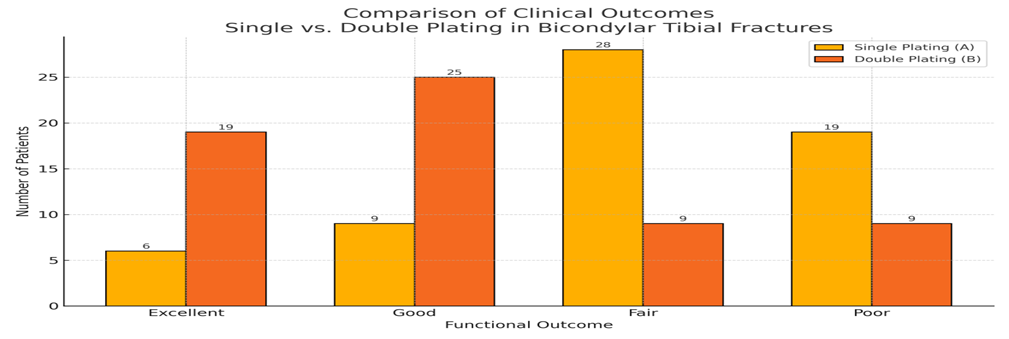
Table 3 presents a comparative analysis of union time in weeks between two groups of patients undergoing different plating techniques. Both groups comprised an equal number of participants (n = 62 each). The mean union time for patients in the Single Plating group (Group A) was 12.97 weeks with a standard deviation of 2.02, whereas the Double Plating group (Group B) had a slightly higher mean union time of 13.39 weeks with a standard deviation of 2.08, the p value= 0.257 (Table 3).
Table 3. Comparison of Union Time (Weeks) Between Groups
|
Group |
N |
Mean |
Std. Deviation |
t-value |
Sig. (2-tailed) |
Mean Difference |
|
Single Plating (Group A) |
62 |
12.97 |
2.024 |
-1.139 |
0.257 |
-0.419 |
|
Double Plating (Group B) |
62 |
13.39 |
2.075 |
DISCUSSION:
In the present study, both single plating and double plating groups were comparable in terms of age, gender distribution, mode of injury, side involved, fracture type, and diabetes status, with no statistically significant differences. The mean age in our series was similar to that reported by Kumar TD et al1 and Shrestha DK et al2, reflecting the tendency for bicondylar tibial plateau fractures to occur predominantly in the middle-aged and active population. Male predominance in our study aligns with earlier reports1-2, although some authors, such as Bryson WN et al.3 have highlighted more balanced gender distribution in certain cohorts, possibly reflecting geographical or occupational variations.
Hypertension was significantly more common in the double plating group (53.2%) compared to the single plating group (22.6%, p=0.000), a demographic factor not frequently discussed in earlier literature. This may be incidental, but it could also suggest that patients with comorbidities are more likely to receive the biomechanically stronger double plating construct to facilitate early mobilization.
Functionally, our study demonstrated significantly better results with double plating, with excellent and good outcomes achieved in 70.9% of cases compared to only 24.2% in the single plating group (p=0.000). This trend is consistent with Çağlar C et al,6 who reported superior functional recovery with double plating due to enhanced stability and restoration of the articular surface. Similar findings were noted by Ashraf D et al,9 who emphasized that a single midline incision for double plating can reduce soft tissue complications without compromising alignment or fixation stability.
Senthurvelan A et al10 also reported high rates of excellent and good outcomes (72%) with bicolumnar plating in Schatzker V and VI fractures, which closely mirrors our double plating results. Likewise, Lee MH et al11 found that dual plating through two incisions provided better medial column support and functional recovery than single lateral locked plating, particularly in comminuted fracture patterns.
Yadav SS et al12reported that double plating achieved earlier mobilization and reduced rates of malalignment compared to single plating, while Hussain AM et al13 found statistically significant improvements in functional scores with dual plating in complex bicondylar fractures. Raj M et al14 further reinforced these findings, noting that dual plating offered better articular congruity, leading to improved range of motion and long-term functional scores.
In contrast, some authors have highlighted potential drawbacks of double plating, such as increased surgical time and the risk of wound complications, especially when separate incisions are used 5,11. However, our study did not observe any major wound breakdowns, possibly due to meticulous soft tissue handling and the relatively small sample size.
Regarding union time, the two groups demonstrated comparable outcomes in our study (12.97 weeks for single plating vs. 13.39 weeks for double plating, p=0.257). This is consistent with Çağlar C et al6 and Lee MH et al11, who found similar healing times between constructs despite differences in functional recovery. This suggests that while stability and functional rehabilitation may improve with dual plating, biological healing rates are largely unaffected by construct choice when optimal fixation principles are followed.
The strengths of our study include a direct head-to-head comparison of single versus double plating in a balanced cohort with uniform postoperative rehabilitation. Additionally, functional outcomes, union times, and demographic variables were systematically compared. Limitations include the relatively small sample size, short follow-up and single-center setting, which may limit generalizability. In addition, the evaluation did not encompass long-term sequelae, including post-traumatic osteoarthritis.
Based on our findings and the supporting literature, double plating should be considered the preferred option for unstable bicondylar tibial plateau fractures, particularly Schatzker V and VI types, due to its superior functional outcomes. However, surgical approach should be tailored to soft tissue conditions to minimize complications. Future multicenter randomized controlled trials with long-term follow-up are recommended to evaluate functional sustainability, patient-reported outcomes, and cost-effectiveness of each construct.
CONCLUSION:
This study demonstrates that double plating provides superior functional outcomes compared to single lateral plating in the management of bicondylar proximal tibial fractures, without a significant increase in union time. The markedly higher proportion of excellent and good functional results in the double plating group highlights its potential to achieve better joint stability and early rehabilitation. The findings support the use of double plating, particularly in complex fracture patterns, though surgical expertise and resource availability should guide implant selection. Further multicenter trials with longer follow-up are recommended to validate these results and assess long-term joint function and post-traumatic osteoarthritis risk.
REFERENCES:
Kumar TD, Chamalla D, Miryabbelli SB, Ashok MS. A prospective study of surgical management of dual plating of bicondylar tibial plateau fracture. Int J Res Orthop 2021; 7:241-7.
2. Shrestha DK, Dipendra KC, Karki P, Shrestha S, Yogi S. Assessment of Functional Outcome of Bicolumnar Dual Plating for Bicondylar Fractures of Tibial Plateau. J Nepalgunj Med Coll. 2021;19(1):101-5.
3. Bryson WN, Fischer EJ, Jennings JW, Hillen TJ, Friedman MV, Baker JC. Three-column classification system for tibial plateau fractures: what the orthopedic surgeon wants to know. Radiographics. 2021;41(1):144-55.
4. Kumar V, Singhroha M, Arora K, Sahu A, Beniwal R, Kundu A. A clinico-radiological study of bicondylar tibial plateau fractures managed with dual locking plates. J Clin Orthop Trauma. 2021; 21:101563.
5. Arouca MM, da Costa GH, Leonhardt MC, Barbosa D, dos Santos Silva J, Kojima KE. Comparison of Bicondylar Tibial Plateau Fractures with Double or Single Lateral Locked Plate. Acta Ortop Bras. 2020;28(4):182-5.
6. Caglar C, Akcaalan S, Ozaslan HI, Bozer M, Emre F, Uğurlu M. Comparative Analysis of Single Lateral Locked Plate and Double Locked Plate Application in the Treatment of Bicondylar Tibial Plateau Fractures. Cureus. 2021;13(11): e19298.
7. Jain N, Agarwal S, Nagaich A. Comparison of dual plating with single lateral locking plate supplemented with two medial cannulated cancellous screws for AO type C tibial plateau fractures—An experience from central India. J Bone Joint Dis. 2022; 37:146-51
8. Ghaffari S, Kazemi A, Razavipour M, Shayestehazar M, Talebi S, Mardanshahi Z. Postoperative Outcomes of Single and Double Plating Osteosynthesis for Proximal Metaphyseal Tibial Fractures. Trauma Mon. 2020;25(3):128-33.
9. Ashraf D, Janjua SN, Mustafa MS, Iqbal S, Habib K. Single Midline Incision Technique for Dual Plating in Proximal Tibial Fractures: An Innovative Approach for Enhanced Fixation. Pak J Med Res. 2024;63(1):7-13.
10. Senthurvelan A, Nayak A, Biradar R, Bulagond A, Kenganal P, Kulkarni S, Patil S. Functional Outcomes of Bicolumnar Plating in Schatzker Type V and VI Proximal Tibial Fractures: A Prospective Study. Cureus. 2025;17(6):e86399. doi:10.7759/cureus.86399.
11. Lee MH, Oh JK, Oh CW, Jeon IH, Kim SJ, Kyung HS, et al. Comparison of Dual Plating via Two Incision and Single Lateral Locked Plating in the Treatment of Bicondylar Tibial Plateau Fractures. Clin Orthop Surg. 2019;11(2):151-9. doi:10.4055/cios.2019.11.2.151.
12. Yadav SS, Khan JA, Kumar A, Jha RK, Kumar S, Kumar R, et al. Comparative Study of Single Versus Double Plating for Bicondylar Proximal Tibia Fractures. Cureus. 2023;15(9):e46840. doi:10.7759/cureus.46840.
13. Hussain AM, Shoaib M, Najeebullah, Qureshi BA. Functional Outcomes in Dual Plating of Schatzker 5 and 6 Tibial Plateau Fractures. Indus J Biosci Res. 2024;2(2):437-41. doi:10.70749/ijbr.v2i02.197.
14. Raj M, Singh S, Rajput AK, Gill SP, Verma SK, Sonarkar SS. The Comparative Analysis of Single Plating Versus Double Plating in the Treatment of Unstable Bicondylar Proximal Tibial Plateau Fractures. Cureus. 2023;15(10):e46840. doi:10.7759/cureus.46840.