Comparison of Radiological and Functional Outcomes in Pediatric Diaphyseal Femoral Fractures Managed With Titanium Elastic Nail versus Submuscular Compression Plates at Tertiary Care Hospital
- Zahid Nawaz Khan , Post Graduate Resident Orthopaedic, Dow University of Health Sciences Civil Hospital Karachi, Pakistan
- Adeel Ahmed Siddiqui , Professor, Dow University of Health Sciences Civil Hospital Karachi, Pakistan
- Sunil Kumar , Associate Professor, Orthopaedic Surgery, Dow University of Health Sciences Civil Hospital Karachi, Pakistan
- Syed Muhammad Khalid Karim , Assistant Professor, Dow Medical College & Dr. Ruth K. M. Pfau Civil Hospital Karachi, Pakistan
- Muhammad Noman , Assistant Professor, Dow University of Health Sciences Civil Hospital Karachi, Pakistan
- Kashif Ali Shaikh , Post Fellow Orthopaedic Surgery, Civil Hospital Karachi, Pakistan
- Syed Wajahat Ali Zaidi , Resident Orthopedic, Dow University of Health Sciences Civil Hospital Karachi, Pakistan
- Teerath Das , Post Graduate Resident Orthopaedic, Dow University of Health Sciences Civil Hospital Karachi, Pakistan
Article Information:
Abstract:
Paediatric femoral shaft fractures can disrupt mobility, schooling and family life. Titanium elastic nailing offers minimally invasive fixation, whereas submuscular compression plating may provide greater mechanical stability. Comparative evidence on early recovery remains limited in resource-constrained tertiary-care settings. Objective: To compare three-month functional and radiological outcomes of paediatric diaphyseal femoral fractures treated with titanium elastic nails or submuscular compression plates. Methods: This single-centre randomized controlled trial was conducted at Civil Hospital Karachi from 25 June, 2025 to 10 November 2025 after institutional ethical approval and CPSP synopsis approval under reference CPSP/REU/OSG-2024-183-3156. Written parental consent and age-appropriate assent were obtained. Overall, 168 children aged 6–16 years with closed, radiographically confirmed femoral shaft fractures were randomized equally and analysed in their assigned groups. The primary outcome was an excellent Flynn functional grade at three months. Secondary outcomes were radiological union, defined as bridging callus across at least three of four cortices, and operative duration. Chi-square or Fisher’s exact tests and the independent-samples t-test were applied, with effect estimates reported alongside 95% confidence intervals. Results: Each group comprised 84 children. Excellent Flynn outcomes occurred in 32 children (38.1%) after titanium elastic nailing and 53 (63.1%) after plating (risk ratio, 1.66; 95% CI, 1.21–2.28; risk difference, 25.0%; 95% CI, 10.4–39.6; p=0.001). The overall Flynn outcome distribution differed between groups (p=0.005). Radiological union was achieved in 56 children (66.7%) after nailing and 57 (67.9%) after plating (risk ratio, 1.02; 95% CI, 0.82–1.26; p=0.869). Mean operative duration was 69.29±15.2 and 107.0±19.8 minutes, respectively; plating required 37.71 additional minutes (95% CI, 32.33–43.09; p<0.001). Conclusion: Submuscular compression plating produced better early functional recovery, while three-month radiological union was similar between techniques. Titanium elastic nailing required substantially less operative time.
Keywords:
Article :
INTRODUCTION:
Diaphyseal femoral fractures account for fewer than 2% of all fractures in children but remain among the most significant paediatric orthopaedic injuries because of their considerable clinical, social and economic consequences (1). Unlike many childhood fractures that can be treated on an outpatient basis, fractures of the femoral shaft frequently require hospital admission, anaesthesia, immobilisation, surgical intervention and repeated follow-up. These injuries may temporarily deprive a child of independent mobility, interrupt schooling and recreational activities, and place a substantial caregiving burden on the family. Population-based studies have reported annual incidence rates of 19.1 per 100,000 children in Maryland and 22.7 per 100,000 children in Switzerland, indicating that paediatric femoral shaft fractures continue to represent an important healthcare concern across different populations (2,3). The incidence increases as children become more physically active and exposed to outdoor and traffic-related risks. Falls are more frequent among younger children, whereas road-traffic collisions, sports injuries and other high-energy mechanisms become increasingly prominent in school-aged children and adolescents.
Treatment of paediatric femoral shaft fractures is determined by several factors, including the child’s age, body weight, fracture location and configuration, associated injuries, expected remodelling potential and the family’s ability to manage prolonged immobilisation. In children younger than six years, early hip spica casting, with or without an initial period of traction, usually provides satisfactory outcomes because of rapid bone healing and substantial remodelling capacity. However, conservative treatment becomes increasingly difficult in older children because prolonged casting may result in loss of independence, joint stiffness, muscle weakness, difficulty with hygiene and transportation, and delayed return to school. These limitations have led to a progressive shift towards operative fixation in school-aged children. The 2024 American Academy of Orthopaedic Surgeons Clinical Practice Guideline supports operative management in many children older than six years, particularly when stable alignment, earlier mobilisation and reduced psychosocial disruption are important treatment goals (4).
Titanium elastic nailing, also known as elastic stable intramedullary nailing, has become a commonly used operative technique for paediatric femoral shaft fractures. The procedure involves the insertion of two flexible nails through small metaphyseal entry points, usually without directly opening the fracture site. The opposing nails provide balanced elastic forces and load-sharing stability while preserving the fracture haematoma, periosteal blood supply and surrounding soft tissues. Controlled movement at the fracture site promotes callus formation and biological healing. Other advantages include smaller surgical scars, limited blood loss, relatively short operative time and less extensive implant removal. These features make titanium elastic nails particularly suitable for transverse and short oblique diaphyseal fractures in appropriately selected children.
Despite its minimally invasive nature, titanium elastic nailing may not provide adequate stability in every fracture pattern. Rotational and angular control can be difficult in long oblique, spiral, comminuted, segmental or length-unstable fractures. Fractures located near the proximal or distal end of the femoral shaft may also be challenging because a shorter intramedullary segment is available to achieve stable three-point fixation. In older or heavier children, elastic nails may deform under greater mechanical loading, increasing the risk of shortening, angulation, rotational malalignment and delayed weight-bearing. Prominent nail ends can cause local pain, skin irritation, bursitis or limitation of knee movement. Such complications may require nail trimming, early removal or additional intervention. The success of titanium elastic nailing therefore depends on careful patient selection, correct nail diameter, symmetrical nail contouring and accurate operative technique.
Published studies have generally demonstrated high union rates and satisfactory functional recovery after titanium elastic nailing, although the reported results are not uniform. A 2024 multicentre analysis of 26 paediatric long-bone fractures, including eight femoral fractures, reported that 73% of patients achieved an excellent outcome according to Flynn’s criteria, while the average time to union was 11.5 ± 2.9 weeks (5). These findings support the effectiveness of elastic nailing but also indicate that a proportion of children may experience residual pain, malalignment, limb-length discrepancy or delayed return to normal activities. Concerns regarding stability in complex fracture configurations have encouraged the use of submuscular plate fixation as an alternative method.
Submuscular compression plating applies the principles of minimally invasive biological fixation. Instead of widely exposing the fracture, a plate is passed through a tunnel beneath the muscle and positioned along the lateral surface of the femur through limited proximal and distal incisions. Screws are inserted away from the fracture site, allowing the plate to act as a bridge across the injured segment. This approach preserves the fracture haematoma and limits disruption of the periosteal circulation while providing effective control of femoral length, alignment and rotation. Submuscular plating is therefore particularly useful for comminuted, long oblique, spiral, length-unstable and proximal or distal diaphyseal fractures in which titanium elastic nails may not provide sufficient stability.
Clinical studies have reported encouraging radiological and functional outcomes after submuscular plating. A prospective Bangladeshi cohort involving 40 children with femoral shaft fractures documented excellent functional outcomes in 85% of cases, with radiological callus formation occurring at a mean of 7.2 weeks and relatively few wound-related complications (6). A matched Turkish study comparing submuscular plating in 23 children with elastic intramedullary nailing in 26 children found that callus appeared earlier in the plating group, at 3.7 weeks compared with 4.3 weeks in the nailing group, while the final functional outcomes were comparable between the two techniques (7). These findings suggest that submuscular plating can achieve reliable fracture healing while maintaining alignment in fractures that may be mechanically unsuitable for elastic nails.
Direct comparisons between titanium elastic nails and plate fixation remain limited. Venkataraman and colleagues compared locking compression plating with titanium elastic nailing in 59 children and reported excellent functional outcomes in 89% of children treated with plates and 83.8% of those treated with elastic nails. The mean time to union was also shorter in the plating group, at 11.4 weeks compared with 14.4 weeks in the titanium elastic nailing group (8). Nevertheless, submuscular plating has potential disadvantages, including greater implant cost, longer surgical exposure and a more extensive procedure for implant removal. Plate prominence, stress shielding, infection and refracture following removal may also occur. Titanium elastic nails, in comparison, usually require smaller incisions and are easier to remove, but closer radiographic monitoring may be needed to identify loss of reduction or progressive deformity.
The choice between these fixation methods therefore requires a balance between surgical invasiveness, mechanical stability, fracture healing, complications and restoration of function. Most available comparative studies have been retrospective, have included relatively small samples and have used different fracture classifications, plate designs and outcome measures. Their findings may not be directly applicable to healthcare settings in Pakistan, where high-energy road-traffic injuries, delayed presentation, financial limitations and restricted access to rehabilitation can influence treatment outcomes. Furthermore, limited local evidence is available regarding the comparative performance of titanium elastic nails and submuscular compression plates during the early healing period.
The present study was conducted from 25 June 2025 to 10 December 2025 at a tertiary care hospital to compare the early radiological and functional outcomes of paediatric diaphyseal femoral fractures managed with titanium elastic nails and submuscular compression plates. The principal research question was whether submuscular compression plating provides earlier radiological union, better maintenance of alignment and a higher proportion of excellent Flynn functional outcomes during the available follow-up period than titanium elastic nailing. It was hypothesised that submuscular compression plating would provide superior early radiological and functional outcomes, particularly in length-unstable or mechanically challenging fractures. This comparison was undertaken to generate locally relevant evidence that may support appropriate implant selection and improve the management of paediatric femoral shaft fractures in tertiary-care practice.
METHODOLOGY:
This single-centre, parallel-group randomized controlled trial was conducted in the Department of Orthopaedic Surgery, Civil Hospital Karachi, 25 June, 2025 to 10 November 2025. The research synopsis was approved by the Research Evaluation Unit of the College of Physicians and Surgeons Pakistan under reference number CPSP/REU/OSG-2024-183-3156, dated 23 June 2025. As the CPSP letter represented approval of the research synopsis rather than institutional ethical clearance, the name, approval number and date of the responsible institutional review board or ethics committee should be reported separately from the original hospital record. Written informed consent was obtained from the parent or legal guardian of every participant, and age-appropriate assent was obtained from children capable of understanding the study procedures. Participant confidentiality was maintained through coded study identifiers and restricted access to identifiable information.
A total of 168 children were enrolled through non-probability consecutive sampling. Children of either sex, aged 6–16 years, with a closed diaphyseal femoral fracture confirmed on anteroposterior and lateral radiographs were eligible. Children with open fractures, pathological fractures, associated neurovascular injury or insufficiency, significant head injury, or another injury likely to interfere with postoperative rehabilitation or outcome assessment
were excluded. Children whose parents or legal guardians declined consent were not enrolled. The approved protocol specified a sample of 168 participants, with 84 participants in each group. However, the expected outcome proportions, clinically important difference, statistical power, level of significance and allowance for attrition used in the original sample-size calculation were not available in the supplied material and should be retrieved from the approved synopsis before submission.
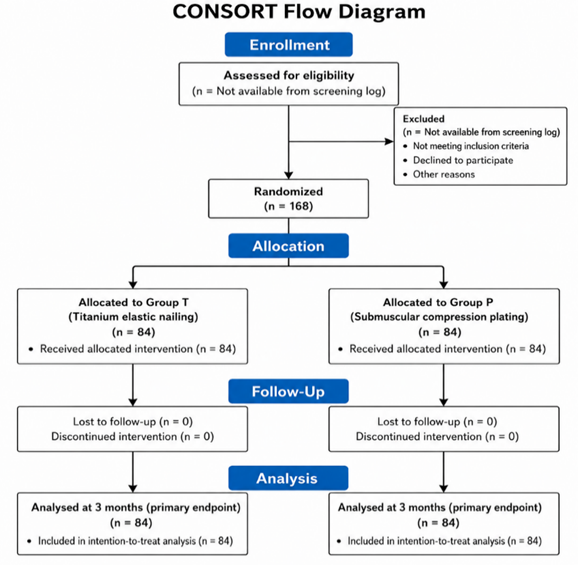
After eligibility assessment and consent, participants were assigned in a 1:1 ratio using a computer-generated random sequence. Eighty-four children were allocated to titanium elastic nailing and 84 to submuscular compression plating. The available study records did not identify the software used to generate the sequence, the person responsible for sequence generation, whether block or stratified randomization was used, or the mechanism employed to conceal upcoming assignments. Allocation concealment was therefore not claimed. These details should be added only after verification from the original randomization record.
All procedures were performed by consultant orthopaedic surgeons with at least five years of operative experience. For titanium elastic nailing, the fracture was reduced under fluoroscopic guidance, and two appropriately contoured flexible titanium nails were introduced through medial and lateral metaphyseal entry points. The nails were advanced across the reduced fracture and seated proximally to provide balanced elastic stability while preserving the fracture site and periosteal circulation. For submuscular plating, indirect reduction was achieved under fluoroscopy, a lateral plate was passed through a submuscular tunnel across the fracture, and proximal and distal fixation was obtained through limited incisions while avoiding direct exposure of the fracture. Final length, alignment, rotation and implant position were assessed fluoroscopically. Implant diameter, plate length, screw configuration, surgical approach and reduction details should be added from the operative records because they were not included in the supplied dataset.
Baseline information was recorded on a structured study proforma and included age, sex, weight, height, body mass index, mechanism of injury, affected side, anatomical fracture location and operative duration. Fracture location was classified as proximal, middle or distal diaphyseal. Although fracture pattern had been listed as a planned variable, detailed configurations such as transverse, oblique, spiral or comminuted morphology and classification as length-stable or length-unstable were not available in the reported dataset. These characteristics should therefore be added from the radiographic records or acknowledged as unavailable.
Both groups received postoperative analgesia, wound care, mobilisation and rehabilitation according to the departmental protocol. Clinical and radiographic reviews were undertaken during the early postoperative period, including a monitoring visit at approximately six weeks and the principal outcome assessment at three months. The six-week visit was used for routine evaluation of wound healing, pain, range of motion, alignment and progression of weight-bearing and was not treated as a separate comparative endpoint. The exact timing of hip and knee exercises, partial weight-bearing and full weight-bearing was not documented in the supplied material and must be verified from the departmental protocol before final publication.
The primary outcome was the proportion of children achieving an excellent Flynn functional outcome at three months. Flynn outcomes were classified as excellent when limb-length inequality was less than 1 cm, angular malalignment was no more than 5°, pain was absent and no complication occurred; satisfactory when limb-length inequality was less than 2 cm, malalignment was no more than 10°, pain was absent and any complication was minor and resolved; and poor when limb-length inequality exceeded 2 cm, malalignment exceeded 10°, pain persisted or a major complication or lasting morbidity occurred. The secondary outcomes were radiological union at three months, operative duration and treatment-related complications.
Radiological union was assessed on anteroposterior and lateral radiographs. A good radiological outcome, subsequently reported as union achieved, was defined as bridging callus across at least three of four cortices on orthogonal views, with substantial reduction or disappearance of the fracture line. A poor radiological outcome, subsequently reported as union not achieved, was defined as failure to meet these criteria at the three-month assessment. Implant migration, loss of reduction, angular deformity, delayed union and other radiographic complications were also recorded. Blinding of functional and radiographic outcome assessors was not documented and was therefore not claimed.
Data were analysed using IBM SPSS Statistics version 19.0. Baseline characteristics were summarized descriptively and were not interpreted as tests of successful randomization. Continuous variables were presented as mean and standard deviation when normally distributed and as median and interquartile range when non-normally distributed. Categorical variables were reported as frequencies and percentages. The overall three-category Flynn outcome was compared using Pearson’s chi-square test or Fisher’s exact test, as appropriate. For the primary analysis, excellent outcomes were also compared with non-excellent outcomes, and the risk ratio and absolute risk difference were reported with 95% confidence intervals. Radiological union was compared using the chi-square or Fisher’s exact test and was accompanied by a risk ratio and risk difference with 95% confidence intervals. Operative duration was compared using the independent-samples t-test, with the mean difference and 95% confidence interval reported; the Mann–Whitney U test was used if normality assumptions were not satisfied.
Because only the three-month assessment was retained as the formal study endpoint, repeated-measures analysis was not required. All 168 randomized participants appeared in the three-month dataset and were analysed in their originally assigned groups, consistent with the intention-to-treat principle. No missing three-month outcomes were evident in the supplied tables. Any treatment crossover, protocol deviation or loss to follow-up should nevertheless be confirmed from the source records and reported in the final CONSORT flow diagram. All tests were two-sided, and statistical significance was defined as p≤0.05.
RESULTS:
A total of 168 children with radiographically confirmed diaphyseal femoral fractures were included in the analysis. Of these, 84 were allocated to titanium elastic nailing and 84 to submuscular compression plating. The supplied dataset contained three-month outcome records for all randomized participants. Baseline characteristics were presented descriptively and were not interpreted as evidence of successful randomization.
The mean age was 11.3 ± 2.7 years in the titanium elastic nail group and 10.9 ± 2.7 years in the submuscular plate group. Mean body weight was 38.9 ± 10.2 kg and 39.08 ± 10.9 kg, respectively, while the corresponding mean heights were 143.6 ± 15.2 cm and 141.2 ± 16.4 cm. Mean body mass index was 18.7 ± 3.12 kg/m² in the titanium elastic nail group and 19.3 ± 3.02 kg/m² in the plating group.
The titanium elastic nail group included 50 male participants (59.5%) and 34 female participants (40.5%), whereas the submuscular plate group included 56 males (66.7%) and 28 females (33.3%). Primary-level education was recorded in 19 children (22.6%) in the titanium elastic nail group and 22 (26.2%) in the plating group. Secondary education was recorded in 30 (35.7%) and 36 (42.9%) children, matriculation in 26 (31.0%) and 20 (23.8%), and intermediate education in 9 (10.7%) and 6 (7.1%), respectively.
Road-traffic accidents were the most frequent mechanism of injury, accounting for 40 cases (47.6%) in the titanium elastic nail group and 43 (51.2%) in the submuscular plate group. Falls accounted for 33 (39.3%) and 31 (36.9%) fractures, sports-related injuries for 8 (9.5%) and 7 (8.3%), and other mechanisms for 3 (3.6%) cases in each group. All fractures were closed.
Mid-diaphyseal fractures predominated, occurring in 56 children (66.7%) treated with titanium elastic nails and 57 (67.9%) treated with submuscular plates. Proximal diaphyseal fractures occurred in 14 (16.7%) and 10 (11.9%) children, whereas distal diaphyseal fractures were recorded in 14 (16.7%) and 17 (20.2%), respectively. Right-sided fractures affected 41 children (48.8%) in the titanium elastic nail group and 45 (53.6%) in the plating group.
Operative duration was shorter with titanium elastic nailing. The mean duration was 69.29 ± 15.2 minutes for titanium elastic nailing and 107.0 ± 19.8 minutes for submuscular plating. The mean difference was 37.71 minutes longer for plating, with a 95% confidence interval of 32.33–43.09 minutes (p<0.001).
At three months, the overall distribution of Flynn functional outcomes differed between the groups (p=0.005). Excellent outcomes were achieved by 32 children (38.1%) in the titanium elastic nail group and 53 (63.1%) in the submuscular plate group. Satisfactory outcomes occurred in 32 (38.1%) and 19 (22.6%) children, while poor outcomes occurred in 20 (23.8%) and 12 (14.3%), respectively.
When the primary outcome was analysed as excellent versus non-excellent function, children treated with submuscular plates were 1.66 times as likely to achieve an excellent outcome as those treated with titanium elastic nails (risk ratio 1.66; 95% confidence interval 1.21–2.28; p=0.001). The absolute risk difference was 25.0 percentage points in favour of plating (95% confidence interval 10.4–39.6 percentage points).
Radiological union at three months was achieved in 56 children (66.7%) treated with titanium elastic nails and 57 (67.9%) treated with submuscular plates. Union had not been achieved in 28 (33.3%) and 27 (32.1%) children, respectively. Submuscular plating was not associated with a significant difference in three-month union compared with titanium elastic nailing (risk ratio 1.02; 95% confidence interval 0.82–1.26; p=0.869). The absolute risk difference was 1.2 percentage points (95% confidence interval −13.0 to 15.4 percentage points).
No comparative safety conclusion was drawn because event-specific data on infection, implant irritation, malalignment, limb-length discrepancy, implant migration, loss of reduction, neurovascular injury and reoperation were not supplied.
Table 1. Baseline demographic and anthropometric characteristics
|
Variable |
Titanium elastic nail, n=84 |
Submuscular plate, n=84 |
p-value |
|
Age, years |
11.3 ± 2.7 |
10.9 ± 2.7 |
0.338 |
|
Weight, kg |
38.9 ± 10.2 |
39.08 ± 10.9 |
0.912 |
|
Height, cm |
143.6 ± 15.2 |
141.2 ± 16.4 |
0.327 |
|
Body mass index, kg/m² |
18.7 ± 3.12 |
19.3 ± 3.02 |
0.207 |
|
Sex |
0.337 |
||
|
Male |
50 (59.5%) |
56 (66.7%) |
|
|
Female |
34 (40.5%) |
28 (33.3%) |
|
|
Educational level |
0.542 |
||
|
Primary |
19 (22.6%) |
22 (26.2%) |
|
|
Secondary |
30 (35.7%) |
36 (42.9%) |
|
|
Matriculation |
26 (31.0%) |
20 (23.8%) |
|
|
Intermediate |
9 (10.7%) |
6 (7.1%) |
Table 2. Injury, fracture and operative characteristics
|
Variable |
Titanium elastic nail, n=84 |
Submuscular plate, n=84 |
p-value |
|
Mechanism of injury |
0.971 |
||
|
Fall |
33 (39.3%) |
31 (36.9%) |
|
|
Road-traffic accident |
40 (47.6%) |
43 (51.2%) |
|
|
Sports-related injury |
8 (9.5%) |
7 (8.3%) |
|
|
Other |
3 (3.6%) |
3 (3.6%) |
|
|
Fracture type |
— |
||
|
Closed |
84 (100.0%) |
84 (100.0%) |
|
|
Open |
0 (0.0%) |
0 (0.0%) |
|
|
Fracture location |
0.617 |
||
|
Proximal diaphysis |
14 (16.7%) |
10 (11.9%) |
|
|
Mid-diaphysis |
56 (66.7%) |
57 (67.9%) |
|
|
Distal diaphysis |
14 (16.7%) |
17 (20.2%) |
|
|
Affected side |
0.537 |
||
|
Right |
41 (48.8%) |
45 (53.6%) |
|
|
Left |
43 (51.2%) |
39 (46.4%) |
|
|
Operative duration, minutes |
69.29 ± 15.2 |
107.0 ± 19.8 |
<0.001 |
|
Mean difference for plating versus nailing, minutes |
Reference |
37.71 (95% CI 32.33–43.09) |
<0.001 |
Table 3. Functional and radiological outcomes at three months
|
Outcome |
Titanium elastic nail, n=84 |
Submuscular plate, n=84 |
Effect estimate for plating versus nailing |
p-value |
|
Flynn functional outcome |
0.005 |
|||
|
Excellent |
32 (38.1%) |
53 (63.1%) |
||
|
Satisfactory |
32 (38.1%) |
19 (22.6%) |
||
|
Poor |
20 (23.8%) |
12 (14.3%) |
||
|
Excellent versus non-excellent |
32/84 (38.1%) |
53/84 (63.1%) |
RR 1.66 (95% CI 1.21–2.28); RD 25.0% (95% CI 10.4–39.6) |
0.001 |
|
Radiological outcome |
0.869 |
|||
|
Union achieved |
56 (66.7%) |
57 (67.9%) |
RR 1.02 (95% CI 0.82–1.26); RD 1.2% (95% CI −13.0 to 15.4) |
0.869 |
|
Union not achieved |
28 (33.3%) |
27 (32.1%) |
DISCUSSION :
The present randomized controlled trial compared early functional and radiological outcomes after titanium elastic nailing and submuscular compression plating in children with diaphyseal femoral fractures. At the three-month assessment, submuscular plating was associated with a higher proportion of excellent Flynn functional outcomes, whereas radiological union was nearly identical between the groups.
Titanium elastic nailing required substantially less operative time. These findings indicated that submuscular plating provided an early functional advantage without demonstrating superior short-term radiographic healing, although the procedure required a longer period in the operating theatre.
Excellent Flynn outcomes were recorded in 63.1% of children treated with submuscular plates and 38.1% of those treated with titanium elastic nails. Children receiving plate fixation were approximately 1.66 times more likely to achieve an excellent functional outcome, with an absolute difference of 25 percentage points between the groups. Poor functional results were also less frequent after plating. The Flynn classification includes limb-length inequality, angular malalignment, pain and treatment-related complications; therefore, the difference may have reflected better early comfort, alignment or functional restoration rather than a difference in fracture union alone. However, individual components of the Flynn score were not reported separately, and the mechanism responsible for the observed functional difference could not be determined from the available data.
The early functional advantage was broadly consistent with previous comparative research. One study reported excellent outcomes in 89% of children treated with locking compression plates and 83.8% of those managed with titanium elastic nails, while earlier union was also observed after plate fixation (8). A randomized study conducted in Lahore similarly reported more favourable early functional outcomes with submuscular plating, although radiological healing remained comparable between the two treatments (9). Differences in follow-up duration, fracture characteristics, implant design and outcome definitions limited direct comparison, but the direction of the functional findings was generally consistent with the present results.
Evidence from systematic reviews has also suggested that plating may be associated with a greater likelihood of excellent functional recovery. A meta-analysis involving six studies and 568 children reported more favourable functional outcomes after plate fixation, without a consistent difference in time to union (10). Another review of school-aged children found that plating was associated with longer operative duration and greater blood loss, while elastic nailing was associated with higher frequencies of implant irritation and malalignment (11). These findings provided context for the present functional results but could not substitute for complication data from the current trial.
Radiological union at three months was achieved in 66.7% of children treated with titanium elastic nails and 67.9% of those treated with submuscular plates. The risk ratio was close to unity, and the confidence interval included the possibility of benefit or disadvantage with either procedure. Both techniques therefore produced comparable early radiological healing within the available follow-up period. Titanium elastic nails provide relative stability and controlled micromotion, which encourage callus formation, whereas submuscular plating preserves the fracture environment through indirect reduction and limited periosteal disruption. The similar union proportions suggested that both constructs maintained biological conditions compatible with healing, although longer observation would have been required to assess complete union, delayed union and remodelling (12).
The difference between functional and radiological outcomes was clinically noteworthy. Radiographic callus formation does not necessarily correspond directly with pain-free movement, limb alignment, joint mobility or return to normal activities. Submuscular plating may have provided more rigid control of alignment during early recovery, while nail prominence or local irritation may have affected some children treated with elastic nails. Nevertheless, these explanations remained speculative because implant irritation, pain severity, angular deformity, limb-length discrepancy and range of motion were not reported as separate outcomes. Future studies should analyse these components individually to clarify why functional grades differed despite similar radiological union (13,14).
Operative duration represented a clear advantage of titanium elastic nailing. The mean operation was approximately 38 minutes shorter than submuscular plating, and the confidence interval indicated a substantial and statistically significant difference. Previous comparative studies have similarly reported shorter operative times with elastic nails (11,12). The additional time required for plate fixation may relate to plate tunnelling, indirect reduction, fluoroscopic assessment and placement of multiple screws. Shorter surgery may reduce theatre occupancy and anaesthetic exposure, although blood loss, anaesthetic complications, resource use and cost were not recorded in the present study. The practical importance of the operative-time difference therefore requires evaluation alongside clinical outcomes and institutional resources (15,16).
Previous literature has not uniformly favoured plating. A comparative study involving predominantly mid-shaft fractures reported similar clinical outcomes between techniques and identified advantages of elastic nailing in operative time, blood loss and cost (12). Variation between studies may be related to age, body weight, fracture pattern, anatomical level and surgeon preference. Earlier publications have suggested that these factors influence implant selection, but the present study did not report detailed fracture configuration, stability classification or weight-based subgroup outcomes. Consequently, the current findings did not establish that plating was superior in heavier children or unstable fractures, nor did they confirm that elastic nails were preferable for particular fracture patterns. Such recommendations should be based on adequately powered, prespecified subgroup analyses rather than extrapolation from the overall comparison (17,18).
The study had several strengths. It included 168 children equally allocated between treatment groups, which was larger than many previous single-centre comparisons. Functional and radiological outcomes were assessed using predefined criteria, and effect estimates with confidence intervals allowed the magnitude and precision of the treatment differences to be considered. The restriction of the analysis to the three-month endpoint also ensured consistency with the study period from 25 June to 10 December 2025 (19,20).
Several limitations remained. The study was conducted at one tertiary care hospital, limiting generalizability. The short follow-up period prevented assessment of complete remodelling, persistent deformity, limb-length discrepancy, implant removal, refracture and long-term activity. Allocation concealment and assessor blinding were not documented. Detailed fracture morphology, rehabilitation adherence, blood loss, hospital stay, cost and patient-reported outcomes were unavailable. In addition, complications and adverse events were not systematically presented. The study therefore could not determine whether the procedures had comparable safety, and it was unlikely to have sufficient statistical power to detect uncommon complications such as deep infection, implant failure or neurovascular injury.
Future multicentre trials should incorporate longer follow-up, concealed allocation, blinded outcome assessment and standardized rehabilitation. Fractures should be classified by stability, configuration and anatomical location, with prespecified analyses according to age and body weight. Complications, cost-effectiveness, implant-removal morbidity, school absence and caregiver burden should also be evaluated. Within the available three-month follow-up, submuscular compression plating produced better early functional outcomes, while radiological union remained comparable and titanium elastic nailing offered a shorter operative duration.
CONCLUSION:
Submuscular compression plating resulted in better early functional recovery than titanium elastic nailing, while both techniques achieved comparable radiological union at three months. Titanium elastic nailing required a shorter operative time. Within the five-and-a-half-month study period, these findings indicated that submuscular plating offered an early functional advantage, whereas both fixation methods remained effective options for the management of paediatric diaphyseal femoral fractures.
BIBLIOGRAPHY:
1. Hinton RY, Lincoln A, Crockett MM, et al. Fractures of the femoral shaft in children: incidence, mechanisms and sociodemographic risk factors. J Bone Joint Surg Am. 1999;81:500-9.
2. Studer D, Suva D, Clavert P, et al. A retrospective epidemiological study of paediatric femoral fractures. Swiss Med Wkly. 2020;150:w20234.
3. Sun J, Wang T, Zhao N, et al. Pediatric femoral shaft fractures: AAOS CPG versus actual management. Transl Pediatr. 2024;13:1032-41.
4. Tella AO, Aldhilan MM. Outcome of titanium elastic nail fixation of paediatric long-bone fractures: a retrospective analysis. Orthop Rev. 2024;16:e118449.
5. Asaduzzaman M, Alam QS, Musa M, et al. Submuscular bridge plating in paediatric femoral diaphyseal fracture. Int J Res Orthop. 2025;11:355-60.
6. Çalışkan G, Çelik O, Elmas Y, Ertürk C. Is submuscular plating as effective and safe as ESIN for paediatric femoral fractures? Med J Bakirkoy. 2024;20:326-32.
7. Venkataraman S, Ethiraj P, Shanthappa AH, Vellingiri K. Locking compression plate versus titanium elastic nailing for paediatric femoral diaphyseal fractures: a comparative study. Cureus. 2022;14:e28924.
8. Hayat U, Gillani SFHS, Masood F, et al. Comparison of submuscular locking plate and titanium elastic nail in children with mid-shaft femur fracture. Pak J Med Health Sci. 2021;15(1):209-12.
9. Strait RT, Pankey C. Submuscular plating versus elastic intramedullary nailing in children with femoral shaft fracture: systematic review and meta-analysis. J Clin Orthop Trauma. 2023;42:102203.
10. Hu D, Xu Z, Shi T, et al. Elastic stable intramedullary nail fixation versus submuscular plate fixation of paediatric femoral shaft fractures: PRISMA-compliant meta-analysis. Medicine (Baltimore). 2023;102(39):e35287.
11. Kaiser N, Slongo T. [Elastic, stable intramedullary nailing of pertrochanteric femoral fractures in children (<6-8 years)]. Oper Orthop Traumatol. 2021;33(1):46-54.
12. Cintean R, Eickhoff A, Pankratz C, Strauss B, Gebhard F, Schütze K. ESIN in femur fractures in children under 3: is it safe? Eur J Trauma Emerg Surg. 2022;48(5):3401-7.
13. Chen Z, Han D, Wang Q, Li L. Four interventions for pediatric femoral shaft fractures: Network meta-analysis of randomized trials. Int J Surg. 2020;80:53-60.
14. Lieber J, Dietzel M, Scherer S, Schäfer JF, Kirschner HJ, Fuchs J. Implant removal associated complications after ESIN osteosynthesis in pediatric fractures. Eur J Trauma Emerg Surg. 2022;48(5):3471-8.
15. Furdock RJ, Huang LF, Ochenjele G, Zirkle LG, Liu RW. Intramedullary Fixation for Pediatric Femoral Nonunion in Low- and Middle-Income Countries. J Bone Joint Surg Am. 2023;105(20):1594-600.
16. Sullivan M, Bonilla K, Donegan D. Malrotation of Long Bones. Orthop Clin North Am. 2021;52(3):215-29.
17. Modeste Ouédraogo SF, Diallo M, Tapsoba WT, Thiombiano K, Ouedraogo I, Wandaogo A. Simultaneous bilateral femoral fracture in children. Afr J Paediatr Surg. 2023;20(2):120-3.
18. van Cruchten S, Warmerdam EC, Kempink DRJ, de Ridder VA. Treatment of closed femoral shaft fractures in children aged 2-10 years: a systematic review and meta-analysis. Eur J Trauma Emerg Surg. 2022;48(5):3409-27.
19. Greenhill DA, Riccio AI, Herman MJ. Treatment of Length-Unstable Pediatric Femur Fractures in Children Aged 5 to 11 years: A Focused Review. J Am Acad Orthop Surg. 2024;32(9):373-80.
20. Greenhill DA, Herman MJ. Treatment of Pediatric Femoral Shaft Fractures. J Am Acad Orthop Surg. 2022;30(22):e1443-e52.