Comparison of Myo-inositol versus Metformin for Treating Obesity in Patients with Polycystic Ovarian Syndrome
- Ayesha Gul , Department of Obstetrics & Gynecology, Bahawal Victoria Hospital, Bahawalpur, Pakistan.
- Shehnaz Anwar , Department of Obstetrics & Gynecology, Bahawal Victoria Hospital, Quaid e Azam Medical College, Bahawalpur, Pakistan.
- Mehwish Rasheed , Department of Obstetrics & Gynecology, Bahawal Victoria Hospital, Bahawalpur, Pakistan.
- Iram Habib , Department of Obstetrics & Gynecology, Tehsil Headquarter Hospital, Kot Addu, Pakistan.
- Khanza Mukhtar , Department of Obstetrics & Gynecology, Bahawal Victoria Hospital, Bahawalpur, Pakistan.
- Maria Mustafa , Department of Obstetrics & Gynecology, Bahawal Victoria Hospital, Bahawalpur, Pakistan.
Article Information:
Abstract:
Objective: To compare the mean body mass index (BMI) three months after treatment with myo-inositol versus metformin in patients with polycystic ovarian syndrome (PCOS). Methodology: This randomized controlled trial was conducted at the Outpatient Department of Obstetrics and Gynecology, Bahawal Victoria Hospital, Bahawalpur, Pakistan, from April 2025 to September 2025. Women aged 18-45 years with PCOS of at least 6 months duration were enrolled and randomly allocated to receive either myo-inositol 1 g twice daily or metformin 250 mg three times daily for 3 months. BMI was assessed after 3 months and compared between groups using independent sample t-test using IBM-SPSS Statistics version 26.0. Results: Among a total of 60 women, the median age, and duration of PCOS were 27.5 (24.0-32.0) years, and 11.5 (8.0-17.0) years, respectively. At baseline, overall mean BMI was 31.8±2.8 kg/m2, with 31.5±2.0 kg/m2 in Myo-inositol group, and 32.1±3.4 kg/m2 in the metformin group (p=0.408). After 3 months, the mean BMI was found to be 29.6±2.0 among women in Myo-inositol group versus 31.1±3.4 kg/m2 in metformin group and the difference turned out to be statistically significant (p=0.042). Post-stratification analysis showed that mean BMI after 3 months remained significantly lower in the myo-inositol group across all subgroups (p<0.05). Conclusion: Myo-inositol was associated with a greater reduction in BMI than metformin after a period of 3 months in women with PCOS.
Keywords:
Article :
INTRODUCTION:
Congenital melanocytic nevi (CMN) are pigmented Polycystic ovary syndrome (PCOS) is an endocrine disorder affecting women of reproductive age group.1 The malfunctioning of the hypothalamic-pituitary-ovarian axis is thought to be the cause of PCOS, however, the actual cause remains unknown.3 PCOS affects about 10-13% of the female reproductive age group. Around 70% females with PCOS are unaware of about their condition globally.4 PCOS usually manifests after the onset of weight gain, and may occur during teenage years.5,6
Pharmacological management of PCOS with metformin remains debatable.7 Free myo-inositol is present in all animal tissues and in all eukaryotic cells, and literature has shown that supplementation of D-chiro inositol can increase the rate of glucose uptake and even sensitize insulin.8 In the recent years, the focus has turned to the precursor of D-chiro inositol which is myo-inositol.9 A local study involving 152 women aged 15-40 years with PCOS found that after 3 months of treatment, the mean BMI in myo-inositol group was 24.3±2.0, and 27.5±1.9 with metformin (p<0.001).10 Another study carried out in Bangladesh found no significant difference in BMIs for patients using myo-inositol 1 g twice daily and metformin 500 mg thrice a day for 3 months (25.89±2.89 vs 26.91±4.70, p-value=0.194), even after 6 months (25.18±2.65 vs 26.19±4.57, p-value=0.179).11
Several Pakistani studies have compared myo-inositol and metformin in women with PCOS, but most have focused on insulin resistance, menstrual irregularity, infertility, clinical symptoms, or safety rather than BMI as the primary outcome. Local data have shown that both agents improve PCOS-related metabolic and clinical parameters, with myo-inositol generally having better tolerability, while metformin remains commonly used for insulin resistance. Despite these studies, there is limited local evidence specifically comparing the short-term effect of myo-inositol and metformin on BMI among women with PCOS, particularly in the South Punjab population. Since obesity is a common and clinically important component of PCOS, this study was designed to compare mean BMI after three months of treatment with myo-inositol versus metformin. The findings may help clinicians select a more suitable treatment option for weight-related management of PCOS in routine outpatient practice.
METHODOLOGY:
This randomized controlled trial (NCT07387679 at: clinicaltrials.gov)) was carried out at the Outpatient Department of Obstetrics and Gynecology, Bahawal Victoria Hospital, Bahawalpur, Pakistan, from April 2025 to September 2025, after obtaining approval from the institutional ethical review board (letter number: 2826/DME/QAMC Bahawalpur, dated: 28/11/2024). A sample size of 60 (30 in each group) was calculated through OpenEpi software, considering the anticipated mean BMI with myo-inositol as 24.28±2.03 kg/m2 and 27.47±1.93 kg/m2 with metformin,10 taking 95% confidence level, and 80% power of study. Women aged 18-45 years, diagnosed with PCOS (≥ 6 months duration) were included. The exclusion criteria were women with hyperprolactinemia or hypothyroidism or those with adrenal hyperplasia or Cushing’s syndrome. PCOS was diagnosed based on the Rotterdam criteria.12 Women with diabetes mellitus or hypertension were not excluded from the study if they fulfilled the eligibility criteria. Sample selection was done using the non-probability consecutive sampling technique. Patients/caregivers were briefed about the objective and safety of the study to obtain informed written consent from them.
The eligible females went through documentation of their baseline data, including age, weight, height, BMI, residence, and marital status. These comorbidities were noted from history and medical record review where present. Women were then randomly assigned to the myo-inositol group and the metformin group equally. Randomization was accomplished through the lottery method using sealed opaque envelopes. The women in the myo-inositol group were given one tablet containing 1g of myo-inositol twice a day continuously for 3 months. The metformin group females were subjected to metformin in a dose of 250 mg thrice daily for 3 months. Medication compliance was assessed at each monthly follow-up visit by pill count and direct questioning regarding missed doses. Participants were asked to bring the remaining tablets or empty strips at each visit. Compliance was calculated as the number of tablets consumed divided by the number of tablets prescribed during that follow-up interval, multiplied by 100. Women who consumed at least 80% of the prescribed medication were considered compliant. Any missed doses, intolerance, or discontinuation of treatment were recorded. The BMI was calculated for each patient at the final follow-up (after 3 months).
The statistical analysis was carried out using IBM-SPSS Statistics, version 26.0. The normality of numerical data was assessed through the Shapiro-Wilk test. For the representation of the quantitative variables, means with standard deviations (SD) or medians with interquartile ranges (IQR) were computed. Mean BMI after three months of treatment between the groups was compared through the independent sample t-test/Mann-Whitney U test, according to the normality distribution of the data. The effect modifiers like age and marital status were controlled through stratification. A post-stratification independent sample t-test was employed to see the effect of effect modifiers on the outcome (BMI). A p-value <0.05 was deemed as significant.
RESULTS:
Among a total of 60 women fulfilling eligibility criteria (figure-I), the median age, and duration of PCOS were 27.5 (24.0-32.0) years, and 11.5 (8.0-17.0) years, respectively.
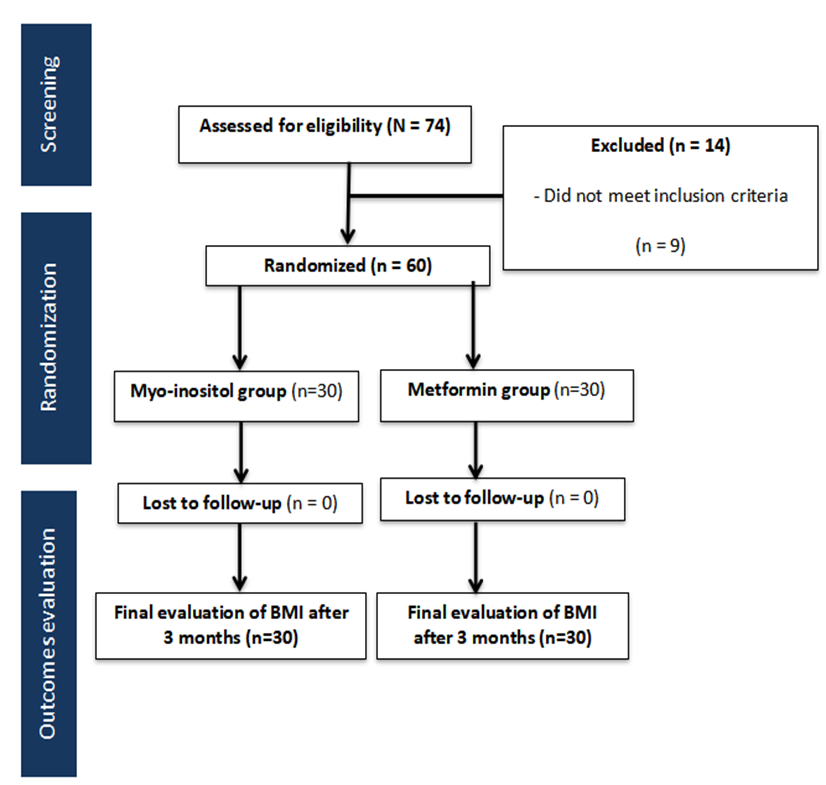
There were 34 (56.7%) women who were married. Residential affiliation of 38 (63.3%) women was urban. Table I is showing comparison of baseline demographic characteristics of women across study groups.
Table I: Comparison of baseline characteristics
|
Characteristics |
Total (N=60) |
Myo-inositol (n=30) |
Metformin (n=30) |
P-value |
|
|
Age (years) |
27.5 (24.0-32.0) |
27.0 (24.0-31.0) |
28.0 (25.0-32.0) |
0.529 |
|
|
Marital status |
Married |
34 (56.7%) |
18 (60.0%) |
16 (53.3%) |
0.602 |
|
Unmarried |
26 (43.3%) |
12 (40.0%) |
14 (46.7%) |
||
|
Duration of PCOS (months) |
11.5 (8.0-17.0) |
11.0 (8.0-16.0) |
12.0 (9.0-17.0) |
0.468 |
|
|
Residence |
Rural |
22 (36.7%) |
10 (33.3%) |
12 (40.0%) |
0.592 |
|
Urban |
38 (63.3%) |
20 (66.7%) |
18 (60.0%) |
||
|
Diabetes mellitus |
6 (10.0%) |
2 (6.7%) |
4 (13.3%) |
0.389 |
|
|
Hypertension |
5 (8.3%) |
3 (10.0%) |
2 (6.7%) |
0.640 |
|
|
Parity |
Nulliparous |
23 (38.3%) |
10 (33.3%) |
13 (43.3%) |
0.436 |
|
Para 1-2 |
27 (45.0%) |
15 (50.0%) |
12 (40.0%) |
||
|
Para>2 |
10 (16.7%) |
5 (16.7%) |
5 (16.7%) |
||
Data are presented as median (IQR) or n (%), as appropriate. Mann-Whitney U test was applied for age and duration of PCOS, while chi-square test or Fisher’s exact test was applied for categorical variables.
At baseline, overall mean BMI was 31.8±2.8 kg/m2, with 31.5±2.0 kg/m2 in Myo-inositol group, and 32.1±3.4 kg/m2 in the metformin group (p=0.408). After 3 months, the mean BMI was found to be 29.6±2.0 among women in Myo-inositol group versus 31.1±3.4 kg/m2 in metformin group and the difference turned out to be statistically significant (p=0.042). Table II is showing details about the comparison of BMI evaluation at baseline, and after 3 months across study groups.
Table II: Comparison of BMI between the study groups (N=60)
|
Evaluation |
Total (N=60) |
Myo-inositol (n=30) |
Metformin (n=30) |
P-value |
|
Baseline BMI (kg/m2) |
31.8±2.8 |
31.5±2.0 |
32.1±3.4 |
0.408 |
|
BMI after 3 months (kg/m2) |
29.8±2.6 |
29.6±2.0 |
31.1±3.4 |
0.042 |
|
Reduction in BMI (kg/m2) |
1.5±0.9 |
1.9±0.9 |
1.0±0.8 |
<0.001 |
Data are presented as mean±SD. Independent sample t-test was applied for between-group comparisons.
Post-stratification analysis showed that mean BMI after 3 months remained significantly lower in the myo-inositol group across most subgroups, and the details are shown in table III.
Table III: Stratification of BMI after 3 months with respect to characteristics of women among study groups (N=60)
|
Characteristics |
Myo-inositol (n=30) |
Metformin (n=30) |
P-value |
||
|
Age groups |
18-30 |
29.1±1.9 |
30.6±3.1 |
0.028 |
|
|
31-45 |
30.4±2.1 |
32.0±3.6 |
0.040 |
||
|
Marital status |
Married |
29.8±2.1 |
31.4±3.3 |
0.029 |
|
|
Unmarried |
29.1±2.0 |
30.8±3.5 |
0.025 |
||
|
Residence |
Rural |
29.9±2.2 |
31.6±3.5 |
0.028 |
|
|
Urban |
29.4±1.9 |
30.8±3.3 |
0.049 |
||
|
Diabetes melliuts |
Yes |
30.2±2.4 |
32.3±3.6 |
0.381 |
|
|
No |
29.5±2.0 |
30.9±3.3 |
0.047 |
||
|
Hypertension |
Yes |
30.5±2.6 |
32.1±3.8 |
0.512 |
|
|
No |
29.4±1.9 |
31.0±3.3 |
0.039 |
||
|
Parity |
Nulliparous |
29.1±1.9 |
30.7±3.4 |
0.045 |
|
|
Para 1-2 |
29.7±2.1 |
31.3±3.2 |
0.041 |
||
|
Para>2 |
30.1±2.3 |
31.8±3.7 |
0.398 |
||
Data are presented as mean±SD. Independent sample t-test was applied after stratification.
DISCUSSION :
This study found that women treated with myo-inositol had significantly lower mean BMI after three months than those treated with metformin. BMI fell in both groups, yet the reduction was greater in the myo-inositol arm, and this pattern remained visible after stratification by age, marital status, and residence. This matters because excess adiposity and insulin resistance amplify menstrual dysfunction, hyperandrogenism, and long term cardiometabolic risk in PCOS, so even a modest short term improvement in body size may carry wider clinical value in symptom control and future metabolic health.13,14 These results sit somewhat differently from the most recent guideline informed evidence synthesis. The 2024 systematic review that informed the 2023 international PCOS guideline reported that metformin may improve waist to hip ratio and hirsutism more than myo-inositol, while the evidence for BMI was very uncertain.15 The guideline summary itself places metformin ahead of myo-inositol for metabolic features in general, yet this broader recommendation reflects pooled evidence across diverse populations, formulations, and outcomes rather than a consistent superiority for BMI in every clinical setting. The present study adds a useful signal that myo-inositol may outperform a metformin based regimen for short-term BMI reduction in some women, especially where tolerability, adherence, and local prescribing patterns shape real world response. Recent evidence also showed that metformin and myo-inositol were broadly comparable for clinical, hormonal, and biochemical outcomes, with a clearer safety advantage for myo-inositol.16 The current trial suggest that when BMI is isolated as a short-term endpoint, myo inositol may show a measurable edge in selected populations.
One explanation for the stronger BMI response with myo-inositol in this study may be the specific treatment context rather than a universal pharmacologic advantage. The metformin dose used here was 250 mg three times daily, which is lower than the dose range commonly discussed in guideline practice points. International guidelines show that metformin is usually introduced gradually in 500 mg increments and that mild gastrointestinal adverse effects are dose dependent and self limiting, with a suggested adult maximum daily dose of 2.5 g.16 That context is important because a lower dose may improve tolerance but may also limit metabolic effect. It is therefore reasonable to interpret the observed BMI advantage of myo-inositol as a finding relevant to this dosage strategy and this clinical population, rather than proof that myo-inositol is always superior to metformin for weight related outcomes.
Ravn and colleagues showed that myo-inositol and metformin did not differ on the primary insulin resistance endpoint, and metformin had favorable effects on fasting glucose, weight reduction, and HDL in women whose baseline BMI was higher than that in the present sample.17 Gudović and colleagues analyzing women of normal weight with PCOS documented that there was again no significant difference between groups across the main biochemical outcomes, even though both treatments improved several parameters over time.18 Together these studies indicate that the relative effect of myo-inositol and metformin may vary with baseline adiposity, phenotype, insulin resistance burden, and the exact outcomes selected.
Another important observation was the consistency of benefit after stratification of demographic characteristics. The value of these results lies less in claiming true effect modification and more in showing that the direction of benefit remained stable across common patient subgroups encountered in outpatient practice. Clinically, this supports consideration of myo-inositol across a broad spectrum of women with PCOS rather than restricting its use to one narrow demographic group.19,20 The broader literature remains more focused on metabolic, hormonal, and menstrual outcomes than on marital or residential subgrouping, so the current study provides locally relevant detail that is rarely reported in recent trials. PCOS management often requires long treatment courses, and agents that are easier to continue may perform better in everyday care than agents with stronger guideline status but poorer acceptance.21,22
The metformin dose used in this trial was 250 mg three times daily, which is lower than the commonly used full therapeutic dose in PCOS. This regimen was selected to improve tolerability and treatment continuation in routine outpatient care. The 2023 International Evidence-Based Guideline for PCOS supports starting metformin at a low dose and increasing gradually to minimize gastrointestinal adverse effects and improve adherence, while suggesting higher daily doses when tolerated. Therefore, the present findings should be interpreted as a comparison of myo-inositol with a low-dose, tolerability-focused metformin regimen rather than with maximum-dose metformin.
Several limitations need to be acknowledged. The sample size was modest and derived from a single center, which limits generalizability. Follow up lasted only three months, which captures early change but not durability. The analysis focused mainly on BMI and basic baseline variables, while waist circumference, insulin resistance indices, menstrual outcomes, and adverse events were not fully integrated into the reported results. The metformin dose was relatively low, which may affect external validity. Subgroup comparisons were exploratory and should be interpreted cautiously.
CONCLUSION :
Myo-inositol was associated with a greater reduction in BMI than metformin after a period of 3 months in women with PCOS. These findings support myo-inositol as a clinically relevant option in the short-term management of PCOS, particularly where treatment acceptance and continuation are important. Larger multicenter studies with longer follow up and broader metabolic and reproductive endpoints are needed to define which women benefit most from myo inositol, metformin, or their combination.
BIBLIOGRAPHY:
1. Singh S, Pal N, Shubham S, Sarma DK, Verma V, Marotta F, et al. Polycystic Ovary Syndrome: Etiology, Current Management, and Future Therapeutics. J Clin Med. 2023;12(4):1454. doi: 10.3390/jcm12041454
2. Mahajan M, Soni T, Victoria, Prabhakar PK. Pathophysiology of Polycystic Ovarian Syndrome. In: Wang Z, editor. Polycystic Ovary Syndrome - Functional Investigation and Clinical Application. London, England: IntechOpen; 2022. doi: 10.5772/intechopen.101921.
3. Jung YW, Lee GH, Han YJ, Cha DH. Insight into the pathogenesis of polycystic ovarian syndrome. J Genet Med. 2020;17(1):1-10. doi: 10.5734/JGM.2020.17.1.1
4. World Health Organization. Polycystic ovary syndrome. 22 January 2026. Available from: https://www.who.int/news-room/fact-sheets/detail/polycystic-ovary-syndrome
5. Barber TM, Franks S. Obesity and polycystic ovary syndrome. Clin Endocrinol (Oxf). 2021;95(4):531-541. doi: 10.1111/cen.14421
6. Shahid R, Iahtisham-Ul-Haq, Mahnoor, Awan KA, Iqbal MJ, Munir H, et al. Diet and lifestyle modifications for effective management of polycystic ovarian syndrome (PCOS). J Food Biochem. 2022;46(7):e14117. doi: 10.1111/jfbc.14117
7. Kim CH, Chon SJ, Lee SH. Effects of lifestyle modification in polycystic ovary syndrome compared to metformin only or metformin addition: A systematic review and meta-analysis. Sci Rep. 2020;10(1):7802. doi: 10.1038/s41598-020-64776-w
8. Artini PG, Malacarne E, Tomatis V, Genazzani AD. The relevance of inositols treatment for PCOS before and during ART. Eur Rev Med Pharmacol Sci. 2021;25(14):4799-4809. doi: 10.26355/eurrev_202107_26393
9. DiNicolantonio JJ, H O'Keefe J. Myo-inositol for insulin resistance, metabolic syndrome, polycystic ovary syndrome and gestational diabetes. Open Heart. 2022;9(1):e001989. doi: 10.1136/openhrt-2022-001989
10. Majeed R, Mobashar S, Sher Z, Jan S, Mumtaz H. Is Myo-inositol better than Metformin for treatment of PCOS Overweight Patients?. J Soc Obstet Gynaecol Pak. 2021;11(3):195-199. https://jsogp.net/index.php/jsogp/article/view/486
11. Karmoker CR, Khatun A, Sarkar AC. Efficacy And Safety of Myo Inositol in The Treatment of PolycysticOvary Syndrome Patients Comparison with Metformin. J Obstet Gynecol. 2025;11(1):10-20. doi: 10.17511/joog.2025.i01.03
12. Rotterdam ESHRE/ASRM-Sponsored PCOS consensus workshop group. Revised 2003 consensus on diagnostic criteria and long-term health risks related to polycystic ovary syndrome (PCOS). Hum Reprod. 2004;19(1):41-47. doi: 10.1093/humrep/deh098
13. Kriplani A, Tank P, Singh P, Maini N, Kaitala S, Kantha GL, et al. A Phase III, Double-Blind, Randomized, Multicenter, Clinical Trial to Evaluate the Efficacy and Safety of a Fixed-Dose Combination of Metformin Hydrochloride and Myo-Inositol Compared to Metformin in Patients With Polycystic Ovary Syndrome. Cureus. 2024 Dec 12;16(12):e75616. doi: 10.7759/cureus.75616
14. Teede HJ, Tay CT, Laven JJE, Dokras A, Moran LJ, Piltonen TT, et al. Recommendations From the 2023 International Evidence-based Guideline for the Assessment and Management of Polycystic Ovary Syndrome. J Clin Endocrinol Metab. 2023 Sep 18;108(10):2447-2469. doi: 10.1210/clinem/dgad463
15. Fitz V, Graca S, Mahalingaiah S, Liu J, Lai L, Butt A, et al. Inositol for Polycystic Ovary Syndrome: A Systematic Review and Meta-analysis to Inform the 2023 Update of the International Evidence-based PCOS Guidelines. J Clin Endocrinol Metab. 2024;109(6):1630-1655. doi: 10.1210/clinem/dgad762
16. Teede HJ, Mousa A, Tay CT, Costello MF, Brennan L, Norman RJ, et al. Summary of the 2023 international evidence-based guideline for the assessment and management of polycystic ovary syndrome: an Australian perspective. Med J Aust. 2024;221(7):389-395. doi: 10.5694/mja2.52432
17. Ravn P, Gram F, Andersen MS, Glintborg D. Myoinositol vs. Metformin in Women with Polycystic Ovary Syndrome: A Randomized Controlled Clinical Trial. Metabolites. 2022;12(12):1183. doi: 10.3390/metabo12121183
18. Gudović A, Bukumirić Z, Milincic M, Pupovac M, Andjić M, Ivanovic K, et al. The Comparative Effects of Myo-Inositol and Metformin Therapy on the Clinical and Biochemical Parameters of Women of Normal Weight Suffering from Polycystic Ovary Syndrome. Biomedicines. 2024;12(2):349. doi: 10.3390/biomedicines12020349
19. Sharon PM, Mellonie P, Manivannan A, Thangaraj P, Logeswari BM. The Effectiveness of Myo-Inositol in Women With Polycystic Ovary Syndrome: A Prospective Clinical Study. Cureus. 2024;16(2):e53951. doi: 10.7759/cureus.53951
20. Duan M, Yang M, Li C, Wu X, Yin X, Zhu H. Effects of inositol in women with polycystic ovary syndrome: an umbrella review of meta-analyses from randomized controlled trials. Front Endocrinol (Lausanne). 2026;17:1741509. doi: 10.3389/fendo.2026.1741509
21. Ee C, Tay CT. Pharmacological management of polycystic ovary syndrome. Aust Prescr. 2024;47(4):109-112. doi: 10.18773/austprescr.2024.030
22. Dason ES, Koshkina O, Chan C, Sobel M. Diagnosis and management of polycystic ovarian syndrome. CMAJ. 2024;196(3):E85-E94. doi: 10.1503/cmaj.231251