FREQUENCY OF ARRHYTHMIA IN POST-OPERATIVE PATIENTS OF CONGENITAL HEART DISEASES
- Talia Arif , Clinical Cardiac Perfusionist / Demonstrator Sharif Medical City Hospital, Lahore / The Superior University Lahore
- M. Salman Ghani , Registrar Cardiac Emergency Gulab Devi Teaching Hospital, Lahore
- Yasir Ali Khan , Consultant Cardiothoracic Surgeon Senior Registrar Cardiac Surgery Sahiwal Institute of Cardiology, Sahiwal
- Muqaddas Latif , BS Cardiac Perfusion Technology Student at Superior University Lahore
- Laiba Nadeem , BS Cardiac Perfusion Technology Student at Superior University Lahore
- Rabiya Ishfaq , BS Cardiac Perfusion Technology Student at Superior University Lahore
Article Information:
Abstract:
CHDs are some of the most prevalent congenital abnormalities that need surgical treatment amongst pediatric patients. Regardless of the progress in surgical methods, the incidence of postoperative arrhythmias is still a very critical complication. Objective: To identify the frequency of postoperative arrhythmias in children who have undergone congenital heart surgery and to determine how they are related to surgical and intraoperative variables. Methodology: A descriptive analytical research was carried out on a population of 99 pediatric patients undertaking congenital heart surgery at Sharif Medical City Hospital Lahore. The information on age, gender, weight, the type of surgery, cardiopulmonary bypass (CPB) time, cross-clamp time and intraoperative hypothermia were gathered. The statistical analysis was done in SPSS, and the associations were measured with the help of the chi-square test. Results: Arrhythmias were also noted postoperative in about two-thirds of patients, which implies that they are frequent among people. The maximum regularly detected arrhythmias were junctional ectopic tachycardia and complete heart block. It was found out that there was a significant relationship between the nature of the surgery and the incidence of arrhythmias and the complexity of the surgery like Tetralogy of Fallot, transposition of the great arteries and TAPVC were more associated with the incidence. Also, long cross-clamp and prolonged CPB duration were related to the risk of arrhythmia. There was a significant association between intraoperative hypothermia and type of arrhythmia; moderate hypothermia was more often associated with tachyarrhythmias. Majority of arrhythmias were treated by either medication or observation, and less percentage were treated by pacing or cardioversion. Conclusion: Pediatric cardiac surgery leads to postoperative arrhythmias, which are largely predisposed by the complexity of the surgery, the duration of the operation, and the management during the operation.
Keywords:
Article :
INTRODUCTION:
Congenital heart diseases (CHDs) are among the most common congenital abnormalities worldwide and remain a major cause of morbidity and mortality in pediatric patients. These defects include acyanotic lesions such as atrial septal defect, ventricular septal defect, and patent ductus arteriosus, as well as cyanotic lesions including tetralogy of Fallot and transposition of the great arteries. The global prevalence of CHDs is estimated to be 8–10 per 1000 live births, making them a significant public health concern that often requires early surgical intervention. Improvements in pediatric cardiology, cardiopulmonary bypass (CPB) techniques, anesthesia, and postoperative intensive care have significantly increased the survival rate of children undergoing congenital heart surgery.
/Despite advancements in surgical management, postoperative complications continue to affect clinical outcomes, among which cardiac arrhythmias are particularly important. Postoperative arrhythmias may occur due to surgical trauma, myocardial ischemia, inflammation, electrolyte imbalance, hypothermia, or injury to the cardiac conduction system during corrective procedures. These rhythm disturbances range from transient benign arrhythmias to potentially life-threatening conditions such as junctional ectopic tachycardia, atrioventricular block, atrial flutter, atrial fibrillation, and ventricular arrhythmias.
The incidence of postoperative arrhythmias following congenital heart surgery has been reported between 10% and 50%, depending on the complexity of the congenital defect and surgical procedure. Complex intracardiac repairs, prolonged CPB duration, and extended aortic cross-clamp times are considered important risk factors for postoperative conduction abnormalities. Junctional ectopic tachycardia is one of the most frequently reported arrhythmias in pediatric cardiac surgery and may result in significant hemodynamic instability and prolonged intensive care unit stay if not identified and managed promptly.
Postoperative arrhythmias can adversely affect patient recovery by reducing cardiac output, prolonging mechanical ventilation, increasing intensive care and hospital stay, and increasing healthcare costs. Severe arrhythmias may lead to low cardiac output syndrome, heart failure, thromboembolic complications, or sudden cardiac death. Therefore, early recognition and continuous cardiac monitoring during the postoperative period are essential to improve patient outcomes and reduce morbidity and mortality associated with congenital heart surgery.
Although several international studies have evaluated postoperative arrhythmias in congenital heart disease patients, limited local data are available in Pakistan regarding their frequency and associated perioperative factors. Differences in patient demographics, healthcare facilities, surgical expertise, and postoperative management may influence clinical outcomes in the local population. Therefore, local evidence is necessary to better understand the burden and pattern of postoperative arrhythmias in pediatric cardiac surgery patients.
The objective of this study was to determine the frequency of postoperative arrhythmias in pediatric patients undergoing congenital heart surgery and to evaluate their association with perioperative factors including cardiopulmonary bypass time, aortic cross-clamp time, and type of congenital heart surgery.
Material Methods:
This descriptive cross-sectional study was conducted in the Department of Cardiac Surgery at Sharif Medical City Hospital, Lahore, over a period of four months. The study included pediatric patients diagnosed with congenital heart diseases (CHDs) who underwent corrective or palliative cardiac surgery and received postoperative care in the Cardiac Surgical Intensive Care Unit (CSICU). Patients were enrolled through non-probability consecutive sampling. A total of 99 patients were included in the study. The sample size was calculated using the single population proportion formula based on a previously reported postoperative arrhythmia frequency of 20.4%, with a 95% confidence level and 8% margin of error.
Patients diagnosed with CHDs through echocardiography and operative records, who underwent congenital heart surgery and had continuous postoperative electrocardiographic (ECG) monitoring, were included in the study. Patients with previous cardiac surgery, preexisting pacemakers, severe multisystem disease, mechanical circulatory support, or incomplete perioperative records were excluded.
Data were collected using a structured proforma that included demographic characteristics, preoperative investigations, intraoperative variables, and postoperative outpe, and intraoperative hypothermia temperature. Continuous ECG monitoring was performed during the postoperative period to detect arrhythmias within the first 72 hours after surgery. Additional clinical parameters including hemodynamic stability, duration of mechanical ventilation, intensive care unit stay, hospital stay, and laboratory investigations such as serum electrolytes, troponin levels, creatinine, and renal function tests were also assessed. Preoperative and postoperative echocardiography was performed to evaluate cardiac function and identify residual defects or postoperative complications.
The primary outcome variable was the occurrence of postoperative arrhythmia, while secondary outcomes included the type of arrhythmia and associated postoperative complications. Statistical analysis was performed using Statistical Package for Social Sciences (SPSS) version 26.0 (IBM Corp., Armonk, NY, USA). Descriptive statistics were used to summarize demographic and clinical variables. Categorical variables were presented as frequencies and percentages, while continuous variables were expressed as mean ± standard deviation. Associations between categorical variables and postoperative arrhythmias were analyzed using the chi-square test. A p-value of <0.05 was considered statistically significant.
RESULTS:
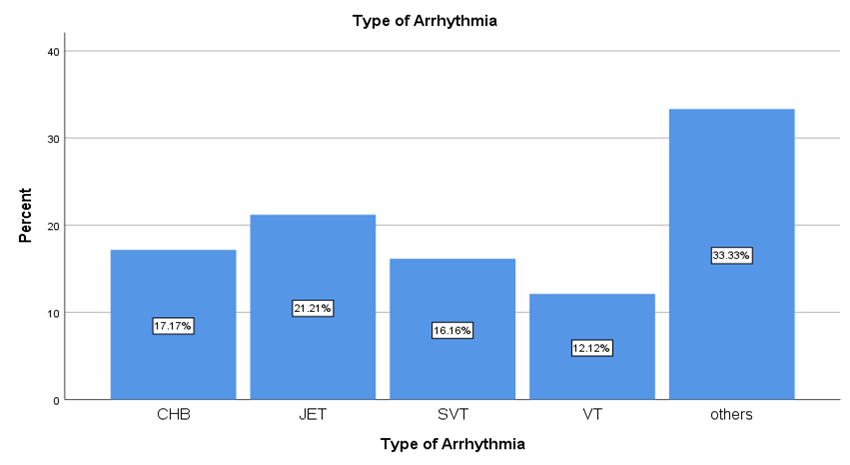
A total of 99 pediatric patients undergoing congenital heart surgery were included in the study. Postoperative arrhythmias occurred in 66 patients (66.7%), while 33 patients (33.3%) did not develop Arrhythmia. The most common arrhythmias were junctional ectopic tachycardia (21.2%), complete heart block (17.2%), supraventricular tachycardia (16.2%), and ventricular tachycardia (12.1%).
Prolonged cardiopulmonary bypass (CPB) time and aortic cross-clamp time were significantly associated with postoperative arrhythmias (p < 0.001). Independent sample t-test analysis demonstrated significant mean differences in cross-clamp time (37.27 min; t = 13.68), CPB time (54.75 min; t = 11.51), and weight (12.19 kg; t = 7.16) between patients with and without Arrhythmia.
A significant association was also observed between hypothermia temperature and occurrence of arrhythmias (χ² = 99.000, p < 0.001). Complex surgeries such as Tetralogy of Fallot, transposition of the great arteries, and TAPVC repair demonstrated a higher frequency of postoperative Arrhythmia compared to simpler procedures. Logistic regression analysis identified types of surgery, hypothermia temperature, and gender as significant predictors of postoperative arrhythmia (p < 0.001).
Table 1. Baseline Demographic and Surgical Characteristics of Patients
|
Variable |
Category |
Frequency (n) |
Percentage (%) |
|
Age Group |
1–5 years |
24 |
24.2 |
|
5–10 years |
56 |
56.6 |
|
|
10–14 years |
19 |
19.2 |
|
|
Gender |
Male |
58 |
58.6 |
|
Female |
41 |
41.4 |
|
|
Weight Group |
<10 kg |
29 |
29.3 |
|
10–20 kg |
52 |
52.5 |
|
|
>20 kg |
18 |
18.2 |
|
|
Type of Surgery |
ASD Repair |
18 |
18.2 |
|
VSD Repair |
24 |
24.2 |
|
|
TOF Repair |
21 |
21.2 |
|
|
TGA Repair |
16 |
16.2 |
|
|
TAPVC Repair |
12 |
12.1 |
|
|
PDA Ligation |
8 |
8.1 |
Table 2. Frequency and Types of Postoperative Arrhythmias
|
Variable |
Frequency (n) |
Percentage (%) |
|
Occurrence of Arrhythmia |
||
|
Yes |
66 |
66.7 |
|
No |
33 |
33.3 |
|
Type of Arrhythmia |
||
|
Junctional Ectopic Tachycardia (JET) |
21 |
21.2 |
|
Complete Heart Block (CHB) |
17 |
17.2 |
|
Supraventricular Tachycardia (SVT) |
16 |
16.2 |
|
Ventricular Tachycardia (VT) |
12 |
12.1 |
|
Other Arrhythmias |
33 |
33.3 |
Table 3. Association Between Perioperative Factors and Postoperative Arrhythmia
|
Variable |
Statistical Test |
Statistical Value |
p-value |
|
Cross-Clamp Time |
Independent t-test |
t = 13.68 |
<0.001 |
|
Cardiopulmonary Bypass (CPB) Time |
Independent t-test |
t = 11.51 |
<0.001 |
|
Weight |
Independent t-test |
t = 7.16 |
<0.001 |
|
Hypothermia Temperature |
Chi-square test |
χ² = 99.000 |
<0.001 |
|
Type of Surgery |
Chi-square test |
Significant association observed |
<0.001 |
Abbreviations: CPB = Cardiopulmonary Bypass; χ² = Chi-square test statistic.
Table 4. Independent Predictors of Postoperative Arrhythmia
|
Variable |
Odds Ratio (OR) |
p-value |
|
Gender |
Significant predictor |
<0.001 |
|
Hypothermia Temperature |
Significant predictor |
<0.001 |
|
Type of Congenital Heart Surgery |
Significant predictor |
<0.001 |
Binary logistic regression analysis identified gender, hypothermia temperature, and type of congenital heart surgery as independent predictors of postoperative arrhythmia.
Figure 1. Frequency of Arrhythmias
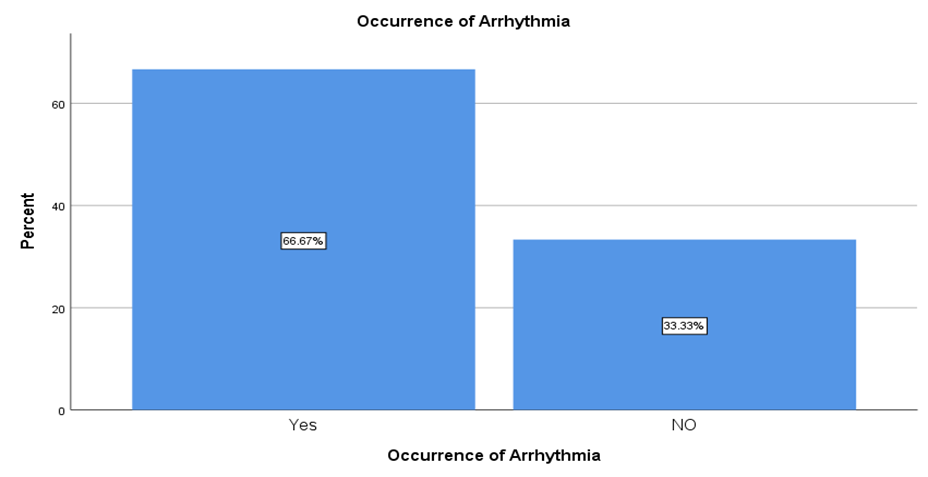
Figure 2. Types of Arrhythmias
DISCUSSION :
Giant congenital melanocytic nevi (GCMN) represent a rare This study demonstrated a high frequency of postoperative arrhythmias in pediatric patients undergoing congenital heart surgery, with arrhythmias occurring in 66.7% of patients. Junctional ectopic tachycardia and complete heart block were the most commonly observed arrhythmias, which is consistent with previous studies in pediatric cardiac surgery.
Prolonged cardiopulmonary bypass (CPB) time and aortic cross-clamp time showed significant associations with postoperative arrhythmias, suggesting that longer ischemic and perfusion durations increase myocardial stress and electrical instability. Complex procedures such as Tetralogy of Fallot, transposition of the great arteries, and TAPVC repair demonstrated a higher frequency of arrhythmias compared to simpler surgeries.
Hypothermia temperature was also significantly associated with arrhythmia development, with moderate and deep hypothermia linked to different arrhythmia patterns. Logistic regression analysis identified type of surgery, hypothermia, and gender as independent predictors of postoperative arrhythmia.
The study was limited by its single-center design, relatively small sample size, and lack of long-term follow-up. Despite these limitations, the findings provide important local data regarding postoperative arrhythmia in pediatric congenital heart surgery patients and highlight the importance of perioperative monitoring and optimization of surgical factors to improve patient outcomes.
CONCLUSION :
Postoperative arrhythmias are frequent complications in pediatric patients undergoing congenital heart surgery. Prolonged cardiopulmonary bypass time, aortic cross-clamp time, hypothermia, and complex surgical procedures were significantly associated with arrhythmia development. These findings emphasize the importance of careful perioperative monitoring and optimization of surgical factors to improve postoperative outcomes.
BIBLIOGRAPHY:
1. Alotaibi RK, Saleem AS, Alsharef FF, Alnemer ZA, Saber YM, Abdelmohsen GA, et al. Risk factors of early postoperative cardiac arrhythmia after pediatric cardiac surgery: A single-center experience. Saudi Medical Journal. 2022;43(10):1111.
2. Costello A, Chaouki AS, Imundo JR. Postoperative Arrhythmias After Congenital Heart Disease Surgery. Cardiac Electrophysiology Clinics. 2025;17(4):619-29.
3. Dodge-Khatami A, Miller O, Anderson R, Gil-Jaurena J, Goldman A, De Leval M. Impact of junctional ectopic tachycardia on postoperative morbidity following repair of congenital heart defects. European Journal of Cardio-Thoracic Surgery. 2002;21(2):255-9.
4. Durak F, Ozcifci G, Kulluoglu EP, Anil AB, Isik O, Akyuz M, et al. Incidence, Risk Factors and Outcomes of Junctional Ectopic Tachycardia After Tetralogy of Fallot Repair in Pediatric Patients. Children. 2025;12(11):1572.
5. Fesseha B, Moges T. Post-operative arrhythmia among children who undergone cardiac surgery for congenital heart disease at Cardiac Center in Ethiopia. Ethiopian Journal of Pediatrics and Child Health. 2025;20(1):31-43.
6. Ganea G, Cinteză EE, Filip C, Iancu MA, Balta MD, Vătășescu R, et al. Postoperative cardiac arrhythmias in pediatric and neonatal patients with congenital heart disease—a narrative review. Life. 2023;13(12):2278.
7. Han F. Sudden cardiac death in congenital heart disease—a narrative review and update. Frontiers in Cardiovascular Medicine. 2025;12:1539958.
8. Hoffman T, Wernovsky G, Wieand T, Cohen M, Jennings A, Vetter V, et al. The incidence of arrhythmias in a pediatric cardiac intensive care unit. Pediatric Cardiology. 2002;23(6):598-604.
9. Jacobs JP, Mayer Jr JE, Mavroudis C, O’Brien SM, Austin III EH, Pasquali SK, et al. The society of thoracic surgeons congenital heart surgery database: 2016 update on outcomes and quality. The Annals of Thoracic Surgery. 2016;101(3):850-62.
10. Joye R, Beghetti M, Wacker J, Malaspinas I, Bouhabib M, Polito A, et al. Early and late postoperative tachyarrhythmias in children and young adults undergoing congenital heart disease surgery. Pediatric Cardiology. 2023;44(2):312-24.
11. Khairy P, Silka MJ, Moore JP, DiNardo JA, Vehmeijer JT, Sheppard MN, et al. Sudden cardiac death in congenital heart disease. European Heart Journal. 2022;43(22):2103-15.
12. Mayaya P-C, Tinică G, Chistol RO, Moraru L, Damian SI, Frăsinariu OE, et al. Incidence and Risk Factors for Early Postoperative Arrhythmias in Congenital Heart Disease–Systematic Review. Journal of Cardiovascular Emergencies. 2025;11(2):43-53.
13. Pecha S, Kirchhof P, Reissmann B. Perioperative arrhythmias. Deutsches Ärzteblatt International. 2023;120(33-34):564.
14. Pecha S, Kirchhof P, Reissmann B. Perioperative arrhythmias. Deutsches Ärzteblatt International. 2023;120(33-34):564.
15. Poorsattar SP, Moore JP, Patel K. Electrophysiology in Patients with Congenital Heart Disease. Congenital Heart Disease in Pediatric and Adult Patients: Anesthetic and Perioperative Management: Springer; 2023. p. 379-88.
16. Shah S, Chahil V, Battisha A, Haq S, Kalra DK. Postoperative atrial fibrillation: a review. Biomedicines. 2024;12(9):1968.
17. Triedman JK, DeWitt E. Electrophysiology studies and transcatheter ablation. Nadas' Pediatric Cardiology: Elsevier; 2025. p. 256-67.
18. Van Der Linde D, Konings EE, Slager MA, Witsenburg M, Helbing WA, Takkenberg JJ, et al. Birth prevalence of congenital heart disease worldwide: a systematic review and meta-analysis. Journal of the American College of Cardiology. 2011;58(21):2241-7.
19. Yılmaz EH, Yurtseven N, Korun O, Çiçek M, Karadağ H, Sürücü M, et al. Junctional ectopic tachycardia after congenital heart surgery: Incidence, risk factors, and outcomes. Turk Kardiyoloji Dernegi Arsivi. 2024;52(8):567.
20. Batra AS, Silka MJ, Borquez A, Cuneo B, Dechert B, Jaeggi E, et al. Pharmacological management of cardiac arrhythmias in the fetal and neonatal periods: a scientific statement from the American Heart Association. Circulation. 2024;149(10):e937-e52.