Role of N-Acetylcysteine in Non-Acetaminophen Induced Acute Liver Failure: A Randomized Controlled Trial
- Anum Yousaf , Postgraduate Resident, Medicine Department, Lahore General Hospital, Lahore, Pakistan
- Mahmood Ul Hassan Taga , Senior Registrar, Multan Institute of Cardiology, Multan, Pakistan
- Farah Sadiqi , Head of Department, Medicine department, Lahore General Hospital, Lahore, Pakistan
- Nashmia Babar , Medical Officer, Medicine Department, Integrated Medical Care Hospital, Lahore, Pakistan
- Muhammad Irfan Jamil , Postgraduate Resident, Medicine Department, Lahore General Hospital, Lahore, Pakistan
Article Information:
Abstract:
Acute liver failure caused by non-acetaminophen has high short-term mortality rate and few viable adjunctive treatments. N-acetylcysteine may support hepatic recovery beyond acetaminophen toxicity. Objective: To compare early post-treatment liver function tests, length of hospital-stay, and 28-day survival between N-acetylcysteine versus standard supportive care. Methods: This study was conducted at a tertiary care hospital enrolling sixty-two patients having non-acetaminophen acute liver injury were enrolled. N-acetylcysteine was given orally or via nasogastric tube using a weight-based regimen, while controls received standard supportive care. Day 4 bilirubin levels, the international normized ratio of albumin hospitalization aspartate aminotransferase and the aminotransferase alanine, and the 28-day survival were all assessed. Results: The groups were assigned 31 participants. The baseline features were comparable. On Day 4, the N-acetylcysteine group had higher albumin (2.82 vs. 2.30 g/dL, p = 0.007) and lower bilirubin (9.02 vs. 13.45 mg/dL, p < 0.001), alanine aminotransferase (679.35 vs. 1072.90 U/L, p < 0.001), aspartate aminotransferase (564.35 vs.001), and international normalized ratio (p < 0.001). A brief hospital stay (0.29 days; p < 0.001) (8.37 + 0.43 versus 9.94 + 0.29 days). The survival rate was 80.6% after 28 days as opposed to 58.1% (p = 0.054), with hepatitis E cases exhibiting an advantage (p = 0.031). Conclusion: Compared with supportive care, N-acetylcysteine produced better early laboratory recovery and fewer inpatient days, and 28-day survival was higher.
Keywords:
Article :
INTRODUCTION:
The medical emergency of acute liver failure can be that is characterized by a rapid decline in the capacity for detoxification and synthesis of hepatic substances that is frequently accompanied by the encephalopathy and coagulopathy. It also is associated with high mortality in the short term. Depending on how long it takes for symptoms to appear before encephalopathy appears, the clinical course can be categorized as hyperacute, fulminant, or subacute [1]. The etiological spectrum is diverse and includes viral hepatitis, idiosyncratic drug reactions, and autoimmune liver disease, which can delay early recognition and limit targeted therapy. Hepatitis E virus has been reported as a leading cause of acute liver failure in many Asian settings, and is associated with poor outcomes, underscoring the need for adjunctive therapies applicable across etiologies [2].
N-acetylcysteine (NAC), a thiol-containing derivative of the amino acid cysteine, has long been used as the treatment option for acetaminophen-induced liver injury. Its effects include scavenging reactive oxygen species, restoring cytosolic and mitochondrial glutathione, and supporting non-toxic metabolic conjugation, thereby limiting hepatocellular injury. It also exerts vasodilatory and inotropic effects, which can improve systemic perfusion and tissue oxygen delivery during hemodynamic compromise [3,4]. Although its role in acetaminophen-induced liver injury is well established, the American Association for the Study of Liver Diseases (AASLD) recommended in 2011 that NAC might benefit non-acetaminophen-related ALF, particularly drug-induced liver injury (DILI) [5,6]. Recent studies have demonstrated the advantages of NAC for acute non-acetaminophen hepatic failure; however, the findings differ between etiologies and study designs and outcomes definitions [7,8]. A meta-analysis has provided mixed results, suggesting improved transplant-free survival with NAC but emphasizing the need for more conclusive research on its efficacy in broader contexts [9].
Uncertainty persists regarding the benefit of N-acetylcysteine in non-acetaminophen-induced acute liver failure, largely because prior studies have focused on selected etiologies and may not reflect mixed-cause presentations. The present randomized controlled trial was therefore designed to evaluate N-acetylcysteine across multiple etiologic groups to improve clinical applicability. Much of the existing evidence comes from well-resourced centers and may not translate directly to settings with constrained intensive care capacity and restricted access to transplantation. This work aimed to generate context-relevant evidence to inform treatment decisions across different healthcare environments.
The study examined the relationship between N-acetylcysteine and regular supportive care, in the 28-day survival rate and duration of hospital stay as well as early post-treatment tests for liver function.
MATERIALS AND METHODS:
Between June 2025 to October 2025, the Department of Medicine at Lahore General Hospital conducted a Randomized Controlled Trial. It was that was registered as NCT06872372. Before the beginning of the study, approval was given by the institution's Ethics Review Board (IRB# 2025/ERC/68 as of 06-01-2025). All participants who were eligible, or, if required, a guardian of the participant gave in writing informed consent. Participants were enrolled using a non-probability consecutive sampling approach.
A total of 62 individuals (31 for each of the groups) was determined using the duration of hospitalization between the N-acetylcysteine treatment group (mean 8.24 + 2.1 days) compared to the control group (10.7 + 3.1 days) with 90 percent power and 99% confidence level [10]. Following recruitment, individuals were randomly allocated to either the N-acetylcysteine group or the control group. Equal numbers of same size and color folded slips labeled “NAC” or “Control” were made before recruitment. For each eligible participant, one slip was drawn after consent and enrollment, and the participant was assigned to the group mentioned on that slip.
Adults 18 to 60 years of either gender with non-acetaminophen acute liver failure were enrolled according to European Association for the Study of the Liver criteria after excluding acetaminophen exposure. Eligibility required alanine aminotransferase above three times the upper limit of normal, defined as >120 U/L in males and >105 U/L in females, and aspartate aminotransferase above the same cutoffs, with total bilirubin >2.0 mg/dL and albumin <3.5 g/dL. Etiologies included hepatitis A, B, or E, non-acetaminophen drug-induced injury, or idiopathic disease. Exclusions were chronic liver disease or cirrhosis, severe systemic illness, prior liver transplant, or potential transplant candidate.
At enrollment, age, gender, symptom duration, etiology, and comorbidities were recorded. Baseline tests included bilirubin, albumin, alanine aminotransferase, aspartate aminotransferase, international normalized ratio, complete blood count, renal profile, electrolytes, and random glucose. Viral markers were assessed (hepatitis A, B, C, and E). When required, autoimmune profile, Wilson’s workup, iron studies, and herpes simplex virus, cytomegalovirus, and Epstein-Barr virus serology were performed.
Patients who were selected at random to receive N-acetylcysteine were given the medication orally or by means of a nasogastric tube. It was 140 mg/kg every 4hrs for 16 hours of treatment. After that, they were given 140 mg/kg every 6-8 hours throughout the course of three days in a row. The only treatment offered to the group of control was the regular. In the unit that provided intensive care, all patients received continual monitoring of their neurological and hemodynamic status. If tolerated the early intake of enteral nutrition was provided in order to prevent hypoglycemia the intravenous dextrose was administered. Empirical broad-spectrum antibiotics as well as proton pump inhibitor prophylaxis was given, with adjustments in accordance with findings of test. Fluid balance and electrolytes were frequently checked and any irregularities were swiftly rectified. In the case of severe to moderate liver encephalopathy, rifaximin is applied following the lactulose treatment. If needed mechanical ventilation as well as airway protection were provided. Coagulopathy was managed with vitamin K and fresh frozen plasma, and platelets were transfused when indicated.
Renal function was monitored daily, nephrotoxic medications were avoided, and preventive nursing care with attendant counselling was provided. Survival was assessed on Day 28, and mortality was defined as death within 28 days of enrollment. Length of stay was measured from admission to discharge or death. Changes from baseline to Day 4 in alanine aminotransferase, aspartate aminotransferase, total bilirubin, albumin, and international normalized ratio were used to assess biochemical recovery. Day 4 outcome measurements were obtained 96 hours after starting the assigned treatment in both groups. Data were captured on a standardized proforma with 28-day follow-up.
SPSS Version 26.0 was used to analyze the data. Gender, comorbidities and etiology life expectancy, and death were some of the categorical traits that were represented as frequency and percentages. Because of regular distributions of data numerical variables like age, hospitalization as well as laboratory variables were presented as mean +/- SD. The Shapiro-Wilk Test was employed to determine the normality in quantitative information. Chi-square tests were utilized to determine mortality and survival differences between groups. After checking the validity of the data's normality assumptions the independent samples were compared using the t-test to determine quantitative variables. A p-value below 0.05 was considered to be statistical significance.
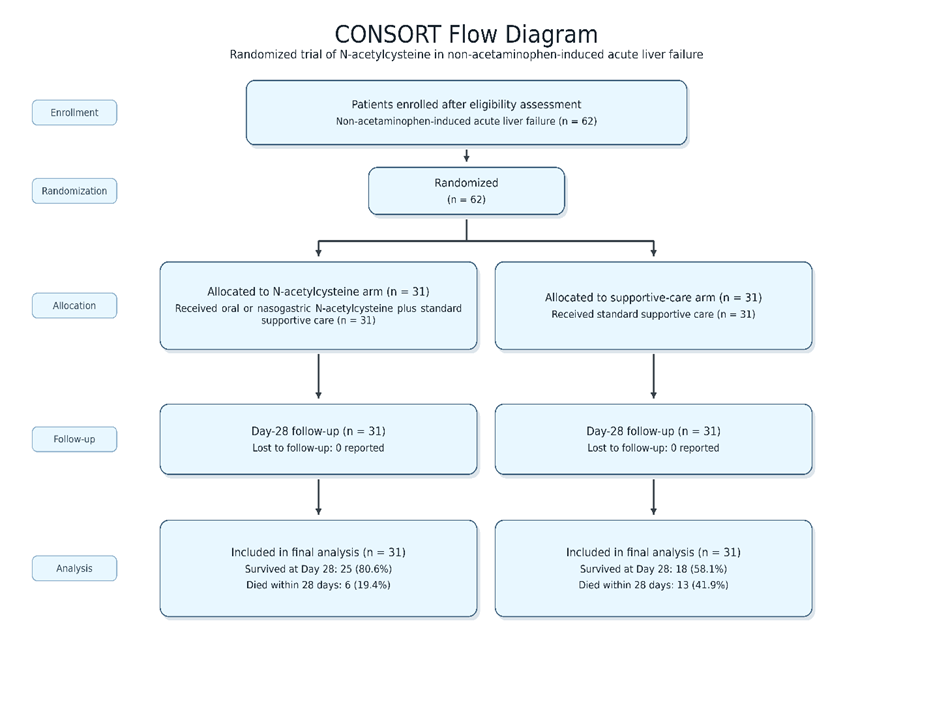
Figure 1: Consort Flow Diagram
RESULTS:
62 individuals with non-acetaminophen-induced acute liver failure were included in the trial; 31 of them received NAC treatment, while the remaining 31 received standard care. The groups' baseline characteristics were similar. The control group's mean age was 40.87 ± 11.13 years, whereas the N-acetylcysteine group's was 35.71 ± 11.43 years. This difference was −5.16 years (95% confidence interval: −11.26 to 0.93, p = 0.076). There was a mean difference of −0.64 days (95% confidence interval: −1.99 to 0.70, p = 0.290) between the mean symptom duration of 6.71 ± 2.15 days and 7.35 ± 2.59 days.
Table 1: Baseline clinical, etiological, and demographic features by treatment group of patients with acute liver failure not caused by acetaminophen (N = 62).
|
Characteristic |
NAC Group (n=31) |
Control Group (n=31) |
p-value |
|
Age 18-40 years, n (%) |
22 (71.0%) |
15 (48.4%) |
0.070† |
|
Age 41-60 years, n (%) |
9 (29.0%) |
16 (51.6%) |
|
|
Male, n (%) |
15 (48.4%) |
13 (41.9%) |
0.610‡ |
|
Female, n (%) |
16 (51.6%) |
18 (58.1%) |
|
|
Etiology, n (%) |
|
|
0.901† |
|
HEV |
6 (19.4%) |
8 (25.8%) |
|
|
HAV |
5 (16.1%) |
6 (19.4%) |
|
|
Acute HBV |
6 (19.4%) |
3 (9.7%) |
|
|
DILI |
5 (16.1%) |
4 (12.9%) |
|
|
Dengue |
5 (16.1%) |
5 (16.1%) |
|
|
Unknown |
4 (12.9%) |
5 (16.1%) |
|
|
Diabetes/Hypertension, n (%) |
8 (25.8%) |
8 (25.8%) |
1.000‡ |
†Pearson Chi-square test; ‡Fisher's exact test.
Overall, baseline characteristics were comparable. By Day 4, N-acetylcysteine was linked to a shorter hospital stay by about 1.57 days and a clearer biochemical response, with alanine aminotransferase and aspartate aminotransferase lower by about 394 U/L and 347 U/L, bilirubin lower by about 4.4 mg/dL, improved international normalized ratio, and higher albumin.
Table 2: Baseline laboratory data and Day 4 biochemical and clinical results in patients treated with N-acetylcysteine or the control group (N = 62) for acute liver failure not caused by acetaminophen.
|
Parameter |
NAC Group Mean ± SD |
Control Group Mean ± SD |
Mean Difference (95% CI) |
p-value |
|
Baseline Parameters |
||||
|
Total Bilirubin (mg/dL) |
14.73 ± 1.01 |
15.36 ± 0.66 |
-0.64 (-1.09, -0.18) |
0.005 |
|
INR |
2.89 ± 0.23 |
3.11 ± 0.21 |
-0.22 (-0.34, -0.11) |
0.0002 |
|
ALT (U/L) |
1336.61 ± 51.55 |
1326.61 ± 30.26 |
10.00 (-14.03, 34.03) |
0.355 |
|
AST (U/L) |
1159.03 ± 38.76 |
1156.13 ± 23.79 |
2.90 (-14.43, 20.23) |
0.725 |
|
Albumin (g/dL) |
2.57 ± 0.08 |
2.54 ± 0.05 |
0.03 (-0.01, 0.07) |
0.117 |
|
Day 4 Outcomes |
||||
|
Hospital Stay (days) |
8.37 ± 0.43 |
9.94 ± 0.29 |
-1.57 (-1.76, -1.37) |
0.0001 |
|
Total Bilirubin (mg/dL) |
9.02 ± 3.42 |
13.45 ± 4.53 |
-4.44 (-6.48, -2.40) |
0.0001 |
|
INR |
1.60 ± 0.08 |
2.00 ± 0.08 |
-0.40 (-0.44, -0.36) |
0.0001 |
|
ALT (U/L) |
679.35 ± 306.83 |
1072.90 ± 373.55 |
-393.55 (-567.22, -219.87) |
0.0000 |
|
AST (U/L) |
564.35 ± 306.15 |
911.29 ± 373.74 |
-346.77 (-520.48, -173.06) |
0.0002 |
|
Albumin (g/dL) |
2.82 ± 0.65 |
2.30 ± 0.81 |
0.51 (0.14, 0.89) |
0.007 |
All comparisons performed using independent samples t-test. CI, confidence interval; SD, standard deviation; ALT, alanine aminotransferase; AST, aspartate aminotransferase; INR, international normalized ratio.
At 28 days, the NAC group had a better overall survival rate (80.6%) than the controls (58.1%), which was almost statistically significant.
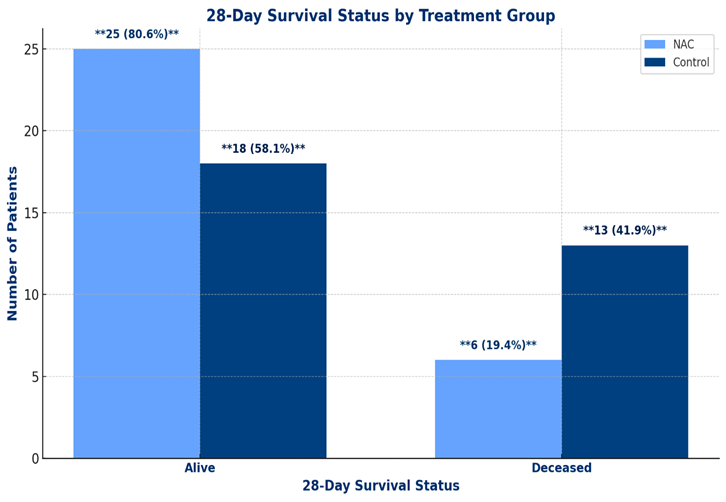
Figure 2: Twenty-eight-day survival status by treatment group in patients with non-acetaminophen-induced acute liver failure. Bars represent the number of patients who were alive or deceased at Day 28. Light blue indicates the N-acetylcysteine group and dark blue indicates the control group. Percentages are calculated within each treatment group.
Twenty-eight-day survival was higher with N-acetylcysteine across most subgroups, although most comparisons did not reach statistical significance, including age 18–40 years (p = 0.438) and 41–60 years (p = 0.229), males (p = 0.433) and females (p = 0.125), and those with diabetes mellitus or hypertension (p = 0.282) or without these comorbidities (p = 0.243). By etiology, a significant survival benefit was observed in hepatitis E virus cases (p = 0.031), whereas acute hepatitis B virus (p = 0.083), hepatitis A virus (p = 0.182), dengue (p = 1.000), drug-induced liver injury (p = 0.444), and unknown etiology (p = 0.524) showed no significant difference.
Table 3: 28-Day Survival Outcomes sorted by age, sex, comorbidity, and etiology subgroup in patients with acute liver failure not caused by acetaminophen by medication group (N = 62).
|
Subgroup |
NAC Survived n/N (%) |
Control Survived n/N (%) |
p-value |
|
Age 18–40 years |
18 (81.8%) |
10 (66.7%) |
0.438 |
|
Age 41–60 years |
7 (77.8%) |
8 (50.0%) |
0.229 |
|
Male |
11 (73.3%) |
7 (53.8%) |
0.433 |
|
Female |
14 (87.5%) |
11 (61.1%) |
0.125 |
|
Diabetes mellitus or hypertension: Yes |
4 (50.0%) |
1 (12.5%) |
0.282 |
|
Diabetes mellitus or hypertension: No |
21 (91.3%) |
17 (73.9%) |
0.243 |
|
Hepatitis A virus |
5 (100.0%) |
3 (50.0%) |
0.182 |
|
Acute hepatitis B virus |
6 (100.0%) |
1 (33.3%) |
0.083 |
|
Hepatitis E virus |
6 (100.0%) |
3 (37.5%) |
0.031 |
|
Drug-induced liver injury |
3 (60.0%) |
4 (100.0%) |
0.444 |
|
Dengue |
3 (60.0%) |
3 (60.0%) |
1.000 |
|
Unknown cause |
2 (50.0%) |
4 (80.0%) |
0.524 |
DM, diabetes mellitus; HTN, hypertension; HEV, hepatitis E virus; HBV, hepatitis B virus; HAV, hepatitis A virus; DILI, drug-induced liver injury. Statistical significance defined as p<0.05. Data are presented as number of survivors followed by percentage in parentheses. Percentages represent within-group survival proportions for each treatment arm. p-values indicate between-group comparisons within each subgroup.
DISCUSSION :
Giant congenital melanocytic nevi (GCMN) represent a The present randomized controlled trial showed that oral N-acetylcysteine was associated with better early biochemical recovery and shorter hospital stay in patients with non-acetaminophen-induced acute liver
failure, while 28-day survival was numerically higher in the treatment group but did not reach conventional statistical significance. This pattern is clinically relevant because the primary objective of the study was not limited to survival alone, but also included short-term laboratory recovery and inpatient outcome measures. Recent reviews and guidelines continue to describe acute liver failure as a rapidly evolving syndrome in which early reversal of hepatic injury, improvement in synthetic function, and prevention of progression to multiorgan dysfunction are important therapeutic goals, particularly in settings where transplantation is not readily available [11–13]. In Asian practice, viral hepatitis remains an important cause of acute liver failure, especially hepatitis E virus, which is consistent with the etiologic pattern observed in the present study [14–16].
Marked biochemical recovery by Day 4 was observed with N-acetylcysteine, with greater reductions in alanine aminotransferase and aspartate aminotransferase and lower bilirubin, alongside higher albumin and lower international normalized ratio, supporting earlier improvement in hepatic injury and synthetic function [8]. These changes suggest earlier attenuation of hepatocellular injury and better short-term recovery of hepatic synthetic function. Recent systematic reviews and narrative reviews have similarly concluded that the strongest and most consistent signal with N-acetylcysteine in non-acetaminophen acute liver failure is seen in transplant-free recovery, laboratory improvement, and shorter hospitalization rather than in a uniform mortality benefit across all etiologies [4,14,17]. The oral N-acetylcysteine study by Sharieff et al. also reported improvement in biochemical recovery and a reduction in hospital stay, which is in the same direction as the present findings [18].
Hospital stay was shorter in the N-acetylcysteine group, with a mean difference of approximately 1.57 days, consistent with reports of reduced hospitalization in treated patients and with the pooled estimate showing a standardized mean difference of about minus 2 days [14,19,20]
Twenty-eight-day survival was higher with N-acetylcysteine, although this comparison approached but did not meet conventional statistical significance. The absolute difference in survival was clinically important, yet the small sample size and limited number of death events reduce statistical power for mortality-based comparisons. Meta-analytic data have shown a directionally similar but non-significant survival benefit at 71% versus 59.8% [14]. The present result is aligned with the current literature, which suggests possible benefit but not uniformly conclusive mortality reduction across all studies and etiologies [4,21].
The subgroup findings also need cautious interpretation. In the present study, survival was numerically higher with N-acetylcysteine in both age groups, in both sexes, and in participants with and without diabetes mellitus or hypertension, but most subgroup comparisons were not statistically significant. The subgroup analysis results should be interpreted with care due to limited patients in each stratum. Attenuation of benefit in the presence of comorbidity has been attributed to reduced physiological reserve and altered treatment response [8]. Survival was numerically higher with N-acetylcysteine in patients aged 18–40 years (81.8% vs 66.7%, p = 0.438) and 41–60 years (77.8% vs 50.0%, p = 0.229), consistent with reports describing greater benefit in younger patients [4,14]. Female patients also showed higher survival with N-acetylcysteine (87.5% vs 61.1%, p = 0.125), which aligns with a small series in which most survivors were female, and all survivors received N-acetylcysteine [18].
Etiology-specific findings were most prominent in hepatitis E virus, where survival was 100% with N-acetylcysteine versus 37.5% with supportive care (p = 0.031), while trends also favored N-acetylcysteine in hepatitis B virus and hepatitis A virus without statistical significance [18]. In drug-induced liver injury, survival was higher in the control arm (100% vs 60%), contrasting with reports of improved transplant-free survival with N-acetylcysteine in drug-induced cases at 58% versus 27% (p = 0.04), and this discrepancy is likely influenced by small subgroup numbers [22]. Heterogeneity by etiology remains biologically plausible given differing injury pathways and variable relevance of oxidative stress [8]. This finding is biologically plausible and clinically relevant because hepatitis E remains a major cause of acute liver failure in South Asia, and severe hepatitis E is recognized as an important driver of adverse outcomes in the region [2,15,16,23]. Recent literature suggests that severe viral hepatitis may be particularly responsive to interventions that reduce oxidative stress and improve hepatic perfusion, which supports the possibility of greater benefit of N-acetylcysteine in selected viral etiologies [8,17]. However, even this significant hepatitis E virus subgroup finding should be interpreted carefully because the numbers were small. Confirmation in a larger trial would be necessary before making etiology-specific recommendations.
This randomized trial used oral N-acetylcysteine with etiological classification and subgroup assessment, which supports applicability in resource-constrained settings. Interpretation is limited by modest sample size, short follow-up, incomplete baseline grading of encephalopathy, and reliance on liver-related measures without standardized neurologic severity assessment. In addition, participants were recruited through non-probability consecutive sampling, however to minimize the bias the randomization was performed while allocation. Oral N-acetylcysteine was associated with earlier biochemical improvement and higher short-term survival, supporting its
use as an adjunct to standard supportive care where transplantation is not readily available. Larger multicenter trials are required to confirm benefit across etiologies and to refine patient selection and dosing strategies.
CONCLUSION :
Oral N-acetylcysteine in non-acetaminophen-induced acute liver failure was associated with better early biochemical recovery and shorter hospital stay than supportive care alone. Twenty-eight-day survival was higher in the N-acetylcysteine group, although the difference did not reach statistical significance.
BIBLIOGRAPHY:
1. Pandey CK, Singh M, Saxena S, Danish M, Khanna A, Srivastava T. Acute liver failure: The medical management. J Indira Gandhi Inst Med Sci. 2024;10:10-6. doi:10.4103/jigims.jigims_51_23
2. Sasaki-Tanaka R, Kanda T, Yokoo T, et al. Hepatitis A and E viruses are important agents of acute severe hepatitis in Asia: A narrative review. Pathogens. 2025;14:454. doi:10.3390/pathogens14050454
3. Shaker HO, Rageh OES, Alnajar M, Alshamaly NF, Abdelmaged WA, Abd-ElGawad M. Efficacy of intravenous N acetylcysteine as an adjuvant therapy in the treatment of acute aluminum phosphide poisoning: A systematic review and meta-analysis. BMC Pharmacol Toxicol. 2023;24. doi:10.1186/s40360-023-00699-2
4. Walayat S, Shoaib H, Asghar M, Kim M, Dhillon S. Role of N-acetylcysteine in non-acetaminophen-related acute liver failure: An updated meta-analysis and systematic review. Ann Gastroenterol. 2021;34:235-40. doi:10.20524/aog.2021.0571
5. Sanabria-Cabrera J, Tabbai S, Niu H, et al. N-acetylcysteine for the management of non-acetaminophen drug-induced liver injury in adults: A systematic review. Front Pharmacol. 2022;13:876868. doi:10.3389/fphar.2022.876868
6. Hrynkiewicz R, Niedźwiedzka-Rystwej P. Etiology of viral induced acute liver failure and defensins as potential therapeutic agents in ALF treatment. Front Immunol. 2023;14:1153528. doi:10.3389/fimmu.2023.1153528
7. Jiang S, Hussaini T, Yoshida E. N-acetylcysteine for non-acetaminophen induced acute liver failure: A review. Saudi J Gastroenterol. 2022;28:85-91. doi:10.4103/sjg.sjg_406_21
8. Popescu M, Bratu A, Agapie M, Borjog T, Jafal M, Sima RM, et al. The use and potential benefits of N-acetylcysteine in non-acetaminophen acute liver failure: An etiologic-based review. Biomedicines. 2024;12(3):676. doi:10.3390/biomedicines12030676
9. Bass SN, Lumpkin M, Mireles-Cabodevila E, Lindenmeyer CC, Dolan B, Pickett C, et al. Impact of duration of N-acetylcysteine in non-acetaminophen-induced acute liver failure. Crit Care Explor. 2021;3:e0411. doi:10.1097/CCE.0000000000000411
10. Nabi T, Nabi S, Rafiq N, Shah A. Role of N-acetylcysteine treatment in non-acetaminophen-induced acute liver failure: A prospective study. Saudi J Gastroenterol. 2017;23:169-75. doi:10.4103/1319-3767.207711
11. Saeidinejad M, Elshabrawi A, Sriphoosanaphan S, Andreola F, Mehta G, Agarwal B, et al. Novel therapeutic approaches in treatment of acute-on-chronic liver failure. Semin Liver Dis. 2023;43:429-45. doi:10.1055/s-0043-1776773
12. Shingina A, Mukhtar N, Wakim-Fleming J, et al. Acute liver failure guidelines. Am J Gastroenterol. 2023;118:1128-53. doi:10.14309/ajg.0000000000002340
13. Fernández J, Bassegoda O, Toapanta D, Fernández J, Bernal W. Acute liver failure: A practical update. JHEP Rep. 2024;6:101131. doi:10.1016/j.jhepr.2024.101131
14. Amjad W, Thuluvath P, Mansoor M, Dutta A, Ali F, Qureshi W. N-acetylcysteine in non-acetaminophen-induced acute liver failure: A systematic review and meta-analysis of prospective studies. Prz Gastroenterol. 2022;17:9-16. doi:10.5114/pg.2021.107797
15. Butt N, Ali S, Khemani H, Mumtaz K. Acute liver failure etiology, clinical manifestation and outcomes in adults: Experience of tertiary care hospital in Karachi. World J Crit Care Med. 2025;14:105428. doi:10.5492/wjccm.v14.i3.105428
16. Luo Q, Chen J, Zhang Y, Xu W, Liu Y, Xie C, et al. Viral hepatitis E: Clinical manifestations, treatment, and prevention. Liver Res. 2024;8:11-21. doi:10.1016/j.livres.2024.01.001
17. Jerome RN, Zahn LA, Abner JJ, et al. Repurposing N-acetylcysteine for management of non-acetaminophen induced acute liver failure: An evidence scan from a global health perspective. Transl Gastroenterol Hepatol. 2024;9:2. doi:10.21037/tgh-23-40
18. Sharieff S, Idrees A, Rafai W, Bukhari SUS. Use of oral N-acetylcysteine (NAC) in non-acetaminophen-induced acute hepatic failure. Cureus. 2023;15:e35852. doi:10.7759/cureus.35852
19. Moosa MS, Maartens G, Gunter H, et al. A randomized controlled trial of intravenous N-acetylcysteine in the management of anti-tuberculosis drug-induced liver injury. Clin Infect Dis. 2021;73:E3377-83. doi:10.1093/cid/ciaa1255
20. Fox AN, Nation BE, Autry MT, Johnson PN. Possible role for acetylcysteine as a treatment for acute liver failure secondary to antitubercular medication use. Am J Health Syst Pharm. 2020;77:1482-7. doi:10.1093/ajhp/zxaa202
21. Orban C, Agapie M, Bratu A, Jafal M, Duțu M, Popescu M. No significant beneficial effects of intravenous N-acetylcysteine on patient outcome in non-paracetamol acute liver failure: A meta-analysis of randomized controlled trials. Biomedicines. 2024;12:1462. doi:10.3390/biomedicines12071462
22. Chughlay MF, Kramer N, Spearman CW, Werfalli M, Cohen K. N-acetylcysteine for non-paracetamol drug-induced liver injury: A systematic review. Br J Clin Pharmacol. 2016;81:1021-9. doi:10.1111/bcp.12880
23. Orosz L, Sárvári KP, Dernovics Á, Rosztóczy A, Megyeri K. Pathogenesis and clinical features of severe hepatitis E virus infection. World J Virol. 2024;13:91580. doi:10.5501/wjv.v13.i2.91580