Mean Change in Hemoglobin Level after Topical Application of Tranexamic Acid Versus Placebo in Controlling Postoperative Bleeding in Open Heart Surgery.
- Umar Zada , PGR FCPS2 Cardiac Surgery, PIMS, Islamabad, Pakistan
- Muhammad Iqbal , Associate Professor of Cardiac Surgery, Department of Cardiac Surgery PIMS, Islamabad, Pakistan.
- Muhammad Ilyas Jan , Associate Professor of Cardiac Surgery, Department of Cardiac Surgery PIMS, Islamabad, Pakistan.
Article Information:
Abstract:
Postoperative bleeding is a common and serious complication following open heart surgery, often leading to a significant decline in hemoglobin levels and increased need for blood transfusions. Objective: To compare the mean change in hemoglobin levels after topical application of tranexamic acid versus placebo in controlling postoperative bleeding in patients undergoing open heart surgery. Methods: This randomized controlled trial was conducted at the Department of Cardiac Surgery, PIMS, Islamabad, from 27th August 2025 to 27th November 2025. A total of 300 patients aged 30–80 years undergoing first-time elective open-heart surgery were enrolled and randomly assigned to two groups: TXA (n=150) and placebo (n=150). Group A received 2.5 g tranexamic acid diluted in 250 mL normal saline, while Group B received normal saline alone. Results: Baseline characteristics were comparable between both groups. The mean hemoglobin drop was significantly lower in the TXA group (2.20 ± 0.43 g/dL) compared to the placebo group (3.08 ± 0.54 g/dL) (p<0.001). Postoperative hemoglobin levels were significantly higher in the TXA group (11.49 ± 0.97 g/dL) than in the placebo group (10.45 ± 0.97 g/dL) (p<0.001). Conclusion: Topical tranexamic acid is effective in reducing postoperative blood loss and preserving hemoglobin levels in patients undergoing open heart surgery.
Keywords:
Article :
INTRODUCTION:
Cardiovascular diseases (CVD) are the most common cause of death in patient. CVD covers a number of disorders e.g. coronary heart disease. World Health Organization reported about 17.9 million people died worldwide from these diseases, they represented 32% of all deaths. Most CVD can be prevented by decreased risk factors such as tobacco use, unhealthy life style. There are also other causes of CVDs. These are social, economic and cultural change, globalization, population ageing, poverty, stress and hereditary factors.1,2
There are various ways for management of cardiovascular diseases, one of which is surgery, which leads to a reduction in mortality from this disease.3 Post-operative excessive bleeding is a complication of cardiac surgery. Excessive bleeding renders patients to increased morbidity and mortality. Therefore timely intervention is expected to decrease the mortality rates, decrease ICU and hospital stay, and lower wound infection rates. The risk associated with blood transfusion has increased the need for safer and alternative ways to preserve the blood of patients undergoing heart surgery like use of drugs such as aminocaproic acid, aprotinin and tranexamic acid.4,5 Administration of Tranexamic acid reduces the number of blood transfusions or the return to theatre for bleeding in patients undergoing cardiac surgery.
Although it successfully reduce bleeding after cardiac surgery but it also increases the risk of thromboembolic complications and consequently early graft closure in coronary artery bypass grafting is increased. So topical application of this drug in pericardial cavity after cardiac surgery was tried to avert most of these effects and effectively reduce postoperative bleeding.6 Ismail et al., gave tranexamic acid solution in the mediastinum and around the heart in one group and equal amount of normal saline (placebo) in the mediastinum and around the heart in other group after open heart surgery. The mean hemoglobin difference between the two groups after surgery was 2.10±1.55 in tranexamic acid group and 2.68±2.03 in normal saline (placebo) group. But the observations were not statistically significant.1 Hosseini et al., also gave tranexamic acid solution in the mediastinum and around the heart in one group and equal amount of normal saline (placebo) in the mediastinum and around the heart in other group after open heart surgery.
The mean hemoglobin difference between the two groups after surgery was 2.21±1.29 in tranexamic acid group and 2.67±1.54 in normal saline (placebo) group. But the observations were not statistically significant.7 Tranexamic acid (TXA), a synthetic antifibrinolytic agent, has gained considerable attention for its role in reducing surgical bleeding. It acts by competitively inhibiting the activation of plasminogen to plasmin, thereby preventing fibrin degradation and stabilizing clot formation. Intravenous TXA has been widely studied and is routinely used in cardiac surgery to reduce blood loss and transfusion requirements. However, systemic administration is not without concerns, as it has been associated with potential adverse effects such as thromboembolic events and seizures, particularly at higher doses. These concerns have prompted interest in alternative routes of administration that may provide effective hemostasis while minimizing systemic exposure.
Topical application of tranexamic acid has emerged as a promising strategy in this regard. By applying TXA directly to the surgical site, high local concentrations can be achieved with minimal systemic absorption, potentially reducing the risk of systemic side effects. Several studies in orthopedic, trauma, and general surgical settings have demonstrated the efficacy of topical TXA in reducing postoperative bleeding. However, its role in open heart surgery remains less well established, with limited evidence evaluating its effectiveness in controlling postoperative blood loss and preserving hemoglobin levels.
Comparatively, placebo or standard saline application provides no antifibrinolytic effect and serves as a control to assess the true efficacy of topical TXA. Evaluating the mean change in hemoglobin levels between patients receiving topical TXA and those receiving placebo offers a direct and clinically relevant measure of its effectiveness in controlling postoperative bleeding. Hemoglobin levels serve as an objective indicator of blood loss and are routinely monitored in the postoperative period, making them a practical and reliable outcome measure. The present study aims to assess the efficacy of topical tranexamic acid on postoperative bleeding in patients undergoing open heart surgery in terms of decrease in the hemoglobin level. To the best of my knowledge, limited studies have been conducted till date to investigate the efficacy of tranexamic acid in cardiac surgeries.
Objective
To determine the mean change in hemoglobin level after topical application of tranexamic acid versus placebo in controlling postoperative bleeding in open heart surgery.
METHODOLOGY:
This randomized controlled trial was conducted at the Department of Cardiac Surgery, Pakistan Institute of Medical Sciences (PIMS), Islamabad, from 27th August 2025 to 27th November 2025. A total of 300 patients undergoing open-heart surgery were included in the study, with 150 in the tranexamic acid group and 150 in the placebo group. The sample size was calculated using the WHO sample size calculator, accounting for a mean postoperative hemoglobin difference of 2.10 ± 1.55 in the tranexamic acid group and 2.68 ± 2.03 in the placebo group, with a significance level of 5% and a power of 80%.
A consecutive non-probability sampling technique was used to recruit patients meeting the inclusion criteria during the study period. Patients of either gender, aged between 30 and 80 years, undergoing first-time elective open heart surgery were included in the study. Patients undergoing surgery for congenital heart diseases, thoracic aorta procedures, redo surgeries, or emergency operations were excluded. Additionally, patients who had taken antiplatelet drugs such as aspirin or clopidogrel within seven days prior to surgery, as well as those with impaired renal function (creatinine clearance <30 mL/min), chronic liver disease, or known bleeding disorders, were excluded from the study.
Data Collection
Approval from the College of Physicians and Surgeons Pakistan (CPSP) and the Institutional Ethical Review Board was obtained prior to the commencement of the study. All eligible patients admitted to the cardiac surgery unit at PIMS Islamabad were enrolled after obtaining written informed consent for both the surgical procedure and participation in the research. Baseline socio-demographic data, including age, gender, address, smoking status, and history of diabetes, were recorded.
Clinical parameters such as hemoglobin level, hematocrit, platelet count, and duration of disease were documented preoperatively. Patients were randomly allocated into two equal groups of 150 each. Group A received a solution containing 2.5 g of tranexamic acid diluted in 250 mL of normal saline, while Group B received an equal volume of normal saline as placebo. The operating surgeon was blinded to the allocation of the solution to ensure unbiased intervention. At the completion of the surgical procedure, after achieving meticulous hemostasis, the study solution at room temperature was applied topically into the pericardial cavity and over mediastinal tissues before sternal closure. Postoperatively, patients were shifted to the cardiac surgical intensive care unit (ICU) for monitoring. After 24 hours, hemoglobin level, hematocrit, and platelet count were reassessed. The duration of the surgical procedure was also recorded. The primary outcome, mean postoperative change in hemoglobin levels, was calculated for both groups. All collected data were entered into a structured proforma.
Statistical Analysis
Data were analyzed using SPSS version 25.0. Quantitative variables such as age, weight, operative time, and hemoglobin levels were expressed as mean ± standard deviation (SD). Qualitative variables such as gender, smoking status, and diabetes were presented as frequencies and percentages. The mean difference in hemoglobin levels between the two groups was compared using the independent sample t-test, with a p-value ≤0.05 considered statistically significant. Stratification was performed for potential effect modifiers including age, gender, diabetes status, weight, operative time, and smoking. Post-stratification analysis was conducted using the Chi-square test, with p ≤0.05 considered significant. Results were presented in the form of tables and graphical representations.
RESULTS:
Data were collected from 300 patients, mean age of patients was similar in both groups (55.25 ± 15.91 vs 55.35 ± 14.37 years). Likewise, BMI values were nearly identical (25.19 ± 2.95 vs 25.01 ± 2.79 kg/m²). Preoperative hemoglobin levels showed no significant difference (13.69 ± 0.86 g/dL in TXA vs 13.53 ± 0.87 g/dL in placebo), suggesting comparable baseline hematological status. Platelet count and hematocrit were also similar between groups (252.3 ± 56.8 vs 249.7 ± 54.9 /µL and 40.2 ± 3.8% vs 39.8 ± 3.6%, respectively). The mean operative time was slightly lower in the TXA group (269.66 ± 54.76 minutes) compared to the placebo group (274.02 ± 52.43 minutes), though the difference was not significant. The distribution of gender, smoking status, and diabetes was also comparable, with males comprising 58.7% vs 56.7%, smokers 42.7% vs 45.3%, and diabetics 39.3% vs 42.0% in the TXA and placebo groups, respectively.
Table 1: Baseline Demographic and Clinical Characteristics (n = 300)
|
Variable |
Category |
TXA Group (n=150) |
Placebo Group (n=150) |
|
Age (years) |
— |
55.25 ± 15.91 |
55.35 ± 14.37 |
|
BMI (kg/m²) |
— |
25.19 ± 2.95 |
25.01 ± 2.79 |
|
Preoperative Hemoglobin (g/dL) |
— |
13.69 ± 0.86 |
13.53 ± 0.87 |
|
Platelet Count (/µL) |
— |
252.3 ± 56.8 |
249.7 ± 54.9 |
|
Hematocrit (%) |
— |
40.2 ± 3.8 |
39.8 ± 3.6 |
|
Operative Time (minutes) |
— |
269.66 ± 54.76 |
274.02 ± 52.43 |
|
Gender |
Male |
88 (58.7%) |
85 (56.7%) |
|
Female |
62 (41.3%) |
65 (43.3%) |
|
|
Smoking |
Yes |
64 (42.7%) |
68 (45.3%) |
|
No |
86 (57.3%) |
82 (54.7%) |
|
|
Diabetes |
Yes |
59 (39.3%) |
63 (42.0%) |
|
No |
91 (60.7%) |
87 (58.0%) |
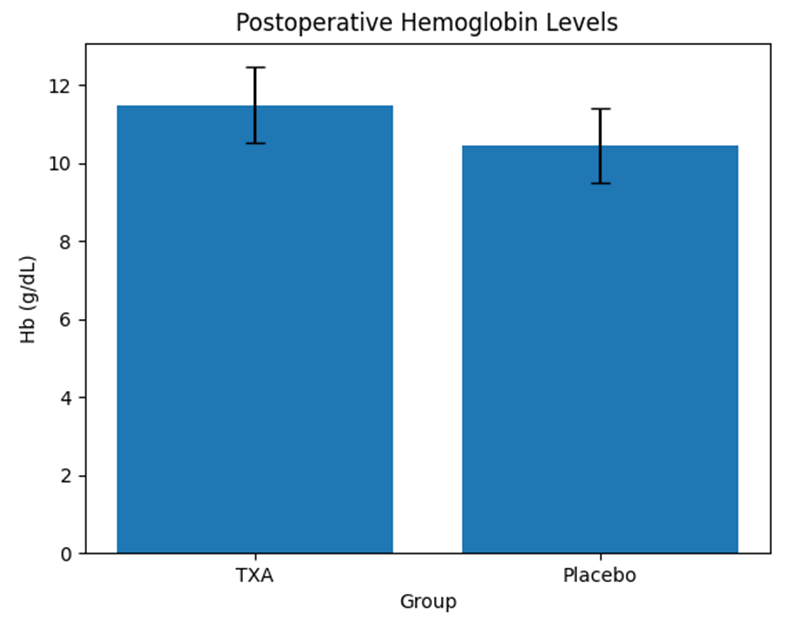
The mean hemoglobin drop was significantly lower in the TXA group (2.20 ± 0.43 g/dL) compared to the placebo group (3.08 ± 0.54 g/dL), with a mean difference of -0.88 g/dL (p<0.001), indicating reduced blood loss in the TXA group. Postoperative hemoglobin levels were significantly higher in the TXA group (11.49 ± 0.97 g/dL) compared to the placebo group (10.45 ± 0.97 g/dL), with a mean difference of +1.04 g/dL (p<0.001). Additionally, platelet counts were better preserved in the TXA group (222.5 ± 53.2 vs 208.6 ± 51.7 /µL, p=0.02), and hematocrit levels were also significantly higher (35.9 ± 3.4% vs 33.8 ± 3.5%, p=0.001), further supporting improved hemostatic control with TXA.
Table 2: Comparison of Hematological Outcomes Between Groups
|
Variable |
TXA Group (Mean ± SD) |
Placebo Group (Mean ± SD) |
Mean Difference |
p-value |
|
Hemoglobin Change (g/dL) |
2.20 ± 0.43 |
3.08 ± 0.54 |
-0.88 |
<0.001 |
|
Postoperative Hemoglobin (g/dL) |
11.49 ± 0.97 |
10.45 ± 0.97 |
+1.04 |
<0.001 |
|
Platelets Postoperative (/µL) |
222.5 ± 53.2 |
208.6 ± 51.7 |
+13.9 |
0.02 |
|
Hematocrit Postoperative (%) |
35.9 ± 3.4 |
33.8 ± 3.5 |
+2.1 |
0.001 |
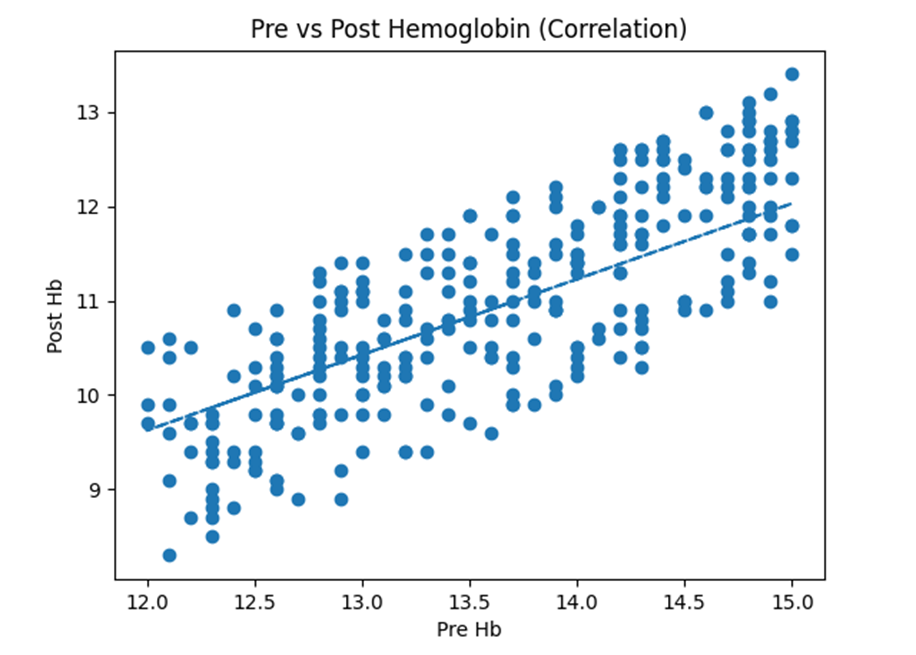
Preoperative hemoglobin levels were comparable (13.69 ± 0.86 vs 13.53 ± 0.87 g/dL, p=0.12), but postoperative levels showed a significant difference favoring the TXA group (11.49 ± 0.97 vs 10.45 ± 0.97 g/dL, p<0.001). Similarly, postoperative platelet counts were higher in the TXA group (222.5 ± 53.2 vs 208.6 ± 51.7 /µL, p=0.02) despite similar baseline values. Hematocrit levels followed the same pattern, with significantly higher postoperative values in the TXA group (35.9 ± 3.4% vs 33.8 ± 3.5%, p=0.001). \
Table 3: Pre- and Postoperative Comparison within Groups
|
Variable |
Time Point |
TXA Group (Mean ± SD) |
Placebo Group (Mean ± SD) |
p-value |
|
Hemoglobin (g/dL) |
Preoperative |
13.69 ± 0.86 |
13.53 ± 0.87 |
0.12 |
|
Postoperative |
11.49 ± 0.97 |
10.45 ± 0.97 |
<0.001 |
|
|
Platelets (/µL) |
Preoperative |
252.3 ± 56.8 |
249.7 ± 54.9 |
0.67 |
|
Postoperative |
222.5 ± 53.2 |
208.6 ± 51.7 |
0.02 |
|
|
Hematocrit (%) |
Preoperative |
40.2 ± 3.8 |
39.8 ± 3.6 |
0.41 |
|
Postoperative |
35.9 ± 3.4 |
33.8 ± 3.5 |
0.001 |
DISCUSSION :
The present study was conducted to evaluate the effect of topical tranexamic acid (TXA) on postoperative bleeding by assessing the mean change in hemoglobin levels in patients undergoing open heart surgery. The findings demonstrated that patients receiving topical TXA experienced significantly less reduction in hemoglobin levels compared to those receiving placebo, indicating better control of postoperative bleeding. This highlights the effectiveness of topical antifibrinolytic therapy as a blood conservation strategy in cardiac surgery.
In this study, the mean hemoglobin drop was significantly lower in the TXA group (2.20 ± 0.43 g/dL) compared to the placebo group (3.08 ± 0.54 g/dL), with a highly significant p-value (<0.001). This finding suggests that topical TXA effectively reduces perioperative blood loss, likely due to its mechanism of inhibiting fibrinolysis at the surgical site. Similar results have been reported in previous research, where antifibrinolytic agents significantly reduced postoperative bleeding and preserved hemoglobin levels. The magnitude of difference observed in this study further strengthens the evidence supporting the use of TXA in cardiac surgery.
Postoperative hemoglobin levels were also significantly higher in the TXA group compared to the placebo group, reinforcing the role of TXA in maintaining hematological stability. Preservation of hemoglobin is clinically important, as it reduces the need for blood transfusions, which are associated with risks such as transfusion reactions, infections, and increased postoperative morbidity. Previous research has similarly demonstrated that the use of tranexamic acid is associated with reduced transfusion requirements and improved postoperative outcomes.
The study also demonstrated that platelet count and hematocrit levels declined in both groups following surgery, which is expected due to the effects of cardiopulmonary bypass and surgical blood loss. However, the decline was less pronounced in the TXA group, suggesting that TXA may contribute to better preservation of overall hemostatic function.
This observation aligns with previous research indicating that antifibrinolytic agents help stabilize clot formation and reduce excessive bleeding. Another important observation was that baseline characteristics, including age, BMI, preoperative hemoglobin levels, and operative time, were comparable between the two groups. This indicates that the observed differences in outcomes were likely due to the intervention rather than confounding factors. The randomization process ensured homogeneity of the study population, thereby enhancing the internal validity of the study.
The findings of this study are consistent with the known pathophysiology of bleeding in cardiac surgery. Cardiopulmonary bypass is associated with activation of fibrinolysis, leading to increased breakdown of fibrin clots and persistent postoperative bleeding. By locally inhibiting plasmin activity, topical TXA helps maintain clot integrity at the surgical site, thereby reducing blood loss. This targeted mechanism of action makes topical TXA particularly advantageous, as it achieves effective hemostasis with minimal systemic exposure.
Compared to intravenous administration, topical application of TXA offers additional benefits, including reduced risk of systemic side effects such as thromboembolic events and seizures. This is especially relevant in high-risk cardiac patients, where minimizing systemic drug exposure is desirable. Previous research has highlighted the safety profile of topical TXA, supporting its use as an alternative or adjunct to systemic administration. The clinical implications of this study are significant. The use of topical TXA can be easily incorporated into routine surgical practice without requiring additional resources or complex protocols. It is cost-effective, simple to administer, and associated with improved patient outcomes. By reducing postoperative bleeding and preserving hemoglobin levels, TXA may contribute to shorter hospital stays, reduced need for transfusion, and overall better recovery.
Limitations
This study has certain limitations that should be acknowledged. Being a single-center study, the findings may have limited generalizability to other populations and healthcare settings with different surgical practices. The follow-up period was restricted to 24 hours postoperatively, which does not allow assessment of long-term outcomes such as delayed bleeding, thromboembolic complications, or overall recovery.
The study primarily evaluated hemoglobin change as the main outcome and did not include other important indicators of bleeding such as chest tube drainage, transfusion requirements, or re-exploration rates, which could provide a more comprehensive assessment. Although randomization was performed, unmeasured confounding factors such as variations in surgical technique, cardiopulmonary bypass duration, and perioperative management may still have influenced the results.
Additionally, the exclusion of high-risk patients, including those with renal or liver disease and those undergoing emergency or redo surgeries, limits the applicability of the findings to broader clinical populations. Lastly, despite efforts to blind the operator, the absence of strict double-blinding may introduce a risk of observer bias.
CONCLUSION :
It is concluded that the topical application of tranexamic acid significantly reduces postoperative blood loss in patients undergoing open heart surgery, as evidenced by a smaller decline in hemoglobin levels compared to placebo. Patients in the tranexamic acid group demonstrated better preservation of postoperative hemoglobin along with improved hematological stability, indicating more effective control of bleeding. Given its targeted mechanism, ease of application, and favorable safety profile, topical tranexamic acid appears to be a valuable adjunct in perioperative blood management.
BIBLIOGRAPHY:
1. Ismail MAM, Abdulkarim MM, El-Midany AA, Ibrahim MA. Effect of topical tranexamic acid on postoperative bleeding in cardiac surgery. Med J Cairo Univ. 2022;90(12):2573-82.
2. Rostami A, Hoseini AH, Kamali A. The effect of tranexamic acid in reducing postoperative hemorrhage in patients undergoing coronary artery bypass graft. Saudi J Anaesth. 2020;14(4):431-5.
3. Rancati V, Scala E, Ltaief Z, Gunga MZ, Kirsch M, Rosner L, et al. Challenges in patient blood management for cardiac surgery: a narrative review. J Clin Med. 2021;10(11):2454.
4. Ul Islam M, Ahmad I, Khan B, Jan A, Ali N, Khan WH, et al. Early chest re-exploration for excessive bleeding in post cardiac surgery patients: does it matter? Cureus. 2021;13(5):e15091
5. Senage T, Gerrard C, Moorjani N, Jenkins DP, Ali JM. Early postoperative bleeding impacts long-term survival following first-time on-pump coronary artery bypass grafting. J Thoracic Dise. 2021;13(10):5670-3.
6. Ockerman A, Vanassche T, Garip M, Vandenbriele C, Engelen MM, Martens J. Tranexamic acid for the prevention and treatment of bleeding in surgery, trauma and bleeding disorders: a narrative review. Thrombosis J. 2021;19:54
7. Hosseini H, Rahimianfar AA, Abdollahi MH, Moshtaghiyoon MH, Haddadzadeh M, Fekri A, et al. Evaluations of topical application of tranexamic acid on post-operative blood loss in off-pump coronary artery bypass surgery. Saudi J Anaesth. 2014;8:224-8.
8. Caruthers CM, Brazier BG, Blackmer MJ, Raehtz S, Etienne G. Topical Tranexamic Acid Reduces Postoperative Blood Loss in Primary Total Hip and Knee Arthroplasty. Spartan Med Res J. 2018 Sep 26;3(2):6942. doi: 10.51894/001c.6942. PMID: 33655140; PMCID: PMC7746078.
9. Mannová J, Kubát P, Pospíchal M, Longin P. Hodnocení účinnosti systémového podání tranexamové kyseliny (Exacylu) u náhrad kyčelního a kolenního kloubu – prospektivní kohortová studie [Evaluation of Efficacy of Systemic Administration of Tranexamic Acid (Exacyl) in Total Hip and Knee Arthroplasty - Prospective Cohort Study]. Acta Chir Orthop Traumatol Cech. 2019;86(2):118-123. Czech. PMID: 31070570.
10. Zeng Y, Si HB, Shen B, Yang J, Zhou ZK, Kang PD, Pei FX. Intravenous Combined with Topical Administration of Tranexamic Acid in Primary Total Hip Arthroplasty: A Randomized Controlled Trial. Orthop Surg. 2017 May;9(2):174-179. doi: 10.1111/os.12287. Epub 2017 Jan 17. PMID: 28093896; PMCID: PMC6584159.
11. Wang X, Qiu H, Yang B, Li Y, Wang W, Fan Y, et al. An ultra-expansible chitosan-silk fibroin miniaturized sponge loaded with tranexamic acid modified gelatin for coagulation abnormalities. Carbohydr Polym. 2026;379:125032.
12. Montoya-Beltran JS, Ramirez-Herrera L, Pinilla JL, Herazo-Cubillos A, Peña-Blanco L, Jimenez Ordoñez AF. Evaluating topical antifibrinolytics in cardiac surgery: A systematic review, meta-analysis, and trial sequential analysis. J Cardiothorac Vasc Anesth. 2026;40(3):1024–1036.
13. Mesquita BS, Gomes ACA, Vasconcelos BCE, Lago CAP, Pereira TdeAC, Andrade ESS. A novel tranexamic acid protocol enhances recovery after lower third molar surgery: A randomized controlled trial. Ann Dent Spec. 2026;14(1):18–28.
14. Motawea KR, Tanas Y, Abouelenien M, Pelletier M, Abu-Omar Y, El-Diasty M. Topical versus intravenous tranexamic acid in cardiac surgery: A meta-analysis of randomized controlled trials. J Cardiothorac Vasc Anesth. 2026.
15. Pu H, Shu X, Tan F, Li X, Qu C, Peng X. Machine learning for predicting extended length of stay in elderly patients with hip fractures: An enhanced recovery after surgery perspective. Digit Health. 2025;11:20552076251406311.
16. Stoner AK, Pezzanite LM, Dow SW, Alfonso NA, McGilvray KC. An in vitro assessment of a biopolymer-based medical foam for enhanced antifibrinolytic and infection prophylaxis for acute wound management. ACS Appl Bio Mater. 2025;8(12):10878–10889.
17. Pan X, Tang M, Xu Z, Yu H, Huang J, Liang P. Efficacy and safety of tranexamic acid in cardiac surgery: A systematic review and network meta-analysis. BMC Anesthesiol. 2025;25(1):1–12.
18. Ahmed MB, Al-Kuwari H, Al-Matwi MA, Alhammadi MA, Rahhal MO, Ahmed MB, et al. The role of tranexamic acid in orthognathic surgery: An umbrella review. Eur J Plast Surg. 2025;48(1):1–10.
19. Schieren M, Collaud S, Bonberg L, Welters J, Wappler F, Defosse J. Prophylactic intravenous tranexamic acid in thoracic surgery: A matched-pair analysis from the German thoracic registry. J Cardiothorac Vasc Anesth. 2025;39(10):2642–2648.
20. Szymańska E, Bereza M, Dembiński M, Prabucka-Marciniak J. Current views on topical tranexamic acid in cardiac surgery—literature and guidelines review. Cardiothorac Surg. 2025;33(1):1–10.