Feto-Maternal Outcomes in Pregnancy with Intrahepatic Cholestasis of Pregnancy (IHCP) in Relation to Bile Acid Levels
- Nimra Tariq , Department of Obstetrics and Gynecology, Lady Dufferin Hospital, Karachi, Pakistan
- Shagufta Shaheen , Department of Obstetrics and Gynecology, Lady Dufferin Hospital, Karachi, Pakistan
- Sahrish Hakim , Department of Obstetrics and Gynecology, Lady Dufferin Hospital, Karachi, Pakistan
- Malka Mahnoor , Department of Obstetrics and Gynecology, Lady Dufferin Hospital, Karachi, Pakistan
- Asma Shahid , Department of Obstetrics and Gynecology, Lady Dufferin Hospital, Karachi, Pakistan
Article Information:
Abstract:
Objective: Intrahepatic cholestasis of pregnancy (IHCP) is a third-trimester liver disorder characterized by pruritus and elevated serum bile acids, with feto-maternal morbidity proportional to biochemical severity. This study determined IHCP frequency among pruritic third-trimester women and evaluated feto-maternal outcomes across bile acid severity strata. Study Design: Prospective observational study. Place and Duration of Study: Lady Dufferin Hospital, Karachi from 8 September to 8 December. Methodology: It enrolling 233 confirmed IHCP cases from 1,093 pruritic third-trimester women by non-probability consecutive sampling. IHCP was classified as mild (19–39 µmol/L), moderate (40–99 µmol/L), or severe (≥100 µmol/L) per BJOG Green-top Guideline No. 43. Outcome variables were mode of delivery, PPROM, PPH, birth weight, five-minute Apgar score, meconium-stained liquor, intrauterine death, and early neonatal death. Median (IQR) and frequencies (%) described the sample; prevalence was estimated with 95% confidence intervals. Hypothesis testing employed chi-square and Fisher's exact tests for categorical outcomes; Spearman's rank correlation assessed bile acid–outcome associations. All analyses used IBM SPSS v26.0. Results: IHCP was confirmed in 21.3% (95% CI 19.0–23.8%) of pruritic women; 70.8% mild, 17.6% moderate, and 11.6% severe. Preterm birth (0% vs 12.2% vs 48.1%), PPROM (0% vs 48.8% vs 37.0%), PPH (0.6% vs 9.8% vs 66.7%), low birth weight, Apgar score <7, and meconium-stained liquor all escalated significantly across severity strata (p<0.001). Intrauterine and early neonatal deaths occurred only in severe disease (7.4% each; p=0.013). Serum bile acid correlated inversely with birth weight (ρ=−0.662) and Apgar score (ρ=−0.551), and positively with all adverse outcomes (p<0.001).Conclusion: IHCP is frequent among pruritic third-trimester women and imposes a severe, bile acid-proportional feto-maternal burden. Quantitative bile acid measurement, severity classification at diagnosis, and severity-stratified delivery planning must be integrated into routine obstetric care in Pakistan.
Keywords:
Article :
INTRODUCTION:
Maternal morbidity and mortality remain a global reproductive health challenge, disproportionately affecting developing countries compared to their counterpart. According to the World Health Organization (2023), the global maternal mortality ratio stands at approximately 197 per 100,000 live births, with Southern Asia and Sub-Saharan Africa collectively accounting for the vast majority of these deaths [1]. Pakistan represents this disparity acutely, with a maternal mortality ratio recorded at 186 per 100,000 live births, where postpartum hemorrhage and hypertensive disorders serve as the primary causes of mortality [2]. Similarly, the national infant mortality rate in Pakistan is 56.9 per 1,000 live births, which sits substantially above the global average of 26.7 per 1,000 [3].
This increased vulnerability emphasizes the critical need for the early identification and management of high-risk obstetric conditions to improve feto-maternal outcomes. Intrahepatic cholestasis of pregnancy (IHCP) is a liver disorder unique to pregnancy, typically presenting in the third trimester. It is characterized by intense pruritus(itching) predominantly affecting the palms and soles, in the absence of a primary skin rash, resolving spontaneously post-delivery [4]. According to the 2022 updated British Journal of Obstetrics and Gynecology guidelines by Girling et al. standardized ICP severity classification based on peak serum bile acid concentration, defining mild ICP as 19 to 39 µmol/L, moderate as 40 to 99 µmol/L, and severe as ≥100 µmol/L, with gestational pruritus distinguished from true ICP by bile acids remaining below 19 µmol/L. This classification framework defines contemporary risk stratification and guides this study's analytical approach [5]. The intrahepatic cholestasis results from impaired hepatocellular bile acids transport leading to systemic circulation, accumulation, and placental transfer affecting the fetus [6]. In the fetal compartment, these acids exert cardiotoxic effects by placental vasoconstriction, leading to restricted growth and directly causing fetal cardiac arrhythmia. Landmark data indicate that stillbirth risk worsens sharply at bile acid concentrations >100/µmol/L [7]. Maternal effects include preterm premature rupture of membranes (PPROM) and postpartum hemorrhage, while neonatal risks include spontaneous preterm birth, meconium-stained liquor, and low Apgar scores [8,9].
Despite this burden, locally derived evidence characterizing IHCP frequency and outcomes stratified by bile acid levels in Pakistan remains limited [10,11].
Objective
This study aimed to determine the frequency of IHCP in third-trimester presentations at a tertiary care outpatient department and to evaluate feto-maternal outcomes in relation to biochemical severity, providing evidence-based data for local risk stratification.
METHODOLOGY:
This prospective observational study was conducted at the Department of Obstetrics and Gynecology, Lady Dufferin Hospital, Karachi, from 8 September 2025 to 8 December 2025. The study was conducted in accordance with the principles outlined in the Declaration of Helsinki. Based on a reported local IHCP prevalence of 1.39%11, a sample of 230 pregnant females presenting with pruritus in the third trimester was included using non-probability consecutive sampling. Following written and informed consent, pregnant women aged 18–41 years presenting in the third trimester (≥28 weeks of gestation) with generalized pruritus were included. Patients with chronic systemic illnesses (chronic hypertension, renal impairment, or chronic liver disease), dermatological conditions independently causing pruritus, pregnancy complications mimicking IHCP (HELLP syndrome, acute fatty liver of pregnancy, viral hepatitis, or obstructive jaundice), hepatotoxic medication use, or a prior obstetric history of preterm birth were excluded. Pregnant women presenting in the third trimester with pruritus were screened for eligibility. After applying exclusion criteria, serum bile acid levels were assessed, and patients with confirmed IHCP were followed for feto-maternal outcomes. IHCP was diagnosed and classified as mild, moderate, or severe in accordance with updated BJOG (Green top guideline no. 43) based on total serum bile acid levels.5 The frequency of IHCP was determined as the proportion of confirmed IHCP cases among all third-trimester patients presenting with pruritus, expressed as a percentage. Baseline demographics, including age, gestational age, parity, and BMI were recorded on a structured proforma by a single trained investigator throughout the study period to minimize information bias. Feto-maternal outcomes comprising mode of delivery, PPROM, PPH, birth weight, Apgar score at five minutes, meconium-stained liquor, intrauterine death, and early neonatal death were documented at delivery and until hospital discharge. Selection bias was mitigated through consecutive enrollment of all eligible participants, and potential confounders including maternal age, parity, and BMI were identified a priori and controlled through stratified analysis. Data were analyzed using IBM SPSS Version 26.0. Normality of continuous variables was assessed using the Shapiro-Wilk test, supplemented by visual inspection of histograms and Q-Q plots. Normally distributed variables were expressed as mean ± standard deviation and non-normally distributed variables as median with interquartile range (IQR). Categorical variables were expressed as frequencies and percentages. Spearman's rank correlation was applied to evaluate the relationship between serum bile acid levels and continuous fetomaternal outcome variables. Outcome distribution was stratified by IHCP severity (mild, moderate, and severe) and assessed using the Chi-square test or Fisher's exact test as appropriate. Stratified analysis was further performed for key effect modifiers including maternal age, parity, and BMI to assess and control for confounding. A p-value ≤0.05 was considered statistically significant throughout.
RESULTS:
A total of 1,093 women in their third trimester presented with pruritus to emergency and outpatient clinics. Among them, 233 were diagnosed with intrahepatic cholestasis of pregnancy (IHCP) based on elevated liver function tests and confirmatory serum bile acid levels, corresponding to a prevalence of 21.3% (95% CI 19.0–23.8%). According to Girling et al.'s BJOG Green-top classification, Mild IHCP was present in 165 women [70.8% (95% CI 64.7–76.3%)], moderate IHCP in 41 women [17.6% (95% CI 13.2–23.0%)], and severe IHCP in 27 women [11.6% (95% CI 8.1–16.3%)].
1 Baseline characteristics
Baseline maternal characteristics did not differ significantly across bile-acid severity groups. Age, gestational age at presentation, BMI, parity, and booking status remained comparable. Median bile-acid concentration increased across mild, moderate, and severe IHCP, confirming biochemical separation of the three study groups (Table 1).
Table 1. Baseline characteristics of confirmed IHCP cases by bile-acid severity
|
Variable |
Mild n=165 |
Moderate n=41 |
Severe n=27 |
|
Age (years) |
29.0 (23.5–34.5) |
30.5 (23.5–36.0) |
30.0 (25.5–33.8) |
|
Gestational age ( weeks) |
32.8 (30.9–35.8) |
32.6 (30.5–34.7) |
34.3 (31.9–36.9) |
|
BMI (kg/m²) |
28.5 (25.1–32.5) |
27.6 (23.8–32.2) |
30.1 (27.1–33.4) |
|
Parity |
2.0 (1.0–3.0) |
2.0 (1.0–4.0) |
2.0 (1.5–3.5) |
|
Booked status |
|
|
|
|
Booked |
87 (37.3%) |
22 (9.4%) |
17 (7.3%) |
|
Unbooked |
78 (33.5%) |
19 (18.2%) |
10 (4.3%) |
|
Bile acid (µmol/L) |
27.6 (23.8–32.1) |
60.6 (51.8–73.9) |
102.2 (101.3–102.9) |
Values are median (IQR) or n (%) and calculated within group percentages.
2 Maternal outcomes
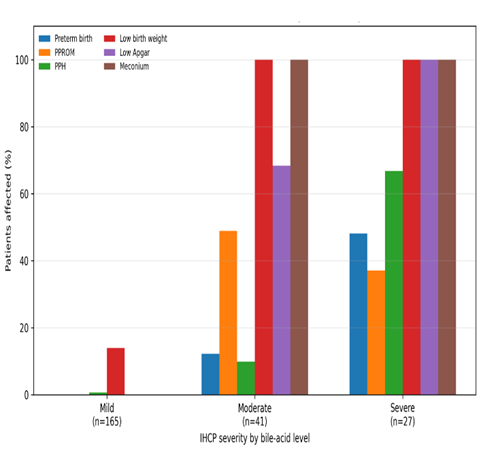
Maternal outcomes differed significantly by bile-acid severity. Preterm birth occurred only in moderate and severe IHCP, with the highest proportion in severe disease. PPROM was absent in mild IHCP and was recorded in both moderate and severe groups. PPH showed the strongest concentration in severe IHCP. Caesarean delivery occurred only in moderate and severe cases, while spontaneous vaginal delivery was most frequent in mild IHCP (Table 2).
Table 2. Maternal outcomes by IHCP severity
|
Outcome |
Overall n=233 |
Mild n=165 |
Moderate n=41 |
Severe n=27 |
p-value |
|
SVD |
177 (76 %) |
149 (90.3%) |
19 (46.3%) |
9 (33.3%) |
<0.001 |
|
Induced delivery |
37 (15.9%) |
16 (9.7%) |
10 (24.4%) |
11 (40.7%) |
|
|
Caesarean section |
19 (8.2%) |
0 (0.0%) |
12 (29.3%) |
7 (25.9%) |
|
|
Preterm birth |
18 (7.7%) |
0 (0.0%) |
5 (12.2%) |
13 (48.1%) |
<0.001 |
|
PPROM |
30 (12.9%) |
0 (0.0%) |
20 (48.8%) |
10 (37.0%) |
<0.001 |
|
PPH |
23 (9.9%) |
1 (0.6%) |
4 (9.8%) |
18 (66.7%) |
<0.001 |
*SVD = Spontaneous vaginal delivery, PPROM= Preterm premature rupture of membranes,
PPH =Postpartum hemorrhage.
The severity-based pattern of maternal complications is illustrated in Figure 1, which shows the stepwise increase in preterm birth and PPH across IHCP severity groups and the clustering of PPROM in moderate and severe disease.
Figure 1. Feto-maternal outcomes by IHCP severity
3 Fetal and neonatal outcomes
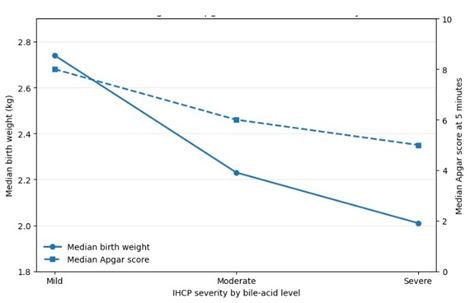
Fetal and neonatal outcomes showed a clear severity-dependent pattern. Median birth weight decreased from mild to severe IHCP, and median five-minute Apgar score followed the same downward trend. Low birth weight, low Apgar score, and meconium-stained liquor were concentrated in moderate and severe IHCP. Both intrauterine deaths and both early neonatal deaths occurred in the severe group (Table 3).
Table 3. Fetal and neonatal outcomes by IHCP severity
|
Outcome |
Mild n=165 |
Moderate n=41 |
Severe n=27 |
p-value |
|
Birth weight (kg) |
2.74 (2.64–2.87) |
2.23 (2.17–2.33) |
2.01 (1.89–2.1) |
<0.001 |
|
Low birth weight <2.5 kg |
23 (13.9) |
41 (100) |
27 (100.0) |
<0.001 |
|
Apgar score at 5 min |
8.0 (7.0–9.0) |
6.0 (5.0–7.0) |
5.0 (4.0–6.0) |
<0.001 |
|
Apgar score <7 |
0 (0.0) |
28 (68.3) |
27 (100) |
<0.001 |
|
Meconium-stained liquor |
0 (0.0) |
41 (100.0) |
27 (100) |
<0.001 |
|
Intrauterine death |
0 (0.0) |
0 (0.0) |
2 (7.4) |
0.013 |
|
Early neonatal death |
0 (0.0) |
0 (0.0) |
2 (7.4) |
0.013 |
Values are median (IQR) or n (%). Low birth weight was derived from birth weight <2.5 kg.
The fall in median birth weight and five-minute Apgar score across bile-acid severity groups is shown in Figure 2. This figure supports the table findings by demonstrating a consistent decline in fetal growth and early neonatal condition with increasing biochemical severity.
Figure 2. Birth weight and APGAR score across IHCP severity
4 Correlation of bile-acid level with outcomes
Serum bile-acid level showed a strong inverse correlation with birth weight (ρ = -0.662, p<0.001) and five-minute Apgar score (ρ = -0.551, p<0.001). Higher bile-acid levels correlated positively with PPROM (ρ = 0.787, p<0.001), meconium-stained liquor (ρ = 0.787, p<0.001), low Apgar score (ρ = 0.711, p<0.001), low birth weight (ρ = 0.643, p<0.001), preterm birth (ρ = 0.577, p<0.001), and PPH (ρ = 0.545, p<0.001). Correlations with intrauterine death (ρ = 0.134, p=0.042) and early neonatal death (ρ = 0.146, p=0.026) were weak. Gestational age at presentation was not associated with bile-acid level (ρ = -0.012, p=0.858).
DISCUSSION:
Confirmed IHCP was frequent among third trimester women presenting with pruritus. Of the 1,093 symptomatic cases, 233 met the diagnostic criteria, yielding a prevalence of 21.3% (95% CI, 19.0–23.8%). This rate far exceeds the pooled global incidence of 2.9%, with higher burdens reported in Asian cohorts [12,13]. The study population comprised a symptomatic tertiary care cohort, enriched for cholestatic disease, not an unselected obstetric population. Recent guideline reviews emphasize bile-acid testing in symptomatic women because pruritus alone cannot distinguish gestational itch from IHCP [12]. In a high-volume Pakistani hospital, pruritus functioned as a high-yield screening trigger.
Maternal morbidity increased with biochemical severity. Preterm birth was absent in mild IHCP and rose to 12.2% in moderate disease and 48.1% in severe disease. PPROM was observed only in the moderate and severe groups, reaching a rate of up to 48.8%, consistent with the pattern reported by Zhou et al [14]. PPH occurred in 66.7% of severe IHCP cases, among the highest rates reported in the global literature, indicating a significant complication of obstetric cholestasis. Recent meta-analysis links IHCP with preterm birth and adverse maternal-obstetric outcomes [8,15]. Cohort studies link increasing bile-acid levels with spontaneous preterm birth and severe adverse perinatal outcomes [16–18]. The caesarean-section pattern likely reflected fetal concern and clinician-initiated delivery, because age, parity, BMI, and booking status remained comparable. Severe PPH may reflect cholestasis-related vitamin K malabsorption, coagulation disturbance, operative delivery, and emergency obstetric complexity [8,15]. These findings support delivery-site readiness, senior obstetric review, and blood-product preparedness when bile acids enter the severe range.
The severity can predict the fetal and neonatal risks. Median birth weight and five-minute Apgar score declined from mild to severely elevated serum bile acid concentrations. Moderate and severe disease are clustered with low birth weight, low Apgar score, and meconium-stained liquor. Recent meta-analysis reports increased fetal distress, meconium-stained fluid, neonatal-unit admission, and adverse neonatal outcome in IHCP [15]. Contemporary studies show higher adverse outcome risk with rising bile-acid burden [19,20]. Both intrauterine deaths and early neonatal deaths occurred in severe IHCP in this cohort. Ovadia et al. showed that stillbirth risk rises markedly at bile-acid concentrations ≥100 µmol/L.7 The absence of fetal deaths in mild and moderate categories should be interpreted cautiously because the sample was modest, and IHCP deterioration can occur abruptly.
The Spearman correlation analysis provided biological coherence to the entire outcome narrative. Bile acid level correlated most strongly with PPROM and meconium-stained liquor (ρ=0.787 each), followed by low Apgar score (ρ=0.711), low birth weight (ρ=0.643), preterm birth (ρ=0.577), and PPH (ρ=0.545), each significant at p<0.001. Inverse correlations with birth weight (ρ=−0.662) and Apgar score (ρ=−0.551) were equally robust. This correlation architecture mirrors the mechanistic framework synthesized by Williamson and Ovadia, collectively validating serum bile acid concentration as a continuous, clinically actionable prognostic biomarker [7,9,21].
Confirmed IHCP was frequent among third trimester women presenting with pruritus. Of the 1,093 symptomatic cases, 233 met the diagnostic criteria, yielding a prevalence of 21.3% (95% CI, 19.0–23.8%). This rate far exceeds the pooled global incidence of 2.9%, with higher burdens reported in Asian cohorts [12,13]. The study population comprised a symptomatic tertiary care cohort, enriched for cholestatic disease, not an unselected obstetric population. Recent guideline reviews emphasize bile-acid testing in symptomatic women because pruritus alone cannot distinguish gestational itch from IHCP [12]. In a high-volume Pakistani hospital, pruritus functioned as a high-yield screening trigger.
Maternal morbidity increased with biochemical severity. Preterm birth was absent in mild IHCP and rose to 12.2% in moderate disease and 48.1% in severe disease. PPROM was observed only in the moderate and severe groups, reaching a rate of up to 48.8%, consistent with the pattern reported by Zhou et al [14]. PPH occurred in 66.7% of severe IHCP cases, among the highest rates reported in the global literature, indicating a significant complication of obstetric cholestasis. Recent meta-analysis links IHCP with preterm birth and adverse maternal-obstetric outcomes [8,15]. Cohort studies link increasing bile-acid levels with spontaneous preterm birth and severe adverse perinatal outcomes [16–18]. The caesarean-section pattern likely reflected fetal concern and clinician-initiated delivery, because age, parity, BMI, and booking status remained comparable. Severe PPH may reflect cholestasis-related vitamin K malabsorption, coagulation disturbance, operative delivery, and emergency obstetric complexity [8,15]. These findings support delivery-site readiness, senior obstetric review, and blood-product preparedness when bile acids enter the severe range.
The severity can predict the fetal and neonatal risks. Median birth weight and five-minute Apgar score declined from mild to severely elevated serum bile acid concentrations. Moderate and severe disease are clustered with low birth weight, low Apgar score, and meconium-stained liquor. Recent meta-analysis reports increased fetal distress, meconium-stained fluid, neonatal-unit admission, and adverse neonatal outcome in IHCP [15]. Contemporary studies show higher adverse outcome risk with rising bile-acid burden [19,20]. Both intrauterine deaths and early neonatal deaths occurred in severe IHCP in this cohort. Ovadia et al. showed that stillbirth risk rises markedly at bile-acid concentrations ≥100 µmol/L.7 The absence of fetal deaths in mild and moderate categories should be interpreted cautiously because the sample was modest, and IHCP deterioration can occur abruptly.
The Spearman correlation analysis provided biological coherence to the entire outcome narrative. Bile acid level correlated most strongly with PPROM and meconium-stained liquor (ρ=0.787 each), followed by low Apgar score (ρ=0.711), low birth weight (ρ=0.643), preterm birth (ρ=0.577), and PPH (ρ=0.545), each significant at p<0.001. Inverse correlations with birth weight (ρ=−0.662) and Apgar score (ρ=−0.551) were equally robust. This correlation architecture mirrors the mechanistic framework synthesized by Williamson and Ovadia, collectively validating serum bile acid concentration as a continuous, clinically actionable prognostic biomarker [7,9,21].
Limitations
Limitations include the single-center tertiary-care design, which limits generalizability and inflates prevalence relative to community estimates. The sample size limited precision for rare outcomes, including intrauterine death and early neonatal death. Non-probability consecutive sampling may have introduced selection bias. Follow-up ended at hospital discharge, so later neonatal morbidity was not assessed. Local delivery thresholds, clinician decisions, and resource availability may have shaped outcome patterns. Serial bile-acid trajectories and treatment-response data were incomplete. Multicenter studies with longer follow-up, standardized surveillance, and molecular or biomarker-supported diagnostics should validate these findings.
Limitations include the single-center tertiary-care design, which limits generalizability and inflates prevalence relative to community estimates. The sample size limited precision for rare outcomes, including intrauterine death and early neonatal death. Non-probability consecutive sampling may have introduced selection bias. Follow-up ended at hospital discharge, so later neonatal morbidity was not assessed. Local delivery thresholds, clinician decisions, and resource availability may have shaped outcome patterns. Serial bile-acid trajectories and treatment-response data were incomplete. Multicenter studies with longer follow-up, standardized surveillance, and molecular or biomarker-supported diagnostics should validate these findings.
CONCLUSION:
IHCP was frequent among pruritic third trimester women, with risk escalating in proportion to bile acid severity. Pruritus warrants biochemical confirmation, and bile acid levels should direct surveillance, counselling, and delivery planning to mitigate maternal and neonatal complications.
REFERENCES:
World Health Organization. Trends in maternal mortality 2000 to 2020: estimates by WHO, UNICEF, UNFPA, World Bank Group and UNDESA/Population Division: executive summary. Geneva: WHO; 2023. Available from:
https://iris.who.int/bitstream/handle/10665/372247/9789240069251-eng.pdf. Accessed 26 March 2026.
2 Midhet F, Khalid SN, Baqai S, Khan SA. Trends in the levels, causes, and risk factors of maternal mortality in Pakistan: A comparative analysis of national surveys of 2007 and 2019. PLoS One. 2025;20(1):e0311730. doi:10.1371/journal.pone.0311730.
3 Tharwani ZH, Bilal W, Khan HA, Kumar P, Butt MS, Hamdana AH, et al. Infant and child mortality in Pakistan and its determinants: A review. Inquiry. 2023;60:00469580231167024. doi:10.1177/00469580231167024.
4 Intrahepatic cholestasis of pregnancy. Nat Rev Dis Primers. 2025;11(1):52. doi:10.1038/s41572-025-00638-x.
5 Girling J, Knight CL, Chappell L. Intrahepatic cholestasis of pregnancy: Green-top Guideline No. 43 June 2022. BJOG. 2022;129(13):e95–e114. doi:10.1111/1471-0528.17206.
6 Lin J, Gu W, Hou Y. Diagnosis and prognosis of early-onset intrahepatic cholestasis of pregnancy: a prospective study. J Matern Fetal Neonatal Med. 2019;32(6):997–1003. doi:10.1080/14767058.2017.1397124.
7 Ovadia C, Seed PT, Sklavounos A, Geenes V, Di Illio C, Chambers J, et al. Association of adverse perinatal outcomes of intrahepatic cholestasis of pregnancy with biochemical markers: results of aggregate and individual patient data meta-analyses. Lancet. 2019;393(10174):899–909. doi:10.1016/S0140-6736(18)31877-4.
8 Tiwari E, Parveen S, Noor N. Obstetric cholestasis and its impact on the maternal outcome. Arch Gynecol Obstet. 2024;310(3):1587–1592. doi:10.1007/s00404-024-07592-1.
9 Geenes V, Chappell LC, Seed PT, Steer PJ, Knight M, Williamson C. Association of severe intrahepatic cholestasis of pregnancy with adverse pregnancy outcomes: A prospective population-based case-control study. Hepatology. 2014;59(4):1482–1491. doi:10.1002/hep.26617.
10 Jhirwal M, Sharma C, Shekhar S, Singh P, Meena SP, Kathuria P, et al. Maternal and perinatal outcome in pregnancy complicated by intrahepatic cholestasis. Cureus. 2022;14(8):e28512. doi:10.7759/cureus.28512.
11 Anwar R, Razzaq K, Shahid A, Afsheen A, Tariq A, Saleem I. Evaluation of risk factors for intrahepatic cholestasis of pregnancy in patients presenting to a tertiary care centre. Pak Armed Forces Med J. 2021;71(5):1852–1856. doi:10.51253/pafmj.v71i5.5310.
12 Odabaş RK, Sökmen Y, Dünder E, Taşpınar A. The incidence of intrahepatic cholestasis of pregnancy and its maternal, fetal, and neonatal adverse outcomes: A systematic review and meta-analysis. J Midwifery Womens Health. 2024;69(3):370–382. doi:10.1111/jmwh.13640.
13 Jamshidi Kerachi A, Shah A, Bhat S, Shetty S, Mitchell AL, Karantzoulis JF. Incidence and prevalence of intrahepatic cholestasis of pregnancy: a systematic review and meta-analysis. BMC Med. 2025;23(1):129. doi:10.1186/s12916-025-03935-0.
14 Zhou Q, Yuan Y, Wang Y, He Z, Liang Y, Qiu S, et al. The severity of intrahepatic cholestasis during pregnancy increases risks of adverse outcomes beyond stillbirth: evidence from 15,826 patients. BMC Pregnancy Childbirth. 2024;24:6676. doi:10.1186/s12884-024-06676-3.
15 Huang X, Gu H, Shen P, Zhang X, Fei A. Systematic review and meta-analysis: Evaluating the influence of intrahepatic cholestasis of pregnancy on obstetric and neonatal outcomes. PLoS One. 2024;19(6):e0304604. doi:10.1371/journal.pone.0304604.
16 Sarker M, Zamudio AR, DeBolt C, Ferrara L. Beyond stillbirth: association of intrahepatic cholestasis of pregnancy severity and adverse outcomes. Am J Obstet Gynecol. 2022;227(3):517.e1–517.e7. doi:10.1016/j.ajog.2022.06.013.
17 Arslanoğlu T, Bilirer KK, Demirkıran Cİ, Ceylan Y, Veliyeva S, Koç İN, et al. Intrahepatic cholestasis of pregnancy and coagulation: a dual risk of hypercoagulability and bleeding. BMC Pregnancy Childbirth. 2025;25(1):7623. doi:10.1186/s12884-025-07623-y.
18 Kong C, Zhu Z, Mei F. Risk factors associated with cesarean section and adverse fetal outcomes in intrahepatic cholestasis of pregnancy. Front Pediatr. 2023;11:1136244. doi:10.3389/fped.2023.1136244.
19 Gregorc P, Verdenik I, Pečlin P. Evaluating the effect of bile acid levels on maternal and perinatal outcomes in intrahepatic cholestasis of pregnancy: A retrospective study. Diagnostics. 2025;15(17):2185. doi:10.3390/diagnostics15172185.
20 Sarker MR, Canfield D, Ferrara L, Ramos GA, DeBolt CA. Adverse outcomes associated with progressive intrahepatic cholestasis of pregnancy. Am J Perinatol. 2024;42(10):1235–1242. doi:10.1055/a-2483-5910.
21 Chen Y, Zhang H, Ning W, Chen Y, Wen C. The impact of intrahepatic cholestasis on pregnancy outcomes: a retrospective cohort study. BMC Gastroenterol. 2023;23(1):2652. doi:10.1186/s12876-023-02652-3.