MENORRHAGIA: RESPONSE TO MEDICAL AND SURGICAL METHODS
- Meeran Shahzad , Department of Gynecology and Obstetrics, PNS SHIFA Hospital, Karachi, Pakistan.
- Shehla Baqai , Bahria University of Health Sciences/ PNS SHIFA Hospital, Karachi, Pakistan.
- Karam Shahzad , Department of Medicine, Rashid Latif Medical College, Lahore, Pakistan.
- Shahida Karamat , Department of Gynecology and Obstetrics, PNS SHIFA Hospital, Karachi, Pakistan.
- Sidra tul Muntaha , Department of Gynecology and Obstetrics, PNS SHIFA Hospital, Karachi, Pakistan.
- Pashmina Dolly , Department of Gynecology and Obstetrics, PNS SHIFA Hospital, Karachi, Pakistan.
Article Information:
Abstract:
Objective: To compare the clinical response of both medical and surgical methods of treatments in women presenting with menorrhagia in terms of the reduction in the amount of menstrual blood loss, the Haemoglobin level and patients satisfaction.Study Design: Comparative cross sectional study.Place and Duration of Study: Department of Obstetrics and Gynaecology, PNS Shifa Hospital, Karachi from April 2025 to September 2025.Methodology: A total of 140 women who were in the age group of 20-50 years having menorrhagia diagnosis, population was divided into two equal groups with non-probability consecutive sampling method. One Group A (n=70) underwent medical therapy (tranexamic acid with an NSAID or hormonal treatment) and the other Group B (n=70) was managed with surgery (endometrial ablation, myomectomy or hysterectomy as appropriate). Assessment was made at six months using the Pictorial Blood Assessment Chart (PBAC) score, haemoglobin level and a structured patient satisfaction grading. Data obtained was analyzed using SPSS version 26.Results: A satisfactory response (≥50% PBAC reduction) was seen in 46 (65.7%) women in Group A versus 64 (91.4%) in Group B (p<0.001). Mean haemoglobin rise was 0.9 ± 0.4 g/dL in Group A compared with 1.8 ± 0.5 g/dL in Group B (p<0.001). 56.4% of the Group A and 87.1% of the Group B patients reported high patient satisfaction (p<0.001).Conclusion: Surgical management achieved a significantly higher rate of symptomatic response, haemoglobin recovery and patient satisfaction than medical therapy, although medical treatment remains a reasonable first-line, fertility-preserving option for selected women with menorrhagia.
Keywords:
Article :
INTRODUCTION:
Menorrhagia, more correctly now known as heavy menstrual bleeding amongst the wider picture of abnormal uterine bleeding, is one of the most common presentations to gynaecologists in the world and is estimated to occur in up to 1/3 of women of reproductive age at sometime during their lives (1). The International Federation of Gynecology and Obstetrics officially categorizes this condition using the PALM-COEIN system, which distinguishes between structural causes, including endometrium polyps, adenomyosis, fibroid/leiomyoma and malignancy; non-structural causes, such as coagulopathy and ovulatory dysfunction; and other factors including endometrium Iatrogenic factors and Unknown factors (1,2). Large proportions of affected women do not seek medical attention despite significant disruption of daily activities, as shown in population-based surveys (3); and heavy menstrual bleeding has significant psychosocial and economic consequences, too, impairing working, social and recreation, and overall quality of life (4).
Because of current evidence-based guidelines, surgical procedures (such as endothelial ablation, myomectomy or hysterectomy) should be considered the last step of managing women who have had persistent symptoms despite the use of medications (such as tranexamic acid, NSAIDs or the levonorgestrel-releasing IUD), or who are not suitable for medications or who decline them (5-8). Although each pharmacological class has its own well-studied mechanism of action and efficacy profile, surgery provides more reliable management and decreases bleeding at a higher rate of invasiveness and, in the case of hysterectomy, lack of fertility post surgery.
In Pakistan, menorrhagia is one of the most common causes of anaemia and seeking care at the out patient departments of the gynaecology wards of hospitals (9); however a significant percentage of women who had menorrhagia presented late, probably due to less awareness, society/cultural norms related to/avoidance of menstrual problems and also because specialist gynaecology care was not easily available outside major cities. A local study from a teaching hospital in Lahore ( Pakistan) has demonstrated that menorrhagia has a significant impact on quality of life for Pakistani women, with many suffering for several years before resorting to formal treatment (9). While hysterectomy is still most commonly performed surgery, there is an increased focus on uterus-conserving options which is becoming more prominent in the global setting and local practice for the management of heavy menstrual bleeding (10).
Although treatment hierarchies are internationally recognized, there are few in the literature that provide comparative evidence directly between medical and surgical rates of response in the Pakistani-tertiary care context, and local clinicians have mostly extrapolated information from Caucasian populations with different demographic, micro-nutritional and healthcare-access characteristics. This gap restricts the gynaecologist's ability to provide patients with assured counselling on what might be expected from each of the treatment options. Differential comparative study of clinical outcome of medical versus surgical treatment was thus designed to assess the reduction in blood loss in menstruation, improvement in haemoglobin and satisfaction of the patient in both treatment options in women reporting menorrhagia in a tertiary-care hospital, Karachi.
MATERIALS AND METHODS:
Study Design and Setting
The study was a comparative cross sectional design undertaken in the Department of Obstetrics and Gynaecology, PNS Shifa Hospital, Karachi from April 2025 to September 2025.The study was conducted following formal approval from the Ethical Review Committee of PNS Shifa Hospital, Karachi. Written informed consent was obtained from all participants prior to enrollment, and patient data confidentiality was strictly maintained throughout the study..
Sample Size and Sampling Technique
Sample size was determined according to WHO formula for comparison of two proportions (11) with satisfactory response to medical approach considered to be 65%, and to surgical approach considered to be 90%, at a 95% confidence level and at power of 80%. This gave a minimum sample size of 39 per group, which was increased to a sample size of 140 women (70 per group) to increase precision, and for potential attrition. Non-probability consecutive sampling was done of patients from the gynaecology out-patient department.
Inclusion Criteria
• Women aged 20 to 50 years
• Clinical and ultrasonographic confirmation of menorrhagia which lasted for at least three months.
• Willingness to give written informed consent and complete 6 months of follow-up
Exclusion Criteria
• Suspected pregnancy or pregnancy
• Postmenopausal bleeding
• Histologically confirmed endometrial and/or cervical malignancy:
• History of any bleeding or clotting problems and/or use of anticoagulants
• Previous endoscopic removal of the uterus lining (endometrial ablation)
Data Collection Procedure
After enrollment, the baseline assessment was conducted that included detailed menstrual history, Pictorial Blood Assessment Chart (PBAC) scoring, transvaginal ultrasonography, and a complete blood count. Treatment group allocation was determined by clinical indication combined with informed patient preference (no randomisation was involved as it was an observational study and our usual treatment approach). Group A (n=70) for medical management. Group B (n=70) had the surgery with either endometrial ablation or myomectomy/hysterectomy as decided by the underlying pathology, and their age and fertility desires. Repeat PBAC scoring and haemoglobin estimation and a structured patient satisfaction questionnaire (high, moderate, low) was used to re-examine outcome at six months. The definition of satisfactory clinical response was a ≥ 50% decrease in PBAC score from baseline.
Statistical Analysis
The data entry and analysis was done in SPSS 26.0. For quantitative variables (Age, Haemoglobin level etc.) data was reported as mean ± standard deviation and quantitative variables (Response rate, Satisfaction grade etc.) were reported as frequencies and percentages. An independent sample t-test was performed for continuous variables and chi-square test for categorical outcomes with P values < 0.05 deemed as statistically significant. Given the observational design and treatment allocation based on clinical indication and patient preference, blinding of participants and outcome assessors was not feasible and was not performed.
RESULTS:
140 women suffering with menorrhagia were recruited of which 70 women were assigned to medical management (Group A) and 70 women were allotted to surgical management (Group B). The age of the study population ranged from 31 to 40 years with the majority (54.3%) being in the age group. The mean age was 37.2±6.5 years. Ovulatory dysfunction was the most common underlying cause (29.3%), followed by structural causes (mainly leiomyoma (27.1%) and adenomyosis (19.3%)). Of those who had symptoms, a majority (65.7%) experienced symptoms for more than 6 months, which is similar to the pattern elsewhere described in Pakistan (9) (Table 1).
Table 1: Baseline Demographic and Clinical Characteristics of Study Participants (n=140).
|
Variable |
Category |
n (%) / Mean ± SD |
|
Age (years) |
Mean ± SD |
37.2 ± 6.5 |
|
|
21–30 years |
19 (13.6%) |
|
|
31–40 years |
76 (54.3%) |
|
|
41–50 years |
45 (32.1%) |
|
Parity |
Nulliparous |
21 (15.0%) |
|
|
Para 1–3 |
84 (60.0%) |
|
|
Para ≥4 |
35 (25.0%) |
|
Duration of Symptoms |
≤6 months |
48 (34.3%) |
|
|
>6 months |
92 (65.7%) |
|
Underlying Aetiology (PALM-COEIN) |
Leiomyoma |
38 (27.1%) |
|
|
Adenomyosis |
27 (19.3%) |
|
|
Endometrial polyp |
19 (13.6%) |
|
|
Ovulatory dysfunction |
41 (29.3%) |
|
|
Coagulopathy / Other |
15 (10.7%) |
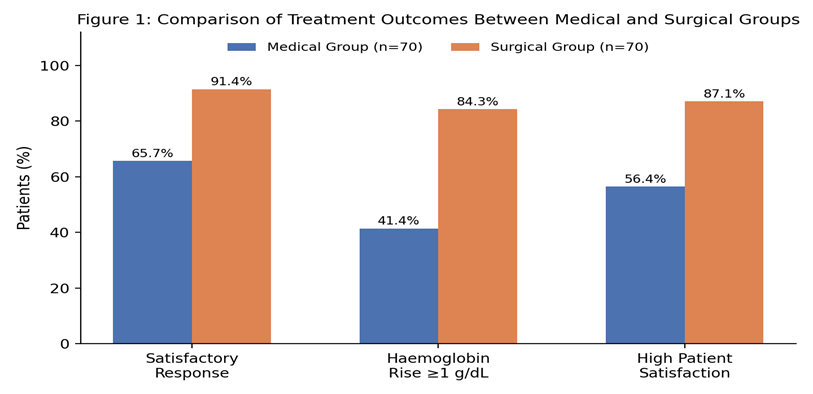
Statistically significant differences in mean PBAC between the groups at follow-up were present ( Group A: 186 ± 42 vs. 96 ± 38; Group B: 191 ± 39 vs. 38 ± 21; p<0.001 for both groups). A satisfactory response was observed in 46 of 70 women (65.7%) in Group A compared with 64 of 70 women (91.4%) in Group B (p<0.001). There was a statistically significant increase in the mean haemoglobin in Group A (0.9 ± 0.4 g/dL) to Group B (1.8 ± 0.5 g/dL) (p<0.001) and greater number of patients in Group B had a rise in haemoglobin by>1 g/dL (84.3%) compared to Group A (41.4%) (p<0.001) (Table 2, Figure 1).
Table 2: Comparison of Treatment Outcome Between Medical and Surgical Groups at 6 Months.
|
Outcome Variable |
Group A – Medical (n=70) |
Group B– Surgical (n=70) |
p-value |
|
Mean PBAC score, baseline |
186 ± 42 |
191 ± 39 |
0.487 |
|
Mean PBAC score, 6 months |
96 ± 38 |
38 ± 21 |
<0.001 |
|
Satisfactory response (≥50% PBAC fall) |
46 (65.7%) |
64 (91.4%) |
<0.001 |
|
Mean haemoglobin rise (g/dL) |
0.9 ± 0.4 |
1.8 ± 0.5 |
<0.001 |
|
Haemoglobin rise ≥1 g/dL |
29 (41.4%) |
59 (84.3%) |
<0.001 |
|
High patient satisfaction |
39 (56.4%) |
61 (87.1%) |
<0.001 |
|
Minor treatment-related complications |
8 (11.4%) |
13 (18.6%) |
0.224 |
Minor treatment related complications occurred in 11.4% of patients in Group A, most commonly gastrointestinal intolerance, and 18.6% of Group B which were mainly surgical site or anaesthesia related without a significant difference between groups (p=0.224). No patient in either group had a major adverse outcome, requiring intensive care or transfusion of greater than 2 units of blood.
DISCUSSION :
Surgical management had a significantly higher satisfactory response rate (91.4%) compared to medical management (65.7%) and the general trend was in line with the published literature of HMB surgical vs medical management. The Cochrane review by Marjoribanks et al. directly compared the surgical and medical treatment of heavy menstruation, finding that although the medical was suitable as the initial treatment, the surgical was found to consistently provide better bleeding scores and patient satisfaction at 1 year, consistent with the findings of the present study (8). A systematic review and economic evaluation conducted by Bhattacharya et al. also indicated that both these interventions (hysterectomy or endometrial ablation) demonstrated better control of bleeding than medical management, however, the latter was more cost-efficient when fertility preservation was a goal (13).
The high degree of satisfaction within the surgical arm is also in keeping with results from the pooled individual-patient meta-analysis conducted by Middleton et al., where hysterectomy was associated with a consistent decrease in blood loss and the highest degree of satisfaction was reported, but there were also fewer peri-operative risks during ablation (14). Alexander et al. conducted a randomised study in which patients also appeared to achieve better psychosocial change after surgery compared with nonsurgical treatment, which is also consistent with the present study Group B, where satisfaction was superior to nonsurgical cases (15). In long-term follow-up up to 10 years, the study by Hurskainen et al also reported that hysterectomy was superior in the number of symptom cases controlled, but was similar to the levonorgestrel intrauterine system LIS in improving quality of life over time (16).
Some studies, however, have been found to produce medical response rate more similar to the surgical rate than the one found here. Both Cochrane reviews of tranexamic acid and the levonorgestrel-releasing intrauterine system demonstrated that, if both are used optimally and for sufficient durations, both treatments are associated with significant reductions in menstrual blood loss, although this reduction still appears to be greater than that with surgical methods (6,8). A levonorgestrel intrauterine system was also demonstrated to be almost as effective as transcervical endometrial resection in decreasing blood loss during menstruation over the course of a year by Kai et al. (17). There are a couple explanations for this — the lower medical response rate in the present cohort (65.7%) may be due to the inconsistent compliance among patients, and the relatively brief 6-month observation period may have underestimated the cumulative benefit of continued medical therapy noted in longer trials (18), since 46.4% of patients had leiomyoma and adenomyosis.
The local information obtained from Yusuf in a Lahore based teaching hospital also revealed that menorrhagia significantly affected the quality of life in Pakistani women and that a significant number deferred in presentation time, which was also common in the current cohort with nearly two thirds of women having symptoms for over 6 months before enrolment (9). This late presentation may be responsible for more complicated structural disease at diagnosis in the routine local setting, in which definitive surgical therapy would perhaps be favored over medical therapy. The similar but statistically non-significant minor complication rate for the two groups in the current study (11.4% vs 18.6%, p=0.224) reflects the relatively low minor complication rates reported in recent network meta-analyses of the outcomes of endometrial ablation versus hysterectomy (10,19), where minor complications continue to be relatively uncommon when performed by an experienced surgeon.
A number of limitations exist with this study. Treatment allocation was based on clinical indication and patient preference and not on random allocation, which could present selection bias as women undergoing surgery may have been those with more advanced or structurally evident disease. The study was conducted in a single centre and the follow-up was only 6 months, meaning that the external validity of the results and long term recurrence or late complications are not assessable. Assessment of patient satisfaction was non-validated categorical rather than standardised instrument of quality-of-life data collection which may impact the comparability of findings against other studies. For the future multicentre studies with larger follow up and randomization are recommended to confirm these results in the larger population of Pakistan.
CONCLUSION :
Over 6 months, this study showed that surgical management of menorrhagia had a significantly higher satisfactory clinical response, haemoglobin recovery and patient satisfaction rate than medical therapy, while also demonstrating a comparable rate of minor complications to medical therapy. Medical therapy should however remain an initial safe and sensible approach, especially when the aetiology is non-structural, severity of the disease is low or the patient expresses a desire to preserve her fertility as a woman. These observations underwrite a tailored step wise approach to the management of menorrhagia with early counselling of realistic expectations from both treatment modalities at the local population level.
ACKNOWLEDGMENT
The authors would like to thank the Surg Cdr Samina Naseem Khattak, Classified Gynaecologist, Department of Obstetrics & Gynaecology, PNS Shifa Hospital, Karachi for her supervision, guidance and continuous support with the design and conduct of this study.
CONFLICT OF INTEREST
None.
FUNDING
None.
REFERENCES:
1. MG.Critchley HOD.Broder MS, Fraser IS. Recommendation for classification of causes of abnormal uterine bleeding in nongravid women of reproductive age: FIGO classification system (PALM-COEIN) Int J Gynaecol Obstet., 2011;113(1):3–13.
2. Fraser IS, Critchley (HOD), Munro MG, Broder M, A process designed to lead to international agreement on the terms and definitions for abnormalities of menstrual bleeding. Fertil Steril. 2007;87(3):466–76.
3. Shapley M, Jordan K, Croft PR., Community survey of menstruating symptoms. Br J Gen Pract. 2004;54(502):359–63.
4. Liu Z, Doan QV, Blumenthal P, Dubois RW. Systematic review of health-related quality of life, work impairment and health-care costs and utilization in abnormal uterine bleeding. Value Health. 2007;10(3):183–94.
5. National Institute for Health and Care Excellence. Heavy menstrual bleeding: assessment and management. NICE guideline NG88. London: NICE; 2018. Available from: https://www.nice.org.uk/guidance/ng88
6. Bryant-Smith AC, Lethaby A, Farquhar C, Hickey M. Antifibrinolytics for heavy menstrual bleeding. Cochrane Database Syst Rev. 2018;4:CD000249.
7. Bofill Rodriguez M, Lethaby A, Farquhar C. NSAIDs for heavy menstruation. Cochrane Database Syst Rev. 2019;9:CD000400.
8. Marjoribanks J, Lethaby A, Farquhar C. Surgery versus medical therapy for heavy menstrual bleeding. Cochrane Database Syst Rev. 2016;1:CD003855.
9. Yusuf L. Menorrhagia's impact on quality of life: a case control study from a teaching hospital in Lahore. Pak J Med Sci. 2018;34(6):1539–43.
10. Cooper KG, Bhattacharya S, et al. Network meta-analysis of second generation endometrial ablation methods in treating heavy menstrual bleeding. BMJ. 2015;350:h2522.
11. World Health Organization. WHO Sample size determination in health studies: a practical manual. Geneva: WHO; 1991.
12. Lethaby A, Hussain M, Rishworth JR, Rees MC. Intrauterine Systems that are progesterone or progestogen giving for heavy menstrual bleeding. Cochrane Database Syst Rev. 2015;4:CD002126
13. Bhattacharya S, Middleton LJ, Tsourapas A, et al. Hysterectomy, endometrial ablation and Mirena for heavy menstrual bleeding: a systematic review of clinical effectiveness and cost-effectiveness analysis. Health Technol Assess. 2011;15(19):1–252.
14. Middleton LJ, Champaneria R, Daniels JP, et al. Heavily bleeding update: Hysterectomy, endometrial destruction, and levonorgestrel releasing intrauterine system (Mirena) for heavy menstrual bleeding: systematic review and meta-analysis of data from individual patients. BMJ. 2010;341:c3929.
15. Alexander DA, Naji AA, Pinion SB, et al. Psychiatric and psychosocial aspects of a randomized trial of hysterectomy versus endometrial ablation for dysfunctional uterine bleeding. BMJ. 1996;312(7026):280–4.
16. Hurskainen R, Teperi J, Rissanen P, et al. 10-year follow-up of a randomized trial to assess clinical outcomes and costs of treating menorrhagia with the levonorgestrel-releasing intrauterine system or with hysterectomy. JAMA. 2004;291(12):1456–63.
17. Kai J, Middleton L, Daniels J et al. Randomised comparison of trans-cervical resection of the endometrium with the levonorgestrel-releasing intrauterine system in the treatment of menorrhagia. BJOG. 2002;109(7):789–96.
18. Reid PC, Virtanen-Kari S. Randomised comparative trial of the levonorgestrel intrauterine system and mefenamic acid for treatment of idiopathic menorrhagia presenting multiple analysis by total menstrual fluid loss, menstrual blood loss and pictorial blood loss assessment charts. BJOG. 2005;112(8):1121–5.
19. Davies J, Kadir RA: An update on the management of heavy periods (menstrual blood loss). Thromb Res. 2017;151(Suppl 1):S70–7.
20. Gokyildiz S, Aslan E, Beji NK, Mecdi M: Menorrhagia's impact on women's quality of life-a case-control study. ISRN Obstet Gynecol. 2013;2013:918179.