Topical Nasal Steroid for Management of Adenoid Hypertrophy in Children
- Amna Naeem , Postgraduate resident ENT(FCPS), Faisalabad Medical University & Affiliated Hospitals, Faisalabad, Pakistan
- Hafiz Sajjad Hyder , Associate Professor, Faisalabad Medical University, Faisalabad, Pakistan
- Muhammad Zahid Rafiq Gill , Professor of ENT, Fatima Jinnah Medical University, Lahore, Pakistan
- Talha Naeem , Medical Officer, Alkhidmat Primary Care Clinic, Pakistan
- Muhammad Noman Ashiq , Medical Officer, Nusrat Fateh Ali Khan Hospital, Faisalabad, Pakistan
Article Information:
Abstract:
Adenoid hypertrophy is a common pediatric nasopharyngeal condition that can cause nasal obstruction, mouth breathing, snoring, sleep disturbance, and recurrent ear or upper airway symptoms. Because adenoidectomy is invasive and may be associated with operative risks or recurrence, intranasal corticosteroid therapy is increasingly considered as a conservative option for symptomatic children. Objective: To determine outcome of topical Nasal Steroid for Management of Adenoid Hypertrophy in Children. Study Design: Quasi experimental study. Place and Duration of Study: From August 2025 to October 2025 at Department of ENT, Allied hospital-II, Faisalabad. Methodology: Total 60 children aged 4 to 12 who had adenoid hypertrophy and persistent symptoms that lasted for more than a year were included. Children who had taken antibiotics or antihistamines during the four weeks of systemic or intranasal steroid treatment, had a history of adenoidectomy, were immunocompromised, had nasal structural disease (such as polyp or septal deviation), were cranio-facial, neuro-muscular, genetic, cardiovascular diseases, or had a serious underlying illness were not included. For 12 weeks, 50 mcg of mometasone furoate nasal spray was administered once daily per nostril. After 12 weeks, a lateral x-ray of the nasopharynx was performed after the intervention. The A/N ratio was once more determined, and the size change of the adenoid was recorded. Sino-nasal Outcome Test (SNOT22) differences between baseline and 12 weeks following nasal steroid treatment indicated a change in nasal obstruction. Results: In our investigation, the A/N ratio had a high significance between two measures with a mean ± SD of 0.79 ± 0.14 before and 0.69 ± 0.53 after the intervention. Prior to intervention, the nasal obstruction SNOT22 score was 46.38 ± 3.65, and following intervention, it was 35.32 ± 4.12. Conclusion: According to our research, children's adenoidal hypertrophy can be effectively treated with intranasal steroids.
Keywords:
Article :
INTRODUCTION:
The nasopharyngeal tonsil, also referred to as adenoids, is a solitary, pyramidal structure found at the intersection of the roof and posterior wall of the nasopharynx. The development of adenoid hypertrophy may occur from weakened systemic and local immunity [1]. Depending on the size, degree, and duration of obstruction, hypertrophied adenoids can induce a range of clinical symptoms. Adenoids undergo hypertrophy until the age of seven, attaining their maximal growth at four years old. Adenoid hypertrophy is estimated to be present in 57.7% of young infants who are admitted to ENT department because of nasal obstructions [2]. A common complaint, bilateral nasal airway blockage can result in obstructive sleep apnea (OSAs), speech problems, deglutition problems, and sleep difficulties [3]. The management of symptomatic adenoidal hypertrophy depends on the extent of nasal airway blockage and any associated morbidity. Despite being a popular therapy for obstruction, adenoidectomy can have major or catastrophic side effects and elevate medical expenses. Children may, however, develop adenoidal regrowth after surgery, which could manifest with comparable symptoms. Nasal steroids administered as a non-surgical treatment may minimize adenoid mucosal irritation and be a useful technique to shrink adenoids [4]. Topical nasal steroids alter the anatomical component. They lower the tonsillar, adenoidal, or nasal levels of upper airway inspiratory resistance. Topical nasal steroids alter the anatomical component. They lower the tonsillar, adenoidal, or nasal levels of upper airway inspiratory resistance [5]. In a research, 106 patients between the ages of 4 and 8 had their adenoidal hypertrophy affected by the topical nasal steroid mometasone furoate. The A/N ratio had a high significance between the two assessments before and after the intervention, with Mean ± SD = 0.78±0.45 and 0.70±0.47, respectively. Prior to intervention, the nasal obstruction SNOT22 score was 44.90±10.41, and following intervention, it was 36.75±12.94.6 The efficacy of intranasal steroid treatment in treating pediatric adenoid hypertrophy has not been evaluated in Pakistan. The sole course of treatment available to them is adenoidectomy. This study aims to offer a novel treatment approach and evaluate the efficacy of intranasal steroids in treating adenoid hypertrophy in our community. If intranasal mometasone is effective in treating adenoid hypertrophy, it could be used as a pediatric supplementary treatment, reducing the need for adenoidectomy.
METHODOLOGY:
This quasi-experimental study was conducted at the Department of ENT department, Allied hospital-II, Faisalabad, from August 2025 to October 2025, following approval by the institutional ethical review committee. With a confidence level of 5%, an absolute precision of 0.12%, and an anticipated mean of 0.70±0.476, a sample size of 60 was determined using a sample size calculator for single means. Children aged 4 to 12 who had adenoid hypertrophy (as shown on a lateral x-ray of the nasopharynx with an A/N ratio >0.73 using the Fujioka method) and persistent symptoms (sleep apnea, mouth breathing, snoring and nasal congestion) that lasted for more than a year were included. Children who had taken antibiotics or antihistamines during the four weeks of systemic or intranasal steroid treatment, had a history of adenoidectomy, were immunocompromised, had nasal structural disease (such as polyp or septal deviation), were cranio-facial, neuro-muscular, genetic, cardiovascular diseases, or had a serious underlying illness were not included. Written informed permission was requested from the patients. Every patient underwent a history taking, clinical examination, and a lateral x-ray of the nasopharynx to measure the A/N ratio and confirm the diagnosis. For 12 weeks, 50 mcg of mometasone furoate nasal spray was administered once daily per nostril. After 12 weeks, a lateral x-ray of the nasopharynx was performed after the intervention. The A/N ratio was once more determined, and the size change of the adenoid was recorded in accordance with the operational definition. Sino-nasal Outcome Test (SNOT22) differences between baseline and 12 weeks following nasal steroid treatment indicated a change in nasal obstruction. Every piece of data was entered into a pre-made proforma. SPSS V-25 was used to enter all of the data. For every quantitative indicator, including age, symptom duration, A/N ratio, and SNOT22 score, the mean and standard deviation were determined. For every qualitative indicator, including gender and symptoms, frequency and percentage were computed. The change in adenoid size was examined using the independent sample t test. The stratification process was used to control for effect modifiers such as age and gender. The independent sample t test was used for post-stratification, and a P-value of less than 0.05 was considered significant.
RESULTS:
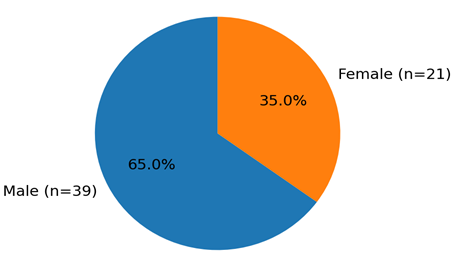
The mean age of the patients was 6.32 ± 2.67 years, with a range of 4 to 12 years. Age distribution is presented as a pie chart to show the relative share of younger and older children in the sample. Of the 60 patients, 39 (65.0%) were male and 21 (35.0%) were female. The symptoms lasted 17.43 ± 4.53 months on average.
Figure 1. Age distribution (n=60).
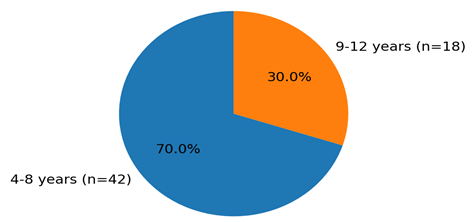
Figure 2. Gender distribution (n=60).
In our investigation, the A/N ratio and SNOT22 score showed statistically significant improvement after 12 weeks of topical nasal steroid therapy. The A/N ratio decreased from 0.79 ± 0.14 at baseline to 0.69 ± 0.53 after treatment, while the SNOT22 score decreased from 46.38 ± 3.65 to 35.32 ± 4.12.
Theory before Table-I: The A/N ratio is an objective radiological indicator of adenoid size, while the SNOT22 score reflects symptom burden and quality-of-life impairment related to sinonasal obstruction. A simultaneous reduction in both measures after therapy indicates improvement in anatomical obstruction and clinical symptoms (Table 1).
Table 1. Outcome of topical nasal steroid for management of adenoid hypertrophy in children
|
Parameter |
Baseline |
Parameter |
Baseline |
|
A/N ratio |
0.79 ± 0.14 |
0.69 ± 0.53 |
0.0001 |
|
SNOT22 score |
46.38 ± 3.65 |
35.32 ± 4.12 |
0.0001 |
Theory before Table-II: Age stratification evaluates whether the response to intranasal ster oid therapy was consistent across the younger and older pediatric age groups. Comparable reductions in both age groups support the use of treatment across the included age range (Table 2).
Table 2. Age-wise stratification of outcome
|
Variable |
Age group |
Baseline |
After 12 weeks |
P-value |
|
A/N ratio |
4-8 years |
0.77 ± 0.52 |
0.68 ± 0.33 |
0.0001 |
|
A/N ratio |
9-12 years |
0.80 ± 0.43 |
0.69 ± 0.47 |
0.0001 |
|
SNOT22 score |
4-8 years |
47.21 ± 3.16 |
37.42 ± 3.78 |
0.0001 |
|
SNOT22 score |
9-12 years |
46.18 ± 3.54 |
35.09 ± 4.02 |
0.0001 |
Theory before Table-III: Gender stratification assesses whether male and female children showed similar improvement after intranasal steroid therapy. Significant reductions in both groups suggest that treatment response was not limited to a single gender group (Table 3).
Table 3. Gender-wise stratification of outcome
|
Variable |
Gender |
Baseline |
After 12 weeks |
P-value |
|
A/N ratio |
Male |
0.78 ± 0.32 |
0.70 ± 0.23 |
0.0001 |
|
A/N ratio |
Female |
0.79 ± 0.29 |
0.69 ± 0.31 |
0.0001 |
|
SNOT22 score |
Male |
46.19 ± 4.23 |
36.89 ± 3.92 |
0.0001 |
|
SNOT22 score |
Female |
45.62 ± 3.23 |
36.75 ± 3.76 |
0.0001 |
DISCUSSION:
The adenoids, which are found in the posterior pharynx, change size during childhood and are involved in immune defense. They usually peak between the ages of five and six and involute by the time they are ten [7]. The average age of the participants in our study was 6.32 ± 2.67 years, falling within the range of symptomatic blockage. Adenoid hypertrophy and tonsillar expansion are the primary causes of OSA and SDB because to their anatomical locations [8]. Untreated OSA and SDB can result in a number of neuropsychological and physiological abnormalities, from hypertension and craniofacial changes to behavioral issues and daytime drowsiness. As a result, prompt treatment is essential, and the first line of treatment is adenotonsillectomy, which involves surgically removing the tonsils and adenoids [9]. But there are risks involved, including as bleeding, infection, adenoid regrowth, and even cardiac hazards from general anesthesia. It has been shown in earlier research that INCS can lower physiologic assessments of adenoid hypertrophy [10]. These reviews, which mostly concentrate on mometasone, have shown conflicting results in terms of subjective indicators of illness severity, like symptom scores [11]. Furthermore, after adenoidectomy, adenoids may recover; multiple studies have reported regrowth rates ranging from 13% to 25% [12,13].
Our results showed that topical steroids were successful in decreasing objective adenoid size, which is consistent with recent research. These findings are distinct, though, in that they show broad reductions in symptom scores rather than a single improvement in nasal obstruction. The A/N ratio in our study was 0.79 ± 0.14 before and 0.69 ± 0.53 after the intervention, with high significance between the two measurements. Prior to intervention, the nasal obstruction SNOT22 score was 46.38 ± 3.65, and following intervention, it was 35.32 ± 4.12. In a research, 106 patients between the ages of 4 and 8 had their adenoidal hypertrophy affected by the topical nasal steroid mometasone furoate. The A/N ratio had a high significance between the two assessments before and after the intervention, with Mean ± SD = 0.78±0.45 and 0.70±0.47, respectively. Prior to intervention, the nasal obstruction SNOT22 score was 44.90±10.41, and following intervention, it was 36.75±12.94.6
To evaluate the effectiveness of intranasal steroid therapy in individuals with either adenoid tissue hypertrophy or allergic rhinitis, a comparative study was carried out. It was discovered that INS therapy was more successful in reducing the adenoid/choana ratio in patients with adenoid hypertrophy but no allergic rhinitis. The AR status should be considered while considering INS treatment for ATH since it can help predict how effectively the treatment will work [2]. A study evaluated the effectiveness of momeyasone furoate as a nasal spray for children with adenoidal hypertrophy as a long-term maintenance treatment. They detailed the first long-term observation of kids treated with mometasone furoate aqueous nasal spray for adenoidal hypertrophy. The decision to temporarily discontinue maintenance medication raises the risk of surgery for this illness, although regular therapy continuation may yield favorable results [14].
Forty-five children with AH, ages 2 to 14, were enrolled in this research trial. They all had an 8-week course of intranasal fluticasone medication, and questionnaires were used to grade and compare their symptoms before and after treatment. Following eight weeks of intranasal corticosteroid treatment, there was a statistically significant reduction in all AH symptoms, including snoring, sleep apnea, mouth breathing, and nasal congestion. 92% of atopic patients reported a 50% improvement in their clinical symptoms of AH following treatment, which was statistically significant (P = 0.024) when compared to non-atopic patients [4].
The effectiveness and safety of fluticasone propionate nasal spray in treating children's adenoidal hypertrophic snoring were examined in a study [15]. We enrolled fifty-six kids who had adenoidal hypertrophic snoring. For four weeks, all patients received the fluticasone propionate nasal spray. 56 patients had significantly lower symptoms scores in the moderate group and nasal obstruction in the severe group after treatment compared to before treatment (P < 0.05). Following therapy, the moderate group experienced considerably greater reductions in symptoms score than the severe group (P<0.001). Following treatment, a lateral nasal X-ray examination revealed that the nasopharynx airway was clearly widened and the adenoid size was clearly reduced in 18 patients. The mean ANR reduced from 0.76±0.10 to 0.72±0.09 (P< 0.001). Children's adenoidal hypertrophy-related snoring can be effectively and safely treated with fluticasone propionate nasal spray [15].
Over the course of six months, 444 individuals participated in a Randomized Control Trial16 at the Hayatabad Medical Complex's ENT department. Using successive non-probability sampling, the patients were randomized into two groups: one group received intranasal steroids for 8 weeks while the other group received saline nasal spray as a placebo. The mean age in Group B was 7 years (SD ± 5.57), while the mean age in Group A was 7 years (SD ± 5.21). Group B included 127 (57%) male children and 95 (43%) female children, whereas Group A had 122 (55%) male children and 100 (45%) female children. Intranasal steroids in Group A were successful in 195 (88%) of the children and ineffective in 27 (12%) of them. 164 (74%) of the children in Group B responded well to saline nasal spray, while 58 (26%) did not [16].
After reviewing twenty-three relevant potential citations, Elbeltagy YM et al [17]. found nine papers that were appropriate for these meta-analyses. Among these were five meta-analyses that included randomized controlled trials. After using intra-nasal corticosteroids, three meta-analyses revealed a significant improvement in adenoid size. Two meta-analyses revealed negligible reduction in nasal obstruction symptoms. 1156 patients from 16 trials were included in a different systematic review and meta-analysis.18 520 patients were used as controls, while 636 patients had INCS examined. Following treatment, the INCS group's percentage of patients with severe AH decreased significantly more than that of the control group (43.5 vs 13.3). Additionally, nasal irritation (0.7 vs. 0.2) and nasal obstruction (1.6 vs. 0.6) decreased more in the INCS group than in the control group. In the treatment group, the rate of adenoidectomy after medical treatment was 22.3%, but in the control group, it was 98.6% [18].
There is significant debate over the exact processes by which INCS efficiently reduces adenoid size; some studies attribute this to the direct anti-inflammatory and immunosuppressive action on adenoid tissues, while others point to the removal of recurrent infections [19]. High levels of glucocorticoid receptors on the tonsils and adenoids were shown in one study by Goldbart et al., offering a plausible defense for the application of topical or systemic steroids in the treatment of hypertrophy [20].
CONCLUSION:
According to our research, children's adenoidal hypertrophy can be effectively treated with intranasal steroids. It is a reasonable method of treatment that can lessen symptoms and eliminate the need for an adenoidectomy by serving as an alternative to surgery.
REFERENCES:
1. Singh G, Jolly P, Prinja S, Bawa AG, Vignesh AK. A comparative study of fluticasone propionate, mometasone furoate, and saline nasal spray in the treatment of children with adenoid hypertrophy. Acta Med Int. 2023;10:59-64.
2. Zwierz A, Masna K, Domagalski K, Burduk P. The long-term effects of 12-week intranasal steroid therapy on adenoid size, its mucus coverage and otitis media with effusion: A cohort study in preschool children. J Clin Med. 2022;11(3):e507.
3. Ahmed MR, Abou‑Halawa AS, Ibrahim IH, Zittoon RF, Makary EF. Effect of topical mometasone furoate on adenoidal lymphoid tissue: A light microscopic study. J Laryngol Otol. 2019;133:106‑9.
4. Sadeghi-Shabestari M, Naderpoor M, Farzipour S, Dastranji A. The Role of Intranasal Corticosteroid Therapy in Pediatric Adenoidal Hypertrophy: A Randomized Clinical Trial Study. Immunol Genetics J. 2021;4(3):161-65.
5. Matin MA, Azad MA, Hasan MB, Haque MM, Akhter T. Medical Treatment of Adenotonsillar Hypertrophy-Study of 50 cases. Bangladesh J Otorhinolaryngol. 2022;28(1):16-21.
6. Ali AZ, Elsheikh MN, Behery AS, Mandour MF. Topical nasal steroid for management of adenoid hypertrophy in children. Int J Otolaryngol Res. 2023;5(2):35-40.
7. Roushdy MM, Jalil AAA, Saeed AM. Mometasone furoate use for recurrent adenoid hypertrophy: randomized controlled clinical trial, Indian J Otolaryngol Head Neck Surg. 2023;75(3):1639–46.
8. Arambula A, Brown JR, Neff L. Anatomy and physiology of the palatine tonsils, adenoids, and lingual tonsils. World J Otorhinolaryngol Head Neck Surg. 2021;7(3):155–60.
9. Tuhanıo˘ glu T, Erkan SO. Evaluation of the effects of montelukast, mometasone furoate, and combined therapyon adenoid size: a randomized, prospective, clinical trial with objective data, Turk J Med Sci. 2017;47(6):1736–43.
10. Elbeltagy YM, Ibrahim SA, Hasaballah MS, Sowilem OM. Efficacy of intranasal corticosteroids in improving nasal airway obstruction in children with symptomatic adenoidal hypertrophy: a meta analysis and systematic review. Egyptian J Otolaryngol. 2019;35(1):30–36.
11. Arslan E, Tulaci KG, Canakci H, Arslan S, Yazici H. Evaluation of the intranasal steroid treatment outcomes in adenoid tissue hypertrophy with or without allergic rhinitis. Otolaryngol Am J. 2021;42(4):102983. https://doi.org/10.1016/j.amj oto. 2021.102983.
12. Chohan A, Lal A, Chohan K, Chakravarti A, Gomber S. Systematic review and meta analysis of randomized controlled trials on the role of mometasone in adenoid hypertrophy in children. Int J Pediatr Otorhinolaryngol. 2015;79(10):1599-608. doi: 10.1016/j.ijporl. 20 15.07.009.
13. Sakarya E, Muluk NB, Sakalar E, Senturk M, Aricigil M, Bafaqeeh S, et al. Use of intranasal corticosteroids in adenotonsillar hypertrophy. J Laryngol Otology. 2017;131(5):384-90.
14. Joshua B, Bahar G, Sulkes J, Shpitzer T, Raveh E. Adenoidectomy: long-term follow-up. Otolaryngol. 2006;135(4):576–80.
15. Duan H, Xia L, Lan Q. Efficacy and safety of fluticasone propionate nasal spray in treatment of adenoidal hypertrophic snoring in children. Braz J Pharm Sci. 2022;58:e21052.
16. Khan A, Orakzai KA, Noor A, Ullah SS, Khan M, Qazi M. Efficacy of Nasal Steroids in Treatment of Adenoidal Hypertrophy in Children. Int J Pathol. 2022;20(2): 56-61.
17. Elbeltagy YM, Ibrahim SA, Hasaballah MS, Sowilem OM. Efficacy of intranasal corticosteroids in improving nasal airway obstruction in children with symptomatic. adenoidal hypertrophy: a meta-analysis and systematic review. Egypt J Otolaryngol 2019;35:30-6.
18. Ripp AT, Kallenberger EM, Nguyen SA, Schafer IV, Clemmens CS, White DR. Topical nasal steroids for adenoid hypertrophy in children: A systematic review and meta-analysis. Int J Pediatr Otorhinolaryngol. 2025;198:112580.
19. Solmaz F, Aşcıoğlu ME, Durgut O, Dikici O, Haksever M. Are nasal steroids effective in children with adenoid hypertrophy? Eur Res J. 2019;5(2):311-8.
20. Goldbart AD. Glucocorticoid receptor subunit expression in adenotonsillar tissue of children with obstructive sleep apnea. Pediatr Res. 2005;57(2).