Prevelance Of Beta Thalassemiatrait In Pregnant Anemic Patients Attending Sindh Government Qatar Hospital
- Zeenat Fatima , post Graduate Trainee Gynecology and obstetrics Sindh Government Qatar Hospital.
- Samreen Mahboob , Head of Department Gynecology and Obstetrics Sindh Government Qatar Hospital
Article Information:
Abstract:
World Health Organization defines anemia in pregnancy as hemoglobin <11 g/dL. Anemia affects 12–25% of pregnant women and is associated with adverse fetomaternal outcomes. Most common causes are iron deficiency anemia and beta thalassemia traitObjective: To determine the prevalence of beta thalassemia trait in pregnant anemic women attending Sindh Government Qatar Hospital, Karachi.Methods: This prospective cross-sectional study was conducted in Department of Obstetrics and Gynecology, Sindh Government Qatar Hospital, Karachi from January to August, 2025. A total of 145 anemic pregnant women (hemoglobin <11 g/dL) in the first and second trimesters attending antenatal clinics were included. Full blood counts were done on a fully automated hematology analyzer and high-performance liquid chromatography was done on the BIORAD D-10 instrument. Data were collected through medical records, physical examination and laboratory investigations and analyzed using SPSS version 26.Results: Mean age of participants was 27.1 ± 5.3 years and mean hemoglobin level was 9.2 ± 1.69 g/dL. The predominant type was moderate anemia (57.2%) followed by mild anemia (28.2%) and severe anemia (14.4%). Consanguineous marriage was noted in 42% of the participants and family history of beta-thalassemia trait was noted in 4.8%. Overall, the beta-thalassemia trait was found in 11.3% of women.Conclusion: This study establishes, that the frequency of β-thalassemia trait amongst pregnant females was alarming (11.3%), highlighting the importance of routine screening in antenatal clinics.
Keywords:
Article :
INTRODUCTION:
The World Health Organization defines anemia as having a hemoglobin level of less than 11 g/dl. Pregnancy outcomes are negatively impacted by anemia, which is estimated to afflict 12 to 25% of pregnant women [1]. The most often documented causes of anemia during pregnancy are iron deficiency anemia and thalassemia trait. The most prevalent hereditary monogenic illness that creates a significant genetic health issue globally is thalassemia [2]. Reduced or missing beta globin gene expression is the cause of beta thalassemia, a diverse set of hemoglobin diseases [3]. Africa, Southeast Asia, the Indian subcontinent, and the Mediterranean areas all have significant rates of this illness [4]. 80 million of the estimated 270 million thalassemia carriers worldwide have beta thalassemia characteristics. It is a serious health issue in Pakistan, where 5-7% of the population (about 9-613 million) have thalassemia minors. Pregnant women with anemia represent the study population due to the coexistence of nutritional and genetic causes of anemia in this group [5]. More than 6,000–7,000 thalassemia major children are born in Pakistan each year as a result of the high carrier state in our community; research has shown that the incidence of beta thalassemia in pregnant women ranges from 40% to 56.7% [6], [7].
In current society, consanguineous marriages are common, which leads to the accumulation of dangerous genes within a family. Effective iron chelation therapy is not always successful in treating individuals with beta thalassemia major who need frequent blood transfusions in a developing nation like Pakistan [8]. As a result, the illness has a high morbidity and fatality rate. Reducing the number of these people by genetic counseling and prenatal diagnosis of affected fetuses might be another long-term solution to this issue [10].
METHODOLOGY:
Following the approval of the research protocol from Ethical Review Committee of the hospital, this prospective Cross-sectional study was carried out over a period of eight months from January to August, 2025 in the department of the Obstetrics & Gynecological Department of Sindh Government, Qatar Hospital, Karachi. After taking the written informed consent, a total of 145 anemic pregnant women (hemoglobin < 11 g/dL as per WHO criteria for pregnant women) in first and 2nd trimester presenting to the hospital for antenatal care were included in the study via non-probability sampling technique. Women with multiple gestations determined by Ultra-sonography, comorbidities of chronic illness like chronic renal failure, congestive cardiac failure determined by history/ previous investigations and women with bleeding disorder determined by history/ previous investigations were excluded. Already diagnosed cases of haemoglobinopathies like thalassemia major, sickle cell anemia on medical grounds were also excluded from the study. OPENEPI calculator was used to calculate the sample size by taking prevalence of beta thalassemia in pregnant anemic women i.e. 40%6, margin of error = 8%, confidence interval = 95%. Demographic details which included age, parity and family h/o thalassemia were noted, then a sample of 10cc of venous blood in EDTA (anti-coagulant) was obtained from all eligible women and were sent to the hospital laboratory in sealed, leak proof containers for the analysis of the complete blood count, red cell indices and hemoglobin (Hb) electrophoresis. Complete blood count (CBC) and red cell indices were analyzed using an automated hematology analyzer. Hemoglobin electrophoresis was performed using High-Performance Liquid Chromatography (HPLC)/capillary electrophoresis, following manufacturer protocols. Internal quality control procedures were maintained throughout the study. Women were found to be carriers of beta thalassemia if their HbA2 levels were more than 3.5%. To minimize selection bias, consecutive eligible patients were enrolled. Laboratory personnel were blinded to clinical history.
All information obtained from the participants was kept strictly confidential. Personal identifiers including name, hospital registration number, and contact details were not entered into the study database. Data were used solely for research purposes and were accessible only to the principal investigator and research team.
Each participant was assigned a unique study identification code at the time of enrollment. Identifying information was recorded separately from clinical and laboratory data and stored in a password-protected file accessible only to the principal investigator. The main dataset used for analysis contained only coded variables without any personal identifiers. Hard copies of consent forms were stored in a locked cabinet within the department. All electronic data were stored on password-protected computers, and data backup was maintained on encrypted storage devices.
Data were entered and analyzed by using SPSS statistical package version 27 software. Shapiro–Wilk test was applied to check the normality of quantitative data. P-value > 0.05 indicated that the data is normally distributed therefore, mean and standard deviations were computed. Frequencies and percentages were calculated for categorical variables. Chi-square test was used for comparison of categorical variables with expected cell counts ≥5, while Fisher’s exact test was applied when expected frequencies were <5 or in small sample sizes. P-value less than and equal to 0.05 was considered as significant.
RESULTS:
Among 145 pregnant women, the mean age was 27.1 ± 5.3 years. The mean hemoglobin was 9.2 ± 1.69 g/dL, with moderate anemia being most common (57.2%), followed by mild (28.2%) and severe (14.4%). Most participants were multiparous (71.7%), and 42% reported consanguineous marriage, while 4.8% had a family history of beta-thalassemia trait. Hematological indices and red cell parameters were within expected ranges, reflecting a population with predominantly moderate anemia (Table#1).
Table 1: Baseline Data of the Patients (n=145)
|
Demographic Data |
(mean + sd)/n(%) |
|
Age (Years) |
27.1 ± 5.3 |
|
WBC Count (103/ul) |
9.5 ± 3.2 |
|
RBC Count (106/ul) |
4.2 ± 0.7 |
|
Hemoglobin (g/dl) |
9.2 ± 1.69 |
|
Hematocrit (%) |
33.1 ± 4.1 |
|
MCV (fl) |
79.0 ± 8.6 |
|
MCH (pg) |
24 ± 4.3 |
|
MCHC (g/dl) |
33.2 ± 2.1 |
|
Platelet Count (103/ul) |
278 ± 62 |
|
RDW-CV (%) |
15.1 ± 2.3 |
|
Parity · Primi Para · Multipara |
41 (28.2%) 104 (71.7%) |
|
Family h/o beta-thalassemia trait |
7 (4.8%) |
|
Consanguinity marriage |
61 (42%) |
|
Severity of Anemia · Mild · Moderate · Severe |
41 (28.2%) 83 (57.2%) 21 (14.4%)
|
Among the anemic pregnant cohort, 16 women (11.3%) were found to carry the beta-thalassemia trait, indicating a notable prevalence in this population (Figure#1).
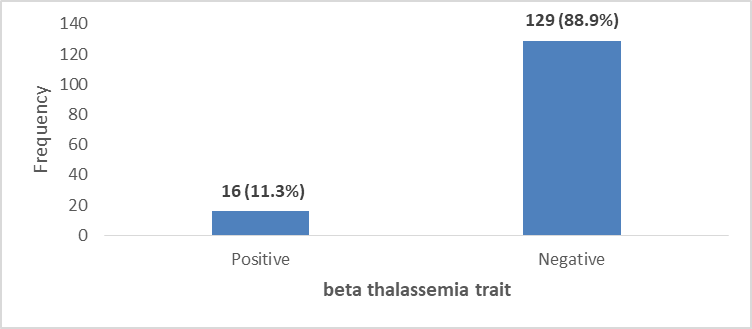
Figure#1 Frequency of beta thalassemia trait in anemic pregnant women
The trait was more frequent among women with a positive family history (6/7, 85.7%; p<0.001) and those with consanguineous marriages (16/61, 26.2%; p<0.001). There was no significant association between the presence of the trait and age (18–30 vs >30 years, p=0.245) or parity (primipara vs multipara, p=0.369). The severity of anemia was significantly associated with the trait, with a higher proportion of moderate and severe anemia observed among carriers (p=0.015). These findings show an association between family history, consanguinity, anemia severity, and beta-thalassemia trait in this population (Table#2).
Table 2: Association of β-thalassemia trait with baseline characteristics among anemic pregnant women (n=145)
|
Baseline Data |
beta thalassemia trait |
P-value |
|
|
Positive (n=16) |
Negative (n=129) |
||
|
Age (Years) · 18-30 · >30 |
12 04 |
111 18 |
0.245 |
|
Parity · Primi Para · Multipara |
03 13 |
38 91 |
0.369 |
|
Family h/o beta-thalassemia trait · Yes · No |
06 10 |
01 128 |
< 0.001
|
|
Consanguinity marriage · Yes · No |
16 00 |
45 84 |
< 0.001
|
|
Severity of Anemia · Mild · Moderate · Severe |
02 08 06 |
39 75 15 |
0.015 |
DISCUSSION :
Unfortunately, pregnancy-related anemia is common in this part of the world and has particular repercussions. The beta thalassemia trait is one of the most frequent causes of anemia during pregnancy. This poses a significant health risk in poor nations like Pakistan. In low socioeconomic nations, the beta thalassemia trait during pregnancy is linked to an increase in child mortality and morbidity.11,12
Thalassemia trait is diagnosed by hemoglobin electrophoresis and other hematological markers, with a reported carrier rate of up to 18% in Pakistan compared to 5 to 7% worldwide.13,14 According to the similar other researches, the patient's mean age ranges from 20 to 35 years, and their mean hemoglobin level is between 7 and 10 gm/dl.15,16 Pregnant women in the current study had a mean hemoglobin level of 9.2 g/dl ± 1.69 and an average age of 27.1 years.
11.3% of pregnant anemic women in our study were found to be carriers of β thalassemia. Patients with mild anemia were most likely to experience it. There have been reports of higher thalassemia trait frequencies in pregnant mothers in our area.
In research conducted in Lahore, Hafeez M et al. found that 53.1% of pregnant women had been diagnosed with beta thalassemia trait.17 Sarda H et al. discovered that 108 (51.6%) of the 209 pregnant anemic women they investigated had the beta thalassemia phenotype.18 In a similar vein, investigations that support our findings have also been published in our area. In a 2015 study, Kulkarni P et al. found that 18 (8.5%) of the 210 pregnant women had thalassemia.19 8.5% of pregnant women are carriers, according to a research by Qamar-ur-Nisa et al.20 In 2010, Sukratetal conducted a study on both anemic and non-anemic pregnant women. In the anemic pregnant instances, 39.7% of the females were determined to be thalassemia carriers; in the other group, the incidence of thalassemia trait was 24.4%.21 Sur D et al. screened 1,083 women for thalassemia in 2016, and the prevalence of carriers was 4.61%. 22.
The beta-thalassemia trait did not significantly correlate with age or parity (p=0.245 and p=0.369, respectively). Similar findings have been seen in regional studies, when carrier status was not independently predicted by demographic factors including mother age and gravidity.23 The occurrence of beta-thalassemia trait is mostly governed by genetic transmission rather than obstetric aspects because it is a hereditary condition produced by mutations in the beta-globin gene (HBB) found on chromosome 11.24.
Positive family history was found to have a highly significant correlation (p=0.00). This is in line with the autosomal recessive inheritance pattern of beta-thalassemia, in which each pregnancy has a 25% chance of producing an afflicted child.24, 25 Family history is one of the best indicators for detecting carriers, according to earlier research, and it should be regularly evaluated throughout prenatal care.22,26 Our results highlight the value of genetic counseling and cascade screening in families with known carriers.
Since every carrier in our sample had a history of consanguinity, consanguineous marriage demonstrated a very substantial correlation with the beta-thalassemia trait (p=0.000). Consanguinity dramatically raises the occurrence of autosomal recessive illnesses, such as beta-thalassemia, in Pakistan and other Middle Eastern and South Asian nations.21,27 The elevated prevalence of intra-family marriages promotes the propagation of mutant alleles over generations, hence maintaining carrier frequencies within the population.
Additionally, there was a significant correlation (p=0.015) between the degree of anemia and the beta-thalassemia trait, with carriers more likely to have moderate to severe anemia. Although moderate microcytic hypochromic anemia is the normal presentation of beta-thalassemia trait, it can overlap with iron deficiency anemia, particularly during pregnancy.28In order to prevent needless iron therapy and to facilitate effective genetic counseling, studies have emphasized the significance of differentiating between iron deficiency anemia and thalassemia trait using red cell indices and hemoglobin electrophoresis.26,28
Enhanced prenatal screening, genetic counseling, and community education programs are clearly necessary to identify carriers early, prevent high-risk births, and lower the burden of thalassemia disease in Pakistan and similar settings, given the high carrier frequency and significant associations with consanguinity and family history in this and other regional studies. Premarital screening of couples and more awareness efforts has to be provided. This approach has been successfully used in other regions of the world, such as Cyprus, where there were no births with thalassemia major between 2002 and 200720.In just six years, Saudi Arabia was able to successfully lower the prevalence of beta-thalassemia by 70%.29.
Our study included a number of limitations. Initially, hemoglobin electrophoresis, a traditional screening method, was employed. Even if there are now more sophisticated and precise methods, they are costly and not generally accessible. Second, the sole facility chosen for the study was the Obstetrics & Gynecological Department of the Sindh Government, Qatar Hospital, Karachi. An improved understanding of the prevalence of this condition in a community could have been obtained by a population-based study or by including the other local hospitals.
Conclusion:
With a frequency of 11% in our sample, the current study shows that the beta-thalassemia trait is reasonably prevalent among anemic pregnant women. Positive family history and consanguineous marriage showed a high and statistically significant correlation with carrier status, although maternal age and parity did not. Furthermore, carriers were more likely to have moderate to severe anemia, underscoring the necessity for additional testing in these situations.
Financial Assistance: Nil
Conflict of Interest: Nil
REFERENCES:
1.
The prevalence of β-thalassemia trait among anemic pregnant women was 11.3% in the present study. The mean age of participants was 27.1±5.3 years and mean hemoglobin level was 9.2±1.69 g/dL. Moderate anemia was the most common presentation (57.2%) followed by mild and severe anemia. β-thalassaemia trait was significantly associated with positive family history, consanguineous marriage and severity of anemia but no statistically significant association was found with maternal age or parity.
The prevalence of β-thalassemia trait observed in our study is comparable with studies reported recently in the region. The frequency in pregnant females is 11% reported by Asghar et al. in Islamabad which is strongly supporting our findings [11]. Similarly, the prevalence of β-thalassemia trait among anemic pregnant women was reported to be similar by Iqbal K et al. i.e. 7.5% [12]. A similar prevalence of 8.5% was reported among pregnant women in the study by Kulkarni et al which is close to our findings [13]. Similar ethnic background, high rates of consanguinity and similar antenatal screening in South Asian populations may explain these similarities.
However, some studies have reported substantially higher frequencies than those observed in our study. Chohan et al. reported a prevalence exceeding 50% among anemic pregnant women attending a tertiary care hospital in Lahore, which contradicts our findings [14]. Likewise, Qadir et al. from Peshawar documented a frequency approaching 40% among anemic pregnant women [15]. Sukrat et al. also observed a higher prevalence among anemic pregnant women compared with non-anemic pregnant women [16]. These differences may be explained by variations in study design, ethnicity, sample size, inclusion criteria, and the selection of predominantly microcytic hypochromic anemia cases in those studies.
The mean maternal age and hemoglobin levels found in our study are also supported by previous literature. Similar hematological characteristics were reported by Tabassum et al[17] in pregnant women screened for β-thalassemia trait and iron deficiency anemia. In the same way, Abbas et al., reported that women of reproductive age with beta-thalassemia trait had hemoglobin levels usually between 7–10 g/dL and mild to moderate anemia [18].
No significant association was found of maternal age and parity with beta-thalassemia trait in our study. These results are in line with previous studies at a regional level, in which demographic and obstetric variables were not independent predictors of carrier status [11], [13]. This may be because β-thalassemia is an inherited autosomal recessive disorder caused by mutations in the β-globin gene and its prevalence is mainly associated with genetic inheritance rather than obstetric characteristics.
In current research, we found a highly substantial correlation between the β-thalassemia phenotype and positive family history. Asghar et al., who also found a significant correlation between carrier status and family history among pregnant women, corroborate this conclusion [11]. Other studies have reported similar results, highlighting the fact that family history is still one of the best indicators of β-thalassemia carriers [12]. These findings underline the need of genetic counseling and family screening in prenatal treatment.
Since all carriers in our sample reported a history of consanguinity, consanguineous marriage also demonstrated a highly significant correlation with the β-thalassemia trait. Studies carried out in Pakistan and nearby nations, where consanguinity significantly contributes to the maintenance of autosomal recessive illnesses like β-thalassemia, provide compelling evidence for this conclusion [11], [13]. The high frequency of intra-family marriages keeps carrier frequencies high in the population and makes it easier for mutant alleles to be passed down through generations.
Additionally, the current study showed a substantial correlation between the β-thalassemia trait and anemia severity, with carriers more often exhibiting moderate to severe anemia. The β-thalassemia trait frequently manifests as microcytic hypochromic anemia and may coexist with iron deficiency anemia during pregnancy, as noted by Tabassum et al. and Jabeen et al. [14], [19]. In order to prevent needless iron therapy and provide accurate genetic counseling, these investigations highlighted the significance of distinguishing iron deficiency anemia from thalassemia trait utilizing red cell indices and hemoglobin electrophoresis.
The results of our study underscore the significance of routine prenatal screening for the β-thalassemia trait in Pakistan and are generally corroborated by recent regional literature. Implementing premarital screening programs, community awareness campaigns, and genetic counseling services may help lessen the burden of thalassemia major in future generations given the high correlation with family history and consanguinity.
The use of HPLC for precise diagnosis and assessment of significant risk variables, such as consanguinity and family history, in a high-risk prenatal population is one of the study's strengths. However, generalizability may be limited by the study's single-center design, small sample size, and non-probability sampling. Additionally, iron testing were not frequently carried out to rule out concurrent iron deficiency anemia. To lessen the prevalence of thalassemia major in Pakistan, premarital counseling, family screening, public awareness campaigns, and routine prenatal screening for β-thalassemia trait are advised. Furthermore, given the high carrier frequency and strong correlations with consanguinity and family history in this and other regional studies, improved prenatal screening, genetic counseling, and community education programs are obviously required to identify carriers early, prevent high-risk births, and reduce the burden of thalassemia disease in Pakistan and similar settings. More awareness campaigns and premarital screening of couples are necessary. Other parts of the world, such Cyprus, where there were no births with thalassemia major between 2002 and 2007, have effectively employed this strategy [20]. Saudi Arabia significantly reduced the prevalence of beta-thalassemia by 70% in just six years [16].
1. Khaliq S. Thalassemia in Pakistan. Hemoglobin. 2022 Jan;46(1):12-14. doi: 10.1080/03630269.2022.2059670.
2. El-Shanshory MR, Sherief LM, Hassab HM, Ragab SM, Yahia S, Mansour AK, et al. Prevalence of iron deficiency anemia and beta thalassemia carriers among relatives of beta thalassemia patients in Nile Delta region, Egypt: a multicenter study. J Egypt Public Health Assoc. 2021 Oct 11;96(1):27.
3. Khadija, Arain SP, Yaser M. Alahmadi, Alolayan SO, Ahmer A, et al. Frequency of beta thalassemia in anemic pregnant women. J Pharma Res Int.2021;33(5):1-5.
4. Ehsan H, Wahab A, Anwer F, Iftikhar R, Yousaf MN. Prevalence of transfusion transmissible infections in beta-thalassemia major patients in Pakistan: a systematic review. Cureus. 2020;12(8).doi.org/10.7759/cureus.10070
5. Elrahim MA, Ibrahim RA, Ragb SM, El Fotoh W. Screening of βthalassemia carriers in high school students in Shebin El-Kom, Menoufia Governorate. Menoufia Med J. 2021;34(1):237-42.doi.org/10.4103/mmj.mmj_358_19
6. Irfan G, Wadood M, Azhar S, Khan M, Nangrejo R, Khan T, et al. Detection of beta thalassemia trait in siblings of beta thalassemia major patients in Karachi: a step towards beta thalassemia major free society. J Haematol Stem Cell Res. 2024;4(2):264-68.
7. Khanzada FA, Asghar S, Chohan U, Najam S, Rajput KK, Sami A, Ameer R. The prevalence and distribution of beta thalassemia trait among outpatient individuals in a tertiary care hospital of Lodhran, Pakistan. Pak J Health Sci. 2024;5(11):191–196. doi:10.54393/pjhs.v5i11.2473
8. Mutua B, Chelangat R, Mustafa B, Were T, Makani J, Soway I, et al. High-performance liquid chromatography local reference ranges of hemoglobin fractions (HbA, HbA2, and HbF) in detection of hemoglobinopathies in Western Kenya. Egypt J Intern Med. 2022;34(1):95. doi:10.1186/s43162-022-00187-9
9. Değermenci Ş, Aslan D. HbA2 levels in children with β-thalassemia trait associated with iron deciency: A perspective for pediatricians. Am J Clin Pathol. 2024 Dec;162(6):544-8. https:// doi.org/10.1093/ajcp/aqae085
10. Idrees M, Yousafzai YM, Khan MTM, Ali A, Rahman IU. Demographics and spectrum of beta globin gene mutations in transfusion dependent β-thalassemia patients treated with low-dose thalidomide. J Popul Ther Clin Pharmacol. 2023;30(18):715-725. doi.org/10.53555/jptcp.v30i18.299
11. Asghar R, Junaid A, Fakhar S. Evaluation of Frequency of Beta Thalassemia Trait Among Pregnant Females. J Islamabad Med Dent Coll. 2024;13(4). doi.org/10.35787/jimdc.v13i4.1312
12. Iqbal K, Iqbal I , Shami N. Frequency of beta thalassemia trait in pregnant females. PJMHS. 2018;12(3):1200-22.
13. Kulkarni P, N R Ramesh Masthi, Niveditha SR, Suvarna R.The Prevalence of the Beta Thalassemia Trait among the Pregnant Women who attended the ANC Clinic in a PHC, by using the NESTROF Test in Bangalore, Karnataka; J Clin Diagn Res. 2013 July; 7(7):1414–17. doi: 10.7860/JCDR/2013/5286.3149.
14. Chohan SA, ul Haq QT, Iltaf S. Frequency of Beta Thalassemia Trait Among Anemic Pregnant Women Presenting to Tertiary Care Hospital. J Soc Obstet Gynaecol Pak. 2023.
15. Qadir M, Amir S. Frequency of Beta Thalassemia Trait in Pregnant Anemic Patients Attending Khyber Teaching Hospital, Peshawar-Pakistan. Khyber Med Univ J. 2017;9(4):185-87.
16. Sukrat B, Suwathanapisate P, SiritaweeS;The prevalence of iron deficiency anemia in pregnant women in Nakhonsawan, Thailand. J Med Assoc Thai. 2010 Jul;93(7):765-70.
17. Tabassum S, Khakwani M, Fayyaz A, Taj N. Role of Mentzer index for differentiating iron deficiency anemia and beta thalassemia trait in pregnant women. Pak J Med Sci. 2022 Mar-Apr;38(4Part-II):878-882. doi: 10.12669/pjms.38.4.4635.
18. Abbas H, Ahmed N, Fareed N, et al. Hematologic Profiling and Spectrum of Beta-Thalassemia Trait in Reproductive-Age Groups. Int J Pathol. 2024. doi.org/10.59736/IJP.23.03.955
19. Jameel T, Baig M, Ahmed I, Hussain MB, Alkhamaly MBD. Differentiation of beta thalassemia trait from iron deficiency anemia by hematological indices. Pak J Med Sci. 2017 May-Jun;33(3):665-669. doi: 10.12669/pjms.333.12098.
Qamar-ur-Nisa, Habibullah, Rizwan F, Memon F, Memon A. Frequency of thalassemia trait in pregnant women.