Frequency and Associated Risk Factors of Diabetes Mellitus Among Women with Polycystic Ovarian Syndrome Presenting to a Tertiary Care Hospital in Karachi: A Cross-Sectional Study
- Rozeena , Postgraduate Resident, Department of Obstetrics and Gynaecology Unit lll, Civil Hospital Karachi, Pakistan
- Tayyeba Anbreen , Assistant Professor, Department of Obstetrics and Gynaecology Unit lll, Civil Hospital Karachi, Pakistan
- Mizna Memon , Postgraduate Resident, Department of Obstetrics and Gynaecology Unit lll, Civil Hospital Karachi, Pakistan
- Baby Safiya , Postgraduate Resident, Department of Obstetrics and Gynaecology Unit 3, Dr Ruth KM Pfau Hospital, Karachi, Pakistan
- Maryam , Postgraduate Resident, Department of Obstetrics and Gynaecology Unit 3, Dr Ruth KM Pfau Hospital, Karachi, Pakistan
Article Information:
Abstract:
Polycystic ovary syndrome (PCOS) is one of the most common endocrine disorders among women of reproductive age and is frequently associated with metabolic abnormalities, particularly insulin resistance and type 2 diabetes mellitus (T2DM). Women with PCOS are at increased risk of developing glucose intolerance and diabetes, making early identification of high-risk individuals essential for preventing long-term complications. Objective: To determine the frequency of diabetes mellitus and identify associated risk factors among women with polycystic ovarian syndrome presenting to a tertiary care hospital in Karachi. Methods: This cross-sectional observational study was conducted in the Department of Obstetrics and Gynecology, Dr. Ruth K. M. Pfau Civil Hospital Karachi in the duration from 15 June, 2025 to 15 November, 2025. A total of 126 women aged 18–45 years diagnosed with PCOS according to the Rotterdam criteria were enrolled using a non-probability consecutive sampling technique. Data regarding age, body mass index (BMI), family history of diabetes mellitus, and lifestyle factors were collected using a structured proforma. Diabetes mellitus was diagnosed according to the American Diabetes Association criteria using fasting plasma glucose, oral glucose tolerance test, and glycated hemoglobin levels. Data were analyzed using SPSS version 25, and associations were assessed using the Chi-square test with a significance level of p<0.05. Results: Among 126 women with PCOS, diabetes mellitus was identified in 32 (25.4%) participants. The mean age of the participants was 29.8 ± 6.4 years, and the mean BMI was 29.1 ± 4.8 kg/m². The majority of participants belonged to the 26–35 years age group (46.0%), while 46.0% were classified as obese. A positive family history of diabetes mellitus was reported by 50.8% of participants, and 57.1% had a sedentary lifestyle. Significant associations were observed between diabetes mellitus and obesity (p=0.003), positive family history of diabetes mellitus (p=0.001), and sedentary lifestyle (p=0.005). Conclusion: Diabetes mellitus was frequently observed among women with PCOS. Obesity, positive family history of diabetes mellitus, and sedentary lifestyle were significantly associated with the presence of diabetes. Routine metabolic screening and early lifestyle-based interventions may facilitate timely identification of high-risk individuals and improve long-term health outcomes in women with PCOS.
Keywords:
Article :
INTRODUCTION:
PCOS (polycystic ovary syndrome) is the predominant endocrinopathy in women, and is estimated to affect 8-13% of women globally with varying prevalence estimates based on the criteria that the research studies employ {1}. Some of the more popular criteria that describe the symptoms of PCOS focus on its reproductive symptoms. There are, however, a number of metabolic symptoms. The metabolic symptoms of PCOS include, but are not limited to, insulin resistance, hyperinsulinemia, obesity and dyslipidemia and chronic low grade inflammation {2}. All of the metabolic symptoms of PCOS have a public health concern, and they also increase the risk of type 2 diabetes, and an impaired glucose tolerance to PCOS more than the general population of PCOS more than the general population of PCOS {3}.
Given that the syndrome of PCOS includes reproductive and metabolic symptoms, it follows that the complications it produces would also be of a reproductive and metabolic dimension. For example, it was found that women with a diagnosis of PCOS have a 2 to 4 times higher risk of developing type 2 diabetes compared with women without the diagnosis of PCOS {4}. Impairment of glucose metabolism occurs in 30-40% of women with the diagnosis of PCOS, and especially among women with PCOS who are also obese {5}. Insulin resistance, a metabolic symptom, affects 65-80% of women with the diagnosis of PCOS, and explains the metabolic disturbance of diabetes and PCOS itself {6}.
Global Health risk posed by diabetes mellitus has burgeoned and continues to do so, for the last several decades. It is currently reported by the International Diabetes Federation that in the year 2021, there were about 537 million cases of diabetes in the world, expected to reach 643 million in 2031. With around 33 million afflicted adult and one of the world highest rates of diabetes prevalence, Pakistan is one of the highest burden countries. Also remaining among the highest burden in all countries, polysystic ovary syndrome (PCOS) is the commonest endocrine disorder in women of reproductive age. With the coexistence of diabetes and PCOS in Pakistan being an added health burden of the highest order, and\n all the high burden in both conditions, additional resource to investigate this is a health care need for Pakistan.{ 7, 8 }
METHODOLOGY::
Following approval from the Dow University of Health Sciences’ Institutional Review Board (IRB), this cross-sectional observational study was conducted from 15 June, 2025 to 15 November, 2025 within the Department of Obstetrics and Gynecology at Dr. Ruth K. M. Pfau Civil Hospital Karachi. This study’s population consisted of women with outpatient department diagnosed with. During the study, women with PCOS, who were outpatient department, with informed consent, were selected for the study.
The PCOS population attending the outpatient department was expected to be around 1000 in 6 months. For estimation, a sample of 126 with a precision of 7%, assuming a prevalence of diabetes amongst PCOS women of 20%, and a CI of 95%, was calculated. The sample was taken utilizing non-probability consecutive sampling.
Women further aged between 18 to 45 years suffering from PCOS (Rotterdam criteria, 2003) were included. Women with diabetes mellitus (before PCOS), pregnancy, and other known endocrine disorders were excluded. These were screened from the medical history and available records.
Data collection was done on a structured pro forma after taking written, informed consent. Age, body mass index (BMI), history of menstruation, family history of diabetes, and lifestyle history were noted. Women were assessed for hyperandrogenism by hirsutism/acne. Tests done were plasma glucose (fasting), 2-hour oral glucose tolerance (OGTT), HbA1c, testosterone, and pelvis ultrasound. Diabetes mellitus was diagnosed as per American Diabetes Association.
Presence of diabetes mellitus was the primary outcome. Data were analyzed by using SPSS version 25. Continuous variables were expressed as mean ± standard deviation, while for categorical variables, frequencies and percentages were used. The association of diabetes mellitus with risk factors was assessed by using Chi-square test. A value of p < 0.05 was deemed to be statistically significant. The confidentiality of the participants was ensured by the use of codes to the data and limiting access to the documents of the study.
RESULTS :
The research highlighted that the sample size was comprised of women with the diagnosis of PCOS, summing to a total of n = 126. The average age of the sample size was noted to be 29.8 ± 6.4 years. The average BMI was noted to be 29.1 ± 4.8 kg/m².
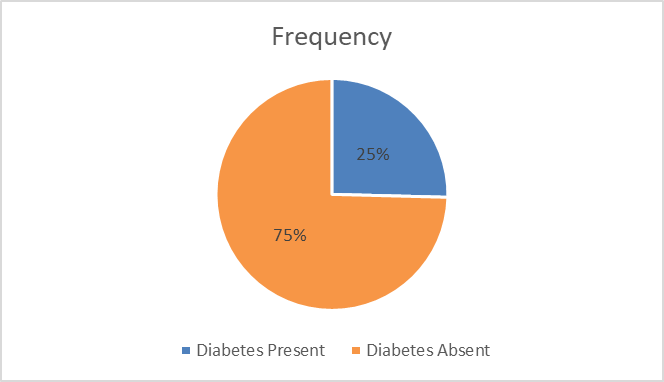
Among the Women with PCOS, the prevalence of diabetes mellitus was n = 32 and among n = 94, it was noted that they were non-diabetic, making up the majority of the sample (Figure 1).
The age group that was mostly represented was that of 26-35 years, making up n = 58 ( 46.0 %). The second most represented age group was that of 18-25 years, with n = 42 (33.3%). The group of participants aged 36-45 years, made up n = 26 (20.6%). In assessing BMI, it was noted that n = 22 (17.5%) had a normal BMI. It was noted that n = 46 (36.5%) were classified as overweight. It was noted that n = 58 (46.0%) were classified as obese. Also of the sample population, n = 64 (50.8%) had diabetes mellitus in the family and n = 72 (57.1%) noted that they lived a sedentary lifestyle (Table 1).
There were n = 32 participants that were noted to be diagnosed with diabetes mellitus, of which n = 22 (68.8%) were classified as obese. It was noted that n = 24 (75.0%) had a positive family history of diabetes mellitus and that n = 25 (78.1%) lived a sedentary lifestyle. It was noted that lifestyle, family history of diabetes mellitus, and obesity were all risk factors that were classified as associated with diabetes mellitus. All had p values of < 0.05 (Table 2).
These findings suggest that obesity, a positive family history of diabetes mellitus, and physical inactivity are important risk factors associated with diabetes mellitus among women with PCOS.
Table 1. Baseline Characteristics of Study Participants (n=126)
|
Variable |
Frequency (n) |
Percentage (%) |
|
18–25 years |
42 |
33.3 |
|
26–35 years |
58 |
46.0 |
|
36–45 years |
26 |
20.6 |
|
Normal BMI |
22 |
17.5 |
|
Overweight |
46 |
36.5 |
|
Obese |
58 |
46.0 |
|
Family History: Yes |
64 |
50.8 |
|
Family History: No |
62 |
49.2 |
|
Active Lifestyle |
54 |
42.9 |
|
Sedentary Lifestyle |
72 |
57.1 |
|
Diabetes Present |
32 |
25.4 |
|
Diabetes Absent |
94 |
74.6 |
Table 2. Association of Risk Factors with Diabetes Mellitus
|
Variable |
Diabetes Present n (%) |
Diabetes Absent n (%) |
p-value |
|
Obese |
22 (68.8) |
36 (38.3) |
0.003 |
|
Overweight |
8 (25.0) |
38 (40.4) |
|
|
Normal BMI |
2 (6.2) |
20 (21.3) |
|
|
Family History Present |
24 (75.0) |
40 (42.6) |
0.001 |
|
Family History Absent |
8 (25.0) |
54 (57.4) |
|
|
Sedentary Lifestyle |
25 (78.1) |
47 (50.0) |
0.005 |
|
Active Lifestyle |
7 (21.9) |
47 (50.0) |
|
Figure 1: Frequency of Diabetes Mellitus among Women with PCOS.
DISCUSSION :
The study focused on the prevalence and risk factors of diabetes mellitus within the polycystic ovarian syndrome (PCOS) population. A fair number of the participants were noted to have diabetes mellitus. The population was observed to have obesity as a risk factor, a positive familial history of diabetes, and a sedentary lifestyle. There is an association of PCOS with insulin resistance, the disruption of glucose metabolism and a greater prevalence of type 2 diabetes mellitus. The metabolic disturbances within women of PCOS are of great significance to the dysglycemia of women within the PCOS population. {9, 10}.
The prevalence of diabetes in this study was also in agreement with the findings of some of the recent international studies, which have shown a lot of women with PCOS suffering from impaired diabetes with an even greater prevalence of type 2 diabetes and an even greater prevalence of impaired glucose tolerance{11}. Some of the previous meta-analyses and systematic reviews have shown that women with PCOS suffer a two to four-fold greater risk of diabetes, compared to the women in the control population. In addition, large cohort studies have shown the metabolic complications of PCOS occur at a younger age. This evidence suggests the use of early diagnosis and preventive measures among this population {12,13}.
Obesity emerged as a significant factor associated with diabetes mellitus for this study. Here, the association makes sense, as the excess adipose tissue increases insulin resistance due to chronic inflammation and disturbance of the adipokine and insulin signaling pathway {14}. In women with PCOS, hyperandrogenism coupled with insulin resistance can increase the risk of developing diabetes and glucose intolerance {15}. Studies have shown that in women with PCOS, insulin resistance and obesity can all worsen metabolic health in unison {16}.
Diabetes mellitus also has a positive family history of developing the disease. There has been evidence of developing type 2 diabetes and PCOS due to a common genetic link {17}. This genetic link may also have an influence on insulin and insulin suppression due to the common lifestyle and environment of the patient {18}. The current investigation also found a meaningful link between sedentary behavior and diabetes mellitus in women who suffer from PCOS. A lack of physical activity is a recognized contributor to diverse illnesses and insulin resistance. Metabolic dysfunction is especially important in the pathology of diabetes. In contrast, consistent exercise improves insulin responses, helps the body process sugars more efficiently, and improves metabolism for women who have PCOS. The research discovered that changing behavior and increasing exercise are essential to preventing and treating diabetes for women who have PCOS. {19,20}A key strength of the current study was the use of PCOS and diabetes mellitus standard diagnostic criteria, as well as the generation of local data from a public sector tertiary care hospital. Evaluation of multiple risk factors provided the opportunity for a more comprehensive examination of the potential determinants of diabetes among women with PCOS. Acknowledging the study’s design, the extent of data collection was limited by the cross-sectional design, and the results may not be generalizable since data were collected from only one center. Furthermore, some lifestyle-related variables were based on participant reporting, which may have resulted in recall bias.
The results of this study are clinically significant. This study suggests that women, particularly those with obesity, a diabetes-positive family history, and those who are sedentary, should have their metabolism assessed regularly as a standard practice. Adaptive measures should be employed to reduce future long-term metabolic and cardiovascular consequences of in this population. The focus of future studies should be on PCOS and diabetes in large, multi-site, ongoing studies to improve the understanding of interrelations and develop better psychosocial, educational, and health promotion prevention strategies. The current study aims to underscore the need to include metabolic evaluation in PCOS treatment and promote lifestyle changes to mitigate future health consequences.
CONCLUSION :
The results of this study are clinically significant. This study suggests that women, particularly those with obesity, a diabetes-positive family history, and those who are sedentary, should have their metabolism assessed regularly as a standard practice. Adaptive measures should be employed to reduce future long-term metabolic and cardiovascular consequences of in this population. The focus of future studies should be on PCOS and diabetes in large, multi-site, ongoing studies to improve the understanding of interrelations and develop better psychosocial, educational, and health promotion prevention strategies. The current study aims to underscore the need to include metabolic evaluation in PCOS treatment and promote lifestyle changes to mitigate future health consequences.
BIBLIOGRAPHY:
1. Teede HJ, Tay CT, Laven JJE, Dokras A, Moran LJ, Piltonen TT, Costello MF, et al. Recommendations from the 2023 International Evidence-based Guideline for the Assessment and Management of Polycystic Ovary Syndrome. Hum Reprod. 2023;38(9):1655-1701.
2. Escobar-Morreale HF. Polycystic ovary syndrome: definition, aetiology, diagnosis and treatment. Nat Rev Endocrinol. 2023;19(6):321-339.
3. Joham AE, Norman RJ, Stener-Victorin E, Legro RS, Franks S, Moran LJ, Boyle J. Polycystic ovary syndrome. Lancet Diabetes Endocrinol. 2022;10(9):668-680.
4. Kakoly NS, Khomami MB, Joham AE, Cooray SD, Misso ML, Norman RJ, Harrison CL, et al. Diabetes mellitus risk in women with polycystic ovary syndrome: a systematic review and meta-analysis. Hum Reprod Update. 2021;27(2):279-297.
5. Couto Alves A, Valcarcel B, Mäkinen VP, Morin-Papunen L, Sebert S, Kangas AJ, et al. Metabolic profiling of polycystic ovary syndrome and glucose dysregulation. J Clin Endocrinol Metab. 2022;107(5).
6. Lim SS, Hutchison SK, Van Ryswyk E, Norman RJ, Teede HJ, Moran LJ. Insulin resistance in polycystic ovary syndrome: epidemiology, pathogenesis and management. Clin Endocrinol (Oxf). 2022;96(5):587-596.
7. International Diabetes Federation. IDF Diabetes Atlas. 10th ed. Brussels: International Diabetes Federation; 2021.
8. Basit A, Fawwad A, Qureshi H, Shera AS, NDSP Members. Prevalence of diabetes, pre-diabetes and associated risk factors in Pakistan: National Diabetes Survey of Pakistan. BMJ Open. 2022;12.
9. Teede HJ, Tay CT, Laven JJE, Dokras A, Moran LJ, Piltonen TT, Costello MF, et al. Recommendations from the 2023 International Evidence-based Guideline for the Assessment and Management of Polycystic Ovary Syndrome. Hum Reprod. 2023;38(9):1655-1701.
10. Joham AE, Norman RJ, Stener-Victorin E, Legro RS, Franks S, Moran LJ, Boyle J. Polycystic ovary syndrome. Lancet Diabetes Endocrinol. 2022;10(9):668-680.
11. Kakoly NS, Khomami MB, Joham AE, Cooray SD, Misso ML, Norman RJ, Harrison CL, et al. Diabetes mellitus risk in women with polycystic ovary syndrome: a systematic review and meta-analysis. Hum Reprod Update. 2021;27(2):279-297.
12. Persson S, Elenis E, Turkmen S, Kramer MS, Yong EL, Sundström-Poromaa I. Risk of type 2 diabetes in women with polycystic ovary syndrome: a population-based cohort study. BMJ Open Diabetes Res Care. 2022;10(1).
13. Glintborg D, Rubin KH, Nybo M, Abrahamsen B, Andersen M. Cardiometabolic morbidity and diabetes in women with polycystic ovary syndrome: a nationwide cohort study. Clin Endocrinol (Oxf). 2021;95(3):475-483.
14. Barber TM, Hanson P, Weickert MO, Franks S. Obesity and polycystic ovary syndrome: implications for pathogenesis and management. Lancet Diabetes Endocrinol. 2022;10(9):652-664.
15. Escobar-Morreale HF. Polycystic ovary syndrome: definition, aetiology, diagnosis and treatment. Nat Rev Endocrinol. 2023;19(6):321-339.
16. Lim SS, Hutchison SK, Van Ryswyk E, Norman RJ, Teede HJ, Moran LJ. Insulin resistance in polycystic ovary syndrome: epidemiology, pathogenesis and management. Clin Endocrinol (Oxf). 2022;96(5):587-596.
17. Day FR, Hinds DA, Tung JY, Stolk L, Styrkarsdottir U, Saxena R, et al. Genetic architecture of polycystic ovary syndrome and metabolic disease. Nat Commun. 2021;12(1):6050.
18. Dapas M, Lin FTJ, Nadkarni GN, Sisk R, Legro RS, Urbanek M. Genetic and familial determinants of metabolic dysfunction in polycystic ovary syndrome. J Clin Endocrinol Metab. 2022;107(8).
19. Moran LJ, Gibson-Helm M, Teede HJ, Deeks AA. Lifestyle interventions in women with polycystic ovary syndrome and metabolic risk: an evidence-based review. Nutrients. 2021;13(11):3895.
20. Greenwood EA, Pasch LA, Cedars MI, Legro RS, Huddleston HG. Exercise and metabolic outcomes in women with polycystic ovary syndrome: contemporary evidence review. Fertil Steril. 2023;119(2):250-259.