Impact of COVID-19 on the teaching-learning process: Perceptions of undergraduate dental students
- Dalvinder Singh , Professor, Department of Anatomy.
- Rana Noor , Professor, Department of Biochemistry, Faculty of Dentistry, Jamia Millia Islamia, Delhi – 110025.
- Alpana Goel Kesar , Reader and Head, Faculty of Dental Sciences, Manav Rachna International Institute of Research and Studies, Faridabad-121004 (Haryana).
- Poonam Patnaik , Professor, Department of Anatomy.
Article Information:
Abstract:
COVID-19 is a newly identified infectious disease caused by a virus called severe acute respiratory syndrome coronavirus 2 (SARS-CoV-2). In order to minimize the spread of this virus, the lockdown has been implemented. As various organizations have been shut down in accordance with the lockdown, the lives of every citizen, including students in the country, have been largely affected. This transition in education from conventional classroom learning to computer-based learning may be one of the biggest educational experiments to date. As the online teaching-learning process has become more prevalent in India, it is important to know its growth and to know whether it is actually helping students achieve what they expect from college. The present study was therefore designed to understand the student's perspective, attitudes, and willingness to study online classes at the university level. During the quarantine, the data was collected by means of an online survey involving 143 respondents using a questionnaire. The objectives of the online survey are to gather data on student expectations and needs for distance learning; to recognize issues and provide stakeholders with data in order to further strengthen the process of distance learning.
Keywords:
Article :
INTRODUCTION:
In human history, a number of major pandemics have been identified, impacting human life and economic growth. Such outbreaks have prompted scientists and policymakers to be concerned about the extent of the devastation of these outbreaks on the world economy and education. After the first case occurred in Wuhan, Hubei province, China, at the end of December 2019, the coronavirus outbreak (COVID-19) has become an international concern. The term 2019 novel coronavirus (2019-nCoV) was used to refer to the coronavirus by the World Health Organization (WHO).This disease is highly contagious and can be easily transmitted from one person to another via the respiratory droplets and through various contact routes, such as hands, nose, and mouth. Transmission by droplets can occur when an infected person is in close proximity (within 1 m) to a normal individual. Infection can also be spread by items such as utensils and clothing used by an infected individual [1-3].The number of cases has increased exponentially, spreading across the globe. Around 211 countries in the world have been affected by the pandemic, affecting 36,237,403 individuals and claiming 1,054,868 lives worldwide. India is not left behind and registers 6,906,151 cases and nearly 106,490 deaths [4, 5].
In order to suppress the progress of the outbreak and buy time for research and vaccine development, a group of epidemiologists supported the shutdown of educational institutions [6, 7].Like any other individual, the life of the student is also affected. Owing to this devastating pandemic, it is difficult to ensure consistent and uninterrupted education at this time of crisis. According to UNESCO monitoring, more than 100 countries have implemented nationwide closure, affecting almost 90 % of the world's student population [8].
The lives of every person in the country have been largely affected, as various organisations have been shut down in compliance with the directives of the Honourable Prime Minister of India, Shri Narendra Modi Ji. As the nation pursued quarantine and lock-down measures, all educational institutions were forced to take classes online, which will possibly prevent COVID-19 from spreading. This has resulted in a transition from traditional classroom teaching to technology-based online teaching.
The advantages of distance learning are mentioned by many researchers and include accessibility, freedom to learn at one's own pace, a seamless schedule, convenience of time and space, significant cost savings, less use of paper, etc. In addition to the many advantages, there are also challenges faced by faculty members and students in the online mode of teaching and learning [9-13].Understanding its advantages and drawbacks will allow educational institutions to enhance the distance learning process, since no other alternative is available due to quarantine. In addition, it was vitally important to get input from students in order to understand what is actually going on in education and to find out about the issues they have faced during distance learning.
Therefore, the present study was conducted to assess the perspective, attitudes and readiness of the student to pursue online classes at the university level. This will provide data to stakeholders to further improve the distance learning process.
Material and Methods:
An online survey on the features of distance learning during the quarantine caused by the spread of COVID-19 was conducted during the period from 01 to 10 August, 2020.The questionnaire was prepared in the form of Google docs and the link was sent to the students via email and social media platforms. A total of 143 first year students from Faculty of Dentistry, Jamia Millia Islamia, Delhi and Manav Rachna International Institute of Research and Studies, Faridabad (Haryana), participated in the study. It should be noted that respondents were already aware of digital technologies and responded to the questionnaire on the basis of their own experience. The survey was conducted online on the basis of anonymity and confidentiality criteria, and the data collected was analysed and the results reported.
Result and Discussion:
The spread of the coronavirus has been effectively slowed down by several nations by taking drastic steps, including restricting public meetings and shutting down educational institutions until further notice. While the closure of educational institutions is an effective way to reduce the spread of the virus, it has posed its own challenges, especially in developing countries such as India. In the midst of a pandemic when students stay out of college, most educational institutions resort to e-learning, which replaces regular interaction with a teacher in a physical classroom with a virtual classroom through the use of the internet and technical devices such as phones , computers and tablets. Due to the precautionary social distance measures outlined by the World Health Organization (WHO) as a way of containing the spread of the virus from individual to individual, 143 BDS Ist Year students were sampled for analysis using an online survey technique.
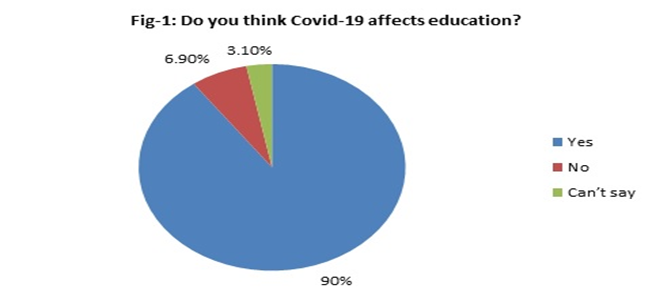
According to our study, 90% of students believe that the lockdown has an impact on their education, 6.9% say it has no impact, and 3.1% are neutral.
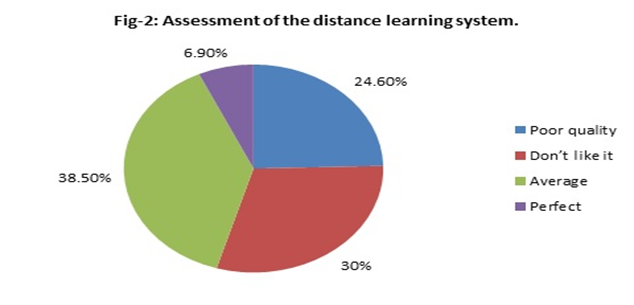
Very few students (6.9%) were pleased when asked about the quality of distance learning, while 38.5% viewed it as average, 24.6% as low quality, and 30% did not like it. As new technologies have changed the way students interact with teachers and peers, it is worth exploring student satisfaction, a key indicator of the quality of teaching experience, on digital platforms [14-16].
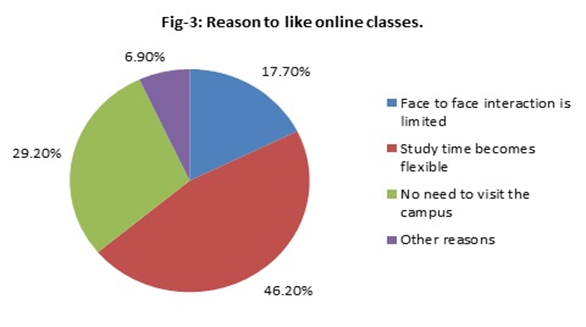
Students can learn from the comfort of their living rooms with a library of resources only a click away. In most cases, there is no transportation, no costly books to purchase and no on-site accommodation to budget for. In the present study with online classes, "study time becomes flexible" (46.2%) was the most common explanation for students who like online classes. The above-mentioned explanation was followed by no need to visit the campus (29.2%), face to face interaction becomes limited (17.7%) and other miscellaneous reasons (6.9%). The results are shown in Figure 3. By comparing the results of the time students take part in distance learning, the authors conclude that the amount of time for independent learning for students has increased compared to the conventional learning process.
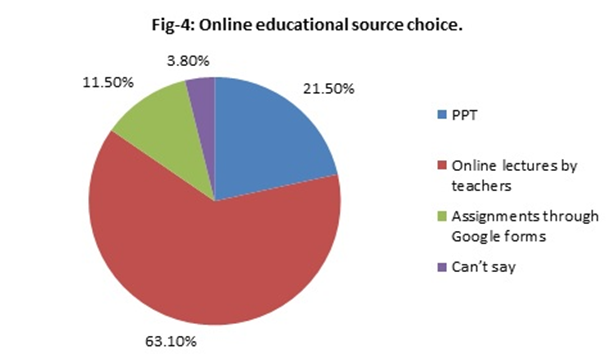
There are various means available by which online teaching can be carried out effectively. After analysing the results, "online lectures by teachers (63.1%)" was the most popular source of the online classes listed by students, followed by PPT (21.5%), assignments via Google forms (11.5%), as shown in Figure 4.The majority of students believe that if teachers take lessons online, it will be more advantageous because students have become used to their teaching skills so that students can understand them.
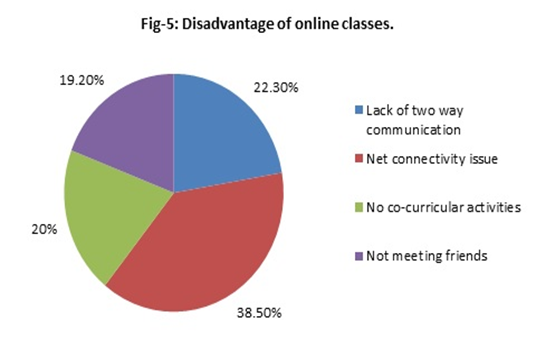
Traditional classrooms have one or more instructors and peers who may hold a student accountable for their work, whereas online courses, by contrast, include setting our own goals, tracking progress and meeting deadlines. Certain issues have been established that could possibly play a detrimental role for students when it comes to online classes. The most frequently mentioned problem with online class was net connectivity issue (38.5%), followed by lack of two-way communication (22.3%), no co-curricular activities (20%), and not meeting friends (19.2%).The reasons mentioned above are depicted in Figure 5.Studies have shown that interaction with emotional and social support between facilitator, learner and study material are critical ingredients for successful learning[17-19].Internet accessibility problems have often adversely affected learning by online modalities, however, simply enhancing the Internet package / speed would help to resolve this. The government should also take decisive measures and telecommunications companies should invest in the nation-wide expansion of their networks.
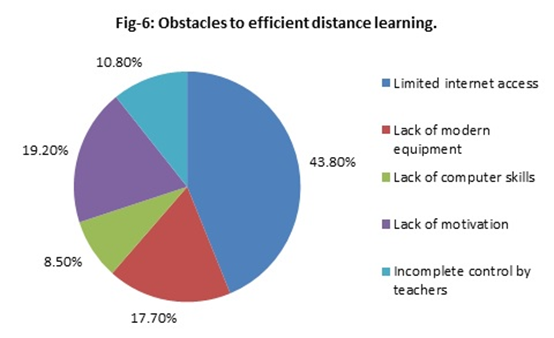
The respondents identified the following among the main obstacles to distance learning in quarantine: limited internet access at 43.8%, lack of modern equipment at 17.7%, lack of computer skills at 8.5%, lack of motivation at 19.2%, incomplete teacher control at 10.8%. The transition to online education has ensured that students do not lose their education and their progress is monitored concurrently with timely assessment. It is probably the first time that India has experimented with the education system and made a paradigm change to the virtual world, integrating classrooms with online learning. A computer or laptop and a safe internet connection are required for online classes. Not all students have access to these types of resources, whether for financial or other reason, which could put them at a disadvantage compared to their classmates. In this unwanted crisis era, lack of electricity and poor internet connectivity further exacerbates the digital learning process problem. Ironically, the reality is that only 48.1 crore people in our country's total population have access to the internet and therefore to e-learning [20]. However universities and the Government of India are constantly trying to find a solution to this problem, as the efficacy of distance learning starts at a point where a reliable method of communication is established [21].
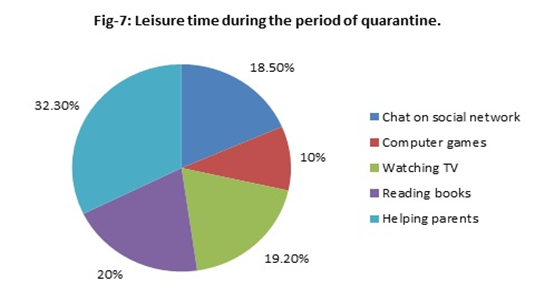
During busy college life, students may not have enough time to speak to their families and spend quality time with them. While being in the quarantine period, institutions conduct virtual classes, students now have no other choice but to spend their time at home. The majority of students (32.3%) support their parents with different household chores. Whereas 20% read books, 19.2% watch television and 28.5% spend time either on social networks or on video games, as shown in Figure 7.
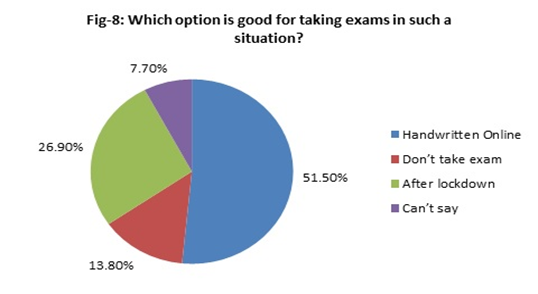
The majority of students (51.5%) suggest that the examination should be conducted online in order to minimise the infection of the corona virus. Whereas 26.9% of students agree that after the lockdown, the examination should be taken, and 13.8% of students say that it should not be conducted.
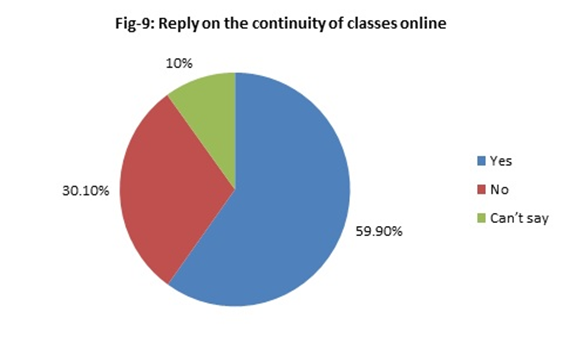
A good number of students (59.90%) prefer the online continuity mode of teaching, based on the data collected, and the same is shown in Figure 9.Online learning is a flexible and effective means of teaching and learning, since most students agree that it enables remote learning with ease of administration and accessibility, with less use of resources and time. Students can conveniently access learning materials irrespective of the time limit. This versatility over face -to- face teaching has also been documented in the literature [22].Students also become self-directed learners, an important competency among health professionals for promoting lifelong learning [23, 24].
CONCLUSION :
After taking the opinion of the students, it is stated that Lockdown has a definite effect on education. The present study promotes the use of e-learning in institutes, as it facilitates student-centered learning and is easily manageable in this situation of lockdown. It is worth considering here that online learning is currently at an evolving stage in India. There is a need to educate faculty on the use of online modalities and to build a learning plan with reduced cognitive load and increased interactivity. What we now perceive is that integrated learning with ‘face-to-face classrooms and virtual lessons’ will be the future of education that will provide our students with engaging and meaningful learning experiences.
Acknowledgement: For their time and contributions, the authors would like to acknowledge the participants.
Conflict of interest: None.
BIBLIOGRAPHY:
1. Li Q, Guan X, Wu P, Wang X, Zhou L, Tong Y. Early transmission dynamics in Wuhan, China, of novel corona virus-infected pneumonia. N Engl J Med 2020; 382:1199-1207.
2. Liu J, Liao X, Qian S, Yuan J, Wang F, Liu Y, et al. Community Transmission of Severe Acute Respiratory Syndrome Coronavirus 2. Emerg Infect Dis 2020; 26(6):1320-1323.
3. Ong SWX, Tan YK, Chia PY, Lee TH, Ng OT, Wong MSY, et al. Air, surface environmental, and personal protective equipment contamination by severe acute respiratory syndrome coronavirus 2 (SARS-CoV-2) from a symptomatic patient. JAMA 2020; 323(16):1610-1612.
4. Lai CC, Shih TP, Ko WC, Tang HJ, Hsueh PR. Severe acute respiratory syndrome coronavirus 2 (SARS-CoV-2) and corona virus disease-2019 (COVID-19): the epidemic and the challenges. Int J Antimicrob Agents 2020; 55(3):105924.doi:10.1016/j.ijantimicag.2020.105924.
5. World Health Organization 2020.Coronavirus. Geneva.
6. Ferrel MN, Ryan J. The impact of COVID-19 on medical education. Cureus 2020; 12(3). e7492. doi:10.7759/cureus.7492
7. Ahmed H, Allaf M, Elghazaly H. COVID-19 and medical education. Lancet Infect Dis 2020; 20(7): 777-778.
8. UNESCO. (2020, March 29). Retrieved from UNESCO web site: https://en.unesco.org/covid19/educationresponse.
9. Carnevale D. Study Assesses What Participants Look for in High-Quality Online Courses. Chron High Educ 2000; 47(9): A46 - A46.
10. Dutton J, Dutton M, Perry J. 2002. How do online students differ from lecture students. JALN 2002; 6(1):1–20.
11. Palloff RM, Pratt K. The virtual student: A profile and guide to working with online learners. ISBN: 978-0-787-96474-0, Jossey-Bass, San Francisco, CA 94103-1741: March 2003,
12. Howell SL, Williams PB, Lindsay NK. Thirty-two trends affecting distance education: An informed foundation for strategic planning. OJDLA 2003; 6(3):1–18.
13. Sadeghi M. A shift from classroom to distance learning: Advantage and limitations. Int J Res Eng Educ 2019; 4(1): 80-88.
14. Moore MG, Kearsley G. Distance education: A systems view. New York, Wadsworth publishing company: 1996.
15. Yukselturk E, Yildirim Z. Investigation of interaction, online support, course structure and flexibility as the contributing factors to students’ satisfaction in an online certificate program. J Educ Techno Soc 2008; 11(4): 51-65.
16. Kaminski K, Switzer J, Gloeckner G. Workforce readiness: A study of university students’ fluency with information technology. Comput Educ 2009; 53(2): 228-233.
17. Wang SL, Wu PY. The role of feedback and self-efficacy on web-based learning: The social cognitive perspective. Comput Educ 2008; 51(4):1589-1598.
18. Bernard RM, Abrami PC, Borokhovski E, Wade CA, Tamim RM, Surkes MA, et al. A meta-analysis of three types of interaction treatments in distance education. Rev Educ Res 2009; 79(3):1243-1289.
19. Kruger J, Dunning D. Unskilled and unaware of it: how difficulties in recognizing one’s own incompetence lead to inflated self-assessments. J Pers Soc Psychol 1999; 77(6):1121-34.
20. IAMAI-Kantar IMRB. 2018. Internet in India 2017. https://cms.iamai.in/Content/ResearchPapers/15c3c84c-128a4ea9-9cf2-a50a6d18f21c.pdf.
21. Keles MK, Ozel SA. A review of Distance Learning and Learning Management Systems. 2016; Retrieved from:https://www.intechopen.com/books/virtual-learning/a-review-of-distance-learning-and-learning-management-systems.https://doi.org/10.5772/65222.
22. Keis O, Grab C, Schneider A, Ochsner W. Online or face-to-face instruction? A qualitative study on the electrocardiogram course at the University of Ulm to examine why students choose a particular format. BMC Med Educ 2017; 17(1):194. doi: 10.1186/s12909-017-1053-6.
23. Kim KJ, Jang HW. Changes in medical students’ motivation and self-regulated learning: a preliminary study. Int J Med Educ 2015; 6:213-15.
24. Lucieer SM, Jonker L, Visscher C, Rikers RM, Lucieer SM. Self-regulated learning and academic performance in medical education Self-regulated learning and academic performance in medical education. Med Teach 2016; 38(6):585-593.