A PROSPECTIVE COMPARATIVE STUDY BETWEEN TUMESCENT AND CONVENTIONAL DISSECTION OF CALOT TRIANGLE IN LAPAROSCOPIC CHOLECYSTECTOMY AT A TERTIARY CARE HOSPITAL IN GANGTOK SIKKIM
- Mahima , MBBS, DNB General Surgery, department of general surgery, Sikkim Manipal Institute of Medical Sciences, Gangtok, Sikkim.
- Kumar Nishant , MBBS, DNB General Surgery, department of general surgery, Sikkim Manipal Institute of Medical Sciences, Gangtok, Sikkim.
- Shah Ashveta Umesh , MBBS, DNB General Surgery, department of general surgery, Sikkim Manipal Institute of Medical Sciences, Gangtok, Sikkim.
- Yashwanth N , MBBS, DNB General Surgery, department of general surgery, Sikkim Manipal Institute of Medical Sciences, Gangtok, Sikkim.
Article Information:
Abstract:
The gallbladder is a partially intraperitoneal structure that lies attached to the undersurface of the liver on segments IVB and V.AIM: The objective of the study is to compare the duration of the surgery between tumescent or conventional dissection of Calot’s triangle dissection during laparoscopic cholecystectomy. METHODOLOGY: The study was conducted in the Department of General Surgery at Central Referral Hospital, a 500-bedded tertiary care teaching hospital associated with Sikkim Manipal Institute of Medical Sciences. RESULT: The tumescent laparoscopic cholecystectomy group demonstrated significantly easier and faster dissection of Calot’s triangle compared to the conventional group, although the overall duration of surgery, intra-operative blood loss, adhesions, gallbladder perforation, bile spillage, and other intra-operative parameters showed no statistically significant differences between the two groups.The study findings suggest that the tumescence technique improves operative ease during Calot’s triangle dissection without increasing intra-operative or post-operative complications, despite some degree of anatomical distortion observed intra-operatively.CONCLUSION: The use of tumescence in laparoscopic cholecystectomy significantly facilitated and reduced the duration of Calot’s triangle dissection, although it caused some distortion of the local anatomy without affecting the overall operative time. Further large-scale studies are required to validate the effectiveness and safety of the tumescence technique in improving surgical dissection during laparoscopic cholecystectomy.
Keywords:
Article :
INTRODUCTION:
The gallbladder is a partially intraperitoneal structure that lies attached to the undersurface of the liver on segments IVB and V1. It is 7 to 10 cm in length, holds 30 to 60 mL of bile as a reservoir, and is divided into neck, infundibulum with Hartmann pouch, body, and fundus.2 On the side of the gallbladder that is attached to the liver, there is no peritoneal covering; a fibrous lining known as the cystic plate occupies this space. Bile is drained via a cystic duct to the common bile duct (CBD). The gallbladder is being suspended by the fundus to expose the infundibulum and porta hepatis3. Cholelithiasis is the most common disease of gallbladder and biliary tree, affecting 10% to 15% of the population. Similarly, Sikkim also has a high prevalence of cholelithiasis.1 Gallstones are generally classified into two major subtypes, cholesterol and pigment stones, depending on the principal solute that precipitates into a stone.4 Four major factors explain most gallstone formation: supersaturation of secreted bile, concentration of bile in the gallbladder, crystal nucleation, and gallbladder dysmotility. The three types of gallstones, cholesterol stones, pigment stones and mixed stones, have different pathophysiology of development. Inadequate contraction of gall bladder or dysfunctional sphincter of Oddi can contribute to suboptimal bile flow and produce transient stasis, prompting stone formation. Gall stones are often asymptomatic but become symptomatic when they obstruct a visceral structure such as a cystic duct.5 However, gallstones often remain asymptomatic, only found incidentally on imaging. Cholecystectomy laparoscopic is the treatment of choice for gallstone disease. Laparoscopic cholecystectomy, first done by Muhe in 1985 (using a direct scope) and later in 1987 by Mouret, is one of the most performed general surgery procedures6. Laparoscopic cholecystectomy has a 0.1% to 0.5% mortality and 2% to 3% morbidity. Laparoscopic surgery results in smaller incisions, less pain, and shorter hospitalization when compared to traditional open cholecystectomy, which has significantly increased the number of these procedures done worldwide. Use of saline Tumescent in the dissection of calot’s triangle has been shown to result in decreased duration of surgery than the conventional technique7.One of the most important among these is meticulous confirmation of Strasberg's critical view of safety. But this can only be achieved after the dissection of the Calot’s triangle has been completed.The dissection of the Calot’s triangle can be hazardous and difficult in several cases8. To minimize this, surgeons use various combinations of sharp and blunt dissection techniques using a plethora of techniques, instruments and power sources. Electro-surgery, ultrasonic dissection and hydro-dissection are a few of these techniques9. But this has never been attempted for surgeries of the extra-hepatic biliary apparatus, especially cholecystectomy. Thus, the current study was planned not only to evaluate the feasibility of this technique but also compare it to the conventional method of dissection10.
AIM
The objective of the study is to compare the duration of the surgery between tumescent or conventional dissection of Calot’s triangle dissection during laparoscopic cholecystectomy.
Material And Methods:
The study was conducted in the Department of General Surgery at Central Referral Hospital, a 500-bedded tertiary care teaching hospital associated with Sikkim Manipal Institute of Medical Sciences. It is the only teaching hospital in the north-eastern state of Sikkim. The study duration was one year and six months, from June 2022 to December 2023. A prospective randomized comparative study design was adopted. All patients undergoing laparoscopic cholecystectomy during the study period were invited to participate. Patients who provided informed consent were included in the study and randomized accordingly.The inclusion criteria comprised patients undergoing elective laparoscopic cholecystectomy. Exclusion criteria included patients unwilling to provide consent for participation, any deviation from the planned procedure, patients presenting with jaundice, difficult cholecystectomy cases classified as Cuschieri scale grades 3 and 4 or Nassar scale grade 4, patients diagnosed with gallbladder malignancy either pre-operatively or post-operatively, and pregnant patients.ts
RESULT :
Table 1: Demographic data of patients Age
|
Mean age (years) |
Conventional group |
Tumescent group |
p-value (Independent t-test) |
|
37.22±10.22years |
39.76±13.27 |
0.306 |
|
|
Gender |
|
|
|
|
Male |
6 |
8 |
0.562 |
|
Female |
40 |
38 |
The mean age of patients in the conventional laparoscopic cholecystectomy group was comparable to that of the tumescent laparoscopic cholecystectomy group (37.22 ± 10.22 years vs. 39.76 ± 13.27 years; p=0.306), with no statistically significant difference observed (p>0.05). A total of 14 males and 78 females were included in the study, with male-to-female ratios of 0.15:1 in the conventional group and 0.21:1 in the tumescent group.
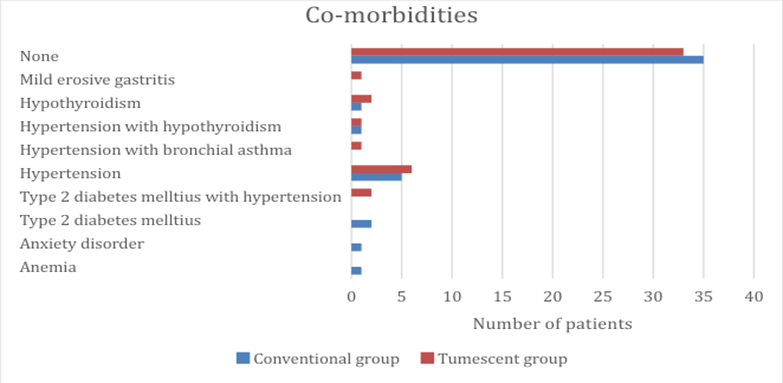
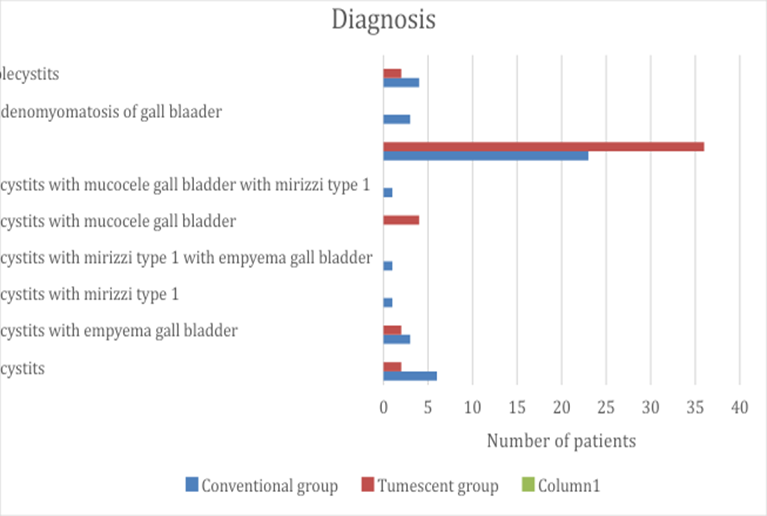
Chart 1,2- Bar chart showing comorbidities distribution and diagnosis in the study groups
The comorbidities observed in the study included diabetes mellitus, hypertension, anaemia, anxiety disorder, hypothyroidism, bronchial asthma, and mild erosive gastritis. Among the 92 patients, 68 had no comorbidities, while hypertension was the most common comorbidity, accounting for 13.9% of the study population with associated illnesses.The most common diagnosis in both the conventional laparoscopic cholecystectomy group and the tumescent laparoscopic cholecystectomy group was cholelithiasis, accounting for 25% and 39.13% of cases respectively.
Table 2:Laboratory investigations
|
Laboratory parameter |
Mean in conventional group |
Mean in tumescent group |
p-value (Independent t-test) |
|
1. Hemoglobin(gm/dl) |
12.804±1.563 |
12.800±1.670 |
0.990 |
|
2.White blood cells(x10^3) |
7.192±1.818 |
6.525±1.774 |
0.078 |
|
3.Total bilirubin(mg/dl) |
0.709±0.325 |
0.69±0.337 |
0.871 |
|
4.Alkaline phosphatase(U/L) |
103.33±29.580 |
105.3±36.137 |
0.768 |
The mean haemoglobin levels, total leukocyte count, serum total bilirubin, and alkaline phosphatase values were comparable between the conventional and tumescent laparoscopic cholecystectomy groups, with no statistically significant differences observed (p>0.05).
Table 3:Intra-operative blood loss and Total duration of surgery
|
Intra-operative blood loss |
Mean in conventional group |
Mean in tumescent group |
|
11.30±21.33 |
8.20±8.041 |
|
|
Duration of surgery |
65.04±27.238 |
63.50±22.363 |
|
Calot’s triangle dissection duration |
18.65±6.447 |
15.96±4.633 |
The average estimated blood loss and mean duration of surgery were lower in the tumescent laparoscopic cholecystectomy group compared to the conventional group; however, these differences were not statistically significant (p>0.05). In contrast, the mean duration of Calot’s triangle dissection was significantly shorter in the tumescent group (15.96 ± 4.633 minutes) compared to the conventional group (18.65 ± 6.447 minutes), with a statistically significant p-value of 0.024.
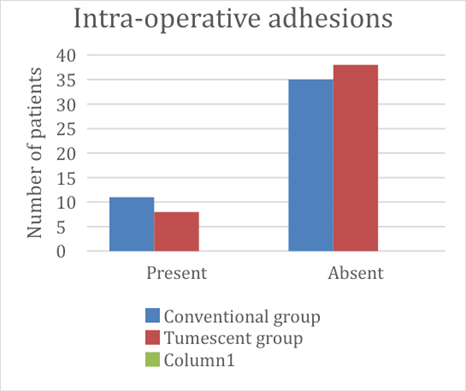
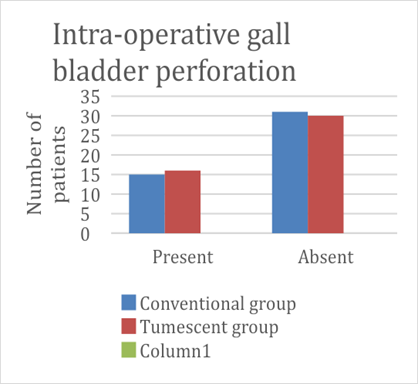
Chart 3,4 -Bar chart showing intra-operative adhesions and gall bladder perforation in study groups.
Among the 92 study participants, intra-operative adhesions were observed in 19 patients, while the remaining 73 patients had no adhesions, with no statistically significant difference between the conventional and tumescent laparoscopic cholecystectomy groups (p>0.05). Similarly, intra-operative gallbladder perforation was noted in 31 participants (33.69%), and comparison between the two groups showed no statistically significant difference (p>0.05).
Table 4:Intra-operative bile and stone spillage
|
Intra-operative bile spillage |
Number of conventional group cases |
Number of tumescent group cases |
p-value(χ²-test) |
|
Present |
13 |
12 |
0.815 |
|
Absent |
33 |
34 |
|
|
Intra-operative stone spillage |
|
|
|
|
Present |
5 |
1 |
0.091 |
|
Absent |
41 |
45 |
In the study group of 92 participants, 25 participants were found to have intra-operative bile spillage (27.17%). In certain instances, perforation may be controlled without bile spillage. p>0.05 means that the difference is insignificant.
In the study group of 92 participants, there was only one spillage in the tumescent group, compared to 5 in the conventional group, this difference was statistically insignificant with a p>0.05.
Table 5:Distortion of Calot’s triangle anatomy
|
Distortion of Calot’s triangle anatomy |
Mean in conventional group |
Mean in tumescent group |
|
4.43±1.088 |
4.96±1.54 |
Based on the Linkert scale values, the mean value of distortion of Calot’s triangle anatomy in the conventional group was 4.43±1.088 and 4.96±1.54 in the tumescent group. The difference was statistically significant with a p-value of 0.028.
Table 6:Post-operative nausea,vomiting,Post-operative abdominal pain
|
Number of patients in groups |
1hour |
8hour |
24hour |
|
Nausea in conventional group |
1 |
11 |
0 |
|
Nausea in tumescent group |
2 |
6 |
1 |
|
Vomiting in conventional group |
2 |
9 |
0 |
|
Vomiting in tumescent group |
2 |
6 |
0 |
|
Mean patient with abdominal pain in conventional group (VAS) |
6.28±0.911 |
5.70±1.297 |
4.11±0.948 |
|
Mean patient with abdominal pain in tumescent group (VAS) |
6.13±0.885 |
5.35±1.178 |
4.28±0.720 |
In this study of 92 participants, 3,17 and 1 participants experienced nausea at 1,8 and 24 hours with a p-value more than 0.05. 4 and 15 participants experienced vomiting at 1 and 8 hours with a p-value more than 0.05 Pain experienced by the patients in the post-operative period was evaluated using a visual analog chart at 1,8 and 24 hours after surgery. There was a significant difference in the pain experienced by the patients in the two groups at 1,8 and 24 hrs. P-value was found to be insignificant.
Table 7:Day of discharge
|
Post-operative day of discharge |
Number of conventional group cases |
Number of tumescent group cases |
p-value(χ²-test) |
|
1st |
19 |
26 |
0.237 |
|
2nd |
26 |
18 |
|
|
3rd |
1 |
2 |
Most of the patients were discharged from the Hospital within 2 days of the surgery. 48.91% patients were discharged on the first post-operative day, 47.82% were discharged on the second post-operative day and 3.26% were discharged on the third post-operative day. The difference across the two groups was deemed statistically insignificant with a p-value of 0.237.
DISCUSSION :
The mean age of this study population was 37.22 and 39.76 years in group 1 and 2 respectively, which was not significant, this finding is also similar to the previous study conducted in our hospital where the mean age was 37.09 years. The male to female ratio was 0.15:1 and 0.21:1 in group 1 and 2 respectively. This also aligns with the well-established predominance of gallstone disease in females, attributed to estrogenic activity that increases cholesterol concentration in bile, leading to stone formation.
The co-morbidities observed in the study population were documented, with hypertension being the most prevalent, followed by diabetes mellitus and hypothyroidism. Prior research has shown a connection between diabetes mellitus, dyslipidaemia, metabolic syndrome, and gallstone disease. A study from North India identified gallstone disease as a lifestyle disorder, establishing its association with diabetes mellitus, hypertension, and hypercholesterolemia. Additionally, recent studies have indicated that hypothyroidism can lead to secondary hypercholesterolemia, thereby increasing the risk of gallstone formation. No similar studies were done in the past which could evaluate the comparison of pre-operative parameters like haemoglobin, total leukocyte count, serum bilirubin and alkaline phosphatase in tumescent cholecystectomy laparoscopic. The difference was not significant in pre-operative blood and USG abdomen parameters in this study.
In this study, we compared our findings with those from other surgical fields where tumescence has been applied successfully. In the discussion section of our thesis, we observed a statistically significant difference in the ease of calot’s triangle dissection between the two groups with a Linkert scale score of 4.59 in group 1 and 6.59 in group 2. This finding suggests that the technique applied to group 2 had a notable impact on the dissection process. It was noted that while the tumescence group benefited from an easier dissection process, there was a corresponding increase in the distortion of Calot’s triangle anatomy with p value of 0.028. This distortion is a significant finding as it may complicate the identification of crucial structures during surgery, potentially increasing the risk of complications but there was no statistically significant complication noted in our study groups intra-operatively and post-operatively. The ease of dissection in the tumescence group weighed against the potential drawback of anatomical distortion with a p-value of 0.177 on comparison of distortion of anatomy and the ease of dissection of Calot’s triangle. Further research is recommended to explore techniques that can mitigate these distortions while maintaining ease of dissection. General Surgery Lubna H.11 demonstrated that hydro-dissection using a suction irrigation probe is a safe and effective technique for clearing difficult anatomy in Calot’s triangle, with improved delineation of crucial anatomical structures. Rethinasamy et al.12 demonstrated the successful application of the tumescent technique in the excision of refractory arteriovenous malformations. Vascular Surgery The study reported that the use of tumescence eliminated the need for preoperative embolization and drastically reduced intra-operative blood loss, thereby facilitating safer surgical excision with improved operative outcomes.
In comparison it was noted that the total duration of surgery did not show statistically significant difference between the two groups with total time of 65.04 minutes and 63.50 minutes in conventional and tumescent groups respectively. While on the other hand there was a statistically significant reduction in the duration of Calot’s triangle dissection in the tumescent group with a p -value of 0.024. The mean duration of Calot’s triangle dissection was 18.65 in the conventional group and 15.96 minutes in the tumescent group. This suggests that the tumescence technique specifically enhances efficiency in the dissection of a calot's triangle, even though it does not affect the overall duration of surgery. Intra-operative adhesions noted in 23.92% in Group 1 and 17.39% in Group 2.
Intra-operative cuschieri difficulty grade was 1 in 50% group 1 and 67.39% in group 2, cuschieri grade 2 was noted in 50% group 1 and 32.60 group 2 participants respectively.
Intra-operative gall bladder perforation and bile spillage were 32.60% and 34.78%, 28.26% and 26.08% in group 1 and 2 respectively. Stone spillage was present in 10.86% and 2.17% in group 1 and 2 respectively.
Intra-operative mean blood loss was 11.30ml and 8.20ml in group 1 and 2 respectively.
There was no statistically significant difference noted between the two groups.
CONCLUSION :
Based on the findings of this study, it was observed that the use of tumescence significantly facilitated the dissection of Calot's triangle. However, there was a noted distortion of the anatomy of Calot's triangle upon visualization following the application of tumescence. The study indicated that the instillation of tumescence in the sub-serosal plane of Calot's triangle resulted in a considerable reduction in the time required to dissect this anatomical area. Despite this improvement, the total duration of the procedure remained unaffected. But further studies need to be done with a larger sample size to validate this.
BIBLIOGRAPHY:
1. Kotwal MR, Rinchen CZ. Gallstone disease in the Himalayas (Sikkim and North Bengal): causation and stone analysis. Indian J Gastroenterol [Internet]. 1998 [cited 2018 May 26];171. Kotwa(3):87–9. Available from: http://www.ncbi.nlm.nih.gov/pubmed/9695387
2. Lee SP, Park HZ, Madani H, Kaler EW. Partial characterization of a nonmicellar system of cholesterol solubilization in bile. Am J Physiol Gastrointest Liver Physiol [Internet]. 1987 [cited 2020 Oct 28];252(3 (15/3)). Available from: https://pubmed.ncbi.nlm.nih.gov/3826377/
3. Groen AK, Noordam C, Drapers JAG, Egbers P, Jansen PLM, Tytgat GNJ. Isolation of a potent cholesterol nucleation‐promoting activity from human gallbladder bile: Role in the pathogenesis of gallstone disease. Hepatology [Internet]. 1990 [cited 2020 Oct 30];11(4):525–33. Available from: https://pubmed.ncbi.nlm.nih.gov/2328950/
4. Levy PF, Smith BF, LaMont JT. Human gallbladder mucin accelerates nucleation of cholesterol in artificial bile. Gastroenterology [Internet]. 1984 Aug 1 [cited 2020 Oct 30];87(2):270–5. Available from: https://linkinghub.elsevier.com/retrieve/pii/0016508584907005
5. Wilkins T, Agabin E, Varghese J, Talukder A. Gallbladder dysfunction: cholecystitis, choledocholithiasis, cholangitis, and biliary dyskinesia. Primary Care - Clinics in Office Practice [Internet]. 2017 Dec 1 [cited 2020 Oct 29];44(4):575–97. Available from: https://augusta.pure.elsevier.com/en/publications/gallbladder-dysfunction-cholecystitis-choledocholithiasis-cholang
6. Wang DQH. Aging per se is an independent risk factor for cholesterol gallstone formation in gallstone susceptible mice. J Lipid Res [Internet]. 2002 Nov 1 [cited 2020 Oct 30];43(11):1950–9. Available from: https://pubmed.ncbi.nlm.nih.gov/12401894/
7. COLEMAN WP, KLEIN JA. Use of the Tumescent Technique for Scalp Surgery, Dermabrasion, and Soft Tissue Reconstruction. J Dermatol Surg Oncol [Internet]. 1992 Feb 1 [cited 2022 May 3];18(2):130–5. Available from: https://onlinelibrary.wiley.com/doi/full/10.1111/j.1524-4725.1992.tb02444.x
8. Goyal NN. Tumescent anaesthesia for liposuction surgery—A review. Dermatological Reviews. 2021 Aug;2(4):180–7.
9. Wilson RG, Macintyre IMC, Nixon SJ, Saunders JH, Varma JS, King PM. Laparoscopic cholecystectomy as a safe and effective treatment for severe acute cholecystitis. BMJ [Internet]. 1992 [cited 2024 Jun 17];305(6850):394–6. Available from: https://pubmed.ncbi.nlm.nih.gov/1392919/
10. Kumar S, Joshi MK. Calot’s Triangle: Proposal to Rename it as Calot’s Region and the Concept of ‘Ducto-Arterial Plane.’ Indian J Surg [Internet]. 2015 Dec 1 [cited 2024 Jun 17];77(Suppl 3):899. Available from: /pmc/articles/PMC4775686/
11. Lubna H, Masoom MR. Hydro-dissection - A simple Solution in Difficult Laparoscopic Cholecystectomy. Mymensingh Med J. 2015 Jul;24(3):592–5.
12. Rethinasamy R, Penubarthi LK, Srinivasan DG, Alexander A. Tumescent solution: a game changer in excising refractory arteriovenous malformation. BMJ Case Rep [Internet]. 2024 Apr 29 [cited 2024 Jun 17];17(4). Available from: https://pubmed.ncbi.nlm.nih.gov/38684349/