Comparative Analysis of Lichtenstein Mesh and Desarda’s Repair for Inguinal Hernia: Assessing Postoperative Outcomes: A Randomized Controlled Trial
- Abu Haraira Sabir , Department of General Surgery, Shalamar Hospital, Lahore.
- Sharjeel Mahmood , Department of General Surgery, East Surgical Ward, Mayo Hospital, Lahore.
- Fakhar Ilyas Malik , Department of General Surgery, Central Park Teaching Hospital, Lahore.
- Taimoor Ahmad Khan , Department of General Surgery, Shalamar Hospital, Lahore.
- Hamza Ahmad , Department of General Surgery, Shalamar Hospital, Lahore.
- Talat Waseem , Department of General Surgery, Shalamar Hospital, Lahore.
Article Information:
Abstract:
Lichtenstein mesh repair is a widely used technique for inguinal hernia repair, but mesh-related complications such as foreign body sensation, chronic discomfort, infection, fibrosis, and cost remain important concerns. Desarda’s repair is a non-mesh alternative that may provide comparable outcomes while avoiding prosthetic material.Objective: To compare short-term postoperative outcomes of Desarda’s non-mesh repair and Lichtenstein mesh repair in patients with primary inguinal hernia.Methods: This randomized controlled trial was conducted at the Department of Surgery, Shalamar Hospital, Lahore. Seventy male patients aged 18–60 years with primary inguinal hernia were randomized into two equal groups. Group A underwent Desarda’s repair, while Group B underwent Lichtenstein mesh repair. Outcomes assessed included operative time, postoperative pain, recurrence, seroma formation, wound infection, foreign body sensation, and return to activities of daily living. Data were analyzed using SPSS version 25, with p≤0.05 considered statistically significant.Results: Baseline characteristics were comparable between the two groups. Mean operative time was significantly shorter in the Desarda group compared with the Lichtenstein group (36.8 ± 6.4 vs. 44.9 ± 7.1 minutes; p<0.001). Postoperative pain, recurrence, seroma formation, wound infection, and return to daily activities were comparable between groups. Foreign body sensation was significantly lower after Desarda’s repair than after Lichtenstein repair (5.7% vs. 22.9%; p=0.040).Conclusion: Desarda’s non-mesh repair showed comparable short-term outcomes to Lichtenstein mesh repair for primary inguinal hernia, with the added benefits of shorter operative time and lower foreign body sensation. It may be considered a safe, effective, and cost-conscious alternative in selected patients.
Keywords:
Article :
INTRODUCTION:
Inguinal hernia is one of the most frequently encountered conditions in surgical practice, with more than 20 million groin hernia repairs performed worldwide each year (1). It is also the most common type of hernia observed in tertiary care surgical settings (1–3). The lifetime risk of developing an inguinal hernia is estimated to be approximately 27% in men and 3% in women (4). The choice of operative technique plays an important role in determining postoperative recovery, recurrence, patient satisfaction, and overall surgical outcome.
Before the introduction of mesh-based repairs, conventional tissue repair techniques such as Bassini and Shouldice repairs were commonly performed. However, these methods were associated with tension along the suture line, which contradicts the basic surgical principle of tension-free repair (5,6). Modern hernia surgery therefore aims to provide a technique that is simple, economical, safe, tension-free, durable, and associated with low recurrence rates. The Lichtenstein mesh repair fulfils many of these criteria and has become one of the most widely used techniques for inguinal hernia repair (7).
Despite its advantages, Lichtenstein mesh repair is not free from complications. Mesh implantation may lead to fibrosis, stiffness, foreign body sensation, chronic discomfort, infection, and persistent inflammatory response (4–6). In some cases, foreign body reaction around the prosthetic mesh may result in meshoma or plugoma formation, which can create difficult surgical challenges if further intervention is required (7–9).
Desarda’s repair has emerged as a promising non-mesh alternative for inguinal hernia repair. First described in 2001, Desarda’s technique uses an undetached strip of external oblique aponeurosis to reinforce the posterior wall of the inguinal canal. It does not require prosthetic mesh, involves relatively simple dissection and suturing, and is considered easy to learn. Previous studies have reported low recurrence rates with this technique (12–14). In addition, avoidance of prosthetic material may reduce mesh-related complications, including infection, which remains an important concern in elective mesh repair of primary inguinal hernias (15).
Several studies have compared Desarda’s repair with Lichtenstein mesh repair. In a randomized study involving 208 male patients, participants were allocated to either Desarda’s repair or Lichtenstein mesh repair. Both groups had two cases of recurrence each, with no statistically significant difference between the two techniques (p=1.000). Chronic pain was reported in 4.8% of patients in the Desarda group and 2.9% of patients in the Lichtenstein group (p=0.464). However, seroma formation was significantly lower in the Desarda group on the 30th postoperative day compared with the Lichtenstein group (0% vs. 7.8%, p=0.004) (16).
Another study reported a significantly shorter operative time with Desarda’s repair compared with Lichtenstein repair, with mean operative durations of 10.02±2.93 minutes and 15.9±3.52 minutes, respectively. The same study found no significant difference in intraoperative complications between Desarda’s and Lichtenstein repair (4.00% vs. 1.96%, p=0.3), nor in postoperative complications (10% vs. 13.70%, p=0.564) (17). A comparative study between Desarda and Bassini repairs for complicated inguinal hernia also reported a shorter mean operative time with Desarda repair (18,19). Similarly, another study found no significant difference between Desarda’s and Lichtenstein techniques in terms of wound infection and time taken to return to activities of daily living (20).
The present study was designed to compare the short-term postoperative outcomes of Lichtenstein mesh repair and Desarda’s repair in patients undergoing surgery for primary inguinal hernia. Although existing literature has compared these techniques, there remains a need for local evidence from our own clinical setting and patient population. Outcomes of hernia repair may vary according to patient characteristics, surgical expertise, hospital resources, infection control practices, affordability, and follow-up compliance.
Determining the most suitable operative technique is important for improving patient well-being, minimizing postoperative complications, reducing recurrence, and enhancing cost-effectiveness in healthcare delivery. This is particularly relevant in resource-limited settings, where the cost of prosthetic mesh and the risk of mesh-related complications may influence surgical decision-making. Since Desarda’s repair avoids the use of mesh, it may offer a practical alternative if it demonstrates comparable postoperative outcomes to Lichtenstein repair.
Therefore, this study aims to evaluate both techniques in the same subset of patients from our local population. The findings may help guide clinical decision-making, improve patient outcomes, and contribute to the optimization of surgical practice for the management of inguinal hernia in our setting.
OBJECTIVES
This study aimed to compare Desarda’s non-mesh repair with Lichtenstein mesh repair for primary inguinal hernia in terms of short-term postoperative outcomes, including recurrence, postoperative pain, seroma formation, wound infection, foreign body sensation, and return to activities of daily living.
METHODOLOGY:
Study Design and Setting
This randomized controlled trial was conducted in the Department of Surgery, Shalamar Hospital, Lahore. The study was to be carried out over a minimum duration of twelve months after approval of the synopsis by the Institutional Review Board. Although the approved study duration was 12 months, recruitment and follow-up of the required sample were completed within 5 months.
Sample Size and Sampling Technique
A total of 70 patients were included in the study, with 35 patients allocated to each group. The sample size was calculated using 80% power of test and a 5% level of significance, with the expected postoperative complication rate taken as 89% for Desarda’s repair and 59% for Lichtenstein repair. Patients were recruited using a non-probability consecutive sampling technique. Eligible patients were enrolled by consecutive sampling and then randomized into two treatment groups.
Selection Criteria
Male patients aged more than 18 years and less than 60 years, presenting with primary inguinal hernia diagnosed clinically by a positive cough impulse and confirmed on ultrasonography, were included in the study. Patients with uncomplicated reducible or irreducible inguinal hernias were eligible for inclusion.
Patients were excluded if they were unwilling to participate in the study, unfit for general anaesthesia with ASA grade III or IV, diabetic, immunocompromised, or had bleeding or coagulation disorders.
Data Collection Procedure
After obtaining approval from the Institutional Review Board, eligible patients were recruited from the surgical outpatient department of Shalamar Hospital, Lahore. Patients fulfilling the inclusion and exclusion criteria were enrolled after informed written consent. A detailed history was taken from each patient, followed by clinical examination and relevant preoperative investigations.
The patients were allocated into two groups using computer-generated random numbers. Group A underwent Desarda’s repair, while Group B underwent Lichtenstein mesh repair. In Group A, no mesh was placed and the hernial defect was repaired using Desarda’s technique. In Group B, the hernial defect was reinforced with mesh using Lichtenstein’s technique. All procedures were performed by a consultant surgeon with a minimum of three years of clinical experience.
Patients were discharged after surgery once they were clinically fit for discharge. Follow-up was performed at 14 days, and 1 month after surgery. At follow-up visits, patients were assessed for recurrence, postoperative pain, seroma formation, wound infection, foreign body sensation, and return to activities of daily living. Postoperative pain was recorded using the Visual Analog Scale. All findings were recorded on a specially designed proforma.
Outcome Measures
The postoperative outcomes assessed in this study included recurrence, postoperative pain, seroma formation, wound infection, foreign body sensation, and return to activities of daily living. Recurrence was assessed during follow-up visits at 14 days and 1 month, and 3 months. Postoperative pain was assessed at 14 days using the Visual Analog Scale. Seroma formation and wound infection were assessed clinically at 14 days and 1 month. Foreign body sensation was assessed at 14 days, and 1 month. Return to activities of daily living was recorded as the time taken by the patient to resume normal daily activities after surgery.
Data Analysis
Data were analyzed using IBM SPSS version 25. Quantitative variables, including age, body mass index, duration of surgery, and postoperative pain score, were expressed as mean ± standard deviation. The independent samples t-test was used to compare quantitative variables between the two groups.
Qualitative variables, including recurrence, wound infection, seroma formation, foreign body sensation, and return to normal activity, were expressed as frequencies and percentages. Chi-square test or Fisher’s exact test was used for categorical variables, as appropriate. A p-value of ≤0.05 was considered statistically significant.
Effect modifiers, including age, duration of surgery, and body mass index, were controlled through stratification. Post-stratification chi-square test and t-test were applied where appropriate.
RESULTS:
A total of 70 male patients with primary inguinal hernia were included in the study. Patients were randomly allocated into two equal groups: Group A included 35 patients who underwent Desarda’s non-mesh repair, while Group B included 35 patients who underwent Lichtenstein mesh repair. All patients completed the planned short-term follow-up and were included in the final analysis.
The baseline demographic characteristics were comparable between the two groups. The mean age of patients in the Desarda group was 38.6 ± 9.7 years, while the mean age in the Lichtenstein group was 39.4 ± 10.2 years. The difference in mean age between the two groups was not statistically significant (p=0.738). Similarly, the mean BMI was 24.1 ± 2.8 kg/m² in the Desarda group and 24.5 ± 3.0 kg/m² in the Lichtenstein group, showing no statistically significant difference between the two groups (p=0.566).
Table 1. Baseline characteristics of patients in both groups.
|
Variable |
Desarda Group (n=35) |
Lichtenstein Group (n=35) |
p-value |
|
Age, years |
38.6 ± 9.7 |
39.4 ± 10.2 |
0.738 |
|
BMI, kg/m² |
24.1 ± 2.8 |
24.5 ± 3.0 |
0.566 |
|
Reducible hernia |
30 (85.7%) |
31 (88.6%) |
0.721 |
|
Irreducible hernia |
5 (14.3%) |
4 (11.4%) |
0.721 |
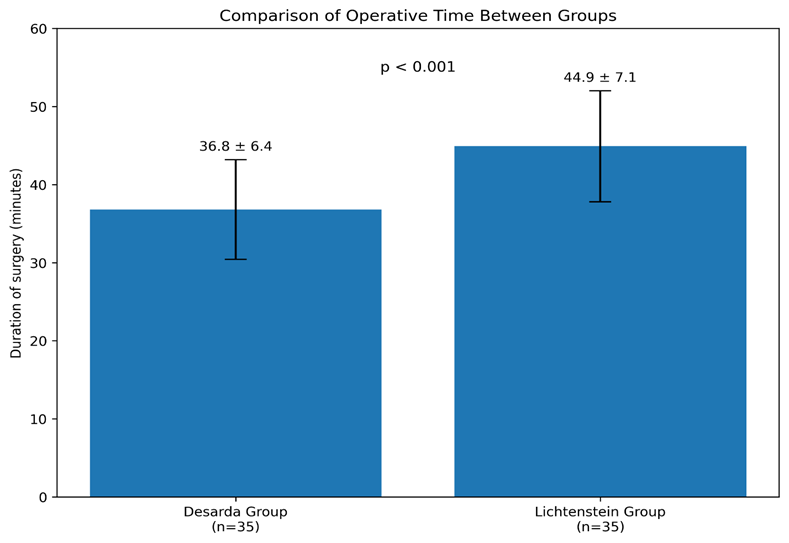
The mean duration of surgery was lower in the Desarda group compared with the Lichtenstein group. The mean operative time was 36.8 ± 6.4 minutes in patients undergoing Desarda’s repair and 44.9 ± 7.1 minutes in patients undergoing Lichtenstein mesh repair. This difference was statistically significant (p<0.001), indicating that Desarda’s repair was associated with shorter operative duration.
Figure 1. Comparison of operative time between both groups.
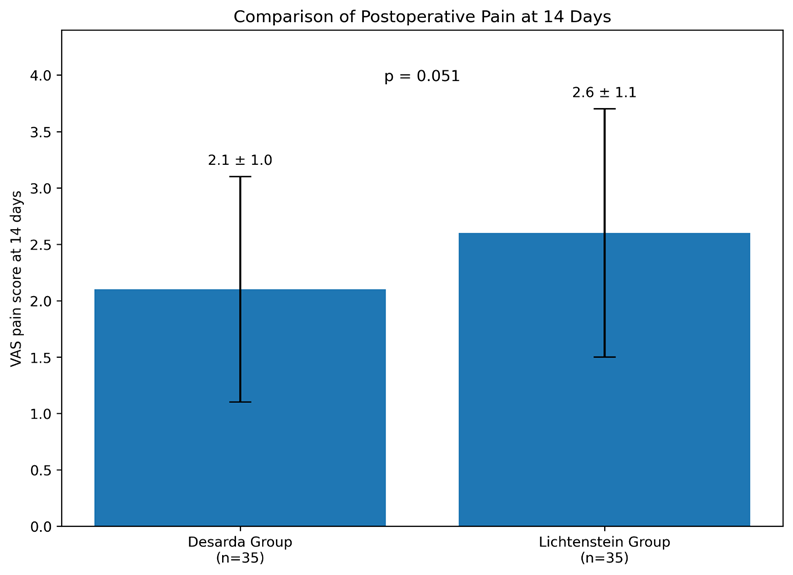
Postoperative pain was assessed at 14 days using the Visual Analog Scale. The mean VAS score was 2.1 ± 1.0 in the Desarda group and 2.6 ± 1.1 in the Lichtenstein group. Although pain scores were slightly lower in the Desarda group, the difference did not reach statistical significance (p=0.051).
Figure 2. Comparison of postoperative pain at 14 days
Postoperative complications were assessed during follow-up visits. Recurrence was not observed in any patient in the Desarda group, while one patient in the Lichtenstein group developed recurrence during follow-up. The difference between the two groups was not statistically significant (p=1.000).
Seroma formation was observed in 1 patient (2.9%) in the Desarda group and 3 patients (8.6%) in the Lichtenstein group. Although seroma formation was more frequent in the Lichtenstein group, the difference was not statistically significant (p=0.614). Wound infection was reported in 2 patients (5.7%) in the Desarda group and 3 patients (8.6%) in the Lichtenstein group, with no statistically significant difference between the two groups (p=1.000).
Foreign body sensation was reported by 2 patients (5.7%) in the Desarda group and 8 patients (22.9%) in the Lichtenstein group. This complaint was more frequent among patients who underwent Lichtenstein mesh repair. The difference was statistically significant using the chi-square test (p=0.040), suggesting a higher frequency of foreign body sensation in the mesh repair group.
Table 2. Comparison of postoperative complications between both groups.
|
Outcome |
Desarda Group (n=35) |
Lichtenstein Group (n=35) |
p-value |
|
Recurrence |
0 (0.0%) |
1 (2.9%) |
1.000 |
|
Seroma formation |
1 (2.9%) |
3 (8.6%) |
0.614 |
|
Wound infection |
2 (5.7%) |
3 (8.6%) |
1.000 |
|
Foreign body sensation |
2 (5.7%) |
8 (22.9%) |
0.040 |
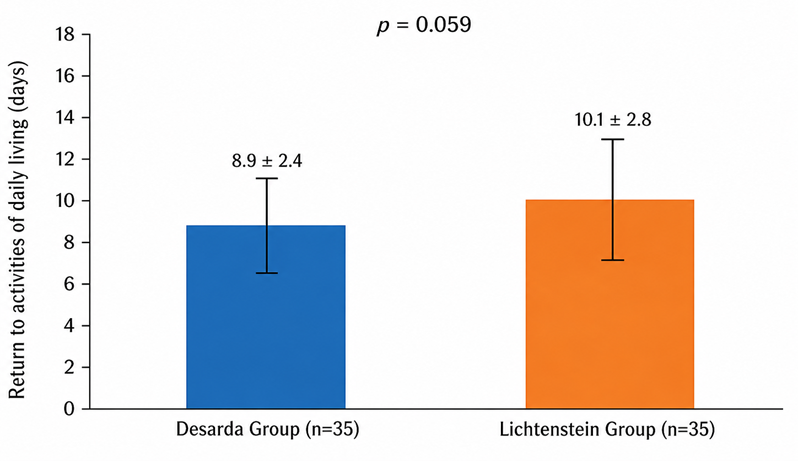
Return to activities of daily living was also compared between the two groups. The mean time to return to normal daily activities was 8.9 ± 2.4 days in the Desarda group and 10.1 ± 2.8 days in the Lichtenstein group. Although patients in the Desarda group returned to routine activities slightly earlier, the difference was not statistically significant (p=0.059).
Figure 3. Comparison of return to activities of daily living.
Overall, Desarda’s repair showed postoperative outcomes comparable to Lichtenstein mesh repair in terms of recurrence, wound infection, seroma formation, postoperative pain, and return to activities of daily living. However, Desarda’s repair was associated with a significantly shorter operative time and a lower frequency of foreign body sensation. These findings suggest that Desarda’s non-mesh repair may be a safe and effective alternative to Lichtenstein mesh repair for primary inguinal hernia, particularly in settings where avoidance of prosthetic mesh may reduce cost and mesh-related discomfort.
DISCUSSION :
Inguinal hernia repair remains one of the most commonly performed general surgical procedures worldwide, and the selection of an optimal repair technique continues to be influenced by recurrence risk, postoperative pain, wound-related complications, patient comfort, cost, and long-term functional recovery. Lichtenstein mesh repair is widely accepted as a standard open technique because of its reproducibility and low recurrence rates. However, mesh-related complications, including foreign body sensation, chronic discomfort, infection, fibrosis, and mesh-related inflammatory reactions, have led to continued interest in effective non-mesh alternatives. Desarda’s repair, which uses an undetached strip of external oblique aponeurosis to reinforce the posterior wall of the inguinal canal, has been proposed as a simple, physiological, and cost-effective alternative to mesh repair.
In the present study, Desarda’s repair demonstrated postoperative outcomes that were broadly comparable to Lichtenstein mesh repair in patients with primary inguinal hernia. Both groups were similar in terms of baseline characteristics, including age, BMI, and type of hernia, indicating adequate comparability between the study groups. This is important because differences in patient factors such as age, body habitus, tissue quality, and hernia characteristics can influence postoperative recovery, complication rates, and recurrence.
The mean operative time was significantly shorter in the Desarda group compared with the Lichtenstein group. This finding is consistent with previous studies that have reported shorter operative duration with Desarda’s repair. The reduced operative time may be explained by the avoidance of mesh placement, trimming, and fixation, as well as the relatively simple tissue-based reconstruction used in Desarda’s technique. Similar findings were reported by Moghe et al., who observed that Desarda’s repair was associated with shorter operative time compared with Lichtenstein repair, without a significant increase in postoperative complications (20). A recent meta-analysis of randomized controlled trials also found Desarda’s repair to be associated with significantly reduced operative time compared with Lichtenstein repair (21).
Postoperative pain was slightly lower in the Desarda group compared with the Lichtenstein group, although the difference was not statistically significant in this study. This finding is in line with previous literature suggesting that Desarda’s repair may be associated with comparable or lower postoperative pain scores. Pain after inguinal hernia repair is multifactorial and may result from tissue dissection, nerve irritation, suture tension, inflammatory response, or prosthetic mesh-related fibrosis. Since Desarda’s repair avoids mesh implantation, it may theoretically reduce mesh-related inflammatory pain and stiffness. However, early postoperative pain can also be influenced by surgical technique, handling of tissues, anaesthesia, analgesic protocols, and individual pain perception. Therefore, the absence of a statistically significant difference in pain between the two groups is understandable, particularly in a relatively small sample size.
Recurrence was uncommon in both groups, with no recurrence observed in the Desarda group and one recurrence observed in the Lichtenstein group during follow-up. The difference was not statistically significant. This finding supports the view that Desarda’s repair can provide recurrence outcomes comparable to mesh repair in appropriately selected patients. Szopinski et al., in a randomized clinical trial with three-year follow-up, reported similar recurrence rates between Desarda and Lichtenstein repair (2). Similarly, systematic reviews and meta-analyses have shown no significant difference in recurrence between the two techniques, suggesting that Desarda’s repair may be an effective alternative to Lichtenstein repair when performed with proper technique and patient selection (10,19,21).
Seroma formation was less frequent in the Desarda group compared with the Lichtenstein group, although the difference was not statistically significant. This trend is consistent with the concept that avoidance of prosthetic material may reduce local inflammatory response and dead space-related fluid collection. Mesh implantation can trigger a foreign body reaction, tissue fibrosis, and inflammatory exudation, which may contribute to seroma formation in some patients. Previous comparative studies and meta-analyses have also reported lower seroma rates with Desarda’s repair compared with Lichtenstein mesh repair (10,21). However, in small studies, the difference may not always reach statistical significance due to limited event rates.
Wound infection was observed in both groups, with no statistically significant difference between Desarda and Lichtenstein repair. This finding is consistent with several previous studies showing comparable wound infection rates between the two techniques. Although mesh infection is an important concern in open mesh repair, the overall risk remains low when proper aseptic technique, antibiotic protocols, and wound care practices are followed. Falagas and Kasiakou emphasized that mesh-related infection, although uncommon, can be clinically significant and may require prolonged treatment or mesh removal in selected cases (3). In resource-limited settings, where infection control practices, affordability, and follow-up may vary, the non-mesh nature of Desarda’s repair may still offer a practical advantage, especially in patients at greater risk of prosthetic-related complications.
Foreign body sensation was significantly more frequent in the Lichtenstein group compared with the Desarda group. This was the most notable difference in postoperative outcomes in the present study. The finding is biologically plausible because Lichtenstein repair involves implantation of synthetic mesh, which can result in stiffness, fibrosis, local awareness of the prosthesis, and chronic groin discomfort. Previous studies have identified mesh-related fibrosis, nerve entrapment, and inflammatory reaction as possible contributors to chronic pain and foreign body sensation after mesh-based hernia repair (4,5,7,8). Since Desarda’s repair does not involve prosthetic mesh, it may reduce the risk of mesh-related awareness and discomfort. This finding is also consistent with the broader literature suggesting that non-mesh repairs may offer advantages in terms of patient comfort, particularly in selected patients.
Return to activities of daily living was slightly earlier in the Desarda group compared with the Lichtenstein group, although the difference did not reach statistical significance. Early return to routine activity is an important patient-centered outcome, particularly in working-age males, who formed the study population in this trial. The shorter operative time, slightly lower pain scores, and reduced foreign body sensation observed in the Desarda group may have contributed to earlier functional recovery. Previous studies have also reported comparable or faster return to normal activity following Desarda’s repair compared with Lichtenstein repair (19–21). However, return to daily activity is influenced not only by surgical technique but also by patient occupation, pain tolerance, postoperative counselling, cultural expectations, and socioeconomic factors.
Overall, the findings of the present study suggest that Desarda’s repair is comparable to Lichtenstein mesh repair in terms of recurrence, wound infection, seroma formation, postoperative pain, and return to activities of daily living. However, Desarda’s repair showed advantages in terms of shorter operative time and lower foreign body sensation. These findings are clinically relevant, particularly in local and resource-limited settings where the cost of mesh, risk of prosthetic infection, and patient concerns regarding mesh-related complications may influence decision-making. International guidelines continue to support mesh-based repair as a standard option for adult inguinal hernia repair, but they also recognize the importance of tailoring surgical technique according to patient factors, surgeon expertise, available resources, and shared decision-making (1,22).
The main strength of this study is its randomized controlled design, with equal allocation of patients into both treatment groups. The study also assessed multiple clinically relevant postoperative outcomes, including recurrence, pain, seroma formation, wound infection, foreign body sensation, and return to daily activities. However, the study has certain limitations. The sample size was relatively small, which may limit the ability to detect statistically significant differences in less frequent outcomes such as recurrence and wound infection. The follow-up duration was short, and therefore long-term recurrence and chronic groin pain could not be fully assessed. In addition, the study included only male patients aged 18–60 years, which limits generalizability to females, elderly patients, recurrent hernias, complicated hernias, and patients with significant comorbidities.
Despite these limitations, the findings of this study support Desarda’s repair as a safe and effective non-mesh alternative to Lichtenstein repair for primary inguinal hernia. In appropriately selected patients, Desarda’s repair may offer comparable short-term outcomes while reducing operative time and foreign body sensation. Larger multicenter trials with longer follow-up are recommended to further evaluate long-term recurrence, chronic pain, cost-effectiveness, patient satisfaction, and quality-of-life outcomes.
BIBLIOGRAPHY:
1. The HerniaSurge Group. International guidelines for groin hernia management. Hernia. 2018;22:1–165.
2. Szopinski J, Dabrowiecki S, Pierscinski S, Jackowski M, Jaworski M, Szuflet Z. Desarda versus Lichtenstein technique for primary inguinal hernia treatment: 3-year results of a randomized clinical trial. World J Surg. 2012;36(5):984–992.
3. Falagas ME, Kasiakou SK. Mesh-related infections after hernia repair surgery. Clin Microbiol Infect. 2005;11(1):3–8.
4. Iakovlev V, Koch A, Petersen K, Morrison J, Grischkan D, Oprea V, Bendavid R. A pathology of mesh and time: dysejaculation, sexual pain, and orchialgia resulting from polypropylene mesh erosion into the spermatic cord. Ann Surg. 2018;267(3):569–575.
5. Fischer JE. Hernia repair: why do we continue to perform mesh repair in the face of the human toll of inguinodynia? Am J Surg. 2013;206(4):619–623.
6. Desarda MP. New method of inguinal hernia repair: a new solution. ANZ J Surg. 2001;71(4):241–244.
7. McRoy LL. Plugoma and the prolene hernia system. J Am Coll Surg. 2010;212:424.
8. Miller JP, Acar F, Kaimaktchiev VB, et al. Pathology of ilioinguinal neuropathy produced by mesh entrapment: case report and literature review. Hernia. 2008;12:213–216.
9. Fawole AS, Chaparala RPC, Ambrose NS. Fate of the inguinal hernia following removal of infected prosthetic mesh. Hernia. 2006;10:58–61.
10. Emile SH, Elfeki H. Desarda’s technique versus Lichtenstein technique for the treatment of primary inguinal hernia: a systematic review and meta-analysis of randomized controlled trials. Hernia. 2018;22(3):385–395.
11. Ota M, Ikezoe T, Kaneoka K, Ichihashi N. Age-related changes in the thickness of the deep and superficial abdominal muscles in women. Arch Gerontol Geriatr. 2012;55(2):e26–e30.
12. Desarda MP. Surgical physiology of inguinal hernia repair: a study of 200 cases. BMC Surg. 2003;3:2.
13. Desarda MP. New method of inguinal hernia repair: a new solution. ANZ J Surg. 2001;71(4):241–244.
14. Desarda MP. Physiological repair of inguinal hernia: a new technique: study of 860 patients. Hernia. 2006;10:143–146.
15. Jain SK, Hameed T, Jain D, Singh M, Nizam A. The role of antibiotic prophylaxis in Lichtenstein repair of primary inguinal hernia: a prospective double-blind randomized placebo-controlled trial. Niger J Surg. 2021;27(1):5–8.
16. de Carvalho DHT, Scholes S, Santos JLF, de Oliveira C, Alexandre TS. Does abdominal obesity accelerate muscle strength decline in older adults? Evidence from the English longitudinal study of ageing. J Gerontol A Biol Sci Med Sci. 2019;74(7):1105–1111.
17. Singh SK, Gulyam-Kuruba SM. The loss of resistance nerve blocks. ISRN Anesthesiology. 2011;2011:421505.
18. Ansari FM, Hameed T, Jain SK, Dua A, Nizam A. Comparison of outcome of Desarda versus Bassini repair in management of complicated inguinal hernia. Int Surg J. 2019;6:3889–3896.
19. Pereira C, Varghese B. Desarda non-mesh technique versus Lichtenstein technique for the treatment of primary inguinal hernias: a systematic review and meta-analysis. Cureus. 2022;14(11):e31630.
20. Moghe D, Prajapati R, Banker A, Khajanchi M. A comparative study of Desarda's versus Lichtenstein's technique for uncomplicated inguinal hernia repair. Cureus. 2022;14(4):e23998. doi:10.7759/cureus.23998.
21. Pompeu BF, Pasqualotto E, Marcolin P, Delgado LM, Farias AGP, Pigossi BDA, et al. Desarda versus Lichtenstein inguinal hernia repair: A meta-analysis of randomized controlled trials. World J Surg. 2024;48(11):2615-2628. doi:10.1002/wjs.12360.
22. Stabilini C, van Veenendaal N, Aasvang E, Agresta F, Aufenacker T, Berrevoet F, et al. Update of the international HerniaSurge guidelines for groin hernia management. BJS Open. 2023;7(5):zrad080. doi:10.1093/bjsopen/zrad080.