“EVALUATION OF KNOWLEDGE AND PERCEPTION OF UNDERGRADUATE DENTAL STUDENTS IN COIMBATORE DISTRICT ON VIRTUAL REALITY(VR)TECHNOLOGY IN DENTISTRY -A QUESTIONNAIRE STUDY.’’
- Nivethitha M , MDS (Periodontology)., RVS Dental College and Hospital, Coimbatore, India
- Reemitha P , MDS (Periodontology)., RVS Dental College and Hospital, Coimbatore, India
- Sumathy K , MDS (Periodontology)., RVS Dental College and Hospital, Coimbatore, India
- Vijay V K , MDS., Professor, Head of the Department (Periodontology) RVS Dental College and Hospital, Coimbatore, India
- Deepshika Saravanan , MDS., MBA (H.M), FADI, PRINCIPAL cum DIRECTOR, RVS Dental College and Hospital, Coimbatore, India
Article Information:
Abstract:
The preclinical training-clinical practice transition is a critical and sometimes challenging phase in the undergraduate dental student, especially in dealing with real patients. Despite gaining experience in the process of working on simulation models, many students lack confidence in the performance of treatments and planning their performance due to the lack of clinical experience. VR is transforming the field of dentistry by enhancing patient care and training and educating dental students. These limitations can be well overcome with integration of virtual reality. The current research was meant to assess the knowledge and perception of dental students towards virtual reality technology.Materials & Methods:A questionnaire-based cross-sectional study was conducted targeting undergraduate dental students in dental colleges in the Coimbatore district in the second, third, and final years and during their internship. Twenty validated questions were created and circulated to 800 students through Google Forms, and the responses were statistically analyzed using percentage analysis and the chi-square test.Results:Most participants self-assessed their knowledge as being at a good level, agreed that VR could be useful for their education, and wanted to incorporate it into dental practice.Conclusion:Only half of the dental students were aware of VR being used in dentistry Integrating virtual reality effectively improves the skills and confidence, leading to better clinical practice.
Keywords:
Article :
INTRODUCTION:
The concept of virtual reality (VR) technology in dentistry is a new twist in the clinical practice and dental education. It combines computer-generated, immersive, three-dimensional, environments that enable users to interact with simulated dental situations in real time. It is possible to provide dental practitioners and dental students with a realistic experience of performing dental procedures, such as tooth restoration, surgery, etc., without having to work on a real patient.
This technology can improve the learning process by providing a repetitive practice in a risk-free environment in which the effects of errors are not actual in the real world. In the case of practitioners, VR may be employed to plan a complex treatment, see anatomical structures in detail, and enhance communication with the patient through virtual demonstrations of the proposed treatment. It is also instrumental in helping to lessen patient anxiety through providing a pre-treatment simulation or distraction therapy during dental procedures.
With the further development of VR tools, their uses in dentistry are getting more sophisticated, merging the elements of realism, accuracy, and interactivity. This combination of technology and clinical know-how is transforming the way future dentists are educated and how they administer patient care in the future in a way that promotes higher standards of accuracy, safety and confidence to the field.
Virtual reality is transforming dentistry as it enhances patient care, education and training to the dental students. Virtual reality (VR) is also providing an engaging and immersive experience that is changing the face of dentistry. This technology can transform the dental experience to one that is more enjoyable, efficient and effective. VR can be greatly used in future shaping, starting with the anxiety-reducing simulations, all the way to the precise treatment planning. This study evaluated dental students’ knowledge regarding the use of virtual reality in dentistry.
Material And Methods:
Study design: This was a descriptive cross-sectional questionnaire-based study. The study was conducted in the dental colleges in the Coimbatore district.
Inclusion criteria: Only undergraduate dental students studying in the second , third , final year, and internship were selected for this study.
Exclusion criteria:
Students in the first year were excluded from this study, as they were new to the dental curriculum, and their response would misguide the data collected for this study.
Study setting:
A total of 20 validated questions related to demographic data (4 questions) and questions evaluating general knowledge on VR (4 questions) and its application in dentistry (12 questions) were created and circulated to 800 undergraduate dental students in dental colleges in the Coimbatore district through Google Forms to analyze the knowledge and perception of virtual reality technology.
The sample size was 465, using Slovin’s formula.
Result::
Of 800 dental students, 467 responded. With the response collected from the undergraduate dental students, statistical analysis was done using percentage analysis and the chi-square test. Results from the chi-square test revealed that gender and knowledge p (0.020), gender and usage p (0.000), and gender and training received on VR technology p (0.035) were significantly related. Gender and awareness of VR technology being used in industry (p- 1.427); gender and usage of VR technology for educational purposes p ( 0.101); and gender and incorporating VR technology in dental programs p ( 0.588) were not significantly related.
Chi-Square Test no: 1
|
Gender * Usage of VR Technology Crosstabulation |
||||
|
Usage of VR Technology |
Total |
|||
|
|
Yes |
No |
||
|
Gender |
Male |
67 |
63 |
130 |
|
Female |
97 |
241 |
338 |
|
|
Total |
164 |
304 |
468 |
|
NULL HYPOTHESIS (H0): There is no significant relationship between gender and usage of VR Technology.
ALTERNATE HYPOTHESIS (H1): There is a significant relationship between gender and usage of VR Technology.
|
Chi-Square Tests |
|||||
|
|
Value |
df |
Asymp. Sig. (2-sided) |
Exact Sig. (2-sided) |
Exact Sig. (1-sided) |
|
Pearson Chi-Square |
21.517a |
1 |
0.000 |
|
|
|
Continuity Correctionb |
20.526 |
1 |
.000 |
|
|
|
Likelihood Ratio |
20.949 |
1 |
.000 |
|
|
|
Fisher's Exact Test |
|
|
|
.000 |
.000 |
|
Linear-by-Linear Association |
21.471 |
1 |
.000 |
|
|
|
N. of Valid Casesb |
468 |
|
|
|
|
Chi-square value = 21.517
p value = 0.000
Degrees of freedom = 1
Level of significance = 5%
Here the. p-value (0.000) is less than 0.05.
H0 is rejected, and H1 is accepted.
Hence, we conclude that gender and usage of VR Technology is significantly related.
Chi-Square Test no: 2
|
Gender * Usage of VR Technology for Educational Purposes Crosstabulation |
||||
|
Usage of VR Technology for Educational Purposes |
Total |
|||
|
|
Yes |
No |
||
|
Gender |
Male |
37 |
93 |
130 |
|
Female |
72 |
266 |
338 |
|
|
Total |
109 |
359 |
468 |
|
NULL HYPOTHESIS (H0): There. is no significant relationship between gender and usage of VR Technology for educational purposes.
ALTERNATE HYPOTHESIS (H1): .There is a significant relationship between gender and usage of VR Technology for educational purposes.
|
Chi-Square Tests |
|||||
|
|
Value |
df |
Asymp. Sig. (2-sided) |
Exact Sig. (2-sided) |
Exact Sig. (1-sided) |
|
Pearson Chi-Square |
2.694a |
1 |
0.101 |
|
|
|
Continuity Correctionb |
2.308 |
1 |
.129 |
|
|
|
Likelihood Ratio |
2.620 |
1 |
.105 |
|
|
|
Fisher's Exact Test |
|
|
|
.113 |
.066 |
|
Linear-by-Linear Association |
2.688 |
1 |
.101 |
|
|
|
N. of Valid Casesb |
468 |
|
|
|
|
Chi-square value = 2.694
p value = 0.101
Degrees of freedom = 1
Level of significance = 5%
Here the p-value (0.101) is more than 0.05.
H0 is accepted and H1 is rejected.
Hence we conclude that gender and usage of VR Technology for educational purposes is not significantly related.
Chi-Square Test no: 3
|
Gender * Awareness of VR being used in Dentistry Crosstabulation |
||||
|
Awareness of VR being used in Dentistry |
Total |
|||
|
|
Yes |
No |
||
|
Gender |
Male |
69 |
61 |
130 |
|
Female |
200 |
138 |
338 |
|
|
Total |
269 |
199 |
468 |
|
NULL HYPOTHESIS (H0): There is no significant relationship between gender and awareness of VR Technology being used in industry.
ALTERNATE HYPOTHESIS (H1): There is a significant relationship between gender and awareness of VR Technology being used in industry.
|
Chi-Square Tests |
|||||
|
|
Value |
df |
Asymp. Sig. (2-sided) |
Exact Sig. (2-sided) |
Exact Sig. (1-sided) |
|
Pearson Chi-Square |
1.427a |
1 |
0.232 |
|
|
|
Continuity Correctionb |
1.188 |
1 |
.276 |
|
|
|
Likelihood Ratio |
1.421 |
1 |
.233 |
|
|
|
Fisher's Exact Test |
|
|
|
.252 |
.138 |
|
Linear-by-Linear Association |
1.424 |
1 |
.233 |
|
|
|
N. of Valid Casesb |
468 |
|
|
|
|
CHI-SQUARE VALUE = 1.427
P VALUE = 0.232
Degrees of freedom = 1
Level of significance = 5%
Here the p-value (1.427) is more than 0.05.
H0 is accepted and H1 is rejected.
Hence, we conclude that gender and awareness of VR Technology being used in industry is not significantly related.
Chi-Square Test no: 4
|
Gender * Knowledge of VR Technology in Dentistry Crosstabulation |
||||||
|
Knowledge of VR Technology in Dentistry |
Total |
|||||
|
|
Very Good |
Good |
Fair |
Poor |
||
|
Gender |
Male |
32 |
58 |
23 |
17 |
130 |
|
Female |
64 |
116 |
93 |
65 |
338 |
|
|
Total |
96 |
174 |
116 |
82 |
468 |
|
NULL HYPOTHESIS (H0): There is no significant relationship between gender and knowledge of VR Technology in industry.
ALTERNATE HYPOTHESIS (H1): There is a significant relationship between gender and knowledge of VR Technology in industry.
|
Chi-Square Tests |
|||
|
|
Value |
df |
Asymp. Sig. (2-sided) |
|
Pearson Chi-Square |
9.838a |
3 |
0.020 |
|
Likelihood Ratio |
10.072 |
3 |
.018 |
|
Linear-by-Linear Association |
7.251 |
1 |
.007 |
|
N of Valid Cases |
468 |
|
|
Chi-square value = 9.838
p value = 0.020
Degrees of freedom = 3
Level of significance = 5%
Here, the p-value (0.020) is less than 0.05.
H0 is rejected and H1 is accepted.
Hence, we conclude that gender and knowledge of VR Technology in industry is significantly related.
Chi-Square Test no: 5
|
Gender * Received training on VR Technology Crosstabulation |
||||
|
Received training on VR Technology |
Total |
|||
|
|
Yes |
No |
||
|
Gender |
Male |
38 |
92 |
130 |
|
Female |
68 |
270 |
338 |
|
|
Total |
106 |
362 |
468 |
|
NULL HYPOTHESIS (H0): There is no significant relationship between gender and training received on VR technology.
ALTERNATE HYPOTHESIS (H1): There is a significant relationship between gender and training received on VR technology.
|
Chi-Square Tests |
|||||
|
|
Value |
df |
Asymp. Sig. (2-sided) |
Exact Sig. (2-sided) |
Exact Sig. (1-sided) |
|
Pearson Chi-Square |
4.450a |
1 |
0.035 |
|
|
|
Continuity Correctionb |
3.945 |
1 |
.047 |
|
|
|
Likelihood Ratio |
4.295 |
1 |
.038 |
|
|
|
Fisher's Exact Test |
|
|
|
.048 |
.025 |
|
Linear-by-Linear Association |
4.440 |
1 |
.035 |
|
|
|
N. of Valid Casesb |
468 |
|
|
|
|
Chi-square value = 4.450
p value = 0.035
Degrees of freedom = 1
Level of significance = 5%
Here, the p-value (0.035) is less than 0.05.
H0 is rejected, and H1 is accepted.
Hence, we conclude that gender and training received on VR technology is significantly related.
Chi-Square Test no: 6
|
Gender * Incorporate VR Technology in Dental Program Crosstabulation |
||||
|
Incorporate VR Technology in Dental Program |
Total |
|||
|
|
Yes |
No |
||
|
Gender |
Male |
111 |
19 |
130 |
|
Female |
295 |
43 |
338 |
|
|
Total |
406 |
62 |
468 |
|
NULL HYPOTHESIS (H0): There is no significant relationship between gender and incorporating VR Technology in dental program.
ALTERNATE HYPOTHESIS (H1): There is a significant relationship between gender and incorporating VR Technology in dental program.
|
Chi-Square Tests |
|||||
|
|
Value |
df |
Asymp. Sig. (2-sided) |
Exact Sig. (2-sided) |
Exact Sig. (1-sided) |
|
Pearson Chi-Square |
0.293a |
1 |
0.588 |
|
|
|
Continuity Correctionb |
.151 |
1 |
.697 |
|
|
|
Likelihood Ratio |
.288 |
1 |
.592 |
|
|
|
Fisher's Exact Test |
|
|
|
.648 |
.344 |
|
Linear-by-Linear Association |
.292 |
1 |
.589 |
|
|
|
N. of Valid Casesb |
468 |
|
|
|
|
Chi-square value = 0.293
p value = 0.588
Degrees of freedom = 1
Level of significance = 5%
Here, the p-value (0.588) is more than 0.05.
H0 accepted, and H1 is rejected.
Hence, we conclude that gender and incorporating VR Technology in dental program is not significantly related.
PERCENTAGE ANALYSIS
TABLE 1:
|
QUESTIONS |
YES |
NO |
MAYBE |
|
Have you ever used VR technology?
|
35.3%
|
64.7%
|
- |
|
If yes, Have you enjoyed using VR technology?
|
43.1%
|
56.9%
|
- |
|
Have you ever used VR for educational purposes?
|
23.6%
|
76.4%
|
- |
|
Have you heard of VR being used in dentistry?
|
57.7%
|
42.3%
|
- |
|
Have you ever received education or training on VR technology in dentistry in your dental program?
|
23%
|
77%
|
-- |
|
Do you want to incorporate VR technology in your dental program?
|
86.8%
|
13.2%
|
|
|
Will you invest in VR technology for your clinical practice?
|
37.7%
|
6.2%
|
56.2%
|
|
Do you think VR will become a standard tool in dental education in upcoming era?
|
48.1%
|
5.1%
|
46.8%
|
PERCEPTION AND KNOWLEDGE OF STUDENTS
Graph 1:
1. 2. 3. Mark only one oval. BDS -1st year BDS -2nd year BDS -3rd year BDS - 4th year Intern 4. Mark only one oval. Intern This content is neither created nor endorsed by Google. Virtual reality : Is it a reality among dental students?- A Questionnaire Study * Indicates required question Name of the student * e - mail ID
Graph 3:
Graph 4:
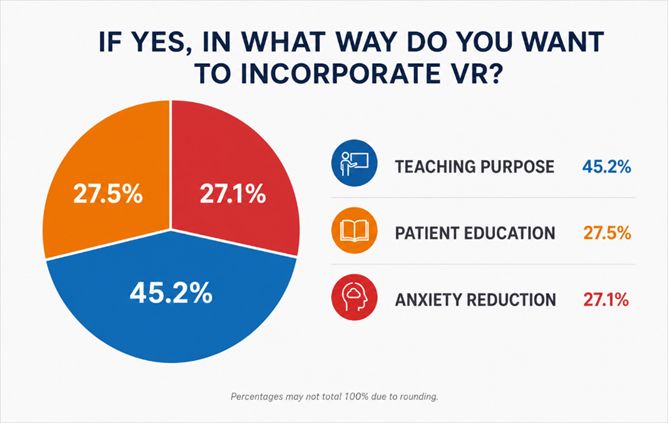
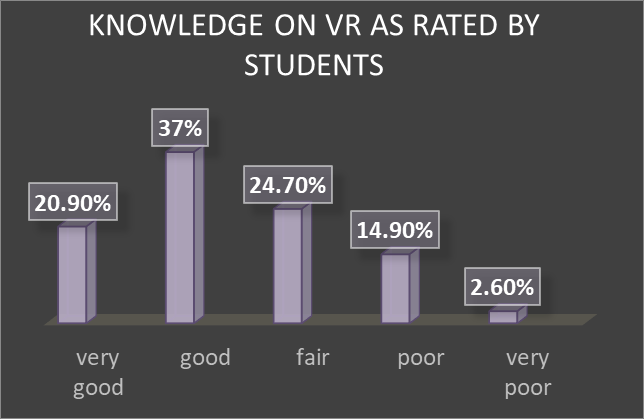
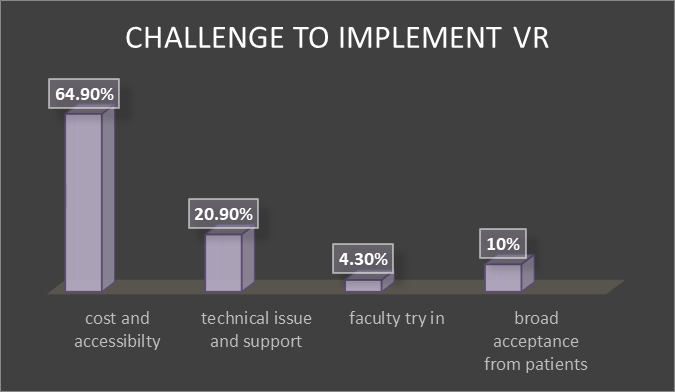
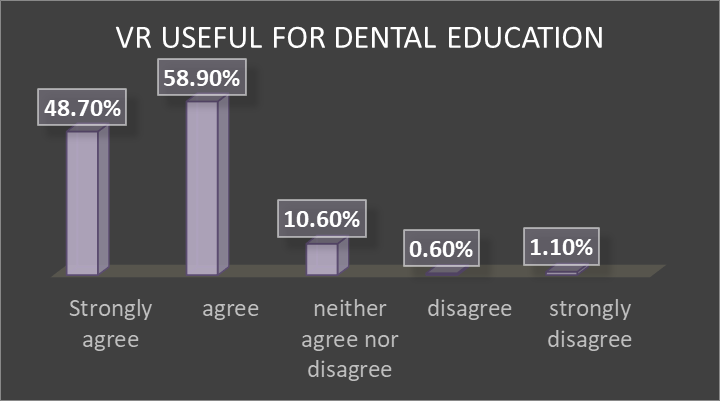
Most of the students rated their knowledge as good (37%) and fair (24.7%), followed by very good (20.9%), poor (14.9%), and very poor (2.60%) [graph 1]; and most of them agreed (58.9%) and strongly agreed (48.7%) that VR could be useful for their education [graph 3]. A few of them (10.6%) neither agreed nor disagreed, and 86.8% of the students wanted to incorporate VR in dental practice [graph 2], mostly for teaching purposes, followed by patient education and anxiety reduction [graph 4].
DISCUSSION :
The surge in research related to virtual reality (VR) in dentistry became particularly evident after 2019, largely influenced by the pandemic COVID-19, which sped up embrace of digital learning platforms and remote training modalities in health care education worldwide (Schlenz et al.,¹ Iyer et al.²). Bibliometric studies by Huang et al.³ and Zitzmann et al.⁴ identified the United States, the United Kingdom, and the Netherlands as leading contributors to VR-based dental education research, highlighting the global relevance and rapid advancement of immersive educational technologies.
VR Applications in Dental Education
Virtual reality has become an integral component of preclinical dental education by providing realistic simulations that enables students to practice psychomotor skills, enhance procedural accuracy, and develop hand-eye coordination without posing any risk to patients.(Towers et al.⁵, Al-Janabi et al.⁶). Systematic reviews by Murbay et al.⁷ and Roy et al.⁸ demonstrate that VR-assisted learning significantly enhances training in cavity preparation, dental anatomy, endodontics, prosthodontics, and oral health education, often resulting in improved academic performance and superior learning outcomes compared with traditional teaching methods. Similar benefits were reported in prosthodontic education by de Boer et al. ⁹.
Patient Management and Clinical Efficiency
VR has shown to be an effective non-pharmacological distraction technique. According to Furman et al.¹ and Wiederhold et al.¹¹, significant changes in patient anxiety, stress, and perceived pain during dental treatment in the presence of VR as an adjunctive tool were reported. Furthermore, Javaid et al.¹² pointed out that the implementation of extended reality (XR), such as VR and augmented reality (AR), enhances the efficiency of the procedure and clinical workflow, as well as improves the patient experience and the performance of professionals.
Clinical Performance and Skills
VR simulators based on haptic education can be used to train fine motor skills by means of a tactile feedback that is very similar to the real clinical experience. The early application of the simulation technology to education was highlighted by Buchanan 13, with Suebnukarn, et al. 14 demonstrating that VR can greatly assist in acquisition of skills and realism in the operative procedures. Luciano et al.¹⁵ have further validated the use of tactile VR training in dental procedures.
Specialty Opportunities
VR applications have demonstrated significant potential in implant dentistry and oral and maxillofacial surgery. Ma et al.¹⁶ and Al-Ekrish et al.¹⁷ demonstrated better educational results in training in the field of implant dentistry. In addition, the AR-assisted surgical guidance systems characterized by Chen et al.¹⁸ have been found to enhance the accuracy of surgery and patient outcomes.
Collaboration and Limitations
Although the research volume on VR-related topics in dentistry is increasing rapidly, Khanagar et al.¹⁹ found that the scholarly output is still confined in a small number of countries, with rather weak international collaboration networks. The main barriers to universal adoption, as pointed out by Wang. et al.²⁰ and Perry. et al.²¹, include the absence of standard training protocols, a lack of accreditation of VR systems, the high cost to implement, and the absence of large-scale randomized controlled trials.
Future perspectives
The implementation of VR in dental curricula is likely to keep expanding, but Plessas²² noted that some additional high-quality studies are necessary to overcome the technological constraints, set up uniform guidelines, and enhance cost-effectiveness. As VR systems continue to become more affordable and technologically advanced, Kwon and Park23 indicated that the immersive technologies will leave a revolutionary impact on education, clinical training, and patient care.
BIBLIOGRAPHY:
1. Schlenz MA, Schmidt A, Wöstmann B, Krämer N, Schulz-Weidner N. Students’ and lecturers’ perspective on the use of virtual reality in dental education. J Dent Educ. 2020;84(10):1085-92.
2. Iyer P, Aziz K, Ojcius DM. Impact of COVID-19 on dental education in the United States. J Dent Educ. 2020;84(6):718-22.
3. Huang TK, Yang CH, Hsieh YH, Wang JC, Hung CC. Augmented reality and virtual reality applied to dental education: A bibliometric analysis. Healthcare (Basel). 2022;10(4):699.
4. Zitzmann NU, Matthisson L, Ohla H, Joda T. Digital undergraduate education in dentistry: A systematic review. Int J Environ Res Public Health. 2020;17(9):3269.
5. Towers A, Field J, Stokes C, Maddock S, Martin N. A scoping review of the use and application of virtual reality in preclinical dental education. J Dent Educ. 2019;83(5):569-77.
6. Al-Janabi S, Al-Janabi A. Immersive virtual reality and its role in dental education. Eur J Dent Educ. 2021;25(2):325-33.
7. Murbay S, Neelakantan P, Chang JW, Yeung S. Evaluation of the effectiveness of virtual reality simulation in dental education: A systematic review. Int J Med Robot. 2020;16(5):e2061.
8. Roy E, Bakr MM, George R. The need for virtual reality simulators in dental education: A review. Saudi Dent J. 2017;29(2):41-7.
9. de Boer IR, Lagerweij MD, Wesselink PR, Vervoorn JM. Evaluation of a virtual reality simulation for preclinical education in prosthodontics. Eur J Dent Educ. 2019;23(4):432-8.
10. Furman E, Jasinevicius TR, Bissada NF, Victoroff KZ, Skillicorn R, Buchner M. Virtual reality distraction for pain control during periodontal procedures. J Am Dent Assoc. 2009;140(12):1508-16.
11. Wiederhold BK, Gao K, Sulea C, Wiederhold MD. Virtual reality as a distraction technique in chronic pain patients. Cyberpsychol Behav Soc Netw. 2014;17(6):371-8.
12. Javaid M, Haleem A, Pratap Singh R, Suman R. Dentistry 4.0 technologies applications in dentistry. J Oral Biol Craniofac Res. 2022;12(3):292-9.
13. Buchanan JA. Use of simulation technology in dental education. J Dent Educ. 2001;65(11):1225-31.
14. Suebnukarn S, Haddawy P, Rhienmora P, Gajananan K. Haptic virtual reality for skill acquisition in dental training. J Dent Res. 2010;89(10):1128-33.
15. Luciano C, Banerjee P, DeFanti T. Haptics-based virtual reality dental training simulator. Stud Health Technol Inform. 2015;220:301-7.
16. Ma L, Choi J, Wang S, Li C. Virtual and augmented reality in oral and maxillofacial surgery. Br J Oral Maxillofac Surg. 2021;59(2):e17-23.
17. Al-Ekrish AA, Al-Sadhan R. Virtual reality applications in implant dentistry education. Saudi Dent J. 2019;31(3):287-95.
18. Chen X, Xu L, Wang Y, Wang H. Augmented reality-assisted dental surgery: A systematic review. J Dent. 2020;95:103302.
19. Khanagar SB, Al-Ekrish AA, Alhajrasi MJ, et al. Global research trends in virtual reality applications in dentistry. BMC Med Educ. 2022;22:700.
20. Wang D, Bhardwaj A, Jamal A. Barriers and challenges in implementing virtual reality in dental education. Educ Sci. 2021;11(9):482.
21. Perry S, Bridges SM, Burrow MF. A review of the use of simulation in dental education. Eur J Dent Educ. 2018;22(3):e273-80.
22. Plessas A. Computer-assisted learning in dentistry. Eur J Dent Educ. 2017;21(Suppl 1):3-6.
23. Kwon HB, Park YS. Future directions of virtual reality in dental education. J Dent Educ. 2020;84(5):538-46.