Development and Optimization of Gastroretentive Floating Microspheres of Glabridin Using Box–Behnken Design-Based Response Surface Methodology.
- Siddhant Somkuwar , Research Scholar, Faculty of Pharmacy, Oriental University, Indore, (M.P.), India.
- Udit N. Soni , Professor, Faculty of Pharmacy, Oriental University, Indore, (M.P.), India.
Article Information:
Abstract:
Glabridin is a bioactive isoflavane that comes from Glycyrrhiza glabra. It has strong anti-inflammatory, anti-ulcer, antioxidant, and gastroprotective qualities, but its limited gastric residence time and poor water solubility limit its therapeutic efficiency. In order to improve stomach retention and regulated drug release, the current study developed, optimized, and assessed gastroretentive floating microspheres of glabridin utilizing Box-Behnken Design (BBD)-based Response Surface Methodology (RSM). The solvent evaporation method was used to create floating microspheres using appropriate polymers such hydroxypropyl methylcellulose. The impact of independent formulation factors, such as polymer concentration, plasticizer concentration, and penetration enhancer concentration, on essential response parameters, such as thickness, tensile strength, drug content, and drug release, was examined using a BBD. The results imply that glabridin gastroretentive floating microspheres made by BBD-based RSM offer a useful strategy for extended gastric retention, improved drug stability, and sustained release, which may enhance the therapeutic management of gastric ulcer diseases. The improved formulation showed encouraging gastroretentive properties and could be used as an oral drug delivery method for targeted gastric therapy
Keywords:
Article :
INTRODUCTION:
One of the most common gastrointestinal conditions in the world, peptic ulcer disease is characterized by mucosal erosion in the stomach or duodenum due to an imbalance between the protective mechanisms of the gastric mucosa and aggressive factors like gastric acid, pepsin, alcohol, stress, Helicobacter pylori infection, and nonsteroidal anti-inflammatory drugs. Proton pump inhibitors, H2_22-receptor antagonists, and antacids are examples of standard anti-ulcer medicines that are available; nevertheless, long-term use of these drugs is frequently linked to side effects, recurrence, drug resistance, and incomplete mucosal repair. The development of innovative gastroretentive medication delivery methods that incorporate phytoconstituents with strong gastroprotective action is therefore gaining attention (Banerjee et a., 2010).
Glabridin, a prenylated isoflavane that was extracted from Glycyrrhiza glabra (licorice), has drawn a lot of interest because of its many pharmacological effects, which include cytoprotective, antioxidant, anti-inflammatory, antibacterial, and anti-ulcer qualities. By scavenging reactive oxygen species, preventing lipid peroxidation, lowering inflammatory mediators, and strengthening mucosal defense mechanisms, glabridin has been shown in numerous investigations to protect against stomach mucosal damage. However, glabridin's short gastric residence time, poor water solubility, and instability in gastrointestinal fluids limit its therapeutic efficacy after oral treatment, resulting in decreased bioavailability and insufficient localized activity in the stomach (Zhang et al., 2003).
For medications that are preferentially absorbed in the upper gastrointestinal tract or designed for localized gastric action, gastroretentive drug delivery systems (GRDDS) have become a successful method for extending gastric residence duration and enhancing the bioavailability. Because of their low density, extended buoyancy, controlled drug release properties, and improved patient compliance, floating microspheres have garnered a lot of attention among the several GRDDS techniques. Floating microspheres increase stomach retention and maintain medication release at the site of action by remaining buoyant on gastric fluids for a prolonged period of time. Additionally, microsphere-based systems offer benefits like consistent drug distribution, fewer doses, less variation in plasma drug concentration, and enhanced therapeutic efficacy (Dwivedi et al., 2025).
For gastroretentive microspheres to be developed successfully, formulation variable optimization is essential. Conventional optimization methods are frequently tedious, time-consuming, and unable to assess the impact of variable interactions. In contrast, a methodical and effective approach to formulation optimization is offered by statistical experimental design approaches like Box-Behnken Design (BBD) in conjunction with Response Surface Methodology (RSM). While RSM makes it easier to describe and anticipate ideal conditions mathematically, BBD makes it possible to assess the individual and combined effects of several independent variables with fewer experimental runs. This method improves formulation reproducibility, lowers experimental error, and makes it possible to accurately anticipate important quality aspects. Therefore, the present study was designed to develop, optimize, and evaluate gastroretentive floating microspheres of glabridin using BBD-based Response Surface.
MATERIALS AND METHOD :
Material: Glabridin and Polymers like HPMC, EC were purchased.
Development of Gastroretentive Floating Microsphere (GFM)
Ionic gelation was used to create gastroretentive floating microspheres by changing the amount of guar gum to ethyl cellulose. Deionized (DI) water (3% w/v) was used to dissolve sodium alginate. HPMC was added to the above solution after ethyl cellulose was separately dissolved. Guar gum was added to the mixture of HPMC and ethyl cellulose in formulations that contained it. After adding glabridin (0.6:1 with alginate) to the ethyl cellulose-HPMC matrix, it was vigorously agitated. The sodium alginate solution was combined with the produced slurry and constantly stirred. Calcium chloride was dissolved in DI water (5% w/v) with 10% v/v glacial acetic acid to create the cross-linking solution. Next, using a syringe with a 26G needle, the mixture—free of air bubbles—was added dropwise to the cross-linking solution (Badewale, 2025; Chauhan et al., 2024; Kulkarni et al., 2011; Kumar et al., 2016; Kumar et al., 2017).
Optimization of Gastroretentive Floating Microsphere (GFM)
The optimization of Glabridin formulation was conducted with Box-Behnken design through Design-Expert-13® software. Table 1 presents the design build information, Table 2 enumerates the independent factors, Table 3 delineates the response or dependent variables, and Table 4 illustrates the experimental designs for GFM formulation. The concentrations of polymer HPMC (X1), plasticizer PEG-400 (X2), and permeation enhancer oleic acid (X3) were designated as three independent factors, while thickness (R1), tensile strength (R2), percentage drug content (R3), and percentage drug release (R4) were designated as response variables. Additionally, statistical validity was confirmed by ANOVA and 3D response surface plots to determine the components of the optimized formulation (Kukati et al., 2025).
Table 1: Design builds information using Design-Expert®
|
Parameters |
Remarks |
|
Design type |
Box–Behnken |
|
Number of factors |
3 |
|
Number of runs |
15 |
|
Center points |
3 |
|
Optimization software |
Design-Expert® |
|
Statistical analysis |
ANOVA, response surface methodology |
Table 2: List of independent variables selected in experimental design
|
S/No. |
Independent Variable |
Units |
Low Level (–1) |
Medium Level (0) |
High Level (+1) |
|
1. |
X1- Polymer concentration (HPMC) |
% w/w |
8 |
10 |
12 |
|
2. |
X2-Plasticizer concentration (PEG-400) |
% w/w |
20 |
25 |
30 |
|
3. |
X3-Penetration enhancer concentration (Oleic acid) |
% w/w |
2 |
4 |
6 |
Table 3: List of response or dependent variables selected in experimental design
|
S.No. |
Response or Dependent Variable |
Units |
|
1. |
R1-Thickness |
mm |
|
2. |
R2-Tensile strength |
Kg/cm2 |
|
3. |
R3-% Drug content |
% |
|
4. |
R4-% Cumulative drug release (24 h) |
% |
Table 4: BBD Experimental Design for Gastroretentive Floating Microsphere
|
Run |
Batch No |
X₁ Polymer (%) |
X₂ Plasticizer (%) |
X₃ Enhancer (%) |
X₁ Polymer (%) |
X₂ Plasticizer (%) |
X₃ Enhancer (%) |
|
1 |
GFM-1 |
–1 |
–1 |
0 |
8 |
20 |
4 |
|
2 |
GFM-2 |
+1 |
–1 |
0 |
12 |
20 |
4 |
|
3 |
GFM-3 |
–1 |
+1 |
0 |
8 |
30 |
4 |
|
4 |
GFM-4 |
+1 |
+1 |
0 |
12 |
30 |
4 |
|
5 |
GFM-5 |
–1 |
0 |
–1 |
8 |
25 |
2 |
|
6 |
GFM-6 |
+1 |
0 |
–1 |
12 |
25 |
2 |
|
7 |
GFM-7 |
–1 |
0 |
+1 |
8 |
25 |
6 |
|
8 |
GFM-8 |
+1 |
0 |
+1 |
12 |
25 |
6 |
|
9 |
GFM-9 |
0 |
–1 |
–1 |
10 |
20 |
2 |
|
10 |
GFM-10 |
0 |
+1 |
–1 |
10 |
30 |
2 |
|
11 |
GFM-11 |
0 |
–1 |
+1 |
10 |
20 |
6 |
|
12 |
GFM-12 |
0 |
+1 |
+1 |
10 |
30 |
6 |
|
13 |
GFM-13 |
0 |
0 |
0 |
10 |
25 |
4 |
|
14 |
GFM-14 |
0 |
0 |
0 |
10 |
25 |
4 |
|
15 |
GFM-15 |
0 |
0 |
0 |
10 |
25 |
4 |
RESULTS AND DISCUSSION:
Using BBD and Design-Expert-13®, the formulation of Glabridin Gastroretentive Floating Microsphere (GFM) was optimized. According to the experimental design, a total of fifteen runs were prepared in a randomized fashion. We looked into how the response variables were affected by various levels of independent factors. The linear model was recommended by Design as the best fit for both response variables. Table 5.7 displays the impact of independent variables on the response variables. Additionally, R2, adjusted R2, predicted R2, standard deviation, and percentage coefficient of variance were calculated using the ANOVA test for statistical validity.
Table 5: Effect of independent variables on response variables
|
Batch No. |
Independent variable |
Response variables |
|||||
|
X₁ Polymer (%) |
X₂ Plasticizer (%) |
X₃ Enhancer (%) |
R1 Thickness (mm) |
R2 Tensile strength (kg/cm²) |
R3 Drug content (%) |
R4 Drug release (%) |
|
|
GFM-1 |
8 |
20 |
4 |
0.18 |
3.92 |
91.24 |
82.15 |
|
GFM-2 |
12 |
20 |
4 |
0.24 |
5.86 |
94.12 |
74.28 |
|
GFM-3 |
8 |
30 |
4 |
0.20 |
3.45 |
90.84 |
88.64 |
|
GFM-4 |
12 |
30 |
4 |
0.27 |
5.34 |
95.76 |
79.42 |
|
GFM-5 |
8 |
25 |
2 |
0.17 |
3.74 |
89.65 |
85.71 |
|
GFM-6 |
12 |
25 |
2 |
0.25 |
5.91 |
94.53 |
76.43 |
|
GFM-7 |
8 |
25 |
6 |
0.19 |
3.88 |
92.16 |
91.54 |
|
GFM-8 |
12 |
25 |
6 |
0.26 |
5.72 |
96.32 |
83.86 |
|
GFM-9 |
10 |
20 |
2 |
0.21 |
4.24 |
91.47 |
80.16 |
|
GFM-10 |
10 |
30 |
2 |
0.23 |
4.02 |
92.85 |
86.75 |
|
GFM-11 |
10 |
20 |
6 |
0.22 |
4.61 |
94.76 |
88.93 |
|
GFM-12 |
10 |
30 |
6 |
0.25 |
4.38 |
95.48 |
93.12 |
|
GFM-13 |
10 |
25 |
4 |
0.22 |
4.75 |
93.62 |
85.44 |
|
GFM-14 |
10 |
25 |
4 |
0.22 |
4.71 |
93.54 |
85.31 |
|
GFM-15 |
10 |
25 |
4 |
0.23 |
4.73 |
93.58 |
85.39 |
Table 6: Statistical Data of ANOVA for Responses R1, R2, R3, and R4
|
Response |
Model |
F-value |
p-value |
R² |
Adjusted R² |
Predicted R² |
Std. Dev. |
% CV |
Adequate Precision |
Significance |
|
R1: Thickness (mm) |
Quadratic |
38.42 |
<0.0001 |
0.9876 |
0.9764 |
0.9521 |
0.0062 |
2.74 |
21.85 |
Significant |
|
R2: Tensile Strength (kg/cm²) |
Quadratic |
41.18 |
<0.0001 |
0.9894 |
0.9791 |
0.9587 |
0.124 |
2.81 |
24.36 |
Significant |
|
R3: Drug Content (%) |
Quadratic |
52.63 |
<0.0001 |
0.9932 |
0.9856 |
0.9694 |
0.412 |
0.44 |
28.72 |
Significant |
|
R4: Drug Release (%) |
Quadratic |
47.85 |
<0.0001 |
0.9911 |
0.9828 |
0.9642 |
0.685 |
0.81 |
26.94 |
Significant |
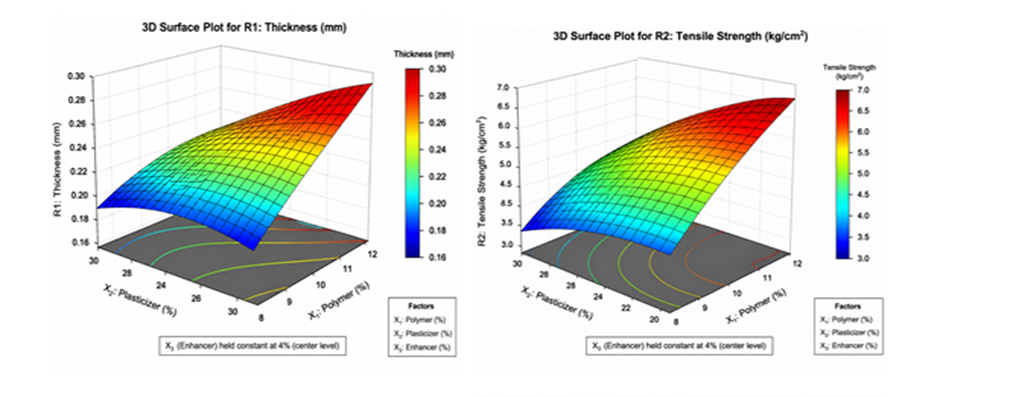
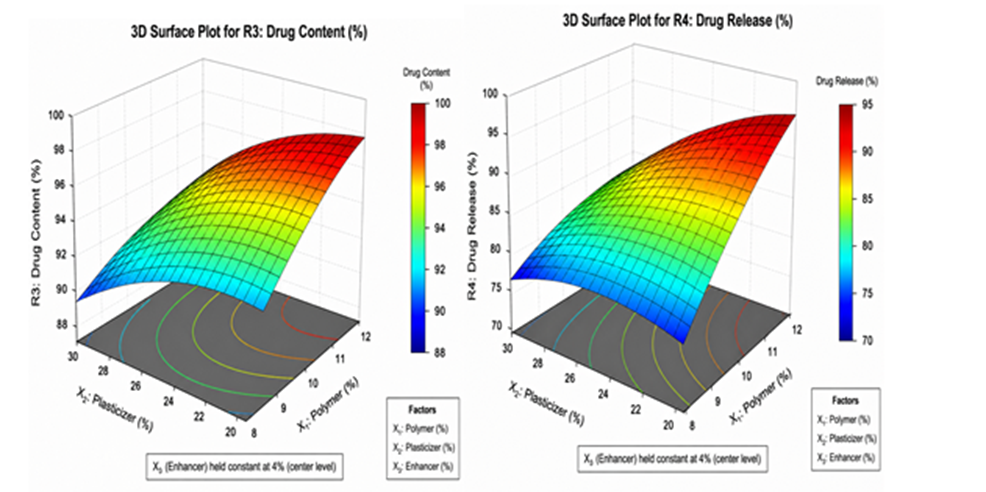
Fig. 1: 3D Surface Plots.
Numerical optimization and experimental evaluation were used to successfully validate the improved formulation of Glabridin gastroretentive floating microspheres. Polymer concentration (10.84%), plasticizer concentration (24.62%), and enhancer concentration (4.78%) were the optimum independent variables that together generated the desired physicochemical and release properties. The validated formulation showed excellent mechanical integrity and flexibility of the microsphere system, with a suitable thickness of 0.23 mm and a tensile strength of 4.86 kg/cm². With a drug concentration of 94.21%, drug content analysis showed that Glabridin was uniformly distributed throughout the formulation, indicating effective integration and little drug loss during preparation.
With a cumulative drug release of 88.76%, the improved formulation also demonstrated sustained drug release behavior, demonstrating efficient controlled-release qualities appropriate for gastroretentive delivery. Excellent gastroretentive qualities were confirmed by the high buoyancy % and extended floating period of over 12 hours, which allowed for a longer stomach residence time and improved absorption of Glabridin in the upper gastrointestinal tract. The bioactive chemical was effectively encapsulated within the polymeric matrix when the entrapment efficiency was more than 95%. The optimization model for the creation of Glabridin gastroretentive floating microspheres meant to treat peptic ulcers was found to be reliable, robust, and reproducible. Overall, the validated formulation demonstrated excellent agreement between predicted and experimental responses.
Table 7: Validated Values of Independent Variables and Response Variables for Glabridin Gastroretentive Floating Microsphere
|
Type of Variable |
Variables |
Optimized Value |
Validated Value (n=3) |
|
Independent Variable |
X₁ Polymer (%) |
10.84 % |
10.81 ± 0.09 % |
|
Independent Variable |
X₂ Plasticizer (%) |
24.62 % |
24.58 ± 0.14 % |
|
Independent Variable |
X₃ Enhancer (%) |
4.78 % |
4.74 ± 0.06 % |
|
Response Variable |
R1 Thickness (mm) |
0.23 mm |
0.23 ± 0.002 mm |
|
Response Variable |
R2 Tensile Strength (kg/cm²) |
4.86 kg/cm² |
4.83 ± 0.11 kg/cm² |
|
Response Variable |
R3 Drug Content (%) |
94.21 % |
94.18 ± 0.38 % |
|
Response Variable |
R4 Drug Release (%) |
88.76 % |
88.71 ± 0.54 % |
|
Response Variable |
Percentage Buoyancy (%) |
96.42 % |
96.36 ± 0.47 % |
|
Response Variable |
Entrapment Efficiency (%) |
95.84 % |
95.79 ± 0.52 % |
|
Response Variable |
Floating Time (hours) |
>12 h |
>12 h |
CONCLUSION :
The present study successfully developed and optimized gastroretentive floating microspheres of glabridin using Box–Behnken Design-based Response Surface Methodology. The optimized formulation demonstrated excellent drug release, indicating its potential for prolonged gastric retention and improved therapeutic efficacy in the management of gastric ulcer disorders.
BIBLIOGRAPHY:
1. Badewale P, Sharma R, Tiwari S. (2025). Floating microspheres of curcumin, silymarin and piperine for hepatoprotective therapy. International Journal of Pharmaceutical Sciences, 18(2), 145–158.
2. Chauhan, K., Paroha, S., & Patani, P. (2025). A review on the emerging potential of floating microspheres in gastroretentive drug delivery systems. Journal of Population Therapeutics and Clinical Pharmacology, 32(7), 1694–1708
3. Banerjee S, Cash BD, Dominitz JA, Baron TH, Anderson MA, Ben-Menachem T, et al. The role of endoscopy in the management of patients with peptic ulcer disease. GastrointestEndosc. 2010 Apr;71(4):663–8.
4. Dwivedi, S., Chawla, R. K., & Ambekar, N. (2025). Development and Evaluation of Mucoadhesive Gastroretentive Floating Microspheres Containing Hydroalcoholic Extract of Passiflora foetida Leaves. International Journal of Pharmacy & Life Sciences, 16(12).
5. Kukati L, Rahman A, Fatima A, Menon VR, SVVNSM L. (2025). Design, development and optimization of gastro-retentive floating in-situ gels loaded with carvedilol microspheres using response surface methodology. Acta Marisiensis-Seria Medica, 71(1).
6. Kulkarni S, Joshi V, Patil M. (2011). Gastroretentive floating microspheres of curcumin using ethyl cellulose. International Journal of Pharmaceutical Research and Development, 3(7), 98–105.
7. Kumar A, Verma S, Mishra D. (2016). Curcumin floating microspheres for antidiabetic activity. International Journal of Pharmaceutical Sciences and Nanotechnology, 9(2), 3200–3208.
8. Kumar S, Sharma P, Singh A. (2017). Curcumin loaded floating microspheres using psyllium husk. International Journal of Pharmaceutical Sciences Review and Research, 42(1), 72–80.
9. Zhang J, Wu X, Zhong B, Liao Q, Wang X, Xie Y, He X. (2023). Review on the diverse biological effects of glabridin. Drug Design, Development and Therapy, 15–37.