Comparison of Artesunate Monotherapy and Artesunate–Clindamycin Combination in Severe Malaria
- Gulnaz Mirjat , FCPS Resident, Department of Medicine, Isra University Hospital, Hyderabad, Sindh, Pakistan
- Fida Hussain Shaikh , Professor, Department of Medicine, Isra University Hospital, Hyderabad, Sindh, Pakistan.
- Kaneez Fatima Mirjat , Assistant Professor, Department of Medicine, Isra University Hospital, Hyderabad, Sindh, Pakistan
- Rabia Khalid , FCPS Resident, Department of Medicine, Isra University Hospital, Hyderabad, Sindh, Pakistan
- Abdullah Memon , Medical Officer, Department of Health, Government of Sindh, Pakistan
- Komal Anwar , House Officer, Department of Medicine, Isra University Hospital, Hyderabad, Sindh, Pakistan
Article Information:
Abstract:
Malaria continues to be a major cause of morbidity and mortality in majority of developing countries. The effectiveness of conventional antimalarial therapies has been increasingly compromised mainly due to poor treatment compliance thus leading to drug resistance (e.g. Quinine). In response, combination therapies involving artemisinin derivatives have been investigated at large. As such, this study aims to assess the therapeutic efficacy of artesunate monotherapy and Artesunate combined with Clindamycin in patients with severe Malaria. Methodology: This Randomized control trial was conducted at outpatient department (OPD) and wards of Department of Medicine ISRA University Hospital Hyderabad from 18 April 2025 to 20 October 2025. Participants both genders, age ranging from 12 to 70 years, were enrolled fulfilling the inclusion criteria. Diagnosis was established by laboratory investigation using ICT malaria antigen test, a rapid diagnostic test that uses immune-chromatographic technology to detect malaria parasites in the blood and complete blood count (CBC). 98 participants were selected for study purpose and were divided in two equal groups, A and B, 49 in each group. Group A was served with Artisunate mono therapy and Group B was served with Artisunate with Clindamycin combination therapy. Results: Malaria types were identified using rapid diagnostic tests. In Group A, 30 cases of Plasmodium vivax, 13 cases of P. falciparum, and 6 mixed infections were detected, while Group B comprised 34 P. vivax, 11 P. falciparum, and 4 mixed cases. The mean fever clearance time after initiation of therapy was significantly shorter in the combination therapy group (29.65 ± 4.92 hours) compared with the monotherapy group (38.21 ± 6.32 hours) (p = 0.014). The most frequently reported adverse effects were nausea (53.06%), headache (32.65%), anorexia (24.49%), vomiting (16.32%), dizziness (14.28%), and hypoglycaemia (14.28%). Allergic reactions were rare in both groups. Conclusion: The study found enough evidence to support the use of a 3-day dose course of Artisunate plus clindamycin in the treatment of severe malaria in patients.
Keywords:
Article :
INTRODUCTION:
Malaria is one of the leading causes of death in many developing nations worldwide, it is an infectious disease with significant medical and economic ramifications that is brought on by parasites of the genus Plasmodium and spread by the bite of a female Anopheles mosquito [1,2]. In Pakistan, malaria is endemic and over 3.4 million suspected cases of malaria were reported in between January and August 2022, up from 2.6 million during 2021. Plasmodium vivax is responsible for 77% of the more than 170,000 laboratory-confirmed cases, while Plasmodium falciparum, linked to the most severe and deadly cases like cerebral malaria, accounts for 23% [3]. It might be challenging to identify the early signs of malaria, which include fever, chills, and headache. However, the patient may develop severe or complicated malaria, a potentially fatal condition, if prompt and efficient treatment is not received. Severe anemia, cerebral malaria, and respiratory distress due to metabolic acidosis are among the symptoms that children with severe malaria typically experience. The age group and the level of transmission in the area affect how severe malaria is. Multiple organ failure frequently coexists with severe malaria in adults. People may become somewhat immune to malaria parasites in endemic locations, which leads to asymptomatic infections in the future [4].
The cornerstone of initiatives to lessen the worldwide burden of malaria has been artemisinin- based combination treatments, or ACTs. However, in the Greater Mekong sub-region (GMS) of South-East Asia (SEA), resistance to artemisinin derivatives and their companion medications has emerged and expanded, endangering the advances [5]. In a two-step procedure combining reduction and esterification utilizing diisobutylaluminum hydride (DIBAL) and succinic anhydride, respectively, artesunate, also known as dihydroartemisinin-12-α-succinate, is a powerful, semisynthetic antimalarial molecule. The advent of parasite resistance to artesunate
monotherapy, which was used as a replacement for chloroquine, prevented its ongoing use [6]. As drug resistance has caused chloroquine and sulfadoxine-pyrimethamine to lose their effectiveness in the majority of malaria-endemic nations [7]. A 3-day regimen of artesunate was shown to have a high cure rate by day 14 (92%) however, the PCR-adjusted cure rate dropped to 72% by day 28 [8].
Multiple medications have been examined alongside derivatives of artemisinin. To date, the central concept has been to combine artemisinin with agents that possess a prolonged plasma elimination half-life. Combination therapy using drugs with differing pharmacokinetic characteristics seems unsuitable for patients living in regions where malaria transmission rates are high, although favorable outcomes have been reported in areas with low malaria endemicity. This occurs because extended exposure to subtherapeutic concentrations of the slowly cleared drug within the regimen elevates the risk of selecting drug-resistant mutants during sustained treatment periods under such therapeutic conditions globally [9].
Based on positive outcomes from animal models, clindamycin was investigated as the most promising medication with a brief half-life that may be administered in conjunction with artemisinin derivatives [10]. Nevertheless, there aren't many studies looking into clindamycin in human models. According to one study, the combination of artesunate and clindamycin had a 40% cure rate [11]. There is no much literature on this comparison, though. To the best of our knowledge, no such study has been conducted in Pakistan yet. Thus, to have evidence of efficacy of adding clindamycin with artesunate in comparison of artesunate monotherapy, the present study was planned.
METHODOLOGY:
This Randomized control trial was conducted at on patients of severe malaria visiting outpatient department (OPD) and admitted in medical wards in the department of Medicine at ISRA University Hospital, Hyderabad from 18 April January 2025 to 20 October 2025 after approval from ethical committee ISRA University Hospital Hyderabad held in 7th April 2025.
A verbal and written consent for extended examination was taken from patients and/or their attendants after explaining the intention of trial. Participants both genders, age ranging from 12 to 70 years were enrolled fulfilling the inclusion criteria. Diagnosis of Malaria was made after collecting all relevant information, history of illness and clinical examination under supervision of consultants. Diagnosis was established by laboratory investigation using ICT malaria antigen test, a rapid diagnostic test that uses immune-chromatographic technology to detect malaria parasites in the blood and complete blood count (CBC). The medical record of all patients was reviewed and proper history was taken for all participants. Patients with the history of severe anaemia, G6PD deficiency disorder, severe allergic reactions, and immunodeficiency syndrome were excluded from the study. 98 participants were selected for study purpose and were divided in two equal groups A and B, 49 in each group. Group A was served with Artisunate mono therapy and Group B was served with Artisunate with Clindamycin combination therapy. Dosage and schedule is as follows:Participants were followed for 15 days and improvement was observed especially fever subsiding time. After start of the treatment usually 24 to 48 hours is required for fever to subside, lab test was performed at 15th day of treatment.
Descriptive analyses were performed to evaluate clinical, radiological, and demographic characteristics. Results were expressed as frequencies (percentages) for qualitative variables and as mean ± standard deviation for quantitative measures. Spearman’s correlation test was applied to assess correlations, while the chi-square test was used to determine associations between categorical variables. A p-value of less than 0.05 was considered statistically significant. Fever clearance time was compared within and between groups using the paired sample t test
RESULTS:
The treatment regimen, baseline sociodemographic characteristics, malaria species distribution, clinical response, and treatment-related adverse effects of the study participants are summarized in Tables 1–3 and Figures 1–2.
Table No. 01 Dosage and Schedule of treatment trial in participants [12]
|
Dosage Schedule |
Mono Therapy |
Combination Therapy |
|
|
Artisunate |
Artisunate + Clindamycin |
||
|
Day 0 |
2.4 mg / Kg at 0 hours |
2.4 mg / Kg at 0 hours |
600 mg every 06 hours for at least 7 days |
|
Day 1 |
2.4 mg / Kg at 12 hours |
2.4 mg / Kg at 12 hours |
|
|
Day 2 onward |
2.4 mg / Kg at 24 hours, 48 hours, and 72 hours |
2.4 mg / Kg at 24 hours, 48 hours, and 72 hours |
|
Sociodemographic information is shown in table No. 02, including age, gender, education and socioeconomic status.\
Table N o . 0 2 Sociodemographic Information of the Participants (n1=49, n2= 49)
|
Sr. No. |
Characteristics |
Group A |
Group B |
p-value |
|
|
Frequency (%) |
Frequency (%) |
||||
|
1 |
Participants' ages |
12 to 25 years old |
19 |
16 |
0.251 |
|
26 to 40 years old |
16 |
23 |
|||
|
41 to 55 years old |
11 |
8 |
|||
|
55 and older |
3 |
2 |
|||
|
2 |
Gender |
Male |
28 |
26 |
0.062 |
|
Female |
21 |
23 |
|||
|
3 |
Level of education |
Illiterate |
11 |
10 |
0.051 |
|
Primary |
19 |
21 |
|||
|
Graduate |
19 |
18 |
|||
|
4 |
Economic and Social Status |
Lower Social Class |
9 |
12 |
0.001 |
|
Middle Social Class |
32 |
30 |
|||
|
Upper Social Class |
8 |
7 |
|||
Malaria types were identified using rapid diagnostic testing. Group A included 30 cases of P. vivax, 13 cases of P. falciparum, and 6 mixed infections, whereas Group B comprised 34 cases of P. vivax, 11 cases of P. falciparum, and 4 mixed infections, as illustrated in Figure 1.
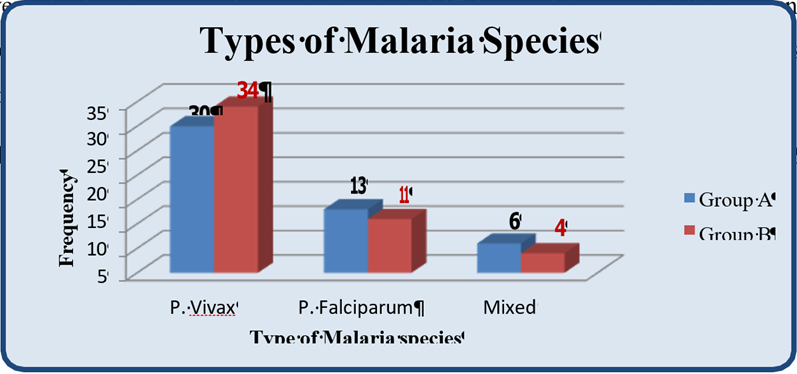
Figure No. 1 Types of Malaria Species in study participants (n1=49, n2=49).
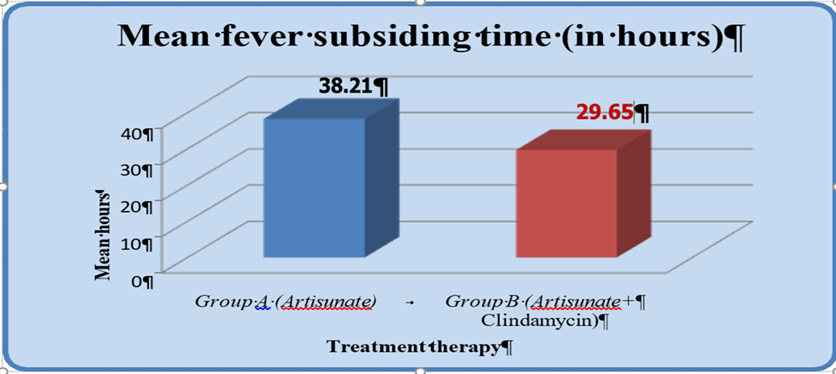
Figure No. 2 Mean fever subsiding time in study participants (n1=49, n2=49)
Mean fever subsiding time was observed after start of 1st dose and it was noted that in mono therapy fever subsiding time was 38.21 ± 6.32 hours while in in combination therapy time was 29.65 ± 4.92 hours with statistically significant difference (p value 0.014)
The above table shows the common side effects experienced by patients during treatment in malaria. most common side effects in group A were Nausea 26 (53.06%), vomiting 8 (16.32%), dizziness 7 ((14.28%), anorexia 12 (24.49%), headache16 (32.65%), and hypoglycaemia 7
(14.28%) while in group B nausea 29 (59.18%), vomiting 13 (26.53%), dizziness 9 (18.36%),
anorexia 16 (32.65%), headache 14 (28.57%), hypoglycaemia 17 (34.69%). Allergic reactions were uncommon in both groups.
Table No. 03 Common side effects observed in study participants
|
Sr. No. |
Side effects |
Group A |
Group B |
|
Frequency (%) |
Frequency (%) |
||
|
1 |
Nausea |
26 (53.06) |
29 (59.18) |
|
2 |
Vomiting |
8 (16.32) |
13 (26.53) |
|
3 |
Dizziness |
7 ((14.28) |
9 (18.36) |
|
4 |
Anorexia |
12 (24.49) |
16 (32.65) |
|
5 |
Headache |
16 (32.65) |
14 (28.57) |
|
6 |
Hypoglycaemia |
7 (14.28) |
17 (34.69) |
|
7 |
Allergic reactions |
1 (2.04) |
2 (4.08) |
Overall, combination therapy significantly reduced fever clearance time, while the incidence and profile of adverse effects were comparable between the two groups treated
DISCUSSION :
The epidemiology of malaria is undergoing rapid change, and eradication may be viable in certain endemic regions within the next decade. Nevertheless, malaria still poses a major global public health challenge. In the absence of an effective vaccine, chemotherapy combined with vector control remains the primary strategy for reducing malaria-related morbidity and mortality. Several studies have linked the emergence of antimalarial drug resistance, particularly to chloroquine, with increased rates of severe malarial anemia, mortality, and malaria-related complications [13].
Referring to WHO standards, who advocate combination of antimalarial medications for optimum results in the treatment of uncomplicated P. Falciparum as well as P. Malaria vivax [14]. Currently, several active antimalarial medications are used in conjunction with artesunate, a semisynthetic artemisinin compound, and other artemisinin derivatives to prevent or postpone the development of resistance to artemisinin derivatives [6].
Drug combinations based on artemisinin are the cornerstone in Africa's battle against drug- resistant malaria. Artemisinin-containing antimalarial medication combinations currently on the market are pharmacokinetically mismatched, which may raise the possibility of resistant mutant selection in regions with high malaria transmission rates. Tolerability was good and comparable in both groups, and no significant adverse events were reported [10]. The artesunate-clindamycin group in our study had much faster fever and parasite clearance times. In our study, patients treated with Artesunate plus clindamycin had better outcomes than those treated with Artesunate alone, and patients treated with combination therapy had a significantly shorter mean fever subsiding time (p value 0.014). This is in accordance to the study as well.
Artesunate-clindamycin combination therapy was shown to be satisfactorily effective in a research by Ramharter M et al. The PP population's total cure rate fell within the range of the cure rate linked to the conventional quinine-clindamycin regimen. The artesunate-clindamycin group showed shorter times to fever and parasite clearance, which are regarded as supporting indicators of antimalarial activity [15].
According to our study data most common side effects in group A were Nausea 26 (53.06%), vomiting 8 (16.32%), dizziness 7 (14.28%), anorexia 12 (24.49%), headache16 (32.65%), andhypoglycemia 7 (14.28%) while in group B nausea 29 (59.18%), vomiting 13 (26.53%), dizziness9 (18.36%), anorexia 16 (32.65%), headache 14 (28.57%), and hypoglycemia 17 (34.69%). A study by Akbar A. et al. reported that the most frequent malaria treatment-related adverse effects included nausea in 21 patients (20.2%), loss of appetite in 13 (12.5%), hypoglycemia in 11 (10.6%), diarrhea in 5 (4.8%), and rash in 2 (1.9%). Nausea showed a significant association with the IVA monotherapy group (p < 0.01), whereas hypoglycemia, observed in 10.6% of cases, occurred exclusively in the combination therapy group (p = 0.01) [16]. No cases of allergic reactions or anaphylactic shock were reported among participants in the referred, consistent with findings reported in other studies. [17].
CONCLUSION :
This study demonstrates that a three-day course of artesunate combined with clindamycin is an effective treatment option for patients with severe malaria. The findings further indicate that artesunate–clindamycin and other suitably matched artemisinin-based combination therapies with short plasma half-lives deserve greater consideration in high-transmission settings, where minimizing prolonged subtherapeutic drug exposure is critical to reducing the risk of drug resistance.
REFERENCES:
1. Tabassum S, Kalsoom T, Zaheer Z, Naeem A, Afifi A, Ohadi L. Reflections on the surge in malaria cases after unprecedented flooding in Pakistan-A commentary. Health Sci Rep. 2023 Oct 10;6(10):e16200.
2. Khan MI, Qureshi H, Bae SJ, Khattak AA, Anwar MS, Ahmad S, et al. Malaria prevalence in Pakistan: A systematic review and meta-analysis (2006-2021). Heliyon. 2023 Apr 11;9(4):e15373.
3. World Health Organization. Malaria Pakistan. Available at: https://www.who.int/emergencies/disease-outbreaknews/item/2022- DON413 [Accessed on 15-09-2025]
4. World Health Organization. The World Malaria Report 2019, Available at: https://www.who.int/publications-detail/worldmalaria-report-2019, [Accessed on 15- 09-2025]
5. Marwa K, Kapesa A, Baraka V, Konje E, Kidenya B, Mukonzo J, Kamugisha E, Swedberg
6. G. Therapeutic efficacy of artemether-lumefantrine, artesunate-amodiaquine and dihydroartemisinin-piperaquine in the treatment of uncomplicated Plasmodium falciparum malaria in Sub-Saharan Africa: A systematic review and meta-analysis. PLoS One. 2022;17(3):e0264339.
7. Adebayo JO, Tijjani H, Adegunloye AP, Ishola AA, Balogun EA, Malomo SO. Enhancing the antimalarial activity of artesunate. Parasitol Res. 2020;119(9):2749-2764.
8. Mharakurwa S, Matsena-Zingoni Z, Mudare N, Matimba C, Gara TX, Makuwaza A, et al. Steep Rebound of Chloroquine-Sensitive Plasmodium falciparum in Zimbabwe. J Infect Dis. 2021;223(2):306-309.
9. Borrmann S, Adegnika AA, Missinou MA, Binder RK, Issifou S, Schindler A, et al. Short- course artesunate treatment of uncomplicated Plasmodium falciparum malaria in Gabon. Antimicrob Agents Chemother. 2003;47(3):901-4.
10. Kremsner PG, Krishna S. Antimalarial combinations. Lancet. 2004;364(9430):285-94.
11. Kremsner PG, Ramharter M, Oyakhirome S, Klouwenberg PK, Adégnika AA, Agnandji ST, et al. Artesunate-clindamycin versus quinine-clindamycin in the treatment of Plasmodium falciparum malaria: a randomized controlled trial. Clin Infect Dis. 2005;40(12):1777-84.
12. Purnama Fitri P, Armila A, Lubis M, Pasaribu S, Lubis CP, Comparison of the efficacy of artesunate-amodiaquine with quinine-clindamycin for treatment of uncomplicated falciparum malaria in children, Pediatrica Indonesia, 2009;28(2):91-96
13. Li Q, Weina P. Artesunate: The Best Drug in the Treatment of Severe and Complicated Malaria. Pharmaceuticals (Basel). 2010 Jul 21;3(7):2322-2332. doi: 10.3390/ph3072322
14. Obonyo CO, Juma EA, Clindamycin plus quinine for treating uncomplicated falciparum malaria: a systematic review and meta-analysis. Malar J. 2012;11(20):. https://doi.org/10.1186/1475-2875-11-2
15. Nsonizau DMP, Kouzitissa DK, Wasadidi N, Mazoba TK, Damien MK, Critical Analysis of the Literature Comparing Artemisinin-Based Combination Therapy and Quinine Treatments for Uncomplicated Malaria in Pregnancy, Open Access Library Journal, 2024;11(2024):e10938.DOI: 10.4236/oalib.1110938
16. Ramharter M, Oyakhirome S, Klouwenberg PK, Adegnika AA, Agnandji S, Missinou MA, et al. Artesunate-Clindamycin versus Quinine-Clindamycin in the Treatment of Plasmodium falciparum Malaria: A Randomized Controlled Trial, Clinical Infectious Diseases, 2005;40(12):1777-84. DOI:10.1086/430309
17. Akbar A, Jabeen I, Kanwal K, Ilyas S, Ahmad S, Efficacy of Artesunate versus a Combination of Artesunate and Quinine Di-Hydrochloride Given Intravenously for the Treatment of Malaria; A Comparative Study: Pakistan Journal of Health Sciences, 2024; 5(11). https://doi.org/10.54393/pjhs.v5i11.19190
18. Dube SK, Panda PS, Agrawal GR, Singh DK. Anaphylaxis to artesunate? Indian J Crit Care Med. 2012 Jan;16(1):55-7. doi: 10.4103/0972-5229.94440