ASSOCIATION BETWEEN TRIGLYCERIDE–GLUCOSE INDEX AND HEART RATE VARIABILITY IN PREHYPERTENSIVE AND NORMOTENSIVE YOUNG ADULTS
- Anjali Gupta , Ph.D. Scholar, Department of Physiology, Index Medical College and Research Centre, Malwanchal University, Indore, India.
- Shrikrishna Nagorao Bamne , Professor, Department of Physiology, Krishna institute of medical sciences, Karad, Maharashtra, India
- Jyoti Dwivedi , Ph.D. Scholar, Department of Physiology, Index Medical College and Research Centre, Malwanchal University, Indore, India.
Article Information:
Abstract:
Prehypertension is considered an early stage of cardiovascular risk and is frequently associated with metabolic and autonomic alterations. The Triglyceride–Glucose (TyG) index is a simple surrogate marker of insulin resistance, while Heart Rate Variability (HRV) reflects autonomic nervous system activity. Early identification of metabolic and autonomic dysfunction in prehypertensive individuals may help in preventing future cardiovascular complications.Methods: This comparative cross-sectional study was conducted among 80 young adults aged 25–40 years, including 40 prehypertensive and 40 normotensive subjects. Blood pressure was recorded using standard sphygmomanometer methods. Fasting blood samples were collected for estimation of glucose and triglyceride levels, and TyG index was calculated. HRV assessment was performed using electrocardiographic recordings, and time-domain parameters including SDNN and RMSSD were analyzed. Statistical analysis included independent t-test for comparison between groups. A p-value <0.05 was considered statistically significant.Results: Prehypertensive subjects demonstrated significantly elevated SBP, DBP, and TyG index levels (124.44 ± 8.43 mmHg; 75.27 ± 6.70 mmHg; 8.60 ± 0.10) compared to normotensive subjects (107.12 ± 7.42 mmHg; 62.05 ± 5.51 mmHg; 8.40 ± 0.09) (p < 0.05). HRV parameters including SDNN and RMSSD were significantly reduced in prehypertensive individuals (24.97 ± 3.47 ms; 27.59 ± 2.76 ms) compared to normotensive controls (32.53 ± 3.11 ms; 33.84 ± 2.54 ms) (p < 0.05). These findings indicate early metabolic dysfunction and autonomic imbalance in prehypertensive young adults.Conclusion: Our study demonstrated significantly elevated TyG index along with reduced HRV parameters in prehypertensive young adults compared to normotensive individuals. These findings suggest the presence of early metabolic dysfunction and autonomic imbalance during the prehypertensive stage. Reduced HRV parameters indicate impaired autonomic regulation, while elevated TyG index reflects increased insulin resistance and cardiometabolic risk. Thus, assessment of TyG index and HRV parameters may serve as useful non-invasive markers for early identification of individuals at risk of future hypertension and cardiovascular disease.
Keywords:
Article :
INTRODUCTION:
Hypertension is one of the leading non-communicable diseases and a major contributor to cardiovascular morbidity and mortality worldwide. It is closely associated with several metabolic abnormalities such as obesity, insulin resistance, dyslipidemia, and diabetes mellitus. Early alterations in blood pressure regulation often begin during the prehypertensive stage, which significantly increases the risk of developing sustained hypertension and cardiovascular disease later in life[1]. In low- and middle-income nations, the percentage of young people with prehypertension is on the rise, and this condition progresses to hypertension as people get older.
In 2003, the term "prehypertension" was initially coined as one of the blood pressure categories by the Seventh Joint National Committee on Prevention, Detection, Evaluation, and Treatment of High Blood Pressure. Prehypertension, defined as systolic blood pressure between 120–139 mmHg and/or diastolic blood pressure between 80–89 mmHg, has emerged as an important public health concern. Studies have shown that individuals with prehypertension are at increased risk of stroke, coronary artery disease, chronic kidney disease, and cardiovascular mortality[2]. Furthermore, the prevalence of prehypertension among young adults is increasing due to sedentary lifestyle, unhealthy dietary habits, obesity, and reduced physical activity.
Insulin resistance plays a significant role in the pathogenesis of hypertension and cardiovascular diseases. Although the hyperinsulinemic-euglycemic clamp technique is considered the gold standard for assessment of insulin resistance, its complexity limits its routine clinical use. Therefore, surrogate markers such as the Triglyceride–Glucose (TyG) index have gained importance because they are simple, economical, and reliable indicators of insulin resistance[3]. Previous studies have demonstrated that elevated TyG index is significantly associated with prehypertension and hypertension[3].
Heart Rate Variability (HRV) is a non-invasive marker used to assess autonomic nervous system function. Reduced HRV reflects autonomic imbalance characterized by increased sympathetic activity and reduced parasympathetic activity, which are commonly observed in hypertension and metabolic disorders. Altered autonomic regulation has been identified even during the prehypertensive stage, suggesting early cardiovascular dysfunction before the development of overt hypertension.
Considering the growing burden of prehypertension among young adults and the limited data regarding the combined assessment of TyG index and HRV, the present study was undertaken to evaluate TyG index and HRV parameters among prehypertensive and normotensive individuals. Early identification of metabolic and autonomic dysfunction may help in prevention of future cardiovascular complications.
METHODOLOGY:
Study Design and Participants
A comparative cross-sectional study was conducted among 80 young adults aged 25–40 years, including 40 prehypertensive subjects and 40 normotensive controls. The study did not proceed with any procedures until all patients had given written informed consent. The research was carried out in the department of physiology's research lab at Index Medical College & Hospital in Indore, M.P., India. The study was approved by the institute's scientific advisory committee and human ethics committee.
There were two groups involved in the research are recruited from the Outpatient Unit of the Department of General Medicine at Index Medical College & Hospital in Indore. On the basis of the blood pressure levels, the following groups were formed according to the JNC-VII classification.
|
Group |
Systolic Blood Pressure(mmHg) |
Diastolic Blood Pressure(mmHg) |
|
Normotensive |
<120 |
<80 |
|
Prehypertension |
120-139 |
89-89 |
|
Stage I Hypertension |
140-159 |
90-99 |
|
Stage II Hypertension |
≥160 |
≥100 |
Prehypertensive subjects were enrolled according to JNC-VII criteria for prehypertension, defined as systolic blood pressure between 120–139 mmHg and/or diastolic blood pressure between 80–89 mmHg. Normotensive subjects with systolic blood pressure <120 mmHg and diastolic blood pressure <80 mmHg were included as controls.
Subjects with a history of hypertension, diabetes mellitus, cardiovascular disease, renal disorders, endocrine disorders, chronic inflammatory diseases, smoking, regular alcohol consumption, acute infections, or use of any medication were excluded from the study. Pregnant women were also excluded.
Written informed consent was obtained from all participants prior to enrollment. Detailed demographic, anthropometric, and clinical history of all subjects was recorded using a structured proforma.
Blood Pressure Measurement
Blood pressure was measured using a standard mercury sphygmomanometer under resting conditions. Participants were advised to avoid caffeine, smoking, and strenuous physical activity before recording. Measurements were taken in sitting position after 5 minutes of rest, and the average of two readings was considered for analysis.
Sample Collection and Biochemical Analysis
Approximately 3 mL of overnight fasting (8–12 hours) venous blood sample was collected from each participant under aseptic precautions. Blood samples were processed for estimation of fasting blood glucose and serum triglyceride levels using standard biochemical methods.
The Triglyceride–Glucose (TyG) index was calculated using the formula:
Heart Rate Variability Analysis
Heart Rate Variability assessment was performed in the Department of Physiology using electrocardiographic recordings under standardized resting conditions. Subjects were instructed to avoid heavy meals, caffeine, and physical exertion prior to HRV recording. Based on the 5-minute electrocardiography (ECG) recording while the subject was lying down, the resting heart rate variability (HRV) was calculated. The ML870 Power Lab 8/30 AD Instruments Data Acquisition Systems were used to digitize the ECG signals, which were then stored for offline analysis using the computer software Kubios HRV, version 2.1, Kuopio, Finland. After identifying the R-wave, the program calculated all of the RR intervals from the ECG data.
Time-domain HRV parameters including:
· Standard Deviation of NN intervals (SDNN)
· Root Mean Square of Successive Differences (RMSSD)
were analysed to assess autonomic nervous system activity.
Statistical Analysis
Statistical analysis was performed using IBM SPSS Statistics software version 25. All continuous variables were expressed as mean ± standard deviation (Mean ± SD). Independent unpaired t-test was used to compare study parameters between prehypertensive and normotensive groups. A p-value <0.05 was considered statistically significant.
RESULT AND OBSERVATION:
A total of 80 young adults were included in the study, comprising 40 normotensive and 40 prehypertensive subjects. The comparison of blood pressure, TyG index, and HRV parameters between the two groups is presented in Table 1.
|
Test Parameters |
Normotensive |
Prehypertensive |
p-value |
|
SBP(mmHg) |
107.12±7.42 |
124.44±8.43* |
<0.05 |
|
DBP(mmHg) |
62.05±5.51 |
75.27±6.70* |
<0.05 |
|
TyG index |
8.40±0.09 |
8.60±0.10* |
<0.05 |
|
|
32.53 ± 3.11 |
24.97 ± 3.47* |
<0.05 |
|
RMSSD(ms) |
33.84 ± 2.54 |
27.59 ± 2.76* |
<0.05 |
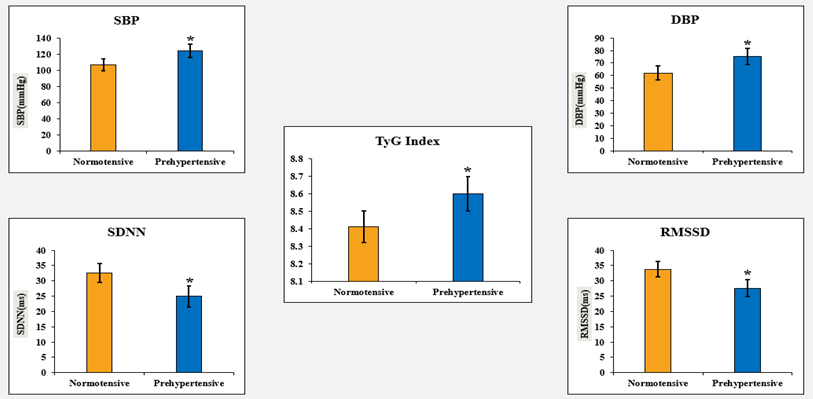
Figure 1 demonstrates comparison of SBP, DBP, TyG index, SDNN, and RMSSD between normotensive and prehypertensive groups. Values are represented as Mean ± SD for 40 subjects in each group. Significant differences were observed between the two groups for all studied parameters (p < 0.05).
Prehypertensive subjects demonstrated significantly elevated systolic blood pressure (SBP) levels (124.44 ± 8.43 mmHg) compared to normotensive subjects (107.12 ± 7.42 mmHg), with statistically significant difference (p < 0.05). Similarly, diastolic blood pressure (DBP) was significantly higher in prehypertensive individuals (75.27 ± 6.70 mmHg) compared to normotensive controls (62.05 ± 5.51 mmHg) (p < 0.05).
The TyG index was significantly elevated in the prehypertensive group (8.60 ± 0.10) compared to normotensive subjects (8.40 ± 0.09), indicating increased metabolic dysfunction and insulin resistance among prehypertensive individuals (p < 0.05).
Assessment of autonomic function revealed significant reduction in HRV parameters among prehypertensive subjects. SDNN values were significantly lower in the prehypertensive group (24.97 ± 3.47 ms) compared to normotensive controls (32.53 ± 3.11 ms) (p < 0.05). Similarly, RMSSD values were markedly reduced in prehypertensive subjects (27.59 ± 2.76 ms) compared to normotensive individuals (33.84 ± 2.54 ms), demonstrating statistically significant difference (p < 0.05).
These findings indicate that prehypertensive individuals exhibit elevated metabolic dysfunction along with reduced autonomic activity, suggesting early cardiometabolic and autonomic alterations during the prehypertensive stage.
DISCUSSION :
The present comparative cross-sectional study evaluated TyG index and HRV parameters among normotensive and prehypertensive young adults. Prehypertensive subjects demonstrated significantly higher systolic and diastolic blood pressure along with elevated TyG index compared to normotensive controls. In addition, HRV parameters including SDNN and RMSSD were significantly reduced in the prehypertensive group, suggesting the presence of early metabolic dysfunction and autonomic imbalance.
The significantly elevated blood pressure values observed in the present study indicate early cardiovascular dysregulation during the prehypertensive stage. Previous studies have reported that insulin resistance and endothelial dysfunction contribute significantly to the development of hypertension through mechanisms involving sympathetic overactivity, oxidative stress, sodium retention, and vascular dysfunction[4–6].
The elevated TyG index observed in the present study suggests underlying insulin resistance among prehypertensive individuals. TyG index has emerged as a reliable and economical surrogate marker of insulin resistance and has been associated with hypertension, metabolic syndrome, and cardiovascular disease. Moon et al. demonstrated that elevated TyG index predicts future atherosclerotic cardiovascular disease and adverse cardiometabolic outcomes[7]. Similarly, Sánchez-Íñigo et al. observed that TyG index may independently predict future cardiovascular events[8]. These findings support the role of TyG index as an early marker of cardiometabolic dysfunction.
Another important observation of the present study was the significant reduction in HRV parameters among prehypertensive subjects. HRV is a non-invasive marker of autonomic nervous system activity, and reduced HRV reflects sympathetic predominance with diminished parasympathetic modulation[9]. SDNN reflects overall autonomic variability, whereas RMSSD primarily represents parasympathetic activity.
The reduced SDNN and RMSSD observed in the present study are comparable with findings reported in earlier studies evaluating autonomic dysfunction in prehypertension and hypertension. Singh et al. demonstrated that reduced HRV is associated with increased risk of future hypertension[10]. Pal et al. also reported sympathovagal imbalance among prehypertensive individuals[11]. Similarly, Hoshi et al. observed that reduced HRV predicts increased risk of developing hypertension[12].
Reduced HRV in prehypertensive individuals may be attributed to insulin resistance, oxidative stress, endothelial dysfunction, chronic low-grade inflammation, and impaired baroreflex sensitivity[13]. Previous studies have also demonstrated close interaction between metabolic dysfunction and autonomic imbalance. Pikkujämsä et al. reported reduced HRV and impaired baroreflex sensitivity among hypertensive individuals with features of insulin resistance syndrome[14]. Saito et al. further demonstrated significant association between insulin resistance and altered autonomic regulation[15].
The coexistence of elevated TyG index and reduced HRV parameters observed in the present study therefore indicates early cardiometabolic dysfunction during the prehypertensive stage. These findings highlight the importance of early cardiovascular risk assessment in young adults. Since TyG index and HRV are simple and non-invasive markers, their assessment may help identify individuals at increased risk for future hypertension and cardiovascular disease. Early lifestyle modification and preventive interventions may therefore help reduce progression toward overt cardiometabolic disorders.
CONCLUSION :
The present study demonstrated that prehypertensive young adults exhibit significantly elevated TyG index along with reduced HRV parameters including SDNN and RMSSD when compared to normotensive individuals. These findings indicate the presence of early metabolic dysfunction and autonomic imbalance even before the development of established hypertension.
The elevated TyG index suggests increased insulin resistance and cardiometabolic risk, whereas reduced HRV parameters reflect impaired autonomic regulation characterized by sympathetic overactivity and reduced parasympathetic activity. The coexistence of these abnormalities highlights the early cardiovascular alterations associated with prehypertension.
Therefore, assessment of TyG index and HRV parameters may serve as useful non-invasive tools for early identification of individuals at risk for future hypertension and cardiovascular disease. Early lifestyle interventions and preventive strategies during the prehypertensive stage may help reduce progression toward overt cardiovascular and metabolic disorders.
LIMITATIONS OF THE STUDY
1. The present study was conducted on a relatively small sample size, which may limit the generalizability of the findings.
2. As the study was cross-sectional in design, causal relationship between TyG index and HRV parameters could not be established.
3. The study included only young adults from a single center therefore, the findings may not represent other populations or age groups.
ACKNOWLEDGEMENTS
We would like to acknowledge the help of all the Physicians, other staff members, lab mates for their constant help throughout the study and the participants who volunteered in the present study.
CONFLICT OF INTEREST
The authors declare that they have no conflicts of interest.
BIBLIOGRAPHY:
1. Rahman MA, Parvez M, Halder HR, Yadav UN, Mistry SK. Prevalence of and factors associated with prehypertension and hypertension among Bangladeshi young adults: An analysis of the Bangladesh Demographic and Health Survey 2017–18. Clin Epidemiol Glob Health. 2021;12:100912.
2. Huang Y, Cai X, Li Y, et al. Prehypertension and the risk of stroke: a meta-analysis. Neurology. 2014;82(13):1153-1161.
3. Zhang F, Zhang Y, Guo Z, Yang H, Ren M, Xing X, et al. The association of triglyceride and glucose index, and triglyceride to high-density lipoprotein cholesterol ratio with prehypertension and hypertension in normoglycemic subjects: A large cross-sectional population study. J Clin Hypertens (Greenwich). 2021;23(7):1405-1412.
4. Wang F, Han L, Hu D. Fasting insulin, insulin resistance and risk of hypertension in the general population: a meta-analysis. Clin Chim Acta. 2017;464:57-63.
5. Rett K, Wicklmayr M, Mehnert H. New aspects of insulin resistance in hypertension. Eur Heart J. 1994;15 Suppl C:78-81.
6. Lastra G, Dhuper S, Johnson MS, Sowers JR. Salt, aldosterone, and insulin resistance: impact on the cardiovascular system. Nat Rev Cardiol. 2010;7(10):577-584.
7. Moon JH, Kim Y, Oh TJ, Kwak SH, Park KS, Cho NH. Triglyceride-glucose index predicts future atherosclerotic cardiovascular diseases: A 16-year follow-up in a prospective community-dwelling cohort study. Endocrinol Metab. 2023;38(4):406-417.
8. Sánchez-Íñigo L, Navarro-González D, Fernández-Montero A, Pastrana-Delgado J, Martínez JA. The TyG index may predict the development of cardiovascular events. Eur J Clin Invest. 2016;46(2):189-197.
9. Task Force of the European Society of Cardiology and the North American Society of Pacing and Electrophysiology. Heart rate variability: Standards of measurement, physiological interpretation and clinical use. Circulation. 1996;93(5):1043-1065.
10. Singh JP, Larson MG, Tsuji H, Evans JC, O’Donnell CJ, Levy D. Reduced heart rate variability and new-onset hypertension: insights into pathogenesis of hypertension. Hypertension. 1998;32(2):293-297.
11. Pal GK, Pal P, Nanda N, Amudharaj D, Adithan C. Cardiovascular dysfunctions and sympathovagal imbalance in hypertension and prehypertension: physiological perspectives. Future Cardiol. 2013;9(1):53-69.
12. Hoshi RA, Santos IS, Dantas EM, Andreão RV, Mill JG, Lotufo PA, et al. Reduced heart-rate variability and increased risk of hypertension: a prospective study of the ELSA-Brasil. J Hum Hypertens. 2021;35(12):1088-1097.
13. Sammito S, Thielmann B, Böckelmann I. Factors influencing heart rate variability: an update-a narrative review. Front Physiol. 2024;15:1430458.
14. Pikkujämsä SM, Huikuri HV, Airaksinen KEJ, Rantala AO, Kauma H, Lilja M, et al. Heart rate variability and baroreflex sensitivity in hypertensive subjects with and without metabolic features of the insulin-resistance syndrome. Am J Hypertens. 1998;11(5):523-531.
15. Saito I, Hitsumoto S, Takeishi Y, Yamada N, Shiba N, Tanida S, et al. Heart rate variability, insulin resistance and insulin sensitivity in Japanese adults: the Toon Health Study. PLoS One. 2015;10(8):e0137837.