Synthesis in Vitro Anti-inflammatory Activity and Molecular Docking of Some New Thiazole-Linked Oxopyrimidine Derivatives
- Samadhan S. More , Department of Chemistry, Milind College of Science, Nagsenvana, Chhatrapati Sambhajinagar - 431002, Maharashtra, India
- Shivcharan L. Rathod , Department of Chemistry, Milind College of Science, Nagsenvana, Chhatrapati Sambhajinagar - 431002, Maharashtra, India
- Achut S. Munde , Department of Chemistry, Milind College of Science, Nagsenvana, Chhatrapati Sambhajinagar - 431002, Maharashtra, India
- Rahul A. Waghmare , Department of Chemistry, Milind College of Science, Nagsenvana, Chhatrapati Sambhajinagar - 431002, Maharashtra, India
Article Information:
Abstract:
N(4(((4(2oxo6phenyl1,2,3,6tetrahydropyrimidin4yl)phenyl)amino)methyl)thiazol2yl)methanesulfonamide (11a-j) were synthesized by convenient synthetic protocols and characterized by FT-IR, 1H NMR, Mass Spectroscopy techniques and elemental analyses. Molecular docking study of the synthesized compounds at the DNA cleavage site of Cyclooxygenase-2 (PDB ID: 1CX2) was done. The interactions of all compounds with the Cyclooxygenase-2 complex were analyzed and found that most compounds showed similar binding patterns with amino acid residues and DNA fragments at the binding site. All the synthesized compounds (11a-j) were screened for in vitro anti-inflammatory activity by protein denaturation assay (Egg albumin), by the modified Williams et al method, with 50µg/ml drug concentration. The most active compounds were 11f and other derivatives 11a, 11c, 11g and 11j were found to be the most potent as compared to the standard drug Ibuprofen.
Keywords:
Article :
INTRODUCTION:
One of the main objectives of organic and medicinal chemistry is to create molecules with therapeutic potential for use as human treatments. In the past ten years, combinatorial chemistry has created chemical libraries. The family of compounds known as heterocyclic scaffolds has well-established uses in medical chemistry are given specific consideration in preferred configurations [1,2]. There is biological activity in many five-membered molecules with two heteroatoms, amino thiazole rings are one of these. [3] Because of its many therapeutic uses, thiazole is an excellent pharmacophore nucleus. Numerous pharmacological activities, including antioxidant, analgesic, antibacterial, anticancer, antiallergic, antihypertensive, anti-inflammatory, antimalarial, antifungal, and antipsychotic, are exhibited by its constituents [4–8]. Among the several aromatic heterocycles in the drug development process, thiazoles, a ring structure found in several commercially available drugs, play an important role. Strong anti-inflammatory properties have been found in compounds containing thiazoles with different pharmacodynamic nuclei [9–11]. Thiazole compounds were described as selective COX-2 inhibitors by Therien et al. [12] and Roy et al. [13]. Heterocyclic compounds containing the pyrimidine moiety are of great interest because they constitute an important class of natural and non-natural products, many of which exhibit useful biological activities and clinical applications [14,15]. Because they make up a significant class of both natural and artificial products, many of which have beneficial biological functions and therapeutic uses, heterocyclic compounds with pyrimidine moieties are of great interest. A recent study has focused on heterocyclic compounds with the pyrimidine moiety because of their many biological effects, including anti-inflammatory, antioxidant, antibacterial, anticancer, antiviral, antidepressant, antiplatelet, antihypertensive, and herbicidal properties. Furthermore, many pharmaceutical drugs and natural items contain molecules that contain pyrimidines [16]. Building on our previous study, the objective of this work is to create a novel class of thiazole derivatives with oxopyrimidine-linked thiazole that have stronger anti-inflammatory characteristics using a simple technique. Their anti-inflammatory potential is evaluated using molecular docking studies, and anti-inflammatory properties are screened in vitro using the protein denaturation assay (Egg albumin) [17].
EXPERIMENTAL
Experimental Section: All the Melting points were determined in open capillaries. 1H NMR spectral data were recorded at 500 MHz (Bruker Avance) Cryo-magnet Spectrometer in DMSO Solvent using TMS as an internal standard. IR spectral data were recorded on an FT Infra-Red Spectrophotometer Model RZX Perkin Elmer. The synthesized products were confirmed by the comparison of their Mass, IR, and 1H NMR spectral data. TLC was carried out on Silica gel G (Merk) plates with an n-Hexane/Ethyl Acetate system.
Chemical and Material
Procedure for the synthesis of 2-Amino-4-(chloromethyl) thiazole hydrochloride (3)
Thiourea ( 7.4 mmol) was added to a solution of 1, 3-dichloropropanone (7.4 mmol) in absolute ethanol (40 ml). The mixture was stirred at room temperature for 24 h and then kept at 5 °C for 12 h. The crystalline material was collected by filtration and recrystallized from ethanol to yield (70%) of hydrochloride with m. p. 143–144 °C. Lit.. 9 mp. 144–145 °C. [18]
Procedure for the synthesis of 2-methylsulphinamino-4-chloromethyl thiazole (5)
Triethyl amine (7.4 mmol) was added to a solution of 2-Amino-(4 chloromethyl) thiazole hydrochloride (7.4 mmol) in DCM (40 ml). The mixture was stirred at room temperature for 30 minutes until a pink colour was observed, which indicates the generation of free 2-amino-4-chloromethyl thiazole. Then the reaction mass is cooled to 0-5 °C, and to it, cooled mesyl chloride (50mmol) was added in one lot. Keeping the temperature and stirring constant, triethylamine (55mmol) was added dropwise to the reaction mass. After complete addition, the reaction mass was stirred at r.t. overnight. The progress of the reaction was monitored by thin-layer chromatography, using n-hexane/ethyl acetate as a solvent system.[18] On completion of the reaction, the product was isolated by pouring the reaction mass into 40 ml water in a separating funnel, followed by separation, drying on sodium sulfate, and finally removing DCM on Rota evaporator to give white crystalline material, which was further recrystallized in ethanol to yield (62%).
General procedure for the preparation of 1-(4-aminophenyl)-3-phenylprop-2en-1-ones (8a-j)
Equimolar quantity (0.01mol) of 4-Amino acetophenone and respective aryl aldehyde were mixed and dissolved in 30 ml of alcohol. To this, add aqueous potassium hydroxide (KOH) 20% solution then it was continuously stirred for 24 hours at room temperature. The reaction progress was monitored on Thin Layer Chromatography (n-hexane /Ethyl Acetate, 8:2). After completion of the reaction, it was poured on crushed Ice and neutralized with dilute. HCl and the obtained product were filtered, dried and recrystallised from alcohol. The physical data is recorded and correlated with the reference [19].
General procedure for the preparation of 6-(4-aminophenyl)-4-phenyl-3,4-dihydropyrimidin-2(1H)-one (10a-j)
A Mixture of Chalcones (0.01mol) and Urea (0.02mol) was taken in Ethanol (30ml) and Conc. HCl (3ml) was added slowly with constant stirring, and the reaction mixture was refluxed for 15 hours. The reaction's progress was monitored on Thin Layer Chromatography (n-Hexane/Ethyl Acetate). After completion of the reaction, it was poured on crushed Ice, filtered, dried and recrystallized from alcohol. The physical data is recorded and correlated with reference [20, 21].
SynthesisofN(4(((4(2oxo6phenyl1,2,3,6tetrahydropyrimidin4yl)phenyl)amino)methyl)thiazol2yl)methanesulfonamide (11a-j)
To the stirred solution (0.001mol) of compound 5 in 20 ml acetone add Compound 10a-j (0.001mol), and stirred the reaction mixture for 8 hrs, maintaining the temp 45-50oC the pH was kept neutral by the appropriate addition of 10% K2CO3 Solution. The temperature was steadily raised to 45 °C maintained for 6 hours. The reaction progress was monitored on Thin Layer Chromatography (n-Hexane/Ethyl Acetate, 7:2). After completion of the reaction, it was poured on crushed Ice. The solid obtained product was filtered and dried. The crude was purified and recrystallized from Acetone
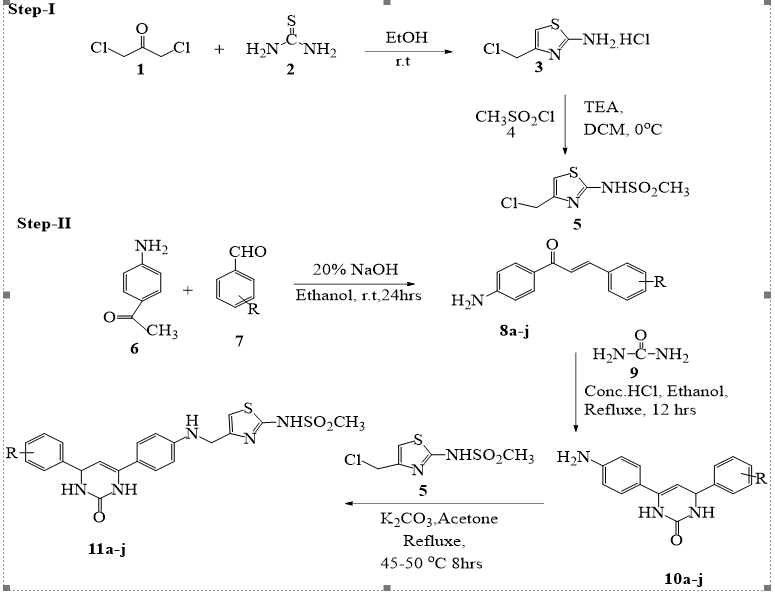
Where: R=H, 2-Cl, 4-Cl, 2,4-Cl, 2-F, 4-F, 4-Br, 2-CH3, 4-CH3, 4-OCH3
Scheme:N-(4-(((4-(2-oxo-6-phenyl-1,2,3,6-tetrahydropyrimidin-4-yl)phenyl)amino)methyl)thiazol-2-yl)methanesulfonamide
Spectral data of intermediate, 2-methylsulphonyl amino -4-chloromethyl thiazole(5): Yield-62%, mp-178-180°C
IR (cm -1): 3256 (NH stretch), 3246 (aromatic CH), 3110 (aromatic CH), 2927 (aliphatic CH), 2857 (aliphatic CH), 1717(C=N strech) 1606 (C=C), 1552 (NH bend), 1293 (S=O assy.) and 1119 (S=O symm.). 1H NMR (DMSO-d6, 300 MHz), δ(ppm) : 3.87 (s, 3H,SO2CH3), 4.61(s, 2H,CH2Cl) and 6.91(s, 1H,thizolyl) and12.50 (s,1H,NH, exchangable with D2O). 13C NMR (DMSOd6, 75 MHz) δ(ppm): 43.07, 56.24, 107.93, 124.81 and 168.05. MS (ESI+ mode): m/z (% intensity): 226. 96 (M+,100), 228.96 (M+2,30). Elemental Analysis : M.F-C5H7ClN2O2S2: Found% (Calculated %): C, 26.23 (26.49); H, 3.09 (3.11); N, 12.31 (12.36); S, 28.25 (28.29).
N-(4-(((4-(2-oxo-6-phenyl-1,2,3,6-tetrahydropyrimidin-4-yl)phenyl)amino)methyl)thiazol-2-yl)methanesulfonamide (11a)
Yield 87%, m.p. 107-109°C. IR (KBr, Vmax,cm-1):3440,3120 (NH-Stretch), 2893 (-C-H-stretch in Ar-H), 1685(C=O stretch in amide Carbonyl), 1562 (C=N amide), 1302 (C-N amine). 1H NMR (DMSO, 500MHz, δ ppm): 10.87 (s, 1H, -NH), 9.07 (s,1H,-NH),7.83(d,2H), 7.68(s,1H NH), 7.20-7.39 (m5H), 6.70(s,1H NH), 6.68 (d,2H), 6.35(s,1H), 6.09 (d,1H), 5.97(d,1H) 4.61(d 2H), 3.14(s 3H) Mass (m/z): 456.11 [m+1] Chemical Formula: C21H21N5O3S2 Elemental Analysis: C, 55.37; H, 4.65; N, 15.37; O, 10.54; S, 14.08 Found: C, 55.13; H, 4.31; N, 15.11; O, 10.16; S, 13.98
N-(4-(((4-(6-(2-chlorophenyl)-2-oxo-1,2,3,6-tetrahydropyrimidin-4-yl)phenyl)amino)methyl)thiazol-2-yl)methanesulfonamide (11b)
Yield 81%, m.p. 95-97°C. IR (KBr, Vmax,cm-1):3440,3120 (NH-Stretch), 2893 (-C-H-stretch in Ar-H), 1680 (C=O stretch in amid Carbonyl), 1562 (C=N amide), 1298 (C-N amine), 754 (C-Cl). 1H NMR (DMSO, 500MHz, δ ppm): 10.91 (s, 1H, -NH), 9.11 (s,1H,-NH),7.68(d,2H), 7.64(s,1H NH), 7.60(dd,1H ), 7.30 (m,1H), 7.28(dd,1H ), 7.22 (m,1H), 6.69(d,2H), 6.70 (s,1H NH), 6.35(s,1H) 6.10(d 1H), 5.97(d,1H ), 4.63 (d,2H), 3.13(s 3H) Mass (m/z): 490.07 [m+1] Formula: C21H20ClN5O3S2 Elemental Analysis: C, 51.48; H, 4.11; Cl, 7.23; N, 14.29; O, 9.80; S, 13.09 Found :C, 51.31; H, 4.01; Cl, 7.09; N, 14.17; O, 9.74; S, 13.01
N-(4-(((4-(6-(4-chlorophenyl)-2-oxo-1,2,3,6-tetrahydropyrimidin-4-yl)phenyl)amino)methyl)thiazol-2-yl)methanesulfonamide (11c)
Yield 89%, m.p. 91-93°C. IR (KBr, Vmax,cm-1):3440,3120 (NH-Stretch), 2893 (-C-H-stretch in Ar-H), 1680 (C=O stretch in amid Carbonyl), 1562 (C=N amide),1295 (C-N amine), 770 (C-Cl). 1H NMR (DMSO, 500MHz, δ ppm): 10.85 (s, 1H, -NH), 9.11 (s,1H,-NH),7.62(d,1H),7.60 (d,2H), 7.44(d,2H ), 7.32(d,2H ), 6.70 (s,1H NH), 6.68(d,2H ), 6.35 (s,1H), 6.15(d,1H), 5.97(d, 1H) 4.61(d,2H) 3.14(s 3H), Mass (m/z): 490.07 [m+1] Formula: C21H20ClN5O3S2 Elemental Analysis: C, 51.48; H, 4.11; Cl, 7.23; N, 14.29; O, 9.80; S, 13.09 Found :C, 51.39; H, 4.03; Cl, 7.11; N, 14.17; O, 9.71; S, 13.02
N-(4-(((4-(6-(2,4-dichlorophenyl)-2-oxo-1,2,3,6-tetrahydropyrimidin-4-yl)phenyl)amino)methyl)thiazol-2-yl)methanesulfonamide (11d)
Yield 88%, m.p. 86-88°C. IR (KBr, Vmax,cm-1):3440,3120 (NH-Stretch), 2893 (-C-H-stretch in Ar-H), 1689(C=O stretch in amid Carbonyl), 1562 (C=N amide), 1297 (C-N amine), 778 (C-Cl). 1H NMR (DMSO, 500MHz, δ ppm): 10.90 (s, 1H, -NH), 9.14 (s,1H,-NH),7.96(d,1H), 7.60(d,2H ), 7.30(dd,1H ), 7.20 (d,1H), 6.73(d,2H ), 6.70 (s,1H NH), 6.38(s,1H), 6.15 (d,1H ), 5.97(d,1H) 4.61(d,2H), 3.14(s,3H ), Mass (m/z): 524.03 [m+1] Formula: C21H19Cl2N5O3S2 Elemental Analysis: C, 48.10; H, 3.65; Cl, 13.52; N, 13.35; O, 9.15; S, 12.23.Found: C, 48.02; H, 3.44; Cl, 13.37; N, 13.19; O, 9.08; S, 12.12
N-(4-(((4-(6-(2-fluorophenyl)-2-oxo-1,2,3,6-tetrahydropyrimidin-4-yl)phenyl)amino)methyl)thiazol-2-yl)methanesulfonamide (11e)Yield 91%, m.p. 81-83°C. IR (KBr, Vmax,cm-1):3440,3120 (NH-Stretch), 2893 (-C-H-stretch in Ar-H), 1685 (C=O stretch in amid Carbonyl), 1298 (C-N amine), 1562 (C=N amide), 968(C-F). 1H NMR (DMSO, 500MHz, δ ppm): 10.83 (s, 1H, -NH), 9.11 (s,1H,-NH),7.69(m,1H), 7.65(s,1H NH), 7.62 (d,2H), 7.60(dd,1H), 7.30 (dd,1H), 7.16(m,1H), 6.72 (s,1H NH), 6.35(s,1H) 6.15(d,1H), 5.97(d,1H) 4.64(d,2H), 3.14(s,3H ), Mass (m/z): 474.10[m+1] Formula: C21H20FN5O3S2 Elemental Analysis: C, 53.26; H, 4.26; F, 4.01; N, 14.79; O, 10.14; S, 13.54 Found C, 53.12; H, 4.14; F, 3.91; N, 14.68; O, 10.03; S, 13.32
N-(4-(((4-(6-(4-fluorophenyl)-2-oxo-1,2,3,6-tetrahydropyrimidin-4-yl)phenyl)amino)methyl)thiazol-2-yl)methanesulfonamide (11f) Yield 83%, m.p. 81-83°C. IR (KBr, Vmax,cm-1):3440,3120 (NH-Stretch), 2893 (-C-H-stretch in Ar-H), 1688 (C=O stretch in amid Carbonyl), 1562 (C=N amide),1299 (C-N amine), 965(C-F). 1H NMR (DMSO, 500MHz, δ ppm): 10.88 (s, 1H, -NH), 9.11 (s,1H,-NH),7.65(d,1H),7.62 (d,2H), 7.30(d,2H ), 7.20(d,2H ), 6.70 (s,1H NH), 6.67(d,2H ), 6.38 (s,1H), 6.15(d,1H), 5.97(d, 1H) 4.63(d,2H) 3.16(s 3H), Mass (m/z): 474.10 [m+1] Chemical Formula: C21H20FN5O3S2 Elemental Analysis: C, 53.26; H, 4.26; F, 4.01; N, 14.79; O, 10.14; S, 13.54 Found :C, 53.12; H, 4.11; F, 3.98; N, 14.66; O, 10.04; S, 13.40
N-(4-(((4-(6-(4-bromophenyl)-2-oxo-1,2,3,6-tetrahydropyrimidin-4-yl)phenyl)amino)methyl)thiazol-2-yl)methanesulfonamide (11g) Yield 91%, m.p. 104-106°C. IR (KBr, Vmax,cm-1):3440,3120 (NH-Stretch), 2893 (-C-H-stretch in Ar-H), 1684 (C=O stretch in amid Carbonyl), 1562 (C=N amide), 1298 (C-N amine), 1121(C-Br). 1H NMR (DMSO, 500MHz, δ ppm): 10.91 (s, 1H, -NH), 9.14 (s,1H,-NH),8.07(d,2H), 7.74 (d,2H), 7.67(s,1H NH ), 7.22(d,2H ), 6.34 (s,1H ), 6.16(d,1H ), 6.70 (s,1H NH), 6.67(d,2H), 5.97(d, 1H) 4.64(d,2H) 3.12(s 3H), Mass (m/z): 534.02 [m+1] Chemical Formula: C21H20BrN5O3S2 Elemental Analysis: C, 47.19; H, 3.77; Br, 14.95; N, 13.10; O, 8.98; S, 12.00 Found: C, 47.07; H, 3.61; Br, 14.83; N, 13.01; O, 8.82; S, 11.97
N-(4-(((4-(2-oxo-6-(o-tolyl)-1,2,3,6-tetrahydropyrimidin-4-yl)phenyl)amino)methyl)thiazol-yl)methanesulfonamide (11h) Yield 79%, m.p. 100-101°C. IR (KBr, Vmax,cm-1):3440,3120 (NH-Stretch), 2893 (-C-H-stretch in Ar-H), 1683 (C=O stretch in amid Carbonyl),1294 (C-N amine), 1300 (C-N amine), 1562 (C=N amide). 1H NMR (DMSO, 500MHz, δ ppm): 10.87 (s, 1H, -NH), 9.13 (s,1H,-NH),7.81(d,2H), 7.71(s,1H NH), 7.35 (dd,1H), 7.25(dd,1H), 7.21 (dd,1H), 7.15(dd,1H), 6.76 (d,2H), 6.72 (s,1H NH), 6.33(s,1H) 6.12(d,1H), 5.95(d,1H), 4.66(d,2H), 3.17(s,3H ), 2.38 (s,3H ), Mass (m/z): 470.12[m+1] Chemical Formula: C22H23N5O3S2 Elemental Analysis: C, 56.27; H, 4.94; N, 14.91; O, 10.22; S, 13.65 found: C, 56.17; H, 4.81; N, 14.80; O, 10.09; S, 13.51
N-(4-(((4-(2-oxo-6-(p-tolyl)-1,2,3,6-tetrahydropyrimidin-4-yl)phenyl)amino)methyl)thiazol-2-yl)methanesulfonamide (11i) Yield 90%, m.p. 97-99°C. IR (KBr, Vmax,cm-1):3440,3120 (NH-Stretch), 2893 (-C-H-stretch in Ar-H), 1685 (C=O stretch in amid Carbonyl), 1296 (C-N amine), 1562 (C=N amide). 1H NMR (DMSO, 500MHz, δ ppm): 10.89 (s, 1H, -NH), 9.13 (s,1H,-NH), 7.81(d,2H), 7.71 (s,1H NH), 7.25(d,2H ), 7.12(d,2H ), 6.72 (s,1H NH ), 6.66(d,2H ), 6.31 (s,1H ), 6.11(d,1H), 5.95(d, 1H) 4.63(d,2H) 3.18(s 3H), 2.40(s 3H), Mass (m/z): 469.13 [m+1] Chemical Formula: C22H23N5O3S2 Elemental Analysis: C, 56.27; H, 4.94; N, 14.91; O, 10.22; S, 13.65 Found: C, 56.16; H, 4.86; N, 14.82; O, 10.14; S, 13.56
N-(4-(((4-(6-(4-methoxyphenyl)-2-oxo-1,2,3,6-tetrahydropyrimidin-4-yl)phenyl)amino)methyl)thiazol-2-yl)methanesulfonamide (11j)Yield 78%, m.p. 93-95°C. IR (KBr, Vmax,cm-1):3440,3120 (NH-Stretch), 2893 (-C-H-stretch in Ar-H), 1679 (C=O stretch in amid Carbonyl), 1302 (C-N amine), 1562 (C=N amide), 1119 (C-O-C). 1H NMR (DMSO, 500MHz, δ ppm): 10.84 (s, 1H, -NH), 9.15 (s,1H,-NH), 7.85(d,2H), 7.73 (s,1H NH), 7.19(d,2H ), 6.81(d,2H ), 6.76 (s,1H NH ), 6.68(d,2H ), 6.36 (s,1H ), 6.12(d,1H), 5.98(d, 1H) 4.65(d,2H) 3.73(s 3H), 3.13(s 3H), Mass (m/z): 486.12 [m+1] Chemical Formula: C22H23N5O4S2 Elemental Analysis: C, 54.42; H, 4.77; N, 14.42; O, 13.18; S, 13.20 Found: C, 54.32; H, 4.64; N, 14.35; O, 13.11; S, 13.09
Molecular docking
The molecular docking study of compounds was carried out at the DNA cleavage site of Cyclooxygenase -2 (PDB ID: 1CX2) [22]. The main purpose of docking studies was to investigate the possible interactions of synthesized compounds with the above enzymes in order to support the analgesic activity [23]. Docking algorithms provide essential structural information about protein-drug interactions, which play a pivotal role in drug development [24]. Molecular docking tools were used to predict the orientation of the newly designed nove
N-(4-(((4-(6-(4-fluorophenyl)-2-oxo-1,2,3,6-tetrahydropyrimidin-4-yl)phenyl)amino)methyl)thiazol-2-yl)methanesulfonamide (11f) of hybrids within the constraints of protein binding pockets [25]. The Cyclooxygenase -2 inhibition results of these hybrids (11a-j) encouraged us to perform molecular docking studies and compare the results with the Cyclooxygenase -2 inhibitor [23].
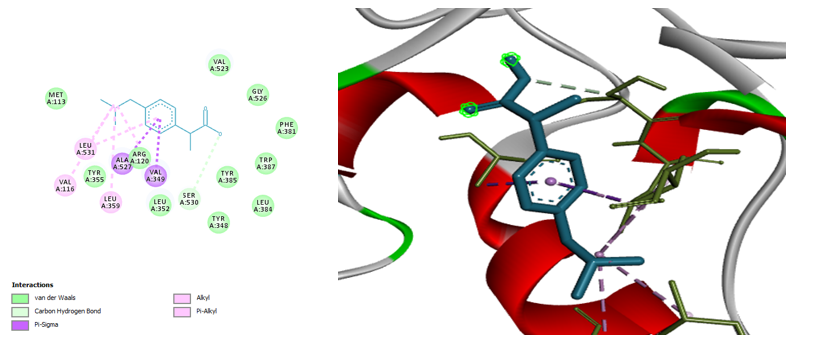
Fig. No.1 Docking pose of Ibuprofen with 1COX2
The docking of the standard Ibuprofen showed that Ibuprofen bind at the DNA cleavage site with binding affinity of–7.5 kcal/mol by establishing pi-sigma bond with amino acid residue ALA-527 and VAL-349 [26] The docking study of synthesized compound showed that compound 11f was able to interact perfectly within the active site of enzyme with binding affinity of -11.4 kcal/mol by developing hydrogen bond with amino acid residue
LYS-3468, ALA-3156, GUN-2327, CYS-036 and TYR-3156 [25] The interaction of all compounds with Cyclooxygenase -2 complex were analyzed and it was revealed that most compounds exhibited identical binding patterns with amino acid residues and DNA fragments at the binding site [23,25] These docking findings suggested that the synthesized compounds were found to be secured within the Cyclooxygenase -2 hydrophobic DNA cleavage site [24]
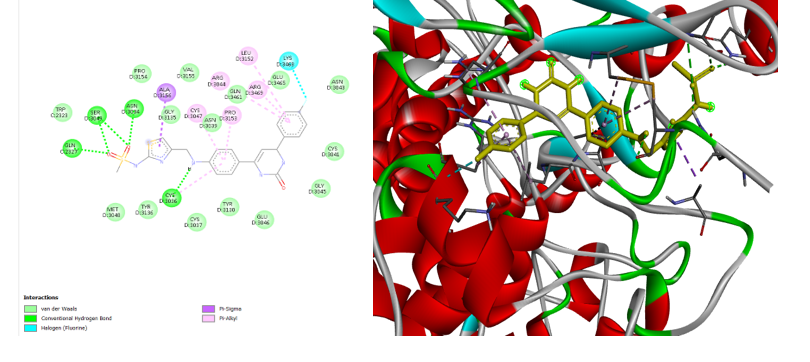
Fig. No.1 Docking pose of 11f with 1CX2
Table no. 1 Docking score
Target Molecule: 1CX2 (Cyclooxygenase-2)
|
Sr. No. |
Drug code |
Binding affinity kcal/mol |
|
1 |
11a |
-11.3 |
|
2 |
11b |
-10.7 |
|
3 |
11c |
-11.4 |
|
4 |
11d |
-11.0 |
|
5 |
11e |
-10.4 |
|
6 |
11f |
-11.5 |
|
7 |
11g |
-11.4 |
|
8 |
11h |
-10.5 |
|
9 |
11i |
-10.4 |
|
10 |
11j |
-11.2 |
|
11 |
Ibuprofen |
-7.5 |
Anti-inflammatory activity
By using the protein Denaturation Assay. (Hen egg albumin) The anti-inflammatory activities of synthesized compounds were determined using a modified version of the BSA assay reported by Williams et al. [27]. The in vitro anti-inflammatory activity by the protein denaturation assay using egg albumin was determined. The reaction mixture (5ml) was prepared, containing 2ml of diluted egg albumin (2% v/v in DI water), 1.0 ml of phosphate buffer saline (PBS, pH 6.4) and 2ml of samples (50µg/ml, prepared using DMF and water and DMF percentage is less than 0.2%) and in the case of the control, 2 ml of DI water. Then the mixtures were incubated for 10 minutes at 37°C and then heated at 60°C in a water bath for an additional 10 minutes to induce denaturation of egg albumin. After cooling the mixture, the absorbance was measured at 660 nm (UV-1700 PharmaSpec UV-visible Shimadzu Spectrophotometer). Standard Clinical Drugs Ibuprofen were used as a positive control for the study [28]. The mean absorbance values were noted after the trials were carried out in triplicate. The following formula was used to calculate the percentage inhibition of precipitation (protein denaturation) in comparison to the negative control [29].
Table 2 screened for in vitro anti-inflammatory activity, by (hen Egg albumin) protein denaturation assay
|
Sr. No. |
Compounds |
Mean absorbance value |
Inhibition of denaturation (in %) |
|
1 |
control |
0.036 |
- |
|
2 |
Ibuprofen |
0.0691 |
91.94% |
|
3 |
11a |
0.0664 |
84.44% |
|
4 |
11b |
0.0687 |
90.83% |
|
5 |
11c |
0.0621 |
72.50% |
|
6 |
11d |
0.0689 |
91.38% |
|
7 |
11e |
0.0613 |
70.27% |
|
8 |
11f |
0.0692 |
92.22% |
|
9 |
11g |
0.0683 |
89.72% |
|
10 |
11h |
0.0647 |
79.22% |
|
11 |
11i |
0.0638 |
77.22% |
|
12 |
11j |
0.0612 |
70.27% |
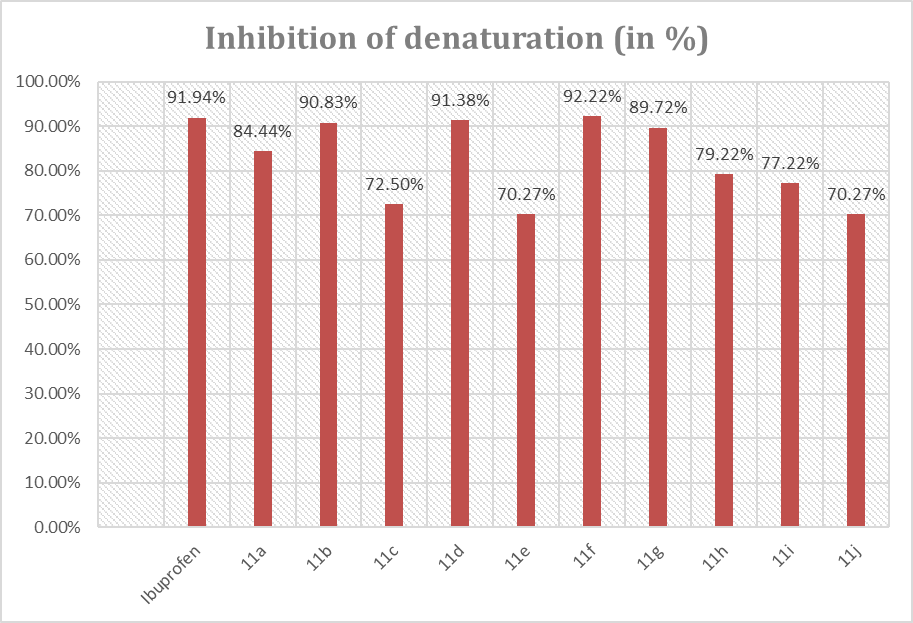
The percentage of protein denaturation was determined using the following equation
% of Inhibition = (Vt / Vc – 1) × 100
Where,
· Vt = Mean absorbance value of test group.
· Vc = Mean absorbance value of the control group
· * % Anti-Denaturation Activity = % Inhibition of Protein Denaturation = % Anti-inflammatory Activity
RESULT AND DISCUSSION:
Literature survey reveals that there are no reports of N-(4-(((4-(2-oxo-6-phenyl-1,2,3,6-tetrahydropyrimidin-4-yl)phenyl)amino)methyl)thiazol-2 yl)methanesulfonamide , hence it was planned to synthesize these compounds. In the present study, step-I, 1,3-dichloropropanone (1) is reacted with thiourea (2) in the presence of ethanol to yield 2-amino-4-(chloromethyl) thiazole hydrochloride (3) in good yield. 2-amino-4-(chloromethyl) thiazole hydrochloride reacted with methyl sulphonyl chloride (4) in the presence of TEA in DCM as a solvent to yield 2-methylsulphinamio-4-chloromethyl thiazole (5). The IR spectra of compound (5) show a strong absorption band at 3256 cm-1, indicating the stretching frequency of the NH functional group. 1293 cm-1 and 1119 cm-1 show stretching frequency of S=O asymmetrical and S=O symmetry, which conform to the thiazole (5) functional groups. 1H NMR spectrum of compound (5) shows a singlet at 12.50 ppm for NH, again a singlet at 6.91 ppm confirms the thiazolyl H. Mass spectral shows the molecular ion peak at 226.96 [M+].
All the spectral analysis confirmations of the thiazole (5) compound. Step-II, 4-amino acetophenone (6), is reacted with the substituted aryl aldehydes (7) in the presence of NaOH, followed by a condensation reaction to yield 1-(4-aminophenyl) 3-phenylprop-2-en-1-one compound derivatives (8a-j) with good yield. Further synthesis, Compounds (8a-j) reacted with the compound (9), which yielded compounds (10a-j). In the final step, compound (10a-j) reacted with compound (5) in the presence of K2CO3 and Acetone as solvent to yield (11a-j) with excellent yield. The IR spectra of (11a) show a strong absorption band at 3440 cm-1 and 3120 cm-1, indicating the Stretching frequency of the -NH- functional group. 1562 cm-1 is the stretching of (-C=N in stretch), 1685cm-1 is the value for (-C=O) stretching in pyrazoline, confirming the synthesis of coupling of oxopyrimidine derivatives with thiazole. 1H NMR Spectrum of (11a) show that a singlet at δ 10.87 ppm for (-NH-) confirms secondary amine, again a singlet at δ 6.70 ppm confirms the (-NH-) coupling of thiazole. The Mass Spectra shows the molecular Ion peak at 456.11 [m+1]. All these Spectral analyses show the Confirmation of the synthesis of (11a-j) compounds. The molecular docking investigation of the compounds was performed at the DNA cleavage site of Cyclooxygenase -2 (PDB ID: 1CX2). The docking of the standard Ibuprofen indicated the binding of Ibuprofen at the DNA cleavage site with a binding affinity of -7.5 kcal/mol by establishing a pi-sigma bond with amino acid residues LYS-3468, ALA-3156, and VAL-349. The docking study of synthesized compound showed that the compound (11e and 11f) was able to interact perfectly with the active site of enzyme with a binding affinity of -11.5 kcal/mol by developing hydrogen bonds with amino acid residues GUN-2327, CYS-036 and TYR-3156. Screening of the biological activities of synthesized compounds revealed that compounds (11a-j) show good anti-inflammatory activities. Compounds (11a, 11c, 11f and 11g), having electron-withdrawing, and 11h is electron donating, show good anti-inflammatory activity using the protein denaturation assay (egg albumin). The Investigation of anti-inflammatory activity data revealed that the compound, which has substituted Chloro, fluoro, Bromo and methyl, shows good anti-inflammatory activity compared to other substituents compared with the standard ibuprofen drug
CONCLUSION:
In the present research, we have reported the synthesis of a new series of N-(4-(((4-(2-oxo-6-phenyl-1,2,3,6-tetrahydropyrimidin-4-yl)phenyl)amino)methyl)thiazol-2-yl)methanesulfonamide derivatives (11a-j). The molecular docking study of compounds was carried out at the DNA cleavage site of Cyclooxygenase -2 (PDB ID: 1CX2). The interaction of all compounds with the Cyclooxygenase-2 complex was analyzed, and it was revealed that most compounds exhibited identical binding patterns with amino acid residues and DNA fragments at the binding site. All the compounds show promising Anti-inflammatory activities as compared to the standard ibuprofen drug. All synthesized compound shows potent Anti-inflammatory activity against the standard ibuprofen drug. Compounds with chlorine, fluorine, bromine and substituents have more Anti-inflammatory activity compared to other substituents. All the synthesized series of compounds show excellent to moderate activity using denaturation methods (egg albumin) and are very promising core molecules as potent anti-inflammatory agents; further investigation is needed.
Acknowledgement
The Authors gratefully acknowledge SAIF and CIL, Chandigarh, India, for 1H NMR, Elemental Analysis, and Mass Spectral Analysis. The authors are very much thankful to the Principal of Milind College of Science, Nagsenvana, Chhatrapati Sambhajinagar, and also, we are appreciative of the IR facilities provided by the Chemistry Department of Dr Babasaheb Ambedkar Marathwada University in Chhatrapati Sambhajinagar. The authors are very thankful to Dr Babasaheb Ambedkar Research and Training Institute (BARTI), Pune, Government of Maharashtra, for providing fellowship during this research.
REFERENCE:
1. Frazen, R.G. Recent Advances in the Preparation of Heterocycles on Solid Support: A Review of the Literature. J. Comb. Chem. 2000, 2, 195–198. [PubMed]
2. Horton, D.A.; Bourne, G.T.; Smythe, M.L. The combinatorial synthesis of bicyclic privileged structures or privileged substructures. Chem. Rev. 2003, 103, 893–930. [CrossRef] 3] Ye, J.; Liu, Q.; Wang, C.; Meng, Q.; Sun, H.; Peng, J.; Ma, X.; Liu, K. Benzylpenicillin inhibits the renal excretion of acyclovir by OAT1 and OAT3. Pharmacol. Rep. 2013, 65, 505–512.
3. Rahmutulla, B.; Matsushita, K.; Satoh, M.; Seimiya, M.; Tsuchida, S.; Kubo, S.; Shimada, H.; Ohtsuka, M.; Miyazaki, M.; Nomura, F. Alternative splicing of FBP-interacting repressor coordinates c-Myc, P27Kip1/cyclinE and Ku86/XRCC5 expression as a molecular sensor for bleomycin induced DNA damage pathway. Oncotarget 2014, 15, 2404–2417. [PubMed]
4. Popsavin, V. Synthesis and antiproliferative activity of two new tiazofurin analogues with 20 -amido functionalities. Bioorg. Med. Chem. Lett. 2006, 16, 2773–2776.
5. Wei, L.; Cheng, J.; Meng, Y.; Ren, Y.; Deng, H.; Guo, Y. A novel formulation of thiamine dilaurylsulphate and its preservative effect on apple juice and sterilised milk. Food Chem. 2014, 1, 415 422. [PubMed].
6. Sevrioukova, I.F.; Poulos, T.L. Dissecting cytochrome P450 3A4-ligand interactions using ritonavir analogues. Biochemistry 2013, 52, 4474–4481.
7. Novakova, I.; Subileau, E.A.; Toegel, S.; Gruber, D.; Lachmann, B.; Urban, E.; Chesne, C.; Noe, C.R.; Neuhaus, W. Transport rankings of nonsteroidal anti-inflammatory drugs across blood-brain barrier in vitro models. PLoS ONE 2014, 9, e86806. [PubMed]
8. M. Baddi and C.S. Mahajanshetti, Synthesis of Some Ethyl-2 arylamino-5-phenylthiothiazole-4-carboxylates and Their Sulphones as Potential Analgesic, Anti-inflammatory and Anti-microbial Agents, Indian J. Chem., 36B, 1074 (1997).
9. B.S. Holla, K.V. Malini, B.S. Rao, B.K. Sarojini and N.S. Kumari, Synthesis of Some New 2,4-Disubstituted Thiazoles as Possible Anti-bacterial and Anti-inflammatory Agents, Eur. J. Med. Chem., 38, 313 (2003); https://doi.org/10.1016/S0223-5234(02)01447-2.
10. S. Mohan and M. Attimarad, Synthesis of Some 2-Arylamino-4-phenyl thiazole-5-acetic acids and Esters as Potent NSAIDS, Indian J. Heterocycl. Chem., 13, 339 (2004).
11. M. Therien, C. Brideau, C.C. Chan, W.A. Cromlish, J.Y. Gauthier, R. Gordon, G. Greig, S. Kargman, C.K. Lau, Y. Leblanc, C.-S. Li, G.P. O’Neill, D. Riendeau, P. Roy, Z. Wang, L. Xu and P. Prasit, Synthesis and Biological Evaluation of 5,6-Diarylimidazo[2.1-b]thiazole as Selective COX-2 Inhibitors, Bioorg. Med. Chem. Lett., 7, 47 (1997); https://doi.org/10.1016/S0960-894X(96)00580-X. P.
12. Roy, Y. Leblanc, R.G. Ball, C. Brideau, C.C. Chan, N. Chauret, W. Cromlish, D. Ethier, J.Y. Gauthier, R. Gordon, G. Greig, J. Guay, S. Kargman, C.K. Lau, G. O’Neill, J. Silva, M. Thérien, C. van Staden, E. Wong, L. Xu and P. Prasit, A New Series of Selective COX-2 Inhibitors: 5,6-Diarylthiazolo[3,2-b][1,2,4]triazoles, Bioorg. Med. Chem. Lett., 7, 57 (1997);
13. Martins M. A. P., Frizzo C. P., Moreira D. N., Buriol L., and Machado P. (2009). Solvent-Free Heterocyclic Synthesis. chem. Rev., 109 4140-4182.
14. Elderfield R. C. (1957) Heterocyclic compounds. J. Am. Pharm. Assoc. (Scientific ed.) USA: John Wiley & Sons, New York, 46 (6) 390-410.
15. Synthesis, reactions, and applications of pyrimidine derivatives Mahmoud S. Tolbaa*, Adel M. Kamal El-Deanb, Mostafa Ahmeda, Reda Hassaniena, Mostafa Sayeda, Remon M. Zakib, Shaaban K. Mohamedc,d, Sameh A. Zawame and Shaban A. A. Abdel-Raheemf Current Chemistry Letters 11 (2022) 121–138
16. G. Chahal et al., "Pyrazoles as Anti-inflammatory and Analgesic Agents," Eco-Vector Journal, Dec. 2023.
17. Synthesis and in vitro Anti-inflammatory Activity of Some 2-(Methylsulphonyl Amino) 4-(Arylthio) methyl Thiazoles Rahul A. Waghmare1, Dinesh L. Lingampalle2, Vasant B. Jagrut3 and Ashish Asrondkar4 doi.org/10.14233/ajomc.2018.AJOMC-P92
18. Synthesis and Anti-Microbial Activity of 2-(Coumarinyl-4-Oxy)-4, 6 Dichloro-1,3,5-Triazine Pyrazole-1-Carboxamide Derivatives. Rahul. R. Dhavse, Santosh. R. Kshirsagar, Rahul. A. Waghmare, Achut. S. Munde* Afr. J. Bio. Sc. 6(6) (2024) 9206-9214
19. A. Ozdemir, G. TuranZitouni, Z.A. Kaplanciklien, G. Revial, K. Guven, Synthesis and antimicrobial activity of 1-(4-aryl-2-thiazolyl)-3-(2-thienyl)-5-aryl-2-pyrazoline derivatives, Eur. J. Med. Chem. 42 (2007) 403–409.
20. Cyclization of Chalcone Derivatives: Design, Synthesis, In Silico Docking Study, and Biological Evaluation of New Quinazolin-2,4-diones Incorporating Five , Six , and Seven-Membered Ring Moieties as Potent Antibacterial Inhibitors Mohamed El-Naggar, Huda R. M. Rashdan, and Aboubakr H.A bdelmonsef*: ACS Omega 2023,8,27216−2723
21. Rasayan Journal. (n.d.). In-silico screening of some hydroxyquinoline analogues through ADMET and molecular docking studies approach using Cyclooxygenase2 (1CX2). https://rasayanjournal.co.in/admin/php/uploads/2168_pdf.pdfrasayanjournal
22. BioMed Pharma Journal. (2024). In-silico investigation and development of Cyclooxygenase-2 (1CX2) selective inhibition as a possible anti-inflammatory activity. https://biomedpharmajournal.org/vol17no3/in-silico-investigation-and-development-of-cyclooxygenase-2-1cx2-selective-inhibition-as-a-possible-anti-inflammatory-activity/biomedpharmajournal
23. PMCID: PMC8630655. (2021). Benchmarking different docking protocols for predicting the binding poses of ligands complexed with cyclooxygenase enzymes and screening chemical libraries. https://www.ncbi.nlm.nih.gov/pmc/articles/PMC8630655/pmc.ncbi.nlm.nih
24. MDPI. (2022). Enlarging the NSAIDs Family: Molecular Docking of Designed Pyrazole and Oxadiazole Derivatives as Novel Anti-Inflammatory Agents. https://www.mdpi.com/1424-8247/15/11/1349mdpi
25. PMC. (2025). Aspirin vs. ibuprofen: Unveiling the distinct cyclooxygenase-1/2 behaviour and dual efficacy of their synthesized analogues via molecular modelling and in vitro biological assessment. https://www.ncbi.nlm.nih.gov/pmc/articles/PMC10556345/pmc.ncbi.nlm.nih
26. Williams, LAD., Connar, AO, Latore, L, Dennis O, Ringer S, Whittaker, JA, Conrad J, Vogler B, Rosner H, Kraus, W. The in vitro anti-denaturation effects induced by natural products and non-steroidal compounds in heat-treated (immunogenic) Bovine Serum Albumin (BSA) is proposed as a screening assay for the detection of anti-inflammatory compounds, without the use of animals in the early stages of the drug discovery process. West Indian Med. J., 57(4), 2008, 327-331.
27. Das P, Ghosal K, Jana NK, Mukherjee A, Basak P: Green synthesis and characterization of silver nanoparticles using belladonna mother tincture and its efficacy as a potential antibacterial and anti-inflammatory agent. Mater Chem Phys. 2019, 228:310-7. 10.1016/j.matchemphys.2019.02.064
28. Yvonne A. Bailey-Shaw*1, Lawrence A. D. Williams1,2, Cheryl E. Green1, Shawntae Rodney1, Ann Marie Smith1 Int. J. Pharm. Sci. Rev. Res., 47(1), November - December 2017; Article No. 27, Pages: 145-153..