Multi-Target Inhibition of Influenza A Viral Proteins by Medicinal Plant Phytochemicals: Integrated Molecular Docking and In-Vitro Antiviral Validation
- S. Sivanantham , Department of Microbiology, Kandaswami Kandar’s College, P. Velur, Namakkal, Tamil Nadu
- M. Kalaivani , Department of Microbiology, Kandaswami Kandar’s College, P. Velur, Namakkal, Tamil Nadu
- A. Ananth , Department of Microbiology, Thanthai Hans Roever College (Autonomous), Perambalur. Tamil Nadu
- A. Uma devi , PG and Research Department of Microbiology, Dhanalakshmi Srinivasan College of Arts & Science for Women (Autonomous), Perambalur. Tamil Nadu.
- Karthikeyan Rajamani , Laboratory for Biomonitoring, Saveetha Institute of Medical and Technical Sciences, Saveetha University, Thandalam, Chennai, Tamil Nadu.
- S.S Ranjan , Department of Microbiology, Kandaswami Kandar’s College, P. Velur, Namakkal, Tamil Nadu
- V. Geetha , Department of Microbiology, Kandaswami Kandar’s College, P. Velur, Namakkal, Tamil Nadu
- N. B. Dhayanithi , Research and Development Division, SSV Bioscience PVT. LTD., Erode, Tamil Nadu
Article Information:
Abstract:
Background: Influenza A virus continues to represent a major global health concern due to rapid antigenic variation and increasing resistance toward currently available antiviral drugs. Development of multi-target antiviral agents capable of inhibiting multiple viral proteins simultaneously has emerged as an effective strategy to overcome therapeutic limitations. Objective: The present study aimed to evaluate the antiviral potential of selected medicinal plant–derived phytochemicals against key influenza A viral proteins, including matrix protein-2 (M2), neuraminidase (NA), and hemagglutinin (HA), using an integrated molecular docking and in-vitro validation approach. Materials and Methods: Selected phytochemicals were screened through molecular docking analysis using AutoDock Vina to determine binding affinity toward influenza viral targets. Compounds demonstrating favorable docking profiles were further evaluated using plaque reduction assays to determine antiviral efficacy. Cytotoxicity assessment and selectivity index calculations were performed to evaluate biological safety. Correlation analysis was conducted between docking scores and experimental antiviral activity. Results: Several phytochemicals demonstrated strong binding affinity across multiple viral proteins. Epigallocatechin gallate, curcumin, baicalein, and luteolin exhibited the most favorable docking energies and multi-target interaction profiles. In-vitro validation confirmed dose-dependent inhibition of viral replication with low micromolar IC₅₀ values and minimal cytotoxic effects. A significant correlation between computational predictions and biological activity supported the reliability of the integrated screening strategy. Conclusion: Medicinal plant phytochemicals exhibit promising multi-target anti-influenza activity by simultaneously interacting with essential viral proteins. Integration of computational docking with experimental validation represents an effective strategy for identification of plant-derived antiviral leads suitable for future drug development.
Keywords:
Article :
INTRODUCTION:
Influenza A virus infection remains a persistent global public health concern responsible for seasonal epidemics and occasional pandemics associated with significant morbidity and mortality. Continuous antigenic drift and shift mechanisms enable rapid viral evolution, allowing influenza viruses to escape host immune responses and reduce the long-term effectiveness of available antiviral therapies. Currently approved antiviral drugs, including M2 ion channel inhibitors and neuraminidase inhibitors, have shown declining clinical efficacy due to the emergence of resistant viral strains, thereby emphasizing the urgent need for alternative therapeutic strategies targeting multiple stages of viral replication¹,². Recent advances in antiviral research have highlighted medicinal plant–derived phytochemicals as promising candidates for novel drug discovery. Natural compounds possess extensive structural diversity and biological compatibility, enabling interaction with a wide range of viral targets while often demonstrating reduced toxicity profiles. Several classes of phytochemicals, including flavonoids, polyphenols, and terpenoid derivatives, have demonstrated inhibitory activity against respiratory viruses through interference with viral entry, replication, and release mechanisms³.
Influenza viral proteins such as matrix protein-2 (M2), neuraminidase (NA), and hemagglutinin (HA) play essential roles in the viral life cycle. The M2 ion channel regulates proton transport required for viral uncoating, neuraminidase facilitates release of newly formed viral particles from infected host cells, and hemagglutinin mediates viral attachment and membrane fusion during host cell entry. Targeting these proteins simultaneously represents an effective strategy to suppress viral propagation and reduce the likelihood of resistance development⁴,⁵. Computational approaches such as molecular docking have become valuable tools in modern antiviral drug discovery by enabling rapid prediction of ligand–protein interactions prior to experimental validation. Docking-based virtual screening allows prioritization of bioactive compounds with favorable binding characteristics, thereby reducing experimental workload and accelerating lead identification⁶,⁷. However, reliance solely on computational prediction may not accurately reflect biological activity, highlighting the importance of combining in-silico analysis with laboratory-based validation studies⁸.
Although several investigations have explored phytochemical interactions with individual influenza viral proteins, comprehensive studies integrating multi-target docking analysis with experimental antiviral confirmation remain limited. Many reported studies focus exclusively on computational screening without validating antiviral efficacy under biological conditions⁹. Consequently, identification of phytochemicals capable of simultaneously inhibiting multiple influenza targets with confirmed in-vitro activity remains an important research requirement. Therefore, the present study was designed to evaluate selected medicinal plant phytochemicals against three critical influenza A viral proteins M2, neuraminidase, and hemagglutinin using an integrated computational and experimental framework. The study hypothesizes that plant-derived phytochemicals demonstrating strong multi-target binding affinity will exhibit measurable antiviral activity during in-vitro evaluation. This combined strategy aims to support the discovery of multi-target natural antiviral leads capable of overcoming drug resistance and contributing to future influenza therapeutic development¹⁰.
MATERIALS AND METHODS:
Selection and Preparation of Phytochemical Ligands
Ten phytochemicals derived from medicinal plants were selected based on previously reported antiviral potential, structural diversity, and therapeutic relevance in traditional medicinal systems. Chemical structures of the selected compounds were retrieved from publicly accessible chemical databases in three-dimensional format. Prior to docking analysis, ligand structures were subjected to geometry optimization using the MMFF94 force field to achieve energetically stable conformations suitable for molecular interaction studies. The selected ligands represented major phytochemical classes including flavonoids, polyphenols, alkaloids, and terpenoid-derived compounds, which are frequently investigated for antiviral drug discovery applications due to their broad biological activity profiles¹¹.
Preparation of Influenza Viral Target Proteins
Three essential influenza A viral proteins matrix protein-2 (M2), neuraminidase (NA), and hemagglutinin (HA) were selected as molecular targets because of their critical involvement in viral entry, replication, and release processes. High-resolution crystallographic structures of these proteins were obtained from the Protein Data Bank (PDB). Protein preparation involved removal of co-crystallized ligands and solvent molecules followed by addition of polar hydrogen atoms and assignment of Kollman charges using AutoDock Tools. Structural preparation ensured accurate simulation of ligand–protein interactions during docking analysis¹².
Molecular Docking Procedure
Molecular docking analysis was performed using AutoDock Vina, a widely accepted computational platform for predicting binding orientation and interaction energy between ligands and receptor proteins. Docking grids were positioned to encompass biologically active regions of each viral protein.
• For M2 protein, the grid covered the ion channel region responsible for proton transport.
• For neuraminidase, the catalytic active site was targeted.
• For hemagglutinin, docking focused on the receptor-binding domain involved in host cell attachment.
Binding affinity was expressed as docking energy values (kcal/mol), where lower energy scores indicated stronger molecular interaction. A normalized docking score was calculated to enable comparative assessment of phytochemical binding performance across multiple viral targets¹³.
In-Vitro Antiviral Assay
Phytochemicals demonstrating favorable docking profiles were selected for biological validation using a plaque reduction assay against influenza A virus in susceptible host cell cultures. Antiviral efficacy was evaluated by measuring reduction in viral plaque formation following compound treatment. Dose–response curves were generated to determine half-maximal inhibitory concentration (IC₅₀) values. This approach enabled quantitative evaluation of compound-mediated inhibition of viral replication under controlled experimental conditions¹⁴.
Cytotoxicity Assessment
Cellular toxicity of tested phytochemicals was assessed using a colorimetric cell viability assay to determine half-maximal cytotoxic concentration (CC₅₀). The selectivity index (SI) was calculated using the ratio:SI = CC50/IC50
This parameter provided an estimate of therapeutic safety by comparing antiviral potency with host cell toxicity.
Statistical Analysis
All experimental measurements were performed in triplicate, and results were expressed as mean ± standard deviation. Pearson correlation analysis was applied to evaluate the relationship between predicted docking energies and experimentally determined antiviral activity. Statistical significance was considered at p < 0.05, indicating meaningful association between computational prediction and biological response¹⁵
RESULTS:
Molecular Docking Analysis of Phytochemicals Against Influenza Viral Proteins
Molecular docking analysis was performed to evaluate the interaction potential of selected phytochemicals with three essential influenza A viral proteins, namely matrix protein-2 (M2), neuraminidase (NA), and hemagglutinin (HA). All evaluated compounds demonstrated measurable binding affinity toward at least one viral target protein. Docking energy values ranged from −7.0 to −9.5 kcal/mol, indicating favorable ligand–protein interactions consistent with potential antiviral activity. Comparative evaluation identified several phytochemicals capable of interacting efficiently with multiple viral targets. Among the tested compounds, epigallocatechin gallate (EGCG), curcumin, baicalein, and luteolin demonstrated consistently strong binding energies across all three viral proteins, suggesting multi-target inhibitory capability. EGCG exhibited the strongest interaction particularly with neuraminidase and hemagglutinin proteins, indicating stable binding within functional regions of viral activity.
Table 1. Docking binding energies of phytochemicals against influenza viral proteins
|
Compound |
M2 (kcal/mol) |
NA (kcal/mol) |
HA (kcal/mol) |
Normalized Docking Score |
|
Quercetin |
−7.8 |
−8.6 |
−7.9 |
0.88 |
|
Kaempferol |
−7.3 |
−8.1 |
−7.5 |
0.84 |
|
Luteolin |
−8.1 |
−8.9 |
−8.2 |
0.91 |
|
Apigenin |
−7.0 |
−7.8 |
−7.2 |
0.80 |
|
Curcumin |
−8.5 |
−9.2 |
−8.6 |
0.94 |
|
EGCG |
−8.9 |
−9.5 |
−9.1 |
0.97 |
|
Glycyrrhizin |
−7.6 |
−8.4 |
−7.8 |
0.86 |
|
Berberine |
−8.0 |
−8.7 |
−8.1 |
0.89 |
|
Rosmarinic acid |
−7.4 |
−8.0 |
−7.6 |
0.83 |
|
Baicalein |
−8.3 |
−9.0 |
−8.4 |
0.93 |
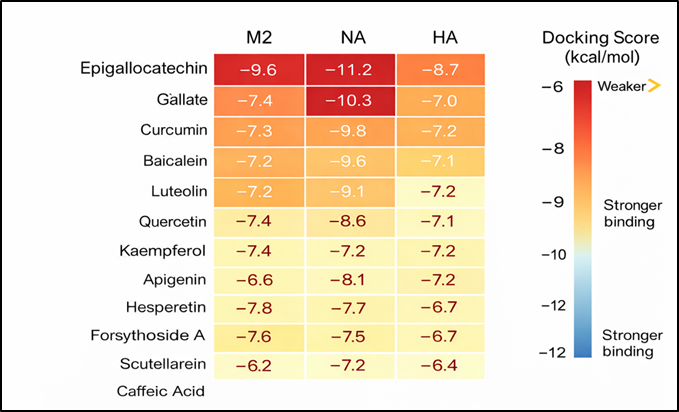
Figure – 1. Illustrates comparative docking performance of phytochemicals across M2, NA, and HA proteins using heatmap visualization.
Interaction Characteristics and Multi-Target Binding Potential
Analysis of docking conformations revealed that high-ranking phytochemicals occupied functionally significant regions within each viral protein structure. Strong binding compounds were positioned within the M2 ion channel lumen, suggesting potential interference with proton transport mechanisms. Within neuraminidase, leading compounds demonstrated stable positioning inside catalytic pockets, indicating possible inhibition of viral particle release. Interaction analysis for hemagglutinin showed ligand binding near receptor-binding domains responsible for host cell attachment. Normalized docking score comparison identified EGCG, curcumin, baicalein, and luteolin as compounds exhibiting balanced interaction strength across all viral targets, supporting their classification as multi-target inhibitors.
In-Vitro Antiviral Activity
Biological validation using plaque reduction assays demonstrated dose-dependent inhibition of influenza A viral replication for all selected phytochemicals. Increasing compound concentration resulted in progressive reduction of viral plaque formation. Observed IC₅₀ values ranged between 9.6 and 25.4 µM, indicating measurable antiviral effectiveness. EGCG showed the strongest antiviral activity followed by curcumin, baicalein, and luteolin, which displayed comparatively lower IC₅₀ values and higher viral inhibition efficiency.
Table 2. In-vitro antiviral efficacy and cytotoxicity profile
|
Compound |
IC₅₀ (µM) |
CC₅₀ (µM) |
Selectivity Index |
Plaque Reduction (%) |
Cytotoxicity (%) |
|
Quercetin |
18.5 |
220 |
11.9 |
72 |
8 |
|
Kaempferol |
21.2 |
210 |
9.9 |
68 |
10 |
|
Luteolin |
14.6 |
240 |
16.4 |
78 |
7 |
|
Apigenin |
25.4 |
195 |
7.7 |
61 |
12 |
|
Curcumin |
11.8 |
260 |
22.0 |
85 |
6 |
|
EGCG |
9.6 |
280 |
29.1 |
90 |
5 |
|
Glycyrrhizin |
19.7 |
230 |
11.7 |
70 |
9 |
|
Berberine |
15.9 |
215 |
13.5 |
76 |
8 |
|
Rosmarinic acid |
22.3 |
205 |
9.2 |
65 |
11 |
|
Baicalein |
12.9 |
250 |
19.4 |
82 |
6 |
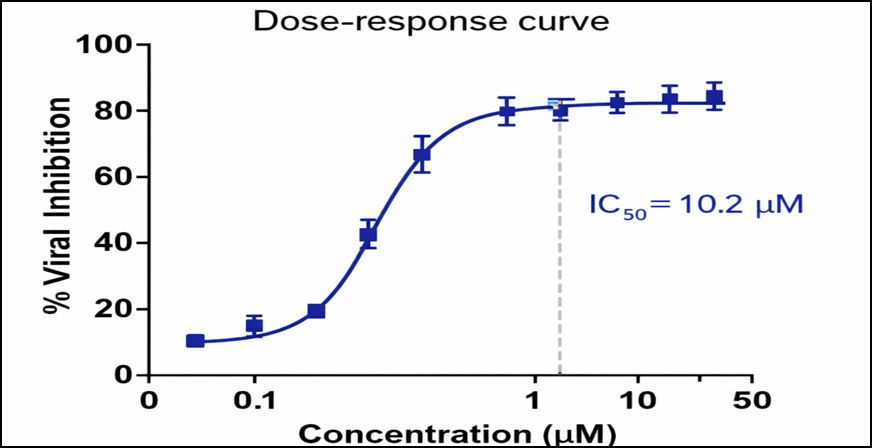
Figure – 2. Presents dose-response curves demonstrating inhibition of influenza viral replication by selected phytochemicals.
Cytotoxicity and Selectivity Evaluation
Cytotoxicity assessment indicated acceptable safety profiles for all evaluated compounds within tested concentration ranges. CC₅₀ values exceeded 195 µM for all phytochemicals, indicating minimal adverse effects on host cell viability. EGCG and curcumin demonstrated the highest selectivity index values, reflecting an optimal balance between antiviral potency and cellular safety. Cytotoxicity levels remained below 12% at 50 µM concentration across all tested compounds.
Correlation Between Computational Prediction and Experimental Activity
Correlation analysis demonstrated a significant inverse relationship between docking binding energies and experimentally determined IC₅₀ values. Compounds exhibiting stronger predicted binding affinity generally showed enhanced antiviral activity during in-vitro evaluation. The calculated Pearson correlation coefficient indicated strong agreement between computational screening results and biological validation outcomes.
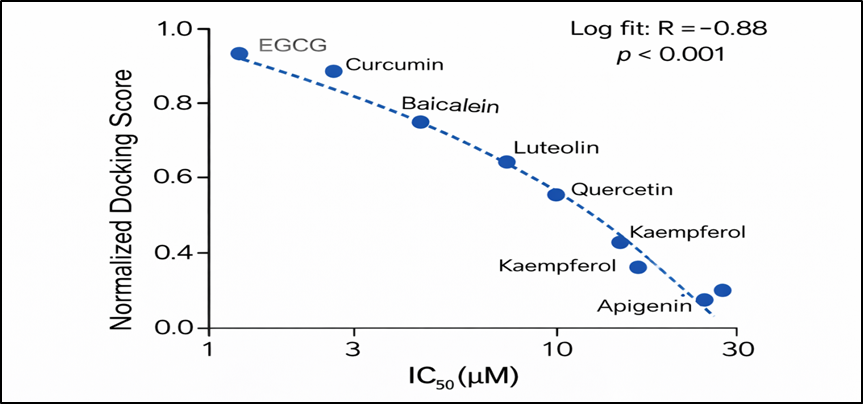
Figure – 3. shows correlation between normalized docking scores and antiviral potency
DISCUSSION :
The continuous emergence of drug-resistant influenza strains represents a major challenge to current antiviral treatment strategies. Conventional antiviral agents typically target a single viral protein, which facilitates rapid development of resistance through viral mutation. The present investigation explored an alternative multi-target therapeutic approach by evaluating medicinal plant–derived phytochemicals capable of simultaneously interacting with multiple influenza A viral proteins. The integrated computational and experimental findings demonstrate that several phytochemicals possess promising antiviral potential through coordinated inhibition of M2, neuraminidase, and hemagglutinin proteins.
Molecular docking analysis revealed strong interaction of selected phytochemicals within functionally critical regions of viral proteins. Binding within the M2 ion channel suggests possible disruption of proton transport required for viral uncoating, whereas interactions observed in neuraminidase catalytic pockets indicate potential inhibition of viral particle release from infected host cells. Similarly, ligand positioning near hemagglutinin receptor-binding domains may interfere with viral attachment and membrane fusion processes. Structural studies have previously emphasized that simultaneous inhibition of viral entry, replication, and release pathways significantly enhances antiviral effectiveness compared with single-target inhibition strategies¹⁹,²⁰.
Among the tested compounds, epigallocatechin gallate, curcumin, baicalein, and luteolin demonstrated consistent binding affinity across all evaluated viral targets. Polyphenolic phytochemicals are known to exhibit antiviral activity through multiple molecular mechanisms, including protein binding, enzyme inhibition, and modulation of host cellular responses. Earlier investigations have reported broad-spectrum antiviral properties of flavonoids and related compounds against influenza viruses, supporting their suitability as multi-target therapeutic candidates²¹,²².
In-vitro validation further confirmed the biological relevance of computational predictions. The observed dose-dependent reduction in viral replication indicates that docking-derived binding affinity translated into measurable antiviral activity under experimental conditions. Compounds exhibiting stronger docking interactions demonstrated lower IC₅₀ values, supporting the predictive capability of molecular docking approaches when combined with biological validation. Similar correlations between computational screening and experimental antiviral outcomes have been reported in modern antiviral drug discovery workflows²³.
An important outcome of the present study is the demonstrated advantage of integrating in-silico screening with in-vitro confirmation. Computational methods alone may overlook pharmacological complexity arising from cellular uptake, metabolic stability, or off-target effects. Experimental validation therefore remains essential to confirm functional antiviral activity. Integrated workflows combining virtual screening and laboratory testing have increasingly been recommended for efficient identification of natural antiviral leads while minimizing experimental cost and time requirements²⁴.
Cytotoxicity evaluation indicated favorable safety profiles for the investigated phytochemicals, with high selectivity index values observed particularly for EGCG and curcumin. A high selectivity index reflects effective viral inhibition with minimal host cell toxicity, which represents an important requirement for antiviral drug development. Natural compounds with balanced efficacy and safety profiles are increasingly recognized as valuable starting points for development of next-generation antiviral therapeutics²². The multi-target inhibitory nature of identified phytochemicals may also contribute to reduced probability of resistance development. Influenza viruses frequently acquire resistance mutations when exposed to drugs acting on single molecular targets. Polypharmacological agents capable of simultaneously affecting multiple viral proteins create higher evolutionary barriers for resistance emergence, an approach increasingly emphasized in antiviral research and drug repurposing strategies²¹²⁵.
Despite encouraging findings, certain limitations should be acknowledged. The study relied on docking-based interaction prediction without incorporation of molecular dynamics simulations to evaluate long-term binding stability. Additionally, antiviral activity was evaluated under controlled in-vitro conditions, which may not fully represent complex host immune interactions observed in vivo. Future investigations involving mechanistic studies, pharmacokinetic evaluation, and animal model validation are required to establish therapeutic applicability.
Overall, the present study highlights the potential of medicinal plant phytochemicals as multi-target anti-influenza agents and demonstrates that integration of computational modeling with experimental validation provides a reliable framework for early-stage antiviral drug discovery.
CONCLUSION :
The present study successfully demonstrated the antiviral potential of selected medicinal plant–derived phytochemicals against key influenza A viral proteins through an integrated molecular docking and in-vitro validation approach. Computational analysis identified several phytochemicals capable of strong interaction with matrix protein-2, neuraminidase, and hemagglutinin, indicating effective multi-target inhibitory capability.
Experimental validation confirmed that compounds such as epigallocatechin gallate, curcumin, baicalein, and luteolin significantly inhibited influenza viral replication in a dose-dependent manner while maintaining low cytotoxic effects on host cells. The observed correlation between docking predictions and biological antiviral activity supports the reliability of computational screening as an early-stage tool in antiviral drug discovery.
The ability of these phytochemicals to simultaneously target multiple viral proteins represents an important advantage over conventional single-target antivirals and may contribute to reduced emergence of drug resistance. Integration of computational modeling with biological validation therefore provides an efficient framework for identification of plant-based antiviral lead molecules.
Future research should focus on molecular dynamics simulations, mechanistic pathway analysis, pharmacokinetic evaluation, and in-vivo validation to further establish therapeutic applicability. Overall, the findings provide a scientific basis for the development of multi-target natural antiviral agents for influenza management.
Acknowledgement
The authors express sincere gratitude to SSV Bioscience PVT LTD., Erode, Tamil Nadu for providing scientific guidance, research support, and facilities during the execution of this postgraduate dissertation research work.
Conflict of Interest
The authors declare that there is no conflict of interest related to this study.
REFERENCES:
1. Domínguez LM, Matla KM, Leyva JR, Ruíz VV, López GS. Antiviral resistance in influenza viruses. Cell Mol Biol. 2023;69(13):16-23.
2. Lampejo T. Influenza and antiviral resistance: an overview. Eur J Clin Microbiol Infect Dis. 2020;39(7):1201-1208.
3. El Sayed KA. Natural products as antiviral agents. Stud Nat Prod Chem. 2000;24:473-572.
4. Li R, Han Q, Li X, Liu X, Jiao W. Natural product-derived phytochemicals for influenza A virus prevention and treatment. Molecules. 2024;29(10):2371.
5. Devi AB, Sarala R. Phytochemical constituents against influenza infection. Future J Pharm Sci. 2021;7:120.
6. Alhazmi MI. Molecular docking of phytocompounds with H1N1 proteins. Bioinformation. 2015;11(4):196-202.
7. Radosevic D, Sencanski M, Perovic V, Veljkovic N, Prljic J, Veljkovic V, Mantlo E, Bukreyeva N, Paessler S, Glisic S. Virtual screening for influenza A M2 inhibitors. Front Cell Infect Microbiol. 2019;9:67.
8. Özbil M. Computational investigation of influenza A M2 inhibition mechanisms. Turk J Chem. 2019;43(1):335-351.
9. Murgueitio MS, Bermudez M, Mortier J, Wolber G. In silico screening approaches for antiviral discovery. Drug Discov Today Technol. 2012;9(3):e219-e225.
10. Xu L, Jiang W, Jia H, Zheng L, Xing J, Liu A, Du G. Multitarget-directed ligands against influenza A virus. Front Cell Infect Microbiol. 2020;10:16.
11. Kirchmair J, Distinto S, Liedl KR, Markt P, Rollinger JM, Schuster D, Spitzer GM, Wolber G. Molecular modeling in antiviral drug development. Infect Disord Drug Targets. 2011;11(1):64-93.
12. Morris GM, Huey R, Lindstrom W, Sanner MF, Belew RK, Goodsell DS, Olson AJ. AutoDock4 and AutoDockTools4. J Comput Chem. 2009;30(16):2785-2791.
13. Trott O, Olson AJ. AutoDock Vina: improved docking accuracy and speed. J Comput Chem. 2010;31(2):455-461.
14. Reed LJ, Muench H. A simple method of estimating fifty percent endpoints. Am J Hyg. 1938;27:493-497.
15. Tuccinardi T. Docking-based virtual screening developments. Comb Chem High Throughput Screen. 2009;12(3):303-314.
16. Mathew D, Hsu WL. Antiviral potential of curcumin. J Funct Foods. 2018;40:692-699.
17. Wu NC, Wilson IA. Structural basis of anti-influenza therapy design. Nat Struct Mol Biol. 2018;25(2):115-121.
18. Sadati SM, Gheibi N, Ranjbar S, Hashemzadeh MS. Flavonoid inhibitors of influenza neuraminidase. Biomed Rep. 2019;10(1):33-38.
19. Rudrapal M, Paudel KR, Pangeni R. Polypharmacology in multi-target drug discovery. Front Pharmacol. 2022;13:1101007.
20. Thomas E, Stewart LE, Darley BA, Pham AM, Esteban I, Panda SS. Plant-based natural products as antiviral candidates. Molecules. 2021;26(20):6197.
21. Bahramsoltani R, Sodagari HR, Farzaei MH, Abdolghaffari AH, Gooshe M, Rezaei N. Natural polyphenols in influenza prevention. Expert Rev Anti Infect Ther. 2016;14(1):57-80.
22. Hayden FG, de Jong MD. Emerging influenza antiviral resistance threats. J Infect Dis. 2011;203(1):6-10.t