Comparison of Fistulectomy and Fistulotomy in Low Variety Peri-Anal Fistula
- Faran Shah , Training Medical Officer, Department of General Surgery, Lady Reading Hospital MTI, Peshawar, Pakistan
- Aurangzeb Alamgir , Trainee Medical Officer, Department of General Surgery, Lady Reading Hospital MTI, Peshawar, Pakistan
- Atta Ullah Arif , Associate Professor General Surgery, Lady Reading Hospital MTI, Peshawar, Pakistan
- Anila Shah Bukhari , Assistant Professor, Department of Anatomy, Pak International Medical College, Peshawar, Pakistan
- Intikhab Alam , Assistant Professor, Department of Gastroenterology, Jinnah Teaching Hospital, Peshawar, Pakistan
- Younas Ahmad , Assistant Professor, Department of Gastroenterology, Jinnah Teaching Hospital, Peshawar, Pakistan
Article Information:
Abstract:
Background: Peri-anal fistula refers to an anorectal disorder, which in most cases is acquired following anorectal infection and abscesses. The most common treatment method remains surgical management with fistulectomy and fistulotomy being the most frequently performed operations in low variety fistula in ano. Nevertheless, there remains doubt on the post-operative outcomes of these methods, especially in the early post-operative pain. Objective: To compare the mean post-operative pain score between fistulectomy and fistulotomy in patients undergoing surgery for low variety peri-anal fistula. Methods: This hospital-based comparative cross-sectional study was conducted in the Lady Reading Hospital, Peshawar, over a duration of three months 20th May 2025 to 20th August 2025. Non-probability consecutive sampling was used to include a total of 68 patients with low variety peri-anal fistula. The patients were separated into two groups of 34 patients each. Group A was subjected to fistulectomy and Group B was subjected to fistulotomy. The intensity of the post-operative pain was measured at the 6th postoperative hour on the Visual Analogue Scale (VAS). Analysis of data was done using IBM SPSS Statistics version 20. To compare the mean pain scores of both groups, independent sample t-test was used. The p-value of 0.05 or less was taken to be statistically significant. Results: The mean age of patients in the fistulectomy group was 44.91 ± 8.21 years, while in the fistulotomy group it was 45.38 ± 8.09 years. Male patients were predominant in both groups. The mean post-operative pain score at the 6th postoperative hour was significantly lower in the fistulectomy group compared with the fistulotomy group (4.08 ± 1.39 vs 5.21 ± 1.65, p=0.003). Conclusion: Fistulectomy was associated with lower early post-operative pain scores compared with fistulotomy in patients with low variety peri-anal fistula. The findings suggest that fistulectomy may provide better early post-operative comfort in selected patients
Keywords:
Article :
INTRODUCTION:
Peri-anal fistula (or fistula in ano) is a malformed epithelialized tract that links the anal canal to the peri-anal skin. It is often seen to occur after the formation of abscesses of the anorectum secondary to cryptoglandular infection. Persistent discharge, pain, local irritation and recurrent peri-anal inflammation are associated with the condition and are known to significantly impact the quality of life of the affected individuals. The disease is more prevalent in males, and is usually noted in the third to fifth decades of life. Although progress has been made in the field of colorectal surgery, peri-anal fistula has remained a rather difficult therapeutic challenge due to the risks of recurrence, delayed healing, and sphincter damage (1-3).
Low variety peri-anal fistula is one which only involves a small portion of the sphincter complex and includes superficial low intersphincteric low trans-sphincteric fistulas. The basis of management rests in the surgical treatment and the ultimate objectives of the management is to eliminate the fistulous tract, prevent recurrence, and maintain continence. Various operative methods have been proposed to treat fistulas such as fistulotomy, fistulectomy, advancement flaps, fibrin glue application, ligation of intersphincteric fistula tract procedures, and video-assisted procedures. Nevertheless, fistulectomy and fistulotomy are some of the most commonly used procedures to low fistula in ano due to their ease of use and positive results (4-6).
Fistulotomy is the laying open of the fistulous tract so that it can heal by secondary intention, and fistulectomy is a complete excision of the tract. The two procedures are good, but there is controversy as to which method offers better post-surgery recovery with little or no complications. Other studies have reported a shorter healing period with fistulotomy as compared to those with fistulectomy, and others have reported better post-operative comfort and lower recurrence rates with fistulectomy. One of the most significant variables in terms of patient satisfaction, mobilization and recovery following anorectal surgery is early post-operative pain (7-9).
The results of previous studies comparing fistulectomy and fistulotomy have been inconsistent and only limited local evidence exists on the effectiveness of the two methods in Pakistani population. Variations in patient attributes, surgical skills as well as peri-operative services can be a factor affecting post-operative results in diverse settings.Therefore, the present study was conducted to compare the mean post-operative pain score between fistulectomy and fistulotomy in patients with low variety peri-anal fistula. The findings of this study may help surgeons select a more suitable treatment option for improving early post-operative outcomes and patient comfort.
METHODOLOGY:
This comparative cross-sectional study was a hospital-based study, which was conducted in the Lady Reading Hospital, Peshawar during a period of three months 20th May 2025 to 20th August 2025. The study received ethical approval by the Research Evaluation Unit of the College of Physicians and Surgeons Pakistan (CPSP), Karachi under reference number CPSP/REU/SGR-2021-022-13080, dated May 20, 2025. Written informed consent was obtained from all participants prior to enrollment, and confidentiality of patient information was maintained throughout the study in accordance with ethical research principles. The study was carried out after obtaining official permission from the hospital administration and relevant department.
The study involved 68 patients with the diagnosis of the low variety peri-anal fistula. The calculation of the sample size used the previously reported mean post-operative pain scores in fistulectomy and fistulotomy groups with a confidence level of 95% and a study power of 80%. Patient recruitment was done using a non-probability consecutive sampling technique. The study included patients aged 30-60 years of age regardless of their gender provided they satisfied the diagnostic criteria of low variety fistula in ano.
Patients with superficial submucous fistula, recurrent fistula in ano, diabetes mellitus, uremia, malignancy, anemia or patients who received steroid therapy were excluded as these conditions had the potential to affect wound healing and post-operative recovery. Patients who had previous history of surgery of fistula in ano were also excluded, in order to minimize confounding effects and enhance reliability of the results.
Fistula in ano diagnosis was made after careful clinical examination (including history, physical examination, digital rectal examination, and proctoscopy). Radiological assessment of the patient was performed with the use of contrast imaging to identify the fistulous tract and internal opening in selected patients. The baseline demographic information such as age, gender, body mass index, place of residence, socioeconomic status, and educational status were recorded on a structured proforma.
The enlisted patients were either fistulectomy or fistulotomy as per the intended surgical management by the treating surgical team. All the operations were conducted under general anesthesia and by a highly qualified surgeon. Patients were also kept on normal post-operative care after surgery. The level of pain was measured at 6th hour after surgery using the Visual Analogue Scale (VAS) with a difference scale of 0 to 10 with the 0 marking the absence of pain and the 10 marking the maximum pain imaginable.
The obtained data were input into and analyzed with an IBM SPSS Statistics version 20. Quantitative variables in the form of mean and standard deviation were used to summarize quantitative variables (age, BMI, and post-operative pain score). The quantitative variables (gender, residence, socioeconomic status, and educational level) were summarized as frequencies and percentages. To compare the mean post-operative pain scores in the fistulectomy and fistulotomy groups, independent sample t -test was used. Age, gender, BMI, residence, education, and socioeconomic status were some of the variables that were stratified to determine their potential impact on the outcome of post-operative pains. A p-value of ≤0.05 was considered statistically significant
RESULTS:
A total of 68 patients with low variety peri-anal fistula were included. Among them, 34 patients underwent fistulectomy and 34 underwent fistulotomy. Baseline characteristics were reviewed first, followed by comparison of post-operative pain score at the 6th postoperative hour.Most patients were aged between 41 and 50 years. Male patients were more frequent than female patients. More than half of the patients belonged to the middle socioeconomic group, and slightly more than half were literate.
Table 1. Baseline demographic profile of patients, n = 68
|
Variables |
Fistulectomy n (%) |
Fistulotomy n (%) |
Total n (%) |
|
Age group |
|
|
|
|
30–40 years |
9 (26.5%) |
10 (29.4%) |
19 (27.9%) |
|
41–50 years |
15 (44.1%) |
14 (41.2%) |
29 (42.6%) |
|
51–60 years |
10 (29.4%) |
10 (29.4%) |
20 (29.4%) |
|
Gender |
|
|
|
|
Male |
25 (73.5%) |
24 (70.6%) |
49 (72.1%) |
|
Female |
9 (26.5%) |
10 (29.4%) |
19 (27.9%) |
|
Residence |
|
|
|
|
Urban |
18 (52.9%) |
17 (50.0%) |
35 (51.5%) |
|
Rural |
16 (47.1%) |
17 (50.0%) |
33 (48.5%) |
The socioeconomic and educational distribution was almost similar in both groups. Middle socioeconomic status was the most common category in both treatment groups.
Table 2. Socioeconomic and educational characteristics of patients, n = 68
|
Variables |
Fistulectomy n (%) |
Fistulotomy n (%) |
Total n (%) |
|
Socioeconomic status |
|
|
|
|
Low |
11 (32.4%) |
12 (35.3%) |
23 (33.8%) |
|
Middle |
18 (52.9%) |
17 (50.0%) |
35 (51.5%) |
|
High |
5 (14.7%) |
5 (14.7%) |
10 (14.7%) |
|
Education status |
|
|
|
|
Literate |
20 (58.8%) |
19 (55.9%) |
39 (57.4%) |
|
Illiterate |
14 (41.2%) |
15 (44.1%) |
29 (42.6%) |
The mean age and BMI were close in both groups. However, the mean post-operative pain score at the 6th postoperative hour was lower in the fistulectomy group than in the fistulotomy group. This difference was statistically significant.
Table 3. Comparison of age, BMI, and post-operative pain score between groups
|
Variable |
Fistulectomy Mean ± SD |
Fistulotomy Mean ± SD |
Mean difference |
p-value |
|
Age, years |
44.91 ± 8.21 |
45.38 ± 8.09 |
0.47 |
0.812 |
|
BMI, kg/m² |
25.76 ± 3.14 |
26.12 ± 3.28 |
0.36 |
0.646 |
|
VAS pain score at 6th hour |
4.08 ± 1.39 |
5.21 ± 1.65 |
1.13 |
0.003 |
Independent sample t-test was applied.
Following stratification, the average pain rating was usually lower in the fistulectomy group at each age, gender, and BMI category. Significant differences were observed between patients aged between 41 and 50 years, 51 and 60 years, male patients and overweight/obese patients.
Table 4. Stratified comparison of post-operative pain score according to age, gender, and BMI
|
Stratification variable |
Category |
Fistulectomy Mean ± SD |
Fistulotomy Mean ± SD |
p-value |
|
Age group |
30–40 years |
3.89 ± 1.17 |
4.90 ± 1.52 |
0.121 |
|
|
41–50 years |
4.07 ± 1.33 |
5.29 ± 1.59 |
0.034 |
|
|
51–60 years |
4.30 ± 1.70 |
5.40 ± 1.84 |
0.049 |
|
Gender |
Male |
4.04 ± 1.41 |
5.17 ± 1.58 |
0.009 |
|
|
Female |
4.22 ± 1.39 |
5.30 ± 1.86 |
0.176 |
|
BMI category |
Normal BMI |
3.85 ± 1.24 |
4.78 ± 1.48 |
0.067 |
|
|
Overweight/Obese |
4.25 ± 1.48 |
5.55 ± 1.72 |
0.011 |
The average pain score was less in the fistulectomy group in all the residence, education and socioeconomic categories. It was noted that there are significant differences between the rural patients, literate and illiterate patients and patients of the middle socioeconomic group.
Table 5. Stratified comparison of post-operative pain score according to residence, education, and socioeconomic status
|
Stratification variable |
Category |
Fistulectomy Mean ± SD |
Fistulotomy Mean ± SD |
p-value |
|
Residence |
Urban |
4.00 ± 1.37 |
4.88 ± 1.54 |
0.083 |
|
|
Rural |
4.19 ± 1.44 |
5.53 ± 1.72 |
0.019 |
|
Education status |
Literate |
3.95 ± 1.32 |
4.95 ± 1.55 |
0.039 |
|
|
Illiterate |
4.29 ± 1.49 |
5.53 ± 1.77 |
0.047 |
|
Socioeconomic status |
Low |
4.36 ± 1.43 |
5.58 ± 1.73 |
0.083 |
|
|
Middle |
3.94 ± 1.35 |
5.12 ± 1.59 |
0.025 |
|
|
High |
3.80 ± 1.30 |
4.60 ± 1.52 |
0.390 |
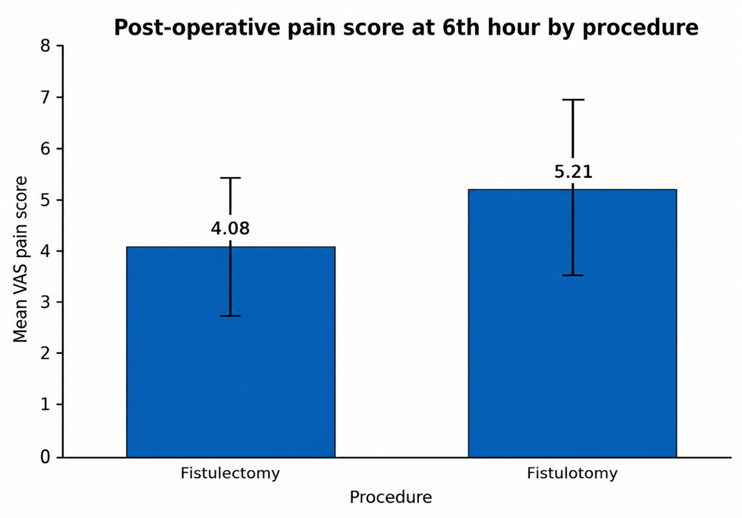
Figure 1: Comparison of mean post-operative pain score at the 6th postoperative hour between fistulectomy and fistulotomy groups.
DISCUSSION:
The present hospital-based comparative cross-sectional study evaluated post-operative pain outcomes between fistulectomy and fistulotomy in patients with low variety peri-anal fistula. A sample size of 68 patients was used with 34 patients in each group of treatment. The results showed that the mean score of postoperative pain measured at the 6th postoperative hour was significantly low in the fistulectomy group but not in the fistulotomy group. These data indicate that fistulectomy could be more comfortable in the early post-operative period in withholding patients with low variety fistula in ano (10-12).
Peri-anal fistula is a frequent surgical disease that has significant impact on quality of life due to pain, discharge and recurrence. The ultimate goal of therapy is to eliminate the fistulous tract, but to avoid sphincter damage and to reduce the likelihood of complications. A number of operative techniques have been introduced in recent years but fistulectomy and fistulotomy remain popular procedures used to treat low fistula in ano due to their simplicity and good clinical results. Comparison of these two methods has continued to be a subject of ongoing debate especially in respect to pain, healing period, recurrence and preservation of continence (13-15).
In the present study, the mean post operative pain score in the fistulectomy group was 4.08 +1.39 whereas the fistulotomy group showed a mean score of 5.21 +1.65. The statistical significance of the difference was found to be statistically significant. Massive studies that had found that patients undergoing fistulectomy had lower levels of post-operative pain than those who received fistulotomy. The authors proposed that excision of the tract in a suitable manner with careful handling of tissues has the potential to mitigate local irritation and early inflammatory response after surgery. Their results are in line with the findings achieved in the current study (16, 17).
The demographic factor of the study population showed that low variety peri-anal fistula was more prevalent among middle-aged males. This trend has also been reported in global epidemiological research. Researchers indicated that men are more likely to get fistula in ano in the third to fifth decades of life due to heightened vulnerability to cryptoglandular infections and peri-anal sepsis. The preponderance of male patients in the current study is thus in line with literature published in the past (18).
The stratification analysis in this study revealed that the fistulectomy group had lower pain scores than the group without fistulectomy across most of the age, gender, and socioeconomic groups. The statistically significant differences were especially observed among middle-aged people and those patients who were overweight or obese. Higher levels of body mass index might be the reason behind the relatively high pain scores of overweight patients undergoing fistulotomy. In colorectal surgery studies, similar relationships between obesity and poor post-operative recovery have been reported.
The results of this study could also be compared with the reports studies found that full excision of the fistulous tract could have satisfactory early post-operative results with acceptable levels of pain and reduced local sepsis. Even though fistulectomy can require a little more dissection of the tissues, a meticulous surgical procedure and an adequate post-operative follow-ups can enhance the comfort of the patients and their recovery (19).
The next significant finding in the current study was the relatively equal baseline characteristics in the two groups. Age, BMI, residence, educational status and socioeconomic status were nearly equal which enhanced the comparability of both treatment groups and minimized selection bias. Such a well-balanced distribution makes the comparison of fistulectomy and fistulotomy more valid with respect to early post-operative pain (20).
Although the positive results linked to fistulectomy are rather favorable, it should be remembered that the decision of the surgical procedure must be kept individualized based on the anatomy of the fistula, expertise of the surgeon and factors related to the patients themselves. Certain research has indicated that fistulotomy can be beneficial in terms of the reduced time of surgery and wound healing in some simple cases. Thus, the management method must be chosen upon thorough clinical examination and appropriate consideration of the fistula nature.
The present study had certain limitations. The sample was rather small and the research was carried out at one center which can be a limitation to the generalizability of the results. Moreover, it was only early post-operative pain at the 6th postoperative hour that was measured. The long-term consequences including recurrence, length of wound healing, level of continence, and patient satisfaction were not addressed. It is also advisable to conduct further multicenter studies with larger sample sizes and longer follow-up periods to provide more comprehensive comparisons between fistulectomy and fistulotomy..
CONCLUSION:
The present study concluded that fistulectomy was associated with lower mean post-operative pain scores compared with fistulotomy in patients undergoing surgery for low variety peri-anal fistula. Patients treated with fistulectomy demonstrated better early post-operative comfort at the 6th postoperative hour. Therefore, fistulectomy may be considered an effective surgical option for selected patients with low variety fistula in ano. However, larger studies evaluating long-term outcomes are recommended to further validate these findings.
REFERENCES:
1. Choudhury CTB, Al Mamun M, Shahadat MJPH. Relative comparisons in surgical outcomes of fistulectomy and fistulotomy in low variety perianal fistula. 2023;3:30-43.
2. Katiyar V, Gupta A, Singh VJAPJOHSУMI. Low lying fistula-in-ano-fistulotomy or fistulectomy. 2020;7(1):53-6.
3. Parwez M, Huda T, Yadav MS, Gupta K, Mital K, Pandya BJSI. A PILOT STUDY on the Clinical and Functional Outcomes of an Improvised Technique of Core-cut Fistulectomy for Fistula-in-ano. 2022;29(3):426-37.
4. Srinivas Reddy K, Bali SJEG, System D. A Review of Various Surgical Managements and their Outcome of Fistula-in-Ano. 2020;7:54-81.
5. Maqbool J, Mehraj A, Shah ZA, Aziz G, Wani RA, Parray FQ, et al. Fistulectomy and incontinence: do we really need to worry? 2022;95(1):59.
6. Elsayed I, Ibrahim M, KAREEM AK, AHMED ADJTMJoCU. Comparative Study between Surgical Outcomes of Fistula Tract LASER Closure (FiLaCTM) Versus Fistulotomy with Primary Sphincter Reconstruction in Management of High Trans-Sphincteric Perianal Fistula. 2022;90(12):1937-47.
7. Panda VJISJ. Evaluation of the role of cyanoacrylate glue in the management of fistula-in-ano. 2020.
8. Charalampopoulos A, Bagias G, Bompetsi G, Nastos K, Papagrigoriadis S, Papaconstantinou DJIJoIRiMS. Anal Fistula of Crypto-Glandular Etiology: A Review of the Literature with a Step-by-Step Approach for Diagnosis and Surgical Management. 2022;7(10).
9. Baakza DAJ. Results of Fistulectomy With Primary Sphincter Repair With Special Reference To Incontinence, Recurrence and Quality of Life 2021.
10. Mishra DGK. A COMPARATIVE STUDY OF LIGATION OF INTERSPHINCTERIC FISTULA TRACT (LIFT) TECHNIQUE AND CONVENTIONAL FISTULOTOMY IN THE TREATMENT OF FISTULA IN ANO 2020.
11. Bibhuti KNS, Panda M, Arawatti SJJoA, Sciences IM. Clinical study of Snuhi Ksharasutra and its role in management of Bhagandara (Fistula in Ano). 2021;6(4):17-23.
12. Maji S, Anchlia DK, Mukhopadhyay P, Chowdhuri S. A comparative study between seton treatment using ksharasutra and conventional surgery in fistula in ANO.
13. Patrizi AJCD. Subcutaneous fistula in infancy: a different diagnosis of a perianal discharging nodule. 2023.
14. Stokes R, Wanaguru D, Saadi A, Adams SJPSI. Management of perianal abscesses in infants without general anaesthesia: a systematic review of the literature. 2020;36(11):1317-25.
15. Wang Y, Rao Q, Ma Y, Li XJIjocd. Platelet-rich plasma in the treatment of anal fistula: a systematic review and meta-analysis. 2023;38(1):70.
16. Hannes S, Kochergin M, Al-Haidary J, Götze T, Habbe N. OTSC Proctology clip as appropriate treatment for complicated anorectal fistula. International Journal of Colorectal Disease. 2023;38(1):222 DOI: 10.1007/s00384-023-04516-4.
17. Scholar P. Clinics of Surgery. 2020.
18. Rizk D. Fistula-associated anal cancer Fistel-assoziierter Analkrebs.
19. Chunduri V. The Efficacy of Transdermal Diclofenac Patch For Postoperative Analgesia In Comparison With Intramuscular Diclofenac in Patients Undergoing Lower Abdominal and Perineal Surgeries under Sub-Arachnoid Block: BLDE (Deemed to be University); 2020.
20. Charalampopoulos A, Bagias G, Papaconstantinou D, Koliakos N, Zavras N, Nastos KJJCR, et al. Chronic Cryptoglandular Anal Fistulas: Surgical Outcomes; A Retrospective Case Control Study In 148 Patients with No Risk Factors for Recurrence. 2022;12(1):2690-1919.