Effect of Dexmedetomidine on Anesthetic Requirements, Recovery Time, and Haemodynamic Stress Response during Burn Debridement and Dressing Procedures at Tertiary Care Hospital, Karachi
- Amir Khan , Senior Registrar Sindh Infectious Diseas Hospital and Research Centre DOW University of Health Sciences, Karachi
- Hanya Javaid , Assistant Professor of anesthesia United medical and dental college, UMDC
- Hina Mahmood , Senior Registrar anesthesia Cardiac Centre Hail
- Mehar Ali , Senior Registrar Department of Anesthesiology Karachi Institute of Medical Sciences
- Kenza Ahsan , Assistant Professor Department Of Anesthesiology Dr Ruth K.M PFAU Civil Hospital Karachi Dow medical college
- Ashok Perchani , Assistant Professor Department of Anesthesiology Dr Ruth K.M PFAU Civil Hospital Dow Medical College
Article Information:
Abstract:
Burn injuries are associated with severe pain and hemodynamic stress during procedures such as debridement and dressing changes. Effective sedation and analgesia are crucial to reduce anesthetic requirements and maintain hemodynamic stability. Dexmedetomidine, an α2-adrenergic agonist, has shown promise in providing sedation, analgesia, and sympatholysis.Objectives: To compare the effects of dexmedetomidine on propofol and ketamine requirements, intraoperative hemodynamic stress response, and recovery time in patients undergoing burn wound debridement and dressing changes.Study Design & Setting: This quasi-experimental study was conducted at a tertiary care hospital in Karachi, Pakistan, from January to June 2025.Methodology: A total of 120 patients aged 18–65 years, with thermal burns involving 5–30% of total body surface area and ASA I–III status, were enrolled and assigned to two groups. Group A received standard anesthesia with propofol and ketamine, while Group B received dexmedetomidine in addition to propofol and ketamine. Intraoperative hemodynamic parameters, anesthetic requirements, and time for recovery were noted. Using SPSS v25 data was analyzed.Results: Baseline demographics and vital signs were comparable between groups. Group B required significantly lower doses of propofol (1.9 ± 0.3 mg/kg vs 2.8 ± 0.4 mg/kg, p<0.001) and ketamine (0.8 ± 0.2 mg/kg vs 1.2 ± 0.2 mg/kg, p<0.001). Hemodynamic parameters, including heart rate and systolic blood pressure, were more stable in Group B throughout the procedure (p<0.001). Recovery time was shorter in Group B (22.1 ± 4.3 minutes vs 28.4 ± 5.6 minutes, p<0.001). Adverse events were minimal and comparable between groups.Conclusion: Dexmedetomidine effectively reduced anesthetic requirements, improved intraoperative hemodynamic stability, and shortened recovery time in patients undergoing burn procedures. It was safe and well-tolerated.
Keywords:
Article :
INTRODUCTION:
A burn injury is defined as damage to the skin or mucous membrane resulting from heat (flame, flash, scald, contact), cold (frostbite), chemicals, electricity, sunlight, radiation, or other external sources. Burn injuries represent adding substantially to morbidity, it is a major worldwide issue in public health, prolonged hospitalization, and disability.1 Thermal burns are the most prevalent kind, but electrical, chemical, and exposure to radiation can also cause these injuries.2 Each year, burn injuries affect millions of people worldwide, with an estimated 11 million individuals requiring medical attention, according to global health reports.3 Nearly 90% of burn-related deaths and illnesses occur in low- and middle-income nations due to overcrowded living conditions, limited safety regulations, and delayed access to specialized care. In many regions, burns constitute major causes of unintentional injuries, with adults and children being particularly vulnerable.4 Despite a worldwide reduction in burn incidence, mortality rates continue to be elevated, with approximately 180,000 fatalities annually.5
In Pakistan, burn injuries remain a substantial health challenge, with an annual estimated incidence of 250,000–300,000 cases, although the true number is likely higher due to underreporting and limited surveillance systems. Domestic accidents such as flame burns from stoves, hot liquids, kerosene heaters, and electrical wiring faults contribute significantly to the national statistics.6 The pathophysiology of burn injury is complex and multifactorial. Local tissue damage results from direct heat-induced protein denaturation, leading to coagulative necrosis. Systemically, large surface-area a strong inflammatory response, marked by the secretion of cytokines, is set off by burns, increased vascular permeability, capillary leak, and haemodynamic instability. These responses result in fluid shifts, hypovolemia, and metabolic disturbances requiring timely and precise resuscitation. Pain pathways are also extensively activated due to exposed nerve endings and inflammatory mediators, making pain of burn one of the most severe forms of acute pain in clinical practice. Repeated procedures such as wound debridement and dressing changes further exacerbate nociceptive, inflammatory, and sympathetic responses.7,8
Current management of burn injuries involves a multidisciplinary approach beginning with initial assessment and stabilization using the ABC (airway, breathing, circulation) protocol. Fluid resuscitation, guided by formulas such as the Parkland formula, is essential in the early phase. Wound management includes debridement, infection control, topical antimicrobial agents, and staged dressing changes, which often require procedural sedation due to the significant pain involved.9 Various agents including propofol, ketamine, benzodiazepines, and opioids are commonly used to achieve adequate sedation and analgesia.10 Recent interest has focused on adjuvant drugs dexmedetomidine is an example of an α2-adrenergic agonist that is known for its sedative, analgesic, and sympatholytic effects that may help stabilize haemodynamics during painful burn procedures. Surgical interventions, grafting, physiotherapy, and long-term rehabilitation constitute the later phases of management.11
Burn debridement and dressing changes are repeatedly performed painful procedures that provoke significant anesthetic requirements and haemodynamic stress, yet an optimal sedation strategy remains unclear. Although dexmedetomidine has been studied internationally as an adjunct anesthetic agent, local evidence comparing its effect on propofol and ketamine requirements during burn procedures is limited. In Pakistan, published data on procedural sedation protocols in burn patients are scarce, particularly regarding haemodynamic stress response and recovery profiles. Variations in patient demographics, burn patterns, and resource availability necessitate locally generated evidence. This study adds new data by simultaneously evaluating anesthetic consumption, haemodynamic stability, and recovery time in a single clinical setting. The findings may help refine sedation practices in tertiary care burn units and support evidence-based anesthetic decision-making in routine clinical practice.
MATERIALS AND METHODS:
quasi-experimental study conducted at a tertiary care hospital in Karachi from January to June 2025. A total of 120 patients aged 18–65 years, of either sex, undergoing scheduled burn wound debridement or dressing changes were enrolled after providing informed written consent. Patients were included if they had thermal burns involving 5–30% of total body surface area and were classified as ASA physical status I–III. Patients with known allergies to dexmedetomidine, propofol, or ketamine, significant organ dysfunction, cardiac conduction abnormalities, chronic sedative or opioid dependence, pregnant or lactating women, active sepsis, or chemical/electrical burns were excluded.
The sample size of 120 patients was eastimated using the WHO-recommended OpenEpi online calculator, considering a 5% level of significance, with 80% power and a 20% anticipated discrepancy in anesthetic requirements among groups. This number was increased to account for potential dropouts and incomplete data.
There were two groups of patients. Propofol and ketamine, the typical anaesthetics, were administered to Group A, whereas Group B received infusion of dexmedetomidine in addition to propofol and ketamine. Regular checks, such as electrocardiograms, non-invasive blood pressure, and heart rate, was applied to all patients throughout the procedure. Preoperative baseline hemodynamic parameters and laboratory investigations were recorded. A loading dosage of 1 µg/kg of dexmedetomidine was given over 10 minutes, and then a continuing infusion of 0.5 µg/kg/hr was started until the operation was finished. Anesthetic requirements of propofol and ketamine were recorded for each patient.
During the process, the patient's haemodynamic parameters were monitored to evaluate their stress response. These parameters included systolic and diastolic blood pressures, heart rate and mean arterial pressure. We measured everything at the start of the procedure and then at regular intervals after that. The duration of recovery was determined as the time it took to go from when the anaesthetic was stopped to when the patient achieved a modified Aldrete score of 9 or higher. No problems or unpleasant events were overlooked. Using SPSS version 25, the data was entered and analysed. Mean ± standard deviation was used to represent continuous variables, whereas frequencies and percentages were used for categorical variables. A p-value less than 0.05 was deemed statistically significant when comparing groups using either an independent t-test or a chi-square test, as applicable.
RESULTS:
The 120 participants were split evenly between two groups of 60 for the study. The two groups were similar in terms of demographics and initial traits. There was no significant difference (p=0.72) in the mean ages of Group A (38.5 ± 12.1 years) and Group B (37.8 ± 11.6 years). With 56.7% men and 53.3% females in Group A and Group B, respectively, the gender distribution was quite close (p=0.68). Group B had a mean weight of 64.1 ± 11.2 kg, while Group A had a mean weight of 63.4 ± 10.8 kg (p=0.65). The ASA physical status distribution did not differ significantly, with most patients classified as ASA II in both groups (p=0.86) as shown in Table 1.
Table 1: Demographic and Baseline Characteristics of Patients (n = 120)
|
Parameter |
Group A (n=60) |
Group B (n=60) |
p-value |
|
Age (years) |
38.5 ± 12.1 |
37.8 ± 11.6 |
0.72 |
|
Gender |
|||
|
Male |
34 (56.7) |
32 (53.3) |
0.68 |
|
Female |
26 (43.3) |
28 (46.7) |
|
|
Weight |
63.4 ± 10.8 |
64.1 ± 11.2 |
0.65 |
|
TBSA burned |
18.7 ± 6.5 |
19.2 ± 6.2 |
0.57 |
|
ASA status, n (%) |
|||
|
I |
20 (33.3) |
18 (30.0) |
0.86 |
|
II |
30 (50.0) |
32 (53.3) |
|
|
III |
10 (16.7) |
10 (16.7) |
|
|
Baseline HR (bpm) |
88.2 ± 10.5 |
87.5 ± 9.8 |
0.71 |
|
Baseline SBP (mmHg) |
124.6 ± 12.4 |
125.3 ± 11.8 |
0.76 |
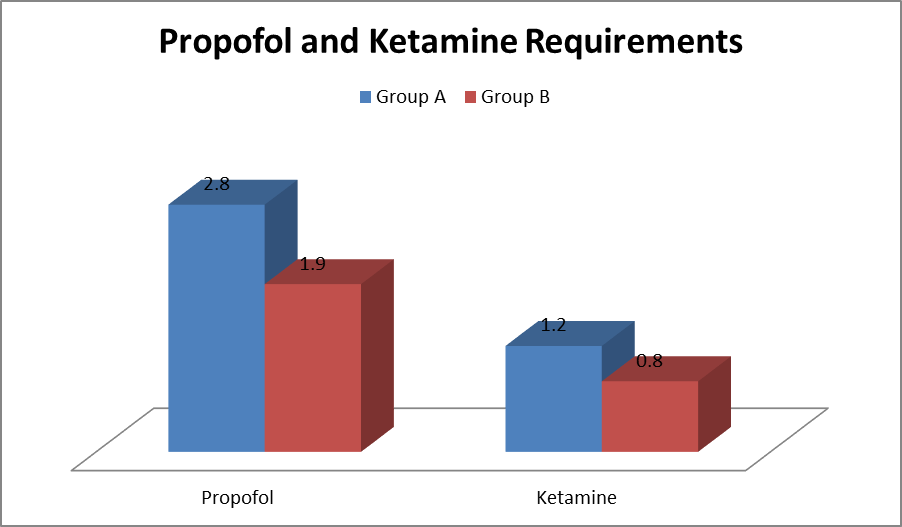
Patients in Group B, who received dexmedetomidine, required lower doses of both propofol (1.9 ± 0.3 mg/kg) and ketamine (0.8 ± 0.2 mg/kg) compared to Group A, which required 2.8 ± 0.4 mg/kg of propofol and 1.2 ± 0.2 mg/kg of ketamine. These differences were statistically significant with p-values <0.001, demonstrating a reduction in anesthetic consumption in the dexmedetomidine group as presented in Table 2.
Table 2: Intraoperative Propofol and Ketamine Requirements
|
Drug |
Group A (n=60) |
Group B (n=60) |
p-value |
|
Propofol (mg/kg) |
2.8 ± 0.4 |
1.9 ± 0.3 |
<0.001 |
|
Ketamine (mg/kg) |
1.2 ± 0.2 |
0.8 ± 0.2 |
<0.001 |
However, during the procedure, Group B maintained lower heart rates and systolic blood pressures compared to Group A. At 10 minutes, the mean heart rate in Group A increased to 102.4 ± 12.3 bpm, while Group B remained at 91.2 ± 10.1 bpm (p<0.001). Similarly, systolic blood pressure at 10 minutes was higher in Group A (138.2 ± 13.5 mmHg) compared to Group B (128.4 ± 12.0 mmHg, p<0.001) as shown in Table 3.
Table 3: Intraoperative Hemodynamic Parameters
|
Parameter |
Time Point |
Group A (n=60) |
Group B (n=60) |
p-value |
|
Heart Rate (bpm) |
Baseline |
88.2 ± 10.5 |
87.5 ± 9.8 |
0.71 |
|
10 min |
102.4 ± 12.3 |
91.2 ± 10.1 |
<0.001 |
|
|
End of procedure |
98.1 ± 11.0 |
88.5 ± 9.5 |
<0.001 |
|
|
Systolic BP (mmHg) |
Baseline |
124.6 ± 12.4 |
125.3 ± 11.8 |
0.76 |
|
10 min |
138.2 ± 13.5 |
128.4 ± 12.0 |
<0.001 |
|
|
End of procedure |
135.1 ± 12.7 |
127.1 ± 11.5 |
<0.001 |
Recovery time was significantly shorter in patients receiving dexmedetomidine. Group B patients achieved a recovery score ≥9 in 22.1 ± 4.3 minutes, compared to 28.4 ± 5.6 minutes in Group A (p<0.001), demonstrating a faster postoperative recovery in the dexmedetomidine group as summarized in Table 4.
Table 4: Recovery Time in both groups A & B
|
Parameter |
Group A (n=60) |
Group B (n=60) |
p-value |
|
Recovery time (minutes), mean ± SD |
28.4 ± 5.6 |
22.1 ± 4.3 |
<0.001 |
There was a minimal incidence of issues in both groups with regard to adverse events. Hypotension occurred in 13.3% of Group A and 8.3% of Group B (p=0.38), while bradycardia was observed in 3.3% of Group A and 6.7% of Group B (p=0.40) as presented in Table 5.
Table 5: Adverse Events During Procedure in groups A & B
|
Adverse Event |
Group A (n=60) |
Group B (n=60) |
p-value |
|
Hypotension |
8 (13.3%) |
5 (8.3%) |
0.38 |
|
Bradycardia |
2 (3.3%) |
4 (6.7%) |
0.40 |
|
Nausea/Vomiting |
5 (8.3%) |
3 (5.0%) |
0.47 |
|
Respiratory depression |
3 (5.0%) |
2 (3.3%) |
0.65 |
DISCUSSION :
At the time Exposure to high temperatures, chemicals, or electricity can produce burns, which are a leading cause of disability globally. Burns trigger complex pathophysiological changes including tissue necrosis, inflammatory response, and hemodynamic instability.12 Procedural pain during debridement and dressing changes is severe and requires effective sedation and analgesia. In burn care, dexmedetomidine's sedative, analgesic, and sympatholytic effects have been studied. It is an α2-adrenergic agonist.13
In the present study, the addition of dexmedetomidine significantly reduced intraoperative propofol and ketamine requirements, improved haemodynamic stability, and shortened recovery time during burn debridement and dressing procedures. These findings are strongly aligned with the results reported by Ravipati et al., who demonstrated markedly lower ketamine (100.5 ± 17.58 mg vs. 231.5 ± 60.39 mg, p<0.0001) and propofol requirements (127.7 ± 15.47 mg vs. 254 ± 59.22 mg, p<0.0001) in the dexmedetomidine group, along with a significantly shorter recovery time (9.57 ± 1.50 min vs. 11.53 ± 2.56 min, p=0.0006) and reduced haemodynamic variability.14 Although absolute drug doses differed due to variations in administration routes and procedural duration, the relative reduction in anesthetic consumption and recovery time observed in our study closely mirrors these findings.
Sohail et al. reported that although both ketamine and dexmedetomidine provided adequate analgesia for burn dressing changes, ketamine resulted in lower pain scores compared to dexmedetomidine (p<0.05).15 This difference may be attributed to their use of oral administration and pain score assessment as the primary outcome, whereas our study focused on anesthetic requirements, haemodynamic stress response, and recovery profile under procedural anesthesia rather than analgesia alone. Stangaciu et al. found that dexmedetomidine did not significantly shorten mechanical ventilation duration (p=0.3) but was associated with lower delirium rates and reduced need for additional analgesics and antipsychotics.16
Similarly, Kiran et al. reported significantly higher heart rate and blood pressure values in the control group compared to the dexmedetomidine group, with recovery times of 12.9 minutes versus 9.5 minutes, respectively.17 They also noted substantially higher ketamine (228.8 ± 21.9 mg vs. 101.1 ± 20.3 mg) and propofol requirements (263.2 ± 22.5 mg vs. 120.8 ± 22.4 mg) in the non-dexmedetomidine group, supporting our observation that dexmedetomidine acts as an effective anesthetic-sparing agent.17
Our findings of improved haemodynamic stability are further supported by Gencer et al., who observed significant reductions in heart rate and mean arterial pressure at 3, 5, and 10 minutes in patients receiving dexmedetomidine during burn sedation (p<0.05).18 While their study compared dexmedetomidine with midazolam and focused on sedation scores and respiratory effects, both studies demonstrated that dexmedetomidine provided acceptable sedation with favorable haemodynamic control and minimal respiratory compromise.
While mechanical ventilation was not an endpoint in our study, their observation of reduced supplemental analgesic requirements aligns with our findings of decreased propofol and ketamine consumption. Bradycardia was noted as the most prominent adverse effect in their cohort, which is consistent with the mild, non-significant increase in bradycardia observed in our dexmedetomidine group. Ding et al. reported higher hypotension rates with dexmedetomidine compared to midazolam (6 vs. 0, p=0.01), while respiratory depression was more common with midazolam (p=0.038).19 In our study, hypotension and bradycardia occurred infrequently and did not differ significantly between groups, possibly due to careful dose titration and exclusion of hemodynamically unstable patients. Lakhtariya et al. demonstrated significant reductions in pulse rate and blood pressure with dexmedetomidine and lower incidence of respiratory depression compared to ketamine-containing regimens, along with better sedation scores and drug-sparing effects.20 These results closely parallel our findings of improved haemodynamic control, reduced anesthetic requirements, and faster recovery in the dexmedetomidine group. Overall, the consistency of our results with both international and regional studies reinforces the role of dexmedetomidine as an effective anesthetic adjuvant during burn debridement and dressing procedures, while minor differences across studies can be explained by variations in drug dosing, routes of administration, patient populations, and outcome measures
This study included a well-defined sample of 120 patients with comparable baseline characteristics, enhancing internal validity. Randomized group allocation minimized selection bias. Continuous monitoring of hemodynamic parameters and precise recording of anesthetic requirements improved data accuracy. Limitations include a single-center design, limiting generalizability. The study excluded patients with extensive burns or severe comorbidities, which may affect external applicability. Postoperative follow-up was limited to immediate recovery, not long-term outcomes.
CONCLUSION :
Dexmedetomidine reduced propofol and ketamine requirements, improved hemodynamic stability, and shortened recovery time during burn debridement and dressing changes. It was safe and well-tolerated with minimal adverse events. Dexmedetomidine may be considered an effective adjunct for procedural sedation in burn patients.
BIBLIOGRAPHY:
1. Yakupu A, Zhang J, Dong W, Song F, Dong J, Lu S. The epidemiological characteristic and trends of burns globally. BMC Public Health. 2022 Aug 22;22(1):1596.
2. Alcocer G, Alcocer P, Marquez C. Burns by Ionizing and nonionizing radiation. Journal of burn care & research. 2024 Nov;45(6):1464-72.
3. Šuca H, Čoma M, Tomšů J, Sabová J, Zajíček R, Brož A, Doubková M, Novotný T, Bačáková L, Jenčová V, Košťáková EK. Current approaches to wound repair in burns: how far have we come from cover to close? A narrative review. Journal of Surgical Research. 2024 Apr 1;296:383-403.
4. Kankam HK, Lee KC, Sardeli AV, Dretzke J, Lord JM, Moiemen N. Acute burn injuries associated with long-term mortality: a systematic review and meta-analysis. Burns. 2022 Dec 1;48(8):1783-93.
5. Obed D, Salim M, Dastagir N, Knoedler S, Dastagir K, Panayi AC, Vogt PM. Comparative analysis of composite mortality prediction scores in intensive care burn patients. International journal of environmental research and public health. 2022 Sep 28;19(19):12321.
6. Kausar S, Arooj L, Rehan M, Iqbal T, Ain Q, Ali A. Epidemiology of Burns in Pakistan: A Systematic Review. J Islamabad Med Dental Coll. 2024; 13(2): 375-381
7. Dobson GP, Morris JL, Letson HL. Pathophysiology of severe burn injuries: new therapeutic opportunities from a systems perspective. Journal of Burn Care & Research. 2024 Jul;45(4):1041-50.
8. Żwierełło W, Piorun K, Skórka-Majewicz M, Maruszewska A, Antoniewski J, Gutowska I. Burns: classification, pathophysiology, and treatment: a review. International journal of molecular sciences. 2023 Feb 13;24(4):3749.
9. Merchant M, Hu SB, Miller C, Ahmadi T, Garcia E, Smith MI. Comprehensive Management of Severe Burn Injuries: A Multidisciplinary Approach from Resuscitation to Rehabilitation. Emergency Care and Medicine. 2025 May 14;2(2):26.
10. Zaki HA, Ibrahim T, Osman A, Elnabawy WA, Gebril A, Hamdi AH, Mohamed EH, Elsayed WA. Comparing the safety and effectiveness of ketamine versus benzodiazepine/opioid combination for procedural sedation in emergency medicine: A comprehensive review and meta-analysis. Cureus. 2023 Mar 27;15(3):e56687.
11. Liu X, Li Y, Kang L, Wang Q. Recent advances in the clinical value and potential of dexmedetomidine. Journal of Inflammation Research. 2021 Dec 30:7507-27.
12. Azam S, Taj MK, Taj I, Khan S, Khan MA, Ali SA, Azam S, Khan N, Taj N, Rehman F, Safdar A. The burn wound injury its causes and management. Journal of Population Therapeutics and Clinical Pharmacology. 2024;31(6):2596-12.
13. Ding X, Luo Y, Shi L, Liu C, Yan Z. Butorphanol in combination with dexmedetomidine provides efficient pain management in adult burn patients. Burns. 2021 Nov 1;47(7):1594-601.
14. Ravipati P, Reddy PN, Kumar C, Pradeep P, Pathapati RM, Rajashekar ST. Dexmedetomidine decreases the requirement of ketamine and propofol during burns debridement and dressings. Indian Journal of Anaesthesia. 2014 Mar 1;58(2):138-42.
15. Sohail F, Bangash R.L, Azim W, Arshad F, Anwar A, Niazi K.A. Analgesia for the Change of Dressing in Burn Victims: A Comparison Between Oral Ketamine and Oral Dexmedetomidine. Esculapio - JSIMS. 2023;17(1):39-44.
16. Stangaciu B, Tsotsolis S, Papadopoulou S, Lavrentieva A. Sedation with dexmedetomidine in critically ill burn patients reduced delirium during weaning from mechanical ventilation. Cureus. 2022 Nov 23;14(11).
17. Kiran S, Rai P, Badhe VK, Kunkulol RR. Dexmedetomidine premedication with ketamine and propofol during burns debridement and dressings. International Journal of Clinical and Biomedical Research. 2017 Oct 25:64-8.
18. Gencer M, Sezen O. A study comparing the effect of premedication with intravenous midazolam or dexmedetomidine on ketamine-fentanyl sedoanalgesia in burn patients: A randomized clinical trial. Burns. 2021 Feb 1;47(1):101-9.
19. Ding X, Cui H, Ma P, Chen X, Sun Y, Qu M, Yan Z. Efficacy of dexmedetomidine versus midazolam when combined with butorphanol for sedation and analgesia during burn dressing changes: A randomized clinical trial. Frontiers in Pharmacology. 2022 Sep 7;13:965441.
20. Lakhtariya S, Tarlika D. Efficacy of dexmedetomidine as a premedication with ketamine, propofol and ketofol for burn debridement and dressings. Ind J Applied Res. 2023;13(10):37-41.