A Study on Sex Determination using Anthropometric Dimensions of Clavicle
- Neeraja M , Assistant professor, Department of Anatomy, Chalmeda Anand Rao Institute of Medical Sciences, Karimnagar, Telangana
- Raja Sekhar Katiki Reddi , Associate professor, Department of Anatomy, Government Medical College Quthbullapur, Medchal, Malkajgiri district, Telangana
- Takkallapally Anitha , Professor & Head, Department of Anatomy, Chalmeda Anand Rao Institute of Medical Sciences, Karimnagar, Telangana
Article Information:
Abstract:
Sex determination is an important component of personal identification in forensic anthropology, especially when unidentified or fragmented skeletal remains are recovered. The clavicle is a useful skeletal element because it is relatively resistant, easily measurable, and shows sexual dimorphism. Aim: The present study was conducted to assess the usefulness of anthropometric dimensions of the clavicle for sex determination. Materials and Methods: This observational cross-sectional study was conducted on 30 dry adult human clavicles of known sex, consisting of 15 male and 15 female clavicles. Both right and left clavicles were included. Parameters measured were maximum clavicular length, mid-shaft circumference, sternal end breadth, acromial end breadth, and weight of clavicle. Measurements were recorded using digital Vernier caliper, measuring tape, osteometric board, and digital weighing balance. Data were analysed using mean, standard deviation, range, and Student’s t-test. Results: All clavicular measurements were higher in males than females on both right and left sides. On the right side, maximum clavicular length was 149.20 ± 7.18 mm in males and 133.40 ± 6.12 mm in females. On the left side, it was 147.90 ± 7.76 mm in males and 132.20 ± 6.58 mm in females. Mid-shaft circumference and weight also showed significant differences between males and females. All parameters showed statistically significant sexual dimorphism. Conclusion: Clavicular anthropometry is a simple and useful supportive method for sex determination. Maximum clavicular length, mid-shaft circumference, and weight were found to be the most reliable parameters.
Keywords:
Article :
INTRODUCTION:
Sex determination is one of the most important components of personal identification in forensic anthropology, especially when unidentified, decomposed, mutilated, burnt, or fragmented skeletal remains are recovered. Although pelvis and skull are considered more reliable for sex estimation, these bones may not always be available in complete condition. In such situations, long bones and individual skeletal elements such as the clavicle can provide useful anthropometric information for sex determination [1,2].
The clavicle is a useful bone for forensic examination because it is relatively resistant, easy to measure, and shows measurable sexual dimorphism in parameters such as maximum clavicular length, mid-shaft circumference, weight, sternal end breadth, and acromial end breadth. Previous studies have shown that male clavicles generally have greater length and mid-shaft circumference than female clavicles, and these measurements can be used for developing population-specific standards for sex estimation [3,4]. Jit and Singh reported the forensic usefulness of adult clavicles for sexing in the Indian population, while Akhlaghi et al. demonstrated that anthropometric dimensions of the clavicle could determine sex with reasonably high accuracy in the Iranian population [1,2].
Since skeletal dimensions vary according to race, geography, nutrition, heredity, and population group, a single universal standard cannot be applied to all populations. Therefore, population-specific studies are necessary to improve the accuracy of sex determination. The present study, “A Study on Sex Determination using Anthropometric Dimensions of Clavicle,” is undertaken to evaluate clavicular measurements and assess their usefulness in determining sex from human skeletal remains [3,4].
Materials and Method:
The present study was designed as an observational, descriptive, cross-sectional anthropometric study to assess the usefulness of clavicular measurements for sex determination.
The study was conducted on dry adult human clavicles obtained from the Department of Anatomy, Chalmeda Anand Rao Institute of Medical Sciences, Karimnagar. Only completely ossified adult clavicles of known sex were included in the study. Both right and left clavicles were considered for measurement.
Inclusion Criteria
Dry adult human clavicles with known sex, intact morphology, and complete bony structure were included in the study.
Exclusion Criteria
Clavicles showing fracture, deformity, pathological changes, erosion, congenital anomaly, or damage at the sternal or acromial end were excluded from the study.
Sample Size
The present study was conducted on 30 dry adult human clavicles of known sex. Out of these, 15 clavicles belonged to males and 15 clavicles belonged to females. Both right and left clavicles were included in the study, depending on availability.
Method
The following anthropometric measurements of the clavicle were recorded:
1. Maximum length of clavicle: measured as the straight distance between the most medial point of the sternal end and the most lateral point of the acromial end.
2. Mid-shaft circumference: measured at the midpoint of the clavicle using a measuring tape.
3. Sternal end breadth: measured at the medial end of the clavicle.
4. Acromial end breadth: measured at the lateral end of the clavicle.
5. Weight of clavicle: measured using a digital weighing balance.
Instruments Used
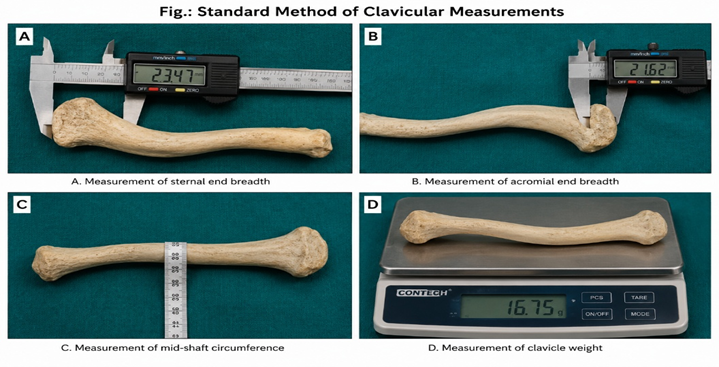
The measurements were taken using a digital Vernier caliper, osteometric board, measuring tape, and digital weighing balance. All measurements were recorded in millimetres, except weight, which was recorded in grams.
Method of Measurement
Each clavicle was cleaned, labelled, and examined carefully. The side of the clavicle was identified as right or left. All anthropometric measurements were taken according to standard anatomical landmarks. Each measurement was taken twice to reduce observer error, and the average value was used for final analysis.
Statistical Analysis
The collected data were entered into Microsoft Excel and analysed using appropriate statistical software. Mean, standard deviation, minimum, and maximum values were calculated for each parameter in males and females. The difference between male and female clavicular measurements was analysed using the Student’s t-test. A p-value of less than 0.05 was considered statistically significant. Discriminant function analysis may be applied to determine the most reliable clavicular parameter for sex determination.
Ethical Consideration
Prior permission was obtained from the concerned department/institution before conducting the study. Since the study was carried out on dry human bones and did not involve living participants, informed consent was not required. All specimens were handled respectfully and used only for academic and research purposes.
Observation and Results:
Table 1 : Distribution of Clavicles According to Sex and Side
|
Sex |
Right Clavicle |
Left Clavicle |
Total |
|
Male |
8 |
7 |
15 |
|
Female |
7 |
8 |
15 |
|
Total |
15 |
15 |
30 |
Table 1 shows that the study included 30 clavicles, of which 15 were male and 15 were female. Among males, 8 were right clavicles and 7 were left clavicles, while among females, 7 were right clavicles and 8 were left clavicles. Thus, the sample was equally distributed between males and females, and nearly equally distributed between right and left sides.
Table 2 : Comparison of Right Clavicle Measurements Between Males and Females
|
Parameter |
Right (Mean ± SD) |
t-value |
p-value |
|
|
Male |
Female |
|||
|
Maximum length of clavicle (mm) |
149.20 ± 7.18 |
133.40 ± 6.12 |
4.55 |
<0.001 |
|
Mid-shaft circumference (mm) |
38.60 ± 3.32 |
32.20 ± 2.76 |
4.04 |
0.001 |
|
Sternal end breadth (mm) |
24.30 ± 2.25 |
20.60 ± 2.08 |
3.29 |
0.006 |
|
Acromial end breadth (mm) |
22.90 ± 2.05 |
19.50 ± 1.88 |
3.33 |
0.005 |
|
Weight of clavicle (g) |
18.70 ± 2.48 |
13.10 ± 1.98 |
4.8 |
<0.001 |
Table 2 shows that all right clavicle measurements were higher in males than females. The mean maximum length was 149.20 ± 7.18 mm in males and 133.40 ± 6.12 mm in females. Similarly, mid-shaft circumference, sternal end breadth, acromial end breadth, and weight were also greater in males. All p-values were statistically significant, showing that the right clavicle has useful sexual dimorphism for sex determination.
Table 3 : Comparison of Left Clavicle Measurements Between Males and Females
|
Parameter |
Left (Mean ± SD) |
t-value |
p-value |
|
|
Male |
Female |
|||
|
Maximum length of clavicle (mm) |
147.90 ± 7.76 |
132.20 ± 6.58 |
4.23 |
<0.001 |
|
Mid-shaft circumference (mm) |
37.80 ± 3.61 |
31.60 ± 2.94 |
3.67 |
0.003 |
|
Sternal end breadth (mm) |
23.90 ± 2.52 |
20.20 ± 2.25 |
3.01 |
0.009 |
|
Acromial end breadth (mm) |
22.50 ± 2.23 |
19.10 ± 2.03 |
3.1 |
0.008 |
|
Weight of clavicle (g) |
18.10 ± 2.82 |
12.70 ± 2.21 |
4.15 |
<0.001 |
Table 3 shows that left clavicle measurements were also higher in males than females. The mean maximum length was 147.90 ± 7.76 mm in males and 132.20 ± 6.58 mm in females. Other parameters such as mid-shaft circumference, sternal end breadth, acromial end breadth, and weight were also significantly higher in males. This indicates that the left clavicle is also useful for sex determination.
Table 4 : Range of Clavicular Measurements in Males and Females According to Side
|
Parameter |
Male(Range) |
Female(Range) |
||
|
Right |
Left |
Right |
Left |
|
|
Maximum length of clavicle (mm) |
138–160 |
137–159 |
123–144 |
122–143 |
|
Mid-shaft circumference (mm) |
34–44 |
33–43 |
28–36 |
27–35 |
|
Sternal end breadth (mm) |
21–28 |
20–28 |
18–24 |
17–23 |
|
Acromial end breadth (mm) |
20–26 |
19–26 |
17–23 |
16–22 |
|
Weight of clavicle (g) |
15–23 |
14–22 |
10–17 |
9–16 |
Table 4 presents the minimum and maximum values of clavicular measurements in males and females on both right and left sides. The ranges show that male clavicles were generally longer, broader, thicker, and heavier than female clavicles. Maximum length, mid-shaft circumference, and weight showed better separation between males and females, while sternal and acromial end breadth showed slight overlapping. Therefore, length, circumference, and weight appear to be more reliable parameters for sex determination.
Image 1 : Clavicle Anatomy and Anthropometric Measurements
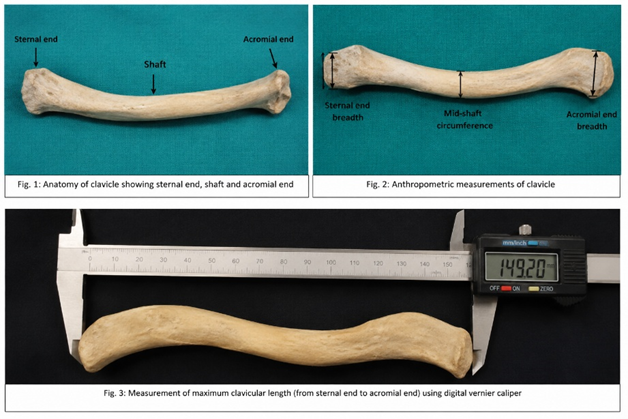
Image 2 : Standard Method of Clavicular Measurements
DISCUSSION :
In the present study, 30 dry adult human clavicles were studied, comprising 15 male and 15 female clavicles. The sample was almost equally distributed according to side, with 15 right and 15 left clavicles. In the present findings, all measured parameters of the clavicle were higher in males than females on both right and left sides, indicating clear sexual dimorphism. On the right side, the mean maximum clavicular length was 149.20 ± 7.18 mm in males and 133.40 ± 6.12 mm in females, while on the left side it was 147.90 ± 7.76 mm in males and 132.20 ± 6.58 mm in females. These differences were statistically significant, suggesting that maximum clavicular length is an important parameter for sex determination.The findings of the present study are comparable with the Indian study by Samala and Manasa, who studied 60 adult clavicles of known sex from Telangana and reported that clavicular dimensions are useful for sex determination [5]. Similarly, Balwir et al. in the Vidarbha region reported that the mean right clavicular length was higher in males than females, with male right clavicles showing a mean length of 140.77 ± 8.04 mm, while female right clavicles showed 125.83 ± 7.72 mm [6]. The present study also showed the same pattern, although the mean values were slightly higher. This difference may be due to variation in sample size, regional population characteristics, nutrition, body build, and genetic factors.
In the present study, mid-shaft circumference was also significantly higher in males than females. The right mid-shaft circumference was 38.60 ± 3.32 mm in males and 32.20 ± 2.76 mm in females, while the left mid-shaft circumference was 37.80 ± 3.61 mm in males and 31.60 ± 2.94 mm in females. These findings are supported by a Telangana-region study, which reported higher mid-shaft circumference in males than females on both sides, with values of 35.62 ± 8.13 mm and 35.94 ± 2.88 mm in male right and left clavicles, and 30.35 ± 2.43 mm and 30.31 ± 3.25 mm in female right and left clavicles [7]. Thus, the present study confirms that mid-shaft circumference is a useful parameter for distinguishing male and female clavicles.
The weight of the clavicle was also greater in males than females in the present study. The mean right clavicle weight was 18.70 ± 2.48 g in males and 13.10 ± 1.98 g in females, while the mean left clavicle weight was 18.10 ± 2.82 g in males and 12.70 ± 2.21 g in females. Similar findings were observed in the Telangana-region study, where the mean weight of right and left clavicles was 20.50 ± 4.52 g and 20.52 ± 3.70 g in males and 12.70 ± 4.19 g and 12.24 ± 3.47 g in females [7]. Therefore, the present study is in agreement with previous Indian studies, showing that male clavicles are generally heavier than female clavicles.
The sternal end breadth and acromial end breadth were also higher in males than females in the present study. On the right side, sternal end breadth was 24.30 ± 2.25 mm in males and 20.60 ± 2.08 mm in females, while acromial end breadth was 22.90 ± 2.05 mm in males and 19.50 ± 1.88 mm in females. On the left side also, both parameters were higher in males. A similar observation was reported in a morphometric study of clavicles in which maximum length, sternal end breadth, acromial end breadth, and mid-clavicular circumference were found to show sexual dimorphism, and the authors concluded that all morphometric parameters contributed to sex determination when taken together [8]. However, in the present study, the range values showed slight overlapping in sternal and acromial end breadth between males and females, suggesting that these parameters may be supportive but less reliable when used alone.
The range of measurements in the present study showed that male clavicles were generally longer, broader, thicker, and heavier than female clavicles. The maximum length, mid-shaft circumference, and weight showed better separation between males and females, whereas sternal end breadth and acromial end breadth showed some overlap. This observation is similar to the autopsy-based regional study from Calicut, which reported that the length, mid-clavicular circumference, and weight of male clavicles were greater than those of female clavicles, but overlap may occur between the two sexes [9]. Therefore, a single clavicular parameter may not always determine sex accurately in every case, and a combination of parameters gives better reliability.
Overall, the present study supports the view that the clavicle is a useful bone for sex determination in forensic identification. The findings are consistent with previous Indian studies, which reported that male clavicles have greater length, circumference, breadth, and weight than female clavicles [5–9]. Among all parameters, maximum clavicular length, mid-shaft circumference, and weight appeared to be more reliable indicators of sex. However, due to the small sample size of the present study, further studies with larger samples and population-specific data are recommended to improve the accuracy of clavicular sex determination.
CONCLUSION :
The present study showed that all anthropometric measurements of the clavicle were higher in males than females on both right and left sides. Maximum clavicular length, mid-shaft circumference, sternal end breadth, acromial end breadth, and weight showed statistically significant differences between male and female clavicles. Among these, maximum clavicular length, mid-shaft circumference, and weight appeared to be the most useful parameters for sex determination.
Thus, clavicular anthropometry can be considered a simple, useful, and reliable supportive method for sex estimation in forensic identification, especially when more reliable skeletal bones such as the pelvis and skull are unavailable or damaged. However, further studies with larger sample size are recommended to develop more accurate population-specific standards.
Conflict of Interest : None
BIBLIOGRAPHY:
1. Jit I, Singh S. The sexing of the adult clavicles. Indian J Med Res. 1966;54(6):551-571.
2. Akhlaghi M, Moradi B, Hajibeygi M. Sex determination using anthropometric dimensions of the clavicle in Iranian population. J Forensic Leg Med. 2012;19(7):381-385.
3. Ishwarkumar S, Pillay P, Haffajee MR, Rennie C. Sex determination using morphometric and morphological dimensions of the clavicle within the KwaZulu-Natal population. Int J Morphol. 2016;34(1):244-251. doi:10.4067/S0717-95022016000100035.
4. Samala N, Manasa B. Sex determination using anthropometric dimensions of clavicle: an observational study. Int J Anat Radiol Surg. 2019;8(1):AO24-AO26. doi:10.7860/IJARS/2019/37954:2455.
5. Samala N, Manasa B. Sex determination using anthropometric dimensions of clavicle: an observational study. Int J Anat Radiol Surg. 2019;8(1):AO24-AO26. doi:10.7860/IJARS/2019/37954:2455.
6. Balwir TK, Badwaik P, Gajbe U, Singh BR, Anjankar S, Gawali R, et al. Determination of sex by discriminant linear regression analysis of clavicle in Vidarbha region. Ann Med Health Sci Res. 2021;11:150-152.
7. Ramamurthi KS. Sex determination using morphometric measurements of adult dry human clavicles in Telangana region. Int J Sci Res. 2021;10(8):30-31. doi:10.36106/ijsr.
8. Determination of sex by various morphometric traits of adult human clavicle. Indian J Forensic Med Toxicol. 2021;15(3).
9. Levis Vaseem M, Prajith TM. Determination of sex from adult clavicle: an autopsy based regional study. Indian J Forensic Med Toxicol. 2020;14(3):800-804.