A COMPARATIVE ANALYSIS OF LEDERMIX PASTE VS. NO MEDICAMENT ON INTER-APPOINTMENT PAIN IN ROOT CANAL THERAPY
- Mehmooda Quttab Shah , Postgraduate TraineeDepartment of Operative Dentistry and Endodontics Dentistry SPH Hospital Quetta
- Syed Atta Ullah Shah , BDS, FCPS Senior Registrar, Department of Operative Dentistry Bolan Medical College, Quetta.
- Dr. Misbah Afsar Khan , Postgraduate TraineeDepartment of Operative Dentistry and Endodontics Dentistry SPH Hospital, Quetta
- Saqiba Achkzai , Postgraduate TraineeDepartment of Operative Dentistry and Endodontics DentistrySPH Hospital, Quetta
- Mahnoor Baloch , Postgraduate TraineeDepartment of Operative Dentistry and Endodontics Dentistry SPH Hospital, Quetta
Article Information:
Abstract:
Objective: To compare the mean inter-appointment pain in patients with acute apical periodontitis treated with Ledermix paste versus no intracanal medicament during root canal therapy.Methodology: This pre-post interventional study was conducted at the Department of Operative Dentistry and Endodontics, Sandeman Provincial Hospital, Quetta, over six months. A total of 59 patients aged 18–65 years diagnosed with acute apical periodontitis in single-rooted teeth were enrolled using non-probability consecutive sampling. Patients were divided into two groups: the Ledermix group and the no medication group. Standard root canal therapy was performed under aseptic conditions, and Ledermix paste was used as intracanal medicament in Group A, while no medicament was used in Group B. Inter-appointment pain was assessed using Visual Analogue Scale (VAS) scores at baseline and 48 hours after treatment. Data were analyzed using SPSS version 22.0, and a p-value ≤0.05 was considered statistically significant.Results: Among 59 patients, 56.7% in the Ledermix group and 55.2% in the no medicament group were males. The mean age was 36.8 ± 10.4 years in the Ledermix group and 38.1 ± 11.2 years in the no medicament group. Baseline pain scores were comparable between both groups (p=0.482). However, at 48 hours, the Ledermix group showed significantly lower mean VAS pain scores compared to the no medicament group (2.1 ± 1.3 vs. 4.8 ± 1.5; p<0.001). Mild pain was observed in 66.7% patients in the Ledermix group compared to 31.0% in the no medicament group, while severe pain was reported in 6.6% and 24.2% patients, respectively.Conclusion: Ledermix paste was significantly more effective than no intracanal medicament in reducing inter-appointment pain during root canal therapy. Its anti-inflammatory and antibacterial properties may improve postoperative comfort and clinical outcomes in patients with acute apical periodontitis.
Keywords:
Article :
INTRODUCTION :
Root canal therapy (RCT) is one of the most common endodontics procedure to eradicate infection from the root canal system and maintain the natural tooth. This includes chemo-mechanical cleansing, shaping, and disinfection of the canals along with obturation to entrap bacteria, allowing for healing of periapical tissues without reinfection. Postoperative and inter-appointment pain is still a common complication impacting the comfort of patients and satisfaction with treatment despite major advancements in endodontic techniques and materials. According to studies, postoperative pain is reported in 3%–58% of patients after root canal therapy; moreover, symptoms usually occur during the first 48 hours after treatment (1, 2).
Inter-appointment pain is defined as the pain felt between two consecutive visits during root canal treatment. It can range from mild discomfort to severe pain that requires emergency help. Postoperative pain is attributable to several factors, including pulpal necrosis, acute apical periodontitis, microbial contamination, extractions of debris during instrumentation, and preoperative pain (3). Despite following the current treatment protocols, research indicates that nearly 55% patients report some pain post root canal therapy. Teeth with necrotic pulps are at risk of reinfection since retained microorganisms and necrotic tissue remnants may provoke an inflammatory response in the periapical tissues (4).
Intracanal medicaments between appointments are a significant adjunct to chemo-mechanical preparation as they aid in reducing the bacterial load and postoperative inflammation. Calcium Hydroxide has been the intracanal medicament of choice because of its antimicrobial properties (5). Studies on whether gabapentin is a good postoperative analgesic are mixed. Lately, the interest in Ledermix paste has been growing since it has anti-inflammatory and antibacterial properties in one. Ledermix is comprised of triamcinolone acetonide, a corticosteroid with an anti-inflammatory and analgesic effect, plus demeclocycline hydrochloride, which belongs to the tetracycline group of antibiotics against microbial infection (6).
The effectiveness of Ledermix paste to avoid inter-appointment-related pain has been confirmed by numerous international studies over the years. In an Australian study, 55 patients had significantly lower pain scores with Ledermix as compared to no intracanal medicament. The 48-hour pain incidence between appointments of 6.9% in the Ledermix group, compared with 16.7% were no medicament group (7). A Pakistani study by Dall AQ and colleagues also highlighted that over 80 also showed that Ledermix paste can lead to less pain for patients during root treatment (8).
Even though some international evidence is available, there is very limited local data comparing Ledermix paste with no intracanal medicament among Pakistani patients undergoing root canal treatment. The variation across different populations in microbial flora, pain perception, and clinical practices may all affect the treatment. Hence, this study is planned to compare the mean inter-appointment pain in patients treated with Ledermix paste as an intracanal medicament (test group) versus no intracanal medicament (control group) during root canal therapy. These findings may contribute to evidence-based local recommendations for pain management and increased patient comfort during endodontic treatment.
METHODOLOGY::
With the approval of the College of Physicians and Surgeons Pakistan (CPSP), this six-month pre-post interventional study was carried out in the Department of Operative Dentistry and Endodontics, Sandeman Provincial Hospital, Quetta, Balochistan, Pakistan. Approval status of the study was provided under a reference number (CPSP/REU/DSG-2023-001-4678). The minimum required sample size was calculated using the WHO sample size calculator based on mean pain scores of the Ledermix group being 9.5 ± 14.6 and no medicament group, with means there were 16.3 ± 20.8 from previous published literature (9), with 80% power of study and taking significance level as a<0.05 at a two-tailed test. The calculated sample size was 59 patients. Patients were recruited using a non-probability consecutive sampling method. One inclusion criterion for the present study was patient age between 18 and 65 years of either gender with symptoms of acute apical periodontitis in single-rooted teeth with necrotic pulp (which required root canal treatment). Patients with systemic disease involved in pain perception (diabetes mellitus and autoimmune disorders), pregnant or lactating females, those who had used analgesics or corticosteroids during the preceding 24 hours, previously treated teeth, multi-rooted teeth and subjects unwilling to participate were excluded from the study.
Data Collection
After getting ethical clearance and administrative approval, patients visiting the outpatient department were enrolled after obtaining written informed consent from all eligible patients. Details of baseline demographic and clinical characteristics were collected on a predesigned proforma, which included age (years), gender (male/female), tooth number, preoperative diagnosis, and preoperative visual analog scale pain score. Patients were distributed into 2 groups: Group A (Ledermix group) and Group B (No Medicament group). All root canal procedures were performed in accordance with basic aseptic principles using conventional endodontic protocols. After local anesthesia and rubber dam isolation, we performed access cavity preparation and established the working length radiographically. The canals were prepared chemically-mechanically by a standard instrumentation technique and irrigated with routine irrigating solutions.
Group A: Ledermix paste (triamcinolone acetonide and demeclocycline hydrochloride) was placed as intracanal medicament inside the prepared root canal, followed by temporary restoration; Group B: No intracanal medicament was placed after canal preparation. The main outcome variable was inter-appointment pain recorded via the Visual Analogue Scale (VAS). Pain scores were obtained at baseline before treatment and 48 hours after the first visit. The (VAS) score is a value between 0 and 10, where 0 is no pain, 1–3 mild pain, 4–6 moderate pain, and 7 to extreme or severe pain. Other study variables registered included the number of visits planned, whether or not chemo-mechanical debridement was performed, radiographic findings, degree of postoperative pain, swelling, procedural complications, and final treatment outcome. Responses will remain anonymous for everyone in the study.
Data Analysis
All data collected were entered and analyzed using Statistical Package for Social Sciences (SPSS) version 22. Quantitative variables such as age and pain scores were expressed in mean ± SD. On the other hand, qualitative variables such as gender, pain classes and treatment results were given in terms of frequency distribution (n) and percentage (%). With it the Ledermix group against no medicament applied independent sample t-test to compare mean pain scores. Changes in pain scores from baseline to 48 hours between the two groups were evaluated using repeated measures analysis. From all the effect modifiers like age and sex, then stratification was performed to control for confounding variables. The independent sample t-test was then carried out as needed with the whole between-subjects data set after stratifying. A p-value of ≤ 0.05 was considered statistically significant.
RESULTS::
Table 1: Baseline demographic characteristics of study participants
|
Variable |
Ledermix Group (n=30) |
No Medicament Group (n=29) |
P-value |
|
Age (years) |
36.8 ± 10.4 |
38.1 ± 11.2 |
0.641 |
|
Male |
17 (56.7%) |
16 (55.2%) |
0.912 |
|
Female |
13 (43.3%) |
13 (44.8%) |
0.912 |
The mean baseline pain score was comparable between the two groups, with no statistically significant difference (p=0.482). However, at 48 hours follow-up, the Ledermix group showed a significantly lower mean VAS pain score compared to the no medicament group (2.1 ± 1.3 vs. 4.8 ± 1.5; p<0.001), indicating superior pain reduction with Ledermix paste (Table 2).
Table 2: Comparison of mean pain scores between groups
|
Pain Assessment |
Ledermix Group |
No Medicament Group |
P-value |
|
Baseline VAS Score |
7.2 ± 1.1 |
7.0 ± 1.2 |
0.482 |
|
48-hour VAS Score |
2.1 ± 1.3 |
4.8 ± 1.5 |
<0.001 |
In our study, we have observed a significant reduction in pain in the Ledermix group at 48 hours (p<0.001) when comparing the mean Visual Analogue Scale (VAS) pain scores between the Ledermix group and the no medicament group at baseline and 48 hours after root canal therapy. Figure 1.
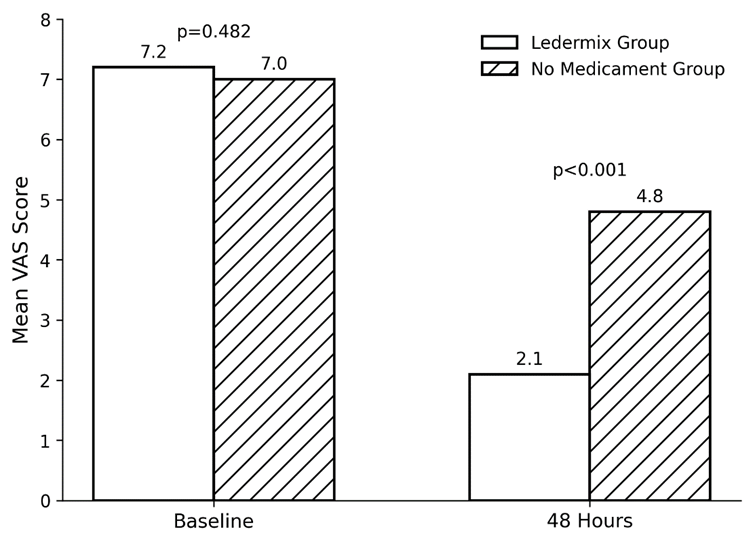
Figure 1 demonstrates the comparison of mean pain scores between both groups at baseline and after 48 hours.
Regarding pain severity at 48 hours, mild pain was more frequent in the Ledermix group (66.7%) compared to the no medicament group (31.0%). Severe pain was observed in only 6.6% of patients in the Ledermix group compared to 24.2% in the no medicament group. This difference was statistically significant (Table 3).
Table 3: Comparison of pain severity at 48 hours between groups
|
Pain Severity at 48 Hours |
Ledermix Group (n=30) |
No Medicament Group (n=29) |
P-value |
|
Mild |
20 (66.7%) |
9 (31.0%) |
0.008* |
|
Moderate |
8 (26.7%) |
13 (44.8%) |
0.041* |
|
Severe |
2 (6.6%) |
7 (24.2%) |
0.032* |
*A p-value <0.05 is considered statistically significant
DISCUSSION :
appointment pain between Ledermix (no intracanal medicament) and no intracanal medicine in patients having acute apical periodontitis during root canal therapy. The results of this study showed that patients treated with Ledermix paste had significantly lower pain scores at 48 hours than those who did not receive intracanal medicament. The present study has shown that the mean VAS pain score at 48 hours was 2.1 ± 1.3 in the Ledermix group and 4.8 ± 1.5 in the no medicament group (p <0.05). The current study shows that most of our patients came under the third and fourth decades of life, in keeping with several international studies conducted on postoperative endodontic pain, which demonstrated a similar age distribution to that observed, where the most predominantly affected demographic aspect was the middle-aged group, followed by elderly individuals (10, 11). This could be due to the frequent incidence of dental caries and pulpal pathologies in this financially productive age range related to increased exposure to cariogenic diets, along with delayed dental visits.
In the present study, males composed 56.7% of the Ledermix group vs 55.2% in the no medicament group. Regional studies in Pakistan and other parts of the world demonstrate similar male predominance (12, 13). This result could be due to higher access to health services in male-related reasons and more severe dental infections caused by tobacco consumption habits or poorer oral hygiene practices. Internationally, however, cervical niech in the case of, and root canal therapy is also higher among females, perhaps indicating an improved seeker behavior on the part of women in developed nations (14-16).
Before intervention, baseline mean pain scores in both groups were comparable and indicate that the study population is homogenous. But at the 48-hour time point, there was a statistically significant lower pain level in the Ledermix group. Such results are in accordance with earlier systematic reviews and randomized controlled trials, as the literature supports that using an intracanal corticosteroid medicament significantly reduces postoperative endodontic pain (17-19). The substrate observed in the present study further demonstrates that Ledermix paste may provide a beneficial adjunctive intracanal medicament for multi-visit root canal therapy.
In the current study, some limitations were encountered. This was a single-center tertiary care study with a smaller sample size, which might limit the generalizability of results. Pain perception is also subjective and probably differs among individuals based on psychological and cultural influences. Furthermore, functional outcomes and radiographic healing were not evaluated long-term. Larger multicenter studies and studies with longer follow-up periods are needed to confirm the efficacy of Ledermix paste in other clinical settings.
CONCLUSION :
In a selected population of patients with irreversible pulpitis/acute apical periodontitis, intracanal medicament with Ledermix paste is more effective than no treatment in reducing inter-appointment pain during endodontic therapy. At 48 hours of follow-up, patients receiving Ledermix had lower mean pain scores and a lower frequency of moderate-to-severe postoperative pain. The cumulative anti-inflammatory and antibacterial effects of the Ledermix paste could lead patients to more comfort and better post-operative outcomes during endodontic treatment.
Conflict of Interest: The authors declare no conflict of interest.
Funding: This research received no specific grant from any funding agency in the public, commercial, or not-for-profit sectors.
BIBLIOGRAPHY:
1. Gomes B, Aveiro E, Kishen A. Irrigants and irrigation activation systems in Endodontics. Braz Dent J. 2023;34(4):1-33.
2. Badawi NM, Kataia MM, Mousa HA. Advancements in Root Canal Therapy: Translational Innovations and the Role of Nanoparticles in Endodontic Treatment. Journal of Nanotechnology. 2025;2025(1):9949991.
3. Jr J, Barnett F. Interappointment pain: Mechanisms, diagnosis, and treatment. Endodontic Topics. 2004;7:93-109.
4. Falatah AM, Almalki RS, Al-Qahtani AS, Aljumaah BO, Almihdar WK, Almutairi AS. Comprehensive Strategies in Endodontic Pain Management: An Integrative Narrative Review. Cureus. 2023;15(12):e50371.
5. Chowdhury K, Antony SDP, Solete P, Elango PK, Sanghavi A, Muskan S. Effectiveness of calcium hydroxide as an intracanal medicament in endodontic retreatment: A systematic review of clinical outcome. J Conserv Dent Endod. 2025;28(9):849-58.
6. Verma J, Verma S, Margasahayam SV. Comparison of pretreatment gabapentin and pregabalin to control postoperative endodontic pain - a double-blind, randomized clinical trial. J Dent Anesth Pain Med. 2022;22(5):377-85.
7. Ehrmann EH, Messer HH, Adams GG. The relationship of intracanal medicaments to postoperative pain in endodontics. Int Endod J. 2003;36(12):868-75.
8. Dall AQ, Jouhar R, Khoso N. Comparison of inter-appointment pain between ledermix & no intracanal medicament in acute apical periodontitis. Journal of Liaquat University of Medical & Health Sciences. 2011.
9. Sattar M, Abbas B, Rahim S, Aamer S, Abbas S. The effect of Ledermix paste and Calcium Hydroxide as intracanal medicament on pain after instrumentation of root canals. Pakistan Armed Forces Medical Journal. 2020;70:368-72.
10. de Oliveira Damasceno C, da Silveira Bueno CE, De Martin AS, Pelegrine RA, Villela AM, Ruivo LM, et al. Factors Associated with Post-Endodontic Treatment Pain Performed by Students in an Endodontic Graduate Program. Iran Endod J. 2020;15(4):221-6.
11. Bassam S, El-Ahmar R, Salloum S, Ayoub S. Endodontic postoperative flare-up: An update. The Saudi Dental Journal. 2021;33(7):386-94.
12. Nagas E, Cehreli ZC, Uyanik MO, Vallittu PK, Lassila LV. Effect of several intracanal medicaments on the push-out bond strength of ProRoot MTA and Biodentine. Int Endod J. 2016;49(2):184-8.
13. Mala K, Jagadish S, Ramya S. Effi cacy of Ledermix as a root canal medicament in symptomatic teeth: A clinical study. Journal of Interdisciplinary History. 2014;4:85-8.
14. Yu VSH, Kvist T. Does gender make a difference in endodontic care delivery? Int Endod J. 2025;58(9):1282-8.
15. Mashyakhy M, Gambarini G. Root and Root Canal Morphology Differences Between Genders: A Comprehensive in-vivo CBCT Study in a Saudi Population. Acta Stomatol Croat. 2019;53(3):213-46.
16. Kaur H, Bharti S, Kaur S. Incidence of root canal treatment in anterior and posterior teeth and its association with the gender and age- A retrospective study. Archives of Dental Research. 2024;14:105-9.
17. Nath R, Daneshmand A, Sizemore D, Guo J, Enciso R. Efficacy of corticosteroids for postoperative endodontic pain: A systematic review and meta-analysis. J Dent Anesth Pain Med. 2018;18(4):205-21.
18. Chance K, Lin L, Shovlin FE, Skribner J. Clinical trial of intracanal corticosteroid in root canal therapy. Journal of Endodontics. 1987;13(9):466-8.
19. Almaslamani MJ, El Mesmari MH, Ismail SM. Effect of Intracanal Medicament Type on Postoperative Pain - A Prospective Study. Indian Journal of Dental Research. 2025;36(3):284-8.