Translation and Psychometric Validation of Short Dark Triad Scale (SD3) in Context of Pakistan: A Confirmatory Factor Analysis
- Rahim Akhtar Khan , Psychologist at Public Sector Organization, Kohat, Pakistan
- Nazia Mustafa , Practicing Clinical cum School Psychologist, at Mental Health Department of Government
- Aisha Rasool , Practicing Clinical Psychologist at Defense Medical Complex, Rawalpindi, Pakistan
- Afzaal Ahmed Khan , Healthcare Administrator at Government Hospital, Quetta, Pakistan
- Syed Shah Khalid , Consultant Psychiatrist at Mental Health Department of Government Hospital, Rawalpindi
- Sehrish Jahan Asif , Medical Specialist at Government Hospital, Quetta, Pakistan
Article Information:
Abstract:
To contextualize & adapt Short Dark Triad Scale (SD3) within the cultural framework of Pakistan. Study Design: Cross- Sectional StudyPlace and Population: A total of 250 participants were taken from different cities of Pakistan above 18 years old. Methodology: The study was conducted in two phases. Cross linguistic validation was carried out by translating the instrument forward and then backward in Urdu language with help of multidisciplinary mental health professionals. The study was conducted in 2 phases; in first pilot phase 50 participants were given the test with a gap of 15 days and in main study 250 participants participated through Google form.Results: Current research supported the normality values of skewness and kurtosis fell within the accepted range ±3.29, while reliability indices for all scales demonstrated consistently good levels. Confirmatory factor analysis (CFA) demonstrated that fit indices were either excellent or fell within the acceptable limits across all parameters.Conclusions: Current research findings established that the Urdu-translated version of the Short Dark Triad Scale is reliable in Pakistani culture.
Keywords:
Article :
INTRODUCTION:
Psychology has long been intrigued by the darkest shadow-like aspects of personality. In recent years however this area has gained renewed momentum. The concept & label of ‘dark personality’ refers to a mix of traits; these traits fall between a spectrum of a ‘normal’ & ‘abnormal’ (ALESSI1,2 Alicia OMAR1, 2018). These traits are subclinical in nature and don’t necessarily reflect psychopathology (Spain, Harms & Lebreton, 2013). The Dark Triad (DT) which comprise of narcissism, psychopathy and Machiavellianism, has always been fascinated the field of psychology. Over the past 20 years, the focus on assessing Dark triad has been growing evidenced by an exponential growth of annual research production (Paulhus and Williams, 2002). The dark triad of personality (DTP) first introduced by Paulhus & Williams, explaining personality through 3 interrelated yet distinct dark traits, typically linked to problematic, antisocial and maladaptive behaviours. (Jones &de roos, 2017)
Studies in recent years suggest that Dark Triad traits are useful predictors of workplace conduct, interpersonal dynamics, aggressiveness and unethical financial practices (Malesza & Ostaszewski, 2016). Empirical research has shown that dark personality traits are found to be associated with addictive online behaviors, as well (Balta, Jonason, Denes, Emirtekin, Tosuntas, Kircaburun & Griffiths, 2019). So for evaluation of these traits as this phenomenon is crucial particularly at organizational level hiring, many organizations are using multiple scales to assess each Dark Triad trait such as Self-Report Psychopathy Scale, The Machiavellian Scale and the Narcissistic Personality Inventory (Furnham et al. 2013). Delineation of these three traits has sparked ongoing debate, given their conceptual complexity, multidimensional nature of the traits and the absence of sufficiently validated assessment instruments (Brugue’s & Caparros, 2022)
Even traditional measures of the Dark Triad have 100 items, if there is a time restriction, brief instruments are more advantageous as they save both time and energy (Gosling et al., 2003). Various scales have been developed for the assessment of Dark Triad, among which the Short Dark Triad (SD3) is the most widely accepted, having 27 self-report items (Jones & Paulhus, 2014). The psychometric properties of the scale showed internal consistency for every dimension and a good convergent validity (Furnham et al., 2013). This scale has been used in a very few studies in Pakistan for adolescent population (Anwar & Zubair., 2021) in organizational settings (Rizvi & Siddiqui, 2023) among university students (Batool, I., Ishaq, G., Batool, H., & Sohail, I. 2025) but all have been using this English version.
The current research intended to contextualize & adapt Short Dark Triad Scale (SD3) within the cultural framework of Pakistan and keeping in mind this rationale the scale was required to be translated into Urdu language by establishing the psychometric properties and determination of its factor structure..
METHODOLOGY:
Research Design
A cross-sectional research design was employed. There were two phases of the study; pilot phase comprised of translation and cross language validation whereas main study was carried out on a larger sample in phase 2. The sample was taken by using Google forms across different cities of Pakistan through convenient sampling. The criteria suggested by past validation studies recommend 5 to10 people per item (Lai, et al.,2011).
Translation of the SD3 & its Cross Language
Before data collection, permission for the translation of scale was taken from the original author via email. Approval from Ethical Committee Psychological Research wing was taken. Permission from Medical directorate was secured as well. A Google form having SD-Form and SD3 along with informed consent was shared with the adults. The form included aim and scope of the research. Using Brislin back translation method (Anderson & Brislin, 1976; Hambleton, 1994) the translation of SD3 and its cross linguistic validation was carried out. During the pilot study 5 bilingual experts translated the forward translation of the scale, Urdu translated version was the discussed with the committee of the subject matter experts from psychology and other health departments. The final Urdu translated version was then translated back to English version with all different bilingual experts. The committee of subject matter experts again re-evaluated the back translated English version, one of them was finalized as a tool for pilot study. For cross language validation the tool was administered on 50 participants in pilot study, 25 participants were given Urdu version and 25 were given English version of the scale with gap of 15 days. The participants remained the same.
Sample
A total of 250 participants were particiaped through google form. Inclusion Criteria: participants above age 18, who were able to understand urdu language and had access to smart phone were included. Exclusion criteria: Those participants who were less than 18 years, having any kind of psychiatric issues in past 6 months or medical condition were excluded.
Instruments
Following instruments were administered: -
a. Socio-demographic form (SD-Form). The SD Form was designed to obtain the following variables data such as age, gender, birth order, marital status, social position, area, language and socioeconomic status, measured through Saleem (2020) method.
b. Short Dark Triad Scale. Short Dark Triad Scale (SD3) consisted of 27 items measuring 3 variables (narcissism, Machiavellianism and psychopathology) was administered. Each construct was measured by 9 items. The participants were supposed to rate each statement on a 5-point Likert scale ranging from strongly disagree to strongly agree.
Procedure
Keeping in mind the ethical consideration, informed consent was taken from the participants, keeping in mind the confidentiality of the participants risk of harm was avoided throughout the study. Besides this if the participants wanted to withdraw from the study, they were allowed.
Data Analysis Plan
A series of preliminary analysis by using Statistical Package for Social Sciences (SPSS version 26, IBM Corp., Armonk, NY, USA). CFA was used to examine the goodness-of-fit index of unique and the implicit structure of the SD3. CFA was performed through AMOS
RESULTS:
The study showed alpha coefficient for Urdu scale version 0.78 and 0.76 for English scale version with test re-test reliability found to be significant (r=.80). Among 250 participants 60.6% were males and 39.4 were females, 54.4% participants were living in nuclear family setup and 46.6% were living in joint setups. The normality values of skewness and kurtosis was within the accepted level (±3.29) (Brown, 2006) with good reliability for all scales.
|
Items |
R |
|
SD3_1 |
0.12 |
|
SD3_2 |
0.48 |
|
SD3_3 |
0.41 |
|
SD3_4 |
0.51 |
|
SD3_5 |
0.63 |
|
SD3_6 |
0.61 |
|
SD3_7 |
0.30 |
|
SD3_8 |
0.38 |
|
SD3_9 |
0.45 |
|
SD3_10 |
0.39 |
|
SD3_11 |
0.22 |
|
SD3_12 |
0.48 |
|
SD3_13 |
0.52 |
|
SD3_14 |
0.57 |
|
SD3_15 |
0.08 |
|
SD3_16 |
0.54 |
|
SD3_17 |
0.20 |
|
SD3_18 |
0.27 |
|
SD3_19 |
0.62 |
|
SD3_20 |
-0.03 |
|
SD3_21 |
0.47 |
|
SD3_22 |
0.30 |
|
SD3_23 |
0.45 |
|
SD3_24 |
0.52 |
|
SD3_25 |
0.06 |
|
SD3_26 |
0.47 |
|
SD3_27 |
0.55 |
table 1 shows item-total correlation of SD3-U. Most of the item’s values were acceptable range 0.08 to 0.50, fulfilling the criteria of recommended value to be more than 0.3 or 0.2. However, the value of these item-total correlations is less than 0.2 for a few items (item no 1, 15, 20, 25) for which further analysis was carried out to see whether to keep these items or should be omitted.
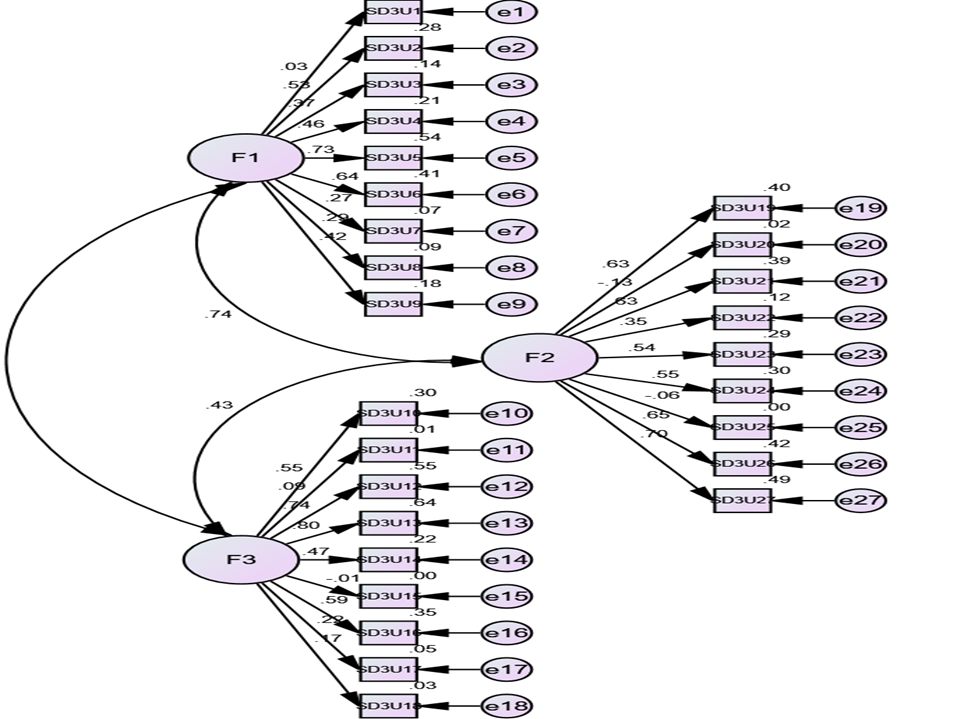
As the scale was translated into Urdu language, it was uni-dimensional scale, for its validation on indigenous culture and for the confirmation of its factor structure CFA was necessary to perform. Visual presentation of its items with their factor loadings is in figure 1 and figure 2.
|
Figure 1: CFA default model for CESDC as model fit
|
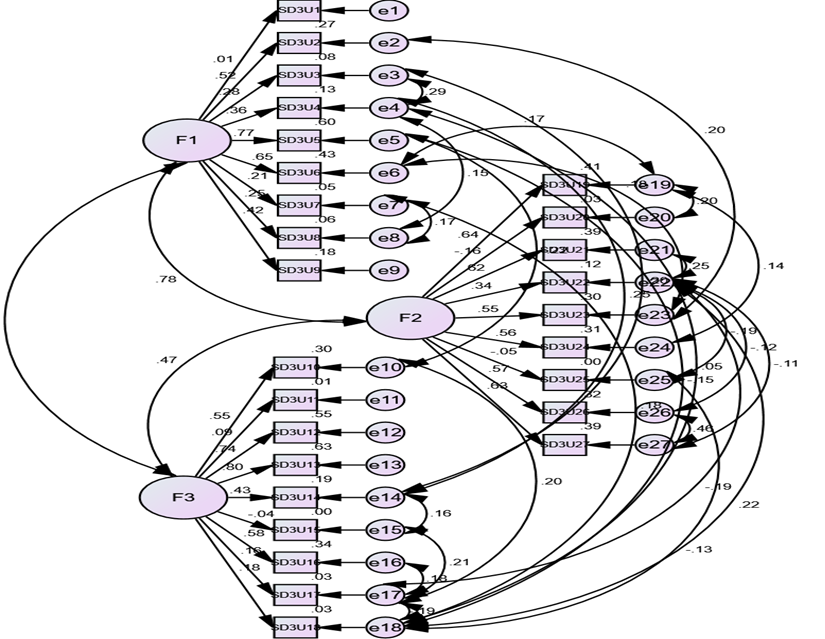
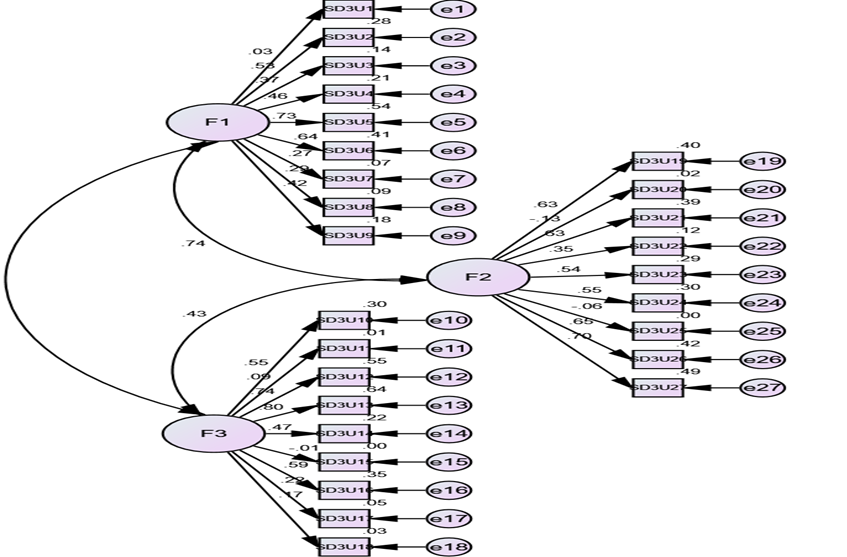
The model Fit indices for the SD3- Urdu version shows that model 1 represent indices which were not fit for default model. As all indicators, χ², IFI, TLI, CFI and RMSEA were not in acceptable range (Brown, 2015; Hooper et al., 2008), So error variances were applied and 4th model was considered as goodness of model fit.
Table 3 Model fit indices for SD3U among adults (N=249)
|
|
X2 (df) |
IFI |
TLI |
CFI |
RMESA |
∆X2(∆df) |
|
688.883(321) |
0.74 |
0.71 |
0.73 |
0.06 |
|
|
|
M2 |
485.410(303) |
0.87 |
0.85 |
0.85 |
0.04 |
203.473(18) |
|
M3 |
438.282(298) |
0.90 |
0.88 |
0.90 |
0.04 |
47.128(5) |
|
M4 |
406.569(294) |
0.92 |
0.90 |
0.92 |
0.03 |
31.713(4) |
Model 1= Default model of CFA for SD3U having three subscales; χ2 = chi-square; df = degree of freedom; RMSEA = root mean square error of approximation; IFI = incremental fit index; NFI = normed fit index; CFI=comparative fit index; TLI =Tucker–Lewis index; *p = 0.000
Table 3 represents the Model Fit Indices for the SD3, Urdu version. Model 1 represents indices were not fit for default model. As all indicators, χ², IFI, TLI, CFI and RMSEA were not in acceptable range (Brown, 2015; Hooper et al., 2008), So error variances were applied and 4th model was considered as goodness of model fit
DISCUSSION :
The three Dark Triad Traits- narcissism, Machiavellianism and psychopathy- are theoretically distinct yet empirical findings show significant overlap. Individuals with these characteristics frequently prioritize themselves, engage in aggressive acts without concern for empathy or guilt, Machiavellianism and psychopathy are closely aligned due to their nature of being destructive while narcissism shows a more defensive and fragile expression. There are very limited differentiating factors. Most attributes are shared confirmed by broader trait-based assessments (Linstead, Maréchal, & Griffin, 2014). This research sought to adapt and validate the SD3 scale in Urdu by focusing on its psychometric properties to be sound and factor structure.
The descriptive statistics of the study variables indicated that the Urdu version of the Short Dark Triad has successfully captured a wide range of responses across Machiavellianism, narcissism and psychopathy. The scale was sensitive to individual difference. Skewness and Kurtosis values fell within acceptable limits. Reliability estimates showed moderate internal consistency for the three subscales (α = .63–.68), which is common in brief measures, whereas the overall SD3 score demonstrated good reliability (α = .79). Other researches in other countries have shown that that the scale has a trifactorial structure, a consistent conclusion both with the theoretical foundations and the factorial composition of the original scale. Maples et al. (2014).
The item-total correlation analysis of SD3-Urdu showed important insights into the effectiveness of individual items as majority of items showed moderate to strong correlations confirming they can measure dark personality traits but few items showed weaker or negative correlations suggesting potential problems in comprehension or cultural appropriateness within urdu speaking population. Taken together, these results provide evidence that the Urdu SD3 is a psychometrically sound tool for assessing dark personality traits in the Pakistani context and can be confidently used in future research.
The limitation of the current study was that neither convergent nor divergent validity was established because no other scale was administered. It can be a future direction as well that it should be established. After validation of the instrument, it can be validated on more diverse sample and a larger sample size would help to generalize the results..
CONCLUSION :
Overall, in terms of psychometric properties of the scale were encouraging and were found to be internally consistent and reliable. And despite the listed limitations, having a scale in native language with sound psychometric properties to measure the darker traits has not only practical benefits for clinical level but at organizational level, too.
REFERNCES:
1. Salessi S, Omar A. Psychometric properties of a scale to measure the dark side of personality. Estud Psicol (Campinas). 2018;35:159-70. doi:10.1590/1982-02752018000200005
2. Spain SM, Harms P, Lebreton JM. The dark side of personality at work. J Organ Behav. 2013;35(2):41-60. doi:10.1002/job.1894
3. Paulhus DL, Williams KM. The dark triad of personality: Narcissism, Machiavellianism and psychopathy. J Res Pers. 2002;36(6):556-63.
4. Jones D, de Roos M. Differential reproductive behavior patterns among the Dark Triad. Evol Psychol Sci. 2017;3(1):10-9. doi:10.1007/s40806-016-0070-8
5. Malesza M, Ostaszewski P, Büchner S, et al. The adaptation of the short dark triad personality measure – Psychometric properties of a German sample. Curr Psychol. 2019;38:855-64. https://doi.org/10.1007/s12144-017-9662-0
6. Balta S, Jonason P, Denes A, Emirtekin E, Tosuntaş ŞB, Kircaburun K, et al. Dark personality traits and problematic smartphone use: The mediating role of fearful attachment. Pers Individ Dif. 2019;149:214-9. https://doi.org/10.1016/j.paid.2019.06.005
7. Furnham A, Richards SC, Paulhus DL. The dark triad of personality: A 10-year review. Soc Personal Psychol Compass. 2013;7:199-216.
8. Brugués G, Caparrós B. Dysfunctional personality, Dark Triad and moral disengagement in incarcerated offenders: Implications for recidivism and violence. Psychiatry Psychol Law. 2022;29(3):431-55. doi:10.1080/13218719.2021.1917011
9. Gosling SD, Rentfrow PJ, Swann WB. A very brief measure of the Big Five personality domains. J Res Pers. 2003;37:504-28. doi:10.1016/S0092-6566(03)00046-1
10. Jones DN, Paulhus DL. Introducing the short dark triad (SD3): A brief measure of dark personality traits. Assessment. 2014;21(1):28-41.
11. Furnham A, Richards SC, Paulhus DL. The dark triad of personality: A 10-year review. Soc Personal Psychol Compass. 2013;7:199-216.
12. Anwar M, Zubair A. Predictive role of dark triad of personality in social skills and lying behavior of adolescents. Found Univ J Psychol. 2021;5(1):81-90. https://doi.org/10.33897/fujp.v5i1.207
13. Rizvi S, Siddiqui D. Dark triad and counterproductive work behavior in Pakistan: The mediatory role of perceived organizational fairness complemented by organizational climate. Int J Soc Sci Entrep. 2023;3:545-68. doi:10.58661/ijsse.v3i2.161
14. Batool I, Ishaq G, Batool H, Sohail I. Impact of Dark Triads of Personality and Rejection Sensitivity on Mental Well-Being among University Students. Pak. J. Humanit. Soc. Sci [Internet]. 2025 Mar. 20 [cited 2025 Sep. 11];13(1):333-4. Available from: https://journals.internationalrasd.org/index.php/pjhss/article/view/2720
15. Lai BPY, Chung TKH, Lee DTS, Kong GWS, Lok IH. Measuring grief following miscarriage: Psychometric properties of the Chinese version of the perinatal grief scale. Assessment. 2011;20:123-9. doi:10.1177/1073191110397275
16. Anderson RBW, Brislin RW. Translation: applications and research. New York: Halsted Press; 1976.
17. Hambleton RK. Guidelines for adapting educational and psychological tests: a progress report. Eur J Psychol Assess. 1994;10(3):229-44