Management of post-dural puncture headache with occipital nerve block: a single-centre interventional study
- Muhammad Umer Saeed , MBBS, MCPS Anesthesiology Consultant Anesthesiologist and interventional spine and Regenerative Physician, Iffat Anwar Hospital
- Saiyyadah Tahzeeb , MBBS, MCPS Anesthesiology, Consultant Anesthesiologist and Interventional Pain Physician, Jinnah Hospital Lahore
- Saadia Butt , MS Anesthesia ,SR Anesthesia, M Islam Teaching Hospital, Gujranwala
- ABDUL BARY , MBBS FCPS, Assistant Professor Anesthesia Department, RAHBAR MEDICAL AND DENTAL COLLEGE
- Amina Qayyum , Post Graduate Resident Anesthesia Anesthesia Department, Jinnah Hospital Lahore
- Umair Ashraf , MS Anesthesia , Senior Registrar Anesthesia Department, M Islam Teaching Hospital, Gujranwala
Article Information:
Abstract:
Post-dural puncture headache (PDPH) remains a common and distressing complication of neuraxial techniques in obstetric practice. Although epidural blood patch (EBP) is widely accepted as the treatment of choice, its invasive nature and potential complications limit its use in some patients. Greater occipital nerve block (ONB), which has demonstrated benefit in other headache syndromes, may represent a less invasive therapeutic option.This interventional study assessed the effectiveness of bilateral ONB in 50 women aged 21–35 years who developed PDPH following spinal anaesthesia for Caesarean delivery. Under aseptic conditions, 2–3 mL of 0.25% bupivacaine was administered on each side. Pain severity was measured using the visual analogue scale (VAS) before the block and at 15 minutes, 60 minutes, 1 week, and 4 weeks post-procedure. The requirement for EBP and any complications were also documented.A significant reduction in VAS scores was observed within 15 minutes of the block, with sustained analgesia throughout follow-up. Most patients did not require subsequent EBP, and no serious adverse effects were reported.Bilateral ONB appears to be an effective and well-tolerated approach for the treatment of PDPH and may be considered as an early alternative to epidural blood
Keywords:
Article :
INTRODUCTION:
PDPH is a well-recognised adverse effect of spinal and epidural anaesthesia, with increased incidence in young female and obstetric populations. The headache is typically bilateral and postural in nature, intensifying in the upright position and improving when supine, and may be associated with symptoms such as nausea, photophobia, neck discomfort, and auditory disturbances. The underlying mechanism is believed to involve leakage of cerebrospinal fluid through the dural puncture site, leading to reduced intracranial pressure and stretching of pain-sensitive intracranial structures.
Methods:
This single-arm interventional study was conducted in the Department of Anaesthesiology, Jinnah Hospital Lahore, from July 2024 to Jule 2025. Written informed consent was obtained from all participants.
Fifty female patients aged 21–35 years who developed PDPH within 7 days following spinal anaesthesia for Caesarean section were included. Patients with allergy to local anaesthetics, history of occipital or neurosurgical procedures, uncontrolled systemic illness, or refusal to participate were excluded.
Bilateral occipital nerve block was performed under aseptic conditions using anatomical landmarks. A volume of 2–3 mL of 0.25% bupivacaine was injected on each side.
Pain intensity was assessed using the visual analogue scale (VAS) at baseline, 15 min, 60 min, 1 week, and 4 weeks after the procedure. The need for epidural blood patch and any adverse effects were recorded.
Data were analysed using SPSS version 21. Quantitative data were expressed as mean (SD). Changes in VAS scores over time were analysed using repeated-measures ANOVA and paired t-tests. A p-value ≤0.05 was considered statistically significant.
Results:
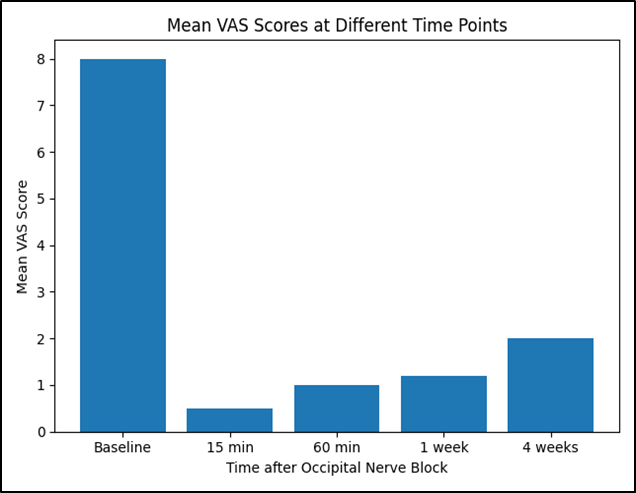
A marked reduction in VAS scores was observed within 15 min of ONB administration. The reduction in pain scores remained sustained at 60 min, 1 week, and 4 weeks. Statistical analysis demonstrated significant within-subject reduction in VAS scores over time.
The majority of patients did not require epidural blood patch following ONB. No significant adverse events or complications were observed.

DISCUSSION :
The analgesic effect of ONB in PDPH may be attributed to blockade of afferent sensory input from the greater occipital nerve, which converges with trigeminocervical pathways involved in headache processing. By modulating these shared nociceptive circuits, ONB may reduce central sensitisation and interrupt the transmission of pain associated with intracranial hypotension.
Compared with epidural blood patch, ONB is simpler, less invasive, and associated with minimal risk. These findings are consistent with previous reports describing the efficacy of ONB in PDPH and other headache disorders.
Limitations include the single-arm design and absence of a control group. Further randomised controlled trials are required to validate these findings.
CONCLUSION :
Bilateral occipital nerve block is a safe, effective, and minimally invasive technique for the management of post-dural puncture headache and may be considered before epidural blood patch in post-Caesarean patients.
Authors’ contributions
ST: study design, data collection, manuscript preparation
MAZ: supervision, critical revision
Declarations of interest
None.
Funding
None.
Ethics approval
Approved by the institutional ethics committee.
Written informed consent obtained.
BIBLIOGRAPHY:
1. Amorim JA, Gomes de Barros MV, Valença MM. Post-dural puncture headache: risk factors and clinical features. Cephalalgia. 2012;32(12):916–923.
2. Schievink WI, Deline CR. Headache secondary to intracranial hypotension. Curr Pain Headache Rep. 2014;18(8):446.
3. Matute E, Bonilla S, Girones A, Planas A. Bilateral greater occipital nerve block for post-dural puncture headache. Anaesthesia. 2008;63(5):557–558.
4. Naja Z, Al-Tannir M, El-Rajab M, Ziade F, Baraka A. Nerve stimulator-guided occipital nerve blockade for PDPH. Pain Practice. 2009;9(1):51–58.
5. Patel R, Urits I, Orhurhu V, et al. A comprehensive update on the treatment and management of postdural puncture headache. Curr Pain Headache Rep. 2020;24:1–9.
6. Elshafei AS, Mowafy SMS. Sphenopalatine ganglion block with or without greater occipital nerve block for obstetric PDPH: RCT. Ain-Shams J Anesthesiol. 2023;15(1):76.