Effect of hyaluronic acid mouthwash soaked gel foam in socket healing
- Sushmitha V , Undergraduate student Saveetha Dental College and Hospitals,Saveetha Institute of Medical and Technical SciencesSaveetha University, Chennai-600077.
- Melvin George A , Associate Professor Saveetha Institute of Medical and Technical Sciences
Article Information:
Abstract:
Hyaluronic acid (HA), a naturally occurring polysaccharide, has gained prominence for its remarkable biological properties, including its ability to promote tissue regeneration, reduce inflammation, and enhance wound healing AIM: In this study, we analysed the effect of HA on soft tissue healing as well as the postoperative pain. MATERIALS AND METHODS: Ten individuals of both genders (60% females and 40% males) with age range 20–50 years, were included who were to undergo extraction (total sockets n = 20)RESULTS: There were no statistically significant differences between the control and study groups regarding the reduction of the socket length and postoperative complications but results revealed that HA enhances and fastens the healing capacity CONCLUSION: HA can be used as adjunctive treatment to improve the wound healing process.
Keywords:
Article :
INTRODUCTION:
Dental extraction is one of the most commonly performed surgical procedures in dentistry, often leaving sockets that require proper healing. The speed at which a tooth extraction socket heals is influenced by several factors, including the patient's age, their oral hygiene, and the nature of the surgery conducted.(1)
Complications arising from inadequate healing, such as alveolar osteitis (dry socket), infection, or delayed closure of the wound, can significantly affect patient comfort and recovery.(2) Consequently, dental research is currently dedicated to enhancing the repair of extraction sockets.
Hyaluronic acid (HA), a naturally occurring polysaccharide, has become well-known for its impressive biological properties, such as promoting tissue regeneration, decreasing inflammation, and improving wound healing.(2,3) Present in the extracellular matrix, HA is essential for cellular functions.
Socket healing following dental extraction is a complex biological process involving inflammation, granulation tissue formation, and remodeling. Any disruption can delay recovery and increase complications such as dry socket.(4) Hyaluronic acid, a naturally occurring glycosaminoglycan, plays a key role in tissue hydration, angiogenesis, and wound repair, making it a promising adjunct in enhancing oral healing outcomes.(4–6)
The use of hyaluronic acid mouthwash soaked gel foam offers a novel approach for localized drug delivery within the extraction socket. This method ensures sustained release, improved tissue contact, and enhanced healing potential. Evaluating its effectiveness may provide a simple, non-invasive strategy to accelerate healing and reduce postoperative complications in dental practice.(7)
The purpose of this study is to assess how mouthwash-soaked gel foam affects socket healing after dental extractions. This study aims to develop a new and effective technique for promoting post-extraction healing, which will improve patient outcomes in dental treatment, by investigating its effects on tissue regeneration, pain management, and infection control.
Materials and methods::
This study was conducted on patients requiring dental extractions, with inclusion criteria encompassing healthy individuals aged 20–50 years with no systemic conditions affecting wound healing. Extractions were limited to non-complicated cases without infection or extensive bone loss. Patients were divided into two groups: the test group, in which gel foam soaked in hyaluronic acid (HA) mouthwash was placed in the socket post-extraction, and the control group, where only standard gel foam without HA was used. The HA mouthwash used in the study contained a standardized concentration of hyaluronic acid, ensuring consistency across applications.
Post-extraction, the gel foam was placed into the socket under sterile conditions and secured with sutures if needed. Patients were monitored for clinical parameters, including pain (measured using a visual analog scale), swelling, and signs of infection. Healing was assessed using a standard healing index at intervals of 7 and 14 days. Data were statistically analyzed to compare the efficacy of HA mouthwash-soaked gel foam versus the control. Ethical approval was obtained, and informed consent was secured from all participants.
Wound healing index (WHI)
It was calibrated to document the gingival inflammation signs; tissue color, bleeding response on palpation, incision margin closure, and suppuration formation of the healing socket using the healing index done in other similar articles . (8,9) Each socket was given a score from 1 (very poor healing) to 5 (excellent healing).
Score 1 (very poor healing): ≥50% of redgingiva, bleeding on tissue palpation, presence ofgranulation tissues, not epithelialized margins withloss of epithelium beyond margins, and presence ofsuppuration.
Score 2 (poor healing): ≥50% of red gingiva,bleeding on tissue palpation, presence of granulationtissues, not epithelialized margins with exposedconnective tissue, and absence of suppuration.
Score 3 (good healing): 25–50% of red gingiva,no bleeding on tissue palpation, no granulation tissues,no exposed connective tissue, and no suppuration.
Score 4 (very good healing): <25% of redgingiva, no bleeding on tissue palpation, no granulationtissues, no exposed connective tissue, and no
suppuration.
Score 5 (excellent healing): No red gingiva, nobleeding on tissue palpation, no granulation tissues, noexposed connective tissue, and no suppuration.
Results::
Ten patients, four of whom were male and six of whom were female, ranging in age from 20 to 50, were involved in all follow-up periods. As indicated in Table 1, the frequency and percentage of participants were computed in order to analyze the gender and age variables.
When comparing the two groups under study in terms of gender, it was discovered that there was no significant difference between them (p > 0.05). Furthermore, there was no discernible difference in age between the two groups under study (p > 0.05).
Table 1: Age and gender data sample frequency distribution
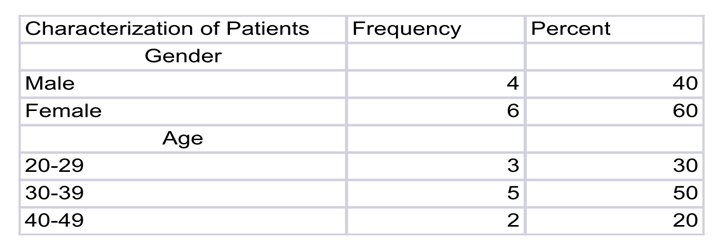
Figure 1: Wound healing after 14 days
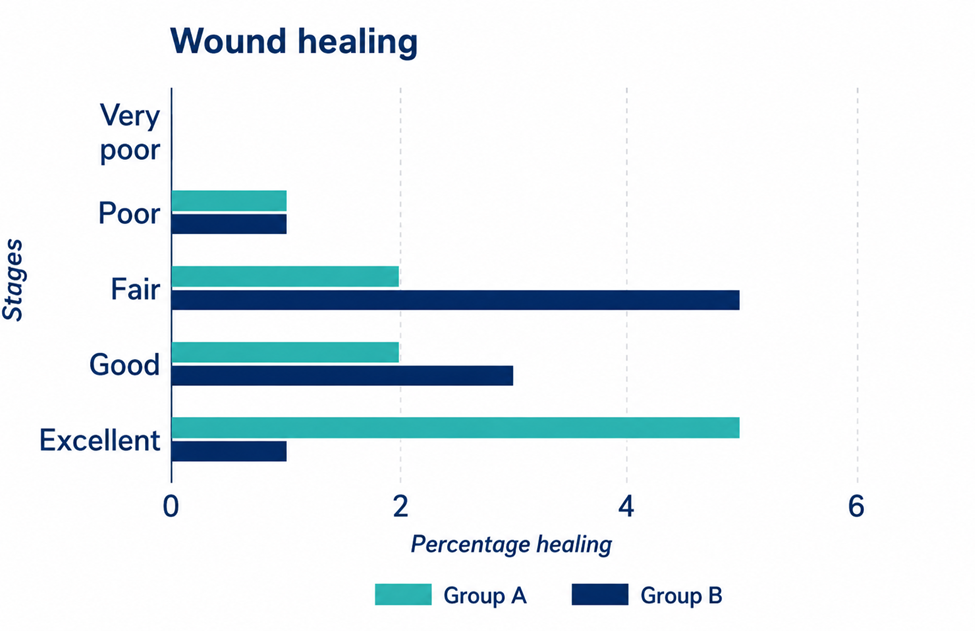
Figure 1 displays the compassion between both groups regarding WHI after 10 days. Results revealed there was a significant difference between both groups regarding healing. In Group A (study group), 50% of the sockets showed excellent healing, 20%, 20%, and 10% of sockets revealed good, fair, and poor improvement, respectively . In Group B (control group), 10% only of the socket showed excellent healing of soft tissues, 30% of the sockets displayed a reduction of the scores and 50% of sockets showed fair improvement while 10% showed poor healing of soft tissues. Regarding the postoperative pain, neither group A nor Group B had any postoperative complications including pain and suppuration, where no statistics could be done.
DISCUSSION :
The findings of this study highlight the significant role of hyaluronic acid (HA) mouthwash-soaked gel foam in enhancing post-extraction socket healing.(3) The test group demonstrated faster and more consistent healing compared to the control group, with reduced pain, inflammation, and improved tissue regeneration observed throughout the follow-up period. (3,10)These outcomes are consistent with the known properties of HA, including its ability to promote angiogenesis, modulate inflammation, and accelerate epithelialization, which are critical for optimal socket healing.(3,10,11)
The gel foam acted as a hemostatic agent and provided a stable scaffold for HA delivery. This combination ensured sustained release of HA at the extraction site, allowing for prolonged therapeutic effects. (3)(1)HA’s hydrophilic nature helped maintain a moist environment, which is crucial for tissue repair and reducing the risk of complications such as alveolar osteitis. Additionally, the anti-inflammatory effects of HA minimized postoperative swelling and discomfort, improving patient compliance and recovery outcomes.(12)
When compared to traditional approaches using gel foam alone, the addition of HA mouthwash significantly enhanced the healing index scores and reduced the time required for complete epithelialization(11,12)(13). These results suggest that integrating HA into routine post-extraction care can address some of the common challenges associated with socket healing, particularly in patients with compromised healing capacities. The simplicity of the application also makes this approach feasible in clinical settings without requiring specialized equipment or technique(3,11,12,14)s.(15)
However, certain limitations must be acknowledged. This study focused on a relatively healthy population with uncomplicated extractions, and the results may not be directly generalizable to patients with systemic conditions or more complex cases. Further research, including randomized controlled trials with larger sample sizes and long-term follow-up, is needed to fully establish the efficacy and safety of HA mouthwash-soaked gel foam. Despite these limitations, this study underscores the potential of HA as a valuable adjunct in enhancing post-extraction socket healing.
CONCLUSION :
The study's findings support the notion that while HA administration improves and speeds up the soft tissue healing capacity, it has no discernible effect on the bone healing of the removed sockets. Nonetheless, HA might be a useful supplemental therapy to speed up the healing of wounds.
BIBLIOGRAPHY:
1. Yang S, Li Y, Liu C, Wu Y, Wan Z, Shen D. Pathogenesis and treatment of wound healing in patients with diabetes after tooth extraction. Front Endocrinol (Lausanne). 2022 Sep 23;13:949535.
2. Brar G, Sodhi A, Brar GS, Kaur A, Verma N, Bawa R, et al. The Effect of Platelet-Rich Fibrin in Preventing Alveolar Osteitis Following Mandibular Third Molar Surgery: A Systematic Review and Meta-Analysis. Cureus. 2026 Feb;18(2):e103522.
3. Domic D, Bertl K, Lang T, Pandis N, Ulm C, Stavropoulos A. Hyaluronic acid in tooth extraction: a systematic review and meta-analysis of preclinical and clinical trials. Clin Oral Investig. 2023 Dec;27(12):7209–29.
4. Jerome WF. The Effect of Epsilon Aminocaproic Acid on the Prevention of Dry Sockets Following Dental Extractions in Monkeys: Proposing to Prevent Clot Breakdown with the Topical Application of an Antifibrinolytic Agent ... : a Thesis Submitted in Partial Fulfillment ... Oral Surgery .. 1978. 122 p.
5. Ronsivalle V, Cammarata U, Perrotta R, Giudice R, Cicciù M. Polynucleotide-Hyaluronic Acid Gel as an Adjunct to Tooth Extraction in Patients at Risk of MRONJ: A Randomized Split-Mouth Clinical Trial. J Craniofac Surg [Internet]. 2026 May 5; Available from: http://dx.doi.org/10.1097/SCS.0000000000012842
6. Seong HJ, Bak Y, Pyeon S, Jeong SG, Yang KY, Nam SH. Synergistic enzymatic - ethanol extraction of arbutin from boiled pear pomace and its whitening and anti-wrinkle activities. Food Sci Biotechnol. 2026 May;35(6):1625–36.
7. Marra A, de Siena AU, Iacovazzo C, Bianco AR, Squillacioti F, Vargas M, et al. Comparison of the efficacy of hyaluronic acid vs corticosteroids, platelet-rich plasma, and physical therapy in chronic shoulder pain:: a systematic review and a frequentist network metanalysis. Arch Phys Med Rehabil [Internet]. 2026 Apr 30; Available from: http://dx.doi.org/10.1016/j.apmr.2026.04.026
8. Kusakci-Seker B, Demirayak-Akdemir M. The effect of non-thermal atmospheric pressure plasma application on wound healing after gingivectomy. Int Wound J. 2020 Oct;17(5):1376–83.
9. Vijayakumar G, Sundaram GA, Kumar SP, Lakshmanan S, Krishnan M, Krishna VK. Comparison of Efficacy of Topical Carica papaya Leaf Extract and Hemocoagulase in Postoperative Wound Healing After Therapeutic Orthodontic Premolar Extractions: a Split Mouth Study. Cureus. 2024 Jun;16(6):e61946.
10. Zhu X, von Werdt L, Zappalà G, Sculean A, Eick S, Stähli A. In vitro activity of hyaluronic acid and human serum on periodontal biofilm and periodontal ligament fibroblasts. Clin Oral Investig. 2023 Sep;27(9):5021–9.
11. Husseini B, Friedmann A, Wak R, Ghosn N, Khoury G, El Ghoul T, et al. Clinical and radiographic assessment of cross-linked hyaluronic acid addition in demineralized bovine bone based alveolar ridge preservation: A human randomized split-mouth pilot study. J Stomatol Oral Maxillofac Surg. 2023 Sep;124(4):101426.
12. Kloss FR, Kau T, Heimes D, Kämmerer PW, Kloss-Brandstätter A. Enhanced alveolar ridge preservation with hyaluronic acid-enriched allografts: a comparative study of granular allografts with and without hyaluronic acid addition. Int J Implant Dent. 2024 Oct 9;10(1):42.
13. Larjava H. Oral Wound Healing: Cell Biology and Clinical Management. John Wiley & Sons; 2012. 433 p.
14. Bs A, Ganesh S B, Eswaramoorthy R, G K. Hyaluronic Acid Hydrogel Combined With Ocimum sanctum and Tendon-Derived Extracellular Matrix Enhances Tenogenesis in Periodontal Ligament Stem Cells. Cureus. 2024 Feb;16(2):e54060.
15. Kantarci A, Stavropoulos A, Sculean A. Biologics and Biology-based Regenerative Treatment Approaches in Periodontics, An Issue of Dental Clinics of North America, E-Book. Elsevier Health Sciences; 2021. 185 p.