Risk Factors, Microbiological Profile, and Outcomes of Neonatal Sepsis in a Tertiary Care Center of Pakistan
- Naseer Ahmad Memon , Associate Prof, Department of Pediatrics, Peoples University of Medical & Health Sciences for Women, Nawabshah, District Shaheed Benazirabad.
- AmeerAli Jamali , Associate Prof, Department of Pediatrics, Peoples University of Medical & Health Sciences for Women, Nawabshah, District Shaheed Benazirabad.
- AzizullahLangah , Associate Prof, Department of Pediatrics, Peoples University of Medical & Health Sciences for Women, Nawabshah, District Shaheed Benazirabad.
- Mubasher Hussain , Senior Registrar, Department of Pediatrics, Peoples University of Medical & Health Sciences for Women, Nawabshah, District Shaheed Benazirabad.
- Arshad Ali Lakho , Senior Registrar, Department of Pediatrics, Peoples University of Medical & Health Sciences for Women, Nawabshah, District Shaheed Benazirabad.
- Ali Akbar Siyal , Professor, Department of Pediatrics, Peoples University of Medical & Health Sciences for Women, Nawabshah, District Shaheed Benazirabad
Article Information:
Abstract:
To determine the risk factors, microbiological profile, and clinical outcomes of neonatal sepsis in a tertiary care center of Pakistan. Study Design: Prospective observational study. Place and Duration of Study: Department of Pediatrics, Peoples University of Medical & Health Sciences for Women, Nawabshah, District Shaheed Benazirabad, Sindh, Pakistan, from January 2024 to December 2024. Methodology: Infants under <28 days of age who were admitted with clinical suspicion of sepsis were registered. The clinical features were assessed through laboratory parameters and /or positive blood cultures on the diagnosis of neonatal sepsis. The maternal and neonatal risk factors, demographics, microbiological, and clinical outcomes were recorded on a structured pro forma. Blood cultures were done as per normal microbiological method. Multivariate logistic regression analysis was conducted to determine predictors of mortality that are independent and receiver operating characteristic (ROC) curve analysis was performed to evaluate the performance of the model. Results: A total of 320 neonates were included, with 61.9% males. Early-onset sepsis was observed in 58.4% of cases. Prematurity (55.0%) and low birth weight (59.1%) were the most frequent risk factors. Blood cultures were positive in 43.1% neonates, with Gram-negative organisms predominating. Klebsiella pneumoniae (37.7%) and Escherichia coli (27.5%) were the most common isolates. Overall mortality was 18.1%, significantly higher among culture-positive neonates compared to culture-negative cases (26.1% vs. 12.1%). Prematurity, low birth weight, culture-positive sepsis, and need for mechanical ventilation were independent predictors of mortality. The ROC curve showed good predictive accuracy with an area under the curve of 0.84. Conclusion: Neonatal sepsis remains a major contributor to neonatal mortality in Pakistan, emphasizing the need for early risk stratification and targeted management.
Keywords:
Article :
INTRODUCTION :
Neonatal sepsis is a fatal clinical syndrome that is defined by an overall infection among infants under the age of 28 days. Although profound progress has been achieved in neonatal intensive care, it also continues to be among the causes of neonatal morbidity and mortality in most countries of the world (1). World Health Organization reports that neonatal infections contribute about 30-35 percent to neonatal deaths, which is 2.3 million per year with the greatest burden in countries with low and middle-income status (LMICs). Neonatal mortality is almost half of the total world with South Asia alone carrying almost 40 percent of the burden with respect to the disproportional effects of the avoidable infectious diseases in resource-strained environments (2, 3).
Pakistan is ranked among the highest countries in the world by the neonatal mortality rate (NMR) with the figures standing at 39-42 deaths per 1,000 live births which is far much higher than the Sustainable Development Goal (SDG) neonatal mortality rate of 12 per 1,000 live births by 2030 (4, 5). Neonatal sepsis is always documented as one of the three leading causes of death in neonatal mortality in the country as it causes about 20-25 percentage of neonatal mortality. Pakistan-based hospital based investigations indicate that there are 30 to 50 percent incidences of suspected neonatal sepsis among NICU hospitalisations with a case fatality ratio among 15 to 35 percent via gestational age, weight of birth, and access to advanced care (6).
The etiology of neonatal sepsis is not uniform across geographic regions and time periods and has been found to depend on disparities in healthcare infrastructures, infection prevention efforts, and patterns of antibiotic use (7). Data from the high-income countries shows that Group B Streptococcus and Escherichia coli dominate the early-onset sepsis cases, but Pakistan and South Asian countries data show the high prevalence of Gram-negative organisms, especially Klebsiella pneumoniae, Escherichia coli, Acinetobacter species, and Pseudomonas aeruginosa (8). Interestingly, the growing antimicrobial resistance among these pathogens is well documented and resistance to the first-line antibiotics like ampicillin and gentamicin is growing, which forms a major therapeutic challenge (9).
There are several maternal and neonatal risk factors that have been attributed to the occurrence of neonatal sepsis. These are prematurity, low birth weight, delayed membrane rupture, maternal intra partum fever, non-cleanliness of delivery procedures, and necessity of invasive procedures in the neonatal intensive care unit (10). These risk factors are especially high in Pakistan, where the preterm birth rates are above 15 percent, and a large percentage of the deliveries are done in environments without a lot of aseptic precautions, which makes a neonate highly susceptible to severe infections (11).
Microbial trends and antibiotic resistance are dynamic, and therefore, local surveillance should be done continuously. But Pakistani data are still piecemeal, usually one-centered, and heterogeneous in approach. The study is thus warranted as an up-to-date center-specific evidence on risk factors, microbiological profiles, and outcomes of neonatal sepsis in one of the tertiary care hospitals in Pakistan. This kind of data will be instrumental in the optimization of empirical antibiotic guidelines, enhancing the overall infection prevention strategies, and eventually the rates of sepsis-associated neonatal mortality in the area.
METHODOLOGY:
The given prospective observational research was performed during twelve months, i. e. January 2024 to December 2024, at the Department of Pediatrics, Department of Pediatrics, Peoples University of Medical & Health Sciences for Women, Nawabshah, District Shaheed Benazirabad, Sindh, Pakistan. The research has been conducted in the neonatal unit of the department and it is a tertiary care referral facility which serves a significant urban and rural population of the interior Sindh. The neonatal unit has the capacity to handle both inborn and outborne babies, preterm and severely ill babies who require intensive care.
Eligibility screening was done to all neonates admitted within the study period (0-28 days) which had a clinical suspicion of sepsis. Clinical definition Neonatal sepsis was used to refer to the presence of systemic manifestations of infection including instability of temperature (fever or hypothermia), poor feeding, lethargy, apnea, respiratory distress, cyanosis, seizures, abdominal distension or lack of hemodynamic stability, with or without demonstration of infection. The time of onset of symptoms divided the neonates into early-onset sepsis (symptoms took place within the first 72 hours of life) and late-onset sepsis (symptoms took place after 72 hours of life).
Inclusion criteria were neonates of both sexes who were <28 days old and had a clinical presentation indicative of sepsis with at least one of the supportive laboratory parameters. These lab parameters were an increase in C-reactive protein above the institutional range, abnormal total leukocyte count or absolute neutrophil count, thrombocytopenia, or a positive blood culture. Inborn and out born neonates were included to cover the whole gamut of the disease burden of the region and both inborn and outborn were taken care of by including both those born in the study hospital and those born in the peripheral healthcare facilities.
The exclusion criteria were that the neonates should be known to have significant congenital defects that were incompatible with life, known chromosomal abnormalities, inborn errors of metabolism or congenital heart disease that are known to cause shock without infection. Neonates admitted with elective or isolated surgical conditions with no clinical or laboratory history of sepsis were excluded. Also, infants that had undergone further antibiotic treatment of more than 72 hours before admission without baseline laboratory tests were excluded because of the possible effect on culture results and inflammatory indices. Those cases that had incomplete clinical records, poor blood samples to be sent to the laboratory, or the denial of consent by the parents or the guardians were also not included in the final analysis.
Data Collection
The data were prospectively gathered using a structured pro forma of standardized data collection that was specifically designed to collect data in this study. Maternal variables were: maternal age, parity, antenatal care status, experience of the prolonged rupture of membranes, occurrence and duration of the ruptured membrane and perineal rupture, maternal intrapartum fever, urinary or genital tract infection history and mode of delivery. Gestational age measured by last menstrual period and/or Ballard scoring, birth weight, sex, Apgar scores at one and five minutes, resuscitation requirement at birth and need to undergo invasive medical treatment like intravenous cannulation or mechanical ventilation were the neonatal variables. Laboratory tests involved complete blood count, C-reactive protein and blood culture findings. Strict aseptic blood samples were withdrawn before antibiotic therapy was administered. Isolation was done by conventional microbiological methods and susceptibility to the antibiotics was tested as per Clinical and Laboratory Standards Institute (CLSI) guidelines. Durability of hospital stay, survival, or death was measured till discharge or death.
Data Analysis
The Statistical Package of Social Sciences (SPSS) was used in the analysis and entry of data version 26. Categorical variables were described into frequencies and percentages whereas continuous variables were described in terms of mean±standard deviation or median with interquartile range depending on the distribution of the data. The chi-square test or Fisher exact test of categorical variables and independent sample t-test or Mann Whitney U test of continuous variables were used to determine the associations between maternal and neonatal risk factors and clinical outcomes. Multivariate logistic regression analysis was done to determine independent predictors of mortality. A p-value below 0.05 was taken as statistically significant
RESULTS :
A total of 320 neonates with clinical suspicion of sepsis were included in the final analysis. Among these, 198 (61.9%) were males and 122 (38.1%) were females. Early-onset sepsis (≤72 hours of life) was identified in 187 (58.4%) neonates, while 133 (41.6%) presented with late-onset sepsis. Baseline demographic and clinical characteristics of the study population are summarized in Table
Table 1. Baseline Demographic and Clinical Characteristics of Neonates
|
Characteristics |
Frequency |
Percentage (%) |
|
Male gender |
198 |
61.9 |
|
Female gender |
122 |
38.1 |
|
Preterm (<37 weeks) |
176 |
55.0 |
|
Term (≥37 weeks) |
144 |
45.0 |
|
Low birth weight (<2.5 kg) |
189 |
59.1 |
|
Normal birth weight |
131 |
40.9 |
|
Early-onset sepsis |
187 |
58.4 |
|
Late-onset sepsis |
133 |
41.6 |
Maternal and neonatal clinical risk factors associated with neonatal sepsis are shown in Table 2. Prematurity and low birth weight were the most common neonatal risk factors, while prolonged rupture of membranes was the leading maternal risk factor.
Table 2. Maternal and Neonatal Risk Factors Associated with Neonatal Sepsis(n = 320)
|
Risk Factors |
Frequency |
Percentage (%) |
|
Prematurity |
176 |
55.0 |
|
Low birth weight (<2.5 kg) |
189 |
59.1 |
|
Prolonged rupture of membranes (>18 hours) |
112 |
35.0 |
|
Maternal fever |
78 |
24.4 |
|
Birth asphyxia |
96 |
30.0 |
|
Need for resuscitation at birth |
94 |
29.4 |
Blood cultures were positive in 138 (43.1%) neonates. The microbiological spectrum of isolated pathogens is presented in Table 3. Gram-negative organisms were predominated.
Table 3. Microbiological Profile of Culture-Positive Neonatal Sepsis(n = 138)
|
Isolated Organisms |
Frequency |
Percentage (%) |
|
Klebsiella pneumoniae |
52 |
37.7 |
|
Escherichia coli |
38 |
27.5 |
|
Acinetobacter species |
21 |
15.2 |
|
Staphylococcus aureus |
19 |
13.8 |
|
Enterococcus species |
8 |
5.8 |
Overall mortality was observed in 58 (18.1%) neonates. Mortality was significantly higher among culture-positive neonates compared to culture-negative neonates (26.1% vs. 12.1%, p<0.01). Clinical outcomes are detailed in Table4
Table 4. Clinical Outcomes of Neonates with Sepsis(n = 320)
|
Outcome |
Frequency |
Percentage (%) |
|
Survived |
262 |
81.9 |
|
Expired |
58 |
18.1 |
|
Mortality in culture-positive cases (n = 138) |
36 |
26.1 |
|
Mortality in culture-negative cases (n = 182) |
22 |
12.1 |
Multivariable logistic regression analysis identified prematurity, low birth weight, culture-positive sepsis, and need for mechanical ventilation as independent predictors of mortality (Table 5). The discriminative performance of the regression model was assessed using receiver operating characteristic (ROC) curve analysis.
Table 5. Multivariable Logistic Regression Analysis of Predictors of Mortality in Neonates with Sepsis
|
Predictors |
Adjusted Odds Ratio (aOR) |
95%Confidence Interval |
p-value |
|
Prematurity |
2.41 |
1.32–4.39 |
0.004* |
|
Low birth weight (<2.5 kg) |
2.88 |
1.54–5.40 |
0.001* |
|
Culture-positive sepsis |
3.26 |
1.78–5.96 |
<0.001* |
|
Mechanical ventilation |
4.12 |
2.10–8.07 |
<0.001* |
|
Prolonged rupture of membranes (>18 hours) |
1.29 |
0.71–2.34 |
0.38 |
aOR = adjusted odds ratio; CI = confidence interval; PROM = prolonged rupture of membranes; * indicates statistically significant p-value (p < 0.05).
ROC curve analysis demonstrated good predictive accuracy of the multivariable model for mortality, with an area under the curve (AUC) of 0.84, indicating strong discrimination (Figure 1).
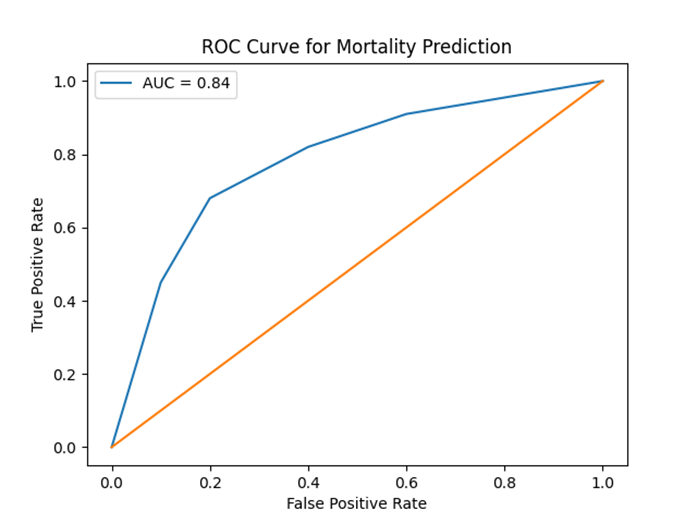
Receiver operating characteristic (ROC) curve demonstrating the predictive performance of the multivariable model for mortality in neonatal sepsis; AUC = 0.84, indicating good discriminative ability.
DISCUSSION :
The current study was done to assess the risk-factors, the microbiological profile and the outcome of neonatal sepsis at a tertiary care center in Pakistan and provide locally pertinent evidence that would be used to generate early risk stratification and empirical management. The results show that the burden of neonatal sepsis is significant, the most significant risk factors are both modifiable and non-modifiable factors, and Gram-negative pathogens are predominant and associated with high mortality rates.
Among this cohort, early onset sepsis (EOS) was detected among 58.4% and late-onset sepsis (LOS) was 41.6%. This distribution is in agreement with the results of several Pakistani tertiary hospitals, in which EOS generally represents 55-65% of cases of neonatal sepsis (12, 13). The same trends have been observed in South Asia, where there has been the lack of contribution of perinatal and intrapartum conditions leading to prolonged rupture of the membranes, poor aseptic delivery practices, and maternal infections (14). Conversely, high-income countries have a comparatively lower EOS rate, which is mainly because of good screening of the antenatal stage and intrapartum prophylaxis with antibiotics (15).
One of the most important results of this research was a high percentage of preterm birth (55.0%) and birth weight (59.1%) in the case of septic newborns. They not only shared these factors as common risk factors but found it to be also independent predictors of mortality with adjusted odds ratios of 2.41 and 2.88, respectively. The Pakistani literature gives consistent support to this association although mortality rates of preterm septic neonates have been reported to be between 25 and 40 percent, as compared to 10-15 percent in term neonates (16). Similarly, low- and middle-income countries have expressed prematurity and low birth weight as one of the key factors of poor outcomes in international studies because of the lack of proper immune responses, the presence of defective skin and mucosal barriers, and the possibility of having to use invasive interventions. (17)
The presence of maternal risk factors including; prolonged rupture of membranes (35.0%), and maternal fever (24.4%) were common in this cohort. Even though the continued membrane rupture was not a significant predictor of mortality after the adjustment, its high prevalence supports the role of its contribution to the pathogenesis of neonatal sepsis, especially EOS. Similar Pakistani investigations indicate PROM in 30-45 percent of the septic neonates, and international statistics in South Asia indicate the same (18, 19). The microbiological profile showed that Gram-negative organisms were the predominant isolates with the most prevalent pathogens of Klebsiella pneumoniae (37.7)% and Escherichia coli (27.5%). This trend is very similar to the published data in Pakistan, where 30-45 percent of all neonatal cases of culture-positive sepsis are due to Klebsiella species (20). Other similar distributions have been reported in India and Bangladesh (21). By contrast, European and North American data show that Group B Streptococcus and E. coli are more common, especially in EOS, indicating a great deal of regional difference in causative pathogens (22).
The general mortality rate in this study 18.1% is in the range reported in tertiary care NICUs in Pakistan where the mortality rates due to neonatal sepsis are 15 to 30% (23). Although it is still significantly elevated compared to mortality rates in high-income nations (which is most commonly 5-10%) (24), it indicates the challenges of resource-restrained environments, such as late presentation, delays in referrals, and limited access to supportive care that is of high quality. Notably, mechanical ventilation was the greatest independent predictor of mortality with an adjusted odds ratio of 4.12. This observation is probably because the disease is serious and not necessarily causal. Similar correlations have been located in Pakistani research, with the overall mortality rates in ventilated neonates being more than 40% underlining the necessity to identify and treat the problem early before it develops into serious respiratory failure (25).
The analysis of the ROC curve indicated that the multivariate model has a good predictive performance as indicated by an AUC of 0.84, which shows that the model is highly discriminating to predict mortality. It implies that a set of easily recognizable clinical variables prematurity, low birth weight, culture positivity, and society in need of ventilation may be utilized successfully to identify early risk in NICU environments. Similar AUC (0.78-0.85) values have been obtained in international neonatal sepsis prediction models, which demonstrates the strength of these predictors in different populations (26, 27).
CONCLUSION :
Although advanced healthcare facilities are available throughout Pakistan, neonatal sepsis continues to be one of the most common causes of morbidity and mortality in tertiary hospitals. Major determinants of adverse outcomes were identified as being premature, low birth weight, requiring mechanical ventilation, and having culture-positive sepsis. The most common pathogens identified were Gram-negative organisms, mainly Klebsiella pneumoniae, and Escherichia coli. Improving the survival of neonates and decreasing mortality due to sepsis in low-resource settings requires the early identification of high-risk newborns, the timely commencement of suitable antimicrobial treatment, and the enhancement of strategies to prevent perinatal infections..
REFERENCES:
1. Kariniotaki C, Thomou C, Gkentzi D, Panteris E, Dimitriou G, Hatzidaki E. Neonatal Sepsis: A Comprehensive Review. Antibiotics. 2025;14(1):6.
2. Rosa-Mangeret F, Benski AC, Golaz A, Zala PZ, Kyokan M, Wagner N, et al. 2.5 Million Annual Deaths-Are Neonates in Low- and Middle-Income Countries Too Small to Be Seen? A Bottom-Up Overview on Neonatal Morbi-Mortality. Trop Med Infect Dis. 2022;7(5).
3. Fleischmann C, Reichert F, Cassini A, Horner R, Harder T, Markwart R, et al. Global incidence and mortality of neonatal sepsis: a systematic review and meta-analysis. Arch Dis Child. 2021;106(8):745-52.
4. Nawaz R, Khalid N, Ajmal F, Akbary MF, Gong S, Zhou Z. The nexus between healthcare provider distribution and neonatal mortality based on the context of maternal and child healthcare services in Pakistan. Journal of Health, Population and Nutrition. 2025;44(1):219.
5. Saleem S, Tikmani SS, Goudar SS, Hwang K, Dhaded S, Guruprasad G, et al. Neonatal mortality among preterm infants admitted to neonatal intensive care units in India and Pakistan: A prospective study. Bjog. 2023;130(Suppl 3):68-75.
6. Raturi A, Chandran S. Neonatal Sepsis: Aetiology, Pathophysiology, Diagnostic Advances and Management Strategies. Clin Med Insights Pediatr. 2024;18:11795565241281337.
7. Attia Hussein Mahmoud H, Parekh R, Dhandibhotla S, Sai T, Pradhan A, Alugula S, et al. Insight Into Neonatal Sepsis: An Overview. Cureus. 2023;15(9):e45530.
8. Chaurasia S, Sivanandan S, Agarwal R, Ellis S, Sharland M, Sankar MJ. Neonatal sepsis in South Asia: huge burden and spiralling antimicrobial resistance. Bmj. 2019;364:k5314.
9. Rallis D, Giapros V, Serbis A, Kosmeri C, Baltogianni M. Fighting Antimicrobial Resistance in Neonatal Intensive Care Units: Rational Use of Antibiotics in Neonatal Sepsis. Antibiotics (Basel). 2023;12(3).
10. Salama B, Tharwat EM. A case control study of maternal and neonatal risk factors associated with neonatal sepsis. J Public Health Res. 2023;12(1):22799036221150557.
11. Bhutta ZA, Yusuf K. Early-onset neonatal sepsis in Pakistan: a case control study of risk factors in a birth cohort. Am J Perinatol. 1997;14(9):577-81.
12. Habib M. Proportion Of Early Onset Sepsis In Local Nicu And Identification Of Maternal Risk Factors. Biological and Clinical Sciences Research Journal. 2024;2024(1):1127.
13. Bhutta Za, Naqvi Sh, Muzaffar T, Farooqui Bj. Neonatal Sepsis in Pakistan: Presentation and Pathogens. Acta Paediatrica. 1991;80(6-7):596-601.
14. Briggs-Steinberg C, Roth P. Early-Onset Sepsis in Newborns. Pediatr Rev. 2023;44(1):14-22.
15. Vulcănescu A, Siminel MA, Dinescu SN, Boldeanu MV, Dijmărescu AL, Manolea MM, et al. Systematic Review: Maternal Risk Factors, Socioeconomic Influences, Neonatal Biomarkers and Management of Early-Onset Sepsis in Late Preterm and Term Newborns-A Focus on European and Eastern European Contexts. Life (Basel). 2025;15(2).
16. kanwal s, Younus I, Raza L. Association of Neonatal Birth weight and neonatal sepsis along with pathogen distribution in Karachi population2024.
17. Belachew A, Tewabe T. Neonatal sepsis and its association with birth weight and gestational age among admitted neonates in Ethiopia: systematic review and meta-analysis. BMC Pediatr. 2020;20(1):55.
18. Alam MM, Saleem AF, Shaikh AS, Munir O, Qadir M. Neonatal sepsis following prolonged rupture of membranes in a tertiary care hospital in Karachi, Pakistan. J Infect Dev Ctries. 2014;8(1):67-73.
19. Alam M, Saleem AF, Shaikh A, Munir O, Qadir M. Neonatal sepsis following prolonged rupture of membranes in a tertiary care hospital in Karachi, Pakistan. The Journal of Infection in Developing Countries. 2014;8:067-73.
20. Shah A, Iqbal A, Wakeel A, Ullah A, Din AU. BACTERIOLOGICAL PROFILE OF NEONATAL SEPTICEMIA AND ANTIBIOTIC SUSCEPTIBILITY PATTERN OF THE ISOLATES IN TERTIARY CARE HOSPITAL. Pakistan Journal of Intensive Care Medicine. 2025;5(02):164.
21. Sharma CM, Agrawal RP, Sharan H, Kumar B, Sharma D, Bhatia SS. "Neonatal Sepsis": Bacteria & their Susceptibility Pattern towards Antibiotics in Neonatal Intensive Care Unit. J Clin Diagn Res. 2013;7(11):2511-3.
22. Bader RS, Allabadi H, Ihsoun JM, Atout H, Khreishi RH, Bzour AM, et al. Identification of bacterial pathogens and antimicrobial susceptibility of early-onset sepsis (EOS) among neonates in Palestinian hospitals: a retrospective observational study. BMC Pediatr. 2025;25(1):118.
23. Memon Z, Fridman D, Soofi S, Ahmed W, Muhammad S, Rizvi A, et al. Predictors and disparities in neonatal and under 5 mortality in rural Pakistan: cross sectional analysis. Lancet Reg Health Southeast Asia. 2023;15:100231.
24. Duran P, Soliz P, Mujica OJ, Cueva DA, Serruya SJ, Sanhueza A. Neonatal mortality in countries of the Americas, 2000-2020: trends, inequalities, and target-setting. Rev Panam Salud Publica. 2024;48:e4.
25. Mukhtar B, Siddiqui NR, Haque A. Clinical Characteristics and Immediate-Outcome of Children Mechanically Ventilated in PICU of Pakistan. Pak J Med Sci. 2014;30(5):927-30.
26. Cao L, Masino AJ, Harris MC, Ungar LH, Shaeffer G, Fidel A, et al. Aligning prediction models with clinical information needs: infant sepsis case study. JAMIA Open. 2025;8(2).
27. Persad E, Jost K, Honoré A, Forsberg D, Coste K, Olsson H, et al. Neonatal sepsis prediction through clinical decision support algorithms: A systematic review. Acta Paediatrica. 2021;110(12):3201-26