Perception, Perspective and Application of Artificial Intelligence among Oral Medicine and Radiology Fraternity- A Questionnaire Study
- M Srinivasa Raju , Professor & Head of Department, Department of Oral Medicine and Radiology, St. Joseph Dental College, Duggirala, Eluru, Andhra Pradesh, India
- Bhanu Teja Pallagani , Post Graduate, Department of Oral Medicine and Radiology, St. Joseph Dental College, Duggirala, Eluru, Andhra Pradesh, India
- Gandi Vyshnavi Durga , Post Graduate, Department of Oral Medicine and Radiology, St. Joseph Dental College, Duggirala, Eluru, Andhra Pradesh, India
- Chimata Pavan Tejasri , BDS, St. Joseph Dental College, Duggirala, Eluru, Andhra Pradesh, India
- Prince Manikya Isaac Valluri , Intern, St. Joseph Dental College, Duggirala, Eluru, Andhra Pradesh, India
- Sarath Babu Puchakayala , Intern, St. Joseph Dental College, Duggirala, Eluru, Andhra Pradesh, India
Article Information:
Abstract:
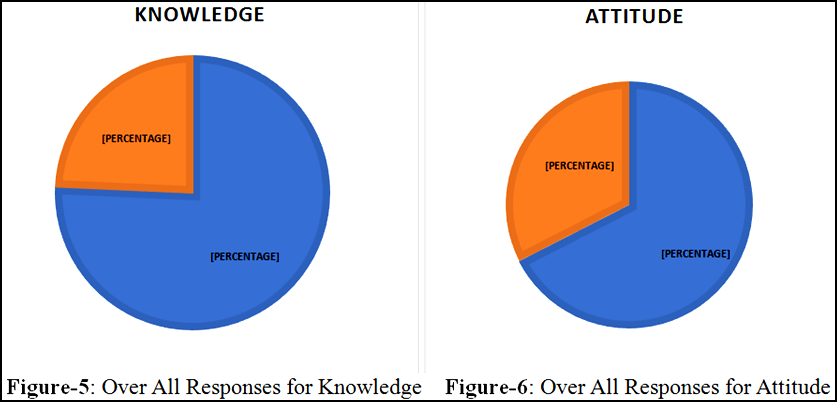
Artificial intelligence is considered as recent technological evolution. AI is simply a machine, especially a computer, mimicking the human brain or simulating human intelligence. The application of AI in healthcare has gained a lot of attention all over the globe. The AI-based applications are thought to bring about a lot of changes for the betterment of the health care system.Materials and Methods: This study was done among Oral Medicine and Radiology professionals through a web based electronic survey using Google forms to obtain information about AI and its usage in dentistry from the participants.Results: OMR Fraternity in this study had 76% of knowledge towards Artificial Intelligence and 67% of Attitude towards usage of artificial intelligence.Conclusion: Most of the fraternity has not attended to AI Workshops so far. If any workshops regarding AI were to be conducted in Andhra Pradesh, it would be helpful. If AI is added in dental curriculum, it would be helpful in understanding and operating the software required.
Keywords:
Article :
INTRODUCTION:
Artificial Intelligence (AI) has emerged as a transformative technology across multiple sectors including healthcare. Machine learning, a core component of AI, enables systems to learn from human expertise and perform tasks requiring cognitive intelligence. In dentistry, AI is revolutionizing traditional practices by ushering in the era of digital dentistry. John McCarthy defined AI as “the science and engineering of creating intelligent machines,” emphasizing its computational foundation. AI applications in dentistry span oral medicine, radiology, orthodontics, periodontics, prosthodontics, and maxillofacial surgery.1 Radiographic diagnosis remains a primary domain where AI demonstrates significant utility. Convolutional Neural Networks (CNNs) have enabled autonomous interpretation of complex imaging datasets. These deep learning models mimic neural architecture, converting radiographic inputs into diagnostic outputs. FDA and CE-approved AI software for radiograph analysis exemplifying its clinical readiness. AI supports treatment planning, predictive analytics, and computer-aided diagnosis in dental workflows.2 Studies have shown AI can outperform clinicians in diagnostic accuracy and efficiency. It reduces time spent on repetitive tasks and minimizes missed findings and overtreatment. Despite its promise, ethical concerns persist around data privacy, liability, and regulatory clarity. The ambiguity surrounding machine error accountability necessitates legal and professional frameworks. Misperceptions about AI capabilities may hinder its acceptance among clinicians. Most existing studies focus on medical students or general practitioners, with limited data on dental specialists.3,4 Radiology-specific tools like dental Xrai are increasingly cited in clinical practice. The inclusion of AI in dental education is seen as a critical step towards broader adoption. Understanding the perception and preparedness of Oral Medicine and Radiology professionals is essential for strategic implementation. This study aims to assess awareness, attitude, and application of AI among dental specialists through a structured questionnaire. By identifying gaps and opportunities, we seek to inform curriculum development and clinical integration strategies.5,6,7,8,9
Materials and Methods:
The study received approval from the Institutional Ethical Committee of St. Joseph Dental College and Hospital. [IEC Protocol Number: SJDC/CEC/OMR/2025/003]. The cross-sectional study involves human participants who could withdraw at any time, and participation was completely voluntary. Each participant’s identity was wholly protected during the investigation. The Google Form received responses from 70 participants in total. Snowball sampling technique was used. The study on our fraternity was limited to Andhra Pradesh. A web-based electronic questionnaire survey (Google Form) was the instrument utilized to gather the data.
Inclusion Criteria
The study included Academicians, Private dental practitioners and Post graduate students in Oral Medicine and Radiology Fraternity.
Exclusion Criteria
Subjects who were unwilling to participate in the questionnaire survey via the online Google Form were excluded from the study.
Participation was entirely voluntary, and informed consent was obtained digitally prior to survey completion. The study respected autonomy and confidentiality, and no identifying information was collected from non-participants. A 20-questionnaire is prepared regarding the AI in dentistry; the first ten are knowledge-based, and the remaining ten are attitude-based toward AI. The questions were mainly 19 closed-ends and 1 open-end question. After preparing all these questions, approval is taken from the three experienced academicians. A pre-designed online questionnaire was made using Google Forms, and the link was created using Google Docs and sent via social media and mail. Mandatory option is included not to skip any question without filling. The purpose of our study was very well explained, and the consent was taken online from the participants, which was the first component of the study questionnaire. Practitioners were asked to tick out any one option provided and fill any blank for open-ended questions. Data from the questionnaire were filled in an Excel worksheet and further evaluated. Following are questionnaires prepared for Knowledge and Attitude analysis in Oral Medicine and Radiology fraternity. A Google Form link is sent via email and social media (WhatsApp) which is active for 14 days; during that time, all participant responses are collected and locked. Responses sent after the given time frames are not added.
Choose your particularization: Academician/ private Dental practitioner/ Post Graduation Student
|
Sl. no |
Questionnaires |
Answer |
|
|
Are you familiar with the concept of artificial intelligence (AI)? |
Yes/No |
|
|
Do you know how AI can be used in oral radiology? |
Yes/No |
|
|
Have you used any AI tools in your practice? |
Yes/No |
|
|
Do you think AI can reduce the number of diagnostic errors in oral radiology? |
Strongly Agree/ Agree/ Neutral/ Disagree/ Strongly Disagree |
|
|
Have you noticed any improvements in patient outcomes when using AI-assisted diagnostics? |
Yes/No/Not Applicable |
|
|
Do you believe the cost of AI technology is justified by its benefits in oral medicine and radiology? |
Yes/No/Not Unsure
|
|
|
Do you trust AI systems to handle patient data securely? |
Yes/No/Unsure |
|
|
Do you believe AI can assist in treatment planning and decision-making processes in oral medicine? |
Yes/No/Unsure |
|
|
What specific AI software or tools have you heard of being used in oral radiology? |
- |
|
|
Do you think AI can enhance the interpretation of radiographic images? |
Yes/No/Unsure |
|
|
Do you think AI can help in early detection of oral diseases that might be missed by human eyes? |
Yes/No/Unsure |
|
|
Have you attended any workshops or training sessions on AI in dentistry? |
Yes/No |
|
|
Do you think AI should be incorporated into the dental curriculum? |
Yes/No/Unsure |
|
|
What are the main barriers to adopting AI in your practice? |
Lack of knowledge & training/Cost/Resistance to change/Others |
|
|
Have you seen any differences in diagnostic outcomes when AI tools are used versus traditional methods? |
Yes/No |
|
|
How important do you think it is for dental professionals to be literate in AI technologies? |
Extremely Important/ Very Important/ Moderately Important/ Slightly Important |
|
|
How user-friendly do you find the current AI tools available in the market for dental practices? |
Very User-Friendly/ User-Friendly/ Neutral/ Not User-Friendly |
|
|
Can AI assist in maintaining quality control in dental radiology imaging? |
Yes/No/Unsure |
|
|
Do you think AI can assist general dentists in making decisions that would otherwise require a specialist's input? |
Yes/No/Unsure |
|
|
Do you think AI can reduce the psychological workload of dental professionals? |
Yes/No/Unsure |
Results:
Table-1: Distribution of study population based on occupation
|
Occupation |
N |
% |
|
Post graduate |
28 |
40% |
|
academician |
22 |
31.4% |
|
Dental practitioner |
20 |
28.6% |
Table-1 depicts that among the all-groups Postgraduates constitute the largest segment of the study population, accounting for 40% (n=28). Academicians form the second-largest group at 31.4% (n=22), Dental practitioners comprise 28.6% (n=20).
Figure-1: Distribution of study population by occupation
Table-2: Overall responses for knowledge questions
|
Questions |
Options |
N |
% |
|
Are you familiar with the concept of artificial intelligence (AI)? |
Yes |
63 |
90.0% |
|
No |
7 |
10.0% |
|
|
Do you know how AI can be used in oral radiology |
Yes |
54 |
77.1% |
|
No |
16 |
22.9% |
|
|
Have you used any AI tools in your practice |
No |
43 |
61.4% |
|
Yes |
27 |
38.6% |
|
|
Do you think AI can reduce the number of diagnostic errors in oral radiology |
Neutral |
17 |
24.3% |
|
Agree |
38 |
54.3% |
|
|
Strongly Agree |
9 |
12.9% |
|
|
Disagree |
6 |
8.6% |
|
|
Have you noticed any improvements in patient outcomes when using AI-assisted diagnostics |
Yes |
33 |
47.1% |
|
No |
23 |
32.9% |
|
|
Not Applicable |
14 |
20.0% |
|
|
Do you believe the cost of AI technology is justified by its benefits in oral medicine, radiology |
Yes |
28 |
40.0% |
|
Unsure |
22 |
31.4% |
|
|
No |
20 |
28.6% |
|
|
Do you trust AI systems to handle patient data securely |
Yes |
30 |
42.9% |
|
Unsure |
20 |
28.6% |
|
|
No |
20 |
28.6% |
|
|
Do you believe AI can assist in treatment planning and decision-making processes in oral medicine |
Yes |
47 |
67.1% |
|
Unsure |
7 |
10.0% |
|
|
No |
16 |
22.9% |
|
|
Do you think AI can enhance the interpretation of radiographic images |
Yes |
53 |
75.7% |
|
Unsure |
13 |
18.6% |
|
|
No |
4 |
5.7% |
Table-2 depicts that the knowledge domain responses reveal a high level of conceptual awareness regarding artificial intelligence (AI) among the study population. A substantial 90% (n=63) of participants reported familiarity with the concept of AI, and 77.1% (n=54) acknowledged understanding its applications in oral radiology. This indicates a strong foundational awareness, likely influenced by academic exposure and digital integration in postgraduate training. Despite this awareness, 61.4% (n=43) of respondents had not used AI tools in practice, suggesting a gap between theoretical knowledge and clinical implementation. This may reflect infrastructural limitations, lack of training, or cost-related barriers. Regarding diagnostic efficacy, 67.2% (n=47) of participants either agreed or strongly agreed that AI can reduce diagnostic errors in oral radiology, while 24.3% (n=17) remained neutral. This reflects cautious optimism toward AI’s potential to enhance diagnostic precision. When asked about patient outcomes, 47.1% (n=33) reported improvements with AI-assisted diagnostics, whereas did not observe any difference, and 20% (n=14) marked it as not applicable—possibly indicating limited exposure or usage. Perceptions of cost-effectiveness were mixed: 40% (n=28) believed the cost of AI is justified, while 31.4% (n=22) was unsure and 28.6% (n=20) disagreed. This suggests economic feasibility remains a concern in adoption. Trust in AI systems for data security was moderate, with 42.9% (n=30) expressing confidence, while 57.2% were either unsure or did not trust AI with patient data—highlighting ethical and privacy apprehensions. Encouragingly, 67.1% (n=47) believed AI can assist in treatment planning and decision-making, and 75.7% (n=53) felt it could enhance radiographic interpretation. These findings underscore the perceived value of AI in augmenting clinical judgment and image analysis.
Figure-2: Overall responses for knowledge questions
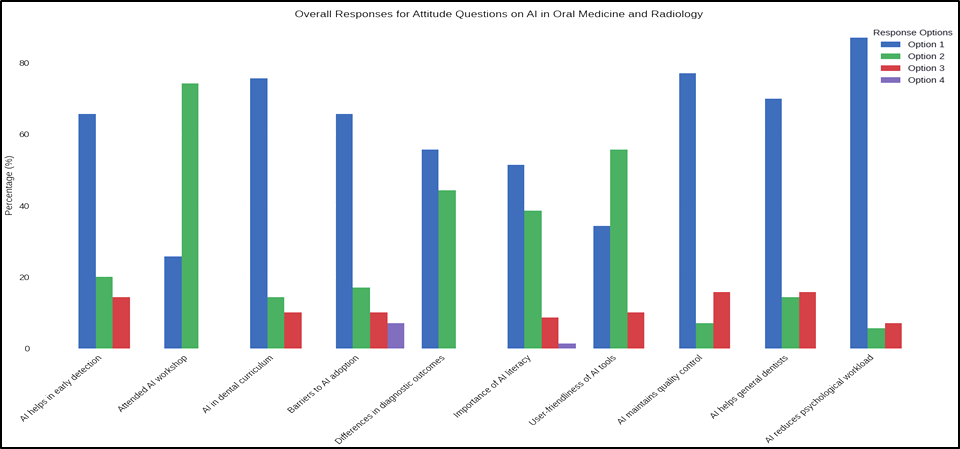
Table-3: Over all responses for attitude questions
|
Questions |
Options |
N |
% |
|
Do you think AI can help in early detection of oral diseases that might be missed by human eyes? |
Unsure |
10 |
14.3% |
|
Yes |
46 |
65.7% |
|
|
No |
14 |
20.0% |
|
|
Have you attended any workshops or training sessions on AI in dentistry |
No |
52 |
74.3% |
|
Yes |
18 |
25.7% |
|
|
Do you think AI should be incorporated into the dental curriculum? |
Yes |
53 |
75.7% |
|
No |
10 |
14.3% |
|
|
Unsure |
7 |
10.0% |
|
|
What are the main barriers to adopting AI in your practice? |
Lack of Knowledge/Training |
46 |
65.7% |
|
Cost |
12 |
17.1% |
|
|
Others |
7 |
10.0% |
|
|
Resistance to Change |
5 |
7.1% |
|
|
Have you seen any differences in diagnostic outcomes when AI tools are used versus traditional methods? |
Yes |
39 |
55.7% |
|
No |
31 |
44.3% |
|
|
How important do you think it is for dental professionals to be literate in AI technologies?
|
Moderately important |
27 |
38.6% |
|
Very important |
36 |
51.4% |
|
|
Slightly important |
6 |
8.6% |
|
|
Not important |
1 |
1.4% |
|
|
How user-friendly do you find the current AI tools available in the market for dental practices? |
Neutral |
39 |
55.7% |
|
Very User Friendly |
24 |
34.3% |
|
|
Not User Friendly |
7 |
10.0% |
|
|
Can AI assist in maintaining quality control in dental radiology imaging |
Yes |
54 |
77.1% |
|
No |
5 |
7.1% |
|
|
Unsure |
11 |
15.7% |
|
|
Do you think AI can assist general dentists in making decisions that would otherwise require a specialist's input |
Unsure |
11 |
15.7% |
|
Yes |
49 |
70.0% |
|
|
No |
10 |
14.3% |
|
|
Do you think AI can reduce the psychological workload of dental professionals |
Yes |
61 |
87.1% |
|
No |
4 |
5.7% |
|
|
Unsure |
5 |
7.1% |
Table-3 depicts that attitudinal responses reflect a generally positive outlook toward AI integration in dentistry. A majority (65.7%, n=46) agreed that AI can aid in early detection of oral diseases potentially missed by human eyes, reinforcing its role in improving diagnostic sensitivity. However, only 25.7% (n=18) had attended AI-related workshops or training, while 74.3% (n=52) had not—indicating a significant gap in formal exposure and continuing education. A strong consensus emerged regarding curriculum reform, with 75.7% (n=53) advocating for AI inclusion in dental education. This aligns with the finding that 51.4% (n=36) considered AI literacy to be “very important” for dental professionals. The primary barrier to AI adoption was identified as lack of knowledge/training (65.7%, n=46), followed by cost (17.1%, n=12) and resistance to change (7.1%, n=5). These insights highlight the need for structured training programs and cost-effective solutions. Regarding diagnostic outcomes, 55.7% (n=39) observed differences when AI tools were used compared to traditional methods, suggesting tangible clinical impact. User experience with AI tools was mixed: 55.7% (n=39) rated them as neutral, while 34.3% (n=24) found them very user-friendly. This indicates room for improvement in interface design and usability. A significant 77.1% (n=54) believed AI can assist in maintaining quality control in radiology imaging, and 70% (n=49) felt it could support general dentists in decision-making typically requiring specialist input. Finally, 87.1% (n=61) agreed that AI can reduce the psychological workload of dental professionals, suggesting its potential to alleviate cognitive burden and improve workflow efficiency.
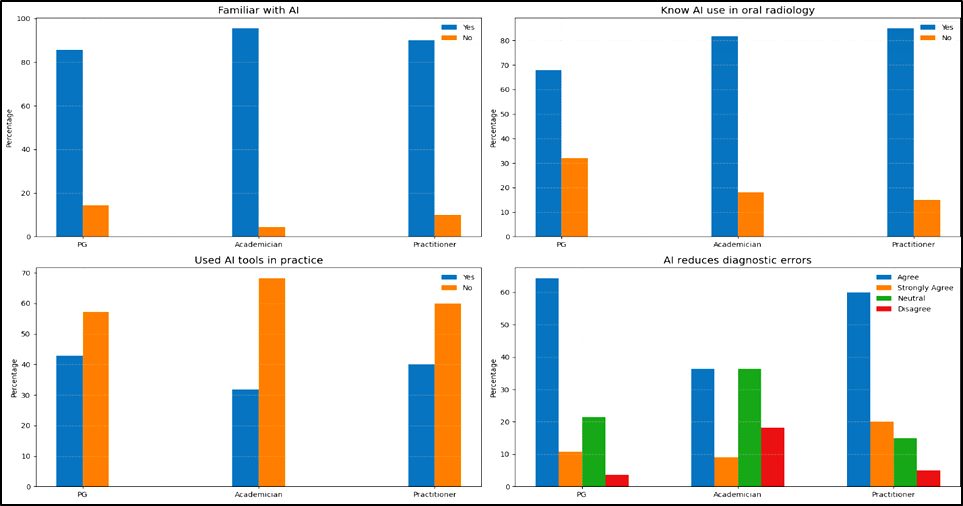
Figure-3: Overall responses for Attitude Questions
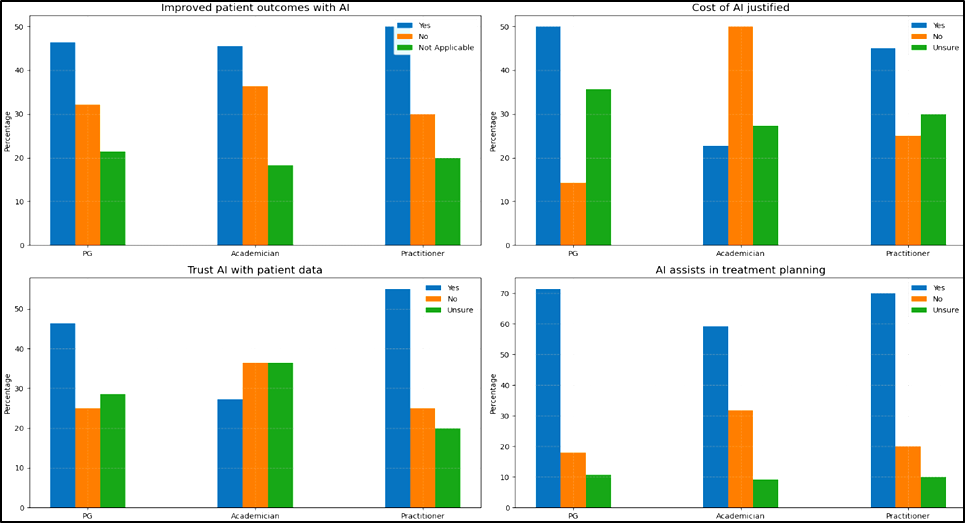
Figure-4: Overall Responses for Attitude Questions
Table-4: Comparison of Knowledge Responses based on Qualification
|
Questions |
Options |
PG |
Academician |
Practitioner |
P value |
|
Are you familiar with concept of artificial intelligence (AI)? |
Yes |
24(85.7) |
21(95.5) |
18(90) |
0.522(NS) |
|
No |
4(14.37) |
1(4.5) |
2(10) |
||
|
Do you know how AI can be used in oral radiology |
Yes |
19(67.9) |
18(81.8) |
17(85) |
0.31(NS) |
|
No |
9(32.1) |
4(18.2) |
3(15) |
||
|
Have you used any AI tools in your practice |
No |
16(57.1) |
15(68.2) |
12(60) |
0.72(NS) |
|
Yes |
12(42.9) |
7(31.8) |
8(40) |
||
|
Do you think AI can reduce the number of diagnostic errors in oral radiology |
Neutral |
6(21.4) |
8(36.4) |
3(15) |
0.19(NS) |
|
Agree |
18(64.3) |
8(36.4) |
12(60) |
||
|
Strongly Agree |
3(10.7) |
2(9.1) |
4(20) |
||
|
Disagree |
1(3.6) |
4(18.2) |
1(5) |
||
|
Have you noticed any improvements in patient outcomes when using AI-assisted diagnostics |
Yes |
13(46.4) |
10(45.5) |
10(50) |
0.993(NS) |
|
No |
9(32.1) |
8(36.4) |
6(30.0) |
||
|
not Applicable |
6(21.4) |
4(18.2) |
4(20) |
||
|
Do you believe the cost of AI technology is justified by its benefits in oral medicine and radiology |
Yes |
14(50) |
5(22.7) |
9(45) |
0.078(NS) |
|
Unsure |
10(35.7) |
6(27.3) |
6(30) |
||
|
No |
4(14.3) |
11(50) |
5(25) |
||
|
Do you trust AI systems to handle patient data securely |
Yes |
13(46.4) |
6(27.3) |
11(55) |
0.45(NS) |
|
Unsure |
8(28.6) |
8(36.4) |
4(20) |
||
|
No |
7(25) |
8(36.4) |
5(25) |
||
|
Do you believe AI can assist in treatment planning and decision-making processes in oral medicine |
Yes |
20(71.4) |
13(59.1) |
14(70) |
0.827(NS) |
|
Unsure |
3(10.7) |
2(9.1) |
2(10) |
||
|
No |
5(17.9) |
7(31.8) |
4(20) |
||
|
Do you think AI can enhance the interpretation of radiographic images |
Yes |
22(78.6) |
15(68.2) |
16(80) |
0.866(NS) |
|
Unsure |
5(17.9) |
5(22.7) |
3(15) |
||
|
No |
1(3.6) |
2(9.1) |
1(5) |
||
|
Fisher exact test p<0.05* significant |
|||||
Table-4 depicts the comparative analysis of knowledge-based responses among postgraduates, academicians, and dental practitioners which revealed no statistically significant differences across all items (p > 0.05). Familiarity with AI was high across all groups, with academicians showing the highest awareness (95.5%), followed by practitioners (90%) and postgraduates (85.7%). Understanding of AI applications in oral radiology was slightly higher among practitioners (85%) and academicians (81.8%) compared to postgraduates (67.9%). Despite this, actual usage of AI tools remained low across all groups, with the majority reporting no prior use. Perceptions regarding AI’s ability to reduce diagnostic errors varied, with postgraduates showing the highest agreement (64.3%), while academicians had a higher proportion of neutral and disagree responses. Views on patient outcomes, cost justification, and data security were mixed, with no significant qualification-based trends.
Table 5: Comparison of Attitude Responses based on Qualification
|
Questions |
Options |
PG |
Academician |
Practitioner |
P value |
|
Do you think AI can help in early detection of oral diseases that might be missed by human eyes? |
Unsure |
4(14.3) |
3(13.6) |
3(15) |
0.05* |
|
Yes |
22(78.6) |
10(45.5) |
14(70) |
||
|
No |
2(7.1) |
9(40.9) |
3(15) |
||
|
Have you attended any workshops or training sessions on AI in dentistry |
No |
25(89.3) |
15(68.2) |
12(60) |
0.053(NS) |
|
Yes |
3(10.7) |
7(31.8) |
8(40) |
||
|
Do you think AI should be incorporated into the dental curriculum? |
Yes |
22(78.6) |
16(72.7) |
15(75) |
0.263(NS) |
|
No |
4(14.3) |
5(22.7) |
1(5) |
||
|
Unsure |
2(7.1) |
1(4.5) |
4(20) |
||
|
What are the main barriers to adopting AI in your practice? |
Lack of Knowledge/Training |
17(60.7) |
13(59.1) |
16(80) |
0.145(NS) |
|
Cost |
7(25) |
4(18.2) |
1(5) |
||
|
Others |
3(10.7) |
4(18.2) |
0(0) |
||
|
Resistance to Change |
1(3.6) |
1(4.5) |
3(15) |
||
|
Have you seen any differences in diagnostic outcomes when AI tools are used versus traditional methods? |
Yes |
15(53.6) |
11(50) |
13(65) |
0.594(NS) |
|
No |
13(46.4) |
11(50) |
7(35) |
||
|
How important do you think it is for dental professionals to be literate in AI technologies? |
Moderately important |
11(39.3) |
8(36.4) |
8(40) |
0.822(NS) |
|
Very important |
14(50) |
12(54.5) |
10(50) |
||
|
Slightly important |
3(10.7)1 |
1(4.5) |
2(10) |
||
|
Not important |
0(0)1 |
1(4.5) |
0(0) |
||
|
How user-friendly do you find the current AI tools available in the market for dental practices? |
Neutral |
15(53.6) |
15(68.2) |
9(45) |
0.106(NS) |
|
Very User Friendly |
11(39.3) |
3(13.6) |
10(50) |
||
|
Not User Friendly |
2(7.1) |
4(18.2) |
1(5) |
||
|
Can AI assist in maintaining quality control in dental radiology imaging |
Yes |
22(78.6) |
15(68.2) |
17(85) |
0.482(NS) |
|
No |
1(3.6) |
2(9.1) |
2(10) |
||
|
Unsure |
5(17.9) |
5(22.7) |
1(5) |
||
|
Do you think AI can assist general dentists in making decisions that would otherwise require a specialist's input |
Unsure |
4(14.3) |
2(9.1) |
5(25) |
0.695(NS) |
|
Yes |
20(71.4) |
17(77.3) |
12(60) |
||
|
No |
4(14.3) |
3(13.6) |
3(15) |
||
|
Do you think AI can reduce the psychological workload of dental professionals |
Yes |
24(85.7) |
19(86.4) |
18(90) |
0.819(NS) |
|
No |
1(3.6) |
2(9.1) |
1(5.0) |
||
|
Unsure |
3(10.7) |
1(4.5) |
1(5.0) |
||
|
Fisher exact test p<0.05* significant |
|||||
Table-5 depicts the comparative analysis of attitude responses among postgraduates, academicians, and dental practitioners which revealed mostly non-significant differences across variables, except for one item. A statistically significant difference (p = 0.05*) was observed in the perception of AI’s role in early detection of oral diseases. Postgraduates (78.6%) and practitioners (70%) showed higher agreement compared to academicians (45.5%), who had a notably higher proportion of disagreement (40.9%). Attendance at AI-related workshops was low overall, but practitioners (40%) and academicians (31.8%) reported higher participation than postgraduates (10.7%), though this difference was not statistically significant (p = 0.053). Support for incorporating AI into the dental curriculum was consistently high across all groups (72.7–78.6%). The most cited barrier to AI adoption was lack of knowledge/training, especially among practitioners (80%), followed by cost and resistance to change. Perceived differences in diagnostic outcomes with AI use were similar across groups, with practitioners showing slightly more positive responses (65%). Regarding AI literacy, all groups emphasized its importance, with over 50% rating it as “very important.” User-friendliness of AI tools was rated “neutral” by most, though practitioners showed greater favorability (50% rated them “very user friendly”).Confidence in AI’s role in quality control and decision support was high across qualifications, with practitioners again showing slightly stronger agreement. Finally, the belief that AI can reduce psychological workload was nearly unanimous across all groups (85.7–90%), indicating broad consensus on its potential to ease clinical stress.
DISCUSSION:
This study explored the perception, awareness, and application of artificial intelligence (AI) among professionals in Oral Medicine and Radiology, revealing a generally positive attitude toward AI integration despite limited practical exposure. These findings align with Hada et al. (2024), who reported that 57.4% of dental practitioners in Bhopal had basic awareness of AI, yet only 12.9% believed AI could replace dentists, emphasizing its role as a supportive tool rather than a substitute.5 Similarly, Eschert et al. (2022) found that most clinicians rated their AI knowledge as average or below, with only 6.3% reporting excellent understanding. Despite this, 66.9% never used AI in daily practice, underscoring the gap between theoretical awareness and clinical implementation. In our study, although 90% of respondents were familiar with AI and 77.1% understood its use in oral radiology, only 38.6% had used AI tools, mirroring the global trend of cautious adoption.10 The Syrian study by Swed et al. (2022) further corroborates this pattern, where 70% of participants had basic AI knowledge, but only 23.7% knew its medical applications, and a mere 10.7% had formal AI education. This highlights the urgent need for structured AI training in dental curricula—a sentiment echoed by 75.7% of our respondents and 41.6% in Hada’s study.11 Concerns about data privacy, liability, and ethical implications were prominent across all studies. Eschert et al. noted high concern scores for machine error responsibility (3.7 ± 1.3) and data security (3.5 ± 1.24), which parallels our findings where only 42.9% trusted AI systems with patient data. These apprehensions suggest that trust-building through regulatory frameworks and transparent AI design is essential.10,3 Interestingly, all studies emphasized AI’s potential to reduce diagnostic errors and psychological workload. In our cohort, 67.2% agreed that AI could reduce diagnostic errors, and 87.1% believed it could ease mental strain—comparable to Eschert et al.’s findings where clinicians valued AI for improving diagnostic uniformity and reducing monotonous tasks.10,12
CONCLUSION :
The Oral Medicine and Radiology community shows that it is prepared to accept AI. However, interdisciplinary collaboration, focused educational changes, and ethical protections are necessary for successful integration. Most of the fraternities have not attended to AI workshops so far, if any workshops regarding AI were to be conducted in Andhra Pradesh it would be helpful. If AI is added in dental curriculum, it would be helpful in understanding and operating the software’s required. AI has the potential to revolutionize clinical practice by improving workflow efficiency and diagnostic accuracy, but only if its application is supported by strong governance and training.
BIBLIOGRAPHY:
1. Khanagar SB, Al-Ehaideb A, Maganur PC, Vishwanathaiah S, Patil S, Baeshen HA, et al. Developments, application, and performance of artificial intelligence in dentistry—a systematic review. J Dent Sci 2021;16:508-22.
2. Thrall JH, Li X, Li Q, Cruz C, Do S, Dreyer K, et al. Artificial intelligence and machine learning in radiology: opportunities, challenges, pitfalls, and criteria for success. J Am Coll Radiol 2018;15:504-8.
3. Gross D, Gross K, Wilhelmy S. Digitalization in dentistry: ethical challenges and implications. Quintessence Int 2019;50:830-8.
4. Kulkarni S, Seneviratne N, Baig MS, Khan AHA. Artificial intelligence in medicine: where are we now? Acad Radiol2020;27:62-70.
5. Hada P, Sharma S, Singh V, Dubey S, Jain S, Goswami D. Evaluation of attitude and awareness of dental practitioners regarding artificial intelligence: a cross-sectional study. J Indian Acad Oral Med Radiol 2024;36:22-5.
6. Fernandes S, Parmar D, Bafna Y. Knowledge, attitude and practice of dental students towards artificial intelligence: a questionnaire-based survey. J Xid Uni 2022;1:284-91.
7. Sit C, Srinivasan R, Amlani A, Muthuswamy K, Azam A, Monzon L, et al. Attitudes and perceptions of UK medical students towards artificial intelligence and radiology: a multicentre survey. Insights Imaging 2020;11:14.
8. Pauwels R, Del Rey YC. Attitude of Brazilian dentists and dental students regarding the future role of artificial intelligence in oral radiology: a multicenter survey. Dentomaxillofac Radiol 2021;50:20200461.
9. Sur J, Bose S, Khan F, Dewangan D, Sawriya E, Roul A. Knowledge, attitudes, and perceptions regarding the future of artificial intelligence in oral radiology in India: a survey. Imaging Sci Dent 2020;50:193-8.
10. Eschert T, Schwendicke F, Krois J, Bohner L, Vinayahalingam S, Hanisch M. A survey on the use of artificial intelligence by clinicians in dentistry and oral and maxillofacial surgery. Medicina 2022;58:1059.
11. Swed S, Alibrahim H, Elkalagi NKH, Nasif MA, Rais MA, Sawaf B, et al. Knowledge, attitude, and practice of artificial intelligence among doctors and medical students in Syria: a cross-sectional online survey. Front Artif Intell 2022;5:1011524.
12. Surdilovic D, Ille T, Souza D. Artificial intelligence and dental practice management. Eur J Artif Intell 2022;1:11-4.
13. Sami A, Tanveer F, Sajwani K, et al. Medical students’ attitudes toward AI in education: perception, effectiveness, and its credibility. BMC Med Educ 2025;25:82.
14. Oh S, Kim JH, Choi SW. Physician confidence in artificial intelligence: an online mobile survey. J Med Internet Res 2019;21:e12422.
15. Khalid T. Perception and utilization of artificial intelligence among dental professionals in Saudi Arabia. Open Dent J 2022;16:1-7.
16. Javed S, Zakirulla M, Baig RU. Development of artificial neural network model for prediction of poststreptococcus mutans in dental caries. Comp Biomed 2019;186:105-98.
17. DosSantos DP, Giese D, Brodehl S, Chon SH, Staab W, Kleinert R, et al. Medical students’ attitude towards artificial intelligence: a multicentre survey. Eur Radiol 2019;29:1640-6.
18. Langlotz CP. Will artificial intelligence replace radiologists? Radiol Artif Intell 2019;1:e190058.
19. Bisdas S, Topriceanu CC, Zakrzewska Z, Irimia AV, Shakallis L, Subhash J, et al. Artificial intelligence in medicine: a multinational multi-center survey on the medical and dental students’ perception. Front Public Health 2021;9:795284.