KNOWLEDGE ON PAEDIATRIC MEDICINES AND THEIR RELATIONSHIP TO DENTAL CARIES AMONG PARENTS IN CHENNAI CITY
- K Dhruv Kiran , Saveetha Dental College and Hospitals, Saveetha Institute of Medical and Technical Sciences (SIMATS),Saveetha University, Chennai – 600077
- Dinesh Kumar , Assistant ProfessorDepartment of Pedodontics, Saveetha Dental College and Hospitals, Saveetha Institute of Medical and Technical sciences (SIMATS), Saveetha University, Chennai – 600077.
Article Information:
Abstract:
Paediatric medicines are often very frequently used in children. The sugar content is to change the bitter taste of the medicines as it will be easier for the children to have medicines. These sugar contents can cause many oral health related problems like dental caries. The parents are not aware about the presence of sugar. This study aims to assess the knowledge and attitude towards use of pediatric medicines and their relationship with dental caries among parents in Chennai city. MATERIALS AND METHODSA cross - sectional study was conducted among 114 parents. A pre-validated questionnaire containing 12 question items were mailed to the parents who had visited a private dental college to seek dental care for their children. Descriptive statistics of the responses was performed using SPSS version 23.0RESULTSAbout 52.63% and 47.37% of the parents had boys and girl children respectively. Among their children 62.28% took medicines very frequently. Majority (68.4%) of the parents were not aware about the effects of paediatric medicines containing sugar related compounds. Most of the children (58.77%) used tablets as a form of medicine. About 62.28% of their children did not clean their teeth after taking medicines. CONCLUSIONMajority of the children took medicines very frequently in the form of tablets. The medicines used by most of them were analgesic. Parents were not aware about the effects of medicines on oral health. Parents were also not concerned about the child’s oral hygiene.
Keywords:
Article :
INTRODUCTION :
Dental caries is one of the most common diseases in the oral cavity. It is caused because of plaque present in the teeth. Some paediatric medicines contain sugars. These sugar present in the medicines makes the medicine easily palatable and acceptable for children. The parents are not aware about the presence of sugar in the medicines, which can cause various oral health problems mainly caries.
The addition of sugar in paediatric medicines was because of changing the bitter taste of medicine (Nikiforuk, 1985). The side effects of sugars in paediatric medicines produce unwanted effects and are ignored (McVeigh and Kinirons, 1999). Ingestion of carbohydrates has a very adverse effect on dental caries (Nagy, 1980). The acid attacks from sugar can last from 25-40 minutes. Change in pH of dental plaque leads to dental caries (Stephan, 1940, 1944). Children get sick very easily. They have to take medicines very frequently (Østergaard, Bjertrup and Samuelsen, 2016). Paediatric medicines contain a lot of sugar related compounds. Children who are chronically ill, will require more medicines and have high prevalence of dental caries (Maguire, Rugg-Gunn and Butler, 1996). Parents are unaware of the medications containing sugar related compounds which can cause many oral health diseases. Even paediatricians prescribe medicines which contain high amounts of sugar, either they are aware of problems that can cause a child's oral health or they are not aware that these medicines contain sugar related compounds. Most of the studies have shown promising results against carcinogenic sugar; to avoid and replace sugar in paediatric medicines (Manley, Calnan and Sheiham, 1994).
Antibiotics, cough syrups, and liquid medications contain the highest amounts of sugars and are regularly used amongst children (Cavalcanti et al., 2010). Many studies have often shown sugar substituents in medicines to be non carcinogenic (Edgar, 1998). Our team has extensive knowledge and research experience that has translated into high quality publications (J et al., 2018; Wahab et al., 2018; Sridharan et al., 2019; Chellapa et al., 2020; Mathew et al., 2020; Mudigonda et al., 2020; R et al., 2020; Samuel, Acharya and Rao, 2020; Vikneshan et al., 2020; Barma et al., 2021; Ezhilarasan et al., 2021; Gowhari Shabgah et al., 2021; Kamala et al., 2021; Muthukrishnan, 2021a, 2021b; Samuel, 2021; Samuel, Kuduruthullah and Khair, 2021; Samuel, Kuduruthullah, et al., 2021; Samuel, Mathew, et al., 2021; Sekar and K, 2021). Adequate knowledge and attitude towards the use of pediatric medicines and their relationship with dental caries among parents is the need for the hour. (Gopalakannan, Senthilvelan and Ranganathan, 2012; Campeau et al., 2014; Parthasarathy et al., 2016; Dhinesh et al., 2017; Sathish and Karthick, 2020)
Thus this study aims to assess knowledge and attitude towards the use of pediatric medicines and their relationship with dental caries among parents in Chennai city.
MATERIALS AND METHODS:
A cross sectional study was done among the parents in Chennai city through online google forms. The survey consisted of 12 semi-closed pre-validated and reliable questionnaires based on knowledge, awareness, effects and attitude both in English and vernacular language (Tamil). The internal consistency of the questionnaire using Cronbach's α was found to be 0.75. A total of 114 parents participated in the survey. The people involved in the study were two, one investigator and one principal investigator. All the parents who visited the dental hospital to seek dental care for their children and who were willing to participate in the study had been included in the study.
Oral consent from the participants had been obtained after explaining the need for the study. Prior approval to carry out the study was obtained from the Institutional Research Committee (IRB) of the author University. The pros of the study is that it was done through online google forms and it was less time consuming than offline surveys. The cons of the survey is that it took place in only one geographical area (Chennai city). Data was collected and analysed using SPSS v23.0 software. Descriptive and inferential statistics were performed to report the responses of the parents.
RESULTS:
A survey was conducted among 114 parents in Chennai city. About 52.63% and 47.37% of the parents had boys and girls respectively. Among them, 57.02% were aged between 10-13 years, 29.82% were aged between 5-9 years and 13.16% were aged between 1-4 years. Out of that 67.54% used medicines frequently [Figure 1]. The form of medicines used were tablets (58.77%), syrups (25.44%) and suspension (15.79%) [Figure-2]. Majority (62.28%) of the children took medicines very frequently. 64.91% of parents are not aware that paediatric medicines contain sugar related compounds which may be harmful for oral health [Figure-3]. 37.72% claimed to make their child brush their teeth after ingestion of these medicines [Figure-4].The type of the drug used the most was analgesic (54.39%), followed by syrups (25.44%) and suspension (15.79%). 31.6% parents were aware of the side effects of paediatric medicines [Figure-5]. Children aged between 10-13 years took mostly tablets (49.12%) whereas children of other age groups preferred syrups as the form of tablets [Figure-6]. The association of the age of children with the frequency of medicines taken is shown in [Figure-7]. The association of the gender with the frequency of the medicines used is shown in [Figure-8].
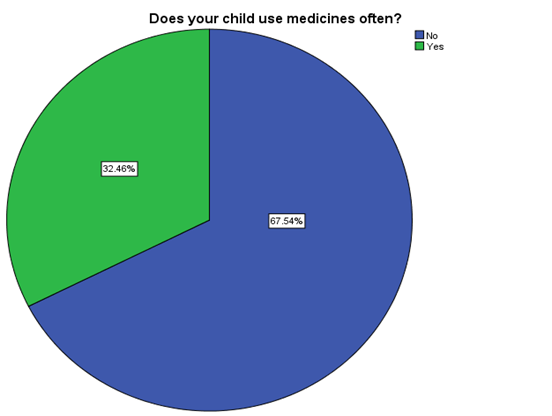
FIGURE 1: Pie chart showing percentage distribution on awareness of usage of medicines by the child. 67.54% did not use medicines often (blue) and 32.46% used medicine often (green).
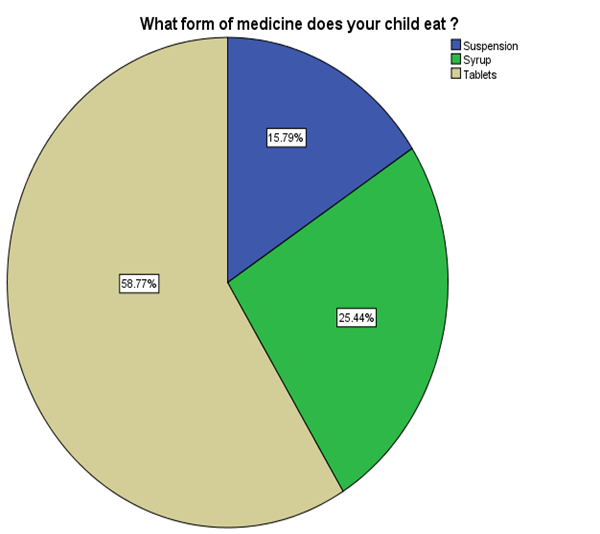
FIGURE 2: Pie chart showing percentage distribution on the form of medicines taken. Majority of them (58.77%) took tablets as the main form (cream), 25.44% used syrup (green) and 15.79% used suspension (blue) as a form of medicine.
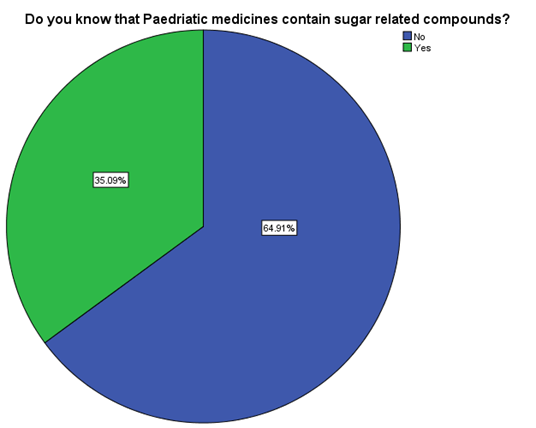
FIGURE 3: Pie chart showing percentage distribution on awareness of parents regarding presence of sugar related compounds in paediatric medicines. 64.91% were not aware about the above statement (blue) whereas 35.09% were aware about it (green).
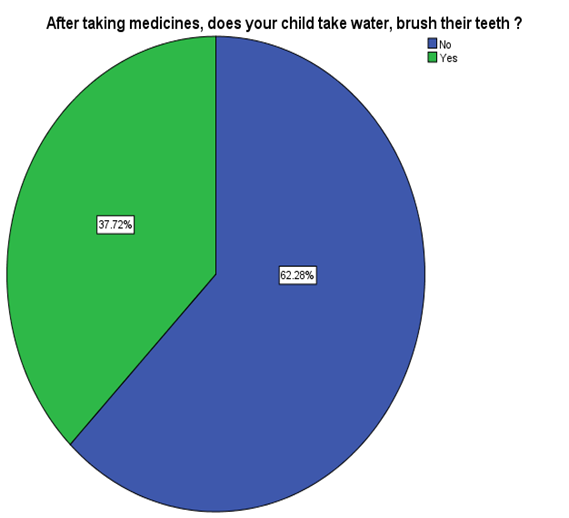
FIGURE 4: Pie chart showing percentage distribution on brushing of the teeth of the child after taking the medicine. 62.28% did not brush their teeth (blue) whereas 37.72% brushed their teeth after taking medicines (green).
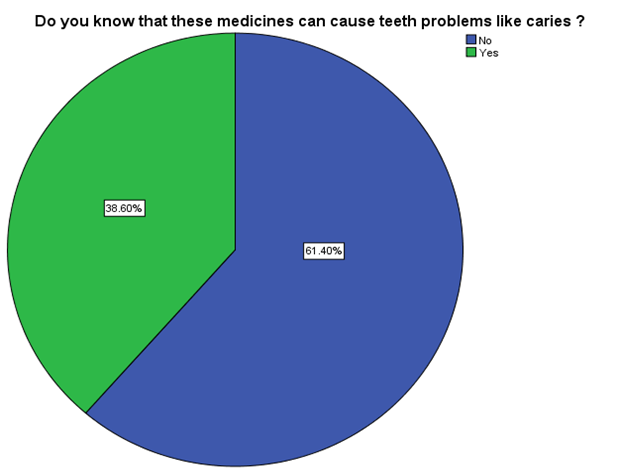
FIGURE 5: Pie chart showing percentage distribution on the awareness of the effects of paediatric medicines on oral health. 38.6% (green) are aware about the effects and 61.4% (blue) are not aware of the effects of paediatric medicines on oral health.
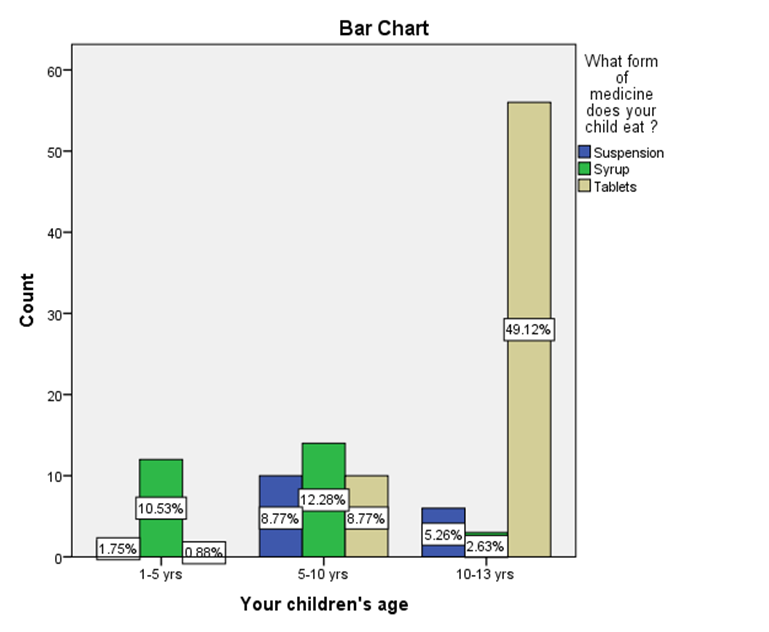
FIGURE 6: Bar graph depicts the association between the age of the child and the form of medicines the child prefers eating. The X axis represents the age of the child and the Y axis represents the count of the child which prefers a specific medicine. According to the figure, children with ages 1-5 Years prefer syrup (10.53%) - green, whereas children with the age of 10-13 years and 5-10 years prefer tablets (49.12%) - cream and syrup (12.28%) - green respectively. Children did not prefer suspension as a form of medicine as depicted in blue. The p value was found to be 0.047 which is statistically significant i.e. there is a significant difference between age and form of medicine used by the child (Chi-square, p value = 0.036 - significant).
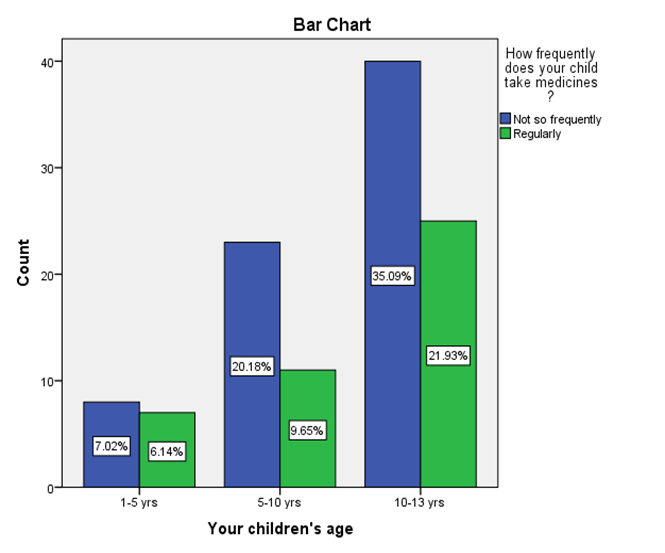
FIGURE 7: Bar graph depicts the association between the age of the child and the frequency of medicines the child eats. The X axis represents the age of the child and the Y axis represents the count of the child corresponding to the frequency of taking medicines. According to the figure, in the children with ages 1-5 Years 7.02% do not take medicines frequently (Blue) whereas 6.14% take medicines regularly (green). The similarity was seen in children aged 10-13 years and 5-10 years in which 35.09% and 20.18% did not take medicines frequently respectively. There is no significant difference between the age and frequency of medicines (Chi-square; p =0.624 - not significant).
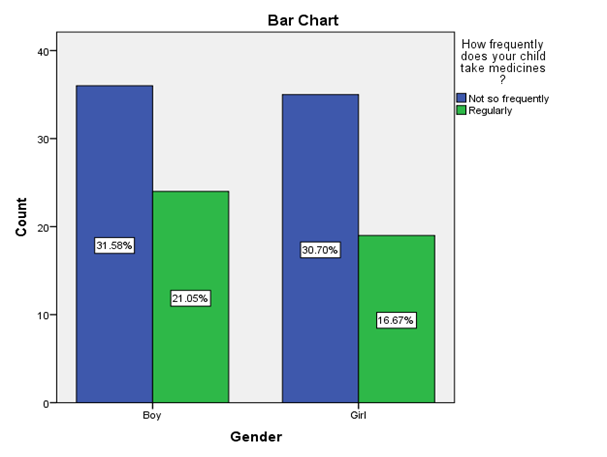
FIGURE 8: Bar graph depicts the association between the gender of the child and the frequency of medicines the child eats. The X axis represents the age of the child and the Y axis represents the percentage of the child corresponding to the frequency of medicines taken. According to the graph, 31.58% boys and 30.70% girls did not take medicines frequently (Blue) whereas 21.05% boys and 16.67% girls took medicines regularly (green). There is no significant difference between gender and the frequency of medicines used (Chi-square; p value = 0.596).
DISCUSSION :
In this study most of the children (58.77%) used tablets as a form of medicine. This result was found to be in contrast with the previous study which stated that 70% of the children consumed liquid medicines that contain sugar (Peres et al., 2005). In this study, the majority of the parents were not aware about the sugar content in paediatric medicines. One study in consistency with the results of the present study found that parents were not aware of the paediatric medicines containing sugar compounds but were aware about the decay of the tooth by sugar (Sunitha et al., 2009).
In this study 31.6% of the parents have the knowledge that these medicines can cause oral health diseases. A previous study also stated that 72.5% of the parents were aware about the effects of pediatric medicines (Menezes et al., 2010). In this study, 62.28% of children did not brush their teeth after taking medicines, which was in consistency with another study which found only 29.4% brushed their teeth after taking medicines (Menezes et al., 2010). On the scale of 1-10 with 10 being most aware, only 27.19% of the parents were most aware of their child’s oral health.
One limitation of the study is the limited sample size with convenience sampling methods. This study was done for the knowledge, awareness and applications on paediatric medicines and its relation to various oral health related problems. Even after knowing about sugar content, some practitioners often prescribe these sugar-containing medicines and ignore the harmful effects; to bypass this the consumers must be aware about the future effects. Sugar containing medicines must have a separate label about the amount of sugar which is easily visible to the consumer.
CONCLUSION :
According to this study, most of the children took medicines very frequently for general health problems. Analgesics in the form of tablets was mostly used. Parents were not aware about the effects of paediatric medicines on oral health. They are less concerned about the oral health of their children. Awareness regarding the use of pediatric medicines and its ill effects on oral health has to be created among the parents.
ACKNOWLEDGEMENT
The authors would like to thank our institution for permitting us to conduct the study.
CONFLICT OF INTEREST
All the authors declare that there was no conflict of interest in the present study.
FUNDING
The present project is sponsored by Saveetha Institute of Medical and Technical Sciences
SaveethaDental College and Hospitals, Saveetha University
AUTHORS CONTRIBUTIONS
Dev Arora: Literature search, Data collection, Analysis, Manuscript drafting.
Arthi Balasubramaniam: Data verification, Manuscript Drafting.
BIBLIOGRAPHY:
1. Barma, M. D. et al. (2021) ‘Inhibition of Streptococcus mutans, antioxidant property and cytotoxicity of novel nano-zinc oxide varnish’, Archives of oral biology, 126, p. 105132.
2. Campeau, P. M. et al. (2014) ‘The genetic basis of DOORS syndrome: an exome-sequencing study’, Lancet neurology, 13(1), pp. 44–58.
3. Cavalcanti, A. L. et al. (2010) ‘Endogenous pH, Titratable Acidity and Total Soluble Solid Content of Mouthwashes Available in the Brazilian Market’, European Journal of Dentistry, pp. 156–159. doi: 10.1055/s-0039-1697823.
4. Chellapa, L. R. et al. (2020) ‘Biogenic nanoselenium synthesis, its antimicrobial, antioxidant activity and toxicity’, Bioinspired, Biomimetic and Nanobiomaterials, 9(3), pp. 184–189.
5. Dhinesh, B. et al. (2017) ‘An experimental analysis on the influence of fuel borne additives on the single cylinder diesel engine powered by Cymbopogon flexuosus biofuel’, Journal of the Energy Institute, 90(4), pp. 634–645.
6. Edgar, W. M. (1998) ‘Sugar substitutes, chewing gum and dental caries--a review’, British Dental Journal, pp. 29–32. doi: 10.1038/sj.bdj.4809535.
7. Ezhilarasan, D. et al. (2021) ‘The ambiguous role of sirtuins in head and neck squamous cell carcinoma’, Oral diseases. doi: 10.1111/odi.13798.
8. Gopalakannan, S., Senthilvelan, T. and Ranganathan, S. (2012) ‘Modeling and Optimization of EDM Process Parameters on Machining of Al 7075-B4C MMC Using RSM’, Procedia Engineering, 38, pp. 685–690.
9. Gowhari Shabgah, A. et al. (2021) ‘Interleukin-25: New perspective and state-of-the-art in cancer prognosis and treatment approaches’, Cancer medicine, 10(15), pp. 5191–5202.
10. J, P. C. et al. (2018) ‘Prevalence and measurement of anterior loop of the mandibular canal using CBCT: A cross sectional study’, Clinical implant dentistry and related research, 20(4), pp. 531–534.
11. Kamala, K. et al. (2021) ‘Identification of haloarchaea during fermentation of Sardinella longiceps for being the starter culture to accelerate fish sauce production’, International journal of food science & technology, (ijfs.15183). doi: 10.1111/ijfs.15183.
12. Maguire, A., Rugg-Gunn, A. J. and Butler, T. J. (1996) ‘Dental health of children taking antimicrobial and non-antimicrobial liquid oral medication long-term’, Caries research, 30(1), pp. 16–21.
13. Manley, M. C., Calnan, M. and Sheiham, A. (1994) ‘A spoonful of sugar helps the medicine go down? Perspectives on the use of sugar in children’s medicines’, Social science & medicine, 39(6), pp. 833–840.
14. Mathew, M. G. et al. (2020) ‘Evaluation of adhesion of Streptococcus mutans, plaque accumulation on zirconia and stainless steel crowns, and surrounding gingival inflammation in primary molars: randomized controlled trial’, Clinical oral investigations, 24(9), pp. 3275–3280.
15. McVeigh, N. and Kinirons, M. J. (1999) ‘Pharmacists’ knowledge, attitudes and practices concerning sugar‐free medicines’, International Journal of Paediatric Dentistry, pp. 31–35. doi: 10.1046/j.1365-263x.1999.00102.x.
16. Menezes, V. A. de et al. (2010) ‘Pediatric medicines and their relationship to dental caries’, Brazilian Journal of Pharmaceutical Sciences, pp. 157–164. doi: 10.1590/s1984-82502010000100018.
17. Mudigonda, S. K. et al. (2020) ‘Non-suturing microvascular anastomosis in maxillofacial reconstruction- a comparative study’, Journal of cranio-maxillo-facial surgery: official publication of the European Association for Cranio-Maxillo-Facial Surgery, 48(6), pp. 599–606.
18. Muthukrishnan, L. (2021a) ‘Multidrug resistant tuberculosis - Diagnostic challenges and its conquering by nanotechnology approach - An overview’, Chemico-biological interactions, 337(109397), p. 109397.
19. Muthukrishnan, L. (2021b) ‘Nanotechnology for cleaner leather production: a review’, Environmental chemistry letters, 19(3), pp. 2527–2549.
20. Nagy, E. A. (1980) ‘Sucrose and dental disease’, British Dental Journal, pp. 68–68. doi: 10.1038/sj.bdj.4804458.
21. Nikiforuk, G. (1985) Understanding Dental Caries: Etiology and mechanisms, basic and clinical aspects. S Karger Ag.
22. Østergaard, L. R., Bjertrup, P. J. and Samuelsen, H. (2016) ‘“Children get sick all the time”: A qualitative study of socio-cultural and health system factors contributing to recurrent child illnesses in rural Burkina Faso’, BMC public health, 16, p. 384.
23. Parthasarathy, M. et al. (2016) ‘Effect of hydrogen on ethanol-biodiesel blend on performance and emission characteristics of a direct injection diesel engine’, Ecotoxicology and environmental safety, 134(Pt 2), pp. 433–439.
24. Peres, K. G. et al. (2005) ‘Sugar content in liquid oral medicines for children’, Revista de saude publica, 39(3), pp. 486–489.
25. R, H. et al. (2020) ‘CYP2 C9 polymorphism among patients with oral squamous cell carcinoma and its role in altering the metabolism of benzo[a]pyrene’, Oral surgery, oral medicine, oral pathology and oral radiology, 130(3), pp. 306–312.
26. Samuel, S. R. (2021) ‘Can 5-year-olds sensibly self-report the impact of developmental enamel defects on their quality of life?’, International journal of paediatric dentistry / the British Paedodontic Society [and] the International Association of Dentistry for Children, 31(2), pp. 285–286.
27. Samuel, S. R., Kuduruthullah, S., et al. (2021) ‘Impact of pain, psychological-distress, SARS-CoV2 fear on adults’ OHRQOL during COVID-19 pandemic’, Saudi journal of biological sciences, 28(1), pp. 492–494.
28. Samuel, S. R., Mathew, M. G., et al. (2021) ‘Pediatric dental emergency management and parental treatment preferences during COVID-19 pandemic as compared to 2019’, Saudi journal of biological sciences, 28(4), pp. 2591–2597.
29. Samuel, S. R., Acharya, S. and Rao, J. C. (2020) ‘School Interventions-based Prevention of Early-Childhood Caries among 3-5-year-old children from very low socioeconomic status: Two-year randomized trial’, Journal of public health dentistry, 80(1), pp. 51–60.
30. Samuel, S. R., Kuduruthullah, S. and Khair, A. M. B. (2021) ‘Dental pain, parental SARS‐CoV‐2 fear and distress on quality of life of 2 to 6 year‐old children during COVID‐19’, Journal of Paediatric …. Available at: https://onlinelibrary.wiley.com/doi/abs/10.1111/ipd.12757?casa_token=ceGAsNdfplEAAAAA:a3ZY7Pn3j_s_oxYI-pqrKCXiKWKMyoscTNh_L81fUo1x5FcPzdqmSzu89OGeID6Xowq28XzEeOhGzNc.
31. Sathish, T. and Karthick, S. (2020) ‘Wear behaviour analysis on aluminium alloy 7050 with reinforced SiC through taguchi approach’, Journal of Materials Research and Technology, 9(3), pp. 3481–3487.
32. Sekar, D. and K, A. P. (2021) ‘Letter to the Editor: H19 Promotes HCC Bone Metastasis by Reducing Osteoprotegerin Expression in a PPP1CA/p38MAPK-Dependent Manner and Sponging miR-200b-3p’, Hepatology . doi: 10.1002/hep.31719.
33. Sridharan, G. et al. (2019) ‘Evaluation of salivary metabolomics in oral leukoplakia and oral squamous cell carcinoma’, Journal of oral pathology & medicine: official publication of the International Association of Oral Pathologists and the American Academy of Oral Pathology, 48(4), pp. 299–306.
34. Stephan, R. M. (1940) ‘Changes in Hydrogen-Ion Concentration on Tooth Surfaces and in Carious Lesions’, The Journal of the American Dental Association, pp. 718–723. doi: 10.14219/jada.archive.1940.0178.
35. Stephan, R. M. (1944) ‘Intra-Oral Hydrogen-Ion Concentrations Associated With Dental Caries Activity’, Journal of Dental Research, pp. 257–266. doi: 10.1177/00220345440230040401.
36. Sunitha, S. et al. (2009) ‘An analysis of concentration of sucrose, endogenous pH, and alteration in the plaque pH on consumption of commonly used liquid pediatric medicines’, Journal of Indian Society of Pedodontics and Preventive Dentistry, p. 44. doi: 10.4103/0970-4388.50817.
37. Vikneshan, M. et al. (2020) ‘Algal biomass as a source for novel oral nano-antimicrobial agent’, Saudi Journal of Biological Sciences, pp. 3753–3758. doi: 10.1016/j.sjbs.2020.08.022.
38. Wahab, P. U. A. et al. (2018) ‘Scalpel Versus Diathermy in Wound Healing After Mucosal Incisions: A Split-Mouth Study’, Journal of oral and maxillofacial surgery: official journal of the American Association of Oral and Maxillofacial Surgeons, 76(6), pp. 1160–1164.