UNVEILING THE HIDDEN CULPRIT AND ROLE OF INSULIN AS A SAVIOR, IN AN INFANT WITH DIABETIC KETOACIDOSIS – A CASE REPORT
- GANAVI RAMAGOPAL , Professor and HoD, Department of Pediatrics, Dhanalakshmi Srinivasan Medical College And Hospital,Perambalur.
- AKBAR ALI F , Postgraduate Student, Department of Pediatrics, Dhanalakshmi Srinivasan Medical College And Hospital,Perambalur
- VISHNU ANAND B , Postgraduate Student, Department of Pediatrics, Dhanalakshmi Srinivasan Medical College And Hospital,Perambalur
- AISHWARYA S , Postgraduate Student, Department of Pediatrics, Dhanalakshmi Srinivasan Medical College And Hospital,Perambalur
- HRRITIK V , Postgraduate Student, Department of Pediatrics, Dhanalakshmi Srinivasan Medical College And Hospital,Perambalur.
- RUTHIKA VAISNAVI S.C , CRMI Student, Department of Pediatrics, Dhanalakshmi Srinivasan Medical College And Hospital,Perambalur.
Article Information:
Abstract:
Diabetic ketoacidosis (DKA) is a life-threatening metabolic emergency with significant mortality in children, especially in developing countries.So,high index of clinical suscipicion,early diagnosis and prompt intervention with Intravenous fluids ,electrolyte correction and the continuous infusion of life saving drug Insulin is very crucial.Reporting a 9-month-old female infant ,who presented with fever, vomiting, tachypnea, and altered sensorium, initially suspected as lower respiratory tract infection. Laboratory evaluation revealed severe DKA with hyperglycemia, metabolic acidosis, and ketonuria. The child was successfully managed with standard DKA protocol and later diagnosed with type 1 diabetes mellitus (T1DM) and on Insulin therapy. This case highlights the importance of early screening for hyperglycemia in critically ill infants and the role of Insulin in preventing mortality, when given at right time.
Keywords:
Article :
INTRODUCTION:
Discovery and development of Insulin :
Insulin is found to be one of the most important medical discoveries in the treatment of diabetes. In the year 1921, researchers Frederick Banting and Charles Best began experiments in Toronto using the pancreatic extracts to treat diabetes in dogs. A major breakthrough came when a dog named Marjorie survived for almost 70 days with these injections. This success led to the first life-saving insulin injection in a human in the year 1922, marking a turning point in the management of Type 1 Diabetes.1
Since then, Insulin production has evolved significantly. Early insulin was then derived from animal sources such as cattle and pigs. By the 1980s, advances in biotechnology enabled the insulin analogues which were introduced—genetically modified forms were designed for better control and flexibility. More recently, biosimilarinsulins have emerged in the market, offering similar effectiveness with slight structural differences due to distinct manufacturing processes.
Overall, the discovery and evolution of insulin have transformed diabetes from a fatal disease into a manageable condition, saving millions of lives worldwide both adults and children.2
Mechanism of action of Insulin:
Insulin, a hormone which is composed of 51 amino acids, and plays an important role in glucosehomeostasis, cell growth, and metabolism. Insulin exterts its action as it binds to specific receptors on the target cells (muscle, adipose tissue, and liver), leads to following effects3,4 :
· Increased glucose uptake
· Glycogen synthesis
· Reduced gluconeogenesis
· Enhanced fat and protein synthesis
Thus lowering of blood glucose levels.
The metabolism of glucose is very much known to be triggered by food intake, leading to simultaneous increase in insulin secretion and production and decrease in glucagon secretion to bring serum glucose levels back to normal5,6,7 .
Insulin Signaling Pathways 8,9
After being secreted from pancreatic cells and circulating through the body, insulin starts its function as it binds to insulin receptors (IRs) on target cell membranes. This binding and activation results in the phosphorylationof insulin receptor substrate (IRS) and the subsequent activation of two primarysignaling pathways, viz. the phosphoinositide3-kinase (PI3K)/protein kinase B (Akt) pathway and the mitogen-activated protein kinase (MAPK) pathway (Figure 1).
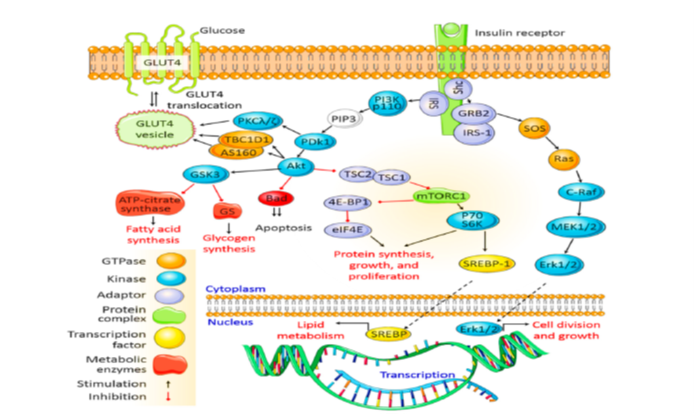
Figure 1. Classic insulin signaling pathway. Insulin regulates cellular functions and metabolic activity by binding to the insulin receptor. Core cellular processes downstream of the insulin signaling system include the PI3K/Akt and MAPK signaling pathways; details on these pathways are given in Section 3. IRS, insulin receptor substrate; IR, insulin receptor; PI3K, phosphoinositide3-kinase; MAPK, mitogenactivated protein kinase; PIP3, phosphatidylinositol 3,4,5-triphosphate; PDK1, 3-phosphoinositide dependent protein kinase-1; Grb2, growth factor receptor-bound protein 2; GSK, glycogen synthase kinase; GS, glycogen synthase; mTORC1, mammalian target of rapamycin complex 1; SREBP, sterol regulatory element-binding protein; glucose transporter 4, GLUT4; MEK, MAPK/Erk kinase; ERK, extracellular signal-regulated kinase.
Insulin And Diabetes Mellitus
Type 1 diabetes is due to autoimmune destruction of pancreatic beta cells which leads to insufficient insulin production resulting in hyperglycemia10 .The common symptoms presenting in type 1 diabetes are
polyuria, polydipsia, and weight loss .11Severe fall in insulin levels leads to increase in lipolysis which in turn will lead to increase in level of ketone bodies resulting metabolic acidosis and compensatory respiratory alkalosis .12Diabetes ketoacidosis (DKA) is the common presentation of type 1 diabetes mellitus seen in children. The prevalence of onset of diabetic ketoacidosis among type 1 diabetes mellitus was found to be 26.3% in one of the studies 13.Common complications observed due to ketoacidosis are electrolyte abnormalities like hypokalemia, hyponatremia leading to cerebral edema and shock .14If Diabetic ketoacidosis is not treated on time, the compensatory mechanism will fail soon and leading to cerebral edema, mental confusion, unconsciousness, coma and death .12,15.DKA is the most common cause of death in children and adolescents with type 1 diabetes and cause of half of all deaths in diabetic patients under the age of 24 years.16Immediate and aggressive intervention is required. Early medical management could prevent complications like cerebral edema, mental confusion, shock and death.17
Types of Insulin18
There are many different types of insulin.
Rapid-Acting - This insulin starts working within 15 minutes and it should be taken just before or just after we eat.
Short-Acting - This insulin starts working within 30 minutes to 1 hour and It should be taken 30-45 minutes before we eat.
Intermediate-Acting - This insulin starts working within 2-4 hours and known to reach its highest level
CASE PRESENTATION:
A 9-month-old female infant presented with fever, cough, and respiratory distress suggestive of Lower respiratory tract infection[LRTI] , along with altered sensorium. On admission, the child was in shock with signs of severe dehydration.
Initial laboratory findings revealed:
· Capillary blood glucose: 558 mg/dL
· Arterial pH: 6.9
· Serum bicarbonate: 5 mEq/L
· Urine ketones: 4+
· HbA1c: 7.2%
· Low C-peptide levels
Further evaluation showed positive glutamic acid decarboxylase (GAD) antibodies. There was a significant family history, with the father diagnosed with Type 1 Diabetes Mellitus and positive autoantibodies.A diagnosis of severe DKA with shock secondary to new-onset T1DM was made.The child was managed according to standard DKA protocols with intravenous fluid resuscitation ,Continuous insulin infusion and Electrolyte correction .
Gradual clinical improvement was observed. Hemodynamic stability was achieved, and metabolic parameters normalized. DKA resolved within 24 hours.
The patient was transitioned to a basal-bolus insulin regimen:Insulinglargine: 0.7 IU and Pre-meal regular insulin: 0.7 IU .The child tolerated feeds well and maintained stable glucose levels at discharge.
DISCUSSION:
Diabetic ketoacidosis is an acute, life threatening diabetic emergency. Overall mortality in children with DKA varies from 3.4% to 13.4% in developing countries22. Hence Accurate diagnosis and management are paramount.DKA as the first presentation of T1DM in infancy is rare but has been increasingly recognized. Infections such as LRTI can act as precipitating factors due to stress-induced counter-regulatory hormone release.
This case Presented here is notable for:
· Very early onset of T1DM (infancy)
· Strong autoimmune association (positive GAD antibodies)
· Positive family history suggesting genetic predisposition
Infants often present with nonspecific symptoms such as lethargy, poor feeding, or respiratory distress, which can cause delay in diagnosis. Severe acidosis (pH < 7.0) and shock can further increase the risk of complications.
Early screening for hyperglycemia in sick infants—especially those with dehydration or altered sensorium—is critical for timely diagnosis.
AssumptaChapp etal reported a 9month old male presented to the children’s emergency room of the Abia state university teaching hospital with a 3 day history of fever and a one day history of frequent stooling and vomitting.This case of permanent diabetes first diagnosed with ketoacidosis at 9 months of age .23
The reported frequency of DKA as the first presentation of childhood T1DM found in various studies ranges from 15% to 67.24 More meaningfully, more than half of children younger than 3 years of age present with DKA as their first presentation of T1DM24.
Other case reported in infants which were similar to our case but was diagnosed as Neonatal diabetes a
nd are as follows.
|
Fredrick F Etal25 |
7 Weeks Old Neonate |
Neonatal Diabetes Mellitus With Diabetic Ketoacidosis, Septicemia, And Severe Malaria. |
|
Doua Khalid Al Etal26
|
A Six-Month-Old Boy Born |
Neonatal Diabetes With Diabetic Ketoacidosis (DKA) |
|
Elhammaleki Etal27 |
A Four-Month-Old Infant Boy |
Diabetic Ketoacidosis |
CONCLUSION :
This case underscores the importance of considering DKA in infants presenting with severe illness and dehydration. Routine blood glucose screening in such scenarios will definitely help identify previously undiagnosed diabetes. Early diagnosis and prompt management are lifesaving and prompt use of INSULIN in this situation .
“Unveiling the hidden culprit” emphasizes how physiological stress can reveal underlying autoimmune diabetes even in very young infants and INSULIN saved the life.
BIBLIOGRAPHY:
1. https://idf.org/about-diabetes/diabetes-management/insulin/
2. https://www.acs.org/education/whatischemistry/landmarks/insulin.html
3. Lewis, G.F.; Brubaker, P.L. The discovery of insulin revisited: Lessons for the modern era. J. Clin. Investig. 2021, 131, e142239.
4. Vecchio, I.; Tornali, C.; Bragazzi, N.L.; Martini, M. The Discovery of Insulin: An Important Milestone in the History of Medicine.Front. Endocrinol. 2018, 9, 613.
5. Csajbok, E.A.; Tamas, G. Cerebral cortex: A target and source of insulin? Diabetologia2016, 59, 1609–1615.
6. Alarcon, C.; Lincoln, B.; Rhodes, C.J. The biosynthesis of the subtilisin-related proproteinconvertase PC3, but no that of the PC2 convertase, is regulated by glucose in parallel to proinsulin biosynthesis in rat pancreatic islets. J. Biol. Chem. 1993, 268, 4276–4280.
7. Kaufman, B.A.; Li, C.; Soleimanpour, S.A. Mitochondrial regulation of beta-cell function: Maintaining the momentum for insulin release. Mol. Asp. Med. 2015, 42, 91–104. [CrossRef] [PubMed]
8. Rahman, M.S.; Hossain, K.S.; Das, S.; Kundu, S.; Adegoke,E.O.; Rahman, M..A.; Hannan, M..A.; Uddin, M.J.; Pang, M.-G. Role of Insulin in Health and Disease: An Update. Int. J. Mol. Sci. 2021, 22, 6403. https://doi.org/10.3390/ijms22126403
9. Felner EI, Klitz W, Ham M, Lazaro AM, Stastny P, Dupont B, et al. Genetic interaction among three genomic regions creates distinct contributions to early- and late-onset type 1 diabetes mellitus. Pediatr Diabetes 2005;6(4):213-20.
10. E. Los, A.S. Wilt, Diabetes Mellitus Type 1 in Children, StatPearls Publishing, 2022. StatPearls [Internet]. Treasure Island (FL), http://www.ncbi.nlm.nih.
11. E.F. Roche, A. Menon, D. Gill, H. Hoey, Clinical presentation of type 1 diabetes, Pediatr. Diabetes 6 (2) (2005) 75–78.
12. L. Kahanovitz, P.M. Sluss, S.J. Russell, Type 1 diabetes – a clinical perspective, Point Care 16 (1) (2017 Mar) 37–40.
13. A.Neu, A. Willasch, S. Ehehalt, R. Hub, M.B. Ranke, Wuerttemberg the D group B-. Ketoacidosis at onset of type 1 diabetes mellitus in children – frequency and clinical presentation, Pediatr. Diabetes 4 (2) (2003) 77–81.
14. Q. Abbas, S. Arbab, A ulHaque, K.N. Humayun, Spectrum of complications of severe DKA in children in pediatric Intensive Care Unit, Pak J Med Sci 34 (1) (2018) 106–109.
15. S.R. Bialo, S. Agrawal, C.M. Boney, J.B. Quintos, Rare complications of pediatric diabetic ketoacidosis, World J. Diabetes 6 (1) (2015) 167–174. Feb 15.
16. C. Palmiere, D. Bardy, P. Mangin, D. Werner, Postmortem diagnosis of unsuspected diabetes mellitus, Forensic Sci. Int. 226 (1) (2013) 160–167. Mar 10,
17. Sharma S, Adhikari A, Adhikari S, Poudel S, Bk R, Mainali G, Yadav SK. Successful medical management of diabetic ketoacidosis at first presentation in a child with type 1 diabetes: A case report. Ann Med Surg (Lond). 2022 Jun 13;79:103981.
18. https://www.niddk.nih.gov/.
19. Types of insulin. Centers for Disease Control and Prevention. Updated March 25, 2021. Accessed January 24, 2022. www.cdc.gov/diabetes/about/how-to-use-insulin.html .
20. Wong EY, Kroon L. Ultra-rapid-acting insulins: how fast is really needed? Clinical Diabetes. 2021;39(4):415–423. doi:10.2337/cd20-0119.
21. https://idf.org/about-diabetes/diabetes-management/insulin/
22. Poovazhagi V. Risk factors for mortality in children with diabetic keto acidosis from developing countries. World J Diabetes. 2014 Dec 15;5(6):932-8. doi: 10.4239/wjd.v5.i6.932. PMID: 25512799; PMCID: PMC4265883.
23. Chapp-Jumbo AU, Ijeoma S. Diabetic ketoacidosis in a 9 month old child and the journey to 4 years. Acta Biomed. 2014 Dec 17;85(3):285-8.
24. Klingensmith GJ, Tamborlane WV, Wood J, Haller MJ, Silverstein J, Cengiz E, et al. Diabetic ketoacidosis at diabetes onset: still an all too common threat in youth. J Pediatr. 2013;162(2):330–4.e1. doi: 10.1016/j.jpeds.2012.06.058. Epub 2012 Aug 15.
25. Fredrick F, Sawe H, Muze K, Mally D, Majaliwa E. A seven weeks old baby with diabetic ketoacidosis: a case report. Clin Case Rep. 2015 Dec 9;4(2):147-50. doi: 10.1002/ccr3.472.
26. Doua Khalid Al Homyani, Lina Al Homaiani,Not All Diabetic Ketoacidosis in Infant Is Type 1: A Case Report Permanent Neonatal Diabetes,AACE Clinical Case Reports,Volume 10, Issue 1,2024,Pages 7-9.
27. ElhamMaleki, Amir Baniasad, Mina Sepehran, et al. The first presentation of diabetes in a four-month-old infant with diabetic ketoacidosis (DKA) precipitating by COVID-19: a case report. Authorea. August 18, 2021.