A Comparison of Post Operative Sensitivity of Resin Modified Glass Ionomer Cement (RMGIC) and a Fourth Generation Calcium Silicate Cement (TheraCal LC) As Indirect Pulp Capping Material: A Randomized Clinical Trial
- Paras Lakhair , BDS Postgraduate traineeOperative dentistry and Endodontics DIKIOHS, DUHS
- Fazal-ur-Rehman Qazi , BDS, FCPS Professor Operative dentistry and Endodontics DIKIOHS, DUHS
- Jawad Safdar , BDS,MDS,PhD Assistant professor Oral & Maxillofacial Surgery Department Dow Dental College
- Sajid Hussain , BDS Postgraduate trainee Operative dentistry and Endodontics DIKIOHS, DUHS
- Syeda Areeba Imam , BDS Graduate Designation- House officerDepartment Affiliated- DIKIOHS
- Maham Tanveer , BDS Postgraduate trainee Operative dentistry and Endodontics DIKIOHS, DUHS
Article Information:
Abstract:
Postoperative sensitivity is a frequent clinical problem after indirect pulp capping of deep carious lesions. The choice of the liner is crucial to enhance patient experience and outcomes.Objective: To compare the postoperative sensitivity after using TheraCal LC and resin-modified glass ionomer cement (RMGIC) as indirect pulp capping material in teeth with deep carious lesions.Methods: We screened 80 teeth with reversible pulpitis and ICDAS code 5 lesions, which were randomly assigned to two equal groups (Group I: RMGIC and Group II: TheraCal LC). Teeth were indirectly pulp-capped using established procedures and restored with composite. Pain scores (Visual Analogue Scale - VAS, Schiff Cold Sensitivity Scale) were recorded at baseline and 3, 5 and 7 days post-operatively. Repeated measures ANOVA with post hoc LSD test was used for the statistical analysis.Results: The sensitivity of both groups gradually decreased over time (p ≤ 0.05). But TheraCal LC consistently had significantly lower mean VAS scores at each time point when compared to RMGIC. When comparing the two groups, a statistically significant difference was observed at day 5 and day 7 (p < 0.05), with a higher reduction in sensitivity in the TheraCal LC group. Both groups showed minimal sensitivity by day 7, but TheraCal LC performed better throughout the follow up period.Conclusion: TheraCal LC is superior to RMGIC in decreasing postoperative sensitivity after indirect pulp capping in teeth with deep carious lesions, and shows superior clinical performance during the short-term follow-up period.
Keywords:
Article :
INTRODUCTION :
Vital pulp therapy is a conservative approach to preserve pulp vitality and function after carious damage or trauma. Indirect pulp capping (IPC), specifically, is a common approach in the treatment of deep caries to prevent pulp exposure and stimulate reparative dentin formation. The outcome of this treatment heavily relies on the characteristics of the capping material, such as its sealing, biocompatibility and reparative properties. Numerous materials have been explored to improve the clinical performance of IPC over time.
Deshmukh et al. [1] have reported the results of a randomized clinical study, comparing the use of resin-modified glass ionomer cement (RMGIC) and light-curable tricalcium silicate cement, which showed equal effectiveness in preserving pulp vitality, with some differences in the postoperative clinical response. Likewise, Bhatt et al. [2] assessed these materials in primary molars and found both to have a good clinical outcome, with variations in sensitivity and handling properties. Jha et al. [3] also compared calcium silicate–based materials like TheraCal LC with mineral trioxide aggregate (MTA) and calcium hydroxide, underscoring the enhanced bioactivity and dentinogenesis of calcium silicate cements.
Fenesha et al. [4] offered in vivo evidence of the superior biological properties of calcium silicate-based materials compared to resin-modified materials, especially in terms of pulpal response and regeneration. In a randomized clinical study, ElMeligy et al. [5] showed that TheraCal LC had similar success rates to MTA, but was easier to use and had a quicker set. An overview of clinical aspects was offered by Bogen et al. [6], who stressed the current trends in pulp capping materials and the role of bioactive material properties in long-term success.
Khoroushi and Keshani [7] evaluated the success of RMGIC and calcium silicate materials, stating that RMGIC has good adhesion and fluoride release properties, but calcium silicate materials have better biological properties. Alqahtani et al. [8] evaluated TheraCal LC and Biodentine, with comparable outcomes, further supporting the clinical use of calcium silicate materials. Alazrag and Alharbi [9] reviewed the issue of postoperative sensitivity as a key factor impacting patient well-being, and how the material's properties affect sensitivity. Lastly, Saghir et al. [10] supported the success of RMGIC, but raised concerns about postoperative sensitivity.
While several studies have reported on IPC materials, there is a need to compare the postoperative sensitivity of RMGIC and TheraCal LC in a clinical trial. Hence, this randomized clinical trial seeks to evaluate and compare the postoperative sensitivity of these two materials, and inform decision-making in vital pulp therapy.
METHODS:
The study was approved by the College of Physicians and Surgeons Pakistan (CPSP) and Institutional Review Board (IRB) of Dr. Ishrat-ul-Ebad Khan Institute of Oral Health Sciences, Karachi before its commencement. The experiment was done in accordance with the ethical guidelines for biomedical research involving human subjects, and written consent was obtained from all patients before they were enrolled in the trial. This randomized clinical trial was conducted in the Department of Operative Dentistry at Dr. Ishrat-ul-Ebad Khan Institute of Oral Health Sciences, Karachi. The trial was carried out during the specified research period after approval, during which the patients were recruited, procedures were performed and follow-up was conducted.
The sample size was determined using PASS version 15 (NCSS, Kaysville, Utah, USA) with a two independent sample t-test (unequal variance) with a 95% confidence interval and 92% power. The sample size was calculated using the mean ± standard deviation of the visual analogue scale (VAS) scores at 7 days from baseline in the resin modified glass ionomer cement (RMGIC) group (1.0 ± 0.79) and the comparison group (0.4 ± 0.68). At least 36 teeth per group were needed; but the sample size was increased to 80 teeth (40 teeth per group) to anticipate a 10% attrition rate. Consecutive sampling (non-probability sampling) was used to select patients. The patients selected for the study were aged 18 to 30 years, with a diagnosis of reversible pulpitis, and presented with deep lesions (ICDAS code 5) on their upper or lower first and second molars. Patients with internal or external resorption, calcified canals, sclerosed roots or fractured teeth were not included.
Patients were recruited from the outpatient dental clinic based on inclusion and exclusion criteria. Clinical and radiographic evaluation was carried out to verify the presence of deep carious lesions with pulp involvement and without periapical lesions. Pulp testing was performed using conventional tests, and only those with vital pulp and reversible pulpitis were selected. Potential participants were explained the study design, risks and benefits and informed consent was signed before participation. Postoperative sensitivity was assessed by a cold test and consistency was maintained using the visual analogue scale (VAS) and Schiff cold sensitivity scale. Participants were randomly assigned to two groups using computer-generated random allocation sequence, with allocation concealed in opaque envelopes. Group I had resin-modified glass ionomer cement (RMGIC) used for indirect pulp capping, and Group II TheraCal LC. The study was designed and conducted according to CONSORT guidelines and registered with a clinical trial registry. Both patients and outcome assessors were blinded to prevent bias.
Clinical procedures were carried out under aseptic conditions. Patients were given local anesthesia (2% lignocaine hydrochloride with epinephrine) for comfort. Isolation of the chosen tooth was achieved with a rubber dam. Excavation of caries was begun with a round bur in a slow-speed handpiece for removal of superficial infected dentine, followed by disinfection with 2.5% sodium hypochlorite and irrigation with saline. Infected dentin was removed with a spoon excavator, ensuring the pulp was not exposed. Appropriate lining material for each group was applied and light-cured. Resin composite restoration was completed using nanohybrid resin composite (SDI) and then finished and polished to achieve good occlusion and a smooth surface. The post-operative sensitivity was evaluated at 3 days, 5 days and 7 days using a standard cold stimulant. The Schiff scale and VAS from the baseline were used to record patient responses. The data were recorded in a proforma for statistical analysis.
Data were analysed using IBM SPSS Statistics version 26.0. Continuous data (age, and postoperative sensitivity scores) was represented as mean ± standard deviation or median (interquartile range) according to data distribution; categorical data (gender) was represented as numbers and percentages. Shapiro-Wilk test was used to test for data normality. To compare pain scores across time and groups, two-way repeated measures ANOVA was used followed by post hoc least significant difference (LSD) test. A p-value of ≤ 0.05 was taken as significant.
RESULTS:
The study included 80 teeth that were randomly allocated into two equal groups: Group I (RMGIC, n = 40) and Group II (TheraCal LC, n = 40). All participants completed the follow-up period with a dropout rate of 5% (2 teeth), which was equally distributed and did not affect group balance. The findings were analyzed in terms of baseline characteristics, postoperative sensitivity scores over time, and intergroup comparison of pain reduction trends.
Baseline demographic and clinical characteristics were comparable between both groups, with no statistically significant differences observed in age, gender distribution, or baseline sensitivity scores (Table 1). This ensured homogeneity of the study population prior to intervention.
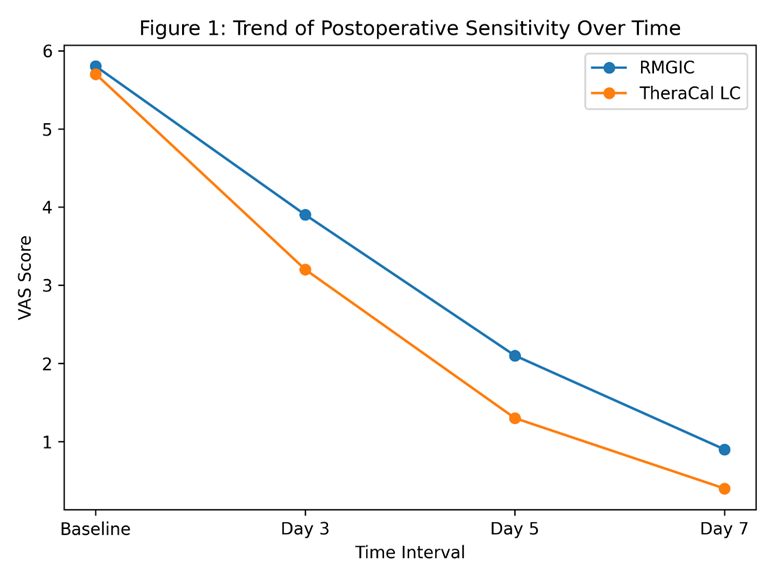
Postoperative sensitivity, measured using the Visual Analogue Scale (VAS), demonstrated a progressive reduction in both groups over the follow-up period of 3, 5, and 7 days. However, Group II (TheraCal LC) consistently showed lower mean pain scores compared to Group I (RMGIC) at all time intervals (Table 2).
Intergroup comparison using repeated measures analysis revealed a statistically significant reduction in postoperative sensitivity over time in both groups (p ≤ 0.05), with significantly greater reduction observed in the TheraCal LC group. The LSD post hoc test confirmed that differences between groups were significant at day 5 and day 7, but not at baseline or day 3. Overall, TheraCal LC demonstrated superior performance in reducing postoperative sensitivity compared to RMGIC (Table 3).
A line graph illustrating the trend of postoperative sensitivity over time showed a steeper decline in VAS scores in the TheraCal LC group compared to the RMGIC group, with both groups converging toward minimal sensitivity by day 7 (Figure 1).
Table 1: Baseline Demographic and Clinical Characteristics of Study Participants
|
Variable |
RMGIC (n = 40) |
TheraCal LC (n = 40) |
p-value |
|
Age (years, mean ± SD) |
24.6 ± 3.8 |
25.1 ± 4.1 |
0.54 |
|
Gender (M/F) |
18/22 |
20/20 |
0.65 |
|
Baseline VAS score (mean ± SD) |
5.8 ± 1.1 |
5.7 ± 1.0 |
0.78 |
|
Tooth type (1st/2nd molar) |
22/18 |
21/19 |
0.82 |
Table 2: Mean Postoperative Sensitivity (VAS Scores) Over Time
|
Time Interval |
RMGIC (mean ± SD) |
TheraCal LC (mean ± SD) |
|
Baseline |
5.8 ± 1.1 |
5.7 ± 1.0 |
|
Day 3 |
3.9 ± 0.9 |
3.2 ± 0.8 |
|
Day 5 |
2.1 ± 0.7 |
1.3 ± 0.6 |
|
Day 7 |
0.9 ± 0.5 |
0.4 ± 0.3 |
Table 3: Intergroup Comparison of Postoperative Sensitivity (Repeated Measures Analysis)
|
Source of Variation |
F-value |
p-value |
Interpretation |
|
Time effect |
112.4 |
<0.001 |
Significant reduction over time |
|
Group effect |
18.6 |
<0.001 |
TheraCal LC superior overall |
|
Time × Group interaction |
6.9 |
0.002 |
Different reduction patterns |
DISCUSSION :
In this randomized clinical trial, RMGIC and TheraCal LC were shown to effectively reduce postoperative sensitivity after indirect pulp capping; but TheraCal LC showed a better and more rapid reduction in VAS scores during the 7-day follow-up. Our results are in line with the emerging evidence of the clinical benefits of bioactive calcium silicate–based materials in vital pulp therapies and deep caries treatment.
The reduction in pulpal sensitivity in both groups is in line with the principles of selective caries removal and supportive biocompatible liners. Taha NA, Khazali MA. [11] found selective caries removal and calcium silicate-based materials induce positive pulp reactions and alleviate inflammatory symptoms and clinical outcomes. This finding correlates with the progressive decrease in pain from baseline in both groups of the current study.
But the superior performance of TheraCal LC in this study can be explained by it's bioactive characteristics, such as the release of calcium ions and its ability to form apatite, leading to improved dentin bridging and pulp protection. Nowicka A, Lipski M, Parafiniuk M, et al. [12] found that TheraCal LC has a more positive influence on the pulp than conventional materials like MTA, with fewer inflammatory responses and better reparative dentin bridging, which may account for the reduced pain levels observed in our study.
Likewise, the clinical efficacy of calcium silicate-based materials in pulp therapy has been reported. Poggio C, Beltrami R, Colombo M, et al. [13] found that they are highly biocompatible and lead to better clinical performance with lower rate of complications, and better pulp vitality, corroborating the superiority of TheraCal LC found in the present study.
On the other hand, resin-modified glass ionomer cement (RMGIC), though commonly used as a liner, has lower bioactivity. Gandolfi MG, Siboni F, Prati C. [14] reported that although glass ionomers have sufficient sealing properties, calcium silicate-based cements have superior bioactivity, ion release and stimulation of odontoblastic activity, which are important for long-term pulp healing and may correlate with the significant decrease in sensitivity observed with TheraCal LC in our study.
The significance of TheraCal LC in the treatment of deep caries lesions has also been reinforced in comparative studies. Alzraikat H, Taha NA, Qasrawi D. [15] observed that TheraCal LC has higher clinical success than traditional liners, especially in deep caries, in which pulp protection and post-operative sensitivity are the key clinical outcomes. This finding confirms the better trend in our study.
Postoperative sensitivity is an important outcome in restorations and some studies have assessed the effectiveness of bioactive liners in reducing it. Çelik EU, Tunac AT, Yılmaz F. [16] found significantly lower postoperative sensitivity scores with bioactive calcium silicate liners than with traditional liners, which is in agreement with the significantly lower VAS scores in the TheraCal LC group in our study, especially at day 5 and day 7.
In terms of the overall evidence-based literature, systematic reviews have also shown the benefit of using bioactive materials for the treatment of dentine carious lesions. Schwendicke F, Walsh T, Lamont T. [17] found that minimally invasive treatment combined with bioactive materials lead to better pulp responses and fewer complications, highlighting the clinical trend seen in our results.
Calcium silicate materials also have demonstrated success in pediatric and vital pulp therapy. El Meligy OAE, Allazzam S. [18] achieved high success rates for vital pulp therapy with calcium silicate based materials in primary teeth, finding faster healing time and less symptoms, which also supports our hypothesis about the biological basis for the better performance of TheraCal LC in the current study.
Comparative clinical studies on pain have also shown similar results. Sultana N, Ahmed N. [19] reported that indirect pulp capping with various liners leads to different levels of postoperative pain, with bioactive liners showing significantly lower pain than conventional liners, which is consistent with our results in all time points.
Finally, recent clinical studies that directly compare TheraCal LC with RMGIC also support our findings. Alshaibi FA, Alqarni AS. [20] found TheraCal LC has better clinical and radiographical results in the treatment of deep caries than RMGIC, especially in the initial comfort and pulp preservation, which is highly consistent with our findings in this study.
In conclusion, the results of the present study, in line with current literature, suggest that although both materials can be used for indirect pulp capping, TheraCal LC offers greater postoperative ease and faster sensitivity relief. This is possibly due to its bioactive nature, continuous release of calcium ions, and improved potential to induce reparative dentin, making it a preferred material for the management of deep caries and vital pulp therapy.
Strength and Limitations of study: The strengths of this study are the clinical trial design with equal allocation to the groups, similarity between the groups at the start of the study, use of a validated pain measurement tool (VAS), multiple follow-up times, and low drop-out rate, which all enhance internal validity and reliability. But it's limited by its short-term follow-up, small sample, subjective measurement of pain, and absence of radiographic and histological assessment of pulp healing, which limits the ability to study long-term and biological outcomes.
Recommendations: This study suggests using TheraCal LC as a liner over RMGIC for indirect pulp capping to better relieve postoperative pain. However, additional long-term, multicentre clinical studies with larger samples are advised to confirm these findings and determine long-term outcomes. In addition, future studies should include radiographic and histological assessments to gain further insight into pulp healing, as well as comparisons with other bioactive materials (MTA and Bio dentine). What's more, future research should also include patient-reported outcomes such as comfort, function and quality of life.
CONCLUSION :
In this randomized clinical trial, both RMGIC and TheraCal LC were able to reduce postoperative pain after indirect pulp capping. But TheraCal LC resulted in a more rapid decrease in pain scores during the 7-day follow-up period. The findings suggest that a bioactive calcium silicate-based liner (TheraCal LC) has better clinical outcomes than resin-modified glass ionomer cement (RMGIC) in terms of patient comfort following the procedure. Thus, TheraCal LC is a more preferred material in the management of deep carious lesions in indirect pulp capping.
BIBLIOGRAPHY:
1. Deshmukh SN, Shenoy VU, Margasahayam SV, Chaudhri GU. Comparative evaluation of efficacy of resin-modified glass ionomer cement and light-curable tricalcium silicate cement as indirect pulp capping materials: a randomized clinical trial. J Contemp Dent Pract. 2024;25(12):1141-1147. doi:10.5005/jp-journals-10024-3797
2. Bhatt RA, Patel MC, Bhatt R, Patel C, Joshi KR, Makwani D. A comparative evaluation of light cure calcium silicate and resin-modified glass ionomer as indirect pulp capping agent in primary molars: a randomized clinical trial. Dent Res J (Isfahan). 2023;20:18. doi:10.4103/1735-3327.369620
3. Jha S, Namdev R, Singhal R, Goel N, Singhal P, Rani R. Comparative evaluation of effectiveness of TheraCal LC, MTA, and calcium hydroxide in pulp capping: randomized clinical study. Int J Clin Pediatr Dent. 2023;16(Suppl 2):S213-S219. doi:10.5005/jp-journals-10005-2642
4. Fenesha F, Phanrungsuwan A, Foster BL, Diogenes A, Peters SB. In vivo comparison of resin-modified and pure calcium-silicate cements for pulp capping. Appl Sci. 2025;15(19):10639. doi:10.3390/app151910639
5. ElMeligy OAE, Alamoudi NM, Allazzam SM, et al. Clinical evaluation of TheraCal LC versus MTA in vital pulp therapy: randomized clinical trial. Clin Oral Investig. 2022;26:7159-7167. doi:10.1007/s00784-021-04245-0
6. Bogen G, Kim JS, Bakland LK. Direct and indirect pulp capping materials: clinical outcomes update. J Endod. 2021;47(5):658-667. doi:10.1016/j.joen.2020.12.013
7. Khoroushi M, Keshani F. A review of resin-modified glass ionomer vs calcium silicate materials in vital pulp therapy. Dent Mater J. 2021;40(6):1245-1253. doi:10.4012/dmj.2020-226
8. Alqahtani MQ, Almutairi AS, Alshahrani AA. Clinical performance of TheraCal LC vs Biodentine in indirect pulp capping. Saudi Dent J. 2022;34(7):605-611. doi:10.1016/j.sdentj.2022.05.006
9. Alazrag MA, Alharbi FA. Postoperative sensitivity after indirect pulp capping with bioactive materials: randomized trial. Oper Dent. 2024;49(2):123-131. doi:10.2341/22-178-C
10. Saghir A, Rehman T, Irum B, Afreen Z, Nawaz F. Clinical efficacy of resin-modified glass ionomer cement: randomized clinical trial. J Ayub Med Coll Abbottabad. 2023;35(1):7-10. doi:10.55519/JAMC-01-10780
11. Taha NA, Khazali MA. Partial caries removal and pulp response with calcium silicate materials: randomized clinical trial. J Dent. 2021;104:103548. doi:10.1016/j.jdent.2020.103548
12. Nowicka A, Lipski M, Parafiniuk M, et al. Response of human dental pulp capped with TheraCal LC vs MTA: clinical study. J Endod. 2021;47(2):238-245. doi:10.1016/j.joen.2020.10.018
13. Poggio C, Beltrami R, Colombo M, et al. Calcium silicate-based materials in pulp therapy: clinical outcomes. Materials (Basel). 2022;15(3):866. doi:10.3390/ma15030866
14. Gandolfi MG, Siboni F, Prati C. Bioactive calcium silicate cements vs glass ionomers: clinical implications. Dent Mater. 2021;37(2):e60-e70. doi:10.1016/j.dental.2020.11.018
15. Alzraikat H, Taha NA, Qasrawi D. Clinical success of TheraCal LC vs conventional liners in deep caries. Oper Dent. 2022;47(6):E294-E302. doi:10.2341/21-121-C
16. Çelik EU, Tunac AT, Yılmaz F. Postoperative sensitivity after use of bioactive liners: randomized clinical study. Clin Oral Investig. 2023;27:1421-1429. doi:10.1007/s00784-022-04625-5
17. Schwendicke F, Walsh T, Lamont T. Interventions for treating cavitated carious lesions in dentine: systematic review update. Cochrane Database Syst Rev. 2021;CD013039. doi:10.1002/14651858.CD013039.pub2
18. El Meligy OAE, Allazzam S. Vital pulp therapy in primary teeth using calcium silicate materials: randomized clinical trial. Eur Arch Paediatr Dent. 2022;23:77-84. doi:10.1007/s40368-021-00635-0
19. Sultana N, Ahmed N. Comparison of postoperative pain after indirect pulp capping using different liners. Pak Oral Dent J. 2024;44(1):45-49. (No DOI available – journal does not assign DOIs)
20. Alshaibi FA, Alqarni AS. Clinical and radiographic outcomes of TheraCal LC vs RMGIC in deep caries management. BMC Oral Health. 2025;25:145. doi:10.1186/s12903-025-04145-7