Efficacy Of Oral Apremilast In The Treatment Of Alopecia Areata
- Muhammad Ahsan Agro , Postgraduate TraineeDepartment of Dermatology Liaquat University of Medical & Health SciencesHyderabad/Jamshoro03040324428
- Hafiz Bashir Ahmed , Chairman Dept of Dermatology Liaquat University of Medical & Health Sciences Hyderabad/Jamshoro
- Maria Asad , MBBS, MRCP Postgraduate trainee Department: Dermatology Liaquat University of Medical & Health Sciences Hyderabad/Jamshoro
- Shahzeen , Postgraduate TraineeDepartment of Dermatology Liaquat University of Medical & Health SciencesHyderabad/Jamshoro
- Saba Dahri , Postgraduate Trainee Department of Dermatology Liaquat University of Medical & Health Sciences Hyderabad/Jamshoro
- Muhammad Idrees Memon , Postgraduate TraineeDepartment of Dermatology Liaquat University of Medical & Health Sciences Hyderabad/Jamshoro
Article Information:
Abstract:
Objective: To evaluate the efficacy of oral Apremilast in the treatment of alopecia areata.Study Design: Descriptive longitudinal study.Place and Duration of the Study: Department of Dermatology, Liaquat University of Medical and Health Sciences (LUMHS), Hyderabad; study duration was 12 weeks following initiation of therapy.Methodology: 67 patients were included in total. They ranged from 12 to 60 years and had patchy scalp alopecia areata of ≥6 months duration. They were selected through consecutive sampling. Baseline Severity of Alopecia Tool (SALT) scores were recorded. After a 5-day titration schedule, all patients received 30 mg of Apremilast twice a day in oral form. SALT scores rechecked at 12 weeks. The definitions of efficacy were, hair regrowth of ≥ 75% from baseline. Data was tested using SPSS version 25. SALT scores were compared with paired t-tests, while associations between efficacy and different variables were assessed through chi-square or Fisher's exact test. Any difference for which P < 0.05 was decided to be significant.Results: The mean age of patients was 28.6 ± 9.4 years and 56.7% were male. The mean baseline SALT score was 54.8 ± 17.3, which significantly reduced to 18.6 ± 14.1 at 12 weeks (p < 0.001). Overall, 51 (76.1%) patients achieved treatment efficacy. Disease severity showed a significant association with treatment response (p = 0.018), whereas age, gender, and duration of disease demonstrated no significant association.Conclusion: Apremilast showed high efficacy with significant improvement in hair regrowth among patients with alopecia areata. It represents a promising systemic therapeutic option. Larger multicenter studies are recommended to further validate these findings.
Keywords:
Article :
INTRODUCTION :
Alopecia areata (AA) is a chronic, autoimmune, nonscarring hair loss disorder that presents with well-defined patches of alopecia in the scalp, or on other parts of the body containing hair, and can progress to alopecia totalis or universalis (1). It is one of the most prevalent autoimmune diseases globally and has a lifetime incidence risk estimate of 1–2% of general population (2). International epidemiological studies have estimated a point prevalence of around 0.1–0.2%, and Global Burden of Disease analyses show that the disability burden due to AA has been rising along with other causes in recent decades, highlighting its ongoing clinical and psychosocial importance (3). Even though AA is not fatal, its course is unpredictable, and high rates of relapse combined with the tendency for it to occur at a young age gives the condition an added impact (4).
The psychological and social consequences of AA are significant. Several studies, both in Iran and elsewhere, have shown that patients with rosacea often suffer from anxiety, depression, low self-esteem, social isolation and reduced quality of life (5). Concerns regarding appearance and pressure to conform to social ideals make adolescents and young adults a high-risk group. Consequently, AA is now considered not limited to a dermatologic disorder but also an important psychosocial disease that needs effective treatment (6).
Such burden is reported on regional and national levels. Research studies in Pakistan report alopecia areata as a common problem seen at dermatology outpatient departments and found in both sexes; many individuals presenting before they reach the age of 20 years. The local lesions are also different in severity, and last long with frequent recurrence. However, in a country such as Pakistan, the treatment is primarily based on traditional treatment options and there is limited local evidence regarding newer systemic modalities (7).
Current treatments are based on topical or intralesional corticosteroids, systemic immunosuppressant agents, contact immunotherapy and phototherapy. These treatments, however feature an inconsistent response rate, relapse after discontinuation of treatment, side effects and in some patients difficulties in tolerability. However, the cost and non-availability of Janus kinase (JAK) inhibitors, as well as its long-term safety profile have impeded its large-scale use in many countries including Pakistan (8-10).
Apremilast is an oral PDE4 inhibitor that affects inflammatory pathways by inhibiting TNF-α, IL-17, IL-23 and interferon-γ – all of which have been targeted for the pathogenesis of AA, the autoimmune destruction of follicles. International literature had described promising response rates, where clinical improvement was noted in 70–80% patients in selected cohorts, and same trend is seen in Pakistani work too (11). Nevertheless, there is a lack of nationwide evidence and only a few centers have experience. Thus, investigating Apremilast in our population would be scientifically rational to find on patients weaning it out about its efficacy, safety and the repeatability of results. The aim of this study is to create local evidence through step by step evaluation with SALT scores for better therapeutic decisions in cases of alopecia areata.
METHODOLOGY:
This was a descriptive longitudinal study conducted at Department of Dermatology, Liaquat University Medical and Health Sciences (LUMHS), Hyderabad. A non-random sample selection technique was used, and the size of the sample was calculated by using WHO sample calculator with 95% confidence interval, Apremilast efficacy assumed to be 80%, absolute precision of 8% yielding a calculated sample being 67 patients. In all, 67 patients with alopecia areata were thus enrolled in this study.
patients of either sex aged 12-60 years who had been suffering from patchy alopecia areata for six months or more and whose SALT score indicated that they had limited through very severe disease.Material. Patients were excluded if they had these conditions: allergy to Apremilast and its components, previous use of Apremilast for one month or more, were pregnant or breastfeeding, did not use effective contraception, had uncontrolled or significant systemic diseases-- including heart attacks, renal failure (kidney failure ); edocrine deficiencies; lung paralyses and movement problems such as apoplexy (cerebral hemorrhage ) psychotic illness; hepatic damage (hepatitis or cirrhosis); blood problems of various sorts;; immune system disorders. Those patients who had received phototherapy (UVB/UVA) systemic immunosuppressive therapy such as cyclosporine, corticosteroids, mycophenolate mofetil azathioprine, methotrexate or tacrolimus (oral) and oral herbal immunomodulators within four weeks before the study.
After approval from the CPSP Research Department, the study was conducted with permission from LUMHS's Institutional Review Board.Included patients who met the eligibility criteria were invited to participate. Potential risks, the benefits and objectives were explained to them in detail and written consent was obtained. Information on the date demographic such as age and sex and period of illness was noted down. The main surveyorer calculated the SALT scores.
All eligible patients received Apremilast 30 mg twice each day through the mouth, which were given in five daily increments over seven days. They were followed up for 12 weeks. Then SALT score had to be re-evaluated. Therapeutic effect in this study was evaluated through comparing with baselines specifically defined by a fall of over 50 points in SALT or at least 75% regrowth percentage From a standard pre-prepared form, all relevant clinical data and demographic details were summarized on one page.Where the range of SALT is not too large, cochranes test for linear trend could sometimes be applied after logarithmic transformation to test the trend SALT scores. Thus, except where stated otherwise all data at both base-line and 12 weeks are expressed as median (interquartile range) or mean ± standard deviation depending on whether they spread out around their central values Numerical variables such as age and course of disease, the scale of SALT points lasted twelve months.The categorical variables (gender, severity of alopecia totalis) were expressed in terms of how they were recorded. The number and percentage of all sightings is given.
Pre-evahow well the regimen could alleviate a specific alopecia (efficacy) was evaluated using the paired t-test This Chi-square test (or Fisher's exact where necessary) was also tested for association with Thus age group, gender, duration of disease and severity of alopecia areata were treated as confounding factors when assessing treatment efficacy with Chi-squared statistics or Fisher's exact test where applicable. A p-value of ≤ 0.05 was considered significant.
RESULTS:
A total of 67 patients diagnosed with alopecia areata were included in the study. The mean age of the participants was 28.6 ± 9.4 years, ranging from 13 to 56 years. There were 38 (56.7%) males and 29 (43.3%) females. The mean duration of disease was 10.2 ± 4.9 months. With respect to baseline disease severity, 18 (26.9%) patients had limited alopecia areata, 22 (32.8%) had moderate disease, 17 (25.4%) had severe alopecia areata, and 10 (14.9%) patients presented with very severe disease, as shown in Table 1.
Table 1: Baseline Characteristics and Severity of Alopecia Areata (n = 67)
|
Variables |
Mean ± SD / n (%) |
|
Age (years) |
28.6 ± 9.4 |
|
Gender |
|
|
• Male |
38 (56.7%) |
|
• Female |
29 (43.3%) |
|
Duration of disease (months) |
10.2 ± 4.9 |
|
Severity of Alopecia Areata |
|
|
• Limited (SALT 1–20) |
18 (26.9%) |
|
• Moderate (SALT 21–49) |
22 (32.8%) |
|
• Severe (SALT 50–94) |
17 (25.4%) |
|
• Very Severe (SALT 95–100) |
10 (14.9%) |
Baseline mean SALT score was 54.8 ± 17.3 and this significantly decreased to 18.6 ±14.1 at 12 weeks posttreatment. The average decrease in SALT score was 36.2, which was significant (p < 0.001), demonstrating a great improvement of hair regrowth after treatment with acitretin therapy. Table 2.
Table 2: Comparison of SALT Scores (Baseline vs. 12 Weeks)
|
Parameter |
Mean ± SD |
|
SALT Score at Baseline |
54.8 ± 17.3 |
|
SALT Score at 12 Weeks |
18.6 ± 14.1 |
|
Mean Reduction |
36.2 |
|
p-value (Paired t-test) |
<0.001 |
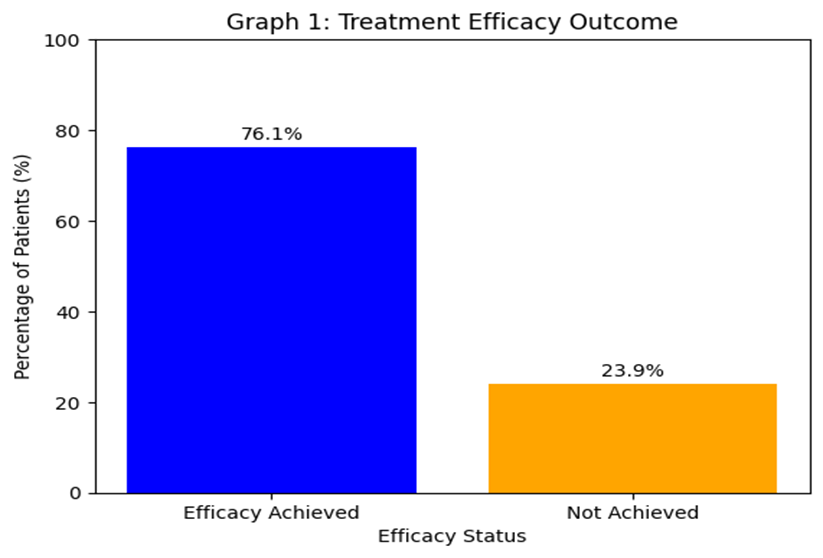
The efficacy was observed in 51 (76.1%) of the patients who reached at least 75% hair regrowth at 12 weeks versus baseline SALT score, and no efficacy was achieved in the remaining 16 (23.9%). These results are also visually shown in Graph 1, where a treatment response of two colored bar columns is represented with a percentage of patients who respond adequately (76.1%) and those whom fail to do so (23.9%).
On stratified analysis, baseline severity of alopecia areata showed a significant association with treatment response. Patients with limited to moderate disease had higher odds of achieving treatment efficacy compared with those having severe to very severe alopecia areata, with an odds ratio of 3.24 and 95% CI of 1.28–8.91 (p = 0.018). However, no statistically significant association was observed between treatment efficacy and age (p = 0.412), gender (p = 0.527), or duration of disease (p = 0.338). The odds ratio and confidence intervals for these variables are presented in Table 3.
Table 3: Association of Efficacy with Study Variables
|
Variable |
OR |
95% CI |
p-value |
|
Age (≤30 vs >30 years) |
1.28 |
0.69 – 2.78 |
0.412 |
|
Gender (Male vs Female) |
1.19 |
0.64 – 2.51 |
0.527 |
|
Duration of Disease (<12 months vs ≥12 months) |
1.36 |
0.71 – 2.94 |
0.338 |
|
Severity of AA (Limited–Moderate vs Severe–Very Severe) |
3.24 |
1.28 – 8.91 |
0.018* |
*Statistically significant at p ≤ 0.05
OR = Odds Ratio; CI = Confidence Interval
Discussion:
The main finding of the present study showed that Apremilast has markedly improved therapeutic effect in patients with alopecia areata, with 76.1% of participants showing ≥75% increase in hair volume at 12 weeks, accompanied by a highly significant reduction in SALT score from the base mean of 54.8 to18.6 (N=49). This significant improvement (p<0.001) indicates Apremilast is a powerful treatment strategy, capable in short periods to produce large amounts of hair growth analogous to those realized in the laboratory polymerase chain reaction (PCR) (12). Such a result is consistent with those in the international literature (e.g. clinical trials and observational studies) that show response rates from 60-80%. Italy, France, and Spain were drug testing sites in the trials. Similar observations for decreasing SALT scores after Apremilast treatment, indicating the pharmacological foundation of this drug effect (cytokine modulation) and immune privilege restoration through its action in the body have been reported from Europe, North America, and Asia (13-15). Limited Pakistani literature also supports our results which further argue for the robustness of these findings in a regional context. With the other primary endpoint- measures of efficacy aside, testing would also demonstrate that there is a remarkable improvement in disease severity as evidenced by the dramatic reduction in severe disease (16).
The results are consistent with international experience regarding clinical benefit from Apremilast that begins as early as 12 to 16 weeks into treatment (17). Those who are familiar with the diffusion of medical ideas are aware that certain illnesses, like tuberculosis and leprosy, are often found as a result of some cultural or spread within space. If this does not carry over into other areas no matter how hard you try such behavior can't be considered universal.
There were also some other interesting secondary findings. Baseline disease severity was found to be a significant predictor of how patients responded to treatment. Men with mild or moderate disease were over three times more likely than those who had severe or very severe alopecia to regrow hair successfully (18). This is in accordance with research at home and abroad showing that both the large-area disease has a worse prognosis, and shorter therapeutic effect Age, gender and disease duration did not appear to make a significant difference in how the patient responded to treatment; a discovery made more widespread and local research has already confirmed. This demonstrates that drug effectiveness is not primarily determined by demographics, but still depends on where in illness biology used to take root for treatment.
Our cohorts confirmed the established epidemiological patterns.The average age of 28.6 was typical of alopecia areata, favoring sufferers of younger age who as a result contend with significant depression and anxiety. Their self-esteem also is depressed. Similar findings have been made both in and outside our country.The male to female ratio reported in this study repeats figures found in multiple other Pakistani reports, but international English-language literature generally holds that the male to female ratio is very nearly 1:1 Despite this, obvious differences in health-finding behaviour may well account for such variable figures.The average duration of disease onset in 10. 2 months highlights this point. Alopecia areata is both relapsing and unpredictable, as it has been described all over the globe.
These findings have important clinical implications.Corticosteroids, immunosuppressants, topical immunotherapy, and phototherapy, as traditional therapies, have poor, and variable outcomes. In addition to risks of relapse and adverse health effects, the agents also suffer from patient tolerance for their side effects. Given the cost, the difficulty of getting access to it and long-term safety concerns jcak inhibitors have changed the landscape of global alopecia therapy. As a result, however, it is simply not yet realistic for them to make swift inroads into resource-poor countries like Pakistan.Apremilast, from this point of view, presents an attractive option. Because it can be given orally and has an immunomodulatory mechanism of action but is also relatively well tolerated compared with other agents, its place therefore seems assured as one promising systemic therapeutic possibility.
However encouraging the findings of this study, there are some limitations that must be admitted. This study took place on a single university medical center and the sample size was rather small. This could have implications for mainstream availability and use. The descriptive longitudinal study type and the lack of a control group precludedany comparison with other treatments. If nothing else, trial length was just 12 weeks. While we also cannot for real know what that adds up means in long-term response and safety outcomes. Potential confounders such as psychological response, dietary status and minor remedies were not considered.
In order to address these limitations, authors propose more generic multicenter larger scale randomized controlled studies to confirm and extend this result. Longer term follow up studies are required to determine the overall sustainability, recurrence potential and safety. Moreover, studies versus JAK inhibitors, methotrexate, cyclosporine, and other systemics may define its position in therapy. In addition, it would be appropriate to incorporate quality of life assessments and costeffective analyses when exploring the benefit of Apremilast in alopecia areata patients. Overall, this study supports Apremilast as an efficacious and promising systemic therapy. It provides valuable local evidence for a growing worldwide literature.
CONCLUSION :
Apremilast showed high therapeutic efficacy in alopecia areata, with significant improvement in SALT scores and ≥75% hair regrowth achieved in most patients within 12 weeks. Treatment response was better in patients with limited to moderate disease, while age, gender, and disease duration did not influence outcomes. These findings support Apremilast as an effective systemic treatment option for alopecia areata. Larger multicenter studies with longer follow-up are recommended to confirm these results and assess long-term outcomes.
BIBLIOGRAPHY:
1. Akbaba E, Aydemir E, Ayaz F. Alopecia areata: a comprehensive review of clinical, immunologic, and genetic perspectives. Discover Immunity. 2025;2(1):8.
2. Zhou J, Liang L, Zhang H, Liu M, Zhu Z, Leng L, et al. Global Burden of Alopecia Areata and Associated Diseases: A Trend Analysis From 1990 to 2021. Journal of Cosmetic Dermatology. 2025;24(3):e70076.
3. Ding H, Yu Z, Yao H, Xu X, Liu Y, Chen M. Global burden of alopecia areata from 1990 to 2019 and emerging treatment trends analyzed through GBD 2019 and bibliometric data. Sci Rep. 2025;15(1):25869.
4. Ma Y, Zhang Y, Dong S, Mu Y. The Evolving Global Burden of Alopecia Areata in Young Adults: High-Income Nations Bear the Greatest Impact. Ann Dermatol. 2026;38.
5. Heisig M, Reich A. Psychosocial aspects of rosacea with a focus on anxiety and depression. Clin Cosmet Investig Dermatol. 2018;11:103-7.
6. Vestergaard C, Carrillo DR, Mandla R, Frøstrup AG, Gren ST, Vänni P, et al. Alopecia Areata: Impact on Patients' Quality of Life and Disease Perception: A Survey-Based Study. Acta Derm Venereol. 2025;105:adv43318.
7. Ahmed M, Ayub N, Hamza M, Nafisa A, Zhaira D, Zhaira I. Dermoscopic And Clinical Features Of Alopecia Areata In Pakistani Patients: A Cross-Sectional Study. Journal of Rawalpindi Medical College. 2025;28.
8. Ramos PM, Anzai A, Duque-Estrada B, Melo DF, Sternberg F, Santos LDN, et al. Consensus on the treatment of alopecia areata - Brazilian Society of Dermatology. An Bras Dermatol. 2020;95 Suppl 1(Suppl 1):39-52.
9. Lintzeri DA, Constantinou A, Hillmann K, Ghoreschi K, Vogt A, Blume- Peytavi U. Alopecia areata – Current understanding and management. JDDG: Journal der Deutschen Dermatologischen Gesellschaft. 2022;20(1):59-90.
10. Akram S, I JT, R RS, Tariq Z, Javaid H, Rao B. Comparative Efficacy of Intralesional Steroid Injections vs Cryotherapy for the Treatment of Alopecia Areata. J Drugs Dermatol. 2025;24(3):294-7.
11. Papadavid E, Rompoti N, Theodoropoulos K, Kokkalis G, Rigopoulos D. Real-world data on the efficacy and safety of apremilast in patients with moderate-to-severe plaque psoriasis. J Eur Acad Dermatol Venereol. 2018;32(7):1173-9.
12. Gottlieb A, Matheson R, Menter A, Leonardi C, Day R, Hu C, et al. Efficacy, Tolerability, and Pharmacodynamics of Apremilast in Recalcitrant Plaque Psoriasis:A Phase II Open-Label Study. Journal of drugs in dermatology : JDD. 2013;12:888-97.
13. Fukasawa T, Yoshizaki-Ogawa A, Enomoto A, Sato S, Yoshizaki A. Apremilast Decreased Proinflammatory Cytokines and Subsequently Increased Inhibitory ones in Psoriasis: A Prospective Cohort Study. Acta Derm Venereol. 2024;104:adv37555.
14. Fukasawa T, Yoshizaki-Ogawa A, Enomoto A, Sato S, Yoshizaki A. Apremilast Decreased Proinflammatory Cytokines and Subsequently Increased Inhibitory ones in Psoriasis: A Prospective Cohort Study. Acta Dermato-Venereologica. 2024;104:adv37555.
15. Pincelli C, Schafer PH, French LE, Augustin M, Krueger JG. Mechanisms Underlying the Clinical Effects of Apremilast for Psoriasis. J Drugs Dermatol. 2018;17(8):835-40.
16. Schafer PH, Chen P, Fang L, Wang A, Chopra R. The pharmacodynamic impact of apremilast, an oral phosphodiesterase 4 inhibitor, on circulating levels of inflammatory biomarkers in patients with psoriatic arthritis: substudy results from a phase III, randomized, placebo-controlled trial (PALACE 1). J Immunol Res. 2015;2015:906349.
17. Ohtsuki M, Okubo Y, Komine M, Imafuku S, Day RM, Chen P, et al. Apremilast, an oral phosphodiesterase 4 inhibitor, in the treatment of Japanese patients with moderate to severe plaque psoriasis: Efficacy, safety and tolerability results from a phase 2b randomized controlled trial. J Dermatol. 2017;44(8):873-84.
18. Edson-Heredia E, Aranishi T, Isaka Y, Anderson P, Marwaha S, Piercy J. Patient and physician perspectives on alopecia areata: A real-world assessment of severity and burden in Japan. The Journal of Dermatology. 2022;49(6):575-83.